Price Indices and Inflation · Índices de Preços e Inflação
| English | Português |
|---|---|
| inflation/ɪnˈfleɪʃn/ | inflação |
| deflation/diːˈfleɪʃn/ | deflação |
| disinflation/ˌdɪsɪnˈfleɪʃn/ | desinflação |
| base year/beɪs jɪə/ | ano-base |
| Consumer Price Index/kənˈsuːmə praɪs ˈɪndeks/ | Índice de Preços ao Consumidor |
| price index/praɪs ˈɪndeks/ | índice de preços |
| fixed market basket/fɪkst ˈmɑːkɪt ˈbæskɪt/ | cesta fixa de mercado |
| inflation rate/ɪnˈfleɪʃn reɪt/ | taxa de inflação |
| biased/ˈbaɪəst/ | viciada |
| substitution/ˌsʌbstɪˈtjuːʃn/ | substituição |
| quality change/ˈkwɒlɪti tʃeɪndʒ/ | mudança de qualidade |
When the whole price tag rises
- One good getting dearer is normal — but what if everything creeps up at once?
- That is a change in the general price level, and it has a name.
- Track it and you can tell a healthy economy from an overheating one.
- Three words describe how the price level moves.
Quando toda a etiqueta de preço sobe
- Um bem ficar mais caro é normal — mas e se tudo subir aos poucos ao mesmo tempo?
- Isso é uma mudança no nível geral de preços, e tem um nome.
- Acompanhá-lo permite distinguir uma economia saudável de uma superaquecida.
- Três palavras descrevem como o nível de preços se move.
Inflation, deflation, disinflation
- Inflation 通货膨胀 — the general price level is rising.
- Deflation 通货紧缩 — the general price level is falling.
- Disinflation 反通货膨胀 — inflation is still happening, but slower than before (prices rise, just less quickly).
Inflação, deflação e desinflação
- Inflação 通货膨胀 — o nível geral de preços está subindo.
- Deflação 通货紧缩 — o nível geral de preços está descendo.
- Desinflação 反通货膨胀 — a inflação ainda está acontecendo, mas mais devagar do que antes (os preços sobem, apenas com menor rapidez).
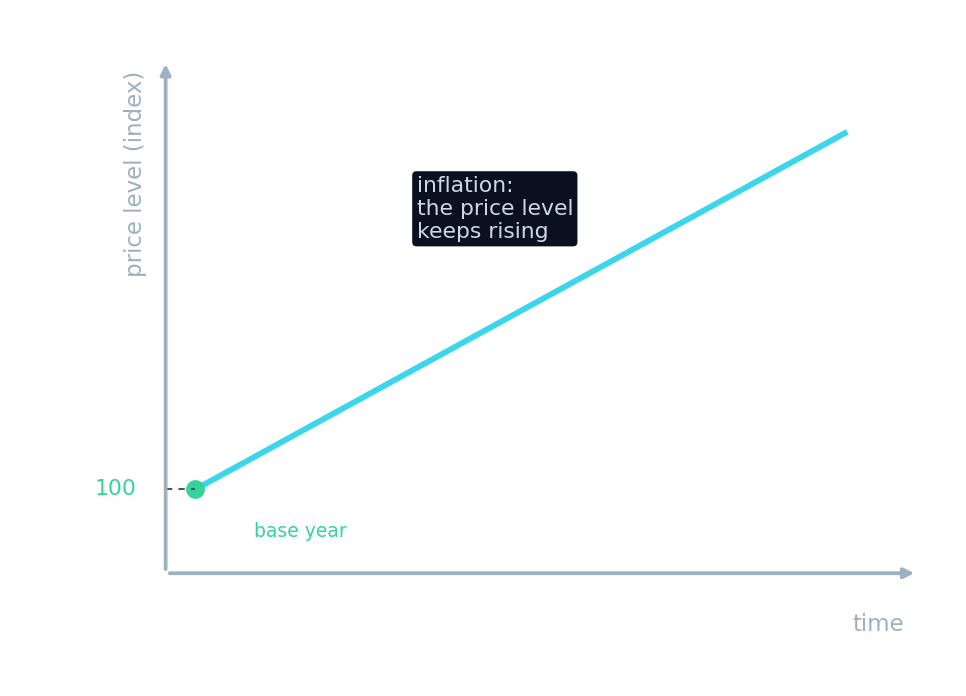
Inflation, deflation, or disinflation? · Inflação, deflação ou desinflação?
Inflation is a rising price level; deflation is a falling one; disinflation is inflation that is still positive but slowing. · Inflação é um nível de preços crescente; deflação é um nível decrescente; desinflação é inflação que ainda é positiva, mas desacelerando.
Inflation is: · Inflação é:
Inflation is the average of all prices rising, not just one good. · Inflação é a média de todos os preços subindo, não apenas um bem.
Inflation slows from 8% to 3%. This is: · A inflação desacelera de 8% para 3%. Isso é:
Prices are still rising (positive inflation), just more slowly — disinflation. · Os preços ainda estão subindo (inflação positiva), apenas mais lentamente — desinflação.
The Consumer Price Index
- A price index 价格指数 tracks the price level; the best-known is the Consumer Price Index 消费者价格指数 (CPI).
- It uses a fixed market basket 固定商品篮子 — a set list of goods a typical family buys, so changes come only from prices.
- Each period is compared to a base year 基年, whose index is set to 100.
- $\text{index} = \dfrac{\text{cost of basket now}}{\text{cost of basket in base year}} \times 100$.
Índice de Preços ao Consumidor
- Um índice de preços 价格指数 acompanha o nível de preços; o mais conhecido é o Índice de Preços ao Consumidor 消费者价格指数 (IPC/CPI).
- Ele usa uma cesta fixa de mercado 固定商品篮子 — uma lista fixa de bens que uma família típica compra, para que as mudanças venham apenas dos preços.
- Cada período é comparado a um ano-base 基年, cujo índice é definido como 100.
- $\text{index} = \dfrac{\text{cost of basket now}}{\text{cost of basket in base year}} \times 100$.
A basket costs 400 in the base year and 440 now. What is this year's price index? · Uma cesta custa 400 no ano base e 440 agora. Qual é o índice de preços deste ano?
Index = (440 ÷ 400) × 100 = 110. · Índice = (440 ÷ 400) × 100 = 110.
A price index is set to 100 in the chosen ______ year. · Um índice de preços é definido como 100 no ano ______ escolhido.
All other years are compared to the base year's index of 100. · Todos os outros anos são comparados ao índice do ano base de 100.
Measuring the inflation rate
- The inflation rate 通货膨胀率 is the percentage change between two index values.
- Worked idea. A basket costs 400 in the base year and 440 now, so this year's index is $\dfrac{440}{400} \times 100 = 110$.
- The base-year index is 100, so inflation is $\dfrac{110 - 100}{100} \times 100 = 10\%$.
- The CPI can be biased 有偏差: the fixed basket ignores substitution 替代 and quality change 质量变化.
Medindo a taxa de inflação
- A taxa de inflação 通货膨胀率 é a variação percentual entre dois valores de índice.
- Exemplo resolvido. Uma cesta custa 400 no ano-base e 440 agora, então o índice deste ano é $\dfrac{440}{400} \times 100 = 110$.
- O índice do ano-base é 100, então a inflação é $\dfrac{110 - 100}{100} \times 100 = 10\%$.
- O IPC pode ter viés 有偏差: a cesta fixa ignora a substituição 替代 e a mudança de qualidade 质量变化.
The price index rose from 100 to 110. What is the inflation rate, in percent? · O índice de preços subiu de 100 para 110. Qual é a taxa de inflação, em percentual?
Inflation = (110 − 100) ÷ 100 × 100 = 10%. · Inflação = (110 − 100) ÷ 100 × 100 = 10%.
Select all · todos reasons the CPI can be a biased measure of the cost of living. · Selecione todas as razões pelas quais o IPC pode ser uma medida enviesada do custo de vida.
Substitution and quality change, plus the fixed basket, make the CPI slightly overstate the cost of living. · Substituição e mudança de qualidade, além da cesta fixa, fazem o IPC superestimar ligeiramente o custo de vida.
The general price level rises (inflation), falls (deflation), or rises more slowly (disinflation). The CPI measures it with a fixed basket against a base year = 100. The inflation rate is the percentage change in the index; the CPI is slightly biased by substitution and quality change.
O nível geral de preços sobe (inflação), cai (deflação) ou aumenta mais lentamente (desaceleração inflacionária). O IPC mede isso com uma cesta fixa contra um ano-base = 100. A taxa de inflação é a variação percentual no índice; o IPC tem um leve viés devido à substituição e mudança de qualidade.