Defining Average and Instantaneous Rates of Change at a Point · Definindo Taxas Médias e Instantâneas de Variação em um Ponto
| English | Português |
|---|---|
| average rate of change/ˈævrɪdʒ reɪt ɒv tʃeɪndʒ/ | taxa média de variação |
| instantaneous rate of change/ˌɪnstənˈteɪnɪəs reɪt ɒv tʃeɪndʒ/ | taxa instantânea de variação |
| difference quotient/ˈdɪfrəns ˈkwəʊʃənt/ | quociente de diferença |
| secant line/ˈsiːkənt laɪn/ | reta secante |
| tangent line/ˈtændʒənt laɪn/ | reta tangente |
From "over an interval" to "at an instant"
- Unit 1 built the idea of a limit. Now we use it to measure change.
- Over an interval, the average rate of change 平均变化率 is total change ÷ interval width.
- At a single instant, the instantaneous rate of change 瞬时变化率 is what a speedometer shows.
- The bridge between them is a limit — and that bridge is the whole point of Unit 2.
De "sobre um intervalo" para "em um instante"
- A Unidade 1 construiu a ideia de limite. Agora a usamos para medir mudança.
- Sobre um intervalo, a taxa média de variação 平均变化率 é mudança total ÷ largura do intervalo.
- Em um único instante, a taxa instantânea de variação 瞬时变化率 é o que um velocímetro mostra.
- A ponte entre elas é um limite — e essa ponte é o ponto central da Unidade 2.
Average rate = slope of a secant
- The average rate of change of $f$ from $x=a$ to $x=b$ is the difference quotient 差商:
-
$$\frac{f(b)-f(a)}{b-a}$$
- Geometrically this is the slope of the secant line 割线 joining $\big(a,f(a)\big)$ and $\big(b,f(b)\big)$.
- It is an average: it smooths over everything that happened between $a$ and $b$.
Taxa média = inclinação de uma secante
- A taxa média de variação de $f$ de $x=a$ para $x=b$ é o quociente de diferença 差商:
-
$$\frac{f(b)-f(a)}{b-a}$$
- Geometricamente, esta é a inclinação da reta secante 割线 que une $\big(a,f(a)\big)$ e $\big(b,f(b)\big)$.
- É uma média: ela suaviza tudo o que aconteceu entre $a$ e $b$.
Find the average rate of change of $f(x)=x^2$ on $[1,3]$. · Encontre a taxa média de variação de $f(x)=x^2$ em $[1,3]$.
$\dfrac{9-1}{3-1}=\dfrac{8}{2}=4$.
The average rate of change over an interval equals the slope of the... · A taxa média de variação sobre um intervalo iguala a inclinação da...
Average rate = rise over run between the two endpoints = secant slope. · Taxa média = elevação sobre deslocamento entre os dois extremos = inclinação da secante.
Shrink the interval
- To get the rate at $x=a$, slide $b$ toward $a$ and watch the secant slope.
- As the interval shrinks, the secant pivots toward the tangent line 切线 at $a$.
- The limiting slope is the instantaneous rate of change at $a$.
- No time actually passes at an instant — the limit is what makes "rate at a point" meaningful.
Reduzir o intervalo
- Para obter a taxa em $x=a$, deslize $b$ em direção a $a$ e observe a inclinação da secante.
- À medida que o intervalo diminui, a secante gira em direção à reta tangente 切线 em $a$.
- A inclinação limite é a taxa instantânea de variação em $a$.
- Tempo nenhum realmente passa em um instante — é o limite que torna "taxa em um ponto" significativo.
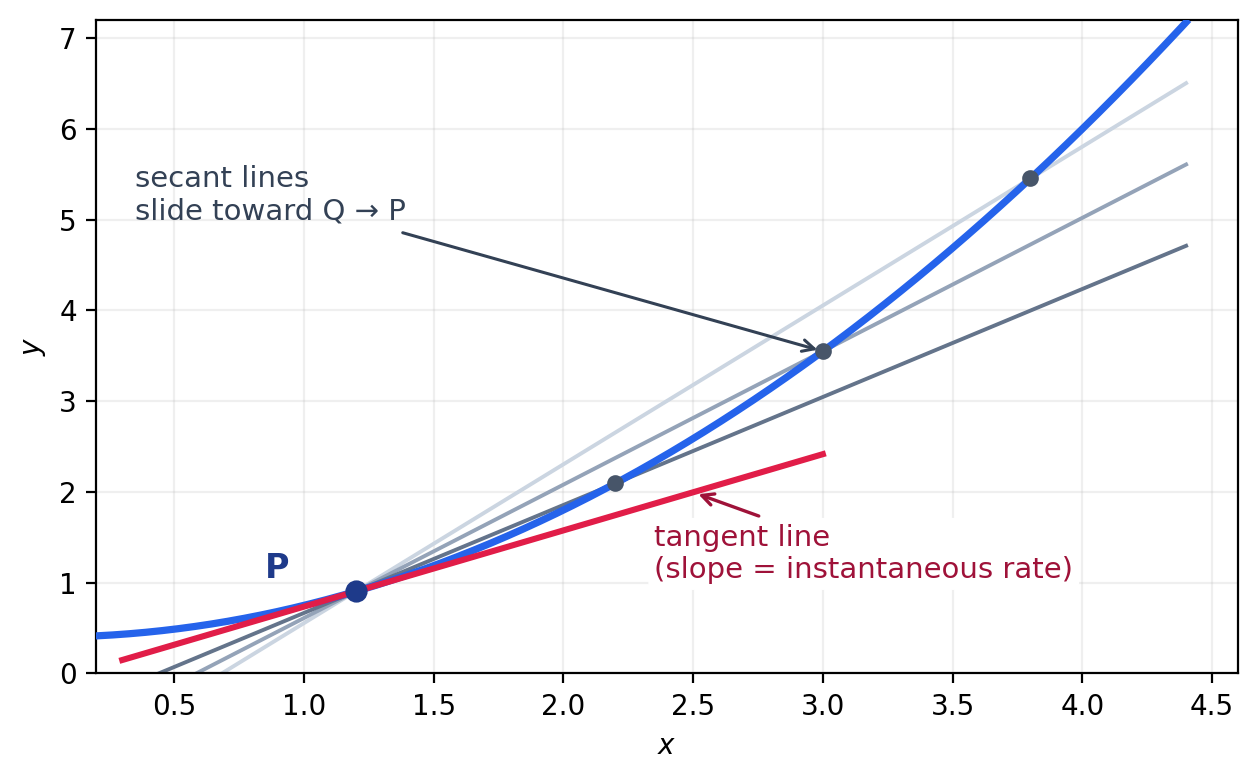
Slide the secant into a tangent · Deslize a secante para uma tangente
y = x²
Move the point along $y=x^2$ — the tangent slope you read off is the instantaneous rate, the limit of the secant slopes. · Mova o ponto ao longo de $y=x^2$ — a inclinação da tangente lida é a taxa instantânea, o limite das inclinações das secantes.
The instantaneous rate of change at a point equals the slope of the ____ line there. · A taxa instantânea de variação em um ponto iguala a inclinação da ____ linha ali.
It is the limit of secant slopes as the interval shrinks — the tangent slope. · É o limite das inclinações das secantes conforme o intervalo diminui — a inclinação da tangente.
Reading the rate in context
- The sign tells direction: positive rate → increasing, negative → decreasing.
- The size tells speed: a bigger magnitude means faster change.
- Units matter: for position in metres over time in seconds, the rate is in $\tfrac{\text{m}}{\text{s}}$ — a velocity.
- So average rate = secant slope (over an interval); instantaneous rate = tangent slope (at a point).
Lendo a taxa no contexto
- O sinal indica a direção: taxa positiva → crescimento, negativa → decrescimento.
- O tamanho indica a velocidade: magnitude maior significa mudança mais rápida.
- As unidades importam: para posição em metros sobre tempo em segundos, a taxa está em $\tfrac{\text{m}}{\text{s}}$ — uma velocidade.
- Então taxa média = inclinação da secante (sobre um intervalo); taxa instantânea = inclinação da tangente (em um ponto).
If the average rate of change of $f$ on $[0,4]$ is $0$, then $f$ must be constant on $[0,4]$. · Se a taxa média de variação de $f$ em $[0,4]$ é $0$, então $f$ deve ser constante em $[0,4]$.
It only means $f(0)=f(4)$; $f$ could rise then fall (e.g. go out and come back). · Isso só significa $f(0)=f(4)$; $f$ poderia subir depois cair (ex.: sair e voltar).
For · A favor $f(x)=x^2$, average rates on $[3,3.1]$ and · e $[3,3.01]$ are $6.1$ and · e $6.01$. Estimate the instantaneous rate at $x=3$. · Para $f(x)=x^2$, as taxas médias em $[3,3.1]$ e $[3,3.01]$ são $6.1$ e $6.01$. Estime a taxa instantânea em $x=3$.
The averages close in on $6$. · As médias convergem para $6$.
A position function has instantaneous rate $-5\,\tfrac{\text{m}}{\text{s}}$ at time $t$. Select all · todos correct readings. · Uma função posição tem taxa instantânea $-5\,\tfrac{\text{m}}{\text{s}}$ no tempo $t$. Selecione todas as interpretações corretas.
Negative rate = moving in the negative direction (so position decreases); its magnitude is the speed; and it is the tangent slope. · Taxa negativa = movimento na direção negativa (logo posição diminui); sua magnitude é a velocidade; e é a inclinação da tangente.
Average and instantaneous rates are not interchangeable. The average rate over $[a,b]$ can be zero while the instantaneous rate is large at every interior point (imagine going out and coming back). Only in the limit of a shrinking interval does the average rate become the instantaneous rate.
Taxas médias e instantâneas não são intercambiáveis. A taxa média sobre $[a,b]$ pode ser zero enquanto a taxa instantânea é grande em todo ponto interior (imagine sair e voltar). Apenas no limite de um intervalo em redução é que a taxa média se torna a taxa instantânea.
For $f(x)=x^2$, find the average rate on $[2,4]$ and estimate the instantaneous rate at $x=2$.
- Average on $[2,4]$: $\dfrac{f(4)-f(2)}{4-2}=\dfrac{16-4}{2}=6$.
- Shrink toward $2$: on $[2,2.1]$, $\dfrac{4.41-4}{0.1}=4.1$; on $[2,2.01]$, $4.01$.
- The average rates close in on $4$ — the instantaneous rate at $x=2$ is $4$.
Para $f(x)=x^2$, encontre a taxa média em $[2,4]$ e estime a taxa instantânea em $x=2$.
- Média em $[2,4]$: $\dfrac{f(4)-f(2)}{4-2}=\dfrac{16-4}{2}=6$.
- Reduzir em direção a $2$: em $[2,2.1]$, $\dfrac{4.41-4}{0.1}=4.1$; em $[2,2.01]$, $4.01$.
- As taxas médias convergem para $4$ — a taxa instantânea em $x=2$ é $4$.
The average rate of change over $[a,b]$ is the difference quotient $\frac{f(b)-f(a)}{b-a}$ — the slope of a secant line. Shrinking the interval, the secant approaches the tangent line, whose slope is the instantaneous rate of change at that point.
A taxa média de variação sobre $[a,b]$ é o quociente de diferença $\frac{f(b)-f(a)}{b-a}$ — a inclinação de uma reta secante. Reduzindo o intervalo, a secante aproxima-se da reta tangente, cuja inclinação é a taxa instantânea de variação naquele ponto.