Hooke's law · Lei de Hooke
| English | Português |
|---|---|
| elastic/ɪˈlæstɪk/ | elástica |
| Hooke's law/hʊks lɔː/ | Lei de Hooke |
| extension/ekˈstenʃn/ | extensão |
| tension/ˈtenʃn/ | tensão |
| natural length/ˈnætʃərəl leŋθ/ | comprimento natural |
| modulus of elasticity/ˈmɒdjʊləs ɒv ɪlæˈstɪsɪti/ | módulo de elasticidade |
| elastic potential energy/ɪˈlæstɪk pəˈtenʃl ˈenədʒi/ | energia potencial elástica |
| compress/kəmˈpres/ | comprimir |
The physics of a bungee jump
- Stretch an elastic 弹性 rope and it pulls back — harder the more you stretch it.
- That simple proportional law, Hooke's law 胡克定律, governs springs, bungee cords, and the energy they store and release.
A física do pulismo bungee
- Estique uma corda elástica 弹性 e ela puxa de volta — quanto mais estica, mais forte puxa.
- Essa lei proporcional simples, Lei de Hooke 胡克定律, rege molas, cordas de bungee e a energia que armazenam e liberam.
An elastic string of natural length 2 m and modulus 50 N is stretched by 0.5 m. Find the tension T = λx/L (N). · Um elástico de comprimento natural 2 m e módulo 50 N é esticado em 0.5 m. Encontre a tensão T = λx/L (N).
T = 50 × 0.5 / 2 = 12.5 N.
By Hooke's law, the tension is proportional to the extension. · Pela Lei de Hooke, a tensão é proporcional à extensão.
T = (λ/L)x, so T ∝ x while the material stays elastic. · T = (λ/L)x, logo T ∝ x enquanto o material permanece elástico.
Hooke's law
- The tension 张力 in an elastic string or spring is proportional to its extension 伸长量 $x$:
- $L$ is the natural length 自然长度 and $\lambda$ the modulus of elasticity 弹性模量 (a property of the material).
Tension rises linearly with extension; the area under the line is the stored elastic energy.
Lei de Hooke
- A tensão 张力 em uma corda ou mola elástica é proporcional à sua extensão 伸长量 $x$:
- $L$ é o comprimento natural 自然长度 e $\lambda$ o módulo de elasticidade 弹性模que (uma propriedade do material).
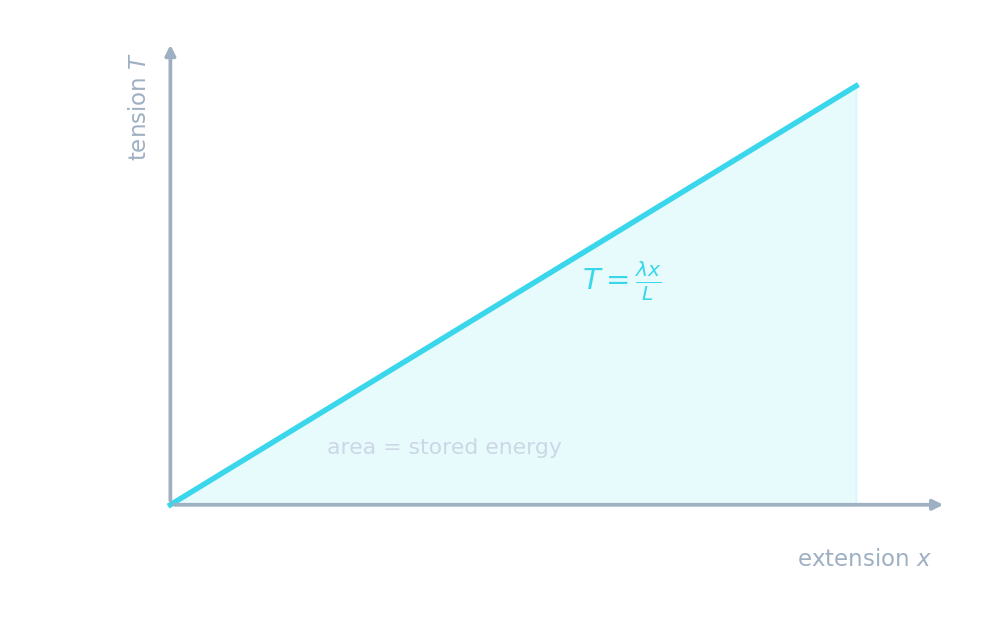
A tensão aumenta linearmente com a extensão; a área sob a linha é a energia elástica armazenada.
Hooke's law · Lei de Hooke
F = k·x
Force is proportional to extension — the gradient is the stiffness k. · A força é proporcional à extensão — a inclinação é a rigidez k.
For the same string (λ = 50, x = 0.5, L = 2), find the stored elastic energy E = λx²/(2L) (J). · Para a mesma corda (λ = 50, x = 0.5, L = 2), encontre a energia elástica armazenada E = λx²/(2L) (J).
E = 50 × 0.25 / 4 = 12.5/4 = 3.125 J.
The elastic energy equals the ______ under the force–extension graph. · A energia elástica é igual à ______ sob o gráfico força-extensão.
Work done stretching = area under the T–x line = ½ × x × (λx/L) = λx²/(2L). · Trabalho realizado ao esticar = área sob a linha T–x = ½ × x × (λx/L) = λx²/(2L).
Elastic potential energy 弹性势能
- Stretching does work, stored as elastic potential energy — the triangular area under the graph:
Energia potencial elástica 弹性势能
- Esticar realiza trabalho, armazenado como energia potencial elástica — a área triangular sob o gráfico:
Worked example
- An elastic string of natural length $2$ m and modulus $50$ N is stretched by $0.5$ m.
- Tension $T = \dfrac{\lambda x}{L} = \dfrac{50 \times 0.5}{2} = 12.5$ N.
- Stored energy $E = \dfrac{\lambda x^2}{2L} = \dfrac{50 \times 0.25}{4} = 3.125$ J.
Exemplo resolvido
- Uma corda elástica de comprimento natural $2$ m e módulo $50$ N é esticada em $0.5$ m.
- Tensão $T = \dfrac{\lambda x}{L} = \dfrac{50 \times 0.5}{2} = 12.5$ N.
- Energia armazenada $E = \dfrac{\lambda x^2}{2L} = \dfrac{50 \times 0.25}{4} = 3.125$ J.
An elastic string (not a spring): · Uma corda elástica (não uma mola):
A string only pulls; when slack its tension is zero. Only a spring pushes when compressed. · Uma corda só puxa; quando frouxa, sua tensão é zero. Apenas uma mola empurra quando comprimida.
String vs spring
A string can't push. An elastic string only pulls (tension when stretched, nothing when slack). A spring also pushes when compressed 压缩 — so a spring's extension $x$ can be negative.
- A conical pendulum is a mass swung in a horizontal circle on a string.
Corda vs mola
Uma corda não pode empurrar. Uma corda elástica apenas puxa (tensão quando esticada, nada quando solta). Uma mola também empurra quando comprimida 压缩 — então a extensão de uma mola $x$ pode ser negativa.
- Um pêndulo cônico é uma massa girada em um círculo horizontal numa corda.
You've got it
- Hooke's law: $T = \dfrac{\lambda x}{L}$ (tension ∝ extension)
- stored elastic PE: $E = \dfrac{\lambda x^2}{2L}$ (area under the force–extension line)
- $\lambda$ = modulus, $L$ = natural length; a string only pulls, a spring also pushes
Entendeu?
- Lei de Hooke: $T = \dfrac{\lambda x}{L}$ (tensão ∝ extensão)
- energia potencial elástica armazenada: $E = \dfrac{\lambda x^2}{2L}$ (área sob a linha força-extensão)
- $\lambda$ = módulo, $L$ = comprimento natural; uma corda só puxa, uma mola também empurra