The light-dependent stage · A fase dependente da luz
| English | Português |
|---|---|
| photophosphorylation/ˌfəʊtəʊˌfɒsfɔːrɪˈleɪʃn/ | fotofosforilação |
| cyclic/ˈsaɪklɪk/ | cíclico |
| non-cyclic/nɒn ˈsaɪklɪk/ | não cíclico |
| photosystem/ˌfəʊtəʊˈsɪstəm/ | fossistema |
| photolysis/fəʊˈtɒləsɪs/ | fotólise |
| ATP synthase/ˌeɪ tiː ˈpiː ˈsɪnθeɪs/ | ATP sintase |
Capturing the Sun
- In the thylakoids, light energy is used to make ATP.
- This is photophosphorylation 光合磷酸化, and it comes in two forms.
- One form also splits water and releases the oxygen we breathe.
Capturando o Sol
- Nos tilacoides, a energia luminosa é usada para produzir ATP.
- Isso é fotofosforilação 光合磷酸化, e ocorre em duas formas.
- Uma forma também divide a água e libera o oxigênio que respiramos.
Water is split in the light-dependent stage by ______. · A água é dividida na fase dependente da luz por ______.
Photolysis releases electrons, H⁺ and oxygen — the oxygen we breathe is a by-product. · A fotólise libera elétrons, H⁺ e oxigênio — o oxigênio que respiramos é um subproduto.
Cyclic 循环 vs non-cyclic 非循环
- Cyclic photophosphorylation: uses photosystem 光系统 I only; chlorophyll is photoactivated; makes only ATP.
- Non-cyclic photophosphorylation: uses photosystems I and II; the oxygen-evolving complex carries out photolysis 光解 of water (releasing oxygen); makes ATP and reduced NADP.
Non-cyclic photophosphorylation in the light-dependent stage
Cíclica 循环 vs não cíclica 非循环
- Fotofosforilação cíclica: usa apenas o fotossistema I 光系统; a clorofila é fotoativada; produz apenas ATP.
- Fotofosforilação não cíclica: usa fotossistemas I e II; o complexo gerador de oxigênio realiza a fotólise 光解 da água (liberando oxigênio); produz ATP e NADP reduzido.
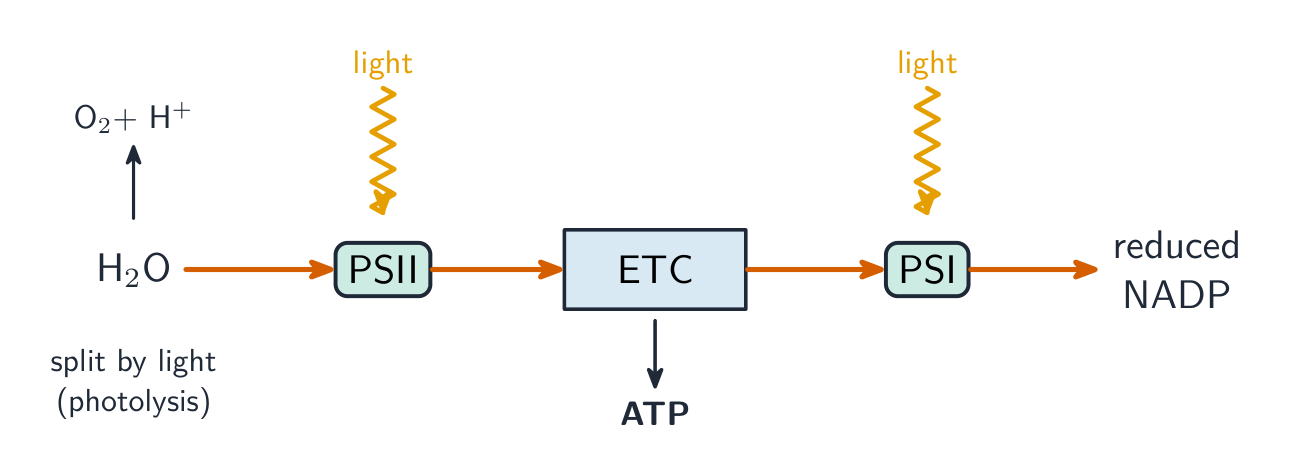
Fotofosforilação não cíclica na etapa dependente de luz
The light-dependent stage · A fase dependente da luz
Step through it. Light excites electrons and splits water; the result is ATP, reduced NADP and oxygen. · Passo por passo. A luz excita elétrons e divide a água; o resultado é ATP, NADP reduzido e oxigênio.
Cyclic photophosphorylation: · Fotofosforilação cíclica:
Cyclic photophosphorylation uses PSI alone and produces ATP only (no NADP reduced, no water split). · A fotofosforilação cíclica usa apenas PSI e produz apenas ATP (nenhum NADP reduzido, nenhuma divisão de água).
Non-cyclic photophosphorylation produces: · A fotofosforilação não-cíclica produz:
Using PSI and PSII, it makes ATP and reduced NADP, and photolysis of water releases oxygen. · Usando PSI e PSII, ela faz ATP e NADP reduzido, e a fotólise da água libera oxigênio.
How the ATP is made
- In both forms:
- energetic electrons pass along an electron transport chain, releasing energy.
- that energy pumps protons across the thylakoid membrane.
- protons flow back into the stroma through ATP synthase ATP合酶, making ATP (chemiosmosis).
Como o ATP é produzido
- Em ambas as formas:
- elétrons energéticos passam por uma cadeia de transporte de elétrons, liberando energia.
- essa energia bombeia prótons através da membrana do tilacoide.
- prótons fluem de volta para o estroma através da ATP sintase ATP合酶, produzindo ATP (quimiosmose).
Photolysis splits water using light energy, releasing oxygen as a by-product. · A fotólise divide a água usando energia luminosa, liberando oxigênio como subproduto.
The oxygen released by photolysis is the source of the oxygen in our atmosphere. · O oxigênio liberado pela fotólise é a fonte do oxigênio em nossa atmosfera.
In the thylakoid, ATP is made as protons flow back through: · No tilacoide, o ATP é feito quando prótons fluem de volta através de:
Protons pumped into the thylakoid space flow back through ATP synthase, driving ATP synthesis. · Prótons bombeados para o espaço tilacoidal fluem de volta através da ATP sintase, impulsionando a síntese de ATP.
Match each part of the light-dependent stage to what it does. · Associe cada parte da fase dependente da luz ao que ela faz.
Light excites electrons and splits water; the chain makes ATP; reduced NADP carries hydrogen onward. · A luz excita elétrons e divide a água; a cadeia faz ATP; o NADP reduzido carrega hidrogênio adiante.
Photolysis of water
- Light energy splits water in photolysis: water → hydrogen ions + electrons + oxygen.
- The electrons replace those lost by chlorophyll, and the oxygen is released as a waste product.
Fotólise da água
- Energia luminosa divide a água na fotólise: água → íons de hidrogênio + elétrons + oxigênio.
- Os elétrons substituem os perdidos pela clorofila, e o oxigênio é liberado como subproduto.
You've got it
- the light-dependent stage = photophosphorylation in the thylakoids
- cyclic: PSI only → ATP only
- non-cyclic: PSI + PSII → photolysis of water (releases O₂) → ATP + reduced NADP
- electrons pump protons → flow back through ATP synthase → ATP (chemiosmosis)
Entendeu?
- a etapa dependente de luz = fotofosforilação nos tilacoides
- cíclica: apenas PSI → apenas ATP
- não cíclica: PSI + PSII → fotólise da água (libera O₂) → ATP + NADP reduzido
- elétrons bombeiam prótons → fluem de volta pela ATP sintase → ATP (quimiosmose)