The Calvin cycle · O Ciclo de Calvin
| English | Português |
|---|---|
| fixation/fɪkˈseɪʃn/ | fixação |
| rubisco/ruːˈbɪskəʊ/ | rubisco |
| RuBP/ruː ˌbiːˈpiː/ | RuBP |
| regeneration/riːˌdʒenəˈreɪʃn/ | regeneração |
| triose phosphate/ˈtraɪəʊs ˈfɒsfeɪt/ | triose fosfato |
Building sugar from air
- The light-independent stage builds sugars in the stroma.
- It uses the ATP and reduced NADP made by the light stage.
- It runs as a cycle, in three main steps.
Construindo açúcar do ar
- A etapa independente de luz constrói açúcares no estroma.
- Usa o ATP e o NADP reduzido produzidos pela etapa dependente de luz.
- Funciona como um ciclo, em três etapas principais.
Step 1: Fixation 固定
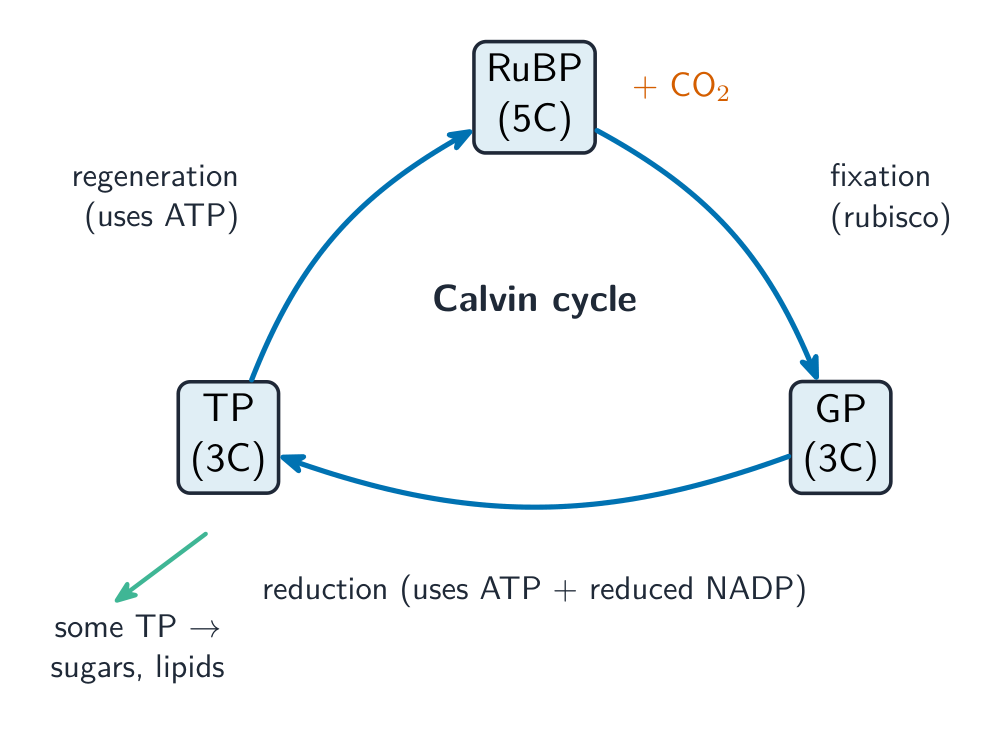
- The enzyme rubisco 核酮糖二磷酸羧化酶 joins carbon dioxide to a 5-carbon molecule, RuBP 核酮糖二磷酸 (ribulose bisphosphate).
- This makes two molecules of a 3-carbon compound, GP (glycerate 3-phosphate).
The Calvin cycle: fixation, reduction and regeneration 再生
Etapa 1: Fixação 固定
- A enzima rubisco 核酮糖二磷酸羧化 enzyme une dióxido de carbono a uma molécula de 5 carbonos, RuBP 核酮糖二磷酸 (ribulose bisfosfato).
- Isso produz duas moléculas de um composto de 3 carbonos, GP (glicerato 3-fosfato).
O Ciclo de Calvin: fixação, redução e regeneração 再生
The Calvin cycle · O Ciclo de Calvin
Step around the cycle. CO₂ is fixed onto RuBP, reduced to sugar using the light-stage's ATP and NADP, and RuBP is regenerated. · Passe pelo ciclo. O CO₂ é fixado na RuBP, reduzido a açúcar usando o ATP e NADP da fase luminosa, e a RuBP é regenerada.
In fixation, the enzyme rubisco: · Na fixação, a enzima rubisco:
Rubisco catalyses carbon fixation: CO₂ + RuBP → 2 GP. · A Rubisco catalisa a fixação de carbono: CO₂ + RuBP → 2 GP.
The enzyme that joins CO₂ to RuBP in the fixation step is ______. · A enzima que une CO₂ à RuBP na etapa de fixação é ______.
Rubisco is the most abundant enzyme on Earth — it fixes nearly all the carbon in the living world. · A Rubisco é a enzima mais abundante na Terra — ela fixa quase todo o carbono do mundo vivo.
The Calvin cycle is the light-independent stage; it uses the ATP and reduced NADP made by the light-dependent stage. · O Ciclo de Calvin é a fase independente da luz; ele usa o ATP e o NADP reduzido feitos pela fase dependente da luz.
It does not need light directly, but it cannot run without the ATP and reduced NADP from the light reactions. · Não precisa de luz diretamente, mas não pode funcionar sem o ATP e o NADP reduzido das reações luminosas.
Steps 2 & 3: Reduction and regeneration
- Reduction: GP is reduced to TP (triose phosphate 丙糖磷酸), using reduced NADP and ATP.
- Regeneration: most TP is used (with more ATP) to regenerate RuBP, so the cycle keeps running.
Etapas 2 & 3: Redução e regeneração
- Redução: GP é reduzido a TP (triose fosfato 丙糖磷酸), usando NADP reduzido e ATP.
- Regeneração: a maior parte do TP é usada (com mais ATP) para regenerar RuBP, mantendo o ciclo funcionando.
GP is reduced to TP using: · GP é reduzido a TP usando:
The reduction step uses the reduced NADP and ATP made in the light-dependent stage. · A etapa de redução usa o NADP reduzido e o ATP feitos na fase dependente da luz.
Put the steps of the Calvin cycle in order. · Coloque as etapas do Ciclo de Calvin em ordem.
CO₂ is fixed onto RuBP (fixation) → GP reduced to TP (reduction) → RuBP regenerated (regeneration). · CO₂ é fixado na RuBP (fixação) → GP reduzido a TP (redução) → RuBP regenerada (regeneração).
Match each step or molecule to its role. · Associe cada etapa ou molécula ao seu papel.
Fix the carbon, reduce GP to sugar, then regenerate the RuBP acceptor so the cycle keeps turning. · Fixe o carbono, reduza o GP a açúcar, depois regenere o receptor RuBP para que o ciclo continue girando.
Making useful molecules
- Some TP leaves the cycle to make carbohydrates, lipids and amino acids.
- GP can also be used to make some amino acids.
Produzindo moléculas úteis
- Algum TP sai do ciclo para formar carboidratos, lipídios e aminoácidos.
- GP também pode ser usado para produzir alguns aminoácidos.
What happens to the TP that leaves the cycle? · O que acontece com o TP que sai do ciclo?
TP that leaves the cycle builds useful molecules: carbohydrates, lipids and amino acids. · TP que sai do ciclo constrói moléculas úteis: carboidratos, lipídios e aminoácidos.
You've got it
- fixation: rubisco + CO₂ + RuBP (5C) → 2 GP (3C)
- reduction: GP → TP using reduced NADP + ATP
- regeneration: TP → RuBP (more ATP) to keep the cycle going
- some TP leaves → carbohydrates, lipids, amino acids
Entendeu?
- fixação: rubisco + CO₂ + RuBP (5C) → 2 GP (3C)
- redução: GP → TP usando NADP reduzido + ATP
- regeneração: TP → RuBP (mais ATP) para manter o ciclo em funcionamento
- algum TP sai → carboidratos, lipídios, aminoácidos