Skip to content · ⁨Pular para o conteúdo⁩

Energetica química

Química do IGCSE · Topic 5 · ⁨Tópico 5⁩

Train · ⁨Treinar⁩
Video lesson for this topic · ⁨Videoaula para este tópico⁩ Open the video page · ⁨Abrir a página do vídeo⁩
5:51

Energetica

Quebre um bastão de luz, e ele acende. Segure uma almofada aquecedora, e ela esquenta. Abra uma bolsa térmica instantânea, e ela fica gelada. Em todos os casos, uma reação química está…

English narration · English + 中文 subtitles burned in · ⁨Narração em inglês · Legendas em inglês + 中文 gravadas⁩

5.1

Exothermic and endothermic reactions · ⁨Reações exotérmicas e endotérmicas⁩

Syllabus · ⁨Programa⁩
English
Core Supplement
1 State that an exothermic reaction transfers thermal energy to the surroundings leading to an increase in the temperature of the surroundings 4 State that the transfer of thermal energy during a reaction is called the enthalpy change, $\Delta H$, of the reaction. $\Delta H$ is negative for exothermic reactions and positive for endothermic reactions
2 State that an endothermic reaction takes in thermal energy from the surroundings leading to a decrease in the temperature of the surroundings
5 Define activation energy, $E_a$, as the minimum energy that colliding particles must have to react
3 Interpret reaction pathway diagrams showing exothermic and endothermic reactions 6 Draw and label reaction pathway diagrams for exothermic and endothermic reactions using information provided, to include: (a) reactants (b) products (c) enthalpy change of the reaction, $\Delta H$ (d) activation energy, $E_a$
7 State that bond breaking is an endothermic process and bond making is an exothermic process and explain the enthalpy change of a reaction in terms of bond breaking and bond making
8 Calculate the enthalpy change of a reaction using bond energies
Português
Central Suplementar
1 Declarar que uma reação exotérmica transfere energia térmica para o meio ambiente, levando a um aumento na temperatura do mesmo 4 Declarar que a transferência de energia térmica durante uma reação é chamada de variação de entalpia, $\Delta H$, da reação. $\Delta H$ é negativa para reações exotérmicas e positiva para reações endotérmicas
2 Declarar que uma reação endotérmica absorve energia térmica do meio ambiente, levando a uma diminuição na temperatura do mesmo
5 Definir energia de ativação, $E_a$, como a energia mínima que as partículas colidentes devem ter para reagir
3 Interpretar diagramas de via de reação mostrando reações exotérmicas e endotérmicas 6 Desenhar e rotular diagramas de via de reação para reações exotérmicas e endotérmicas usando informações fornecidas, para incluir: (a) reagentes (b) produtos (c) variação de entalpia da reação, $\Delta H$ (d) energia de ativação, $E_a$
7 Declarar que a ruptura de ligações é um processo endotérmico e a formação de ligações é um processo exotérmico, e explicar a variação de entalpia de uma reação em termos de ruptura e formação de ligações
8 Calcular a variação de entalpia de uma reação usando energias de ligação

Source: Cambridge International syllabus · ⁨Fonte: Programa Cambridge International⁩

English
Reaction profile: exothermic energy change

In every chemical reaction, energy is transferred. The reaction is either exothermic or endothermic, depending on which way the energy moves.

  • An exothermic reaction 放热反应 gives out thermal energy 热能 to the surroundings 环境. So the temperature of the surroundings goes up.
  • An endothermic reaction 吸热反应 takes in thermal energy from the surroundings. So the temperature of the surroundings goes down.

Examples of exothermic reactions are combustion 燃烧 (burning a fuel) and neutralisation 中和 (an acid reacting with an alkali). An example of an endothermic reaction is the thermal decomposition 分解 of a compound (breaking it down using heat).

Português
Perfil de reação: mudança de energia exotérmica
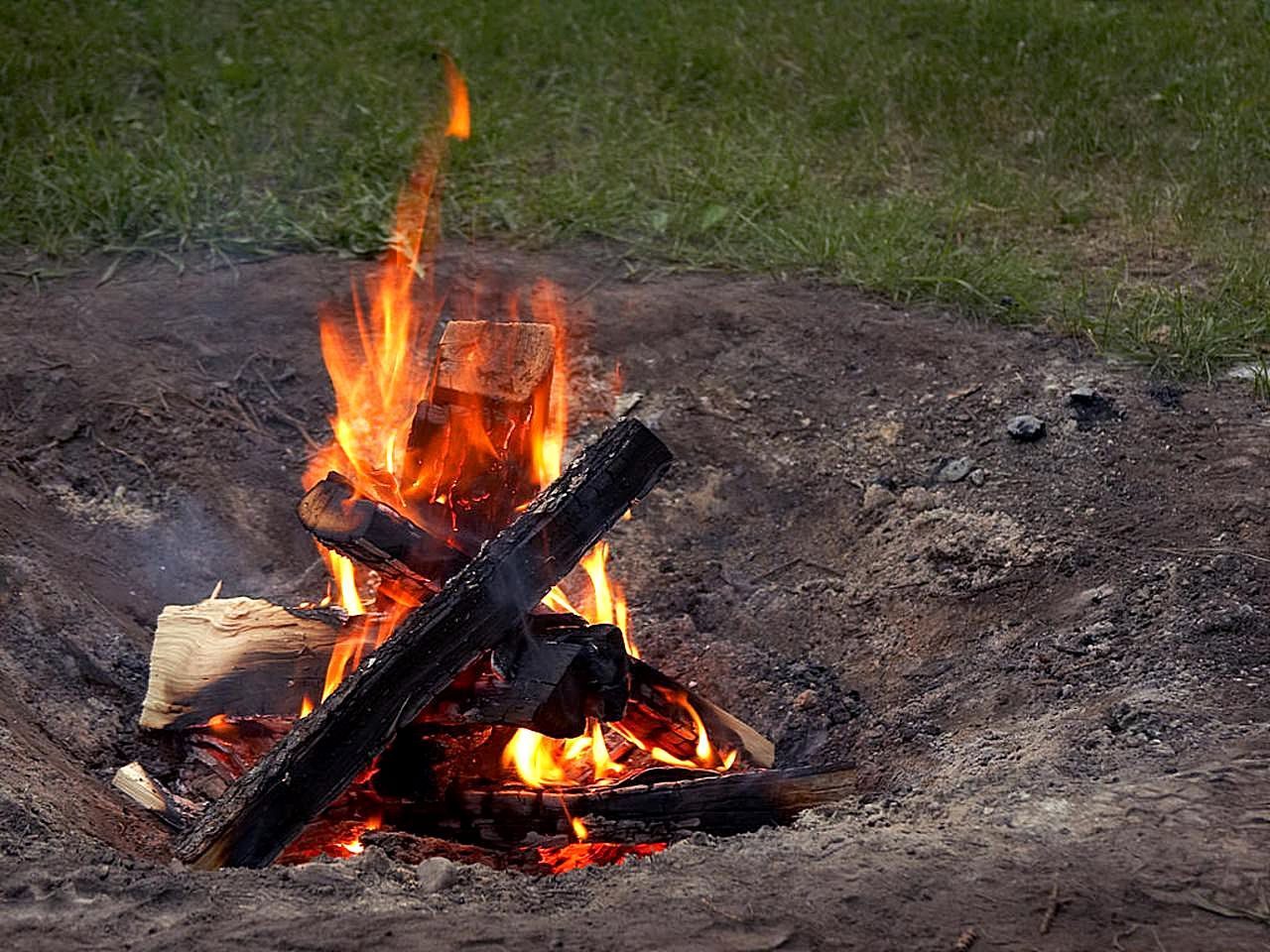
Uma fogueira queimando madeira
Queimar madeira é exotérmico, liberando calor para o ambiente.

Em toda reação química, a energia é transferida. A reação é exotérmica ou endotérmica, dependendo da direção do fluxo de energia.

  • Uma reação exotérmica 放热反应 libera energia térmica 热能 para o ambiente 环境. Então a temperatura do ambiente sobe para cima.
  • Uma reação endotérmica 吸热反应 absorve energia térmica do ambiente. Então a temperatura do ambiente desce para baixo.

Exemplos de reações exotérmicas são combustão 燃烧 (queimar um combustível) e neutralização 中和 (um ácido reagindo com uma base). Um exemplo de reação endotérmica é a decomposição térmica decomposition 分解 de um composto (quebrá-lo usando calor).

Dois termômetros: em uma reação exotérmica a leitura sobe, em uma reação endotérmica ela cai
Uma reação exotérmica aquece os arredores; uma reação endotérmica os esfria
Explore · ⁨Explorar⁩

Exotérmico & endotérmico

ΔH = produtos − reagentes

Exotérmico desce para produtos de menor energia (libera calor); endotérmico sobe para maior energia.

Vocabulary · ⁨Vocabulário⁩ Train · ⁨Treinar⁩
English · ⁨Inglês⁩ Chinese · ⁨Chinês⁩ Pinyin
exothermic reaction/eɡzəˈðɜːmɪk rɪˈækʃn/ 放热反应 fàng rè fǎn yìng
thermal energy/ˈθɜːml ˈenədʒi/ 热能 rè néng
surroundings/səˈraʊndɪŋz/ 环境 huán jìng
endothermic reaction/ˌendəʊˈθɜːmɪk rɪˈækʃn/ 吸热反应 xī rè fǎn yìng
combustion/kəmˈbʌstʃn/ 燃烧 rán shāo
neutralisation/ˌnjuːtrəlaɪˈzeɪʃn/ 中和 zhōng hé
decomposition/ˌdiːkɒmpəˈzɪʃn/ 分解 fēn jiě
enthalpy change/enˈθælpi tʃeɪndʒ/ 焓变 hán biàn
activation energy/ˌæktɪˈveɪʃn ˈenədʒi/ 活化能 huó huà néng
colliding/kəˈlaɪdɪŋ/ 碰撞 pèng zhuàng
5.1

Enthalpy change, ΔH · ⁨Variação de entalpia, ΔH⁩

English

The amount of thermal energy transferred in a reaction is called the enthalpy change 焓变. It is written as $\Delta H$ and has these signs:

  • $\Delta H$ is negative for an exothermic reaction, because energy leaves the chemicals.
  • $\Delta H$ is positive for an endothermic reaction, because energy is taken in.
Português

A quantidade de energia térmica transferida em uma reação é chamada de variação de entalpia 焓变. Ela é escrita como $\Delta H$ e tem estes sinais:

  • $\Delta H$ é negativo para uma reação exotérmica, porque a energia sai dos químicos.
  • $\Delta H$ é positivo para uma reação endotérmica, porque a energia é absorvida.
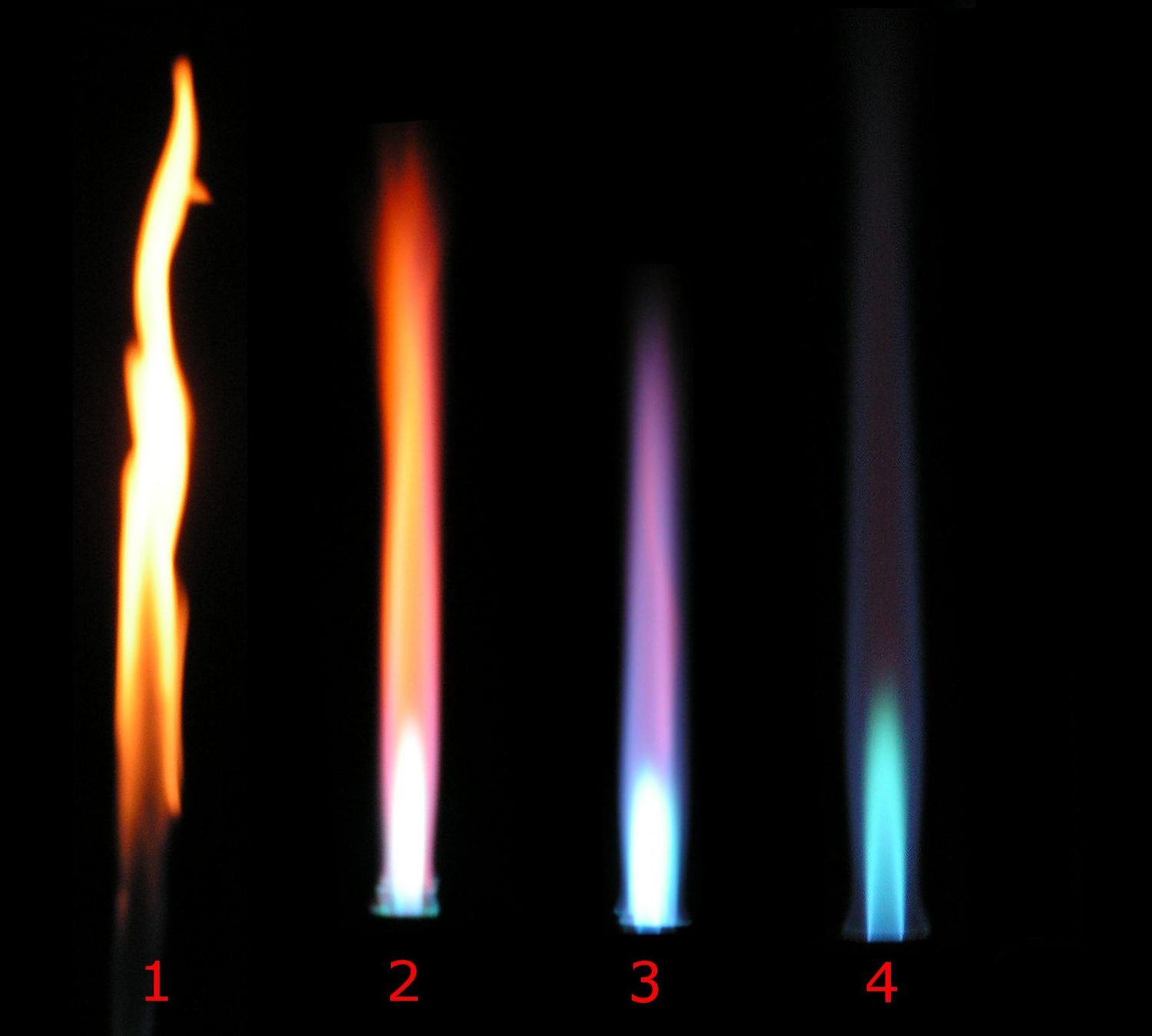
Uma chama de Bunsen fornece energia: a variação de entalpia ΔH é o calor transferido à pressão constante
Uma chama de Bunsen fornece energia: variação de entalpia ΔH é o calor transferido a pressão constante
5.1

Activation energy · ⁨Energia de ativação⁩

English

Particles do not react every time they meet. The activation energy 活化能 ($E_a$) is the smallest amount of energy that colliding 碰撞 particles 粒子 must have before they can react. It is like a hill the particles must get over before the reaction can happen.

Português

As partículas não reagem toda vez que se encontram. A energia de ativação 活化能 ($E_a$) é a menor quantidade de energia que partículas colidindo 碰撞 particles 粒子 devem ter antes que possam reagir. É como uma colina que as partículas precisam ultrapassar antes que a reação possa acontecer.

Explore · ⁨Explorar⁩

Energia de ativação

Ea = a barreira de energia

Toda reação deve subir a barreira de energia de ativação antes que os produtos possam se formar.

Vocabulary · ⁨Vocabulário⁩ Train · ⁨Treinar⁩
English · ⁨Inglês⁩ Chinese · ⁨Chinês⁩ Pinyin
particles/ˈpɑːtɪklz/ 粒子 lì zi
reaction pathway diagram/rɪˈækʃn ˈpæθweɪ ˈdaɪəɡræm/ 反应进程图 fǎn yìng jìn chéng tú
reactants/rɪˈæktənts/ 反应物 fǎn yìng wù
products/ˈprɒdʌkts/ 生成物 shēng chéng wù
bond breaking/bɒnd ˈbreɪkɪŋ/ 断键 duàn jiàn
bond making/bɒnd ˈmeɪkɪŋ/ 成键 chéng jiàn
5.1

Reaction pathway diagrams · ⁨Diagramas de caminho de reação⁩

English

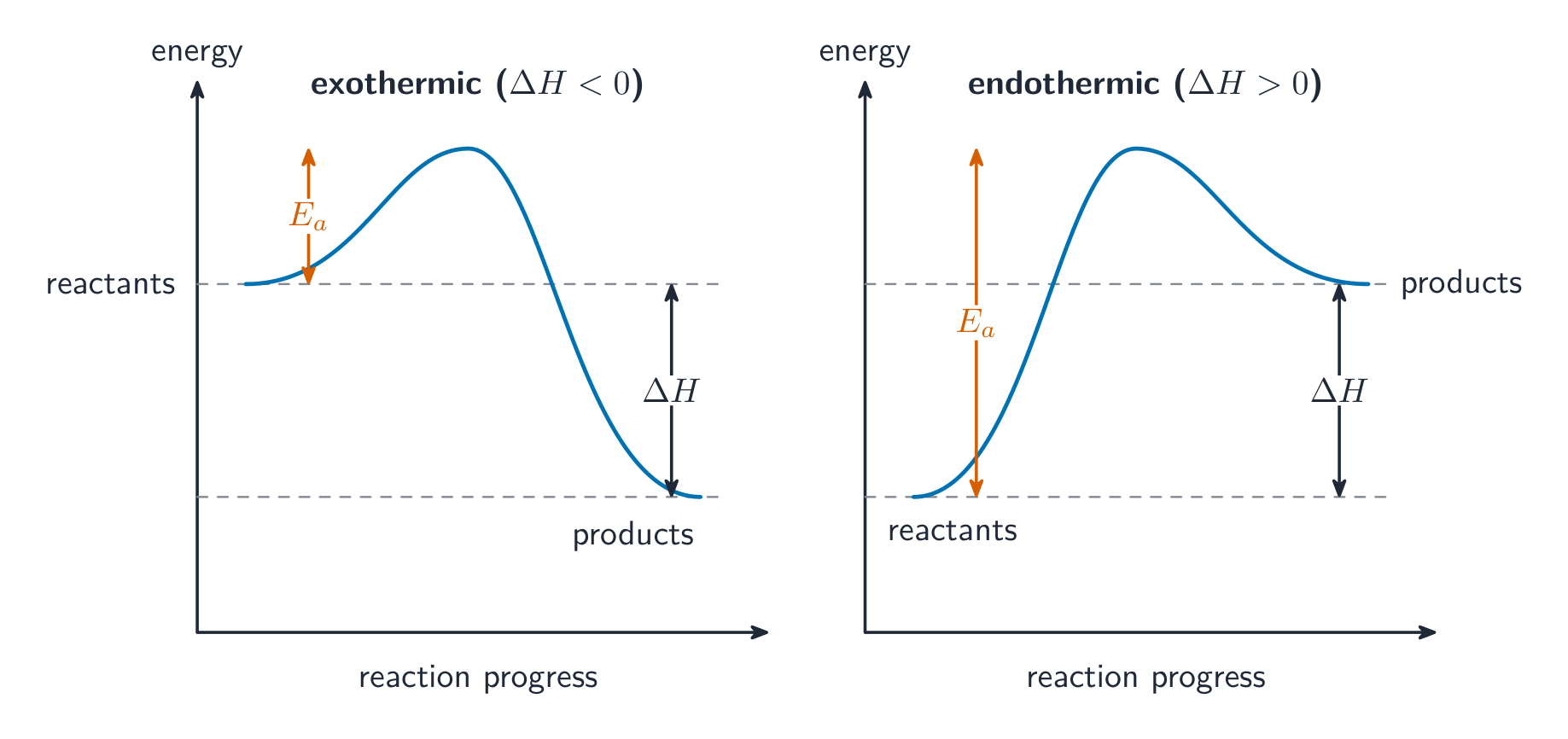
A reaction pathway diagram 反应进程图 shows how the energy changes as a reaction happens. Energy is on the vertical axis, and the progress of the reaction is on the horizontal axis.

  • The line starts at the energy level of the reactants 反应物.
  • It rises over a 'hill' — the height of this hill is the activation energy $E_a$.
  • It then falls or rises to the energy level of the products 生成物.
  • The gap between the reactant level and the product level is the enthalpy change $\Delta H$.

For an exothermic reaction, the products are lower than the reactants, so energy is given out and $\Delta H$ is negative.

For an endothermic reaction, the products are higher than the reactants, so energy is taken in and $\Delta H$ is positive.

Português

Um diagrama de caminho de reação 反应进程图 mostra como as energias mudam conforme uma reação ocorre. A energia está no eixo vertical, e o progresso da reação está no eixo horizontal.

  • A linha começa no nível de energia dos reativos 反应物.
  • Ele sobe sobre uma 'colina' — a altura dessa colina é a energia de ativação $E_a$.
  • Depois ela desce ou sobe até o nível de energia dos produtos 生成物.
  • A diferença entre o nível dos reagentes e o nível dos produtos é a variação de entalpia $\Delta H$.

Para uma reação exotérmica, os produtos estão abaixo dos reagentes, então a energia é liberada e $\Delta H$ é negativo.

Para uma reação endotérmica, os produtos estão acima dos reagentes, então a energia é absorvida e $\Delta H$ é positivo.

Dois diagramas de caminho de reação: um exotérmico com produtos abaixo dos reagentes e um endotérmico com produtos acima
Reações exotérmicas terminam mais baixas do que começam ($\Delta H<0$); reações endotérmicas terminam mais altas ($\Delta H>0$)
Explore · ⁨Explorar⁩

Diagramas de vias de reação

Arraste ΔH e a energia de ativação. Exotérmica liberta energia; endotérmica absorve-a; a elevação é a barreira energética.

5.1

Bonds and energy · ⁨Ligações e energia⁩

English

A reaction involves breaking the bonds in the reactants and making new bonds in the products.

  • Bond breaking 断键 takes in energy, so it is an endothermic step.
  • Bond making 成键 gives out energy, so it is an exothermic step.

The bond energy 键能 is the energy needed to break one mole of a particular bond. You can use bond energies to find the enthalpy change:

$$\Delta H = (\text{energy to break all bonds}) - (\text{energy released making all bonds})$$

If more energy is given out making bonds than is taken in breaking bonds, the reaction is exothermic ($\Delta H$ negative). If less energy is given out, it is endothermic ($\Delta H$ positive).

Worked example

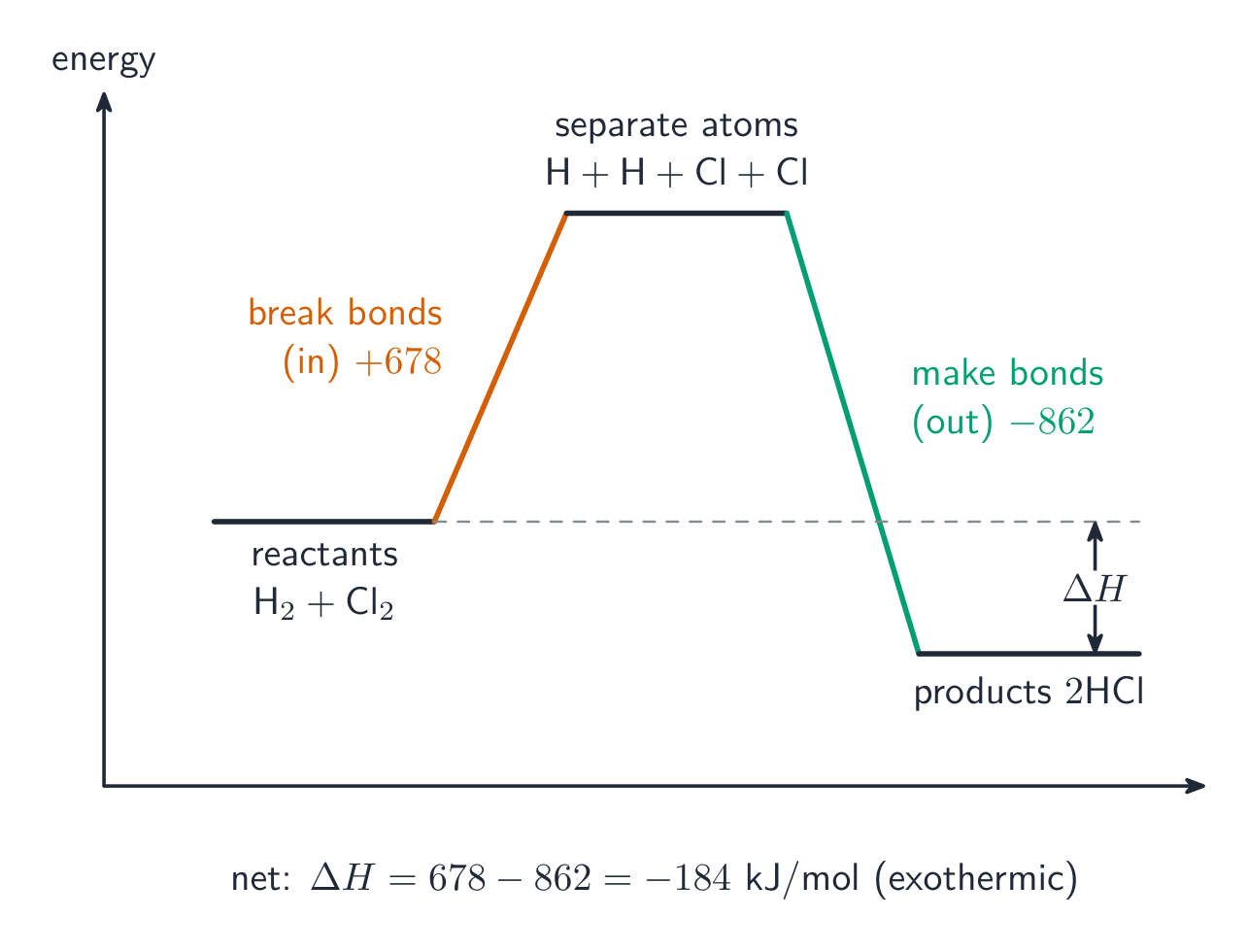
For the reaction $\text{H}_2 + \text{Cl}_2 \rightarrow 2\text{HCl}$, use these bond energies (in kJ/mol): H–H $= 436$, Cl–Cl $= 242$, H–Cl $= 431$.

Bonds broken: one H–H and one Cl–Cl $= 436 + 242 = 678$.

Bonds made: two H–Cl $= 2 \times 431 = 862$.

$$\Delta H = 678 - 862 = -184 \text{ kJ/mol}$$

The answer is negative, so this reaction is exothermic.

Português
Um bico de Bunsen com chama azul
Quebrar e formar ligações transfere energia — a chama a fornece aqui.

Uma reação envolve quebrar as ligações nos reagentes e formar novas ligações nos produtos.

  • Quebra de ligação 断键 absorve energia, então é uma etapa endotérmica.
  • Formação de ligação 成键 libera energia, então é uma etapa exotérmica.

A energia de ligação 键能 é a energia necessária para quebrar um mol de uma ligação específica. Você pode usar energias de ligação para encontrar a variação de entalpia:

$$\Delta H = (\text{energy to break all bonds}) - (\text{energy released making all bonds})$$

Se mais energia é liberada formando ligações do que é absorvida quebrando ligações, a reação é exotérmica ($\Delta H$ negativo). Se menos energia é liberada, é endotérmica ($\Delta H$ positivo).

Exemplo resolvido

Para a reação $\text{H}_2 + \text{Cl}_2 \rightarrow 2\text{HCl}$, use estas energias de ligação (em kJ/mol): H–H $= 436$, Cl–Cl $= 242$, H–Cl $= 431$.

Ligações quebradas: uma H–H e uma Cl–Cl $= 436 + 242 = 678$.

Ligações formadas: duas H–Cl $= 2 \times 431 = 862$.

$$\Delta H = 678 - 862 = -184 \text{ kJ/mol}$$

A resposta é negativa, então esta reação é exotérmica.

Um diagrama de nível de energia para hidrogênio mais cloro formando cloreto de hidrogênio: uma subida para quebrar ligações, depois uma descida maior para formar ligações, terminando abaixo do início
Quebrar ligações absorve energia ($+678$); formar ligações libera mais ($-862$); então $\Delta H = -184$ kJ/mol
Vocabulary · ⁨Vocabulário⁩ Train · ⁨Treinar⁩
English · ⁨Inglês⁩ Chinese · ⁨Chinês⁩ Pinyin
bond energy/bɒnd ˈenədʒi/ 键能 jiàn néng
5.1

Exam tips · ⁨Dicas de prova⁩

English
  • Exothermic gives out heat, so the surroundings warm up and $\Delta H$ is negative; endothermic takes in heat, so the surroundings cool and $\Delta H$ is positive.
  • Bond breaking takes energy in (endothermic); bond making gives energy out (exothermic). Use $\Delta H = (\text{energy to break bonds}) - (\text{energy released making bonds})$.
  • If more energy is released making bonds than is used breaking them, the reaction is exothermic. Always check the sign of your final answer.
  • On a reaction pathway diagram, an exothermic reaction ends lower than it starts; an endothermic one ends higher. The height of the hill is the activation energy.
Português
  • Exotérmica libera calor, então o ambiente esquenta e $\Delta H$ é negativo; endotérmica absorve calor, então o ambiente esfria e $\Delta H$ é positivo.
  • Quebra de ligação absorve energia (endotérmica); formação de ligação libera energia (exotérmica). Use $\Delta H = (\text{energy to break bonds}) - (\text{energy released making bonds})$.
  • Se mais energia for liberada formando ligações do que usada quebrando-as, a reação é exotérmica. Sempre verifique o sinal da sua resposta final.
  • Em um diagrama de via de reação, uma reação exotérmica termina abaixo de onde começou; uma endotérmica termina acima. A altura da colina é a energia de ativação.

Interactive lessons on this topic · ⁨Aulas interativas sobre este tópico⁩

Work through it step by step, with instant-check exercises. · ⁨Passe por ele passo a passo, com exercícios de verificação instantânea.⁩

Past Papers · ⁨Provas Anteriores⁩

More topics in Química do IGCSE · ⁨Mais tópicos em Química do IGCSE⁩

Log in or create account · ⁨Entrar ou criar conta⁩

IGCSE, A-Level & AP