English
- describe the reaction with acyl chlorides to form esters using ethyl ethanoate
Português
- descrever a reação com cloretos de acila para formar ésteres usando etanoato de etila
Química do A-Level · Topic 32 · Tópico 32
 8:38
8:38
Compostos hidroxilados (A2): fenol
Nos anos sessenta do século dezenove, a cirurgia era aterrorizante. O corte podia ser sobrevivido; a infecção que seguia frequentemente não podia. Após uma amputação, quase metade…
English narration · English + 中文 subtitles burned in · Narração em inglês · Legendas em inglês + 中文 gravadas

Source: Cambridge International syllabus · Fonte: Programa Cambridge International
At A Level you meet one more reaction of an alcohol 醇: it reacts with an acyl chloride 酰氯 to make an ester 酯. This works faster and more completely than using a carboxylic acid. For example, ethanol and ethanoyl chloride give ethyl ethanoate, plus fumes of $\text{HCl}$.
No nível A, você encontra outra reação de um álcool 醇: ele reage com um cloreto de acila 酰氯 para formar um éster 酯. Isso ocorre mais rápido e completamente do que usando um ácido carboxílico. Por exemplo, etanol e cloreto de etanoílo dão etanoato de etila, além de vapores de $\text{HCl}$.
Siga a substituição nucleofílica de acila até um éster.
| English · Inglês | Chinese · Chinês | Pinyin |
|---|---|---|
| alcohol/ˈælkəhɒl/ | 醇 | chún |
| acyl chloride/əˈkɪl ˈklɔːraɪd/ | 酰氯 | xiān lǜ |
| ester/ˈestə/ | 酯 | zhǐ |
Source: Cambridge International syllabus · Fonte: Programa Cambridge International
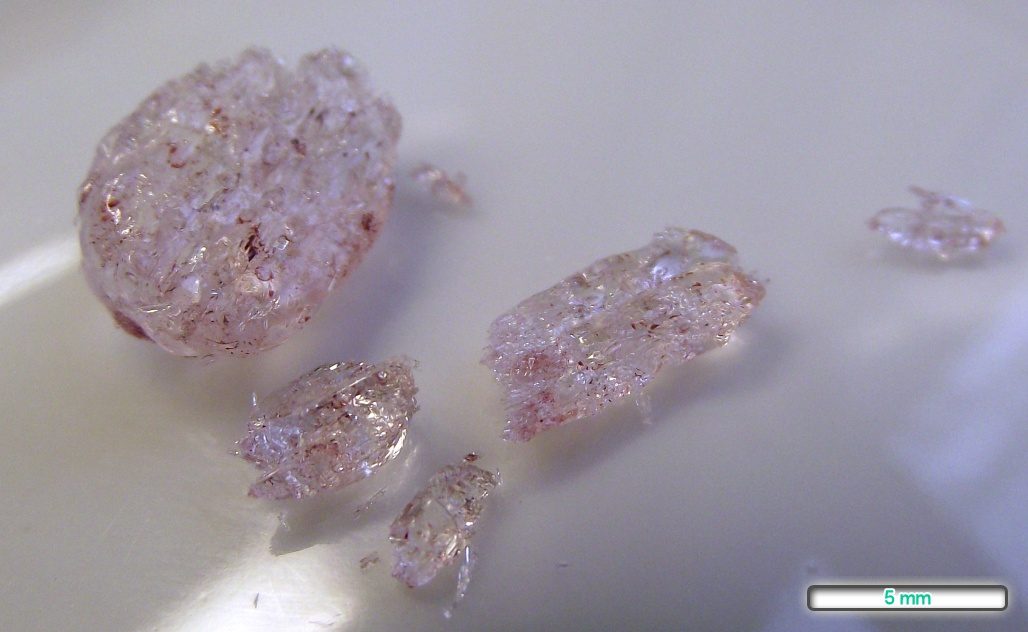
Phenol 苯酚 has an $\text{–OH}$ group joined directly to a benzene 苯 ring. This changes the chemistry of both the $\text{–OH}$ group and the ring.
Cool phenylamine 苯胺 with $\text{NaNO}_2$ and dilute acid below $10\,°\text{C}$ to make a diazonium salt 重氮盐. Warming this salt with water then gives phenol (and nitrogen gas).
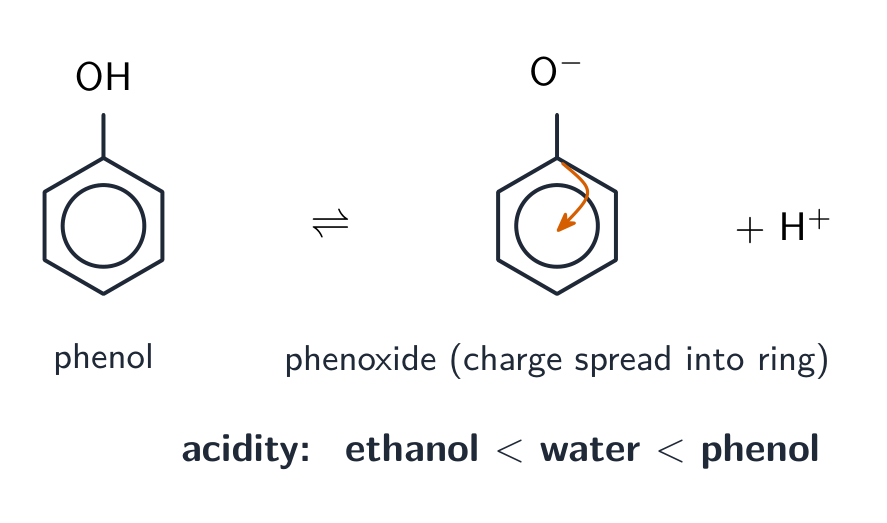
Phenol loses its $\text{H}^+$ to form a phenoxide ion. This ion is stabilised because its negative charge is spread (delocalised) into the ring. So phenol's acidity 酸性 is higher than that of water or ethanol:
(Phenol is still a weak acid — weaker than a carboxylic acid.)
A lone pair on the phenol oxygen is partly delocalised 离域 into the ring. This makes the ring more electron-rich, so it attracts electrophiles more strongly. Phenol therefore reacts faster and under much milder conditions than benzene — no catalyst is needed, and dilute reagents work at room temperature.
The $\text{–OH}$ group directs new substituents to the 2-, 4- and 6-positions. The same ideas apply to other phenolic compounds, such as naphthol.
Worked example. Phenol, ethanol and ethanoic acid are each shaken with aqueous $\text{NaOH}$ and then with aqueous $\text{Na}_2\text{CO}_3$. Predict what happens, and order the three by acidity. Acidity depends on how well the anion left behind is stabilised. Ethanol's ethoxide keeps its charge stuck on one oxygen, so ethanol is weakest and reacts with neither. Phenol's phenoxide spreads the charge into the ring, making phenol acidic enough to react with the strong base $\text{NaOH}$ but not with the weaker $\text{Na}_2\text{CO}_3$ - so no fizzing. Ethanoate spreads the charge over two oxygens, the most effective of the three, so ethanoic acid reacts with both and fizzes with the carbonate. Order: ethanol < phenol < ethanoic acid. The carbonate is the discriminating test - only a carboxylic acid fizzes, which is exactly how you tell phenol from an acid.
Fenol 苯酚 tem um grupo $\text{–OH}$ ligado diretamente a um benzeno 苯 anel. Isso altera a química tanto do grupo $\text{–OH}$ quanto do anel.
Resfrie fenilamina 苯胺 com $\text{NaNO}_2$ e ácido diluído abaixo de $10\,°\text{C}$ para formar um sal de diazônio 重氮盐. Aquecer este sal com água depois dá fenol (e gás nitrogênio).
O fenol perde seu $\text{H}^+$ para formar um íon fenóxido. Este íon é estabilizado porque sua carga negativa é espalhada (deslocalizada) para o anel. Assim, a acidez 酸性 do fenol é maior que a da água ou do etanol:
(O fenol ainda é um ácido fraco — mais fraco que um ácido carboxílico.)
Um par solitário no oxigênio do fenol é parcialmente deslocalizado 离域 para o anel. Isso torna o anel mais rico em elétrons, então ele atrai eletrófilos com mais força. Portanto, o fenol reage mais rápido e em condições muito mais suaves que o benzeno — nenhum catalisador é necessário, e reagentes diluídos funcionam à temperatura ambiente.
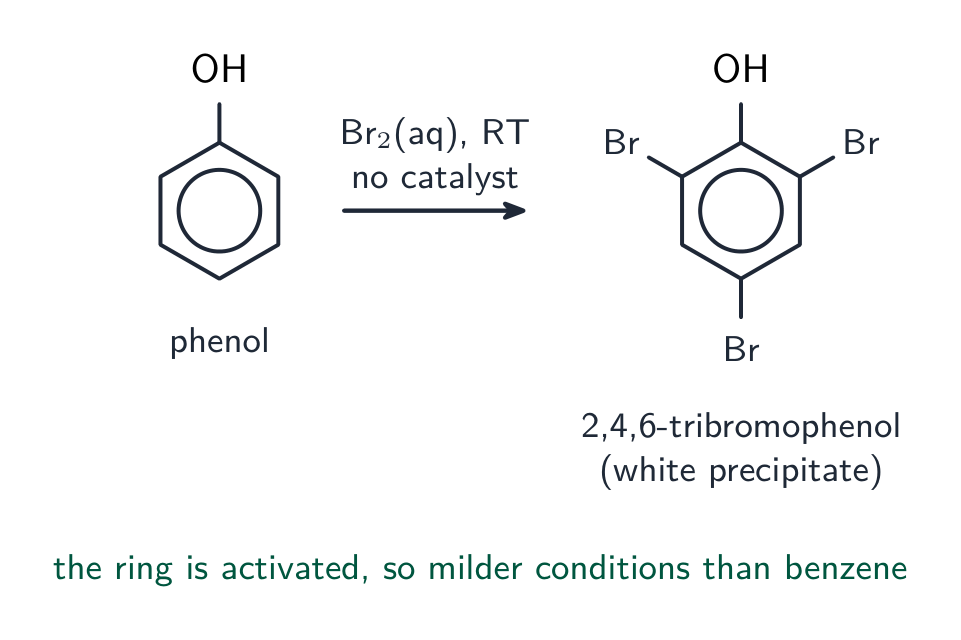
O grupo $\text{–OH}$ orienta novos substituintes para as posições 2-, 4- e 6-. Os mesmos princípios aplicam-se a outros compostos fenólicos, como o naftol.
Exemplo resolvido. Fenol, etanol e ácido etanoico são agitados separadamente com $\text{NaOH}$ aquoso e depois com $\text{Na}_2\text{CO}_3$ aquoso. Preveja o que acontece e ordene os três pela acidez. A acidez depende de quão bem o ânion resultante é estabilizado. O etóxido do etanol mantém sua carga concentrada em um único oxigênio, então o etanol é o mais fraco e não reage com nenhum. O fenóxido do fenol espalha a carga para dentro do anel, tornando o fenol ácido o suficiente para reagir com a base forte $\text{NaOH}$ mas não com a mais fraca $\text{Na}_2\text{CO}_3$ — logo, sem efervescência. O etanoato espalha a carga sobre dois oxigênios, a forma mais eficaz das três, então o ácido etanoico reage com ambos e efervesce com o carbonato. Ordem: etanol < fenol < ácido etanoico. O carbonato é o teste discriminatório — apenas um ácido carboxílico efervesce, que é exatamente como se distingue o fenol de um ácido.
Classifique as reações do fenol pelo papel do grupo OH aromático.
| English · Inglês | Chinese · Chinês | Pinyin |
|---|---|---|
| phenol/ˈfenɒl/ | 苯酚 | běn fēn |
| benzene/ˈbenziːn/ | 苯 | běn |
| phenylamine/ˌfiːˈnaɪləmiːn/ | 苯胺 | běn àn |
| diazonium salt/ˌdaɪəˈzəʊnɪəm sɒlt/ | 重氮盐 | zhòng dàn yán |
| azo compound/ˈɑːzəʊ ˈkɒmpaʊnd/ | 偶氮化合物 | ǒu dàn huà hé wù |
| nitration/naɪˈtreɪʃn/ | 硝化 | xiāo huà |
| bromination/ˌbrəʊmɪˈneɪʃn/ | 溴化 | xiù huà |
| acidity/æˈsɪdɪti/ | 酸性 | suān xìng |
| delocalised/dɪˈlɒkəlaɪzd/ | 离域 | lí yù |
Work through it step by step, with instant-check exercises. · Passe por ele passo a passo, com exercícios de verificação instantânea.
Past Papers · Provas Anteriores
Loading subjects… · Carregando matérias…