O diamante funde a três mil e quinhentos e cinquenta graus Celsius. O iodo funde a cento e catorze. Ambos são feitos apenas de átomos de não-metais, e em…
English narration · English + 中文 subtitles burned in · Narração em inglês · Legendas em inglês + 中文 gravadas
4.1
The gaseous state · Estado gasoso
Syllabus · Programa
English
explain the origin of pressure in a gas in terms of collisions between gas molecules and the wall of the container
understand that ideal gases have zero particle volume and no intermolecular forces of attraction
state and use the ideal gas equation$pV = nRT$ in calculations, including in the determination of $M_r$
Português
explicar a origem da pressão em um gás em termos de colisões entre moléculas de gás e as paredes do recipiente
compreender que gases ideais têm volume de partícula zero e nenhuma força intermolecular de atração
enunciar e usar a equação do gás ideal$pV = nRT$ em cálculos, incluindo na determinação de $M_r$
Source: Cambridge International syllabus · Fonte: Programa Cambridge International
English
Where gas pressure comes from
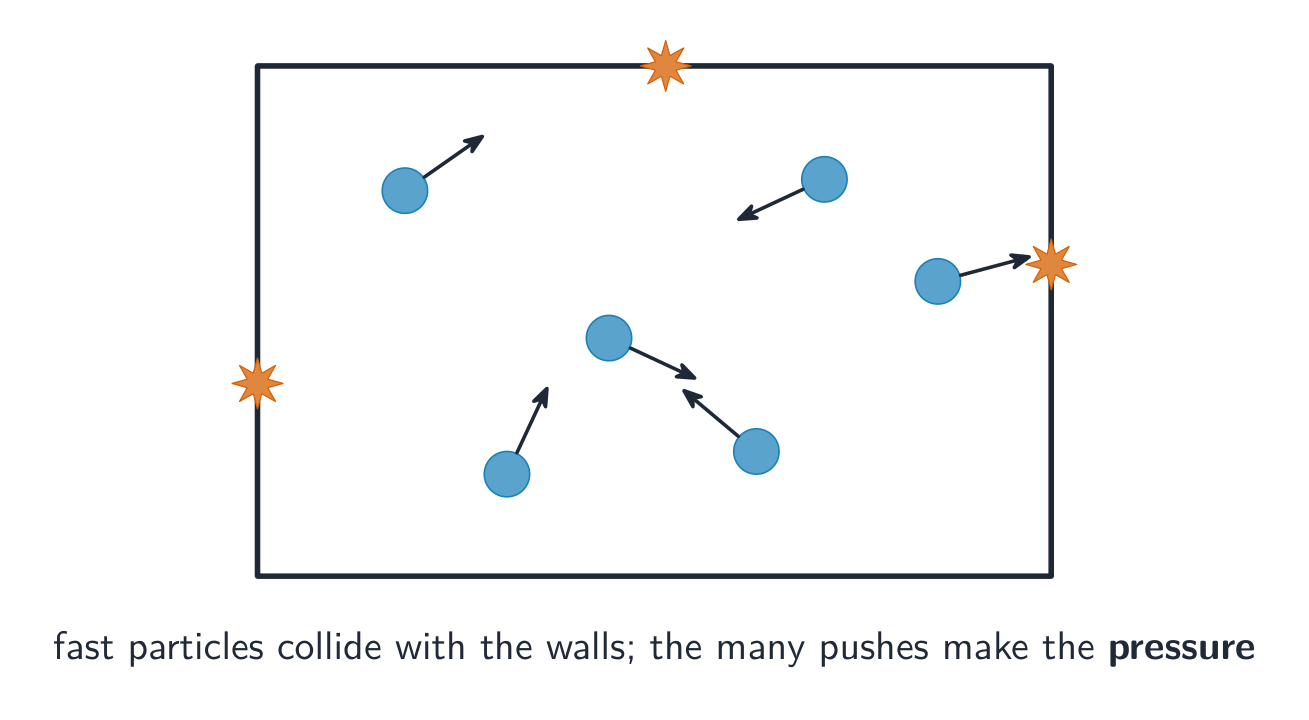
Gas molecules move fast in all directions. They keep hitting — colliding 碰撞 with — the walls of their container. Each hit gives the wall a tiny push. The pressure 压强 of the gas is the overall result of these many collisions on the walls.
Ideal gases
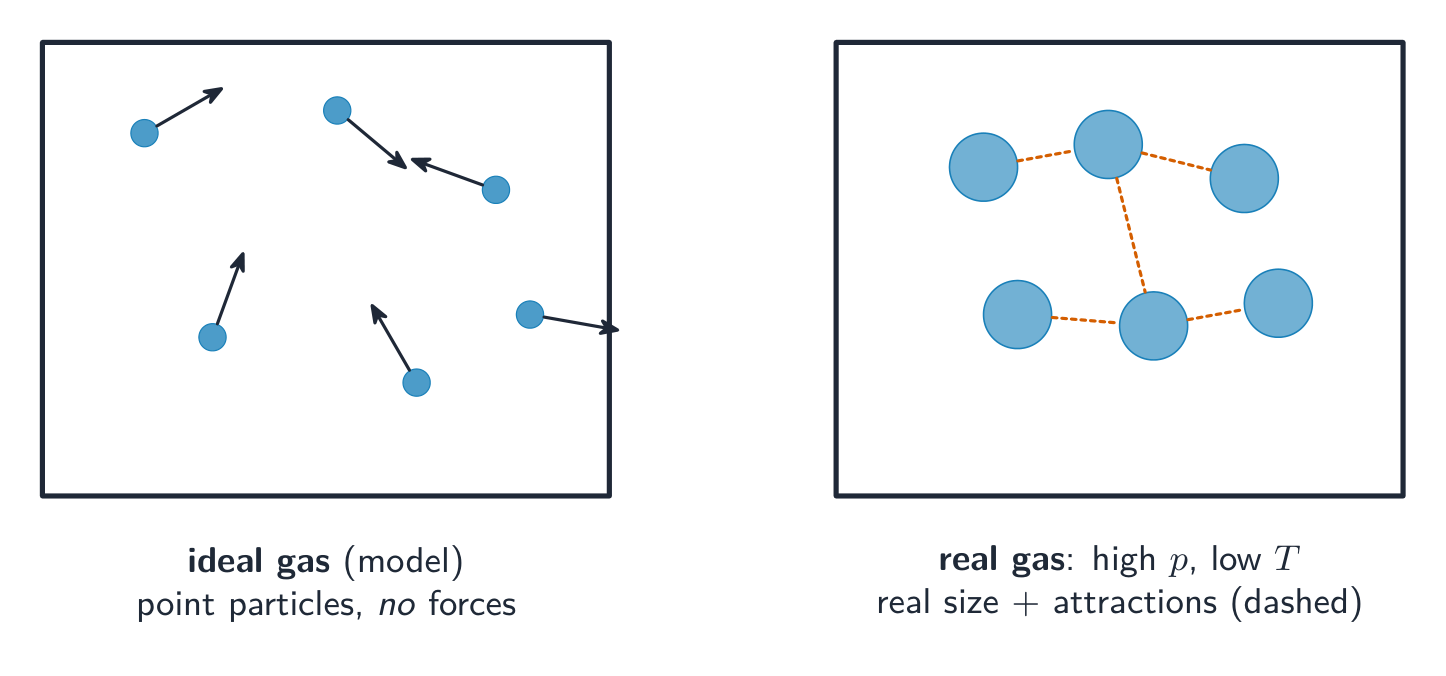
An ideal gas 理想气体 is a simple model. We assume two things:
the particles themselves take up zero volume.
there are no intermolecular forces 分子间作用力 of attraction between the particles.
A real gas 实际气体 follows this model closely at low pressure and high temperature. It behaves least like an ideal gas at high pressure and low temperature, when the particles are squeezed close together and the forces between them start to matter.
The ideal gas equation
The ideal gas equation 理想气体方程 links pressure, volume, amount and temperature:
$$pV = nRT$$
where $p$ is the pressure in Pa, $V$ is the volume in $\text{m}^3$, $n$ is the amount in moles, $T$ is the temperature in kelvin 开尔文 (K), and $R$ is the gas constant 气体常量 ($8.31\ \text{J K}^{-1}\,\text{mol}^{-1}$).
Always change the units first: °C to K (add 273), and $\text{cm}^3$ or $\text{dm}^3$ to $\text{m}^3$.
Worked example. Find the volume of $0.50\ \text{mol}$ of an ideal gas at $27\ ^{\circ}\text{C}$ and $100\ \text{kPa}$. ($R = 8.31\ \text{J K}^{-1}\,\text{mol}^{-1}$.)
You can also use the equation to find a molar mass 摩尔质量. Since $n = m/M$:
$$pV = \frac{m}{M}RT \qquad\Rightarrow\qquad M = \frac{mRT}{pV}$$
This lets you work out $M_r$ from the mass (or the density) of a gas.
Worked example. A flask holds $0.96\ \text{g}$ of a gas in $600\ \text{cm}^3$ at $100\ \text{kPa}$ and $27\ ^{\circ}\text{C}$. Find the molar mass of the gas. ($R = 8.31\ \text{J K}^{-1}\,\text{mol}^{-1}$.)
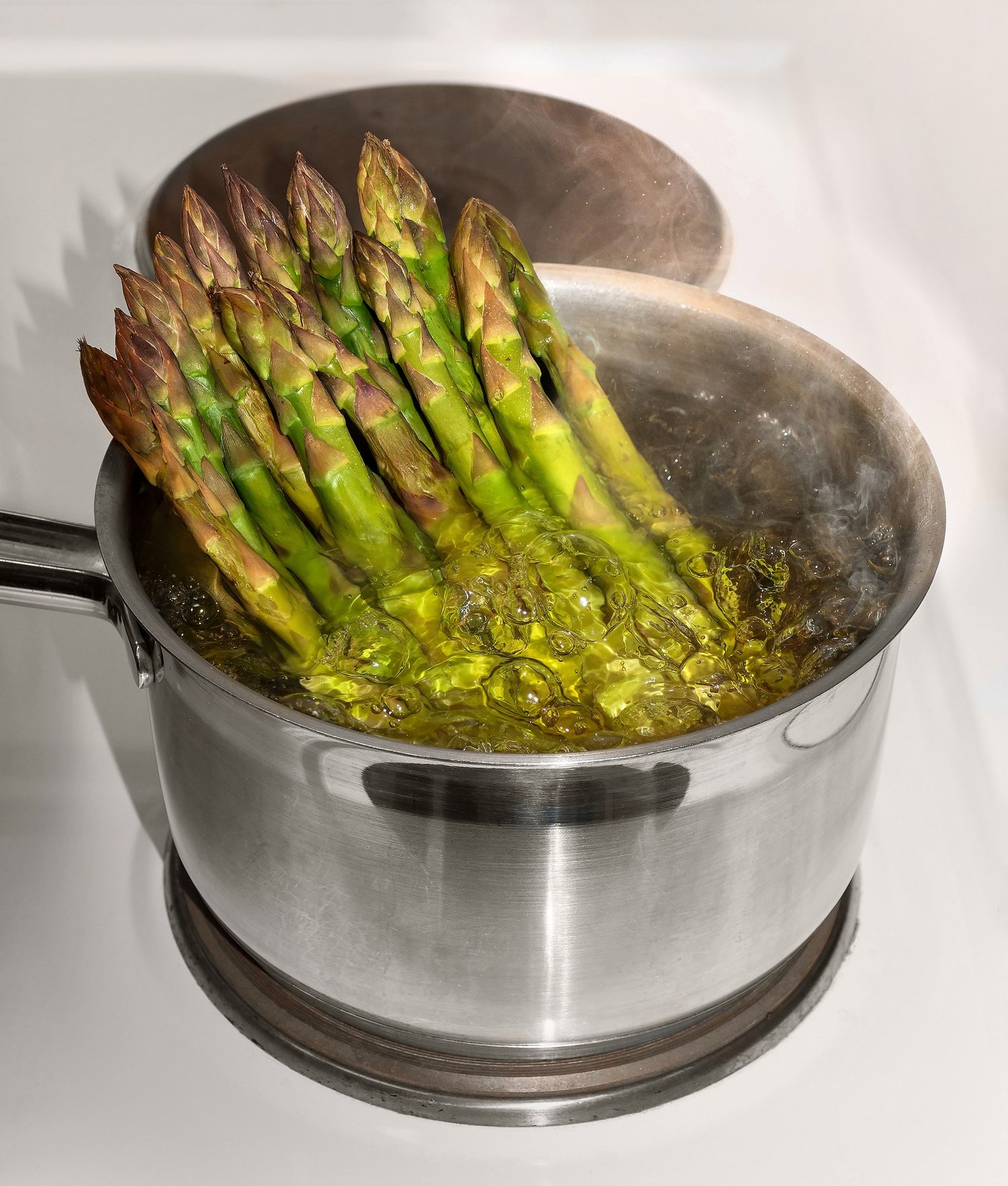
Fervir transforma a água líquida em vapor — uma mudança entre estados da matéria.
De onde vem a pressão do gás
As moléculas de gás movem-se rapidamente em todas as direções. Elas continuam batendo — colidindo 碰撞 com — as paredes de seu recipiente. Cada impacto dá um pequeno empurrão à parede. A pressão 压强 do gás é o resultado geral desses muitos colisões nas paredes.
Pressão do gás: moléculas rápidas se movem em todas as direções e colidem com as paredes; os muitos pequenos empurrões somam-se à pressão
Gases ideais
Um gás ideal 理想气体 é um modelo simples. Assumimos duas coisas:
as próprias partículas ocupam volume zero.
não há forças intermoleculares 分子间作用力 de atração entre as partículas.
Um gás real 实际气体 segue esse modelo de perto em baixa pressão e alta temperatura. Ele se comporta menos como um gás ideal em alta pressão e baixa temperatura, quando as partículas são comprimidas próximas umas das outras e as forças entre elas começam a importar.
Um gás ideal é um modelo: partículas pontuais sem forças entre elas. Um gás real se comporta menos assim em alta pressão e baixa temperatura, quando as partículas estão lotadas e seu tamanho real e atrações começam a importar
A equação do gás ideal
A equação do gás ideal 理想气体方程 relaciona pressão, volume, quantidade e temperatura:
$$pV = nRT$$
onde $p$ é a pressão em Pa, $V$ é o volume em $\text{m}^3$, $n$ é a quantidade em mols, $T$ é a temperatura em kelvin 开尔文 (K), e $R$ é a constante dos gases 气体常量 ($8.31\ \text{J K}^{-1}\,\text{mol}^{-1}$).
Sempre converta as unidades primeiro: °C para K (adicione 273), e $\text{cm}^3$ ou $\text{dm}^3$ para $\text{m}^3$.
Exemplo resolvido. Encontre o volume de $0.50\ \text{mol}$ de um gás ideal a $27\ ^{\circ}\text{C}$ e $100\ \text{kPa}$. ($R = 8.31\ \text{J K}^{-1}\,\text{mol}^{-1}$.)
Você também pode usar a equação para encontrar uma massa molar 摩尔质量. Como $n = m/M$:
$$pV = \frac{m}{M}RT \qquad\Rightarrow\qquad M = \frac{mRT}{pV}$$
Isso permite calcular $M_r$ a partir da massa (ou densidade) de um gás.
Exemplo resolvido. Um frasco contém $0.96\ \text{g}$ de um gás em $600\ \text{cm}^3$ a $100\ \text{kPa}$ e $27\ ^{\circ}\text{C}$. Encontre a massa molar do gás. ($R = 8.31\ \text{J K}^{-1}\,\text{mol}^{-1}$.)
describe, in simple terms, the lattice structure of a crystalline solid which is: (a) giant ionic, including sodium chloride and magnesium oxide (b) simple molecular, including iodine, buckminsterfullerene $\text{C}_{60}$ and ice (c) giant molecular, including silicon(IV) oxide, graphite and diamond (d) giant metallic, including copper
describe, interpret and predict the effect of different types of structure and bonding on the physical properties of substances, including melting point, boiling point, electrical conductivity and solubility
deduce the type of structure and bonding present in a substance from given information
Português
descrever, em termos simples, a estrutura de rede de um sólido cristalino que é: (a) iônico gigante, incluindo cloreto de sódio e óxido de magnésio (b) molecular simples, incluindo iodo, buckminsterfullereno $\text{C}_{60}$ e gelo (c) molecular gigante, incluindo dióxido de silício(IV), grafite e diamante (d) metálico gigante, incluindo cobre
descrever, interpretar e prever o efeito de diferentes tipos de estrutura e ligação nas propriedades físicas das substâncias, incluindo ponto de fusão, ponto de ebulição, condutividade elétrica e solubilidade
deduzir o tipo de estrutura e ligação presente em uma substância a partir de informações dadas
Source: Cambridge International syllabus · Fonte: Programa Cambridge International
English
How a substance behaves depends on how its particles are joined. There are four main structures of a crystalline solid 晶体.
Giant ionic
A giant ionic 离子晶体 structure is a huge regular lattice 晶格 of positive and negative ions 离子, held together by strong attraction in every direction. Examples are sodium chloride and magnesium oxide.
Simple molecular
A simple molecular 分子晶体 structure is made of small molecules 分子. The bonds inside each molecule are strong, but the intermolecular forces between the molecules are weak. Examples are iodine ($\text{I}_2$), fullerene 富勒烯 ($\text{C}_{60}$) and ice.
Giant molecular
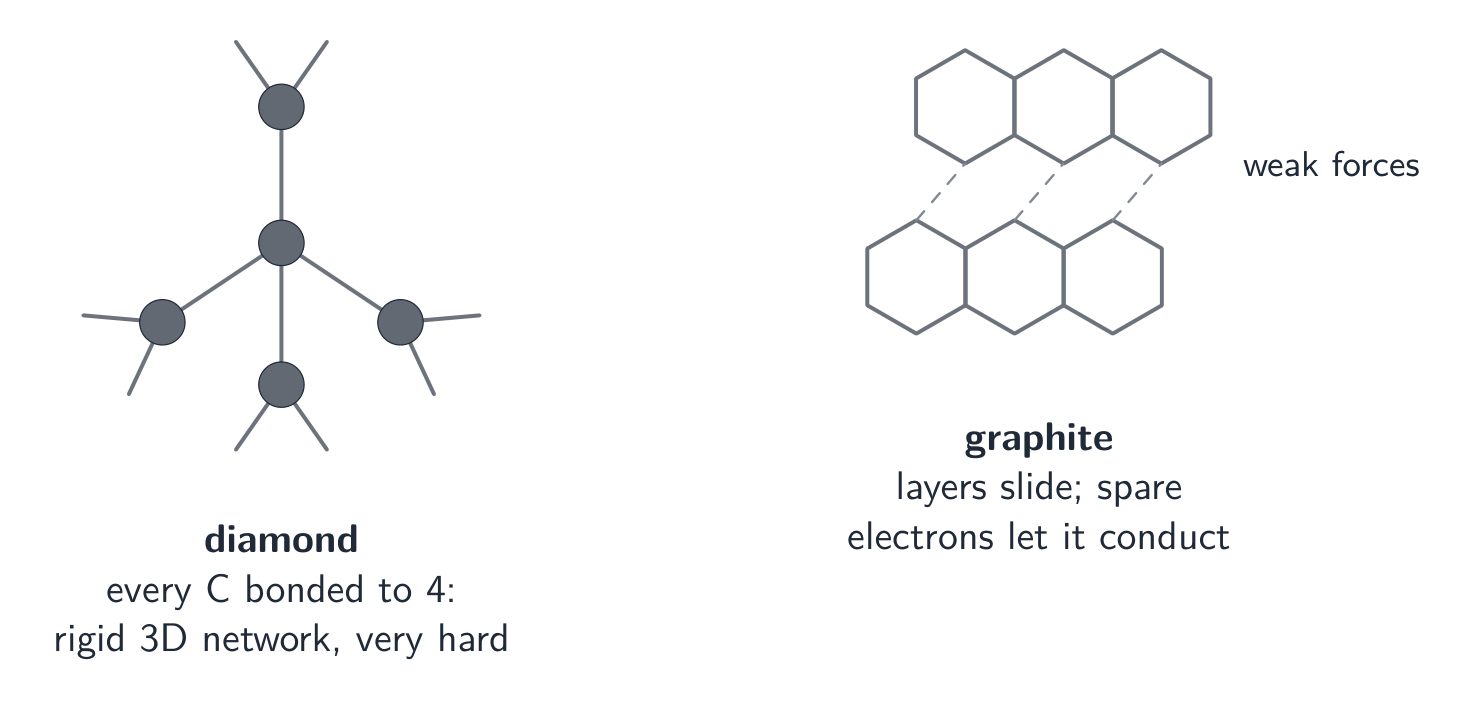
A giant molecular 原子晶体 structure (also called giant covalent) is a huge network of atoms joined by strong covalent bonds 共价键. Examples are silicon(IV) oxide 二氧化硅, graphite 石墨 and diamond 金刚石.
Giant metallic
A giant metallic 金属晶体 structure is a lattice of positive metal ions in a "sea" of delocalised electrons 离域电子. An example is copper.
Physical properties
The structure decides the physical properties:
Structure
Melting/boiling point
Conducts electricity?
Solubility in water
giant ionic
high
only when molten or dissolved
usually soluble
simple molecular
low
no
usually low
giant molecular
very high
no (except graphite)
insoluble
giant metallic
high
yes (solid and molten)
insoluble
melting point 熔点 and boiling point 沸点 are high when strong forces (ionic, covalent or metallic) must be broken, and low when only weak intermolecular forces break.
electrical conductivity 导电性 needs charged particles that can move — ions that are free (when molten or dissolved) or delocalised electrons. Graphite conducts because some of its electrons are delocalised.
solubility 溶解度 in water is usually high for ionic solids and low for molecular and giant covalent solids.
You can work backwards too: from the melting point, conductivity and solubility of an unknown substance, deduce the type of structure and bonding it has.
Português
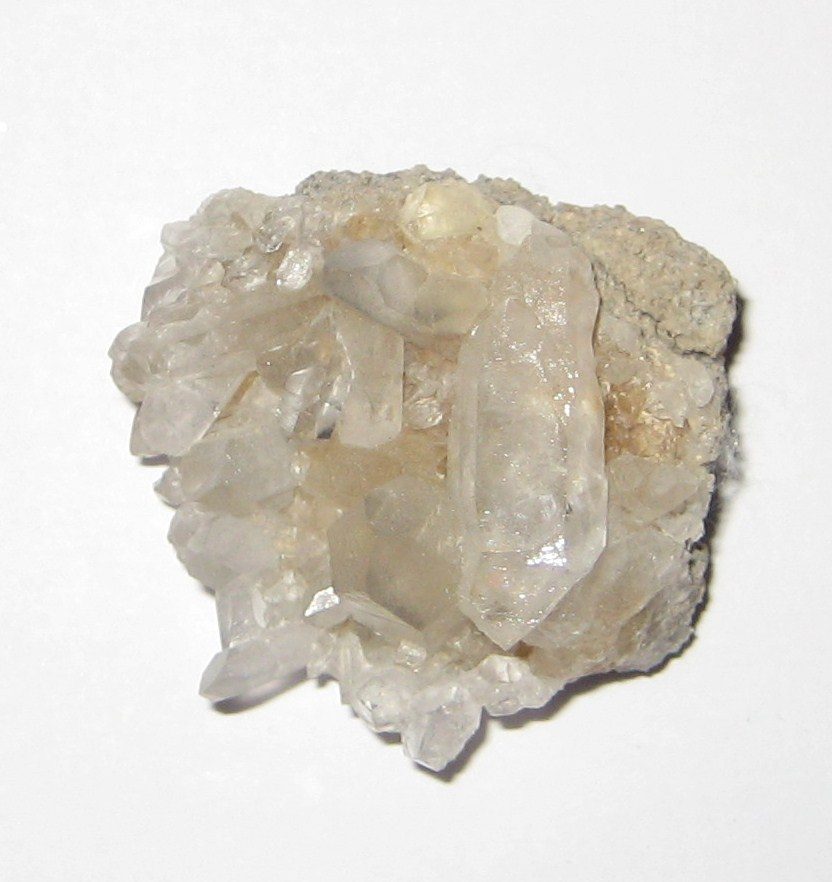
O quartzo é uma estrutura covalente gigante de silício e oxigênio.
Como uma substância se comporta depende de como suas partículas estão unidas. Existem quatro estruturas principais de um sólido cristalino 晶体.
As quatro estruturas de um sólido cristalino — a estrutura determina o ponto de fusão, condutividade e solubilidade
Iônico gigante
Uma estrutura iônica gigante 离子晶体 é uma enorme rede regular de íons 离子 positivos e negativos, mantida por forte atração em todas as direções. Exemplos são cloreto de sódio e óxido de magnésio.
Molecular simples
Uma estrutura molecular simples 分子晶体 é formada por pequenas moléculas 分子. As ligações dentro de cada molécula são fortes, mas as forças intermoleculares entre as moléculas são fracas. Exemplos são iodo ($\text{I}_2$), fullereno 富勒烯 ($\text{C}_{60}$) e gelo.
Molecular gigante
Uma estrutura molecular gigante 原子晶体 (também chamada covalente gigante) é uma grande rede de átomos unidos por fortes ligações covalentes 共价键. Exemplos são óxido de silício(IV) 二氧化硅, grafite 石墨 e diamante 金刚石.
Duas formas covalentes gigantes do carbono: o diamante é uma rede rígida 3D (muito duro); a grafite tem camadas deslizantes e elétrons livres que conduzem eletricidadeUm diamante real na rocha em que cresceu. Todo esse cristal é uma única molécula gigante — uma rede única e ininterrupta de átomos de carbono, cada um ligado a outros quatro. Quebrá-lo significa quebrar incontáveis ligações covalentes fortes, sendo por isso o diamante o material natural mais duro
Metálico gigante
Uma estrutura metálica gigante 金属晶体 é uma rede de íons metálicos positivos em um "mar" de elétrons deslocalizados 离域电子. Um exemplo é o cobre.
Um pedaço de metal de cobre puro. O brilho, bem como a capacidade dos metais de conduzirem e se deformarem, decorrem dessa rede gigante de íons de cobre imersos em um mar compartilhado de elétrons deslocalizados
Propriedades físicas
A estrutura determina as propriedades físicas:
Estrutura
Ponto de fusão/ebulição
Conduz eletricidade?
Solubilidade em água
iônico gigante
alto
apenas quando fundido ou dissolvido
geralmente solúvel
molecular simples
baixo
não
geralmente baixa
molecular gigante
muito alto
não (exceto grafite)
insolúvel
metálico gigante
alto
sim (sólido e fundido)
insolúvel
ponto de fusão 熔点 e ponto de ebulição 沸点 são altos quando devem ser quebradas forças fortes (iónicas, covalentes ou metálicas), e baixos quando apenas forças intermoleculares fracas são quebradas.
condutividade elétrica 导电性 requer partículas carregadas que possam se mover — íons livres (quando fundidos ou dissolvidos) ou elétrons deslocalizados. A grafite conduz porque alguns de seus elétrons são deslocalizados.
solubilidade 溶解度 em água é geralmente alta para sólidos iônicos e baixa para sólidos moleculares e covalentes gigantes.
Você também pode fazer o caminho inverso: a partir do ponto de fusão, condutividade e solubilidade de uma substância desconhecida, deduzir o tipo de estrutura e ligação que ela possui.
Explore · Explorar
Laboratório de estrutura gigante
Compare estruturas gigantes por partículas e ligações.
Use SI units in $pV = nRT$: pressure in Pa, volume in $\text{m}^3$ ($\text{cm}^3 \times 10^{-6}$), temperature in K ($^\circ\text{C} + 273$).
State the ideal-gas assumptions (negligible molecular volume, no intermolecular forces) and when real gases deviate (high pressure, low temperature).
Link each property to structure: giant ionic (high m.p., conducts molten), giant covalent (very high m.p.), simple molecular (low m.p.), giant metallic (conducts, malleable).
Graphite conducts because each carbon has a delocalised electron; diamond does not — a favourite comparison.
Português
Use unidades SI em $pV = nRT$: pressão em Pa, volume em $\text{m}^3$ ($\text{cm}^3 \times 10^{-6}$), temperatura em K ($^\circ\text{C} + 273$).
Enuncie as premissas do gás ideal (volume molecular desprezível, sem forças intermoleculares) e quando os gases reais desviam (alta pressão, baixa temperatura).
Vincule cada propriedade à estrutura: iônico gigante (alto p.f., conduz fundido), covalente gigante (m.p. muito alto), molecular simples (m.p. baixo), metálico gigante (conduz, maleável).
A grafite conduz porque cada carbono tem um elétron deslocalizado; o diamante não — uma comparação favorita.
Interactive lessons on this topic · Aulas interativas sobre este tópico
Work through it step by step, with instant-check exercises. · Passe por ele passo a passo, com exercícios de verificação instantânea.
Pick one and the site follows you — notes, papers, videos and practice all open on it. · Escolha uma e o site te seguirá — notas, provas, vídeos e prática abrirão nela.
Type to search notes, lessons, code, vocabulary and past-paper questions across every subject. · Digite para pesquisar notas, aulas, código, vocabulário e questões de provas anteriores em todas as disciplinas.