Aqui está um problema. Uma colher de chá única de água contém cerca de duzentos mil bilhões de bilhões de moléculas. Você nunca poderia contá-las — nem em uma vida, nem…
English narration · English + 中文 subtitles burned in · Narração em inglês · Legendas em inglês + 中文 gravadas
2.1
Relative masses of atoms and molecules · Massas relativas de átomos e moléculas
Syllabus · Programa
English
define the unified atomic mass unit as one twelfth of the mass of a carbon-12 atom
define relative atomic mass, $A_r$, relative isotopic mass, relative molecular mass, $M_r$, and relative formula mass in terms of the unified atomic mass unit
Português
defina a unidade de massa atômica unificada como um décimo-e-doze da massa de um átomo de carbono-12
defina massa atômica relativa, $A_r$, massa isotópica relativa, massa molecular relativa, $M_r$, e massa fórmula relativa em termos da unidade de massa atômica unificada
Source: Cambridge International syllabus · Fonte: Programa Cambridge International
English
Atoms 原子 are far too light to weigh in grams, so we compare every mass to one standard. The standard is the unified atomic mass unit 统一原子质量单位 (symbol u), defined as exactly one twelfth of the mass of one carbon-12 atom.
Using this unit, we state masses as simple numbers:
the relative atomic mass 相对原子质量$A_r$ of an element is the average mass of its atoms compared with $\tfrac{1}{12}$ of a carbon-12 atom. It is an average over all the isotopes 同位素, weighted by how common each one is.
the relative isotopic mass 相对同位素质量 is the mass of one atom of a single isotope, compared with $\tfrac{1}{12}$ of a carbon-12 atom.
the relative molecular mass 相对分子质量$M_r$ of a molecule 分子 is the sum of the relative atomic masses of all its atoms.
the relative formula mass 相对式量 is the same idea for a substance that is not made of molecules (such as an ionic compound). Add up the relative atomic masses shown in the formula.
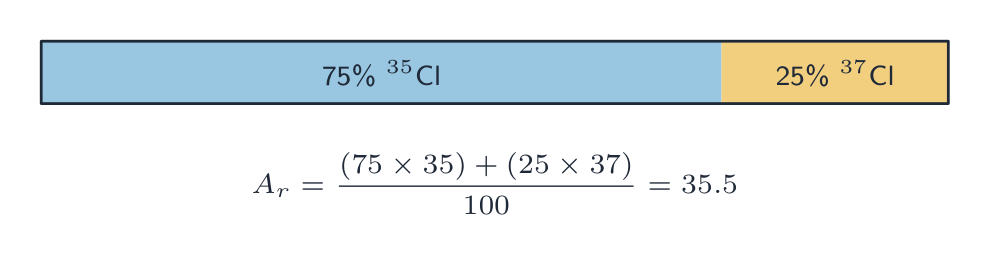
To find $A_r$ from isotope data, multiply each isotope mass by its percentage, add these up, and divide by 100.
Worked example. Chlorine is $75\%$${}^{35}\text{Cl}$ and $25\%$${}^{37}\text{Cl}$. Find its relative atomic mass.
Átomos 原子 são muito leves para serem pesados em gramas, então comparamos cada massa a um padrão. O padrão é a unidade de massa atômica unificada 统一原子质量单位 (símbolo u), definida como exatamente um décimo segundo da massa de um átomo de carbono-12.
Usando esta unidade, declaramos massas como números simples:
a massa atômica relativa 相对原子质量$A_r$ de um elemento é a massa média de seus átomos comparada com $\tfrac{1}{12}$ de um átomo de carbono-12. É uma média sobre todos os isótopos 同位素, ponderada pela frequência de cada um.
a massa isotópica relativa 相对同位素质量 é a massa de um átomo de um único isótopo, comparada com $\tfrac{1}{12}$ de um átomo de carbono-12.
a massa molecular relativa 相对分子质量$M_r$ de uma molécula 分子 é a soma das massas atômicas relativas de todos os seus átomos.
a massa fórmula relativa 相对式量 é a mesma ideia para uma substância que não é composta por moléculas (como um composto iônico). Some as massas atômicas relativas mostradas na fórmula.
A massa atômica relativa é uma média ponderada: os dois isótopos do cloro (75% ³⁵Cl, 25% ³⁷Cl) têm média Aᵣ = 35.5
Para encontrar $A_r$ a partir de dados de isótopos, multiplique a massa de cada isótopo por sua porcentagem, some esses valores e divida por 100.
Exemplo resolvido. O cloro é $75\%$${}^{35}\text{Cl}$ e $25\%$${}^{37}\text{Cl}$. Encontre sua massa atômica relativa.
Exemplo resolvido. Um espectrômetro de massas mostra que o cobre é $69.2\%$${}^{63}\text{Cu}$ e $30.8\%$${}^{65}\text{Cu}$. Encontre sua massa atômica relativa.
unified atomic mass unit/ˈjuːnɪfaɪd əˈtɒmɪk mæs ˈjuːnɪt/
统一原子质量单位
tǒng yī yuán zi zhì liàng dān wèi
relative atomic mass/ˈrelətɪv əˈtɒmɪk mæs/
相对原子质量
xiāng duì yuán zi zhì liàng
isotope/ˈaɪsətəʊp/
同位素
tóng wèi sù
relative isotopic mass/ˈrelətɪv ˌaɪsəˈtɒpɪk mæs/
相对同位素质量
xiāng duì tóng wèi sù zhì liàng
relative molecular mass/ˈrelətɪv məˈlekjʊlə mæs/
相对分子质量
xiāng duì fèn zǐ zhì liàng
molecule/ˈmɒlɪkjuːl/
分子
fèn zǐ
relative formula mass/ˈrelətɪv ˈfɔːmjʊlə mæs/
相对式量
xiāng duì shì liàng
mole/məʊl/
摩尔
mó ěr
Avogadro constant/ˌævəˈɡædrəʊ ˈkɒnstənt/
阿伏伽德罗常量
ā fú gā dé luó cháng liàng
2.2
The mole and the Avogadro constant · O mol e a constante de Avogadro
Syllabus · Programa
English
define and use the term mole in terms of the Avogadro constant
Português
defina e use o termo mol em termos da constante de Avogadro
Source: Cambridge International syllabus · Fonte: Programa Cambridge International
English
Chemists count particles in groups called moles, just as we count eggs in dozens.
One mole 摩尔 (symbol mol) is the amount of substance that contains the same number of particles as there are atoms in exactly 12 g of carbon-12. That number is the Avogadro constant 阿伏伽德罗常量:
$$N_A = 6.02 \times 10^{23}\ \text{mol}^{-1}$$
So one mole of anything contains $6.02 \times 10^{23}$ particles. The particles may be atoms, molecules or ions 离子 — always say which.
The mass of one mole in grams equals the relative mass ($A_r$ or $M_r$). This is the molar mass 摩尔质量, with units $\text{g mol}^{-1}$. The key equation is:
$$n = \frac{m}{M}$$
where $n$ is the amount in moles, $m$ is the mass in grams, and $M$ is the molar mass.
Worked example. How many moles are in $8.0\ \text{g}$ of methane, $\text{CH}_4$? ($A_r$: C $= 12$, H $= 1$.)
The molar mass is $M = 12 + 4(1) = 16\ \text{g mol}^{-1}$, so
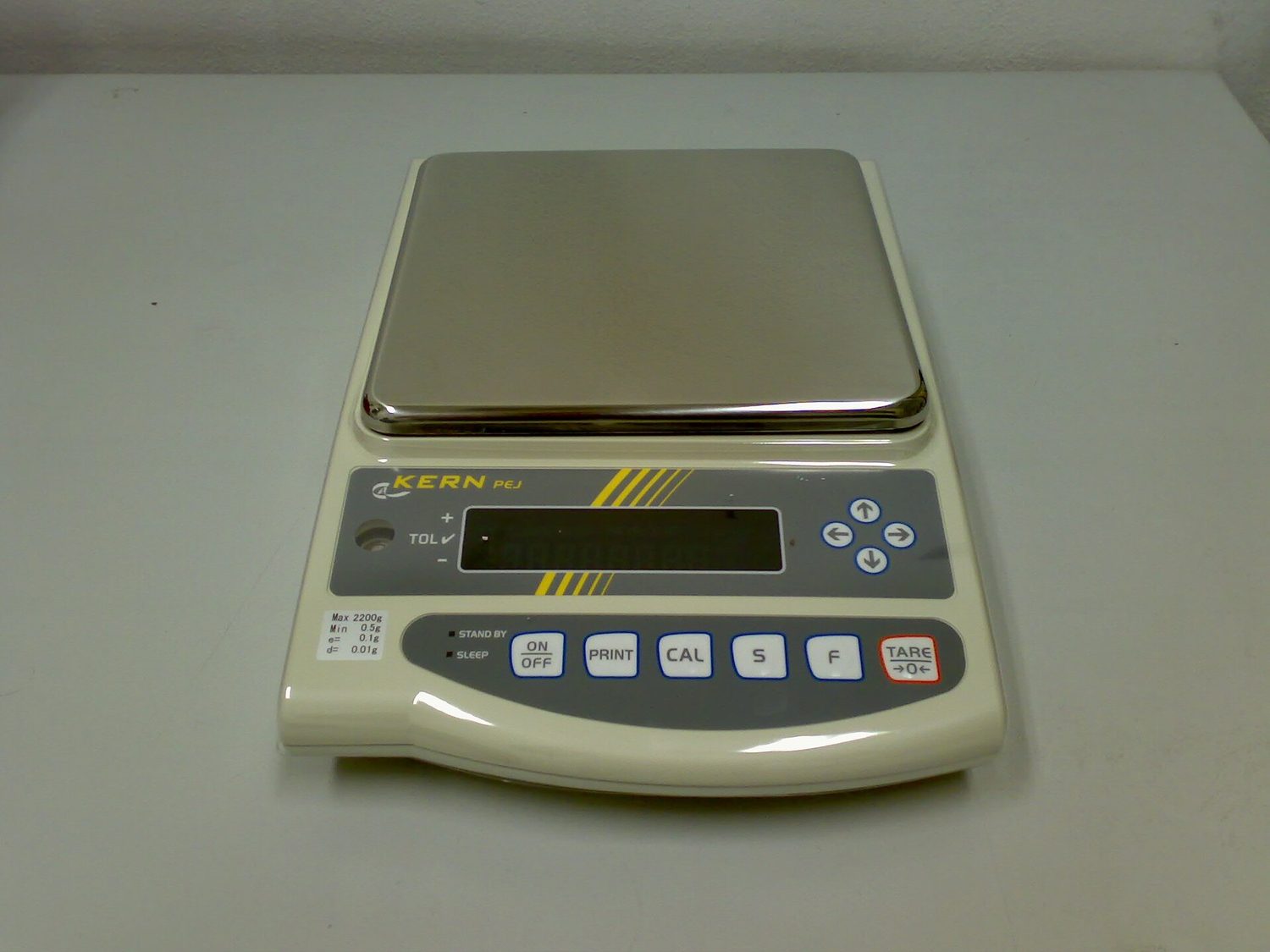
Uma balança eletrônica moderna mede massa — a base dos cálculos de mol.
Químicos contam partículas em grupos chamados mols, assim como contamos ovos em dúzias.
Um mol 摩尔 (símbolo mol) é a quantidade de substância que contém o mesmo número de partículas que há em exatamente 12 g de carbono-12. Esse número é a constante de Avogadro 阿伏伽德罗常量:
$$N_A = 6.02 \times 10^{23}\ \text{mol}^{-1}$$
Portanto, um mol de qualquer coisa contém $6.02 \times 10^{23}$ partículas. As partículas podem ser átomos, moléculas ou íons 离子 — diga sempre quais são.
A massa de um mol em gramas é igual à massa relativa ($A_r$ ou $M_r$). Esta é a massa molar 摩尔质量, com unidades $\text{g mol}^{-1}$. A equação chave é:
$$n = \frac{m}{M}$$
onde $n$ é a quantidade em mols, $m$ é a massa em gramas, e $M$ é a massa molar.
Exemplo resolvido. Quantos mols estão em $8.0\ \text{g}$ de metano, $\text{CH}_4$? ($A_r$: C $= 12$, H $= 1$.)
A massa molar é $M = 12 + 4(1) = 16\ \text{g mol}^{-1}$, portanto
O mol é o centro de todos os cálculos de quantidade: converta para massa ($n=m/M$), partículas ($\times N_A$), volume de gás ($n=V/24$) ou solução ($n=cV$)
Explore · Explorar
Laboratório de massa molar
n = m / M
Mude a massa e veja os moles escalarem através da massa molar.
write formulas of ionic compounds from ionic charges and oxidation numbers (shown by a Roman numeral), including: (a) the prediction of ionic charge from the position of an element in the Periodic Table (b) recall of the names and formulas for the following ions: $\text{NO}_3^-$, $\text{CO}_3^{2-}$, $\text{SO}_4^{2-}$, $\text{OH}^-$, $\text{NH}_4^+$, $\text{Zn}^{2+}$, $\text{Ag}^+$, $\text{HCO}_3^-$, $\text{PO}_4^{3-}$
(a) write and construct equations (which should be balanced), including ionic equations (which should not include spectator ions) (b) use appropriate state symbols in equations
define and use the terms empirical and molecular formula
understand and use the terms anhydrous, hydrated and water of crystallisation
calculate empirical and molecular formulas, using given data
Português
escreva fórmulas de compostos iônicos a partir de cargas iônicas e números de oxidação (mostrados por numeral romano), incluindo: (a) a previsão da carga iônica a partir da posição de um elemento na Tabela Periódica; (b) relembre os nomes e fórmulas dos seguintes íons: $\text{NO}_3^-$, $\text{CO}_3^{2-}$, $\text{SO}_4^{2-}$, $\text{OH}^-$, $\text{NH}_4^+$, $\text{Zn}^{2+}$, $\text{Ag}^+$, $\text{HCO}_3^-$, $\text{PO}_4^{3-}$
(a) escreva e construa equações (que devem estar balanceadas), incluindo equações iônicas (que não devem incluir íons espectadores); (b) use símbolos de estado adequados nas equações
defina e use os termos fórmula empírica e molecular
entenda e use os termos anidro, hidratado e água de cristalização
calcule fórmulas empíricas e moleculares, usando dados fornecidos
Source: Cambridge International syllabus · Fonte: Programa Cambridge International
English
A compound 化合物 is a substance made of two or more elements chemically joined.
Charges and formulas of ionic compounds
In an ionic compound 离子化合物 the total positive charge balances the total negative charge, so the compound is neutral overall.
You can predict the charge of many ions from the element's position in the Periodic Table:
Group
1
2
13
15
16
17
Usual ion charge
$+1$
$+2$
$+3$
$-3$
$-2$
$-1$
Hydrogen forms $\text{H}^+$, and the Group 18 noble gases do not normally form ions.
Some ions you must know by name and formula:
Name
Formula
nitrate
$\text{NO}_3^{-}$
carbonate
$\text{CO}_3^{2-}$
sulfate
$\text{SO}_4^{2-}$
hydroxide
$\text{OH}^{-}$
ammonium
$\text{NH}_4^{+}$
zinc
$\text{Zn}^{2+}$
silver
$\text{Ag}^{+}$
hydrogencarbonate
$\text{HCO}_3^{-}$
phosphate
$\text{PO}_4^{3-}$
For a metal that can have more than one charge, a Roman numeral shows the oxidation number 氧化数. For example, iron(II) is $\text{Fe}^{2+}$ and iron(III) is $\text{Fe}^{3+}$. To write a formula, balance the charges: iron(III) oxide is $\text{Fe}_2\text{O}_3$, because two $\text{Fe}^{3+}$ balance three $\text{O}^{2-}$.
Equations and state symbols
A chemical equation must be balanced 配平 — the same number of each kind of atom on both sides. Add state symbols 状态符号 to show the state of each species: (s) solid, (l) liquid, (g) gas, and (aq) aqueous 水溶液 (dissolved in water).
An ionic equation 离子方程式 shows only the ions and molecules that actually change. The ions that do not change are spectator ions 旁观离子, and you leave them out. For example, the reaction that forms silver chloride is:
The empirical formula 实验式 is the simplest whole-number ratio of the atoms of each element in a compound. The molecular formula 分子式 shows the actual number of atoms of each element in one molecule.
For example, ethane has empirical formula $\text{CH}_3$ but molecular formula $\text{C}_2\text{H}_6$.
Hydrated and anhydrous solids
Some solids hold water inside their crystals. This water is the water of crystallisation 结晶水. A solid that contains it is hydrated 水合的; the same solid with the water removed is anhydrous 无水的.
For example, hydrated copper(II) sulfate is $\text{CuSO}_4 \cdot 5\text{H}_2\text{O}$. Heating it drives off the water to leave anhydrous $\text{CuSO}_4$.
Calculating empirical and molecular formulas
To find the empirical formula from masses (or percentages by mass):
divide each element's mass by its $A_r$ to get the moles.
divide all the mole values by the smallest one.
round to the nearest whole numbers — that ratio is the empirical formula.
To get the molecular formula, you also need $M_r$. Find how many times the empirical formula mass fits into $M_r$, then multiply the formula by that number.
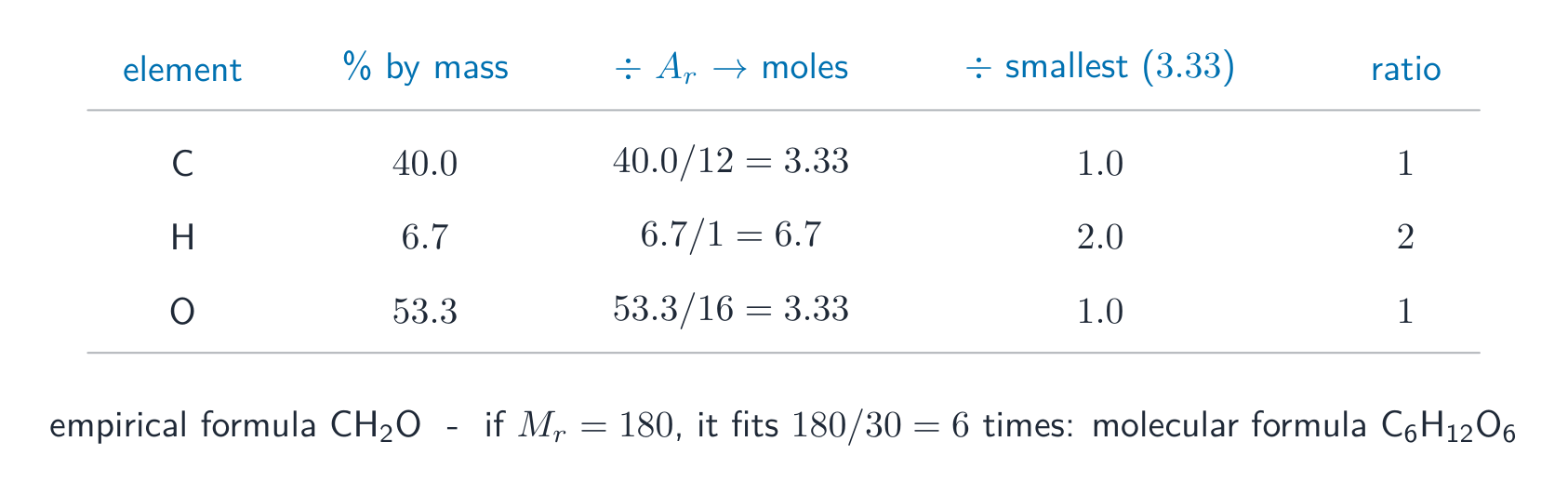
Worked example. A compound is $40.0\%$ carbon, $6.7\%$ hydrogen and $53.3\%$ oxygen by mass. Find its empirical formula. ($A_r$: C $= 12$, H $= 1$, O $= 16$.)
Take $100\ \text{g}$ and divide each mass by its $A_r$ to get moles: C $= 40.0/12 = 3.33$, H $= 6.7/1 = 6.7$, O $= 53.3/16 = 3.33$. Dividing through by the smallest ($3.33$) gives a ratio C : H : O $= 1 : 2 : 1$, so the empirical formula is $\text{CH}_2\text{O}$.
Português
Um composto 化合物 é uma substância feita de dois ou mais elementos quimicamente ligados.
Cargas e fórmulas de compostos iônicos
Em um composto iônico 离子化合物, a carga positiva total equilibra a carga negativa total, resultando em neutralidade geral.
Você pode prever a carga de muitos íons a partir da posição do elemento na Tabela Periódica:
Grupo
1
2
13
15
16
17
Carga iônica usual
$+1$
$+2$
$+3$
$-3$
$-2$
$-1$
O hidrogênio forma $\text{H}^+$, e os gases nobres do Grupo 18 normalmente não formam íons.
Alguns íons que você precisa saber pelo nome e fórmula:
Nome
Fórmula
nitrato
$\text{NO}_3^{-}$
carbonato
$\text{CO}_3^{2-}$
sulfato
$\text{SO}_4^{2-}$
hidróxido
$\text{OH}^{-}$
amônio
$\text{NH}_4^{+}$
zinco
$\text{Zn}^{2+}$
prata
$\text{Ag}^{+}$
bicarbonato
$\text{HCO}_3^{-}$
fosfato
$\text{PO}_4^{3-}$
Para um metal que pode ter mais de uma carga, um numeral romano indica o número de oxidação 氧化数. Por exemplo, ferro(II) é $\text{Fe}^{2+}$ e ferro(III) é $\text{Fe}^{3+}$. Para escrever uma fórmula, equilibre as cargas: óxido de ferro(III) é $\text{Fe}_2\text{O}_3$, porque dois $\text{Fe}^{3+}$ equilibram três $\text{O}^{2-}$.
Equações e símbolos de estado
Uma equação química deve estar balanceada 配平 — o mesmo número de cada tipo de átomo em ambos os lados. Adicione símbolos de estado 状态符号 para mostrar o estado de cada espécie: (s) sólido, (l) líquido, (g) gás e (aq) aquoso 水溶液 (dissolvido em água).
Uma equação iônica 离子方程式 mostra apenas os íons e moléculas que realmente mudam. Os íons que não mudam são íons espectadores 旁观离子, e você os omite. Por exemplo, a reação que forma cloreto de prata é:
A fórmula empírica 实验式 é a proporção inteira mais simples de átomos de cada elemento em um composto. A fórmula molecular 分子式 mostra o número real de átomos de cada elemento em uma molécula.
Por exemplo, o etano tem fórmula empírica $\text{CH}_3$, mas fórmula molecular $\text{C}_2\text{H}_6$.
Sólidos hidratados e anidros
Alguns sólidos retêm água dentro de seus cristais. Essa água é a água de cristalização 结晶水. Um sólido que a contém é hidratado 水合; o mesmo sólido com a água removida é anidro 无水.
Por exemplo, o sulfato de cobre(II) hidratado é $\text{CuSO}_4 \cdot 5\text{H}_2\text{O}$. Ao aquecê-lo, a água é eliminada, deixando o anidro $\text{CuSO}_4$.
Calculando fórmulas empíricas e moleculares
Para encontrar a fórmula empírica a partir de massas (ou percentagens em massa):
divida a massa de cada elemento por sua $A_r$ para obter os mols.
divida todos os valores de mols pelo menor deles.
arredonde para os números inteiros mais próximos — essa razão é a fórmula empírica.
Para obter a fórmula molecular, você também precisa de $M_r$. Encontre quantas vezes a massa da fórmula empírica cabe em $M_r$, depois multiplique a fórmula por esse número.
Exemplo resolvido. Um composto é $40.0\%$ carbono, $6.7\%$ hidrogénio e $53.3\%$ oxigénio em massa. Encontre a sua fórmula empírica. ($A_r$: C $= 12$, H $= 1$, O $= 16$.)
Pegue $100\ \text{g}$ e divida cada massa pela sua $A_r$ para obter mols: C $= 40.0/12 = 3.33$, H $= 6.7/1 = 6.7$, O $= 53.3/16 = 3.33$. Dividindo tudo pelo menor ($3.33$), obtemos uma razão C : H : O $= 1 : 2 : 1$, então a fórmula empírica é $\text{CH}_2\text{O}$.
A receita da fórmula empírica: divida pela Ar, divida pelo menor, leia a razão
Explore · Explorar
Rota de balanceamento de equações
Siga os átomos através de uma equação química para que ambos os lados correspondam.
Reacting masses and volumes · Massas e volumes reagentes
Syllabus · Programa
English
perform calculations including use of the mole concept, involving: (a) reacting masses (from formulas and equations) including percentage yield calculations (b) volumes of gases (e.g. in the burning of hydrocarbons) (c) volumes and concentrations of solutions (d) limiting reagent and excess reagent (When performing calculations, candidates’ answers should reflect the number of significant figures given or asked for in the question. When rounding up or down, candidates should ensure that significant figures are neither lost unnecessarily nor used beyond what is justified (see also Mathematical requirements section).) (e) deduce stoichiometric relationships from calculations such as those in 2.4.1(a)–(d)
Português
realize cálculos incluindo o uso do conceito de mol, envolvendo: (a) massas de reação (a partir de fórmulas e equações), incluindo cálculos de rendimento percentual; (b) volumes de gases (ex.: na queima de hidrocarbonetos); (c) volumes e concentrações de soluções; (d) reagente limitante e reagente em excesso (Ao realizar cálculos, as respostas dos candidatos devem refletir o número de algarismos significativos fornecidos ou solicitados na questão. Ao arredondar para cima ou para baixo, os candidatos devem garantir que algarismos significativos não sejam desnecessariamente perdidos nem usados além do justificado (veja também a seção Requisitos Matemáticos).) (e) deduza relações estequiométricas a partir de cálculos como aqueles em 2.4.1(a)–(d)
Source: Cambridge International syllabus · Fonte: Programa Cambridge International
English
Reacting masses and percentage yield
The numbers in front of each species in a balanced equation give the mole ratio — this is the stoichiometry 化学计量. To find a reacting mass: change the known mass to moles, use the mole ratio to find the moles you want, then change back to mass.
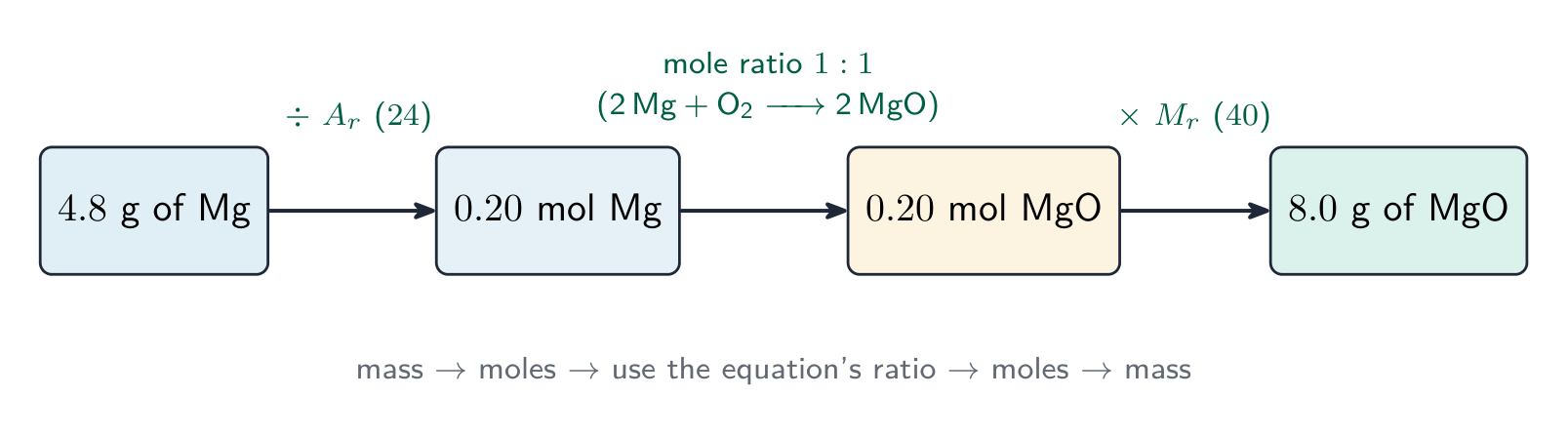
Worked example. What mass of magnesium oxide forms when $4.8\ \text{g}$ of magnesium burns completely? $2\text{Mg} + \text{O}_2 \rightarrow 2\text{MgO}$. ($A_r$: Mg $= 24$, O $= 16$.)
Moles of Mg $= 4.8/24 = 0.20\ \text{mol}$. The ratio Mg : MgO is $1 : 1$, so $0.20\ \text{mol}$ of MgO forms. Its molar mass is $24 + 16 = 40\ \text{g mol}^{-1}$, so
$$m = nM = 0.20 \times 40 = 8.0\ \text{g}.$$
In real reactions you usually get less product than the maximum. The percentage yield 产率 compares the amount you actually made with the most you could make:
$$\text{percentage yield} = \frac{\text{actual amount of product}}{\text{maximum possible amount}} \times 100\%$$
Limiting and excess reagent
When two reactants are mixed, one usually runs out first. The limiting reagent 限量试剂 is the one that runs out — it decides how much product forms. The other is the excess reagent 过量试剂, because there is more than enough of it. Always base the calculation on the limiting reagent.
To find it: work out the moles of each reactant, divide each by its number in the equation, and the smallest result is the limiting reagent.
Volumes of gases
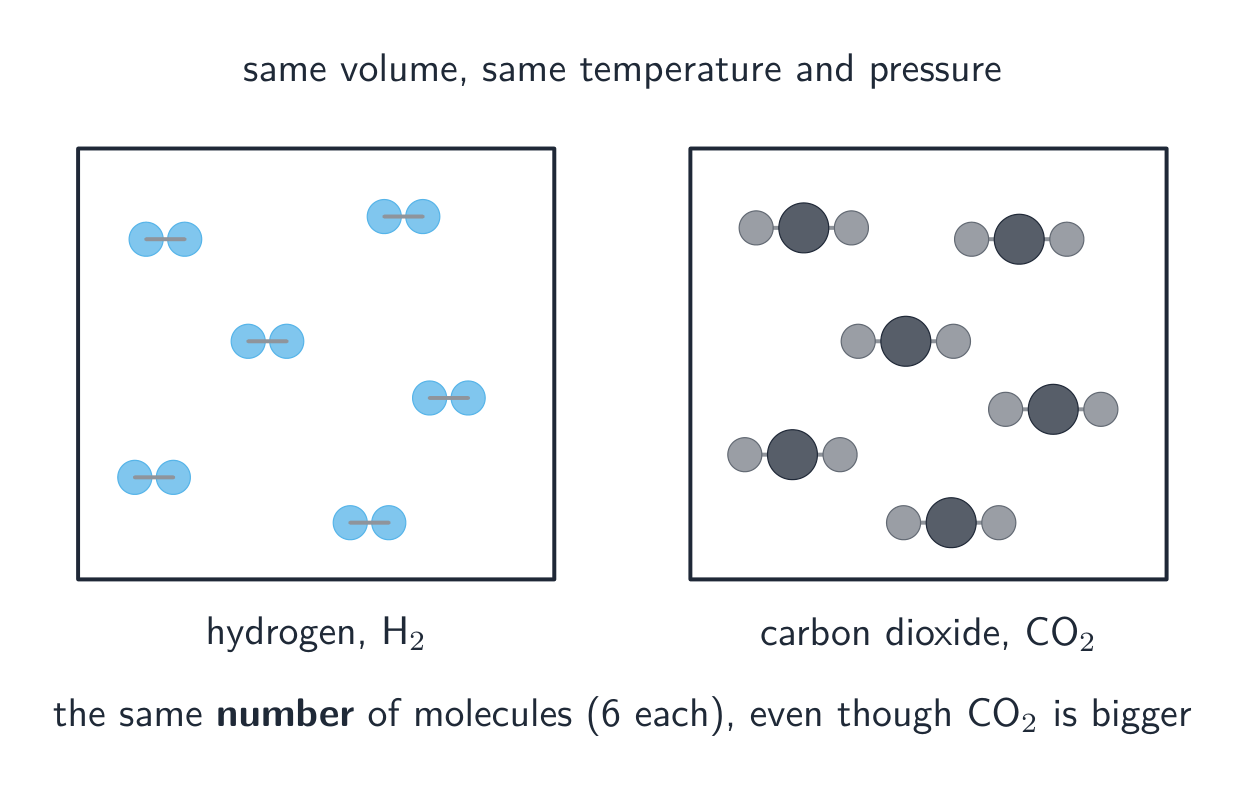
At the same temperature and pressure, equal volumes of any gases contain equal numbers of molecules. At room temperature and pressure (r.t.p.), one mole of any gas takes up $24.0\ \text{dm}^3$, so:
$$n = \frac{V}{24.0}\qquad (V \text{ in } \text{dm}^3 \text{ at r.t.p.})$$
This is used when burning hydrocarbons 碳氢化合物 (compounds of only carbon and hydrogen), where you compare gas volumes.
Volumes and concentrations of solutions
The concentration 浓度 of a solution is the amount of solute 溶质 in each cubic decimetre of solution 溶液, measured in $\text{mol dm}^{-3}$:
$$n = c \times V$$
where $c$ is the concentration and $V$ is the volume in $\text{dm}^3$. Remember that $1000\ \text{cm}^3 = 1\ \text{dm}^3$.
Worked example. In a titration, $25.0\ \text{cm}^3$ of sodium hydroxide solution is exactly neutralised by $20.0\ \text{cm}^3$ of $0.100\ \text{mol dm}^{-3}$ hydrochloric acid: $\text{NaOH} + \text{HCl} \rightarrow \text{NaCl} + \text{H}_2\text{O}$. Find the concentration of the sodium hydroxide.
Moles of HCl $= cV = 0.100 \times \dfrac{20.0}{1000} = 2.00 \times 10^{-3}\ \text{mol}$. The ratio is $1 : 1$, so there are $2.00 \times 10^{-3}\ \text{mol}$ of NaOH in $25.0\ \text{cm}^3$:
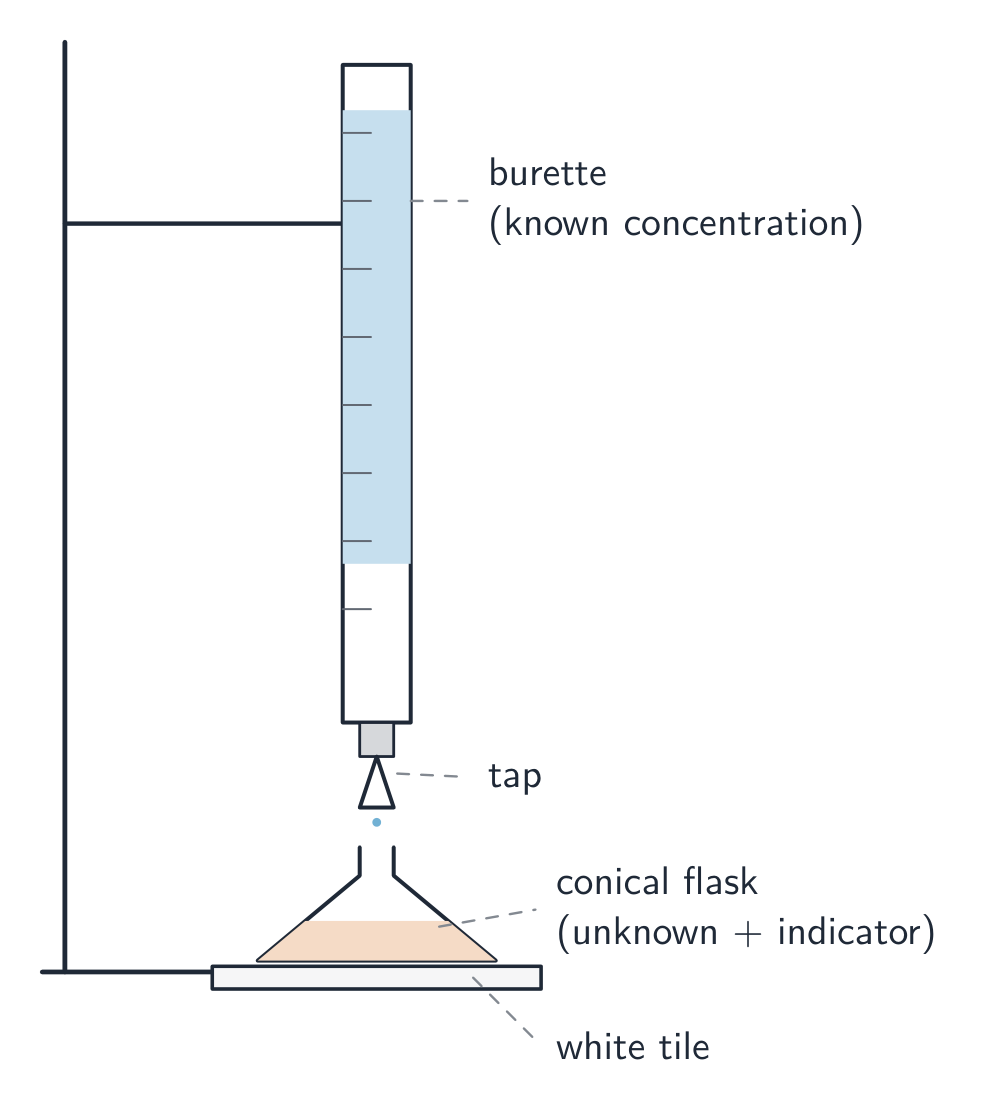
This is the basis of a titration 滴定, where you find an unknown concentration by reacting it with a solution whose concentration you already know.
Significant figures
Give your answer to a sensible number of significant figures 有效数字 — usually match the data in the question. Do not write more digits than the data supports, and do not round so early that you lose accuracy.
Português
Uma titração encontra volumes reagentes com precisão.
Massas reagentes e rendimento percentual
Os números à frente de cada espécie em uma equação balanceada fornecem a razão molar — esta é a estequiometria 化学计量. Para encontrar uma massa reagente: converta a massa conhecida em mols, use a razão molar para encontrar os mols desejados, depois converta novamente para massa.
Exemplo resolvido. Que massa de óxido de magnésio se forma quando $4.8\ \text{g}$ de magnésio queima completamente? $2\text{Mg} + \text{O}_2 \rightarrow 2\text{MgO}$. ($A_r$: Mg $= 24$, O $= 16$.)
Mols de Mg $= 4.8/24 = 0.20\ \text{mol}$. A razão Mg : MgO é $1 : 1$, então $0.20\ \text{mol}$ de MgO se forma. Sua massa molar é $24 + 16 = 40\ \text{g mol}^{-1}$, logo
$$m = nM = 0.20 \times 40 = 8.0\ \text{g}.$$
A ponte molar: massa para mols, razão, depois de volta para massa
Em reações reais, geralmente se obtém menos produto do que o máximo. O rendimento percentual 产率 compara a quantidade que você realmente produziu com a máxima possível:
$$\text{percentage yield} = \frac{\text{actual amount of product}}{\text{maximum possible amount}} \times 100\%$$
Agente limitante e reagente em excesso
Quando dois reagentes são misturados, um geralmente acaba primeiro. O agente limitante 限量试剂 é aquele que acaba — ele determina quanto produto se forma. O outro é o agente em excesso 过量试剂, pois há mais do que suficiente dele. Baseie sempre o cálculo no agente limitante.
Para identificá-lo: calcule os mols de cada reagente, divida cada um pelo seu número na equação, e o menor resultado será o agente limitante.
O agente limitante acaba primeiro e determina quanto produto se forma; o reagente restante está em excesso
Volumes de gases
Na mesma temperatura e pressão, volumes iguais de qualquer gás contêm iguais números de moléculas. Na temperatura e pressão ambiente (r.t.p.), um mol de qualquer gás ocupa $24.0\ \text{dm}^3$, portanto:
$$n = \frac{V}{24.0}\qquad (V \text{ in } \text{dm}^3 \text{ at r.t.p.})$$
Volumes iguais de gases na mesma temperatura e pressão contêm iguais números de moléculas, independentemente do gás
Isso é usado ao queimar hidrocarbonetos 碳氢化合物 (compostos apenas de carbono e hidrogênio), onde se comparam volumes gasosos.
Volumes e concentrações de soluções
A concentração 浓度 de uma solução é a quantidade de soluto 溶ute em cada decímetro cúbico de solução 溶液, medida em $\text{mol dm}^{-3}$:
$$n = c \times V$$
onde $c$ é a concentração e $V$ é o volume em $\text{dm}^3$. Lembre-se de que $1000\ \text{cm}^3 = 1\ \text{dm}^3$.
Exemplo resolvido. Em uma titração, $25.0\ \text{cm}^3$ de solução de hidróxido de sódio é neutralizado exatamente por $20.0\ \text{cm}^3$ de ácido clorídrico $0.100\ \text{mol dm}^{-3}$: $\text{NaOH} + \text{HCl} \rightarrow \text{NaCl} + \text{H}_2\text{O}$. Encontre a concentração do hidróxido de sódio.
Mols de HCl $= cV = 0.100 \times \dfrac{20.0}{1000} = 2.00 \times 10^{-3}\ \text{mol}$. A razão é $1 : 1$, então há $2.00 \times 10^{-3}\ \text{mol}$ de NaOH em $25.0\ \text{cm}^3$:
Esta é a base de uma titulação 滴定, onde se encontra uma concentração desconhecida reagindo-a com uma solução cuja concentração já se conhece.
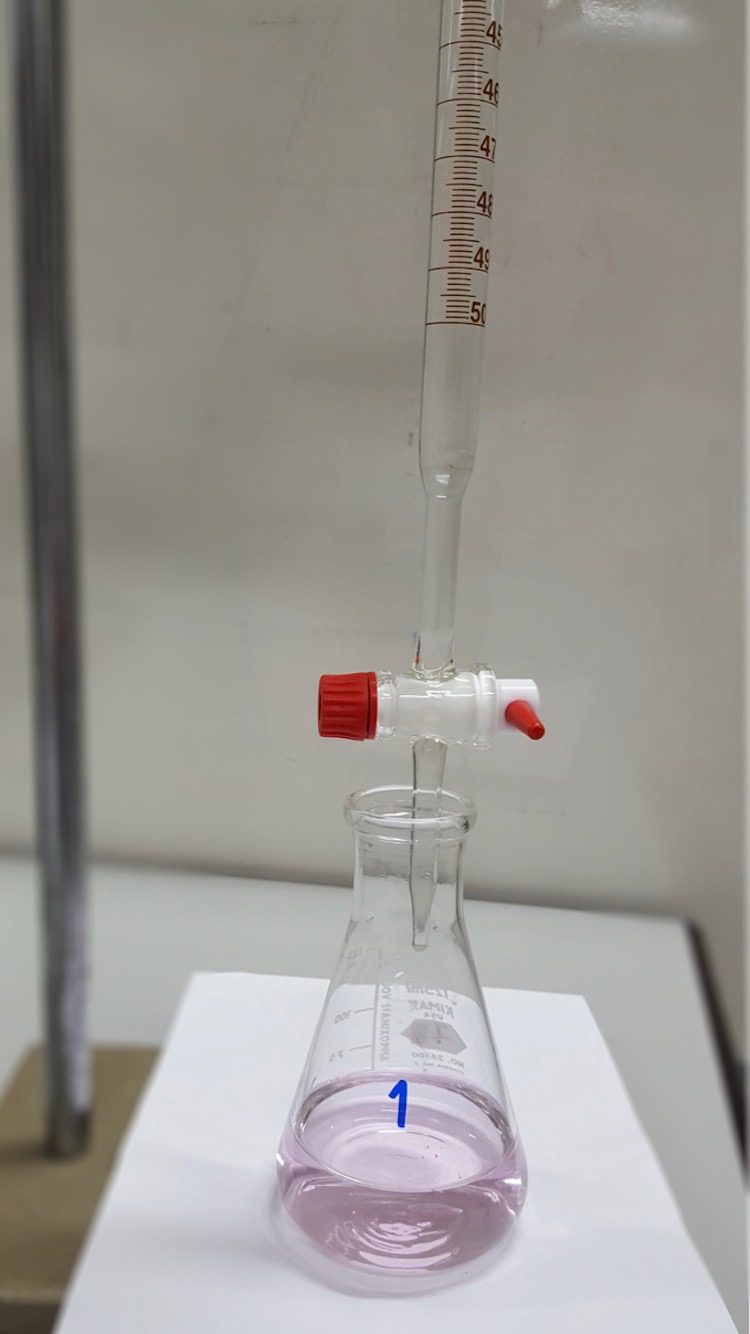
Em uma titração, uma bureta adiciona uma solução de concentração conhecida ao desconhecido no balão erlenmeyer, até a mudança do indicador
Algarismos significativos
Forneça sua resposta com um número sensato de algarismos significativos 有效数字 — geralmente corresponda aos dados da questão. Não escreva mais dígitos do que os dados suportam, nem arredonde tão cedo que perca precisão.
Explore · Explorar
Rota de massa reagida
Siga uma equação balanceada a partir da massa conhecida até a massa de produto prevista.
Explore · Explorar
Laboratório de volume gasoso
n = V / 24 dm3
Mude o volume gasoso e veja os mols escalonarem em condições ambientes.
Convert volumes to $\text{dm}^3$before using concentration ($25.0\ \text{cm}^3 = 0.0250\ \text{dm}^3$); the missing $\div 1000$ is the most common titration error.
Use the balancing numbers as the mole ratio between species — never the $M_r$ values.
Empirical formula: divide each mass/percentage by $A_r$, then by the smallest, then scale to whole numbers; use $M_r$ to reach the molecular formula.
For gases at r.t.p. use $\text{volume} = \text{moles} \times 24\ \text{dm}^3$; quote the equation you use every time.
Give the answer to the same significant figures as the data (usually 3) and always include units.
Português
Converta volumes para $\text{dm}^3$antes de usar a concentração ($25.0\ \text{cm}^3 = 0.0250\ \text{dm}^3$); a falta de $\div 1000$ é o erro de titração mais comum.
Use os números de balanceamento como a razão molar entre espécies — nunca os valores $M_r$.
Fórmula empírica: divida cada massa/porcentagem por $A_r$, depois pelo menor, depois escale para números inteiros; use $M_r$ para alcançar a fórmula molecular.
Para gases à r.t.p., use $\text{volume} = \text{moles} \times 24\ \text{dm}^3$; cite a equação que usa toda vez.
Dê a resposta com os mesmos algarismos significativos dos dados (geralmente 3) e sempre inclua unidades.
Interactive lessons on this topic · Aulas interativas sobre este tópico
Work through it step by step, with instant-check exercises. · Passe por ele passo a passo, com exercícios de verificação instantânea.
Pick one and the site follows you — notes, papers, videos and practice all open on it. · Escolha uma e o site te seguirá — notas, provas, vídeos e prática abrirão nela.
Type to search notes, lessons, code, vocabulary and past-paper questions across every subject. · Digite para pesquisar notas, aulas, código, vocabulário e questões de provas anteriores em todas as disciplinas.