Skip to content · ⁨Pular para o conteúdo⁩

Grupo 2

Química do A-Level · Topic 27 · ⁨Tópico 27⁩

Train · ⁨Treinar⁩
Video lesson for this topic · ⁨Videoaula para este tópico⁩ Open the video page · ⁨Abrir a página do vídeo⁩
8:06

Grupo 2 (A2)

Aqui está um enigma. Desça pelo Grupo 2, do magnésio ao bário, e os hidróxidos tornam-se mais solúveis. Desça o mesmo grupo, e os sulfatos tornam-se menos solúveis.…

English narration · English + 中文 subtitles burned in · ⁨Narração em inglês · Legendas em inglês + 中文 gravadas⁩

27.1

Thermal stability of the nitrates and carbonates · ⁨Estabilidade térmica dos nitratos e carbonatos⁩

Syllabus · ⁨Programa⁩
English
  1. describe and explain qualitatively the trend in the thermal stability of the nitrates and carbonates including the effect of ionic radius on the polarisation of the large anion
  2. describe and explain qualitatively the variation in solubility and of enthalpy change of solution, $\Delta H^{\ominus}_{\text{sol}}$, of the hydroxides and sulfates in terms of relative magnitudes of the enthalpy change of hydration and the lattice energy
Português
  1. descrever e explicar qualitativamente a tendência na estabilidade térmica dos nitratos e carbonatos, incluindo o efeito do raio iônico sobre a polarização do grande ânion
  2. descrever e explicar qualitativamente a variação na solubilidade e na variação de entalpia de solução, $\Delta H^{\ominus}_{\text{sol}}$, dos hidróxidos e sulfatos em termos das magnitudes relativas da variação de entalpia de hidratação e da energia reticular
Source: Cambridge International syllabus · ⁨Fonte: Programa Cambridge International⁩

English

The thermal stability 热稳定性 of the Group 2 nitrates 硝酸盐 and carbonates 碳酸盐 increases down the group. Here is the reason, in terms of how the ions affect each other.

A small cation 阳离子 with a small ionic radius 离子半径 has a high charge density. It pulls on the electrons of the nearby anion and distorts its shape — this is polarisation 极化. Distorting the large anion 阴离子 (the carbonate or nitrate ion) weakens a bond inside it, so the compound breaks down more easily.

Going down the group, the cation gets larger. Its charge density drops, so it polarises the anion less. The anion is less distorted, so the compound is harder to break down — it is more thermally stable and needs a higher temperature to decompose.

Worked example. Down Group 2 the hydroxides become more soluble while the sulfates become less soluble. Explain why the two trends run in opposite directions. Solubility is a contest between the lattice energy holding the solid together and the hydration energy rewarding the ions for dissolving. Both get less exothermic as the cation grows, so whichever falls faster decides the trend. With the small hydroxide ion, the lattice energy depends strongly on the cation's size, so it falls faster than the hydration energy: the lattice gets relatively easier to break and solubility rises. With the large sulfate ion, the lattice energy is already dominated by that big anion and barely changes down the group, while the cation's hydration energy still falls - so solubility falls. Name both energies and say which one falls faster; simply restating the trends earns no explanation marks.

Português

A estabilidade térmica 热稳定性 dos nitratos 硝酸盐 e carbonatos 碳酸盐 do Grupo 2 aumenta ao descer no grupo. Aqui está a razão, em termos de como os íons afetam uns aos outros.

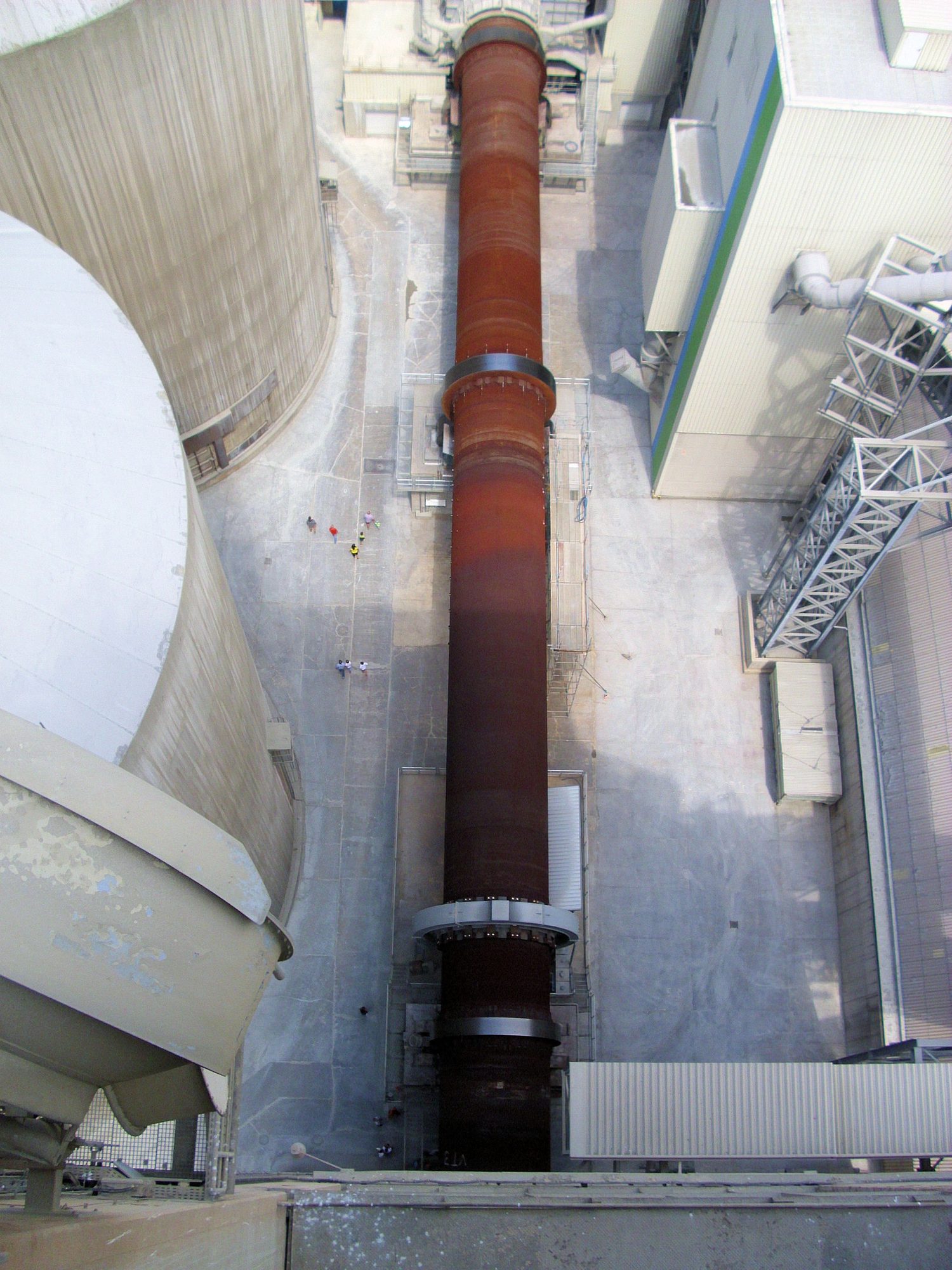
Forno rotativo em uma fábrica de cal
Aquecer pedra calcária (carbonato de cálcio) em um forno decompon-o em óxido de cálcio — uma decomposição térmica

Um ** cátion** 阳离子 pequeno com raio iônico 离子半径 pequeno tem alta densidade de carga. Ele atrai os elétrons do ânion vizinho e distorce sua forma — isso é polarização 极化. Distorcer o grande ânion 阴ião (o íon carbonato ou nitrato) enfraquece uma ligação interna, fazendo com que o composto se decomponha mais facilmente.

Ao descer no grupo, o cátion fica maior. Sua densidade de carga diminui, polarizando o ânion menos. O ânion é menos distorcido, tornando o composto mais difícil de quebrar — é mais termicamente estável e requer temperatura mais alta para decompor.

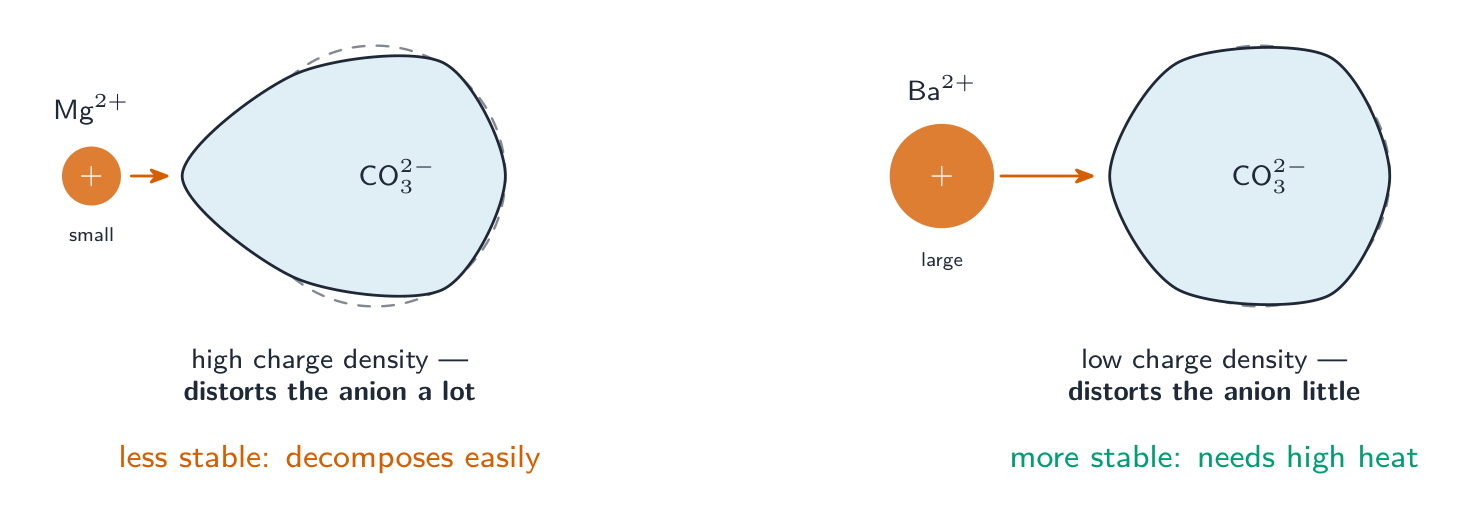
Dois cenários: um cátion magnésio pequeno distorce fortemente a nuvem eletrônica do ânion carbonato em formato de gota, enquanto um cátion bário grande quase não o distorce
Um cátion pequeno tem alta densidade de carga, distorcendo (polarizando) mais o grande ânion — enfraquecendo-o, logo o composto é menos estável

Exemplo resolvido. Ao descer no Grupo 2, os hidróxidos tornam-se mais solúveis enquanto os sulfatos tornam-se menos solúveis. Explique por que as duas tendências correm em direções opostas. A solubilidade é uma disputa entre a energia reticular mantendo o sólido unido e a energia de hidratação recompensando os íons pela dissolução. Ambas ficam menos exotérmicas à medida que o cátion cresce, então qual delas cai mais rápido decide a tendência. Com o íon pequeno hidróxido, a energia reticular depende fortemente do tamanho do cátion, caindo mais rápido que a energia de hidratação: a rede torna-se relativamente mais fácil de quebrar e a solubilidade aumenta. Com o íon grande sulfato, a energia reticular já é dominada por esse grande ânion e mal muda ao descer no grupo, enquanto a energia de hidratação do cátion ainda cai — logo a solubilidade diminui. Nome ambas as energias e diga qual cai mais rapidamente; simplesmente repetir as tendências não garante pontos de explicação.

Explore · ⁨Explorar⁩

Escada de estabilidade térmica do Grupo 2

Desça pelo Grupo 2 e veja por que os carbonatos tornam-se mais difíceis de decompor.

Explore · ⁨Explorar⁩

Laboratório de solubilidade do Grupo 2

Classifique os compostos do Grupo 2 pela tendência de solubilidade.

Vocabulary · ⁨Vocabulário⁩ Train · ⁨Treinar⁩
English · ⁨Inglês⁩ Chinese · ⁨Chinês⁩ Pinyin
thermal stability/ˈθɜːml stəˈbɪlɪti/ 热稳定性 rè wěn dìng xìng
nitrate/ˈnaɪtreɪt/ 硝酸盐 xiāo suān yán
carbonate/ˈkɑːbəneɪt/ 碳酸盐 tàn suān yán
cation/ˈkætaɪən/ 阳离子 yáng lí zi
ionic radius/aɪˈɒnɪk ˈreɪdɪəs/ 离子半径 lí zi bàn jìng
polarisation/ˌpəʊləraɪˈzeɪʃn/ 极化 jí huà
anion/ˈænaɪən/ 阴离子 yīn lí zi
enthalpy change of solution/enˈθælpi tʃeɪndʒ ɒv səˈluːʃn/ 溶解焓变 róng jiě hán biàn
lattice energy/ˈlætɪs ˈenədʒi/ 晶格能 jīng gé néng
enthalpy change of hydration/enˈθælpi tʃeɪndʒ ɒv haɪˈdreɪʃn/ 水合焓变 shuǐ hé hán biàn
27.1

Solubility of the hydroxides and sulfates · ⁨Solubilidade dos hidróxidos e sulfatos⁩

English

When an ionic solid dissolves, two energy changes compete. The enthalpy change of solution 溶解焓变 is the sum of them:

$$\Delta H^{\ominus}_{\text{sol}} = -\Delta H_{\text{latt}} + \Delta H_{\text{hyd}}$$
  • you must first pull the lattice apart (this needs the lattice energy 晶格能).
  • then water surrounds the ions (this releases the enthalpy change of hydration 水合焓变).

If the energy released on hydration roughly matches (or beats) the energy needed to break the lattice, the solid dissolves easily.

Going down the group, both the lattice energy and the hydration enthalpy get smaller (less negative), because the cation is larger. But they shrink at different rates, and this explains the opposite trends:

Compound Trend in solubility 溶解度 down the group Why
hydroxides 氢氧化物 increases the $\text{OH}^-$ ion is small, so the lattice energy falls a lot down the group; this change outweighs the fall in hydration energy
sulfates 硫酸盐 decreases the $\text{SO}_4^{2-}$ ion is large, so the lattice energy stays almost the same; the fall in hydration energy then dominates, so dissolving becomes less favourable
Português

Quando um sólido iônico se dissolve, duas mudanças energéticas competem. A entalpia de solução 溶解焓变 é a soma delas:

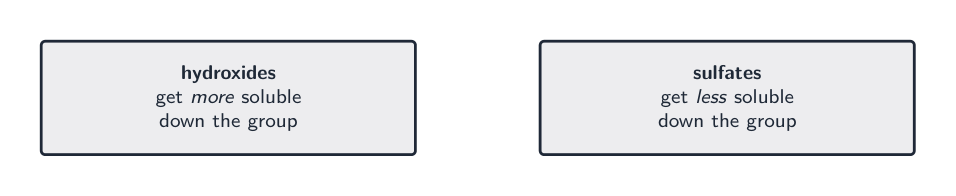
Ao descer no Grupo 2, os hidróxidos tornam-se mais solúveis mas os sulfatos tornam-se menos solúveis
Descendo no Grupo 2, os hidróxidos tornam-se mais solúveis, mas os sulfatos menos
$$\Delta H^{\ominus}_{\text{sol}} = -\Delta H_{\text{latt}} + \Delta H_{\text{hyd}}$$
  • você primeiro precisa separar a rede (isso exige a energia reticular 晶格能).
  • depois a água circunda os íons (isso libera a entalpia de hidratação 水合焓变).

Se a energia liberada na hidratação corresponde aproximadamente (ou supera) a energia necessária para quebrar a rede, o sólido dissolve-se facilmente.

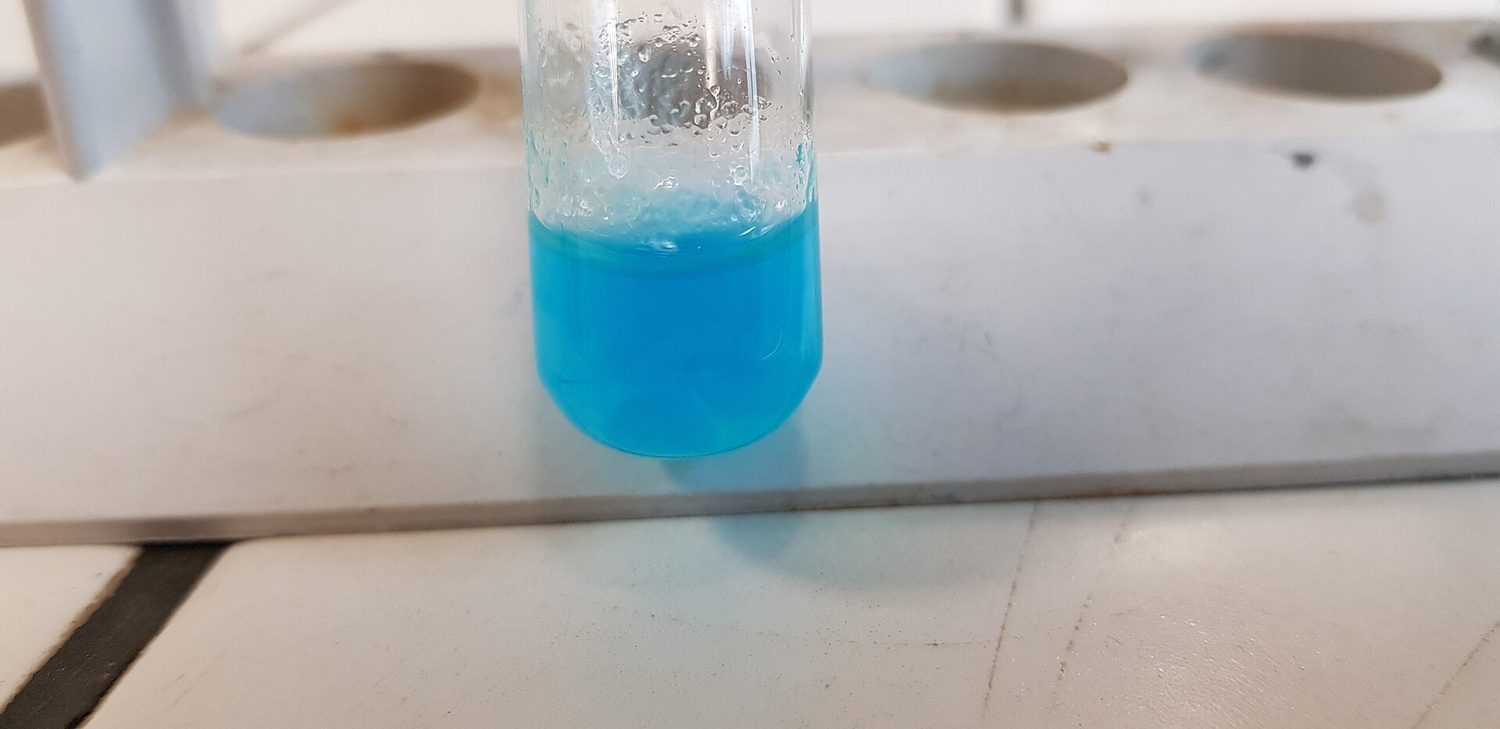
Um precipitado gelatinoso azul-pálido de hidróxido de cobre(II)
Um hidróxido metálico insolúvel forma-se como precipitado gelatinoso quando sua energia reticular é muito grande para ser compensada pela hidratação

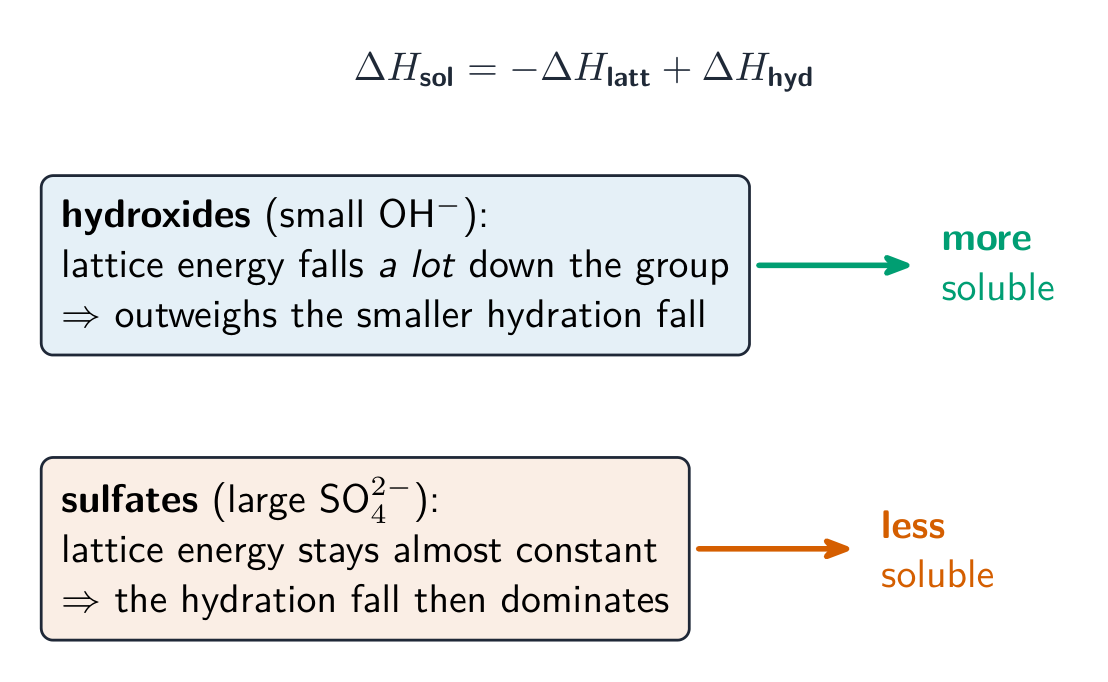
Ao descer no grupo, tanto a energia reticular quanto a entalpia de hidratação ficam menores (menos negativas), porque o cátion é maior. Mas elas diminuem em taxas diferentes, e isso explica as tendências opostas:

Dois quadros contrastando hidróxidos e sulfatos: para hidróxidos a energia reticular cai muito, para sulfatos permanece constante, dando tendências de solubilidade opostas
Por que as tendências são opostas: a energia reticular pequena OH$^-$ cai muito ao descer no grupo (hidróxidos dissolvem mais), mas a energia reticular grande SO$_4^{2-}$ mal muda (sulfatos dissolvem menos)
Compósito Tendência de solubilidade 溶解度 ao descer no grupo Por quê
hidróxidos 氢氧化物 aumenta o íon $\text{OH}^-$ é pequeno, logo a energia reticular cai muito ao descer no grupo; essa mudança supera a queda na energia de hidratação
sulfatos 硫酸盐 diminui o íon $\text{SO}_4^{2-}$ é grande, logo a energia reticular permanece quase a mesma; a queda na energia de hidratação então domina, tornando a dissolução menos favorável
Vocabulary · ⁨Vocabulário⁩ Train · ⁨Treinar⁩
English · ⁨Inglês⁩ Chinese · ⁨Chinês⁩ Pinyin
solubility/ˌsɒljuːˈbɪlɪti/ 溶解度 róng jiě dù
hydroxide/haɪˈdrɒksaɪd/ 氢氧化物 qīng yǎng huà wù
sulfate/ˈsʌlfeɪt/ 硫酸盐 liú suān yán
27.1

Exam tips · ⁨Dicas de prova⁩

English
  • Thermal stability of carbonates and nitrates increases down the group — larger cations polarise the anion less.
  • Give the decomposition products: carbonates → oxide + $\text{CO}_2$; nitrates → oxide + $\text{NO}_2$ + $\text{O}_2$ (brown gas).
  • Hydroxides get more soluble and sulfates less soluble down the group.
  • Explain trends with cation charge density (polarising power), not just size.
Português
  • A estabilidade térmica de carbonatos e nitratos aumenta ao descer no grupo — cátions maiores polarizam o ânion menos.
  • Forneça os produtos de decomposição: carbonatos → óxido + $\text{CO}_2$; nitratos → óxido + $\text{NO}_2$ + $\text{O}_2$ (gás marrom).
  • Hidróxidos tornam-se mais solúveis e sulfatos menos solúveis ao descer no grupo.
  • Explique as tendências usando a densidade de carga do cátion (poder polarizante), não apenas o tamanho.

Interactive lessons on this topic · ⁨Aulas interativas sobre este tópico⁩

Work through it step by step, with instant-check exercises. · ⁨Passe por ele passo a passo, com exercícios de verificação instantânea.⁩

Past Papers · ⁨Provas Anteriores⁩

More topics in Química do A-Level · ⁨Mais tópicos em Química do A-Level⁩

Log in or create account · ⁨Entrar ou criar conta⁩

IGCSE, A-Level & AP