English
- recall the reactions (reagents and conditions) by which halogenoalkanes can be produced: (a) the free-radical substitution of alkanes by $\text{Cl}_2$ or $\text{Br}_2$ in the presence of ultraviolet light, as exemplified by the reactions of ethane (b) electrophilic addition of an alkene with a halogen, $\text{X}_2$, or hydrogen halide, $\text{HX(g)}$, at room temperature (c) substitution of an alcohol, e.g. by reaction with $\text{HX(g)}$; or with $\text{KCl}$ and concentrated $\text{H}_2\text{SO}_4$ or concentrated $\text{H}_3\text{PO}_4$; or with $\text{PCl}_3$ and heat; or with $\text{PCl}_5$; or with $\text{SOCl}_2$
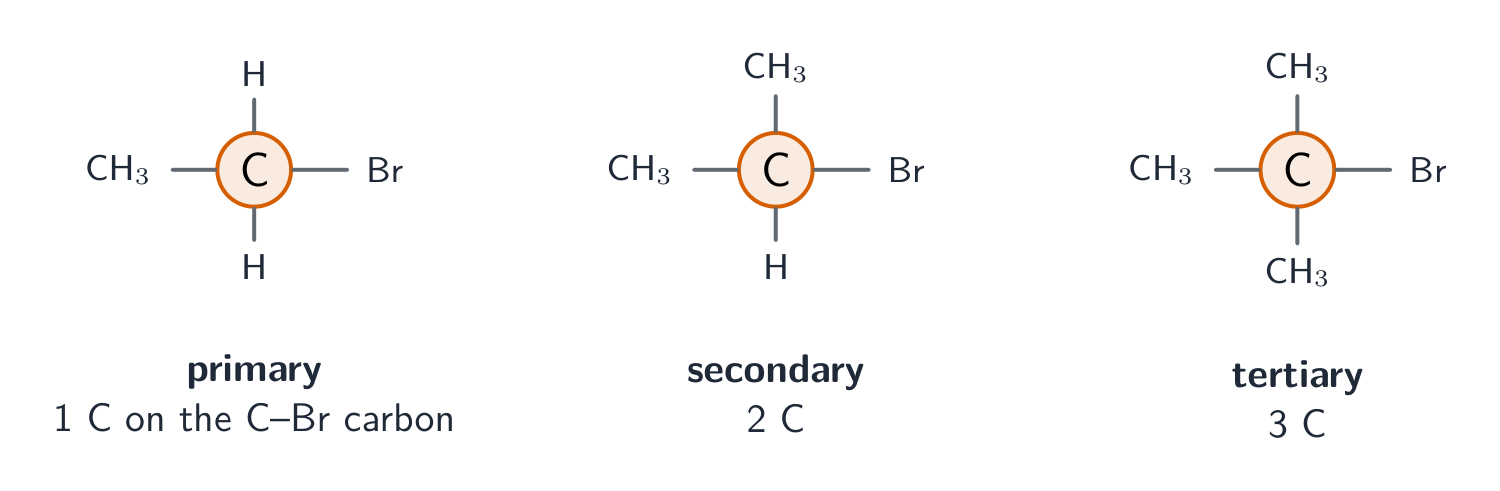
- classify halogenoalkanes into primary, secondary and tertiary
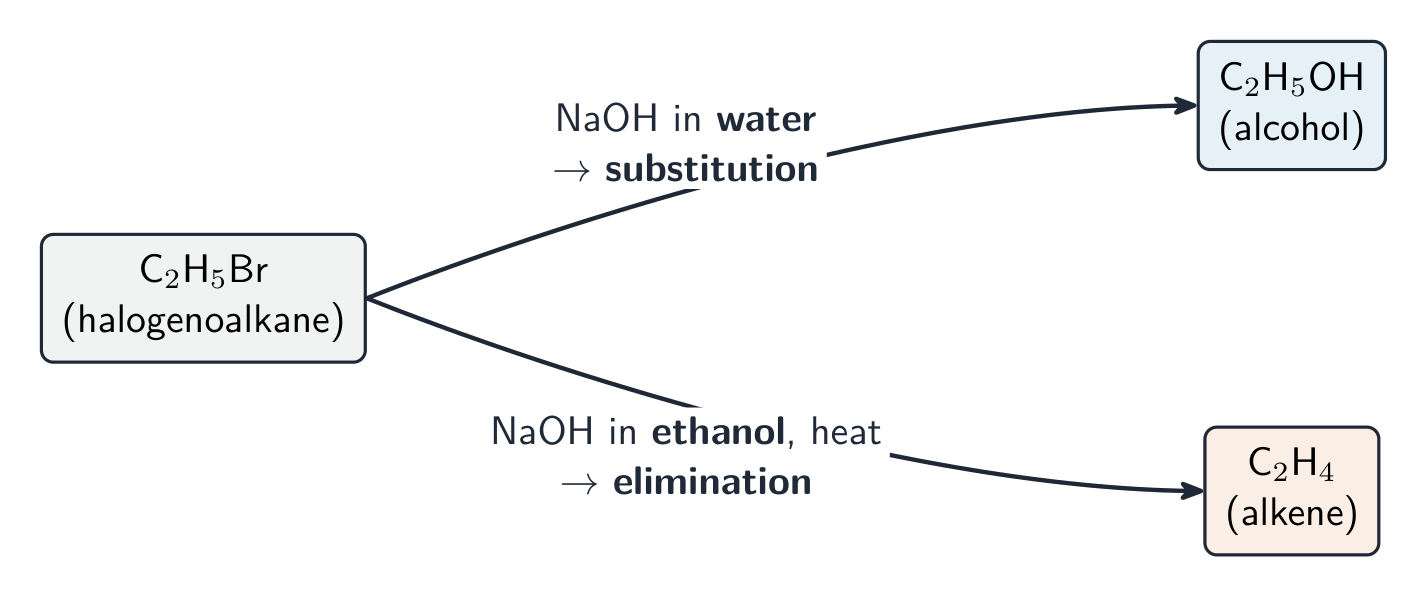
- describe the following nucleophilic substitution reactions: (a) the reaction with $\text{NaOH(aq)}$ and heat to produce an alcohol (b) the reaction with $\text{KCN}$ in ethanol and heat to produce a nitrile (c) the reaction with $\text{NH}_3$ in ethanol heated under pressure to produce an amine (d) the reaction with aqueous silver nitrate in ethanol as a method of identifying the halogen present as exemplified by bromoethane
- describe the elimination reaction with $\text{NaOH}$ in ethanol and heat to produce an alkene as exemplified by bromoethane
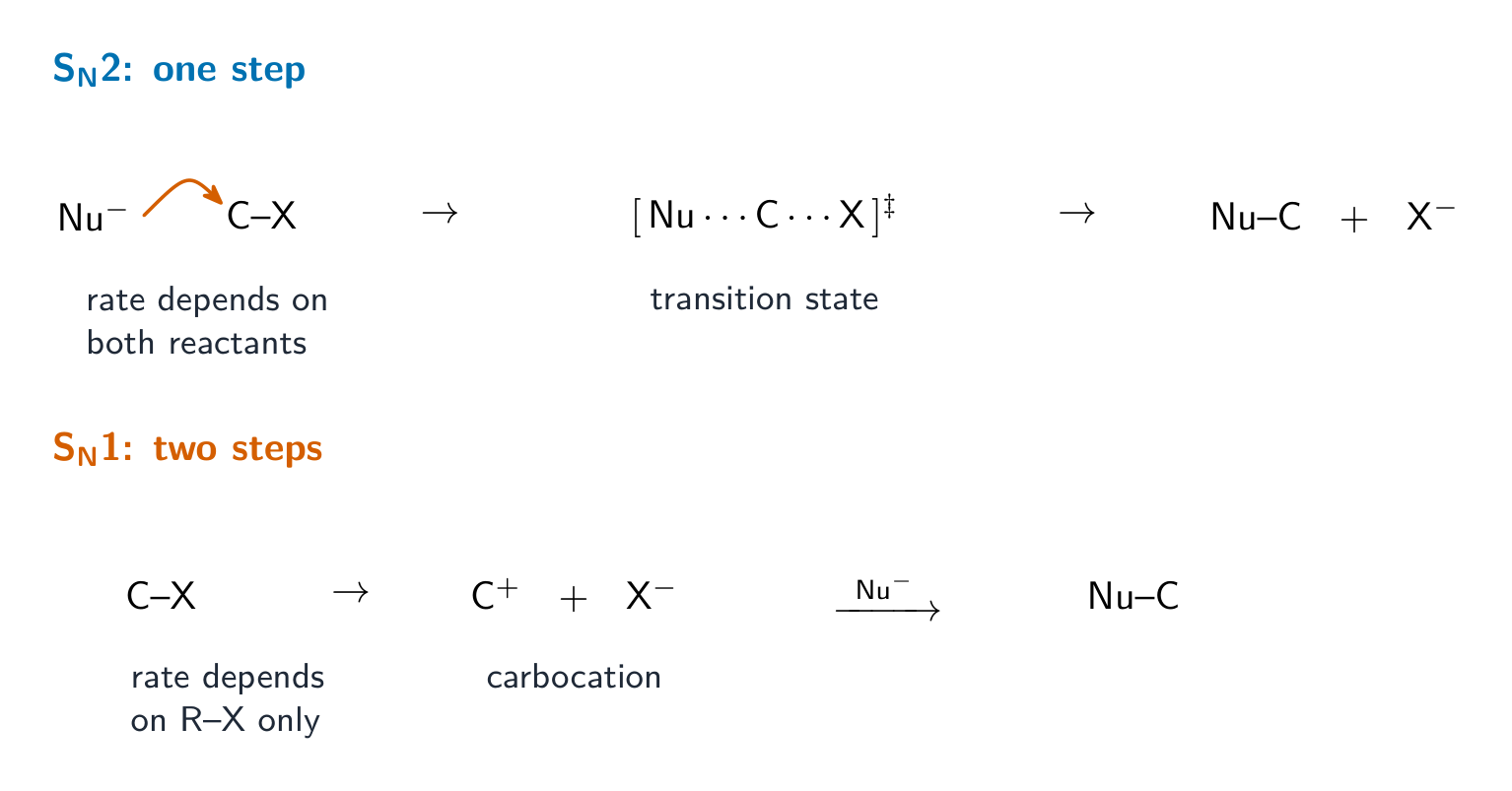
- describe the $\text{S}_\text{N}1$ and $\text{S}_\text{N}2$ mechanisms of nucleophilic substitution in halogenoalkanes including the inductive effects of alkyl groups
- recall that primary halogenoalkanes tend to react via the $\text{S}_\text{N}2$ mechanism; tertiary halogenoalkanes via the $\text{S}_\text{N}1$ mechanism; and secondary halogenoalkanes by a mixture of the two, depending on structure
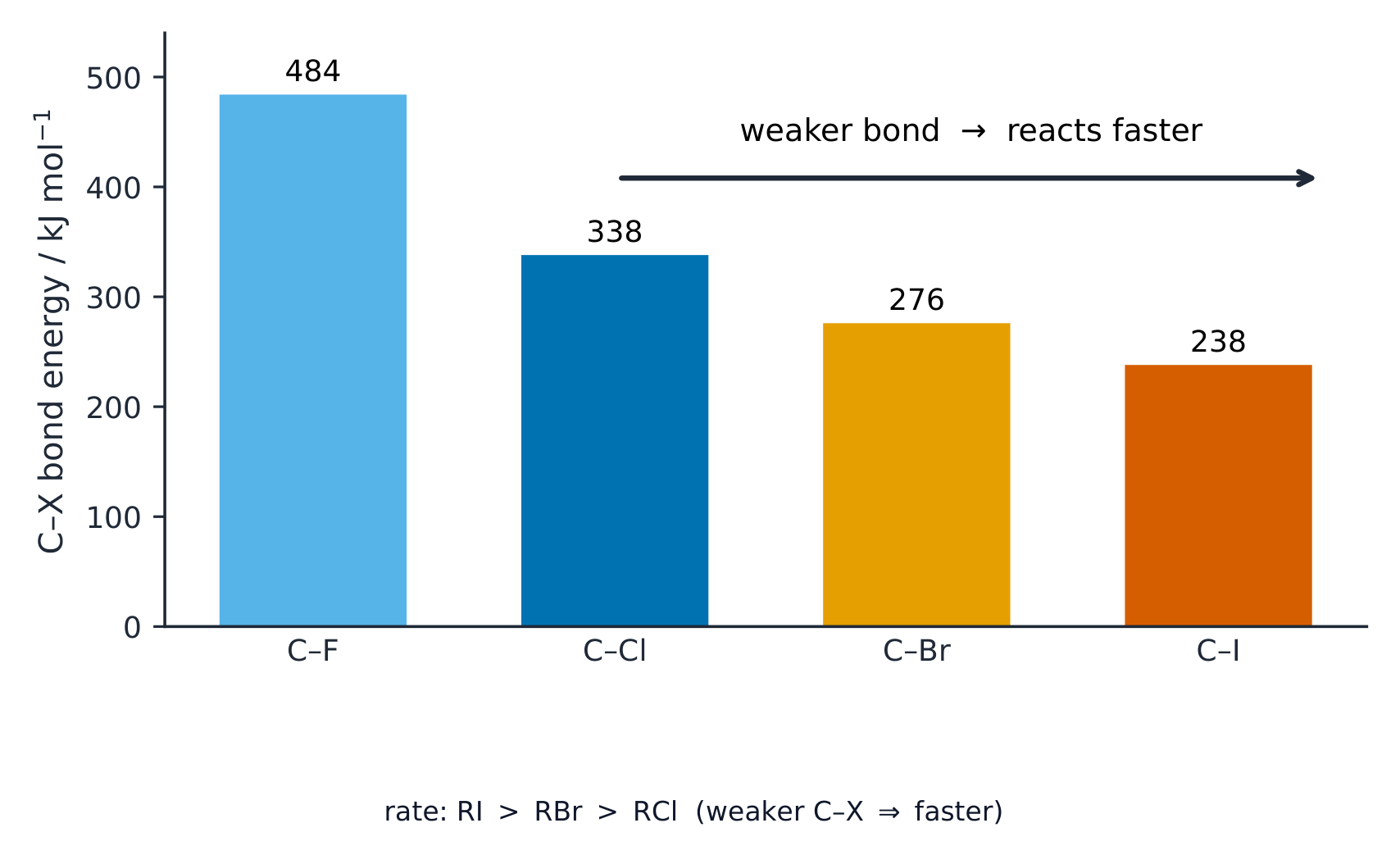
- describe and explain the different reactivities of halogenoalkanes (with particular reference to the relative strengths of the C–X bonds as exemplified by the reactions of halogenoalkanes with aqueous silver nitrates)
Português
- relembre as reações (reagentes e condições) pelas quais haloalcanos podem ser produzidos: (a) a substituição por radicais livres de alcanos por $\text{Cl}_2$ ou $\text{Br}_2$ na presença de luz ultravioleta, exemplificada pelas reações do etano; (b) adição eletrofílica de um alceno com um halogênio, $\text{X}_2$, ou haleto de hidrogênio, $\text{HX(g)}$, à temperatura ambiente; (c) substituição de um álcool, ex.: pela reação com $\text{HX(g)}$; ou com $\text{KCl}$ e concentrado $\text{H}_2\text{SO}_4$ ou concentrado $\text{H}_3\text{PO}_4$; ou com $\text{PCl}_3$ e calor; ou com $\text{PCl}_5$; ou com $\text{SOCl}_2$
- classifique haloalcanos em primários, secundários e terciários
- descreva as seguintes reações de substituição nucleofílica: (a) a reação com $\text{NaOH(aq)}$ e calor para produzir um álcool; (b) a reação com $\text{KCN}$ em etanol e calor para produzir um nitrila; (c) a reação com $\text{NH}_3$ em etanol aquecido sob pressão para produzir uma amina; (d) a reação com nitrato de prata aquoso em etanol como método para identificar o halogênio presente, exemplificado pelo bromoetano
- descreva a reação de eliminação com $\text{NaOH}$ em etanol e calor para produzir um alceno, exemplificado pelo bromoetano
- descreva os mecanismos $\text{S}_\text{N}1$ e $\text{S}_\text{N}2$ de substituição nucleofílica em haloalcanos, incluindo os efeitos indutivos dos grupos alquila
- relembre que haloalcanos primários tendem a reagir via mecanismo $\text{S}_\text{N}2$; haloalcanos terciários via mecanismo $\text{S}_\text{N}1$; e haloalcanos secundários por uma mistura dos dois, dependendo da estrutura
- descreva e explique as diferentes reatividades dos haloalcanos (com referência particular às forças relativas das ligações C–X, exemplificadas pelas reações de haloalcanos com nitratos de prata aquosos)