Aqui estão três soluções incolores. Elas parecem exatamente iguais. Uma é cloreto, uma é brometo, uma é iodeto — mas você não pode dizer qual é qual por…
English narration · English + 中文 subtitles burned in · Narração em inglês · Legendas em inglês + 中文 gravadas
11.1
Physical properties of the halogens · Propriedades físicas dos halogéneos
Syllabus · Programa
English
describe the colours and the trend in volatility of chlorine, bromine and iodine
describe and explain the trend in the bond strength of the halogen molecules
interpret the volatility of the elements in terms of instantaneous dipole–induced dipole forces
Português
descrever as cores e a tendência de volatilidade do cloro, bromo e iodo
descrever e explicar a tendência na força da ligação das moléculas dos halogênios
interpretar a volatilidade dos elementos em termos de forças dipolo instantâneo-dipolo induzido
Source: Cambridge International syllabus · Fonte: Programa Cambridge International
English
The halogens 卤素 are the Group 族 17 elements. They exist as diatomic molecules ($\text{Cl}_2$, $\text{Br}_2$, $\text{I}_2$). Going down the group:
Element
Colour and state at room temperature
chlorine
pale green gas
bromine
red-brown liquid
iodine
grey-black solid (purple vapour)
The volatility 挥发性 (how easily a substance turns to vapour) decreases down the group: chlorine is a gas, but iodine is a solid. This is because the molecules get larger and have more electrons, so the instantaneous dipole 瞬时偶极 and induced dipole 诱导偶极 forces between them get stronger. Stronger forces are harder to break, so the boiling point rises and volatility falls.
The bond energy 键能 (bond strength) of the $\text{X}\text{–}\text{X}$ molecules generally falls from $\text{Cl}_2$ to $\text{I}_2$, because the shared electrons are further from the nuclei in the larger atoms.
Português
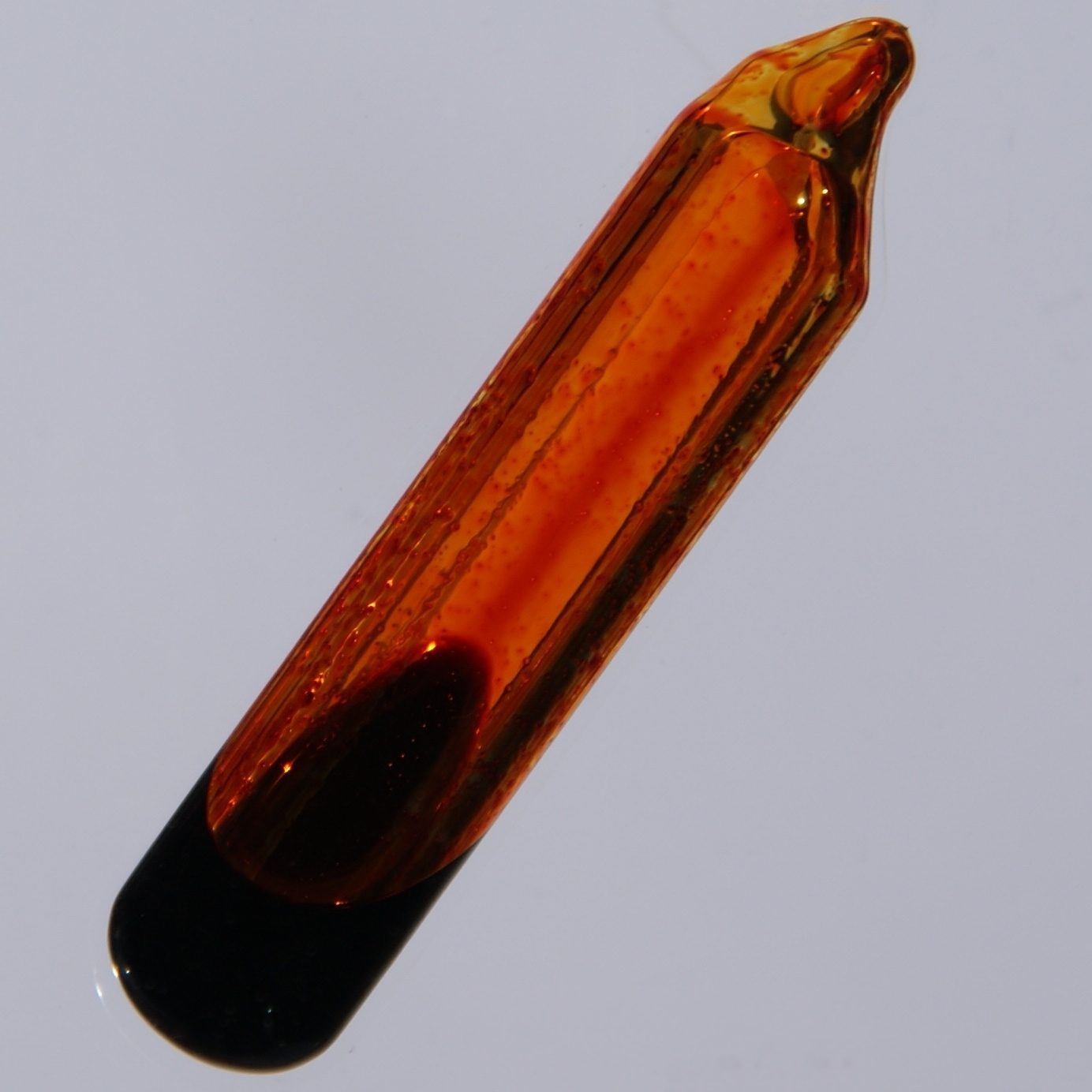
O bromo é um halogénio do Grupo 17 — um líquido escuro que emite um vapor laranja.
Os halogéneos 卤素 são os elementos do Grupo 族 17. Eles existem como moléculas diatómicas ($\text{Cl}_2$, $\text{Br}_2$, $\text{I}_2$). Descendo no grupo:
Elemento
Cor e estado à temperatura ambiente
cloro
gás verde-pálido
bromo
líquido vermelho-marrom
iodo
sólido cinzento-negro (vapor roxo)
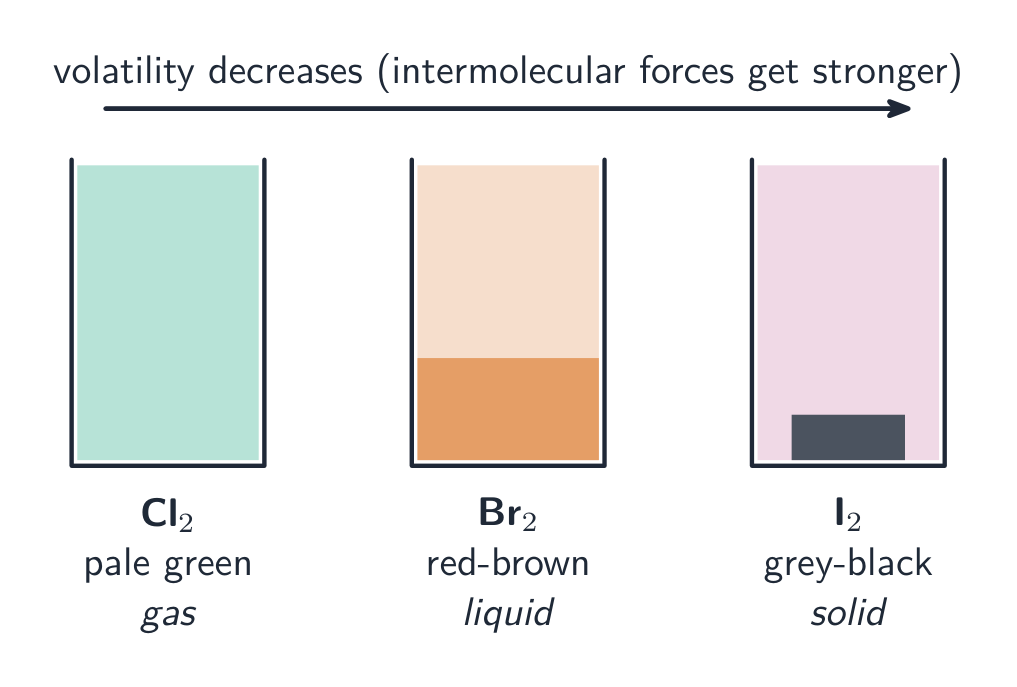
A volatilidade 挥发性 (facilidade com que uma substância se transforma em vapor) diminui descendo no grupo: o cloro é um gás, mas o iodo é um sólido. Isto ocorre porque as moléculas ficam maiores e têm mais eletrões, por isso as forças de dipolo instantâneo 瞬时偶极 e dipolo induzido 诱导偶ipo entre elas ficam mais fortes. Forças mais fortes são mais difíceis de romper, por isso o ponto de ebulição sobe e a volatilidade cai.
Descendo no Grupo 17, os halogéneos mudam de um gás verde-pálido para um líquido vermelho-marrom para um sólido cinzento-negro à medida que a volatilidade cai
A energia de ligação 键能 (força da ligação) das moléculas $\text{X}\text{–}\text{X}$ geralmente diminui de $\text{Cl}_2$ para $\text{I}_2$, porque os elétrons compartilhados estão mais afastados dos núcleos nos átomos maiores.
Explore · Explorar
Laboratório: tendência física dos halogênios
Siga os halogênios descendo no grupo e relacione estado, cor e volatilidade.
Chemical properties of the halogens and hydrogen halides · Propriedades químicas dos halogênios e dos haleto de hidrogênio
Syllabus · Programa
English
describe the relative reactivity of the elements as oxidising agents
describe the reactions of the elements with hydrogen and explain their relative reactivity in these reactions
describe the relative thermal stabilities of the hydrogen halides and explain these in terms of bond strengths
Português
descrever a reatividade relativa dos elementos como agentes oxidantes
descrever as reações dos elementos com hidrogênio e explicar sua reatividade relativa nessas reações
descrever a reatividade relativa das estabilidades térmicas dos haletos de hidrogênio e explicá-las em termos de forças das ligações
Source: Cambridge International syllabus · Fonte: Programa Cambridge International
English
Halogens as oxidising agents
Each halogen reacts by gaining one electron to form a $1-$ ion, so it acts as an oxidising agent 氧化剂. This power decreases down the group, because the larger atoms attract an extra electron less strongly. A more reactive halogen can push out a less reactive one from its salt:
The reaction gets less vigorous down the group: chlorine reacts explosively in light, bromine needs heat, and iodine reacts slowly and only partly.
Thermal stability of the hydrogen halides
The thermal stability 热稳定性 of the hydrogen halides decreases down the group. The H–X bond gets weaker as the halogen atom gets larger, so HI breaks apart on gentle heating while HCl is very stable.
Português
Halogênios como agentes oxidantes
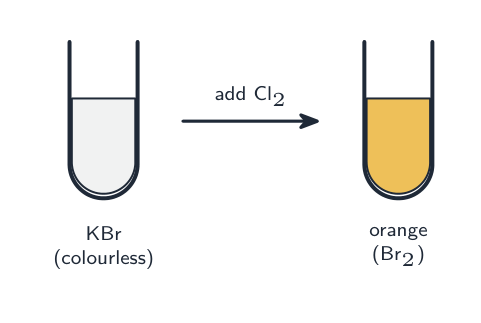
Cada halogênio reage ganhando um elétron para formar um íon $1-$, atuando assim como um agente oxidante 氧化剂. Esse poder diminui descendo no grupo, porque os átomos maiores atraem um elétron extra com menos intensidade. Um halogênio mais reativo pode deslocar um menos reativo de seu sal:
A reação fica menos vigorosa descendo no grupo: o cloro reage explosivamente na luz, o bromo precisa de calor e o iodo reage lentamente e apenas parcialmente.
Estabilidade térmica dos haletos de hidrogênio
A estabilidade térmica 热稳定性 dos haletos de hidrogênio diminui descendo no grupo. A ligação H–X enfraquece à medida que o átomo de halogênio aumenta, então o HI se decompõe com aquecimento suave, enquanto o HCl é muito estável.
Explore · Explorar
Laboratório: halogênios e haleto de hidrogênio
Classifique a química dos halogênios por força oxidante e redutora.
11.3
Reactions of the halide ions · Reações dos íons haleto
Syllabus · Programa
English
describe the relative reactivity of halide ions as reducing agents
describe and explain the reactions of halide ions with: (a) aqueous silver ions followed by aqueous ammonia (the formation and formula of the $[\text{Ag}(\text{NH}_3)_2]^+$ complex is not required) (b) concentrated sulfuric acid, to include balanced chemical equations
Português
descrever a reatividade relativa dos íons haleto como agentes redutores
descrever e explicar as reações dos íons haleto com: (a) íons prata aquosos seguidos de amônia aquosa (a formação e a fórmula do complexo $[\text{Ag}(\text{NH}_3)_2]^+$ não são necessárias) (b) ácido sulfúrico concentrado, incluindo equações químicas balanceadas
Source: Cambridge International syllabus · Fonte: Programa Cambridge International
English
Halide ions as reducing agents
A halide ion 卤离子 (such as $\text{Cl}^-$) can give away an electron, acting as a reducing agent 还原剂. This power increases down the group, because a larger ion holds its outer electron less tightly.
Reaction with aqueous silver ions
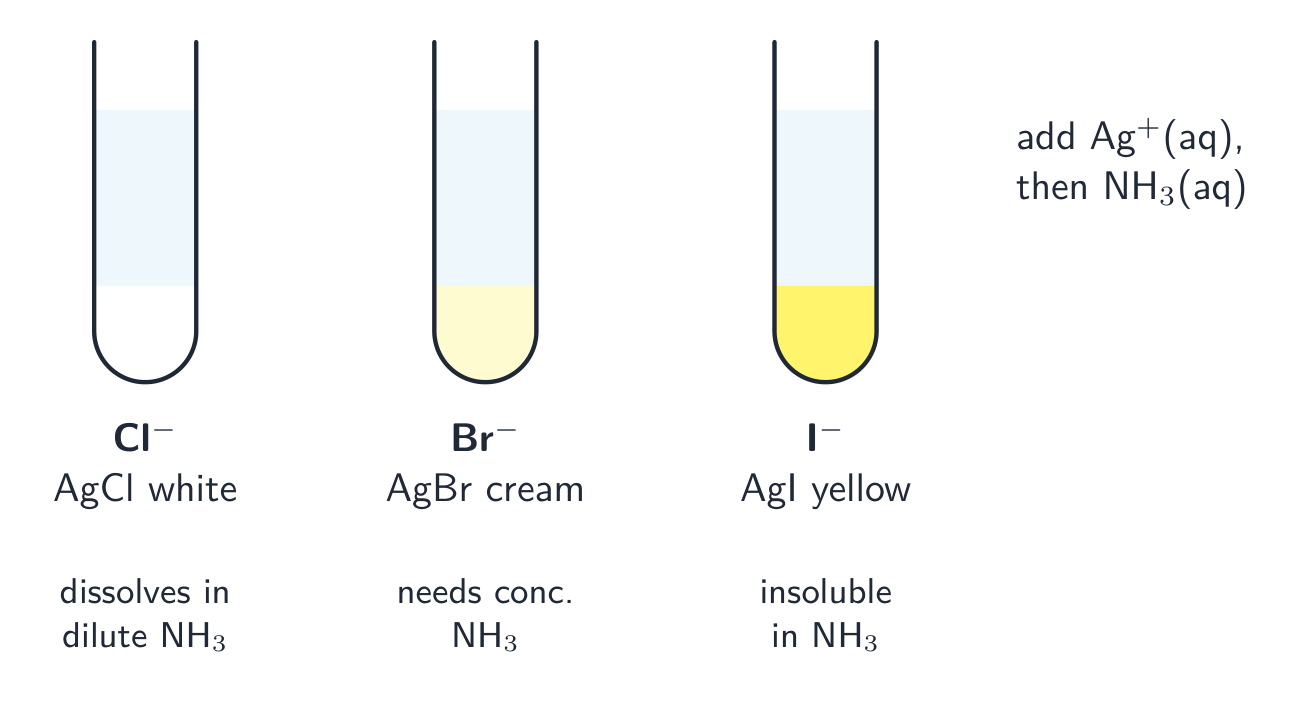
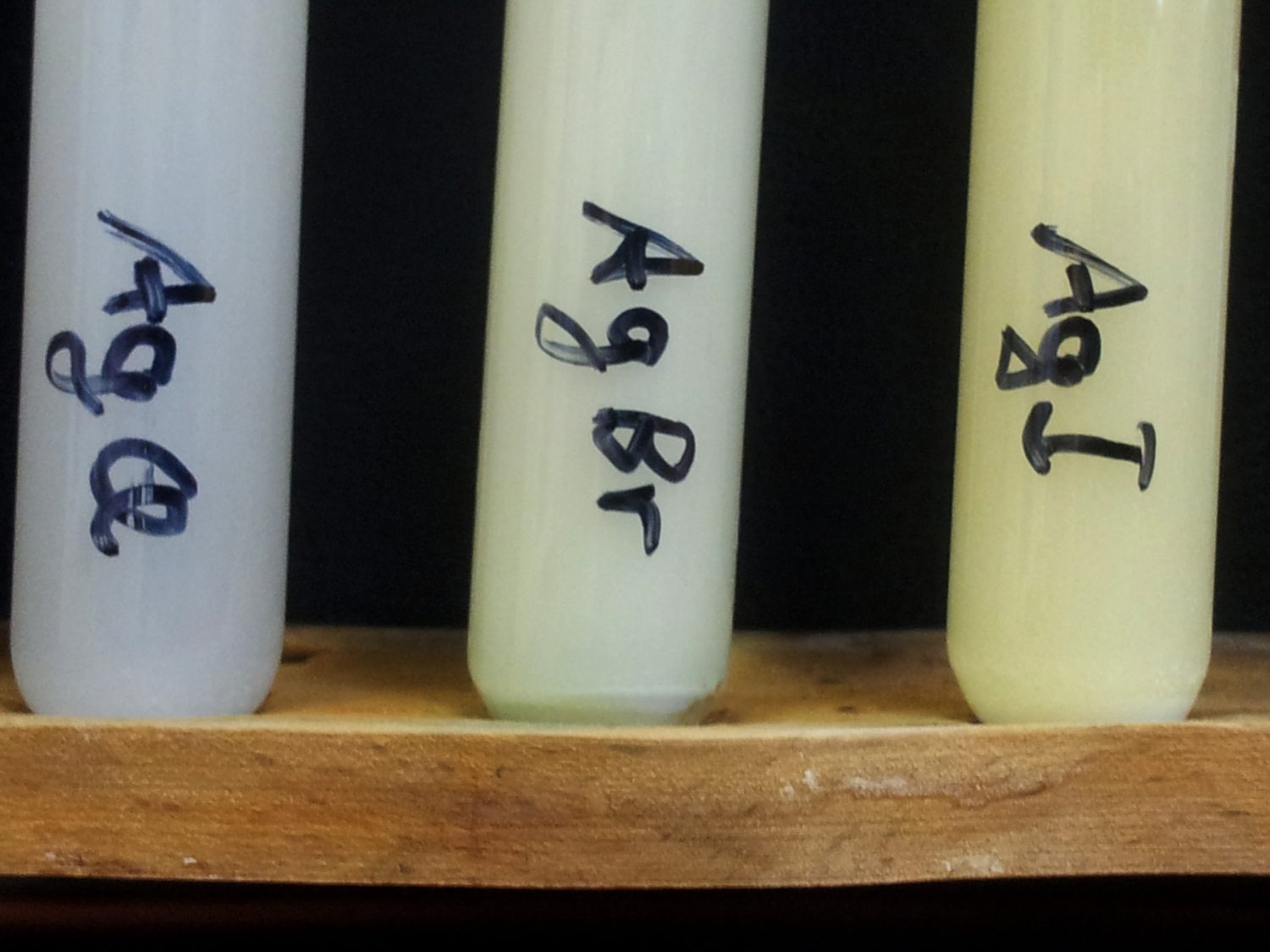
Add aqueous silver nitrate, then aqueous ammonia 氨, to identify the halide from the colour of the silver halide precipitate 沉淀:
Halide
Precipitate with $\text{Ag}^+$
Solubility in ammonia
$\text{Cl}^-$
white
dissolves in dilute ammonia
$\text{Br}^-$
cream
dissolves only in concentrated ammonia
$\text{I}^-$
yellow
insoluble in ammonia
Reaction with concentrated sulfuric acid
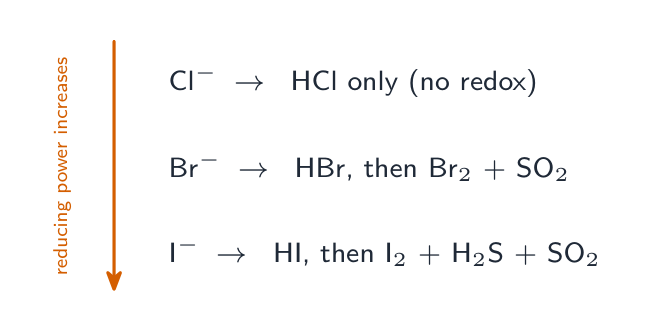
All the halides first give the hydrogen halide. The lower halides are then oxidised by the acid, because they are stronger reducing agents:
bromide also gives some brown $\text{Br}_2$ and $\text{SO}_2$.
iodide gives $\text{I}_2$ and the smelly gases $\text{H}_2\text{S}$ and $\text{SO}_2$, because $\text{I}^-$ is the strongest reducing agent.
Português
Íons haleto como agentes redutores
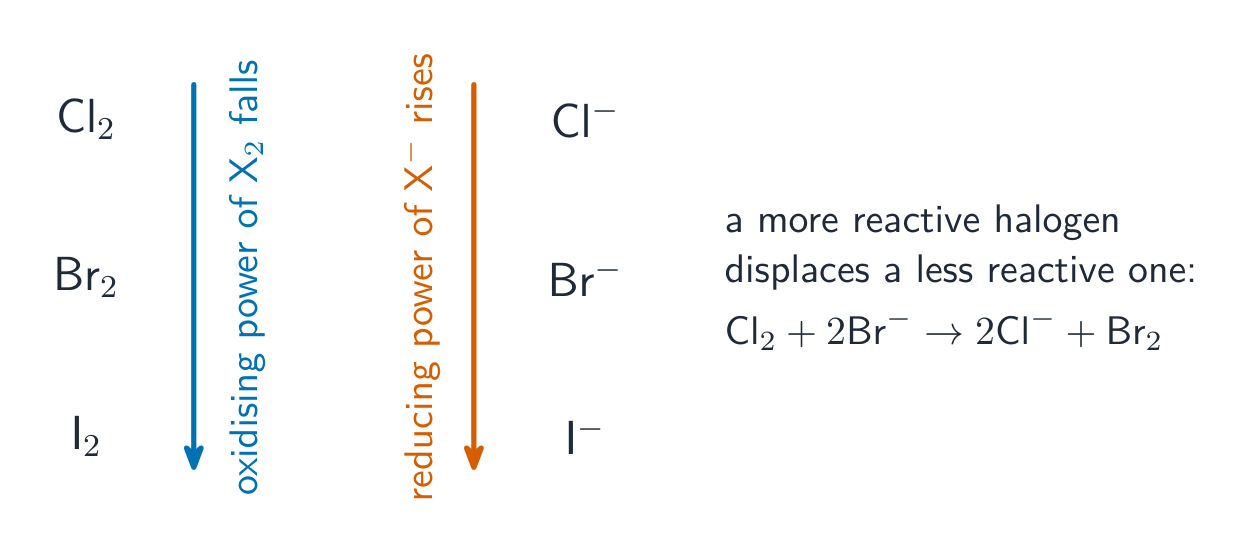
Um íon haleto 卤离子 (como $\text{Cl}^-$) pode ceder um elétron, atuando como um agente redutor 还原剂. Esse poder aumenta descendo no grupo, porque um íon maior segura seu elétron externo com menos firmeza.
Duas tendências opostas: o poder oxidante dos halogênios cai descendo no grupo, enquanto o poder redutor dos íons haleto sobe
Reação com íons prata aquosos
Adicione nitrato de prata aquoso, seguido de amônia 氨 aquosa, para identificar o haleto pela cor do precipitado 沉淀 de haleto de prata:
Haleto
Precipitado com $\text{Ag}^+$
Solubilidade em amônia
$\text{Cl}^-$
branco
dissolve em amônia diluída
$\text{Br}^-$
creme
dissolve apenas em amônia concentrada
$\text{I}^-$
amarelo
insolúvel em amônia
Precipitados de haletos de prata: AgCl é branco, AgBr creme e AgI amarelo — e sua solubilidade em amônia confirma qual haleto está presenteO teste de haletos de prata: AgCl é branco, AgBr creme e AgI amarelo
Reação com ácido sulfúrico concentrado
Todos os haletos primeiro produzem o haleto de hidrogênio. Os haletos inferiores são então oxidados pelo ácido, pois são agentes redutores mais fortes:
describe and interpret, in terms of changes in oxidation number, the reaction of chlorine with cold and with hot aqueous sodium hydroxide and recognise these as disproportionation reactions
explain, including by use of an equation, the use of chlorine in water purification to include the production of the active species $\text{HOCl}$ and $\text{ClO}^-$ which kill bacteria
Português
descrever e interpretar, em termos de mudanças no número de oxidação, a reação do cloro com hidróxido de sódio aquoso frio e quente, reconhecendo-as como reações de disproportionação
explicar, incluindo o uso de uma equação, o uso do cloro na purificação de água, incluindo a produção da espécie ativa $\text{HOCl}$ e $\text{ClO}^-$ que mata bactérias
Source: Cambridge International syllabus · Fonte: Programa Cambridge International
English
With sodium hydroxide
With cold, dilute sodium hydroxide, chlorine reacts to form chloride and chlorate(I):
The active species $\text{HOCl}$ and $\text{ClO}^-$ kill bacteria 细菌, making the water safe to drink.
Worked example. Solid $\text{NaCl}$, $\text{NaBr}$ and $\text{NaI}$ are each warmed with concentrated $\text{H}_2\text{SO}_4$. Predict the products. Reducing power increases down the group, so how far each halide reduces the sulfuric acid differs. $\text{Cl}^{-}$ is too weak to reduce it at all, so you get only steamy $\text{HCl}$ - an acid-base reaction. $\text{Br}^{-}$ reduces it a little: $\text{HBr}$ plus brown $\text{Br}_2$ and $\text{SO}_2$. $\text{I}^{-}$ is the strongest reducing agent: $\text{HI}$ plus $\text{I}_2$, and it drives the sulfur all the way down to $\text{H}_2\text{S}$, with its bad-egg smell. Every halide gives the hydrogen halide first; the extra products appear only where the halide is a strong enough reducing agent to attack the sulfur.
Português
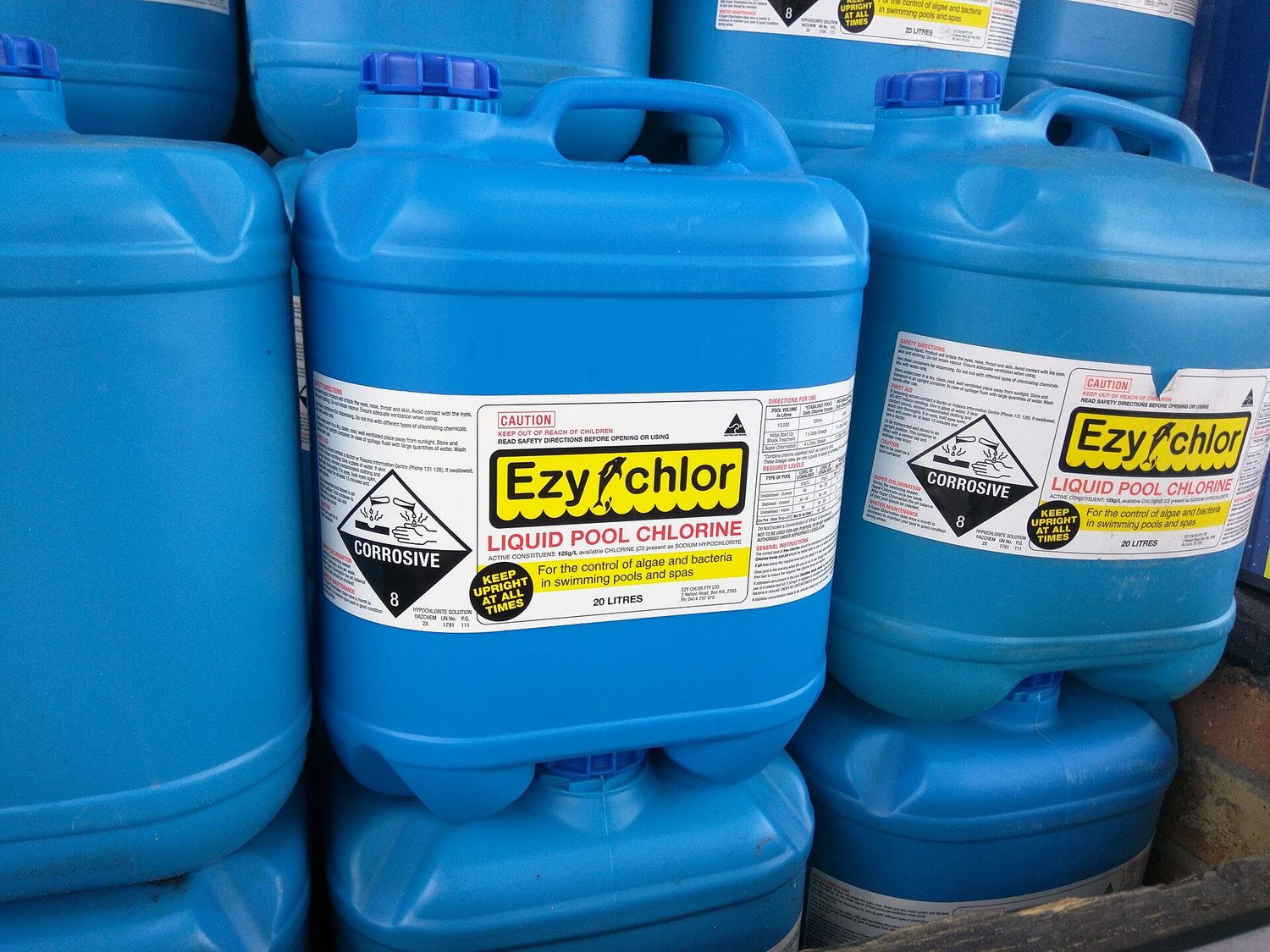
O cloro é adicionado à água da piscina para matar micróbios.
Com hidróxido de sódio
Com hidróxido de sódio frio e diluído, o cloro reage formando cloreto e clorato(I):
As espécies ativas $\text{HOCl}$ e $\text{ClO}^-$ matam bactérias 细菌, tornando a água segura para beber.
Exemplo resolvido. Os sólidos $\text{NaCl}$, $\text{NaBr}$ e $\text{NaI}$ são aquecidos separadamente com $\text{H}_2\text{SO}_4$ concentrado. Preveja os produtos. O poder redutor aumenta ao longo do grupo, portanto, o quanto cada haleto reduz o ácido sulfúrico varia. $\text{Cl}^{-}$ é fraco demais para reduzi-lo em absoluto, então você obtém apenas $\text{HCl}$ fumegante — uma reação ácido-base. $\text{Br}^{-}$ reduz um pouco: forma-se $\text{HBr}$ além de $\text{Br}_2$ marrom e $\text{SO}_2$. $\text{I}^{-}$ é o agente redutor mais forte: produz-se $\text{HI}$ e $\text{I}_2$, e ele leva o enxofre até o estado de oxidação $\text{H}_2\text{S}$, que tem cheiro de ovo podre. Todo haleto produz primeiro o haleto de hidrogênio; os produtos adicionais aparecem somente quando o haleto é um agente redutor forte o suficiente para atacar o enxofre.
Explore · Explorar
Rotação de reação do cloro
Siga o cloro desde o tratamento de água até reações redox.
11.4
Exam tips · Dicas de prova
English
Halogens get less reactive down the group (harder to gain an electron); oxidising power decreases.
Displacement: a more reactive halogen displaces a less reactive halide — state the colour change.
Test halide ions with $\text{AgNO}_3$: white ($\text{Cl}^-$), cream ($\text{Br}^-$), yellow ($\text{I}^-$), then confirm with dilute/concentrated ammonia.
Chlorine with water and with cold $\text{NaOH}$ are disproportionation — show the oxidation-number changes.
Português
Halogênios ficam menos reativos descendo no grupo (mais difícil ganhar um elétron); o poder oxidante diminui.
Deslocamento: um halogênio mais reativo desloca um haleto menos reativo — indique a mudança de cor.
Teste íons haleto com $\text{AgNO}_3$: branco ($\text{Cl}^-$), creme ($\text{Br}^-$), amarelo ($\text{I}^-$), depois confirme com amônia diluída/concentrada.
Cloro com água e com $\text{NaOH}$ frio são disproporcionamento — mostre as mudanças no número de oxidação.
Interactive lessons on this topic · Aulas interativas sobre este tópico
Work through it step by step, with instant-check exercises. · Passe por ele passo a passo, com exercícios de verificação instantânea.
Pick one and the site follows you — notes, papers, videos and practice all open on it. · Escolha uma e o site te seguirá — notas, provas, vídeos e prática abrirão nela.
Type to search notes, lessons, code, vocabulary and past-paper questions across every subject. · Digite para pesquisar notas, aulas, código, vocabulário e questões de provas anteriores em todas as disciplinas.