Antes de um raio-X estomacal, o paciente é solicitado a beber um líquido branco espesso. Ele está cheio de bário — e íons de bário são venenosos. Engolir um sal de bário solúvel…
English narration · English + 中文 subtitles burned in · Narração em inglês · Legendas em inglês + 中文 gravadas
10.1
The Group 2 metals · Metais do Grupo 2
Syllabus · Programa
English
describe, and write equations for, the reactions of the elements with oxygen, water and dilute hydrochloric and sulfuric acids
describe, and write equations for, the reactions of the oxides, hydroxides and carbonates with water and dilute hydrochloric and sulfuric acids
describe, and write equations for, the thermal decomposition of the nitrates and carbonates, to include the trend in thermal stabilities
describe, and make predictions from, the trends in physical and chemical properties of the elements involved in the reactions in 10.1.1 and the compounds involved in 10.1.2, 10.1.3 and 10.1.5
state the variation in the solubilities of the hydroxides and sulfates
Português
descrever, e escrever equações para, as reações dos elementos com oxigênio, água e ácidos clorídrico e sulfúrico diluídos
descrever, e escrever equações para, as reações dos óxidos, hidróxidos e carbonatos com água e ácidos clorídrico e sulfúrico diluídos
descrever, e escrever equações para, a decomposição térmica dos nitratos e carbonatos, incluindo a tendência nas estabilidades térmicas
descrever, e fazer previsões baseadas em, as tendências nas propriedades físicas e químicas dos elementos envolvidos nas reações em 10.1.1 e nos compostos envolvidos em 10.1.2, 10.1.3 e 10.1.5
afirmar a variação nas solubilidades dos hidróxidos e sulfatos
Source: Cambridge International syllabus · Fonte: Programa Cambridge International
English
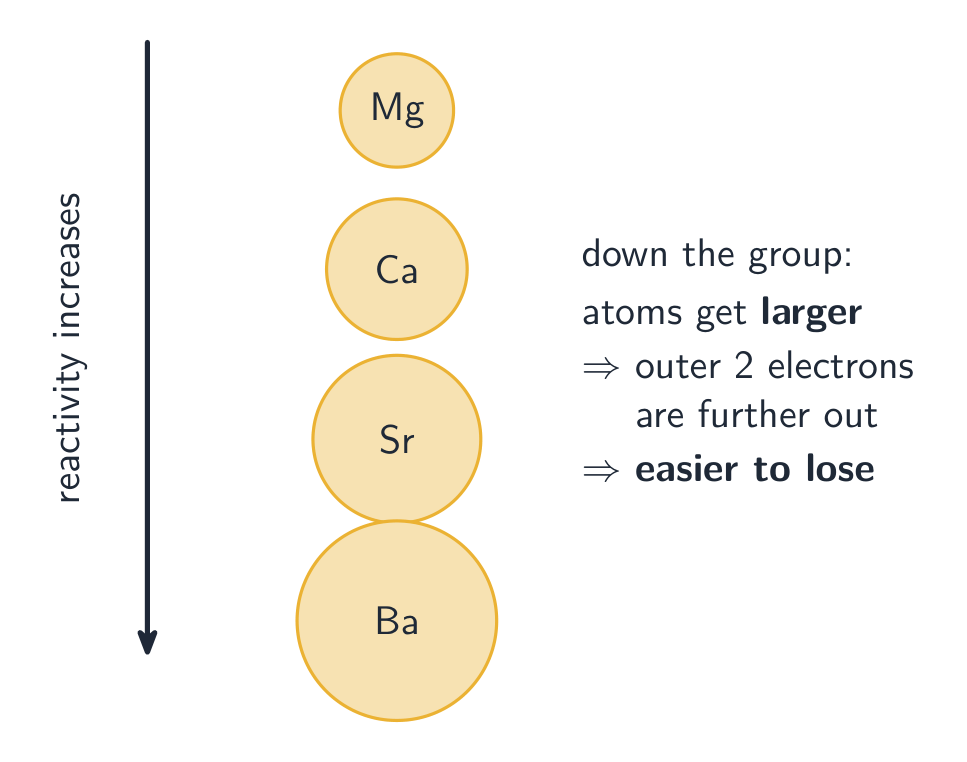
Group 族 2 holds the metals magnesium, calcium, strontium and barium. They all have two outer electrons, which they lose to form $2+$ ions. Going down the group, the atoms get larger and the outer electrons are easier to lose, so the metals get more reactive — their reactivity 反应活性 increases down the group.
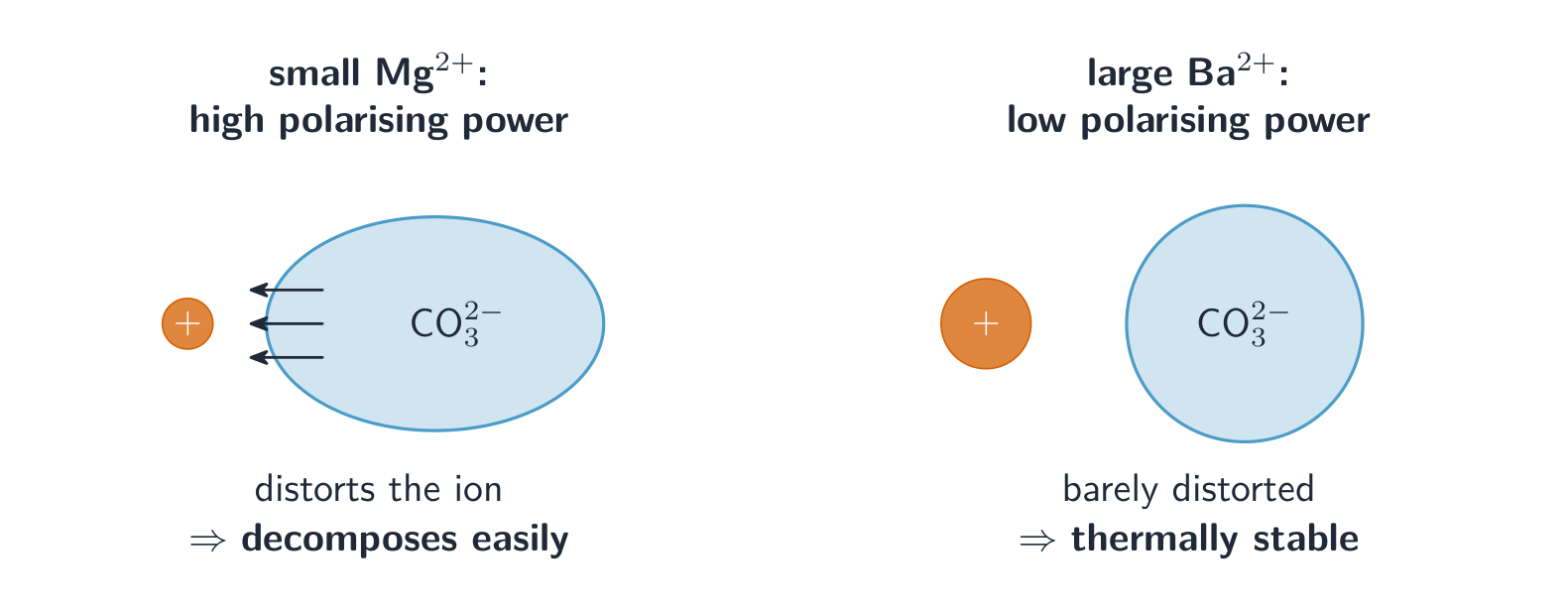
The thermal stability 热稳定性 of both the carbonates and the nitrates increases down the group. A larger metal ion pulls less on the carbonate or nitrate ion, so the compound is harder to break apart — it needs a higher temperature. So magnesium carbonate decomposes most easily, and barium carbonate is the hardest.
Trends in solubility
Compound
Trend in solubility 溶解度 down the group
hydroxides
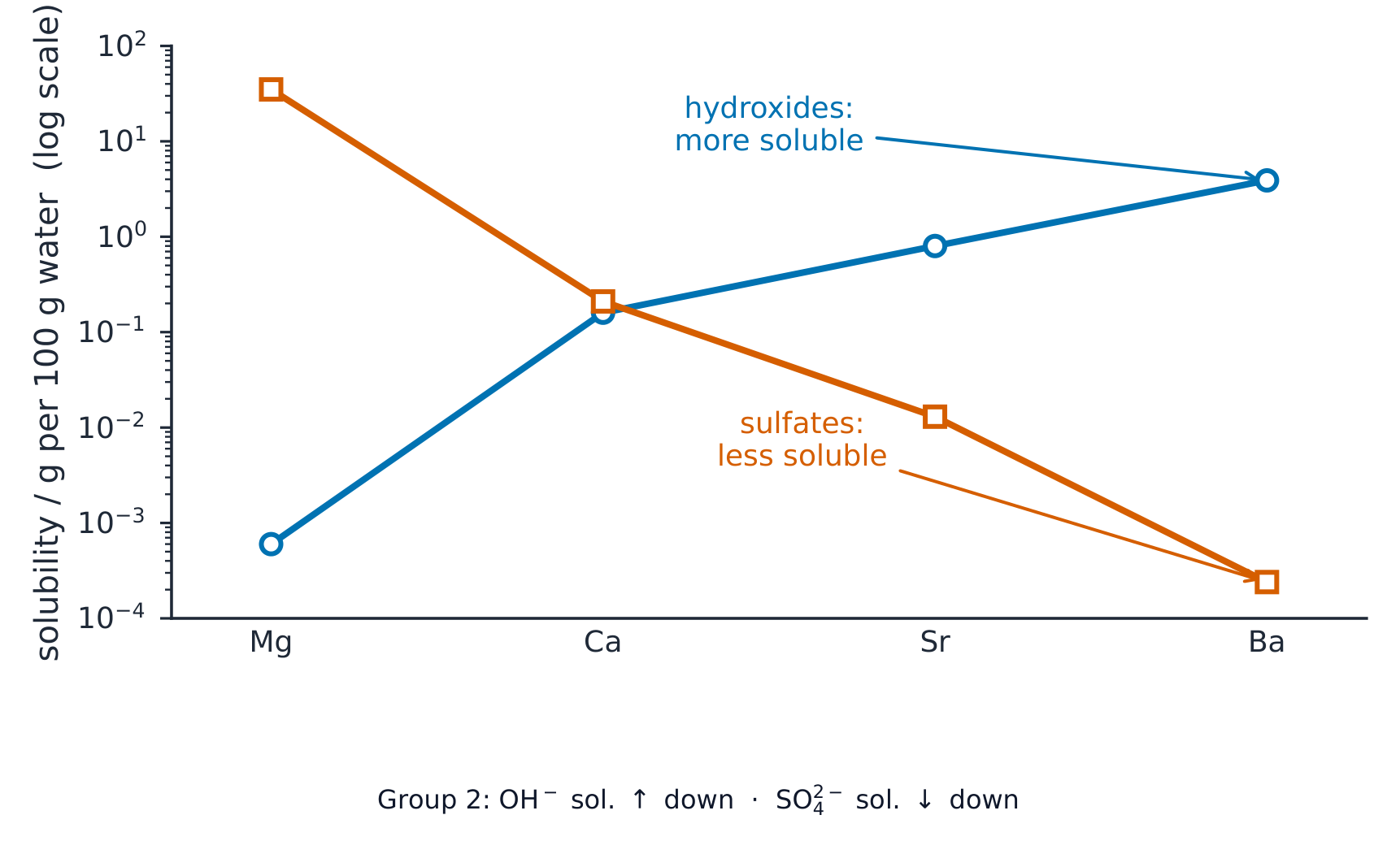
increase (Mg(OH)$_2$ almost insoluble; Ba(OH)$_2$ soluble)
sulfates
decrease (MgSO$_4$ soluble; BaSO$_4$ insoluble)
From these trends you can predict the properties of the next element down, radium, and of its compounds.
Worked example.$\text{MgCO}_3$ decomposes at about $540\ °\text{C}$ and $\text{BaCO}_3$ at about $1360\ °\text{C}$. Explain the trend and predict where $\text{CaCO}_3$ sits. Going down Group 2 the cation gets larger, so its charge is spread over a bigger surface and its polarising power falls. A less polarising cation distorts the carbonate ion less, so the $\text{C-O}$ bond is weakened less and more heat is needed to break it. Thermal stability therefore increases down the group, and $\text{CaCO}_3$, lying between Mg and Ba, decomposes at an intermediate temperature of about $900\ °\text{C}$. Argue the whole chain - cation size, then polarising power, then distortion of the anion; "it is more reactive" explains nothing here.
Português
A pedra calcaria é carbonato de cálcio — um composto do metal do Grupo 2, cálcio.
Group 族 2 contém os metais magnésio, cálcio, estrôncio e bário. Todos têm dois eletrões externos, que perdem para formar iões $2+$. Ao ir para baixo do grupo, os átomos ficam maiores e os eletrões externos são mais fáceis de perder, logo os metais tornam-se mais reativos — a sua reactivity 反应活性 aumenta ao longo do grupo.
A reatividade aumenta ao longo do Grupo 2: átomos maiores seguram menos firmemente os seus dois eletrões externos, logo perdem-nos mais facilmente
A thermal stability 热稳定性 tanto dos carbonatos como dos nitratos aumenta ao longo do grupo. Um ião metálico maior atrai menos o ião carbonato ou nitrato, logo o composto é mais difícil de quebrar — precisa de temperatura mais alta. Assim, o carbonato de magnésio decomõe-se mais facilmente, e o carbonato de bário é o mais difícil.
A estabilidade térmica aumenta ao longo do grupo: um catião pequeno polariza (deforma) mais o ião carbonato, enfraquecendo-o para que se decomponha mais facilmente
Tendências na solubilidade
Composto
Tendência na solubility 溶解度 ao longo do grupo
hidróxidos
aumenta (Mg(OH)$_2$ quase insolúvel; Ba(OH)$_2$ solúvel)
sulfatos
diminui (MgSO$_4$ solúvel; BaSO$_4$ insolúvel)
Ao longo do Grupo 2 os hidróxidos tornam-se mais solúveis enquanto os sulfatos tornam-se menos solúveis (note a escala logarítmica)
Destas tendências pode prever as propriedades do próximo elemento para baixo, o rádio, e dos seus compostos.
Exemplo resolvido.$\text{MgCO}_3$ decompõe-se a cerca de $540\ °\text{C}$ e $\text{BaCO}_3$ a cerca de $1360\ °\text{C}$. Explique a tendência e preveja onde $\text{CaCO}_3$ se situa. Indo para baixo no Grupo 2, o catião torna-se maior, por isso a sua carga é distribuída por uma superfície maior e o seu poder polarizante cai. Um catião menos polarizante distorce menos o ião carbonato, por isso a ligação $\text{C-O}$ é enfraquecida menos e é necessário mais calor para a quebrar. A estabilidade térmica, portanto, aumenta descendo no grupo, e $\text{CaCO}_3$, situando-se entre Mg e Ba, decompõe-se a uma temperatura intermédia de cerca de $900\ °\text{C}$. Argumente toda a cadeia — tamanho do catião, depois poder polarizante, depois distorção do anião; "é mais reativo" não explica nada aqui.
Explore · Explorar
Escada de reatividade do Grupo 2
Desça pelo Grupo 2 e veja por que as reações tornam-se mais vigorosas.
Explore · Explorar
Laboratório de tendência do Grupo 2
Compare as tendências de estabilidade térmica e solubilidade ao longo do Grupo 2.
Reactivity increases down Group 2: ionisation energy falls as atoms get larger, so electrons are lost more easily.
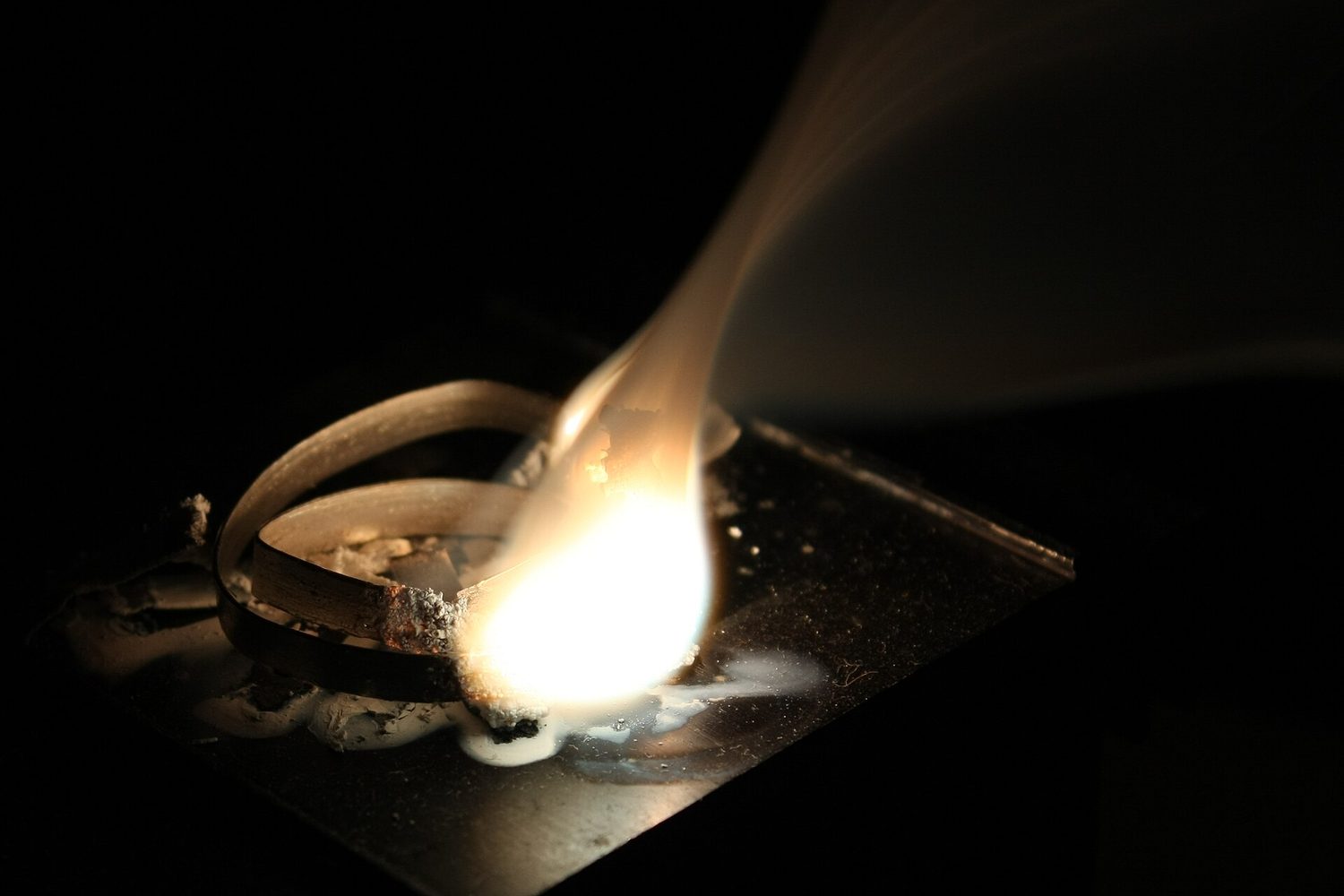
Reactions with water become more vigorous down the group; Mg reacts slowly with cold water but fast with steam (→ MgO).
Hydroxides get more soluble down the group; sulfates get less soluble ($\text{BaSO}_4$ insoluble — the basis of the sulfate test).
Write equations with the correct $+2$ ion and state the observations (fizzing, dissolving).
Português
A reatividade aumenta descendo no Grupo 2: a energia de ionização cai à medida que os átomos ficam maiores, por isso os eletrões são perdidos mais facilmente.
As reações com a água tornam-se mais vigorosas descendo no grupo; Mg reage lentamente com água fria, mas rapidamente com vapor (→ MgO).
Os hidróxidos ficam mais solúveis descendo no grupo; os sulfatos ficam menos solúveis ($\text{BaSO}_4$ insolúvel — a base do teste de sulfato).
Escreva equações com o íon $+2$ correto e indique as observações (efervescência, dissolução).
Interactive lessons on this topic · Aulas interativas sobre este tópico
Work through it step by step, with instant-check exercises. · Passe por ele passo a passo, com exercícios de verificação instantânea.
Pick one and the site follows you — notes, papers, videos and practice all open on it. · Escolha uma e o site te seguirá — notas, provas, vídeos e prática abrirão nela.
Type to search notes, lessons, code, vocabulary and past-paper questions across every subject. · Digite para pesquisar notas, aulas, código, vocabulário e questões de provas anteriores em todas as disciplinas.