English
| Enduring Understanding | Learning Objective | Essential Knowledge |
|---|---|---|
CLE-1 | 3.A |
|
한국어
| Enduring Understanding | Learning Objective | Essential Knowledge |
|---|---|---|
CLE-1 | 3.A |
|
AP English Language and Composition · AP 영어 어법 및 작문 · Topic 6 · 주제 6
 5:21
5:21
단원 6: 증거, 논제, 및 스타일적 선택
유닛 6은 종합 유닛이며, 이 과정에서 가장 날카로운 구분을 포함합니다. 입장과 관점은 다릅니다. 출처는 …을 가질 수 있습니다…
English narration · English + 中文 subtitles burned in · 영어 내레이션 · 영어 + 중국어 자막 burned-in

| Enduring Understanding | Learning Objective | Essential Knowledge |
|---|---|---|
CLE-1 | 3.A |
|
| Enduring Understanding | Learning Objective | Essential Knowledge |
|---|---|---|
CLE-1 | 3.A |
|
Source: College Board AP Course and Exam Description · 출처: College Board AP Course and Exam Description
Unit 6 is the synthesis unit, and it contains the single sharpest distinction in the course.
유닛 6은 합성 유닛이며, 이 과정에서 가장 날카로운 차이를 포함하고 있습니다.
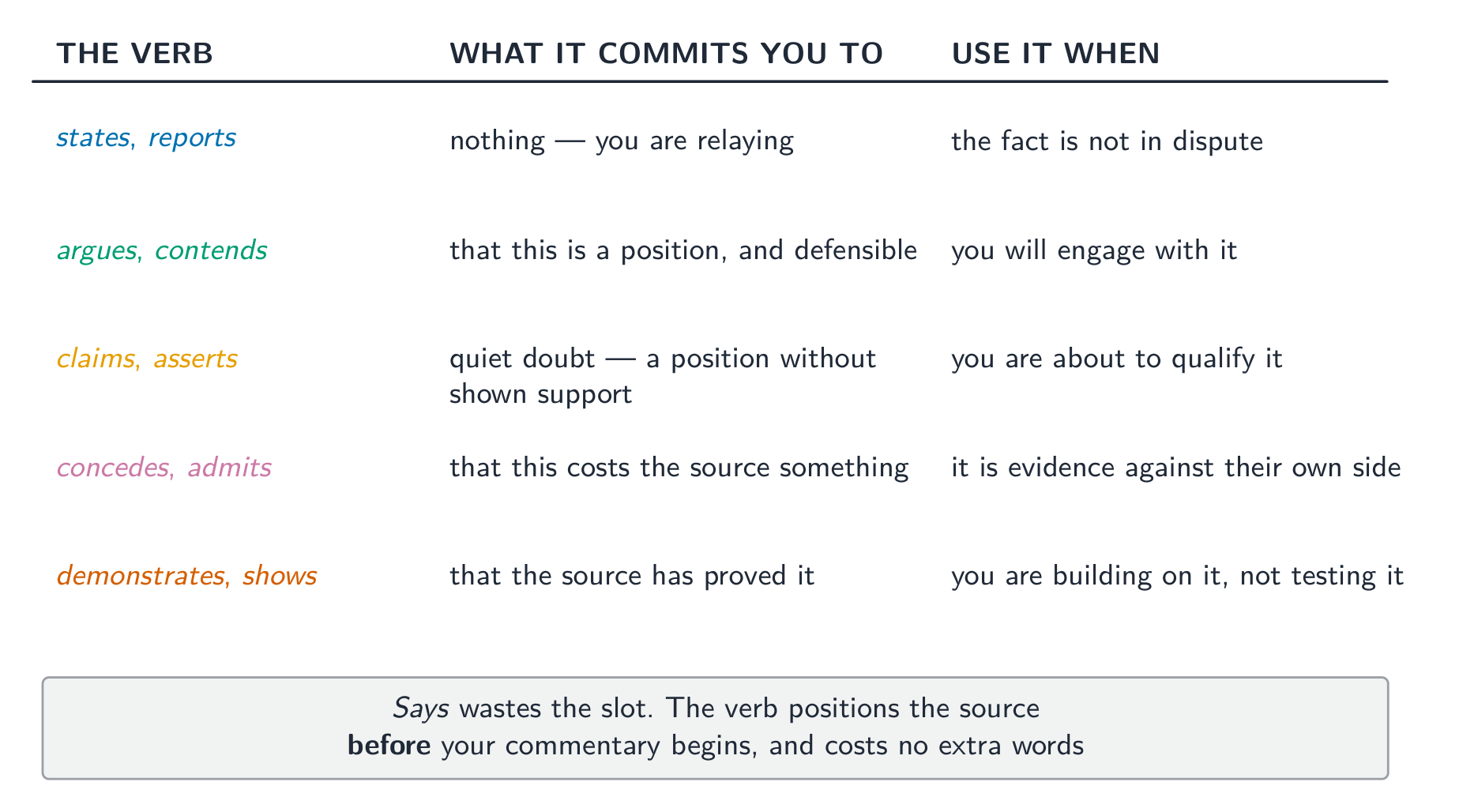
The verb commits you to something about the source's status, before your commentary starts, and costs no extra words. · 해설 시작 전에 출처의 지위에 대해所以你承诺某些东西,且不额外消耗词汇。

| Enduring Understanding | Learning Objective | Essential Knowledge |
|---|---|---|
CLE-1 | 4.A |
|
| Enduring Understanding | Learning Objective | Essential Knowledge |
|---|---|---|
CLE-1 | 4.A |
|
Source: College Board AP Course and Exam Description · 출처: College Board AP Course and Exam Description
The position-and-perspective distinction is what makes synthesis possible. If you sort the sources only by position, you get two piles - for and against - and a paragraph per pile. If you sort them by perspective, you can say things like:
Both the economist and the teacher support the measure, but they support it for reasons that do not survive together: one values the measurable gain, the other the change in what students attempt.
That sentence is synthesis. It uses two sources, is grounded in what each actually says, and produces a claim neither source makes.
Also examinable: use the credibility test. A source that never acknowledges any other position is, by the CED's own standard, less credible - and saying so about a source is legitimate evidence in your essay.
입장-관점의 구분은 합성이 가능하게 하는 것입니다. 출처를 입장에 따라만 분류하면 두 무리(지지와 반대)와 무리당 한 문단이 됩니다. 하지만 관점에 따라 분류하면 다음과 같은 말을 할 수 있습니다:
경제학자와 교사는 모두 해당 조치를 지지하지만, 그들이 지지하는 이유는 함께 공존할 수 없습니다: 하나는 측정 가능한 이득을 중시하고, 다른 하나는 학생들이 시도하는 것의 변화를 중시합니다.
그 문장은 합성입니다. 두 출처를 사용하여 각 출처가 실제로 말한 내용에 근거하며, 어느 출처도 하지 않은 주장을 도출해냅니다.
또한 출제 가능한 항목: 신뢰성 테스트를 사용하십시오. CED의 기준에 따르면 다른 입장을 전혀 인정하지 않는 출처는 신뢰성이 낮으며, 이를 출처에 대해 언급하는 것은 논문에 유효한 증거가 됩니다.
A synthesis essay is not a tour of the sources. The third move is where the synthesis happens, and it is the one most often missing. · 합성 논술은 출처의 여행이 아닙니다. 세 번째 단계에서 합성이 이루어지며, 이것이 가장 자주 누락되는 부분입니다.
| Enduring Understanding | Learning Objective | Essential Knowledge |
|---|---|---|
CLE-1 | 3.B |
|
| Enduring Understanding | Learning Objective | Essential Knowledge |
|---|---|---|
CLE-1 | 3.B |
|
Source: College Board AP Course and Exam Description · 출처: College Board AP Course and Exam Description
A short but load-bearing point: consideration and use of new evidence may require revision of the thesis statement and/or changes to the line of reasoning.
Reading a text, this means a writer's thesis may be responsive - shaped by the evidence rather than imposed on it. Look for where an argument turns.
짧지만 핵심이 되는 포인트: 새로운 증거의 검토 및 활용은 주장문(thesis statement)의 수정 및/또는 논리의 방향 변경을 필요로 할 수 있습니다.
텍스트를 읽을 때는 작가의 주장이 반응적(responsive) 일 수 있음을 의미합니다: 증거에 의해 형성된 것이 아니라 증거 위에 강요된 것이 아닙니다. 논리가 전환되는 지점을 찾으십시오.
| Enduring Understanding | Learning Objective | Essential Knowledge |
|---|---|---|
CLE-1 | 4.B |
|
| Enduring Understanding | Learning Objective | Essential Knowledge |
|---|---|---|
CLE-1 | 4.B |
|
Source: College Board AP Course and Exam Description · 출처: College Board AP Course and Exam Description
Writing under time pressure, this is permission you should use. If, while drafting, you find the evidence does not support the thesis you began with, change the thesis, not the evidence. Examiners reward an argument that fits its evidence; there are no marks for having predicted your own conclusion.
In practice, spend the first minutes reading sources and sketching claims before fixing the thesis. A thesis written after the evidence is nearly always better than one written before it.
시간 압박 하에 글을 쓸 때는 이러한 허용권을 사용하십시오. 초안 작성 중 원하던 주장문을 뒷받침하는 증거를 발견하지 못했을 경우, 증거를 바꾸는 대신 주장문을 변경하십시오. 채점자는 증거와 일치하는 논리를 평가합니다; 자신의 결론을 미리 예측했다는 점에는 점수가 부여되지 않습니다.
실무적으로는 주장문을 확정하기 전에 첫 몇 분간 출처를 읽고 주장의 초안을 그리는 데 시간을 쓰십시오. 증거를 본 뒤에 쓴 주장문은的证据를 보기 전에 쓴 주장문보다 훨씬 더 나은 경우가 많습니다.

Enduring Understanding (STL-1): The rhetorical situation informs the strategic stylistic choices that writers make.
Learning Objective 7.A: Reading – Explain how word choice, comparisons, and syntax contribute to the specific tone or style of a text.
지속적 이해 (STL-1): 수사적 상황은 작가들이 하는 전략적 스타일적 선택에 영향을 미친다.
학습 목표 7.A: 독해 – 어휘 선택, 비교, 구법이 텍스트의 특정 톤이나 스타일에 어떻게 기여하는지 설명한다.
Source: College Board AP Course and Exam Description · 출처: College Board AP Course and Exam Description
The third is the analytical gold. A tone shift is a visible event in a text: something changed at that point, and explaining what the writer wanted the reader to do differently after it is exactly the kind of answer that scores.
세 번째는 분석의 금광입니다. 톤 변화는 텍스트 내에서 관찰 가능한 사건입니다: 그 지점에서 무언가가 바뀌었으며, 작가가 그 이후에 독자에게 다르게 하기를 원했던 것을 설명하는 것이 바로 높은 점수를 받는 답변의 유형입니다.
| English | 한국어 |
|---|---|
| tone/təʊn/ | 톤 |
| shifts in tone/ʃɪfts ɪn təʊn/ | 톤의 변화 |
Enduring Understanding (STL-1): The rhetorical situation informs the strategic stylistic choices that writers make.
Learning Objective 8.A: Writing – Strategically use words, comparisons, and syntax to convey a specific tone or style in an argument.
지속적 이해 (STL-1): 수사적 상황은 작가들이 하는 전략적 스타일적 선택에 영향을 미친다.
학습 목표 8.A: 글쓰기 – 논증에서 특정 톤이나 스타일을 전달하기 위해 단어를 전략적으로 사용하고, 비교 및 구문을 활용한다.
Source: College Board AP Course and Exam Description · 출처: College Board AP Course and Exam Description
In your own writing, tone should be consistent and controlled, and deliberately shifted only where the argument turns - for example when moving from stating your position to conceding part of an opposing one.
Worked example (a real AP exam task). On a synthesis prompt, compare two uses of the same two sources. Weak: "Source B agrees with Source D that the policy should continue." That is position-sorting, and it produces nothing. Strong: "Sources B and D both defend the policy, but B defends it as an administrator measuring compliance while D defends it as a participant describing what it made possible - so the agreement is thinner than it appears, and the case rests on whether we are measuring the policy's operation or its effect." Same two sources, but the perspectives are doing the work, and the claim belongs to the writer.
본인의 글쓰기에서 톤은 일관되고 통제되어야 하며, 논리가 전환되는 지점에서만 의도적으로 변화시켜야 합니다. 예를 들어 자신의 입장을 밝이는 것에서 상대방의 일부 입장을 인정하는 것으로 넘어갈 때처럼요.
작문 예시 (실제 AP 시험 문제). 합성compose prompt에서 동일한 두 출처의 두 가지 사용을 비교하십시오. 약한 답변: "출처 B는 출처 D와 같이 이 정책이 계속되어야 한다고 동의한다." 이는 단순한 위치 정렬에 불과하며, 아무런 논리적 진전도 제공하지 못합니다. 강한 답변: "출처 B와 D는 모두 이 정책을 옹호하지만, B는 준수 여부를 측정하는 관리자의 관점에서 옹호하는 반면, D는 참여자로서 그것이 무엇을 가능하게 했는지 서술하는 관점에서 옹호하므로, 두 출처 간의 동의는 겉보기보다 더 얇으며, 이 논증은 우리가 정책의 운영을 측정하고 있는지, 아니면 그 효과를 측정하고 있는지에 달려 있습니다." 동일한 두 출처를 사용했음에도 관점이 논증의 핵심 역할을 하며, 주장은 작가 자신의 것이 됩니다.
Work through it step by step, with instant-check exercises. · 즉시 체크 기능 exercises를 통해 단계별로 진행하세요.
Loading subjects… · 과목 로드 중…