Skip to content · ⁨본문 바로가기⁩

Line of Reasoning and Methods of Development · ⁨논증의 흐름 및 전개 방법⁩

AP English Language and Composition · ⁨AP 영어 어법 및 작문⁩ · Topic 3 · ⁨주제 3⁩

Video lesson for this topic · ⁨이 주제용 영상 수업⁩ Open the video page · ⁨영상 페이지 열기⁩
5:57

단원 3: 추론의 흐름 및 발전 방법

단원 3은 수업이 부분들에 대해 이야기하는 것을 멈추고 구조에 대해 이야기하기 시작하는 곳입니다. 여기是你是否有结构的测试입니다. 에세이를 가져와…

English narration · English + 中文 subtitles burned in · ⁨영어 내레이션 · 영어 + 중국어 자막 burned-in⁩

3.1

Identifying Claims and Evidence · ⁨주장과 증거 식별⁩

Syllabus
English
Enduring UnderstandingLearning ObjectiveEssential Knowledge

CLE-1
Writers make claims about subjects, rely on evidence that supports the reasoning that justifies the claim, and often acknowledge or respond to other, possibly opposing, arguments.

3.A
Reading – Identify and explain claims and evidence within an argument.

  • CLE-1.K Effective use of evidence uses commentary to establish a logical relationship between the evidence and the claim it supports.
  • CLE-1.L Writers introduce source material by using commentary to properly integrate it into their line of reasoning.
  • CLE-1.M Synthesis requires consideration, explanation, and integration of others’ arguments into one’s own argument.
  • CLE-1.N Writers must acknowledge words, ideas, images, texts, and other intellectual property of others through attribution, citation, or reference.
한국어
Enduring UnderstandingLearning ObjectiveEssential Knowledge

CLE-1
작가는 주제에 대한 주장을 내세우고, 주장을 정당화하는 추론을 뒷받침할 증거를 reliance하며, 때로는 다른, 대립될 수 있는 주장들을 인정하거나 반응하기도 한다.

3.A
독해 – 논증 내의 주장과 증거를 식별하고 설명한다.

  • CLE-1.K 증거의 효과적인 활용은 코멘트를 사용하여 증거와 그것이 지지하는 주장 사이의 논리적 관계를 설정하는 데 사용된다.
  • CLE-1.L 작가는 코멘트를 사용하여 원본 자료를 도입하고, 이를 자신의 추론 흐름에 적절하게 통합시킨다.
  • CLE-1.M 합성(Synthesis)은 타인의 논증을 자신의 논증으로 고려, 설명, 그리고 통합하는 것을 요구한다.
  • CLE-1.N 작가는 출처 표기(attribution), 인용(citation), 또는 참고(referenced)를 통해 타인의 단어, 아이디어, 이미지, 텍스트 및 기타 지적 재산을 인정해야 한다.

Source: College Board AP Course and Exam Description · ⁨출처: College Board AP Course and Exam Description⁩

English

Unit 3 is where the course stops being about parts and starts being about structure. Its subject is the line of reasoning 推理线索 - the path an argument takes from where it starts to what it proves.

First, four claims about how evidence gets into an argument properly:

  • Effective use of evidence uses commentary 评述 to establish a logical relationship between the evidence and the claim.
  • Writers introduce source material using commentary to integrate it into their line of reasoning - so commentary comes before as well as after.
  • Synthesis 综合 requires consideration, explanation, and integration of others' arguments into one's own. That is the exact skill Question 1 tests, and the word integration rules out a paragraph that simply summarises each source in turn.
  • Writers must acknowledge the words, ideas, images, and texts of others through attribution and citation 归属与引用.
한국어

유닛 3는 과정이 부분적 분석에서 구조에 대한 연구로 전환되는 지점입니다. 이 단원의 주제는 추론선(推理线索) - 즉, 논증이 시작점에서 증명된 결과에 이르기까지 취하는 경로입니다.

먼저, 증거가 논증에 올바르게 도입되는 방식에 대한 네 가지 주장이 있습니다:

  • 효과적인 증거 활용은 평述(评述) 을 사용하여 证据와 claim(주장) 사이의 논리적 관계를 확립합니다.
  • 작가들은 자신의 추론선에的证据를 통합하기 위해 평述(评述)을 사용하여 출처 자료를 소개하므로, 평述(评述)은引入之前과之后 모두에 위치합니다.
  • Synthesis(综合) 은 타인의 논증을 고려하고 설명하며 자신의 논증에 통합하는 것을 요구합니다. 이것이 Question 1가 시험하는 정확한 기술이며, integration이라는 단어는 각 출처를 순차적으로 요약만 하는 문단에는 적합하지 않음을 의미합니다.
  • 작가들은 归属感与引用(归属与引用) 를 통해 타인의 언어, 아이디어, 이미지 및 텍스트를 인용(acknowledge) 하여 반드시 명시해야 합니다.
Vocabulary · ⁨어휘⁩ Train · ⁨연습하기⁩
English 한국어
Synthesis/ˈsɪnθəsɪs/ Synthesis(통합)
attribution and citation/ətrɪˈbjuːʃn ænd saɪˈteɪʃn/ 출처 표시 및 인용
Methods of development/ˈmeθədz ɒv dɪˈveləpmənt/ 발전 방법
narration/nəˈreɪʃn/ 서술
cause-effect/kɔːz ɪˈfekt/ 인과관계
3.2

Developing a Paragraph with Claim and Evidence · ⁨주장과 증거를 포함한 단락 발전⁩

Syllabus
English
Enduring UnderstandingLearning ObjectiveEssential Knowledge

CLE-1
Writers make claims about subjects, rely on evidence that supports the reasoning that justifies the claim, and often acknowledge or respond to other, possibly opposing, arguments.

4.A
Writing – Develop a paragraph that includes a claim and evidence supporting the claim.

  • CLE-1.K Effective use of evidence uses commentary to establish a logical relationship between the evidence and the claim it supports.
  • CLE-1.L Writers introduce source material by using commentary to properly integrate it into their line of reasoning.
  • CLE-1.M Synthesis requires consideration, explanation, and integration of others’ arguments into one’s own argument.
  • CLE-1.N Writers must acknowledge words, ideas, images, texts, and other intellectual property of others through attribution, citation, or reference.
한국어
Enduring UnderstandingLearning ObjectiveEssential Knowledge

CLE-1
작가는 주제에 대한 주장을 내세우고, 주장을 정당화하는 추론을 뒷받침할 증거를 reliance하며, 때로는 다른, 대립될 수 있는 주장들을 인정하거나 반응하기도 한다.

4.A
글쓰기 – 주장과 이를 지지하는 증거가 포함된 문단을 개발한다.

  • CLE-1.K 증거의 효과적인 활용은 코멘트를 사용하여 증거와 그것이 지지하는 주장 사이의 논리적 관계를 설정하는 데 사용된다.
  • CLE-1.L 작가는 코멘트를 사용하여 원본 자료를 도입하고, 이를 자신의 추론 흐름에 적절하게 통합시킨다.
  • CLE-1.M 합성(Synthesis)은 타인의 논증을 자신의 논증으로 고려, 설명, 그리고 통합하는 것을 요구한다.
  • CLE-1.N 작가는 출처 표기(attribution), 인용(citation), 또는 참고(referenced)를 통해 타인의 단어, 아이디어, 이미지, 텍스트 및 기타 지적 재산을 인정해야 한다.

Source: College Board AP Course and Exam Description · ⁨출처: College Board AP Course and Exam Description⁩

English

Applied to your own writing, the change from Unit 2 is that commentary now has two jobs, not one: it introduces the evidence into the reasoning, and it explains the relationship afterwards.

A paragraph that does both reads: claim - a sentence positioning the evidence - the evidence, embedded - commentary establishing the logical relationship - the link onward. The sentence before the quotation is doing as much work as the one after it, and most students write neither.

한국어

본인의 글쓰기에 적용할 때 유닛 2에서의 변화는 평述(评述)이 더 이상 한 가지 역할이 아닌 두 가지 역할을 수행한다는 점입니다: 증거를 추론에 도입하고 이후 그 관계를 설명하는 것입니다.

두 역할을 모두 수행하는 문단은 다음과 같이 읽힙니다: 주장 - evidence(证据)를 배치하는 문장 - 내재화된 evidence(证据) - 논리적 관계를 확립하는 평述(评述) - 다음으로 이어지는 연결. 인용문 앞의 문장이 뒤의 문장만큼 중요한 기능을 하지만, 대부분의 학생들은 둘 다 쓰지 않습니다.

Relevant and sufficient are two different failures with two opposite fixes
Explore · ⁨탐색하기⁩

Diagnose the evidence problem · ⁨证据 문제를 진단하라⁩

Relevant and sufficient are two different failures with two opposite fixes. · ⁨relevant하고 sufficient함은 서로 다른 패이며 서로 반대되는 해결책이 필요함.⁩

3.3

Describing the Line of Reasoning · ⁨추론선(推理线索) 묘사하기⁩

Syllabus
English
Enduring UnderstandingLearning ObjectiveEssential Knowledge

REO-1
Writers guide understanding of a text’s lines of reasoning and claims through that text’s organization and integration of evidence.

5.A
Reading – Describe the line of reasoning and explain whether it supports an argument’s overarching thesis.

  • REO-1.A Writers may lead readers through a line of reasoning and then arrive at a thesis.
  • REO-1.B Writers may express a claim and then develop a line of reasoning to justify the claim.
  • REO-1.C Writers explain their reasoning through commentary that connects chosen evidence to a claim.
  • REO-1.D Commentary explains the significance and relevance of evidence in relation to the line of reasoning.
  • REO-1.E The sequence of paragraphs in a text reveals the argument’s line of reasoning.
  • REO-1.F Flaws in a line of reasoning may render an argument specious or illogical.
한국어
Enduring UnderstandingLearning ObjectiveEssential Knowledge

REO-1
작가는 텍스트의 조직과 증거의 통합을 통해 텍스트의 추론의 흐름과 주장에 대한 이해를 이끌어낸다.

5.A
독해 – 추론의 흐름을 서술하고, 그것이 논증의 핵심 주제를 지지하는지 설명한다.

  • REO-1.A 작가는 독자를 추론의 흐름을 통해 안내한 후 핵심 주제에 도달할 수 있다.
  • REO-1.B 작가는 주장을 제시한 후 이를 정당화하기 위한 추론의 흐름을 발전시킬 수 있다.
  • REO-1.C 작가는 선택한 증거를 주장과 연결하는 코멘트를 통해 자신의 추론 과정을 설명한다.
  • REO-1.D 코멘트는 추론의 흐름과 관련하여 증거의 중요성과 관련성을 설명한다.
  • REO-1.E 텍스트의 문단 순서는 논증의 추론 흐름을 드러낸다.
  • REO-1.F 추론의 결함은 논증을 허구적이거나 비논리적으로 만들 수 있다.

Source: College Board AP Course and Exam Description · ⁨출처: College Board AP Course and Exam Description⁩

English

The CED allows two arrangements, and both are valid:

  • Writers may lead readers through a line of reasoning and then arrive at a thesis - the argument builds to its claim.
  • Writers may express a claim and then develop a line of reasoning to justify it - the argument declares and then defends.

Whichever order is used, the same requirements hold:

  • Writers explain their reasoning through commentary that connects chosen evidence to a claim.
  • Commentary explains the significance and relevance of evidence in relation to the line of reasoning.
  • The sequence of paragraphs in a text reveals the argument's line of reasoning - which is the practical tool for reading. To find a writer's reasoning, write one sentence per paragraph and read the list.
  • Flaws in a line of reasoning may render an argument specious or illogical.
한국어
Two legitimate orders, one requirement - and the requirement is the commentary
순서는 선택의 문제이지만, 연결 고리는 그렇지 않습니다

CED(College Board Exam Description)는 두 가지 구성 방식을 허용하며, 둘 다 유효합니다:

  • 작가들은 독자를 추론선을 따라 인솔한 후 최종 주장을 도출할 수 있습니다 - 즉, 논증이 claim(주장)을 향해 구축됩니다.
  • 작가들은 주장을 먼저 제시하고 이를 정당화하기 위한 추론선을 전개할 수 있습니다 - 즉, 논증이 claim(주장)을 선언한 후 이를 방어합니다.

어떤 순서를 사용하든 동일한 요구사항이 적용됩니다:

  • 저자는 선정된 증거를 claim에 연결하는 commentary를 통해 자신의 추론을 설명한다.
  • commentary는 추론의 흐름과 관련되어 증거의 의의와 관련성 significance and relevance를 설명한다.
  • 텍스트의 문단 순서는 논증의 추론선(推理线索)을 드러냅니다 - 이는 독해 시 실용적인 도구입니다. 작가의 논리를 찾기 위해서는 각 문당 한 문장씩 작성하여 나열한 뒤 읽어보십시오.
  • 추론의 결함은 논증을 허구적이거나 비논리적으로 만들 수 있습니다.
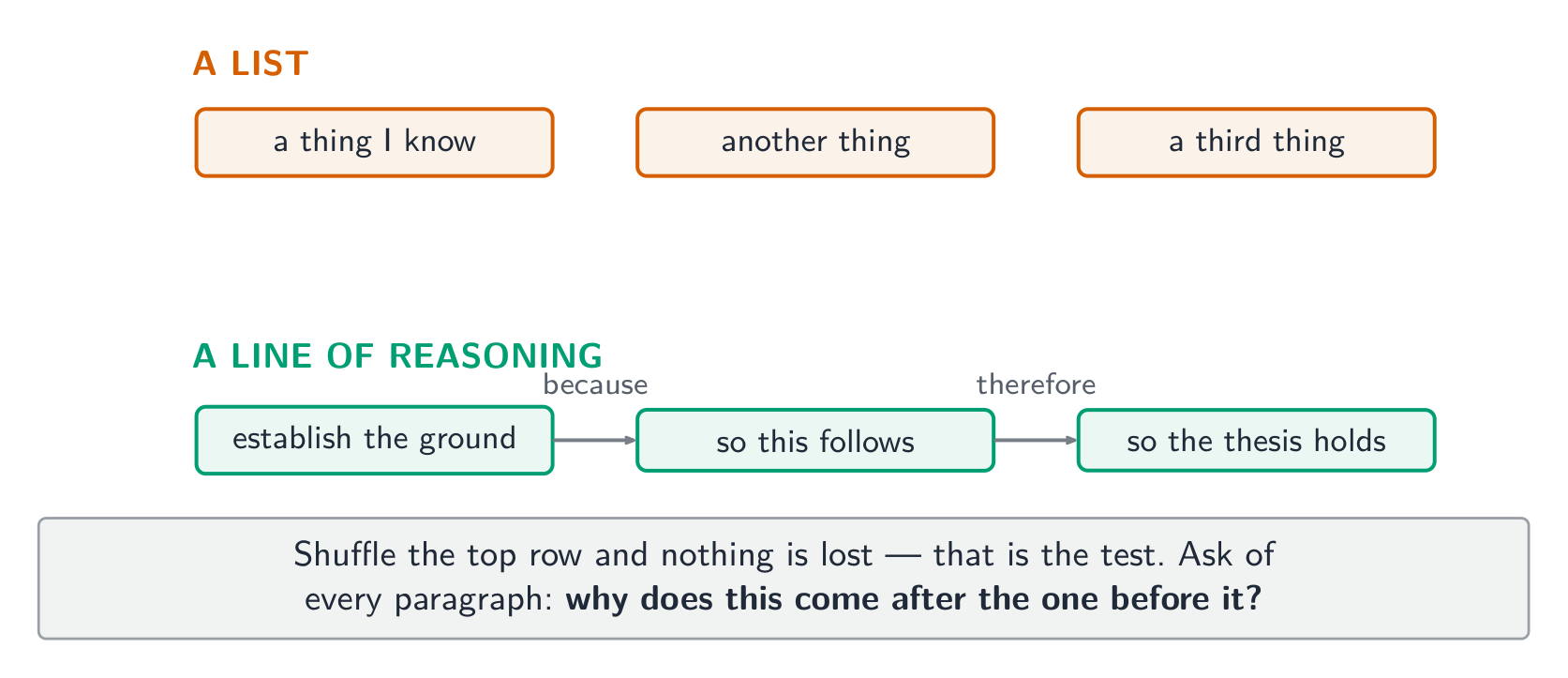
 Shuffle 테스트: 문단들이 순서를 바꾼 후에도 의미가 손실되지 않는다면 이는 나열에 불과합니다
Vocabulary · ⁨어휘⁩ Train · ⁨연습하기⁩
English 한국어
line of reasoning/laɪn ɒv ˈriːzənɪŋ/ 추론의 흐름
commentary/ˈkɒməntri/ 비평(commentary)
3.4

Developing a Line of Reasoning and Commentary · ⁨추론과 비평 개발하기⁩

Syllabus
English

Enduring Understanding (REO-1): Writers guide understanding of a text’s lines of reasoning and claims through that text’s organization and integration of evidence.

Learning Objective 6.A: Writing – Develop a line of reasoning and commentary that explains it throughout an argument.

  • REO-1.A Writers may lead readers through a line of reasoning and then arrive at a thesis.
  • REO-1.B Writers may express a claim and then develop a line of reasoning to justify the claim.
  • REO-1.C Writers explain their reasoning through commentary that connects chosen evidence to a claim.
  • REO-1.D Commentary explains the significance and relevance of evidence in relation to the line of reasoning.
  • REO-1.E The sequence of paragraphs in a text reveals the argument’s line of reasoning.
  • REO-1.F Flaws in a line of reasoning may render an argument specious or illogical.
한국어

Enduring Understanding (REO-1): 작가는 텍스트의 조직과 증거의 통합을 통해 텍스트의 추론의 흐름과 주장에 대한 이해를 이끌어낸다.

학습 목표 6.A: 작문 – 논증 전반에 걸쳐 그 이유를 설명하는 추론과 해설을 구축한다.

  • REO-1.A 작가는 독자를 추론의 흐름을 통해 안내한 후 핵심 주제에 도달할 수 있다.
  • REO-1.B 작가는 주장을 제시한 후 이를 정당화하기 위한 추론의 흐름을 발전시킬 수 있다.
  • REO-1.C 작가는 선택한 증거를 주장과 연결하는 코멘트를 통해 자신의 추론 과정을 설명한다.
  • REO-1.D 코멘트는 추론의 흐름과 관련하여 증거의 중요성과 관련성을 설명한다.
  • REO-1.E 텍스트의 문단 순서는 논증의 추론 흐름을 드러낸다.
  • REO-1.F 추론의 결함은 논증을 허구적이거나 비논리적으로 만들 수 있다.

Source: College Board AP Course and Exam Description · ⁨출처: College Board AP Course and Exam Description⁩

English

For your own essays, the useful discipline is to decide the order of your claims before writing any of them. An essay whose paragraphs could be shuffled without loss has no line of reasoning - it has a list.

Test a draft by asking of each paragraph: why does this come after the one before it? If the only answer is "it is another thing I know about the topic", the structure is a list and the reasoning point is at risk.

한국어

본인의 에세이를 쓸 때 유용한 관행은 모든 주장을 쓰기 전에 그 서열을 결정하는 것입니다. 문단들의 순서를 바꾸어도 의미가 변하지 않는 에세이는 추론이 없으며, 단순히 나열된 목록일 뿐입니다.

초안 검토 시 각 단락에 대해 다음 질문을 하십시오: 이 단락은 이전 단락의 바로 뒤에 오는 이유는 무엇인가? 만약 유일한 답변이 "이 주제가 내가 아는 다른 내용"이라면, 구조는 나열형이며 추론 포인트가 위험에 처해 있습니다.

비평을 네 줄로 표현 - 추론 포인트는 마지막 줄에서 부여됨
Explore · ⁨탐색하기⁩

Climb the four rungs of commentary · ⁨Commentary의 네 사다리 계단을 오르라⁩

'Explain your evidence' is unusable. Four questions, each answerable in a sentence, make it a procedure. · ⁨' evidence를 설명하라'는 사용 불가능함. 네 가지 질문, 각 답을 한 문장으로 할 수 있게 하면它就是一种程序。⁩

3.5

Recognizing Methods of Development · ⁨전개 방식의 식별⁩

Syllabus
English

Enduring Understanding (REO-1): Writers guide understanding of a text’s lines of reasoning and claims through that text’s organization and integration of evidence.

Learning Objective 5.C: Reading – Recognize and explain the use of methods of development to accomplish a purpose.

  • REO-1.G Methods of development are common approaches writers frequently use to develop and organize the reasoning of their arguments. A method of development provides an audience with the means to trace a writer’s reasoning in an argument.
  • REO-1.H Some typical methods of development are narration, cause-effect, comparison-contrast, definition, and description.
  • REO-1.I When developing ideas through narration, writers offer details about real-life experiences and offer reflections and insights on the significance of those experiences.
  • REO-1.J When developing ideas through cause-effect, writers present a cause, assert effects or consequences of that cause, or present a series of causes and the subsequent effect(s).
한국어

Enduring Understanding (REO-1): 작가는 텍스트의 조직과 증거의 통합을 통해 텍스트의 추론의 흐름과 주장에 대한 이해를 이끌어낸다.

학습 목표 5.C: 독해 – 목적을 달성하기 위해 사용된 개발 방법의 활용을 인식하고 설명한다.

  • REO-1.G 개발 방법은 작가들이 논증의 추론을 발전시키고 조직화할 때 자주 사용하는 일반적인 접근법이다. 개발 방법은 청중에게 논증 속 작가의 추론을 추적할 수 있는 수단을 제공한다.
  • REO-1.H 대표적인 개발 방법으로는 서사, 인과관계, 비교·대조, 정의, 묘사가 있다.
  • REO-1.I 서사를 통해 아이디어를 발전시킬 때, 작가들은 실제 경험에 대한 세부 사항을 제시하고 해당 경험의 의의에 대한 반성과 통찰을 담는다.
  • REO-1.J 인과관계를 통해 아이디어를 발전시킬 때, 작가들은 원인을 제시하거나 그 원인에 따른 결과 또는 영향을 주장하거나, 일련의 원인과 그에 따른 결과들을 제시한다.

Source: College Board AP Course and Exam Description · ⁨출처: College Board AP Course and Exam Description⁩

English

Methods of development 展开方法 are common approaches writers use to develop and organise the reasoning of an argument. The CED's list: narration, cause-effect, comparison-contrast, definition, and description. This unit treats the first two.

  • Developing through narration 叙述: writers offer details about real-life experiences and reflections on them. The reflection is what makes narration an argument rather than a story - an anecdote with no reflection has supplied no reasoning.
  • Developing through cause-effect 因果: writers present a cause, then assert the effects or consequences of that cause - or begin from an effect and trace it back.
한국어

전개 방식 展开方法은 논증의 논리를 발전시키고 구성하기 위해 작가들이 사용하는 일반적인 접근법입니다. CED의 목록에는 서술, 인과관계, 비교-대조, 정의, 묘사가 포함됩니다. 이 단원은 첫 번째 두 가지 방식을 다룹니다.

  • 서술 叙述을 통한 전개: 작가는 실제 경험과 그에 대한 성찰에 대한 디테일을 제시합니다. 성찰이 서술을 이야기/story가 아닌 논증으로 만듭니다. 성찰 없는 에피소드는 어떤 논리도 제공하지 못했습니다.
  • 인과관계 因果를 통한 전개: 작가는 원인을 제시한 후 그 원인의 결과나 영향을 주장하거나, 반대로 결과를 시작하여 거슬러 올라갑니다.
3.6

Using Methods of Development · ⁨전개 방식의 활용⁩

Syllabus
English

Enduring Understanding (REO-1): Writers guide understanding of a text’s lines of reasoning and claims through that text’s organization and integration of evidence.

Learning Objective 6.C: Writing – Use appropriate methods of development to advance an argument.

  • REO-1.G Methods of development are common approaches writers frequently use to develop and organize the reasoning of their arguments. A method of development provides an audience with the means to trace a writer’s reasoning in an argument.
  • REO-1.H Some typical methods of development are narration, cause-effect, comparison-contrast, definition, and description.
  • REO-1.I When developing ideas through narration, writers offer details about real-life experiences and offer reflections and insights on the significance of those experiences.
  • REO-1.J When developing ideas through cause-effect, writers present a cause, assert effects or consequences of that cause, or present a series of causes and the subsequent effect(s).
한국어

Enduring Understanding (REO-1): 작가는 텍스트의 조직과 증거의 통합을 통해 텍스트의 추론의 흐름과 주장에 대한 이해를 이끌어낸다.

학습 목표 6.C: 작문 – 논증을 추진하기 위해 적절한 개발 방법을 사용한다.

  • REO-1.G 개발 방법은 작가들이 논증의 추론을 발전시키고 조직화할 때 자주 사용하는 일반적인 접근법이다. 개발 방법은 청중에게 논증 속 작가의 추론을 추적할 수 있는 수단을 제공한다.
  • REO-1.H 대표적인 개발 방법으로는 서사, 인과관계, 비교·대조, 정의, 묘사가 있다.
  • REO-1.I 서사를 통해 아이디어를 발전시킬 때, 작가들은 실제 경험에 대한 세부 사항을 제시하고 해당 경험의 의의에 대한 반성과 통찰을 담는다.
  • REO-1.J 인과관계를 통해 아이디어를 발전시킬 때, 작가들은 원인을 제시하거나 그 원인에 따른 결과 또는 영향을 주장하거나, 일련의 원인과 그에 따른 결과들을 제시한다.

Source: College Board AP Course and Exam Description · ⁨출처: College Board AP Course and Exam Description⁩

English

Choosing a method is a rhetorical decision, not a stylistic one. Narration works when the audience needs to feel the situation before they will accept a claim about it. Cause-effect works when the audience already accepts the facts but not the connection between them.

Worked example (a real AP exam task). On a Question 1 synthesis prompt, compare two paragraphs using the same two sources. The weak version: "Source A says X. Source C says Y. Both discuss the issue." That is summary in sequence - no claim, no integration, no reasoning. The strong version: "The strongest objection to the proposal is not that it fails but that it succeeds too narrowly: Source A's data show the intended outcome improving, while Source C's account of the same programme records the second-order costs that the measurement in Source A was never designed to capture." Here the sources are integrated into the writer's own claim, and the commentary establishes the logical relationship - which is what the four evidence-and-commentary points are awarded for.

한국어

방식을 선택하는 것은 스타일보다 수학적/언어적(레토릭) 결정입니다. 청중이 주장에 수용되기 전에 상황을 느끼게 해야 할 때 서술이 효과적입니다. 청중이 사실은 인정하지만 connecting between them(그들 사이의 연결고리)은 인정하지 않을 때 인과관계가 효과적입니다.

풀이 예시 (실제 AP 시험 문제). Question 1 합성 prompt에서 동일한 두 소스를 사용하여 두 단락을 비교하십시오. 약한 버전: “Source A는 X라고 한다. Source C는 Y라고 한다. 둘 다 그 문제를 다루고 있다.” 이는 순차적인 요약일 뿐입니다 - 주장, 통합, 논리가 없습니다. 강력한 버전: “이 제안에 대한 가장 강력한 반박은 실패했기 때문이 아니라, 오히려 너무 좁은 범위에서만 성공했기 때문이다: Source A의 데이터는 목표 Outcome가 개선되었음을 보여주지만, Source C의 같은 프로그램에 대한 기록은 Source A의 측정이 결코 포착하도록 설계되지 않은 2차 비용(second-order costs)을 담고 있다.” 여기서 소작가는 작가의 자신의 주장에 통합되었으며, 비평은 논리적 관계를 설정합니다 - 이것이 네 개의 증거 및 비평 포인트가 수여되는 이유입니다.

3.6

Exam tips · ⁨시험 팁⁩

English
  • Commentary has two jobs: introducing evidence into the reasoning, and explaining the relationship afterwards. Write both sentences.
  • Synthesis means integration, not summary in sequence. A paragraph per source is the classic low-scoring shape.
  • To find a writer's line of reasoning, summarise each paragraph in one sentence and read the list.
  • Ask of your own paragraphs: why does this one follow that one? No answer means no line of reasoning.
  • Narration needs reflection. An anecdote without it has told a story, not made an argument.
  • Choose a method of development for a rhetorical reason and be able to say what it is.
한국어
  • 비평은 두 가지 역할이 있습니다: 논리에 증거를 도입하고, 이후에 그 관계를 설명하는 것입니다. 두 문장을 모두 작성하십시오.
  • 합성은 순차적 요약이 아니라 통합입니다. 소스당 한 단락은 전형적으로 낮은 점수 형식입니다.
  • 작가의 논리 흐름을 찾기 위해, 각 단락을 한 문장으로 요약하고 목록을 읽어보십시오.
  • 자신의 문단들에 대해 물어보십시오: 왜 이 문단이 저 문단 뒤에 오는가? 이에 대한 답이 없다면 추론도 없습니다.
  • 서술에는 성찰이 필요합니다. 성찰 없는 에피소드는 논증을 만드는 것이 아니라 이야기를 말한 것입니다.
  • 레토릭적 이유를 위해 전개 방식을 선택할 수 있어야 하며 그것이 무엇인지 말할 수 있어야 합니다.

Interactive lessons on this topic · ⁨이 주제에 대한 인터랙티브 수업⁩

Work through it step by step, with instant-check exercises. · ⁨즉시 체크 기능 exercises를 통해 단계별로 진행하세요.⁩

Past Papers · ⁨과거 시험지⁩

More topics in AP English Language and Composition · ⁨AP 영어 어법 및 작문⁩ · ⁨AP English Language and Composition · ⁨AP 영어 어법 및 작문⁩ 내 추가 주제⁩

Log in or create account · ⁨로그인 또는 계정 만들기⁩

IGCSE, A-Level & AP