Write the photosynthesis word and symbol equations, and describe it as endothermic.
Explain how light intensity, CO2 concentration and temperature limit the rate of photosynthesis, including interpreting limiting-factor graphs.
(HT) Use the inverse-square relation between light intensity and distance, and reasons for greenhouse economics.
Describe RP6: light intensity and the rate of photosynthesis with pondweed, its controls and the rate calculation.
Source: Cambridge International syllabus
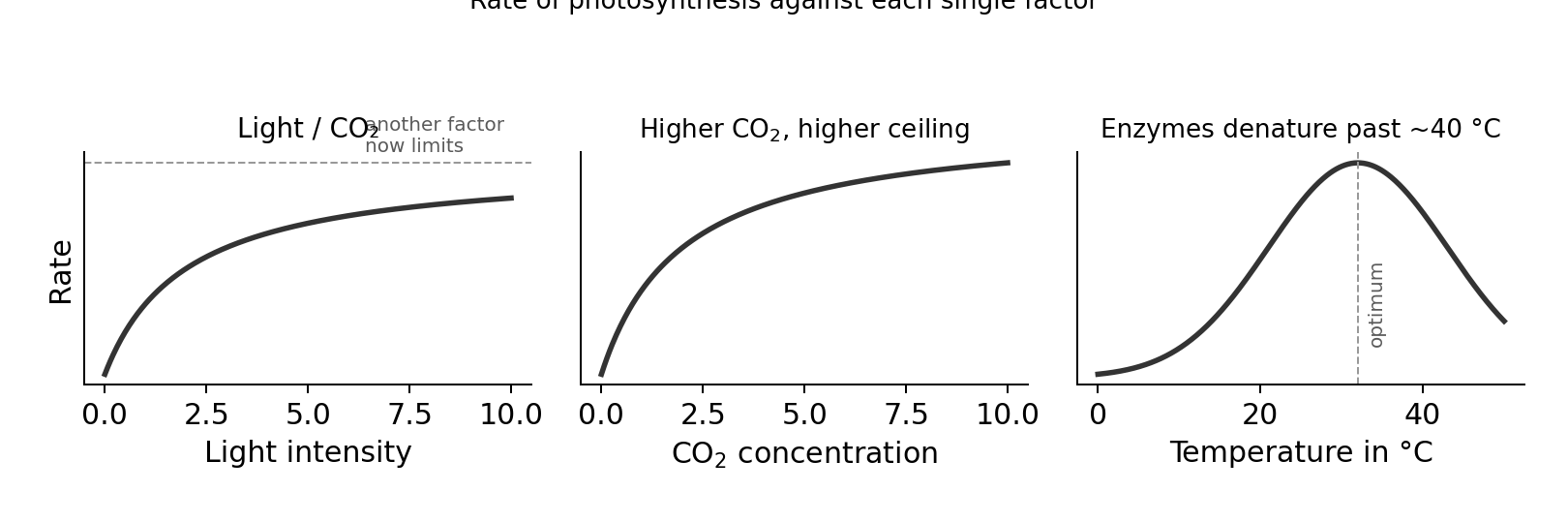
Each curve rises then flattens where another factor limits.
Rate increases with: light intensity, CO₂ concentration, temperature (to the enzyme optimum), and the amount of chlorophyll.
Reading single-factor graphs: the flat top means something else has become the limiting factor 限制因素. (HT) On two- or three-factor graphs, decide which factor is limiting at each point.
(HT) Inverse square law: doubling the distance from the lamp quarters the light intensity:
(HT) Greenhouse economics: adding heat, light or CO₂ raises the rate — but each costs money; the grower adds the cheapest factor that is limiting, up to the point where extra yield no longer pays.
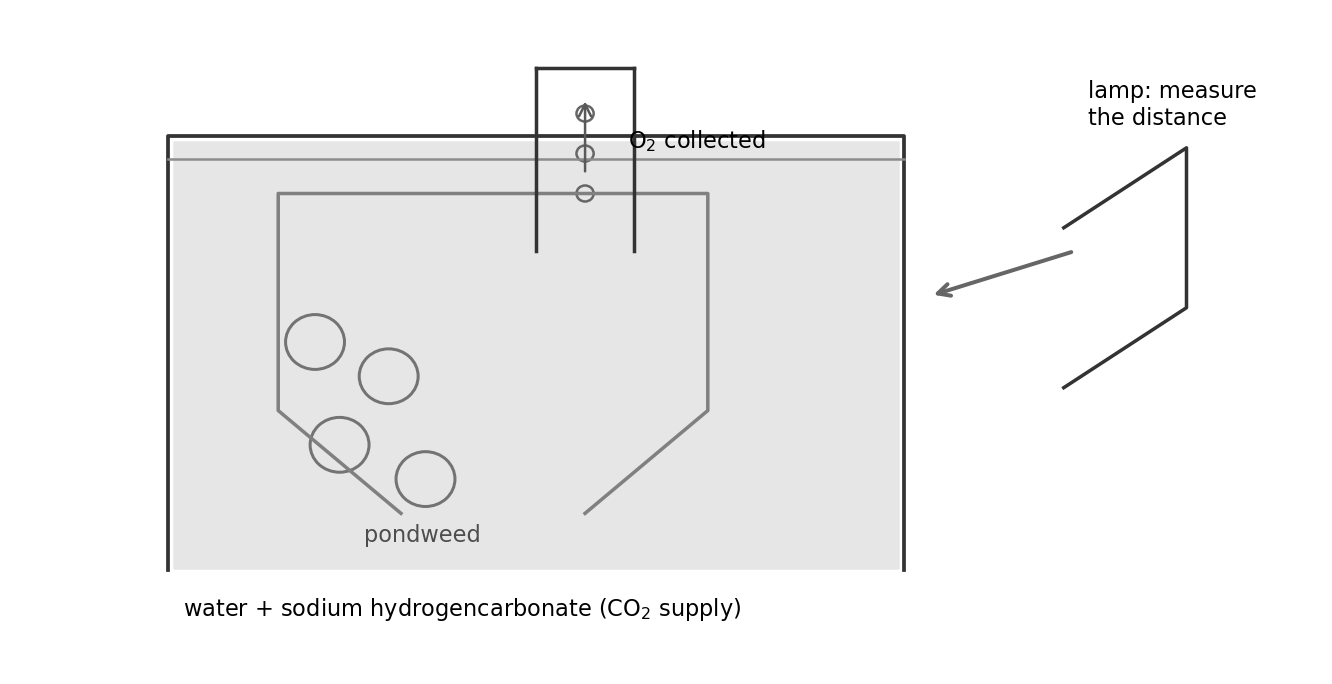
RP6: pondweed in water at different lamp distances; count the oxygen bubbles per minute (or collect the gas); control temperature and CO₂ (sodium hydrogencarbonate); repeat and mean; rate = bubbles ÷ time.
Worked example. Bubbles: 30 per minute at 10 cm; at 20 cm the light intensity is a quarter, so expect about 8 per minute (if light is still limiting).
Write the photosynthesis word and symbol equations, and describe it as endothermic.
Explain how light intensity, CO2 concentration and temperature limit the rate of photosynthesis, including interpreting limiting-factor graphs.
(HT) Use the inverse-square relation between light intensity and distance, and reasons for greenhouse economics.
Describe RP6: light intensity and the rate of photosynthesis with pondweed, its controls and the rate calculation.
Source: Cambridge International syllabus
Glucose from photosynthesis is used for:
respiration;
converted to insoluble starch for storage;
fat or oil for storage;
cellulose for cell walls;
amino acids for protein — this also needs nitrate ions from the soil.
4.2
Respiration (4.4.2.1)
Syllabus
Respiration and metabolism (AQA 8461 statements 4.4.1.3, 4.4.2.1-4.4.2.3).
Name five uses of glucose from photosynthesis.
Compare aerobic and anaerobic respiration in muscle and yeast, with word equations, and fermentation's economic importance.
Explain the body's response to exercise and (HT) oxygen debt and the liver's role.
Define metabolism and list the reactions it includes.
Source: Cambridge International syllabus
Respiration is an exothermic 放热 reaction occurring continuously in living cells, transferring the energy for: building larger molecules, movement, and keeping warm.
Aerobic
Anaerobic (muscle)
Anaerobic (plant/yeast)
oxygen
needed
not needed
not needed
equation
glucose + oxygen → CO₂ + water
glucose → lactic acid
glucose → ethanol + CO₂
energy
much more
much less
much less
Anaerobic respiration in yeast is fermentation 发酵, economically important in bread (CO₂ makes it rise) and alcoholic drinks.
Respiration and metabolism (AQA 8461 statements 4.4.1.3, 4.4.2.1-4.4.2.3).
Name five uses of glucose from photosynthesis.
Compare aerobic and anaerobic respiration in muscle and yeast, with word equations, and fermentation's economic importance.
Explain the body's response to exercise and (HT) oxygen debt and the liver's role.
Define metabolism and list the reactions it includes.
Source: Cambridge International syllabus
During exercise the heart rate, breathing rate and breath volume increase to deliver more oxygenated blood to muscles. If oxygen supply is insufficient, muscles switch to anaerobic respiration: incomplete glucose oxidation builds up lactic acid 乳酸 → fatigue; an oxygen debt 氧债 builds.
(HT) Blood carries lactic acid to the liver, which converts it back to glucose. The oxygen debt is the extra oxygen needed after exercise to react with and remove the accumulated lactic acid.