| Learning Objective | Essential Knowledge |
|---|---|
4.1.A |
|
Functions Involving Parameters, Vectors, and Matrices
AP Precalculus · Topic 4
 8:04
Functions Involving Parameters, Vectors, and Matrices
Look at this roller coaster. At every moment the car has two facts: where it is, and which way it is going. One equation cannot hold both. This planet runs a…
English narration · English + 中文 subtitles burned in
4.1
Parametric Functions
Syllabus
Source: College Board AP Course and Exam Description
Unit 4 is part of the course but is not assessed on the AP Precalculus Exam (which covers only Units 1–3); it builds tools used in later courses.
A parametric function 参数函数 describes a curve by giving both coordinates as functions of a third variable, the parameter 参数 $t$: $\big(x(t),\,y(t)\big)$. As $t$ runs through its domain, the point traces a path – and, unlike $y=f(x)$, the path may loop or cross itself.
Explore
What parametric form allows
In parametric form, x and y each depend on a parameter t. Sort each statement.
Vocabulary
Train
| English |
|---|
| parametric function/ˌpærəˈmetrɪk ˈfʌŋkʃn/ |
| parameter/pəˈræmɪtə/ |
4.2
Parametric Functions and Planar Motion
Syllabus
| Learning Objective | Essential Knowledge |
|---|---|
4.2.A |
|
Source: College Board AP Course and Exam Description
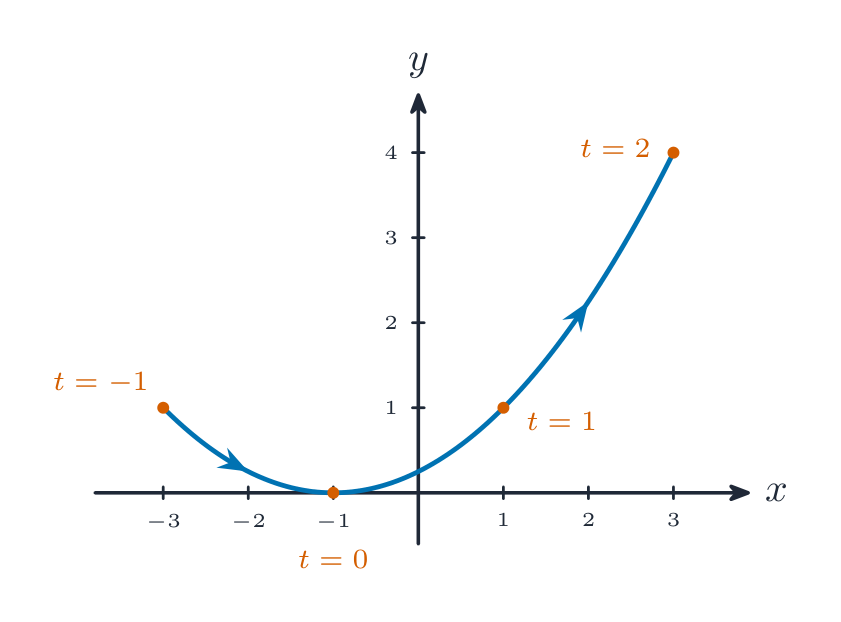
Reading $t$ as time, a parametric function models motion in the plane. $x(t)$ and $y(t)$ give the horizontal and vertical position; the point's direction of travel is the order in which the curve is drawn as $t$ increases (mark it with arrows).
Worked example. A particle moves with $x(t)=2t-1$ and $y(t)=t^2$ for $-1\le t\le 2$. Describe its path.
Make a table first:
| $t$ | $-1$ | $0$ | $1$ | $2$ |
|---|---|---|---|---|
| $(x,y)$ | $(-3,1)$ | $(-1,0)$ | $(1,1)$ | $(3,4)$ |
To eliminate the parameter, solve $x=2t-1$ for $t=\tfrac{x+1}{2}$ and substitute: $y=\tfrac{(x+1)^2}{4}$. The path is the part of this parabola from $(-3,1)$ to $(3,4)$. Because $x$ increases with $t$, the particle moves left to right: down to the vertex $(-1,0)$ at $t=0$, then up.
Common mistake. Giving the whole parabola $y=\tfrac{(x+1)^2}{4}$ as the answer. The restriction $-1\le t\le 2$ becomes $-3\le x\le 3$, and the equation alone shows no direction.
Explore
A path traced by a parameter
As the parameter runs, the point moves and traces out a planar curve.
4.3
Parametric Functions and Rates of Change
Syllabus
| Learning Objective | Essential Knowledge |
|---|---|
4.3.A |
|
Source: College Board AP Course and Exam Description
Over an interval of $t$, the average rate of change of $x$ is $\dfrac{\Delta x}{\Delta t}$ and of $y$ is $\dfrac{\Delta y}{\Delta t}$. Their signs tell you which way the point moves (right/left, up/down); together they describe the motion's speed and direction along the path.
Worked example. Find the average rates of change for the same particle on $0\le t\le 2$ and on $-1\le t\le 0$.
$$0\le t\le 2:\quad \frac{\Delta x}{\Delta t}=\frac{3-(-1)}{2}=2,\quad \frac{\Delta y}{\Delta t}=\frac{4-0}{2}=2; \qquad -1\le t\le 0:\quad \frac{\Delta y}{\Delta t}=\frac{0-1}{1}=-1.$$
On the first interval it moves right and up on average; on the second it moves down while it moves right.
Explore
Add two vectors tip to tail
Drag the two vectors and watch their sum. A vector has both a direction and a magnitude, unlike a plain number.
4.4
Parametrically Defined Circles and Lines
Syllabus
| Learning Objective | Essential Knowledge |
|---|---|
4.4.A |
|
Source: College Board AP Course and Exam Description
A circle of radius $R$ centered at $(h,k)$ is $x=h+R\cos t,\ y=k+R\sin t$. A line through $(x_0,y_0)$ with direction $(a,b)$ is $x=x_0+at,\ y=y_0+bt$. Adjusting the coefficients changes the start point, speed, and direction of tracing.
Worked example. The circle with center $(3,-2)$ and radius $5$ is $x=3+5\cos t,\ y=-2+5\sin t$ for $0\le t<2\pi$. It starts at $(8,-2)$ and turns counterclockwise. Writing $y=-2-5\sin t$ instead traces the same circle clockwise.
Worked example. The segment from $(1,4)$ to $(7,1)$ has direction $(7-1,\,1-4)=(6,-3)$, so $x=1+6t,\ y=4-3t$ for $0\le t\le 1$. At $t=0$ the point is at $(1,4)$; at $t=1$ it reaches $(7,1)$.
4.5
Implicitly Defined Functions
Syllabus
| Learning Objective | Essential Knowledge |
|---|---|
4.5.A |
|
4.5.B |
|
Source: College Board AP Course and Exam Description
An implicit 隐式 equation relates $x$ and $y$ without solving for either, such as $x^2+y^2=25$. Its graph may fail the vertical-line test (not a function), so it is often split into pieces or described parametrically.
Explore
Explicit or implicit?
An implicit equation relates x and y without solving for y. Sort each.
Vocabulary
Train
| English |
|---|
| implicit/ɪmˈplɪsɪt/ |
4.6
Conic Sections
Syllabus
| Learning Objective | Essential Knowledge |
|---|---|
4.6.A |
|
Source: College Board AP Course and Exam Description
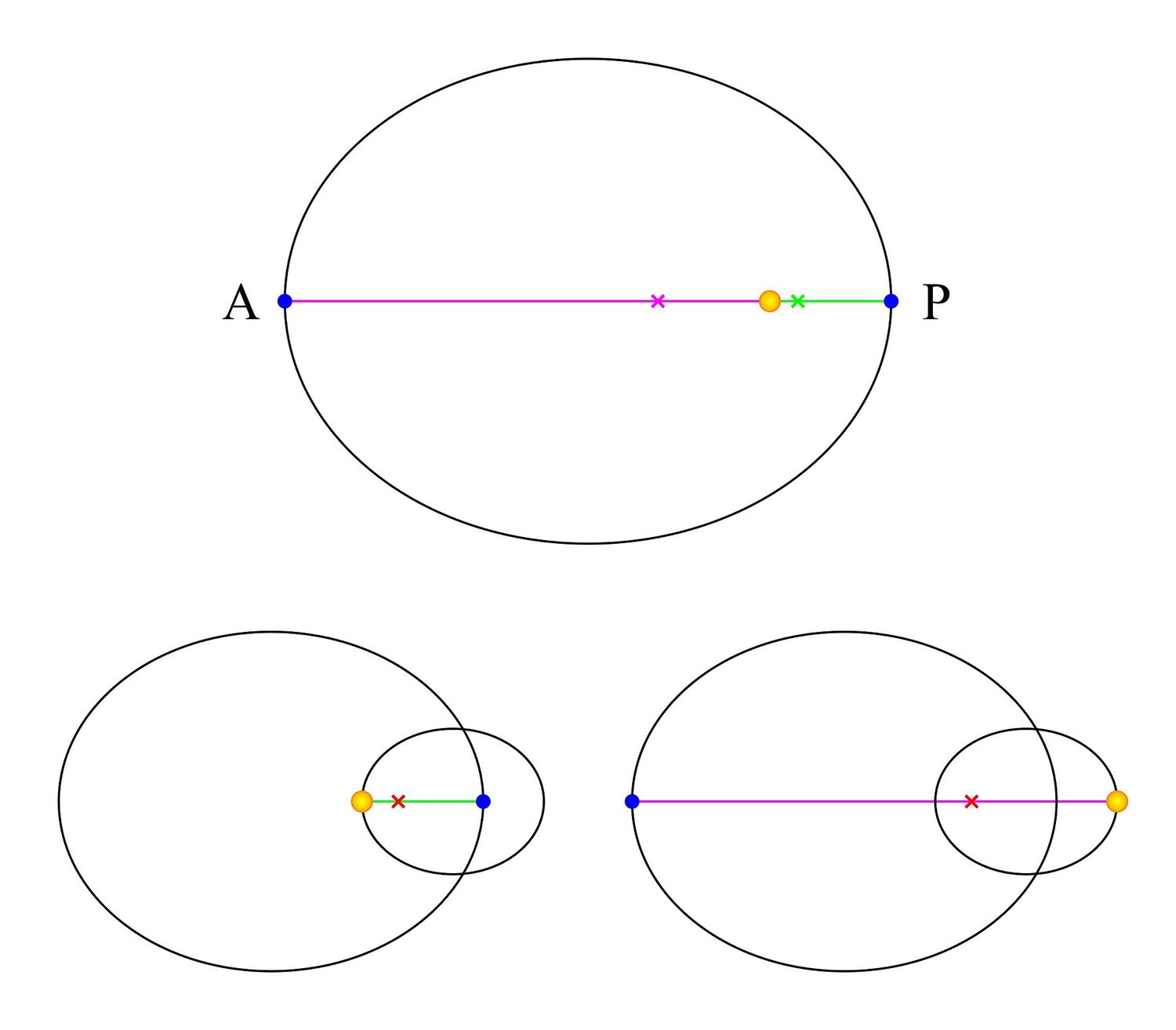
Conic sections 圆锥曲线 – circles, ellipses, parabolas, and hyperbolas – are the curves from slicing a cone, each given by a quadratic equation in $x$ and $y$. Their standard forms reveal centers, vertices, axes, and asymptotes.
Worked example. Identify $4x^2+9y^2-16x+18y-11=0$.
Complete the square in each variable:
$$4(x^2-4x)+9(y^2+2y)=11 \;\Rightarrow\; 4(x-2)^2-16+9(y+1)^2-9=11 \;\Rightarrow\; 4(x-2)^2+9(y+1)^2=36.$$
Divide by $36$: $\dfrac{(x-2)^2}{9}+\dfrac{(y+1)^2}{4}=1$. This is an ellipse 椭圆 with center $(2,-1)$, reaching $3$ units left and right (to $(-1,-1)$ and $(5,-1)$) and $2$ units up and down (to $(2,1)$ and $(2,-3)$).
Worked example. The hyperbola 双曲线 $\dfrac{x^2}{16}-\dfrac{y^2}{9}=1$ has vertices $(\pm4,0)$ and asymptotes $y=\pm\tfrac34x$. The minus sign makes it a hyperbola, and the positive $x^2$ term means it opens left and right.
Common mistake. Forgetting to subtract the constants that completing the square adds ($-16$ and $-9$ above), or dividing only one term by $36$.
Explore
Which conic section?
The squared terms tell you the conic. Sort each equation.
Vocabulary
Train
| English |
|---|
| Conic sections/ˈkɒnɪk ˈsekʃnz/ |
| ellipse/ɪˈlɪps/ |
| hyperbola/haɪˈpɜːbələ/ |
4.7
Parametrizing Implicit Curves
Syllabus
| Learning Objective | Essential Knowledge |
|---|---|
4.7.A |
|
4.7.B |
|
Source: College Board AP Course and Exam Description
Many implicit curves can be parametrized – rewritten as $\big(x(t),y(t)\big)$ – which makes them easier to graph and to treat as motion. The circle above is the basic example; ellipses use $x=h+A\cos t,\ y=k+B\sin t$.
For the ellipse above, $x=2+3\cos t,\ y=-1+2\sin t$, $0\le t<2\pi$.
Explore
Turn a circle equation into motion
The implicit circle x squared plus y squared equals 4 becomes the parametric x = 2 cos t, y = 2 sin t as the angle sweeps.
4.8
Vectors
Syllabus
| Learning Objective | Essential Knowledge |
|---|---|
4.8.A |
|
4.8.B |
|
4.8.C |
|
4.8.D |
|
Source: College Board AP Course and Exam Description
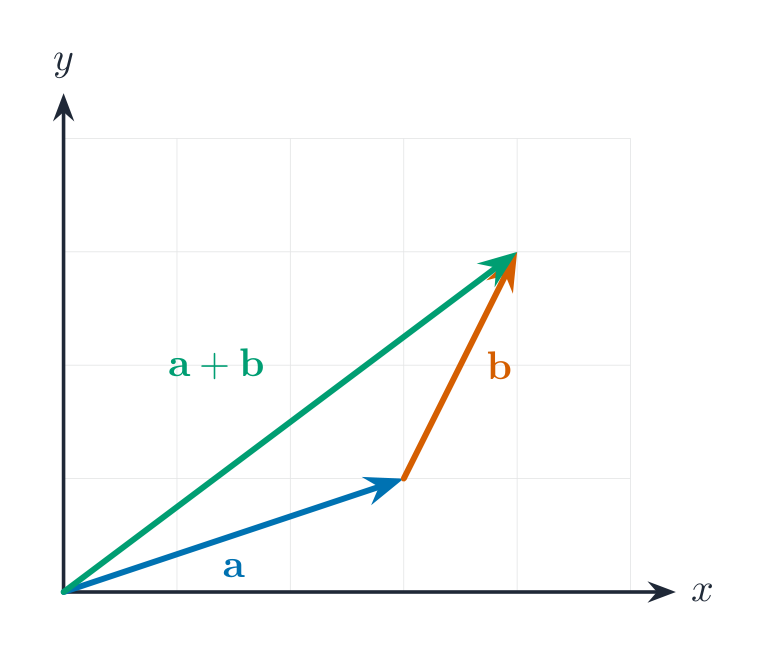
A vector 向量 has both magnitude 大小 (length) and direction. Write it by components $\langle a,b\rangle$. Add vectors component-by-component; scale by multiplying each component; the magnitude is $\sqrt{a^2+b^2}$. Vectors model displacements, velocities, and forces.
Worked example. Let $\vec u=\langle 3,-4\rangle$ and $\vec v=\langle -1,2\rangle$. Then $\vec u+2\vec v=\langle 3-2,\,-4+4\rangle=\langle 1,0\rangle$, and $\lvert\vec u\rvert=\sqrt{9+16}=5$. The unit vector in the direction of $\vec u$ divides by its magnitude: $\tfrac15\vec u=\left\langle \tfrac35,-\tfrac45\right\rangle$.
Explore
Add two vectors tip to tail
A vector has magnitude and direction. Adding two vectors places them tip to tail; the resultant runs from the first tail to the last tip. Drag each to see the sum.
Vocabulary
Train
| English |
|---|
| vector/ˈvektə/ |
| magnitude/ˈmæɡnɪtjuːd/ |
4.9
Vector-Valued Functions
Syllabus
| Learning Objective | Essential Knowledge |
|---|---|
4.9.A |
|
Source: College Board AP Course and Exam Description
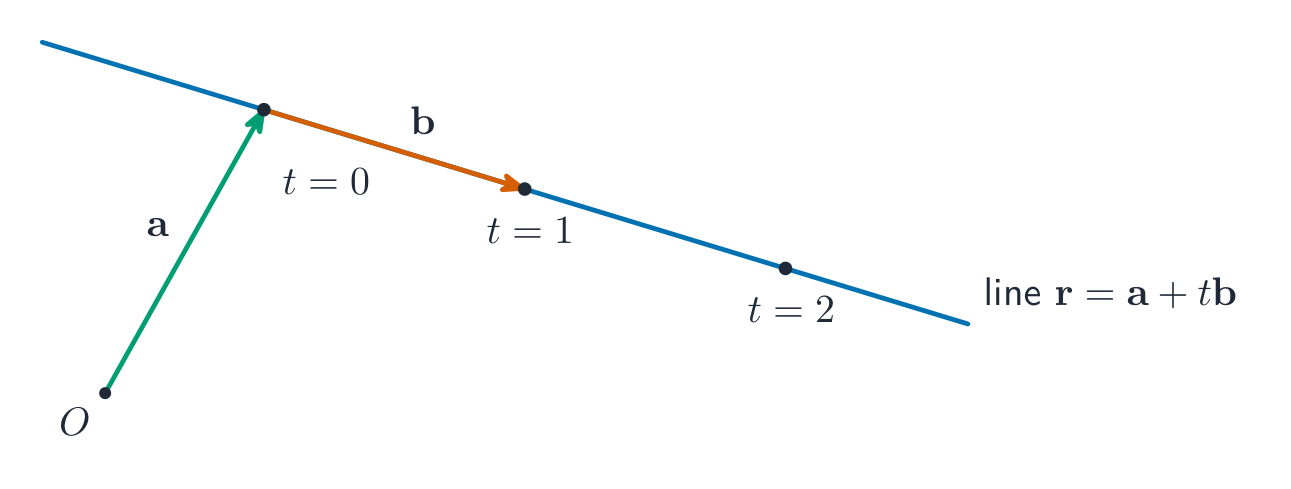
A vector-valued function 向量值函数 outputs a vector for each input, e.g. $\vec{r}(t)=\langle x(t),y(t)\rangle$ – the same information as a parametric function, packaged as a moving position vector.
Explore
Vector-valued functions
A vector-valued function outputs a vector; add the component vectors to get the resultant.
Vocabulary
Train
| English |
|---|
| vector-valued function/ˈvektə ˈvæljuːd ˈfʌŋkʃn/ |
4.10
Matrices
Syllabus
| Learning Objective | Essential Knowledge |
|---|---|
4.10.A |
|
Source: College Board AP Course and Exam Description
A matrix 矩阵 is a rectangular array of numbers. Add matrices of the same size entry-by-entry; multiply a matrix by a compatible one by combining rows with columns. Matrices store and transform data compactly.
Worked example.
$$\begin{bmatrix}1 & 2\\ 0 & 1\end{bmatrix}\begin{bmatrix}3 & 0\\ 1 & 2\end{bmatrix}=\begin{bmatrix}1\cdot3+2\cdot1 & 1\cdot0+2\cdot2\\ 0\cdot3+1\cdot1 & 0\cdot0+1\cdot2\end{bmatrix}=\begin{bmatrix}5 & 4\\ 1 & 2\end{bmatrix}.$$
In the other order the product is $\begin{bmatrix}3 & 6\\ 1 & 4\end{bmatrix}$, which is different. Matrix multiplication is not commutative: order matters.
Explore
A matrix transforms the plane
A 2x2 matrix moves every point of the plane; this one shears it sideways.
Vocabulary
Train
| English |
|---|
| matrix/ˈmeɪtrɪks/ |
4.11
The Inverse and Determinant of a Matrix
Syllabus
| Learning Objective | Essential Knowledge |
|---|---|
4.11.A |
|
4.11.B |
|
Source: College Board AP Course and Exam Description
The determinant 行列式 of a $2\times 2$ matrix $\begin{bmatrix} a & b \\ c & d\end{bmatrix}$ is $ad-bc$. A matrix has an inverse 逆矩阵 exactly when its determinant is nonzero; the inverse undoes the matrix, and it solves matrix equations (like a reciprocal for numbers).
Worked example. For $A=\begin{bmatrix}3 & 1\\ 2 & 4\end{bmatrix}$, the determinant is $ad-bc=(3)(4)-(1)(2)=10$. Since it is nonzero, $A$ is invertible, and $A^{-1}=\dfrac{1}{10}\begin{bmatrix}4 & -1\\ -2 & 3\end{bmatrix}$ (swap the diagonal, negate the off-diagonal, divide by the determinant).
Worked example. Solve $3x+y=7,\ 2x+4y=8$ with $A^{-1}$. In matrix form $A\begin{bmatrix}x\\y\end{bmatrix}=\begin{bmatrix}7\\8\end{bmatrix}$, so
$$\begin{bmatrix}x\\y\end{bmatrix}=A^{-1}\begin{bmatrix}7\\8\end{bmatrix}=\frac{1}{10}\begin{bmatrix}4\cdot7-1\cdot8\\ -2\cdot7+3\cdot8\end{bmatrix}=\frac{1}{10}\begin{bmatrix}20\\10\end{bmatrix}=\begin{bmatrix}2\\1\end{bmatrix}.$$
Check: $3(2)+1=7$ and $2(2)+4(1)=8$.
Explore
The determinant is an area factor
The determinant tells you how much a matrix scales area; here it scales area by four.
Vocabulary
Train
| English |
|---|
| determinant/dɪˈtɜːmɪnənt/ |
| inverse/ɪnˈvɜːs/ |
4.12
Linear Transformations and Matrices
Syllabus
| Learning Objective | Essential Knowledge |
|---|---|
4.12.A |
|
Source: College Board AP Course and Exam Description
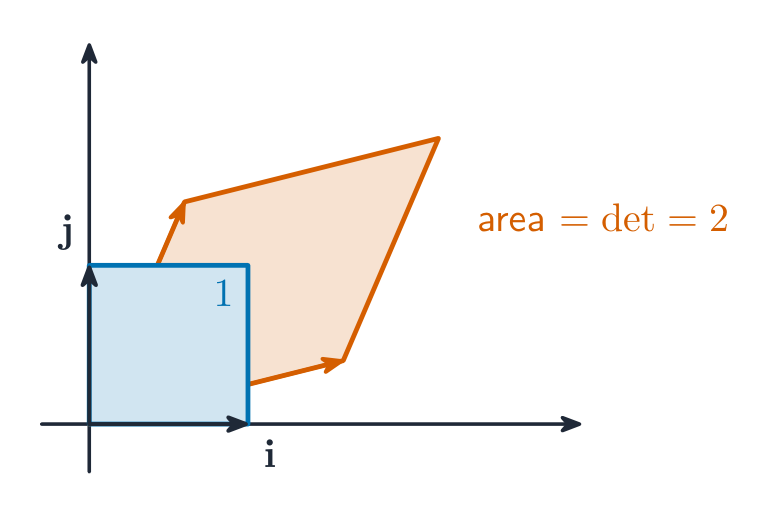
A $2\times 2$ matrix acts as a linear transformation 线性变换 of the plane – rotating, reflecting, stretching, or shearing points – by multiplying each position vector. The determinant measures how the transformation scales area (and its sign tells whether orientation flips).
Worked example. The matrix $\begin{bmatrix}2 & 0\\ 0 & 3\end{bmatrix}$ stretches the plane by $2$ horizontally and $3$ vertically, sending the vector $\begin{bmatrix}1\\1\end{bmatrix}$ to $\begin{bmatrix}2\\3\end{bmatrix}$. Its determinant $2\times3=6$ means every area is multiplied by $6$, so the unit square becomes a $2\times3$ rectangle.
Worked example. The rotation by angle $\theta$ counterclockwise about the origin is $\begin{bmatrix}\cos\theta & -\sin\theta\\ \sin\theta & \cos\theta\end{bmatrix}$. For $\theta=90^\circ$ it is $\begin{bmatrix}0 & -1\\ 1 & 0\end{bmatrix}$, which sends $\begin{bmatrix}3\\1\end{bmatrix}$ to $\begin{bmatrix}-1\\3\end{bmatrix}$. Its determinant is $0\cdot0-(-1)(1)=1$: a rotation keeps every area the same.
Explore
Transform the plane with a matrix
A $2\times2$ matrix maps every point to a new one, so it stretches, rotates or shears the whole grid. Change the entries and watch the unit square transform.
Vocabulary
Train
| English |
|---|
| linear transformation/ˈlɪnɪə trænsfɔːˈmeɪʃn/ |
4.13
Matrices as Functions
Syllabus
| Learning Objective | Essential Knowledge |
|---|---|
4.13.A |
|
4.13.B |
|
4.13.C |
|
Source: College Board AP Course and Exam Description
Because a matrix maps input vectors to output vectors, it is a function on the plane. Composing transformations corresponds to multiplying their matrices, and the inverse matrix reverses the mapping.
Explore
A matrix as a function
A matrix takes an input vector and returns an output vector - a function on vectors.
4.14
Matrices Modeling Contexts
Syllabus
| Learning Objective | Essential Knowledge |
|---|---|
4.14.A |
|
4.14.B |
|
Source: College Board AP Course and Exam Description
Matrices model systems that step forward in stages – for example, populations moving between states each year. Repeated multiplication by a transition matrix advances the model one step at a time, so matrix powers predict long-run behavior.
Worked example. Each year $90\%$ of a town's residents who use bus A keep using it and $10\%$ switch to bus B; $20\%$ of bus B users switch to A and $80\%$ stay. Write the model with each column holding where one group goes:
$$T=\begin{bmatrix}0.9 & 0.2\\ 0.1 & 0.8\end{bmatrix}, \qquad T\begin{bmatrix}600\\400\end{bmatrix}=\begin{bmatrix}0.9(600)+0.2(400)\\ 0.1(600)+0.8(400)\end{bmatrix}=\begin{bmatrix}620\\380\end{bmatrix}.$$
After one year, $620$ use A and $380$ use B. The numbers stop changing when the flows balance, $0.1A=0.2B$, so $A=2B$. Out of $1000$ residents, that is about $667$ on A and $333$ on B in the long run.
Explore
A good use of a matrix?
Matrices model transformations, systems and transitions. Sort each task.
4.14
Exam tips
- A parametric function gives $x(t)$ and $y(t)$ separately — track the direction of motion as $t$ increases.
- A vector has magnitude and direction; add component-by-component and find magnitude with $\sqrt{a^2+b^2}$.
- The determinant of a $2\times2$ matrix is $ad-bc$ (mind the minus sign); it scales area under the transformation.
- A $2\times2$ matrix transforms the plane (rotate, reflect, stretch); an inverse exists only when the determinant is non-zero.
- Note this unit is not tested on the AP Precalculus Exam (Units 1–3 only), but it underpins later courses.
Interactive lessons on this topic
Work through it step by step, with instant-check exercises.
- Parametric Functions
- Parametric Functions and Planar Motion
- Rates of Change in Parametric Functions
- Parametric Circles and Lines
- Implicitly Defined Functions
- Conic Sections
- Parametrizing Implicit Curves
- Vectors
- Vector-Valued Functions
- Matrices
- The Inverse and Determinant of a Matrix
- Linear Transformations and Matrices
- Matrices as Functions
- Matrices Modeling Contexts