| Learning Objective | Essential Knowledge |
|---|---|
3.1.A |
|
3.1.B |
|
Trigonometric and Polar Functions
AP Precalculus · Topic 3
 8:08
Trigonometric & Polar Functions
Watch a point travel around a circle at a steady rate. Its height rises, falls, and rises again, over and over. Trace that height against time, and you get a…
English narration · English + 中文 subtitles burned in
3.1
Periodic Phenomena

Syllabus
Source: College Board AP Course and Exam Description
A relationship is periodic 周期性 if its output pattern repeats at regular input steps. The period 周期 is the smallest positive $k$ with $f(x+k)=f(x)$ for all $x$. You can build the whole graph by copying a single cycle 周期段, and estimate the period by finding how far apart the pattern repeats. Within each cycle a periodic function still has intervals of increase/decrease and maxima/minima.
Explore
Complete cycles and repeated heights
Compare a full pattern with selected equal-height pairs.
Explore
A wave that repeats forever
y = a·sin(b(x − c)) + d
Slide along this wave and notice it repeats. The horizontal length of one full repeat is its period.
Vocabulary
Train
| English |
|---|
| periodic/ˌpɪərɪˈɒdɪk/ |
| period/ˈpɪərɪəd/ |
| cycle/ˈsaɪkl/ |
3.2
Sine, Cosine, and Tangent
Syllabus
| Learning Objective | Essential Knowledge |
|---|---|
3.2.A |
|
Source: College Board AP Course and Exam Description
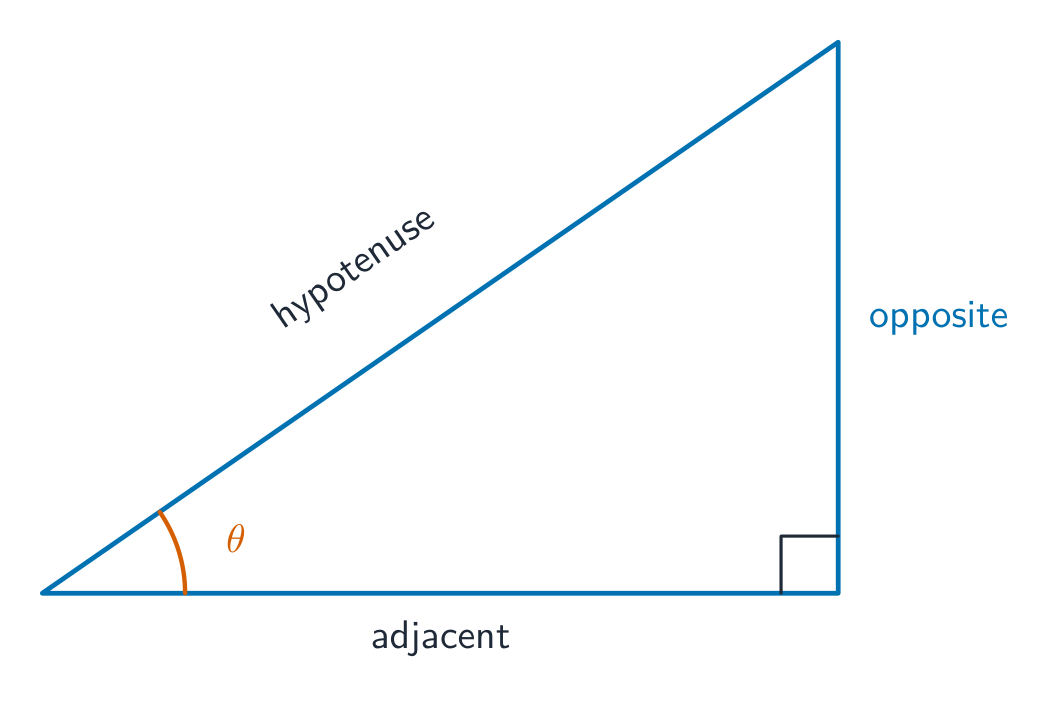
An angle is in standard position 标准位置 when its vertex is at the origin and its initial ray lies on the positive $x$-axis. Its radian 弧度 measure is the arc length on a unit circle. For the point $P$ where the terminal ray meets a circle of radius $r$:
$$\cos\theta = \frac{x}{r},\qquad \sin\theta = \frac{y}{r},\qquad \tan\theta = \frac{y}{x}\ (\text{the slope of the terminal ray}).$$
Explore
Read sine and cosine off the unit circle
On the unit circle a point at angle $\theta$ has coordinates $(\cos\theta,\ \sin\theta)$. Spin the angle to watch sine and cosine trace out as the height and width.
Explore
Signed coordinates and circle ratios
Normalise by the radius and check where tangent is defined.
Vocabulary
Train
| English |
|---|
| standard position/ˈstændəd pəˈzɪʃn/ |
| radian/ˈreɪdɪən/ |
3.3
Sine and Cosine Function Values
Syllabus
| Learning Objective | Essential Knowledge |
|---|---|
3.3.A |
|
Source: College Board AP Course and Exam Description
On a circle of radius $r$, $x=r\cos\theta$ and $y=r\sin\theta$. Exact values at the special angles ($0,\tfrac{\pi}{6},\tfrac{\pi}{4},\tfrac{\pi}{3},\tfrac{\pi}{2},\dots$) come from isosceles right and equilateral triangle 等边三角形 geometry, with signs set by the quadrant 象限 of the angle.
Explore
Read sine and cosine at any angle
Move the angle and watch the sine (height) and cosine (across) values change and repeat.
Explore
Exact special-angle values and signs
Keep fractions and radicals exact while changing the radius or adding full turns.
Vocabulary
Train
| English |
|---|
| equilateral triangle/ˌiːkwɪˈlætərəl ˈtraɪæŋɡl/ |
| quadrant/ˈkwɒdrənt/ |
3.4
Sine and Cosine Function Graphs
Syllabus
| Learning Objective | Essential Knowledge |
|---|---|
3.4.A |
|
Source: College Board AP Course and Exam Description
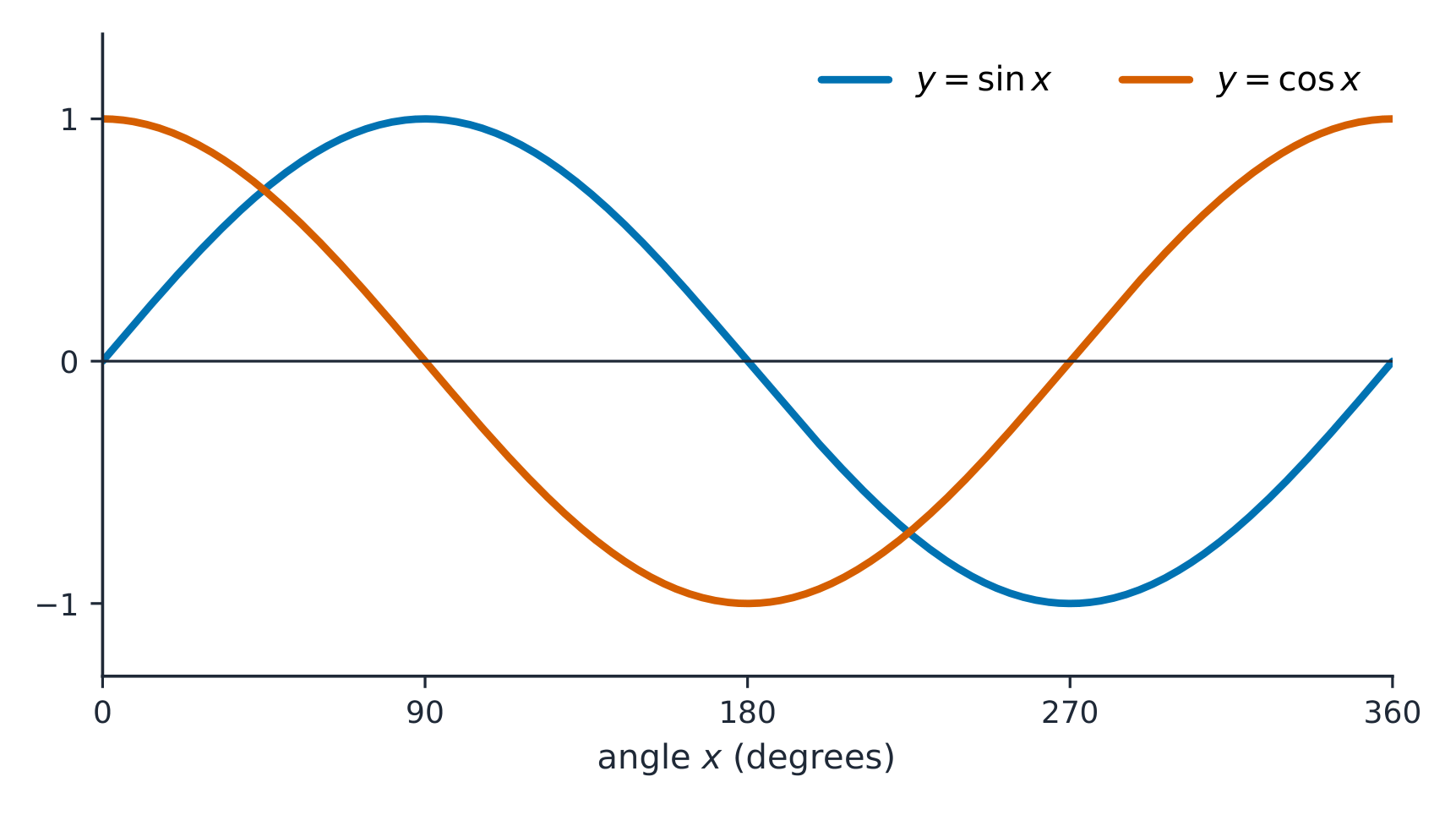
On the unit circle 单位圆 ($r=1$), $\sin\theta$ is the $y$-coordinate and $\cos\theta$ is the $x$-coordinate. As $\theta$ increases, both oscillate 振荡 smoothly between $-1$ and $1$ with period $2\pi$. Sine starts at $0$ (rising); cosine starts at $1$. They are the same wave shifted by $\tfrac{\pi}{2}$.
Explore
Graph a sine wave
Unrolling the circle gives the wave $y=\sin x$: it repeats every $2\pi$ (its period) and swings between $-1$ and $1$ (its amplitude).
Vocabulary
Train
| English |
|---|
| unit circle/ˈjuːnɪt ˈsɜːkl/ |
| oscillate/ˈɒsɪleɪt/ |
3.5
Sinusoidal Functions
Syllabus
| Learning Objective | Essential Knowledge |
|---|---|
3.5.A |
|
Source: College Board AP Course and Exam Description
A sinusoidal function 正弦型函数 is any transformation of sine (or cosine). Its key features:
- Period and frequency 频率 are reciprocals; $\sin\theta$ has period $2\pi$.
- Amplitude 振幅 = half the distance between the maximum and minimum output.
- Midline 中线 $y=d$ = the average of the maximum and minimum (the horizontal center line).
The graph alternates concave up and concave down each half-cycle.
Worked example. For $f(\theta)=3\sin(2\theta)+1$: the amplitude is $3$, the period is $\dfrac{2\pi}{2}=\pi$, and the midline is $y=1$. So the maximum output is $1+3=4$ and the minimum is $1-3=-2$.
Explore
Reshape a sinusoid with four controls
y = a·sin(b(x − c)) + d
a sets the amplitude, b sets the period, c shifts it sideways, and d sets the midline. Change each and watch.
Vocabulary
Train
| English |
|---|
| sinusoidal function/ˌsaɪnəˈsɔɪdl ˈfʌŋkʃn/ |
| frequency/ˈfriːkwənsi/ |
| Amplitude/ˈæmplɪtjuːd/ |
| Midline/ˈmɪdlaɪn/ |
3.6
Sinusoidal Function Transformations
Syllabus
| Learning Objective | Essential Knowledge |
|---|---|
3.6.A |
|
Source: College Board AP Course and Exam Description
The general sinusoid is
$$f(\theta)=a\sin\big(b(\theta+c)\big)+d \quad\text{or}\quad a\cos\big(b(\theta+c)\big)+d,$$
where $|a|$ is the amplitude, $\dfrac{2\pi}{|b|}$ is the period, $-c$ is the horizontal phase shift 相移 (a $+c$ inside the bracket shifts the graph left by $c$), and $d$ is the vertical shift (midline). A negative $a$ reflects the wave.
Explore
Stretch and shift a sinusoid
In $y=a\sin(bx+c)+d$: $a$ sets the amplitude, $b$ the period, $c$ a horizontal phase shift, and $d$ a vertical shift. Change each and watch the wave respond.
Vocabulary
Train
| English |
|---|
| phase shift/feɪz ʃɪft/ |
3.7
Sinusoidal Function Context and Data Modeling
Syllabus
| Learning Objective | Essential Knowledge |
|---|---|
3.7.A |
|
Source: College Board AP Course and Exam Description
To model periodic data (tides, daylight, temperature): read the period from where the pattern repeats, get the amplitude and midline from the max and min, and set the phase shift so a peak lands at the right input. Technology fits a sinusoidal regression. Such a model is only trustworthy over its contextual domain.
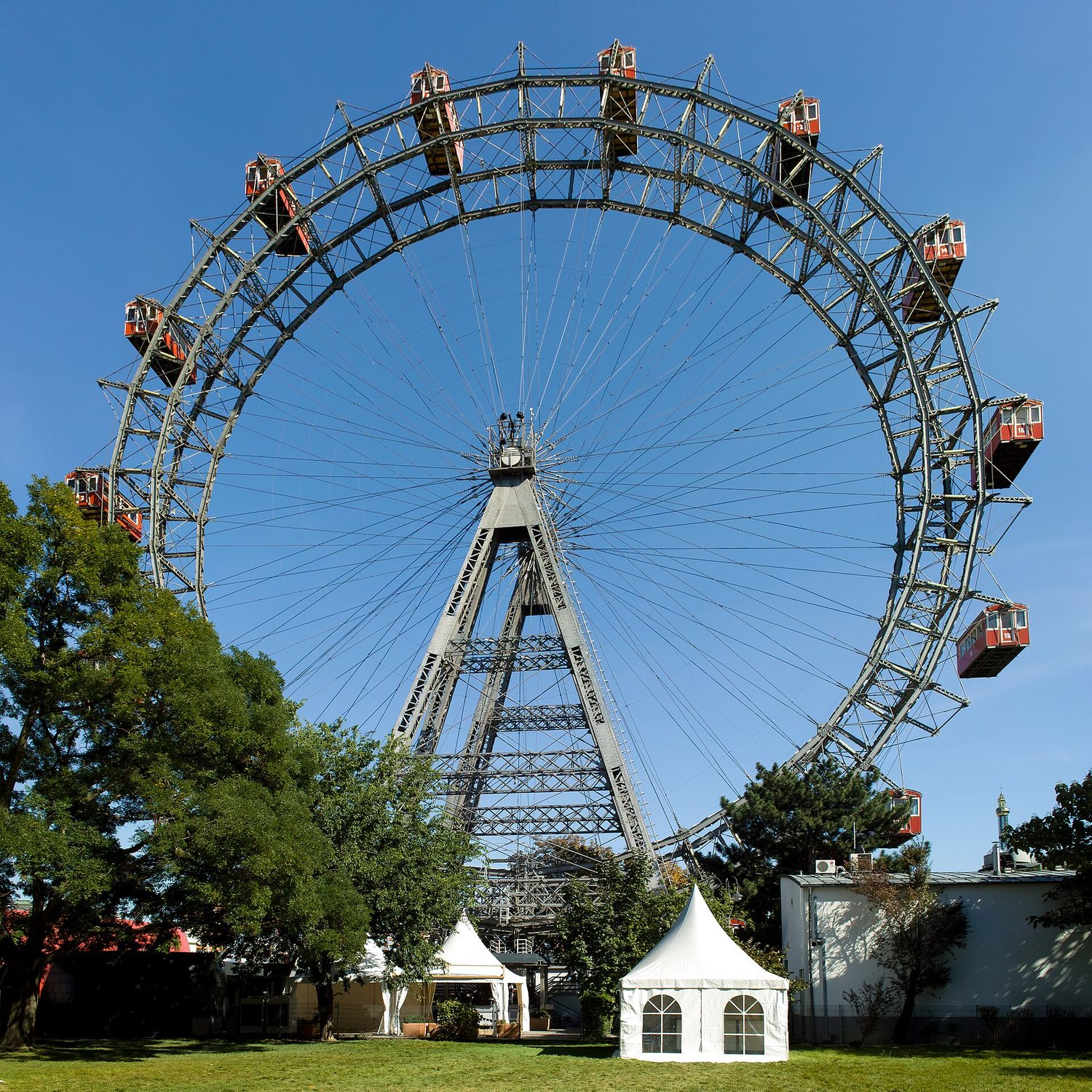
Worked example: a Ferris wheel. A rider's height $h$ (metres) on a wheel varies from $2$ m at the bottom to $50$ m at the top, and one turn takes $12$ minutes. At $t=0$ the rider is at the bottom. Build a model.
- Amplitude $=\tfrac{50-2}{2}=24$; midline $y=\tfrac{50+2}{2}=26$.
- Period $12$, so $b=\tfrac{2\pi}{12}=\tfrac{\pi}{6}$.
- At $t=0$ the height is a minimum. $\cos$ starts at a maximum, so $-\cos$ starts at a minimum and no phase shift is needed:
$$h(t)=-24\cos\!\left(\frac{\pi}{6}t\right)+26.$$
Check: $h(6)=-24\cos\pi+26=50$ (the top, after half a turn). After $2$ minutes, $h(2)=-24\cos\tfrac{\pi}{3}+26=-12+26=14$ m.
3.8
The Tangent Function
Syllabus
| Learning Objective | Essential Knowledge |
|---|---|
3.8.A |
|
3.8.B |
|
Source: College Board AP Course and Exam Description
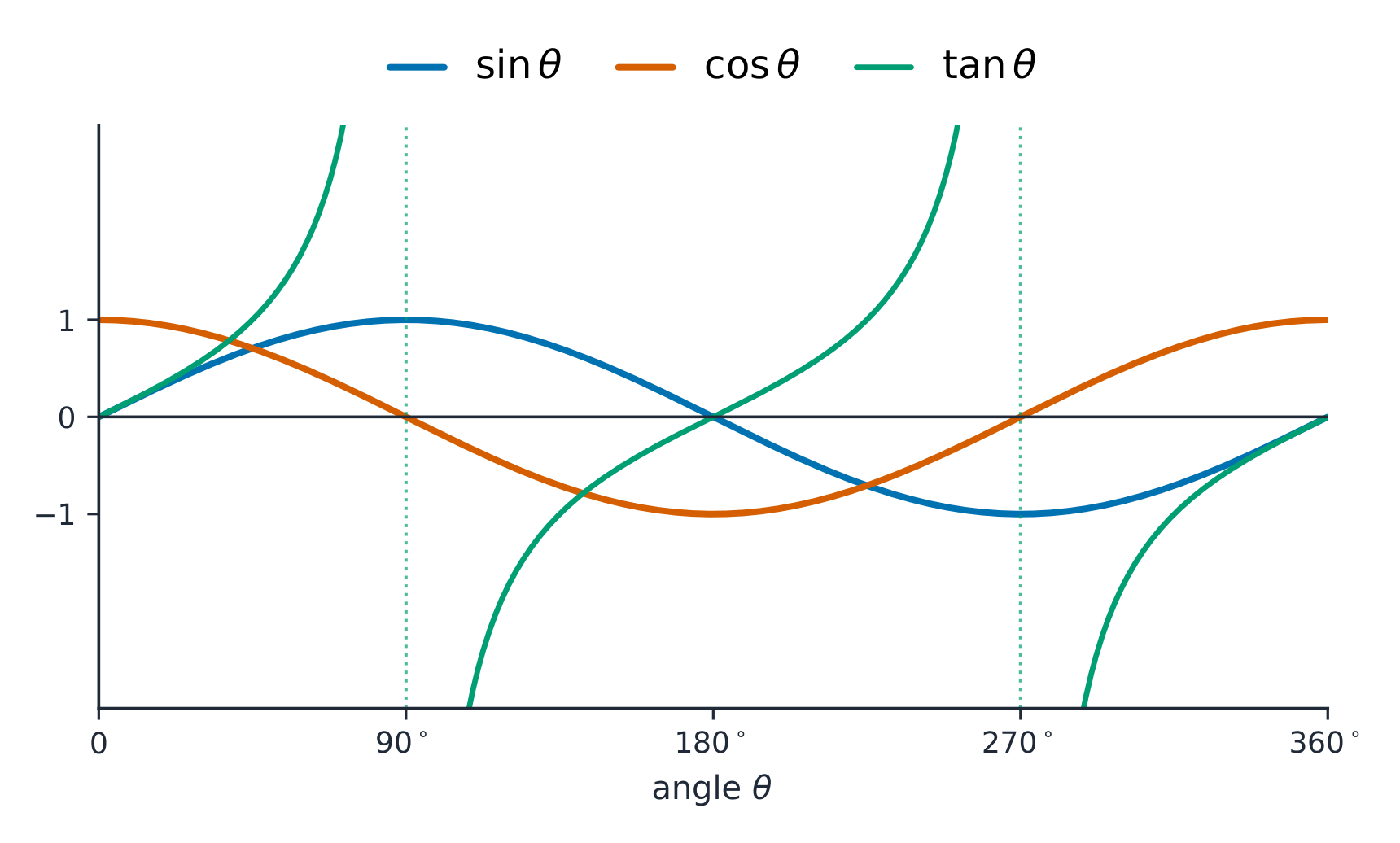
$\tan\theta=\dfrac{\sin\theta}{\cos\theta}$ is the slope of the terminal ray. Its slope values repeat every half-revolution, so its period is $\pi$. It has vertical asymptotes where $\cos\theta=0$ (at $\theta=\tfrac{\pi}{2}+k\pi$), and it is always increasing between consecutive asymptotes, switching concavity at each zero.
Explore
Tangent as a slope that runs away
On the unit circle, tangent is the slope of the radius line. As the angle nears 90 degrees, that slope shoots toward infinity.
3.9
Inverse Trigonometric Functions
Syllabus
| Learning Objective | Essential Knowledge |
|---|---|
3.9.A |
|
Source: College Board AP Course and Exam Description
The inverse trigonometric functions 反三角函数 – arcsine 反正弦, arccosine, arctangent – reverse the trig functions, so they take a ratio and return an angle. Because sine, cosine, and tangent repeat, their domains must be restricted (e.g. sine to $[-\tfrac{\pi}{2},\tfrac{\pi}{2}]$) before an inverse can exist.
So each inverse returns an angle in one fixed range: $\arcsin$ in $\left[-\tfrac{\pi}{2},\tfrac{\pi}{2}\right]$, $\arccos$ in $[0,\pi]$, $\arctan$ in $\left(-\tfrac{\pi}{2},\tfrac{\pi}{2}\right)$. For example, $\arcsin\!\left(-\tfrac12\right)=-\tfrac{\pi}{6}$, but $\arccos\!\left(-\tfrac12\right)=\tfrac{2\pi}{3}$ (not $-\tfrac{\pi}{3}$, which is outside $[0,\pi]$).
Explore
From a ratio back to an angle
An inverse trig function answers the reverse question — given the sine or cosine value, which angle produced it?
Vocabulary
Train
| English |
|---|
| inverse trigonometric functions/ɪnˈvɜːs ˌtrɪɡənəʊˈmetrɪk ˈfʌŋkʃnz/ |
| arcsine/ˈɑːksaɪn/ |
3.10
Trigonometric Equations and Inequalities
Syllabus
| Learning Objective | Essential Knowledge |
|---|---|
3.10.A |
|
Source: College Board AP Course and Exam Description
Use inverse trig functions to solve trig equations. Because the functions are periodic, there are usually infinitely many solutions – write the general solution by adding multiples of the period, then keep those in the required (often contextual) domain.
Worked example. Solve $2\sin\theta=1$ on $[0,2\pi)$. Then $\sin\theta=\tfrac12$, and on the unit circle sine is positive in the first and second quadrants, so $\theta=\dfrac{\pi}{6}$ or $\dfrac{5\pi}{6}$. Over all reals you would add $2\pi k$ to each.
Explore
Every crossing is a solution
y = sin x
The sine wave meets a horizontal target line again and again, so a trig equation has endlessly many solutions.
3.11
The Secant, Cosecant, and Cotangent Functions
Syllabus
| Learning Objective | Essential Knowledge |
|---|---|
3.11.A |
|
Source: College Board AP Course and Exam Description
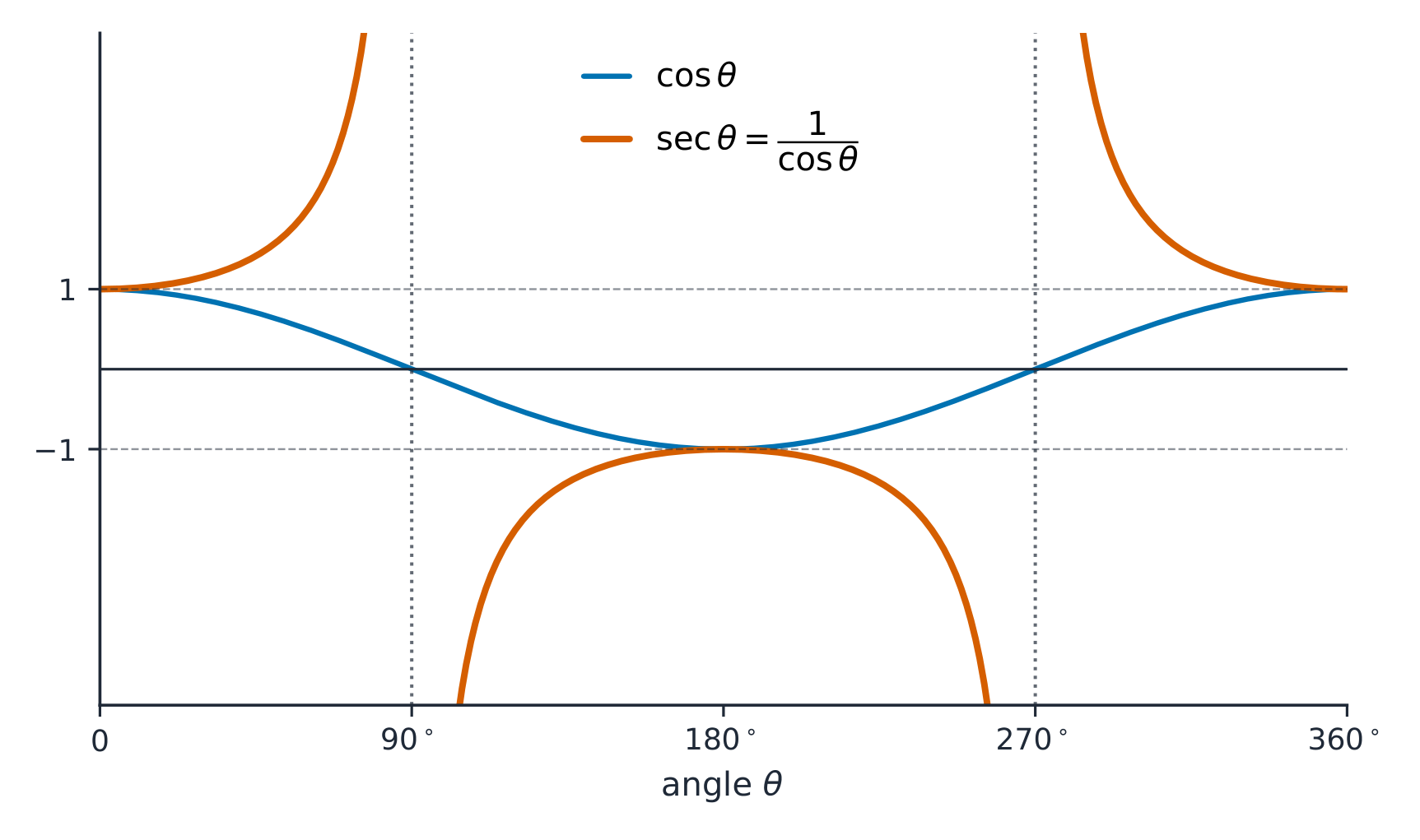
These are the reciprocals 倒数 of the main three:
$$\sec\theta=\frac{1}{\cos\theta},\qquad \csc\theta=\frac{1}{\sin\theta},\qquad \cot\theta=\frac{1}{\tan\theta}.$$
Secant and cosecant have vertical asymptotes where cosine and sine are zero; cotangent has them where tangent is zero (where sine is zero).
Vocabulary
Train
| English |
|---|
| reciprocals/rɪˈsɪprəklz/ |
3.12
Equivalent Representations of Trigonometric Functions
Syllabus
| Learning Objective | Essential Knowledge |
|---|---|
3.12.A |
|
3.12.B |
|
3.12.C |
|
Source: College Board AP Course and Exam Description
The Pythagorean identity 毕达哥拉斯恒等式 comes from $x^2+y^2=1$ on the unit circle:
$$\sin^2\theta+\cos^2\theta=1,$$
which rearranges into forms with $\sec$ and $\tan$. The sum identities 和角公式:
$$\sin(\alpha+\beta)=\sin\alpha\cos\beta+\cos\alpha\sin\beta,\qquad \cos(\alpha+\beta)=\cos\alpha\cos\beta-\sin\alpha\sin\beta,$$
also give the difference and double-angle 二倍角 identities (set $\beta=\alpha$).
Worked example. Find the exact value of $\sin\tfrac{5\pi}{12}$ (that is, $\sin 75^{\circ}$). Write $\tfrac{5\pi}{12}=\tfrac{\pi}{4}+\tfrac{\pi}{6}$:
$$\sin\frac{5\pi}{12}=\sin\frac{\pi}{4}\cos\frac{\pi}{6}+\cos\frac{\pi}{4}\sin\frac{\pi}{6}=\frac{\sqrt2}{2}\cdot\frac{\sqrt3}{2}+\frac{\sqrt2}{2}\cdot\frac12=\frac{\sqrt6+\sqrt2}{4}\approx 0.966.$$
Vocabulary
Train
| English |
|---|
| Pythagorean identity/ˈpaɪθəɡɔːrɪən aɪˈdentɪti/ |
| sum identities/sʌm aɪˈdentɪtiz/ |
| double-angle/ˈdʌbl ˈæŋɡl/ |
3.13
Trigonometry and Polar Coordinates
Syllabus
| Learning Objective | Essential Knowledge |
|---|---|
3.13.A |
|
Source: College Board AP Course and Exam Description
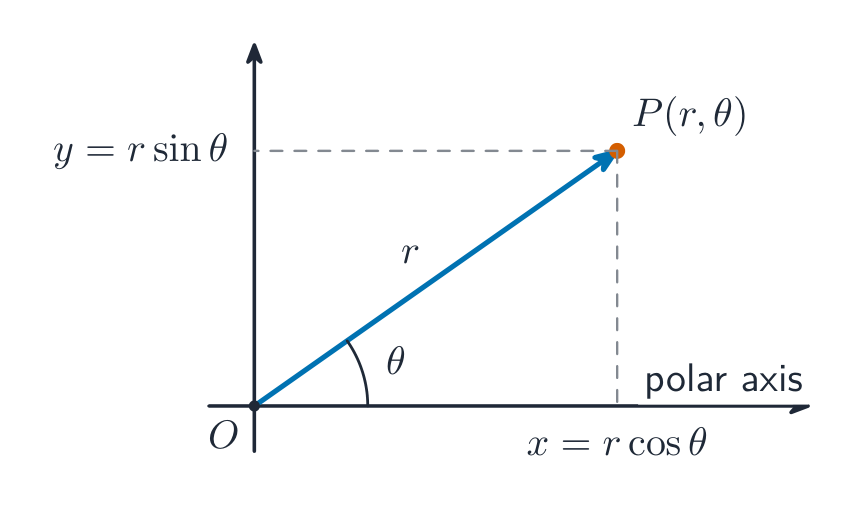
Polar coordinates 极坐标 locate a point by $(r,\theta)$ – distance $r$ from the origin at angle $\theta$. Convert with
$$x=r\cos\theta,\quad y=r\sin\theta,\qquad r=\sqrt{x^2+y^2},\quad \tan\theta=\frac{y}{x}.$$
A complex number 复数 is the point $(x,y)=x+yi$ and can likewise be written with $r$ and $\theta$.
Worked example. Write the point $(-1,\sqrt3)$ in polar form. $r=\sqrt{(-1)^2+(\sqrt3)^2}=2$ and $\tan\theta=\tfrac{\sqrt3}{-1}=-\sqrt3$. A calculator's $\arctan(-\sqrt3)=-\tfrac{\pi}{3}$ points into the fourth quadrant, but the point is in the second quadrant ($x<0$, $y>0$), so add $\pi$: $\theta=\tfrac{2\pi}{3}$. The polar form is $\left(2,\tfrac{2\pi}{3}\right)$. Always check the quadrant before trusting $\arctan$.
Vocabulary
Train
| English |
|---|
| Polar coordinates/ˈpəʊlə kəʊˈɔːdɪnəts/ |
| complex number/ˈkɒmpleks ˈnʌmbə/ |
3.14
Polar Function Graphs
Syllabus
| Learning Objective | Essential Knowledge |
|---|---|
3.14.A |
|
Source: College Board AP Course and Exam Description
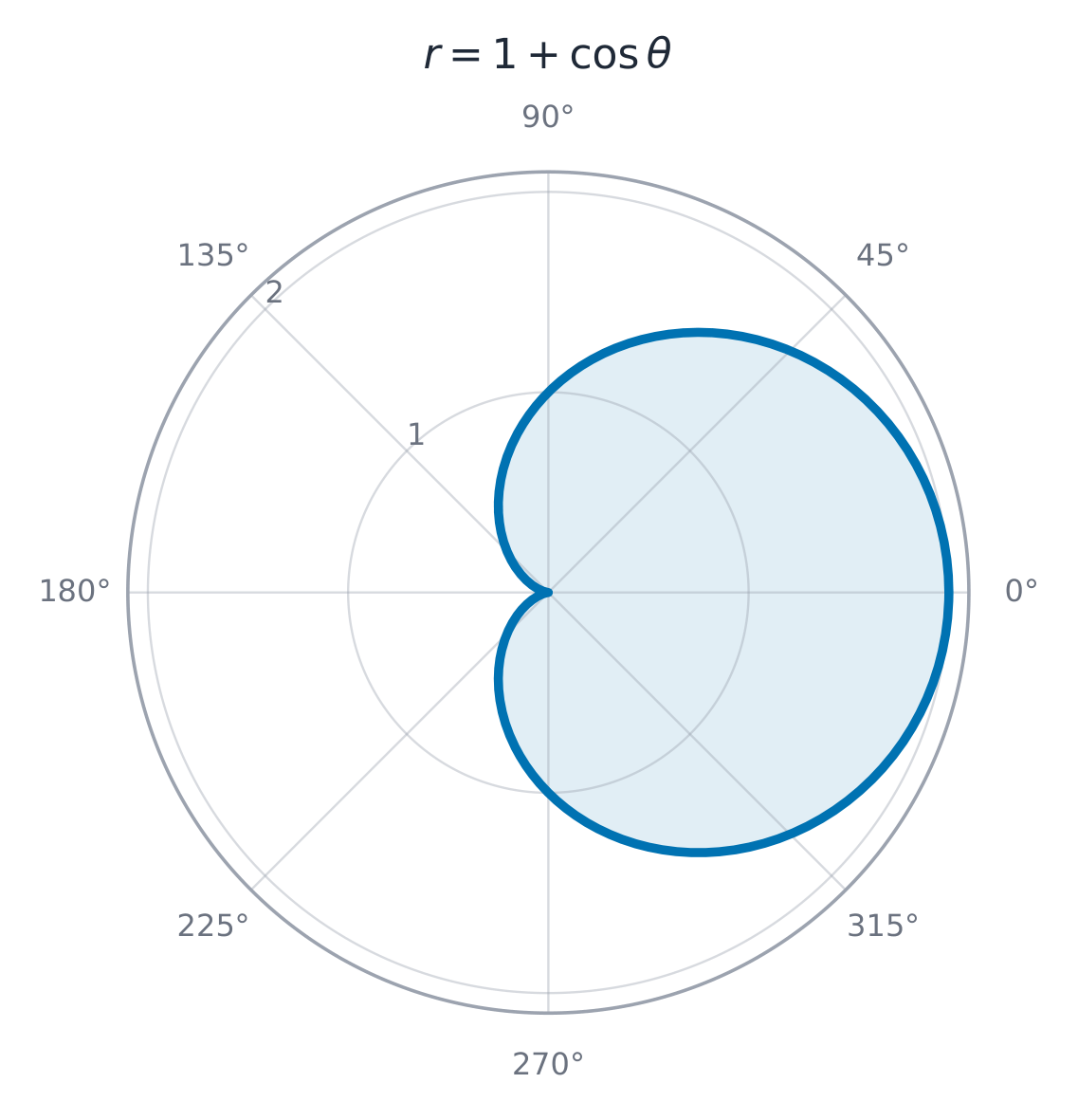
The graph of $r=f(\theta)$ is all points $(r,\theta)$ as $\theta$ sweeps around. Restricting the domain of $\theta$ draws only part of the curve. As $\theta$ increases, $r$ grows or shrinks, tracing spirals, circles, roses, and limaçons.
Explore
Plot a curve in polar coordinates
In polar form a point is a distance $r$ at angle $\theta$. Letting $r$ depend on $\theta$ traces shapes a rule in $x,y$ can't — like this cardioid.
3.15
Rates of Change in Polar Functions
Syllabus
| Learning Objective | Essential Knowledge |
|---|---|
3.15.A |
|
Source: College Board AP Course and Exam Description
As $\theta$ increases, the distance from the origin $r$ changes:
- $r$ positive and increasing (or negative and decreasing) $\Rightarrow$ moving away from the origin;
- $r$ positive and decreasing (or negative and increasing) $\Rightarrow$ moving toward the origin.
Where $r$ switches between increasing and decreasing, the distance reaches a relative extreme. The average rate of change of $r$ with respect to $\theta$, $\dfrac{\Delta r}{\Delta \theta}$, estimates how fast the curve moves in or out over an interval.
Worked example. For $r=3+2\cos\theta$ on $\left[0,\tfrac{\pi}{2}\right]$: $r(0)=5$ and $r\!\left(\tfrac{\pi}{2}\right)=3$. The average rate of change is $\dfrac{3-5}{\pi/2-0}=-\dfrac{4}{\pi}\approx-1.27$. Here $r$ is positive and decreasing, so the curve moves toward the origin, on average by about $1.27$ units of distance per radian.
Explore
Watch the radius grow as the angle sweeps
In a spiral, r increases with theta. The rate of change of r decides how quickly the curve winds outward.
3.15
Exam tips
- Use radians and the unit circle: $\cos\theta$ and $\sin\theta$ are the coordinates, always between $-1$ and $1$.
- For a sinusoid $a\sin(b(\theta+c))+d$: $|a|$ is the amplitude, $\tfrac{2\pi}{|b|}$ the period, $d$ the midline, and the phase shift is $-c$ (a $+c$ shifts left).
- Model periodic data by reading period, amplitude, and midline from the max and min.
- Inverse trig functions need a restricted domain and return an angle; trig equations have infinitely many solutions (add the period).
- Convert polar↔rectangular with $x=r\cos\theta$, $y=r\sin\theta$.
Interactive lessons on this topic
Work through it step by step, with instant-check exercises.
- Periodic Phenomena
- Sine, Cosine, and Tangent
- Sine and Cosine Function Values
- Graphs of Sine and Cosine
- Sinusoidal Functions
- Transformations of Sinusoidal Functions
- Modeling with Sinusoidal Functions
- The Tangent Function
- Inverse Trigonometric Functions
- Trigonometric Equations and Inequalities
- Secant, Cosecant, and Cotangent
- Equivalent Trigonometric Expressions
- Polar Coordinates
- Graphs of Polar Functions
- Rates of Change in Polar Functions