- Atoms are the building blocks: protons and neutrons in a tiny nucleus, electrons in shells; the outer shell runs the chemistry.
- The periodic table orders elements by atomic number; groups share outer-shell electrons and so share properties.
- Group 0 is unreactive, Group 1 gets more reactive down, Group 7 less; transition metals (chemistry only) behave differently from Group 1.
-
1
Atomic structure and the periodic table
1.1
Atomic structure and the periodic table: the particles and the pattern
語彙 練習するEnglish 日本語 atomic number/əˈtɒmɪk ˈnʌmbə/ 原子番号 outer shell electron/ˈaʊtə ʃel ɪˈlektrɒn/ 最外殻電子 1.1
Atoms, elements, compounds and mixtures (4.1.1.1–4.1.1.4)
シラバス
Atoms, elements, compounds and mixtures (AQA 8462 statements 4.1.1.1-4.1.1.4).
- Distinguish atoms, elements, compounds and mixtures, with symbols and formulae.
- Describe the five physical separation methods and choose one for a given mixture.
- Recount the development of the model of the atom from sphere to neutron.
- Use proton, neutron and electron charges and masses, atomic and mass numbers, isotopes and relative atomic mass.
- Write electronic structures for the first twenty elements.
出典: Cambridge International シラバス
All substances are made of atoms 原子 — the smallest part of an element that can exist. Each element has a chemical symbol (O, Na, …); about 100 elements exist, shown in the periodic table.
Compounds 化合物 form when elements combine chemically in fixed proportions; they are represented by formulae and can only be separated back into elements by chemical reactions. Chemical reactions always form one or more new substances, often with a detectable energy change. Equations: word equations and symbol equations with balanced formulae; (HT) balanced half-equations and ionic equations.
Mixtures 混合物: two or more elements or compounds not chemically combined; each substance keeps its properties. Separated by physical processes only — no new substances:
- filtration 过滤 — insoluble solid from liquid;
- crystallisation 结晶 — dissolved solid from solution;
- simple distillation 蒸馏 简单蒸馏 — liquid from dissolved solid (and solvents);
- fractional distillation 分馏 — liquids with different boiling points;
- chromatography 色谱法 — soluble substances in a mixture.
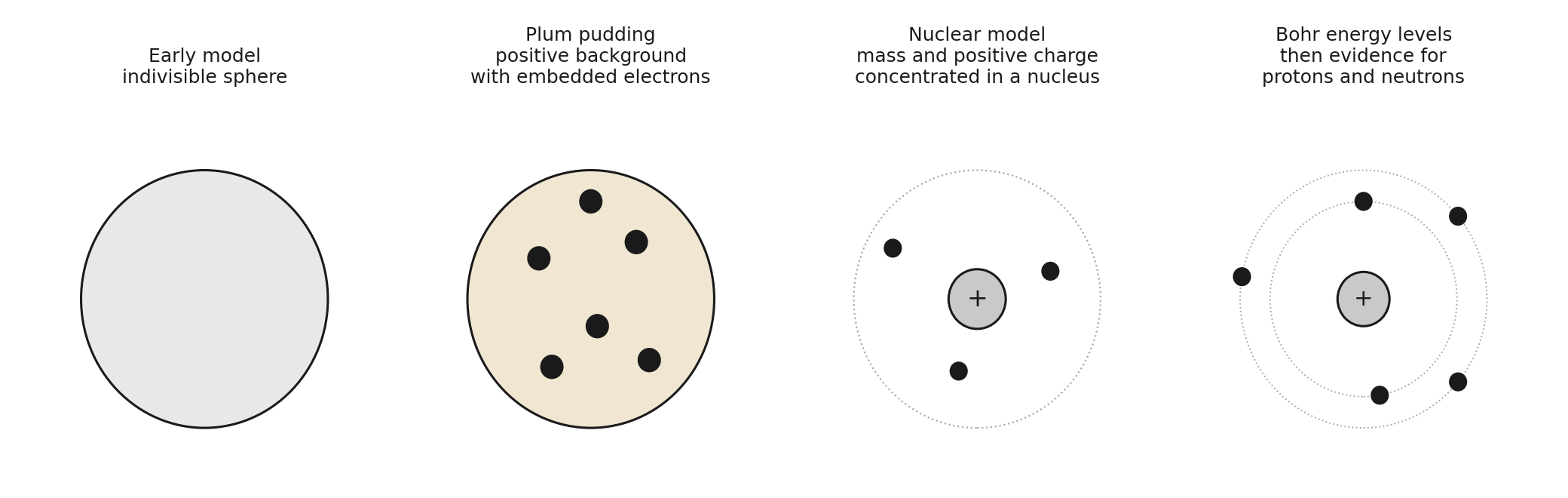
Development of the atom model: atoms were first thought to be indivisible spheres → the electron's discovery gave the plum pudding model 布丁模型 (ball of positive charge with negative electrons embedded) → the alpha-scattering experiment showed mass and positive charge concentrated in a central nucleus (nuclear model) → Bohr: electrons orbit at specific distances → protons identified in the nucleus → Chadwick: the neutron 中子. New evidence changes or replaces models.
particle relative mass relative charge proton 1 +1 neutron 1 0 electron very small −1 In an atom protons = electrons, so no overall charge. Atomic number = protons; mass number = protons + neutrons. Atoms of the same element with different neutron numbers are isotopes 同位素. Atom radius ≈ 0.1 nm (1 × 10⁻¹⁰ m); the nucleus is less than 1/10 000 of that. Almost all mass is in the nucleus.
Relative atomic mass (Ar) averages over the isotopes' abundance — calculate it from percentage abundances. Electronic structure: electrons fill the lowest levels first — sodium is 2,8,1; represent the first twenty elements both as numbers and diagrams.
語彙 練習するEnglish 日本語 atom/ˈætəm/ 原子 compound/ˈkɒmpaʊnd/ 化合物 mixture/ˈmɪkstʃə/ 混合物 filtration/fɪlˈtreɪʃn/ ろ過 crystallisation/ˌkrɪstəlaɪˈzeɪʃn/ 結晶化 distillation/dɪstɪˈleɪʃn/ 蒸留 chromatography/krəʊməˈtɒɡrəfi/ クロマトグラフィー plum pudding model/plʌm ˈpʊdɪŋ ˈmɒdl/ プラム・プディングモデル neutron/ˈnjuːtrɒn/ 中性子 isotope/ˈaɪsətəʊp/ 同位素 simple distillation/ˈsɪmpl dɪstɪˈleɪʃn/ 単純蒸留 fractional distillation/ˈfrækʃənl dɪstɪˈleɪʃn/ 分馏 1.2
The periodic table (4.1.2)

シラバス
The periodic table (AQA 8462 statement 4.1.2).
- Relate group and period to outer-shell electrons and atomic number.
- Describe the development of the periodic table, including Mendeleev's gaps and the isotope explanation.
- Distinguish metals from non-metals by position and properties.
- State and explain the trends in Groups 0, 1 and 7, including displacement.
出典: Cambridge International シラバス
The table orders elements by atomic (proton) number 原子序数, so that elements with similar properties fall in groups (columns). For main-group elements, group position reflects outer-shell electrons 最外层电子 and similar chemical properties; helium has two outer electrons, while the other Group 0 elements have eight. Explain an element's position from its electronic structure; predict probable reactivity from position.
Development: early tables ordered by atomic weight — incomplete, with some elements misplaced. Mendeleev left gaps for undiscovered elements and sometimes changed the order; his predicted elements were found, supporting his table. Isotopes later explained why atomic-weight order was sometimes wrong.
Metals and non-metals: metals usually lose electrons to form positive ions; many non-metals gain electrons to form negative ions or share electrons in covalent bonds. Metals sit left and lower; non-metals right and upper. Know the characteristic physical and chemical differences, and link atomic structure to position.
Group 0 — noble gases: unreactive — stable outer-shell arrangements (8 outer electrons; helium 2), so they do not easily form molecules. Boiling points increase down the group (with relative atomic mass).
Group 1 — alkali metals: one outer electron. Reactions of Li, Na, K with oxygen, chlorine and water (e.g. 2 Na + 2 H₂O → 2 NaOH + H₂). Reactivity increases down the group — the outer electron is lost more easily further from the nucleus.
Group 7 — halogens: seven outer electrons; non-metals, diatomic molecules (Cl₂, Br₂, I₂). Reactivity decreases down the group; melting and boiling points increase. A more reactive halogen displaces 置换 a less reactive one from a salt solution (chlorine displaces bromine from potassium bromide).
1.3
Transition metals — chemistry only (4.1.3)
シラバス
遷移金属、化学のみ(AQA 8462 宣言 4.1.3)。
- 遷移元素と第1族を、融点、密度、強度、硬さ、反応性で比較せよ。
- 異なる電荷を持つイオン、有色化合物、触媒作用を説明し、具体的な例を挙げる。
出典: Cambridge International シラバス
Compared with Group 1, the transition elements (exemplify with Cr, Mn, Fe, Co, Ni, Cu) have higher melting points, densities, strength and hardness, and are less reactive with oxygen, water and halogens.
Typical properties: ions with different charges (Fe²⁺/Fe³⁺), coloured compounds, and use as catalysts 催化剂 (iron in the Haber process).
語彙 練習するEnglish 日本語 catalyst/ˈkætəlɪst/ 触媒 1.3
Checklist before you call this topic done
- p/n/e table, atomic and mass numbers, isotopes, Ar from abundance, 2,8,x structures for the first 20.
- The atom-model timeline: sphere → plum pudding → nuclear → Bohr → proton → neutron.
- Five separation methods each matched to a mixture; Mendeleev's gaps and the isotope explanation.
- Group 0/1/7 trends with electron explanations; halogen displacement equations.
- (Chem) transition metals vs Group 1: four differences plus ions, colours, catalysts.
語彙 練習するEnglish 日本語 displacement/dɪˈspleɪsmənt/ 置換反応 -
2
Bonding, structure and the properties of matter
2.1
Bonding, structure and the properties of matter
- Three bonds hold matter together: ionic (transferred electrons, charged ions), covalent (shared electron pairs) and metallic (delocalised electrons).
- Structure follows bonding: giant ionic lattices, small molecules, polymers, giant covalent structure networks and metal lattices — each predicts melting point and conductivity.
- Carbon shows every trick: diamond, graphite, graphene, fullerenes; nanoparticles (chemistry only) turn surface area into properties.
語彙 練習するEnglish 日本語 delocalised electron/dɪˈlɒkəlaɪzd ɪˈlektrɒn/ 非局在電子 fullerene/ˈfʊləren/ フルレネ 2.1
Ionic, covalent and metallic bonding (4.2.1)

シラバス
Ionic, covalent and metallic bonding (AQA 8462 statements 4.2.1.1-4.2.1.5).
- Explain the three bond types in terms of electrons and electrostatic forces.
- Draw dot and cross diagrams for electron transfer and for the eight named molecules.
- Deducie ion charges and empirical formulae from group numbers and lattice models; state model limitations.
出典: Cambridge International シラバス
Three strong chemical bonds, all explained by electrostatic forces:
- Ionic 离子键 — a metal atom transfers outer electrons to a non-metal: metal atoms lose electrons to become positive ions; non-metal atoms gain them to become negative ions; Groups 1/2 metals and 6/7 non-metals form ions with noble-gas electronic structures. Draw the electron transfer with dot and cross diagrams; deduce ion charges from group number (Group 1 → +1, Group 2 → +2, Group 6 → −2, Group 7 → −1).
- Covalent 共价键 — non-metal atoms share pairs of electrons. Know dot-and-cross diagrams for H₂, Cl₂, O₂, N₂, HCl, H₂O, NH₃, CH₄, and line representations for small molecules, polymer repeating units and giant covalent structures.
- Metallic 金属键 — a giant lattice of metal atoms with delocalised outer electrons 游离电子 free to move through the whole structure; the sharing of these electrons gives strong metallic bonding.
Know the limitations of models: dot-and-cross, ball-and-stick, 2D and 3D diagrams all simplify — no forces shown, fixed bond lengths, giant structures drawn as small fragments. Deduce empirical formulae from lattice models; molecular formulae from molecule diagrams.
語彙 練習するEnglish 日本語 metallic bond/məˈtælɪk bɒnd/ 金属結合 2.2
Bonding, structure and properties (4.2.2)

シラバス
Bonding, structure and properties (AQA 8462 statements 4.2.2.1-4.2.2.8).
- Link states of matter and state symbols to particle theory, with (HT) its limitations.
- Explain the melting points and conductivity of ionic compounds, small molecules, polymers and metals.
- Explain why alloys are harder than pure metals.
出典: Cambridge International シラバス
States of matter: solid, liquid, gas; melting/freezing at the melting point, boiling/condensing at the boiling point. Particle theory (small solid spheres) explains the changes; the stronger the forces between particles, the higher the melting/boiling points. (HT) The simple model's limits: no forces shown, all spheres, solid particles. State symbols: (s), (l), (g), (aq).
Structure Bonding/forces Melting point Conducts electricity? ionic lattice strong electrostatic forces in all directions high only when molten or dissolved — ions free to move small molecules strong covalent bonds inside, weak intermolecular forces between 分子间作用力 low — only weak intermolecular forces are overcome no — no overall charge polymers strong covalent chains, stronger intermolecular forces solid at room temperature no giant covalent every atom covalently bonded very high generally no (graphite the exception) metals metallic bonding — delocalised electrons mostly high yes — delocalised electrons carry charge (and heat) Larger molecules → stronger intermolecular forces → higher melting/boiling points. Alloys 合金 are harder than pure metals because different-sized atoms distort the layers, stopping them sliding.
語彙 練習するEnglish 日本語 ionic bond/aɪˈɒnɪk bɒnd/ イオン結合 covalent bond/ˈkəʊvələnt bɒnd/ 共有結合 intermolecular force/ˌɪntəməˈlekjʊlə fɔːs/ 分子間力 alloy/ˈælɔɪ/ 合金 2.3
Structure and bonding of carbon (4.2.3)
シラバス
Structure and bonding of carbon (AQA 8462 statements 4.2.3.1-4.2.3.3).
- Explain diamond's properties from its four-bond giant structure.
- Explain graphite's properties from three bonds, layers and delocalised electrons.
- Describe graphene and fullerenes, including carbon nanotubes and their uses.
出典: Cambridge International シラバス
- Diamond — a giant covalent structure 巨型共价结构 in which each carbon forms four covalent bonds: very hard, very high melting point, does not conduct.
- Graphite — each carbon forms three bonds, layers of hexagonal rings with no covalent bonds between layers (soft, slippery — lubricant); one delocalised electron per atom → conducts electricity like a metal.
- Graphene — a single layer of graphite: one atom thick, strong, conducts — electronics and composites.
- Fullerenes — hollow molecules of carbon hexagons (plus 5- or 7-membered rings); Buckminsterfullerene C₆₀ 富勒烯 is spherical. Carbon nanotubes 碳纳米管 — cylindrical fullerenes with huge length-to-diameter ratios: nanotechnology, electronics, materials.
語彙 練習するEnglish 日本語 giant covalent structure/ˈdʒaɪənt ˈkəʊvələnt ˈstrʌktʃə/ 巨大共有結合構造 carbon nanotube/ˈkɑːbən ˌnænəʊˈtjuːb/ 炭素ナノチューブ 2.4
Bulk and surface properties incl. nanoparticles — chemistry only (4.2.4)

シラバス
Bulk and surface properties including nanoparticles, chemistry only (AQA 8462 statement 4.2.4).
- Compare nanoparticle, fine and coarse particle size ranges.
- Apply the surface-area-to-volume factor-of-10 rule to cubes.
- Explain why nanoparticles differ from bulk materials, their uses and the concerns.
出典: Cambridge International シラバス
Nanoscience = structures 1–100 nm (a few hundred atoms). Nanoparticles 纳米颗粒 are smaller than fine particles (PM2.5, 100–2500 nm), which are smaller than coarse particles/dust (PM10, 1 × 10⁻⁵–2.5 × 10⁻⁶ m).
Surface area : volume: as a cube's side decreases 10×, SA:V increases 10×. Nanoparticles may have different properties from the bulk material because of this high ratio — catalysts (smaller quantities work), medicine delivery, cosmetics, electronics. Concerns: effects inside the body and in the environment are not fully known.
語彙 練習するEnglish 日本語 nanoparticle/ˌnænəʊˈpɑːtɪkl/ ナノ粒子 2.4
Checklist before you call this topic done
- The three bonds in terms of electrons and electrostatic forces; ion charges from group numbers.
- Dot-and-cross for the eight named molecules; model limitations named.
- The properties table above rebuilt from memory — which forces are overcome on melting.
- Diamond vs graphite vs graphene vs fullerenes, bonding to property.
- (Chem) SA:V factor-of-10 rule; the three particle-size bands and nanoparticle uses and concerns.
-
3
Quantitative chemistry
3.1
Quantitative chemistry: counting atoms by mass
- Atoms are neither lost nor made: the balanced equation is a mass ledger, and conservation of mass closes every account.
- The mole converts grams into particle counts; moles turn equations into reacting-mass arithmetic.
- Yield, atom economy, concentration (chem only) and gas volumes (HT) finish the quantitative toolkit.
3.1
Conservation of mass and equations (4.3.1)

シラバス
Chemical measurements, conservation of mass and equations (AQA 8462 statements 4.3.1.1-4.3.1.4).
- Balance symbol equations and use conservation of mass.
- Calculate relative formula masses and percentage by mass of an element.
- Explain apparent mass changes when a gas is involved.
- Estimate uncertainty as the range of repeat measurements about the mean.
出典: Cambridge International シラバス
Conservation of mass 质量守恒: no atoms are lost or made, so the mass of products equals the mass of reactants. Symbol equations are balanced in atom numbers; know the difference between a multiplier before a formula (numbers of units) and a subscript within it (atoms in the unit).
Relative formula mass (Mr) 相对分子质量 = sum of the relative atomic masses in the numbers shown. In a balanced equation, ΣMr of reactants = ΣMr of products. Percentage by mass of an element = (Ar × number of atoms ÷ Mr) × 100 %.
Mass changes with gases: metal + oxygen → oxide gains mass; thermal decomposition of a carbonate loses the escaped CO₂ — no law is broken once the gas is counted.
Uncertainty: every measurement carries uncertainty; use the range of repeated measurements about the mean as its estimate (and mean ± range/2 in calculations).
語彙 練習するEnglish 日本語 conservation of mass/ˌkɒnsəˈveɪʃn ɒv mæs/ 質量保存の法則 relative formula mass/ˈrelətɪv ˈfɔːmjʊlə mæs/ 相対式量 3.2
Moles and reacting masses — HT (4.3.2)
シラバス
物質量と反応質量、HT(AQA 8462 記述 4.3.2.1-4.3.2.5)。
- モル、アボガドロ定数およびモル=質量/Mrを用いる。
- 平衡化学方程式から反応質量を計算する。
- 反応質量から化学方程式を平衡させる。
- 限界反応物質について説明し、用它する。
- g/dm3単位の濃度を計算し、mol/dm3との組み合わせで質量・体積関係を用いる。
出典: Cambridge International シラバス
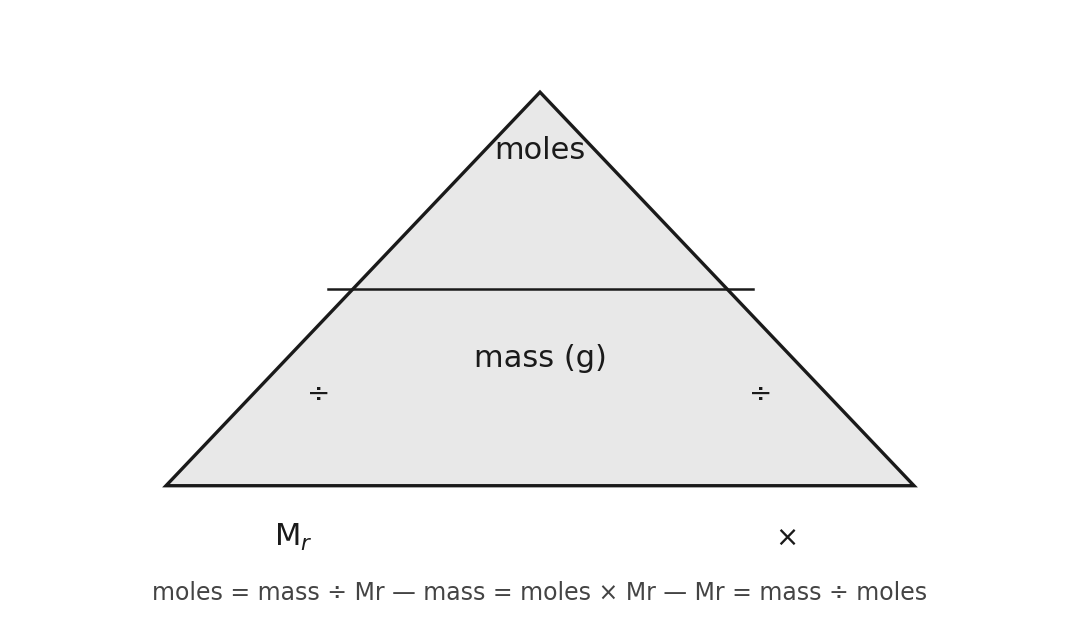
The mole 摩尔: the mass of one mole of a substance in grams is numerically its Mr. One mole contains the Avogadro constant 阿伏伽德罗常数 of particles — 6.02 × 10²³ — the same count of stated particles (atoms, molecules, ions) as a mole of any other substance.
$$\text{moles} = \frac{\text{mass (g)}}{M_r}$$Equations as mole ratios: Mg + 2 HCl → MgCl₂ + H₂ reads "1 mol Mg reacts with 2 mol HCl → 1 mol MgCl₂ + 1 mol H₂". Given any one mass, calculate all others: mass → moles → ratio → moles → mass.
Balancing from masses: convert each mass to moles, divide by the smallest, clear fractions to whole numbers.
Limiting reactant 限量反应物: the reactant completely used up limits the product; an excess of the other ensures completion. Calculate the product from the limiting reactant's moles only.
Concentration 浓度: in g/dm³ for all tiers — mass of solute in a given volume; (HT) also mol/dm³: moles = concentration × volume(dm³), rearranged as needed.
語彙 練習するEnglish 日本語 mole/məʊl/ モル Avogadro constant/ˌævəˈɡædrəʊ ˈkɒnstənt/ アボガドロ定数 limiting reactant/ˈlɪmɪtɪŋ rɪˈæktənt/ 限量反応物 concentration/ˌkɒnsənˈtreɪʃn/ 濃度 3.3
Yield and atom economy — chemistry only (4.3.3)
シラバス
収率と原子利用率、化学のみ(AQA 8462 記述 4.3.3)。
- 収率が100%未満となる3つの理由を挙げる。
- 百分収率を計算し、(HT) まず理論質量を求める。
- 原子利用率を計算し、その重要性を説明する。
出典: Cambridge International シラバス
Percentage yield 产率 is below 100 % because: the reaction is reversible; product is lost on separation; reactants react in unwanted ways.
$$\%\ \text{yield} = \frac{\text{mass actually made}}{\text{maximum theoretical mass}} \times 100$$Atom economy 原子经济 measures how much of the starting material ends up in the useful product — high atom economy matters for sustainability and cost:
$$\text{atom economy} = \frac{M_r \text{ of desired product}}{\text{sum of } M_r \text{ of all reactants}} \times 100\ \%$$(HT) calculate the theoretical mass from the balanced equation, then the yield.
語彙 練習するEnglish 日本語 percentage yield/pəˈsentɪdʒ jiːld/ 収率 atom economy/ˈætəm ɪˈkɒnəmi/ 原子効率 3.4
Concentrations in mol/dm³ — chemistry only, HT (4.3.4)
シラバス
mol/dm3単位の濃度、化学のみ、HT(AQA 8462 記述 4.3.4)。
- モル、質量、体積およびmol/dm3単位の濃度の関係を述べる。
- 滴定体積と化学方程式の係数比から未知の濃度を計算する。
出典: Cambridge International シラバス
Concentration in mol/dm³ links moles, mass and volume: moles = C × V; from a titration 滴定, knowing the volumes of both solutions and one concentration gives the other — moles of acid = moles of alkali at neutralisation (respect the ratio in the equation).
語彙 練習するEnglish 日本語 titration/taɪˈtreɪʃn/ 滴定 3.5
Gas volumes — chemistry only, HT (4.3.5)
シラバス
気体の体積、化学のみ、HT(AQA 8462 記述 4.3.5)。
- 同温同圧では等しい気体の体積は等しいモル数を含むことを述べる。
- 化学方程式の係数比を用いて、反応における気体の体積の関係を述べる。
出典: Cambridge International シラバス
A given volume of gas contains the same number of moles at the same temperature and pressure — equal volumes = equal moles. The volumes of reacting gases (and products) follow the equation's ratio directly, e.g. 2 volumes of hydrogen react with 1 volume of oxygen.
3.5
Checklist before you call this topic done
- Balance equations; Mr and percentage-by-mass sums; explain apparent mass changes with gases.
- (HT) mole ↔ mass conversions, Avogadro constant, ratio chains, balancing from masses, limiting reactant.
- (Chem/HT) percentage yield with its three reasons; atom economy formula; titration concentration; gas-volume ratios.
-
4
Chemical changes
4.1
Chemical changes: reactivity, acids and electrolysis
- Metals differ in how easily they lose electrons — the reactivity series 活动性顺序 orders them, drives displacement 置换 and decides how each is extracted.
- Acids donate H⁺; alkalis donate OH⁻; their reaction makes a salt 盐 — and the salt's name reads off the acid and the base.
- Electrolysis forces ions to give up or take electrons at electrodes — extracting the most reactive metals and splitting solutions.
語彙 練習するEnglish 日本語 reactivity series/rɪəkˈtɪvɪti ˈsɪəriːz/ 活性系列 displacement/dɪˈspleɪsmənt/ 置換反応 salt/sɒlt/ 塩 4.1
Reactivity of metals (4.4.1.1–4.4.1.4)

シラバス
金属の反応性(AQA 8462 記述 4.4.1.1-4.4.1.4)。
- 炭素や水素を含む反応性の順序を暗記し、水や酸との反応について述べる。
- 反応性を正イオン生成傾向として説明し、結果から順序を導き出す。
- 炭素還元と電気分解の反応性との関連。
- (HT) OIL RIGを用いて、置換反応および酸化還元反応のイオン方程式を記す。
出典: Cambridge International シラバス
Reactivity series (learn the order): potassium, sodium, lithium, calcium, magnesium, [carbon], zinc, iron, [hydrogen], copper. Reactivity = the metal's tendency to form positive ions.
- With water: K, Na, Li, Ca react ( fizzing, hydroxide + hydrogen); Mg very slow; Zn/Fe/Cu no reaction.
- With dilute acids: Mg, Zn, Fe react → salt + hydrogen; Cu does not.
- A more reactive metal displaces a less reactive one from its compound: Zn + CuSO₄ → ZnSO₄ + Cu.
Extraction: unreactive metals (gold) occur native; metals below carbon are extracted by reduction 还原 with carbon (loss of oxygen); metals above carbon need electrolysis 电解. Identify oxidation 氧化 (gain of oxygen) and reduction (loss of oxygen).
(HT) Redox in electrons: oxidation is loss of electrons, reduction is gain — OIL RIG. Write ionic equations for displacement: Zn + Cu²⁺ → Zn²⁺ + Cu.
語彙 練習するEnglish 日本語 reduction/rɪˈdʌkʃn/ 還元 oxidation/ˌɒksɪˈdeɪʃn/ 酸化 electrolysis/ɪlekˈtrɒləsɪs/ 電気分解 4.2
Reactions of acids and making salts (4.4.2)
シラバス
酸の反応(AQA 8462 statements 4.4.2.1-4.4.2.6)。
- 酸-金属および酸-塩基反応の生成物を予測し、酸と塩基から生成する塩の名前を付ける。
- 不溶性酸化物または炭酸塩からのRP1塩の調製法を説明する。
- pHスケール、万能指示薬、pHプローブを使用し、中和反応のイオン方程式を記す。
- (Chem) タイトレーション法(RP2)を説明し、(HT) 強酸・弱酸における倍率の10 pH則を用いる。
出典: Cambridge International シラバス
Acids neutralised by alkalis (soluble hydroxides) and bases (insoluble oxides/hydroxides) → salt + water; by metal carbonates → salt + water + carbon dioxide. The acid decides the salt's negative ion: hydrochloric → chlorides, nitric → nitrates, sulfuric → sulfates; the base supplies the positive ion. Predict products and write salt formulae from ion charges.
Making a soluble salt (RP1): add the insoluble solid (metal oxide/carbonate) to warm dilute acid until no more dissolves (excess solid proves completion), filter off the excess, evaporate to the crystallisation point and leave to crystallise; dry the crystals.
pH scale: 0–14, measured with universal indicator or a pH probe; 7 neutral, <7 acid, >7 alkaline. Acids give H⁺(aq); alkalis give OH⁻(aq). Neutralisation 中和: H⁺ + OH⁻ → H₂O.
(Chem) Titrations 滴定 (RP2): measure reacting volumes of a strong acid and strong alkali accurately — burette, pipette, indicator; (HT) calculate concentrations in mol/dm³ and g/dm³ (topic 3.4 methods).
(HT) Strong and weak acids: strong acids (HCl, HNO₃, H₂SO₄) are completely ionised; weak acids (ethanoic, citric, carbonic) are partially ionised. Same concentration → stronger acid → lower pH. Each pH unit down multiplies [H⁺] by 10. Dilute/concentrated = amount of substance per volume — different axis from strong/weak.
語彙 練習するEnglish 日本語 neutralisation/ˌnjuːtrəlaɪˈzeɪʃn/ 中和 titration/taɪˈtreɪʃn/ 滴定 4.3
Electrolysis (4.4.3)

シラバス
電気分解(AQA 8462 statements 4.4.3.1-4.4.3.4)。
- 電解質、電極への吸引、および放電を説明する。
- 溶融二元化合物および水溶液の電気分解における生成物を予測する。
- アルミウムの抽出:クリオライト混合物とアノードの交換について説明する。
- (HT) 両電極における平衡な半反応式を記す。
出典: Cambridge International シラバス
Electrolytes 电解质: molten or dissolved ionic compounds — ions free to move, so they conduct. Positive ions → cathode (negative); negative ions → anode (positive); ions are discharged as elements.
- Molten binary compounds (lead bromide): metal at the cathode, non-metal at the anode.
- Extraction (aluminium): electrolysis of molten Al₂O₃ + cryolite — the mixture lowers the melting point, saving energy; carbon anode burns away (with the oxygen produced) and must be replaced. Electrolysis is used when the metal is too reactive for carbon reduction.
- Aqueous solutions (RP3): at the cathode, hydrogen is produced if the metal is more reactive than hydrogen (else the metal deposits); at the anode, oxygen — unless halide ions are present, when the halogen forms.
(HT) Half-equations 半方程 — balance charge with electrons:
- cathode: Cu²⁺ + 2e⁻ → Cu; 2H⁺ + 2e⁻ → H₂
- anode: 2Cl⁻ → Cl₂ + 2e⁻; 4OH⁻ → O₂ + 2H₂O + 4e⁻
語彙 練習するEnglish 日本語 cathode/ˈkæθəʊd/ 陰極 anode/ˈænəʊd/ 陽極 electrolyte/ɪˈlektrəlaɪt/ 電解質 half equation/hɑːf ɪˈkweɪʒn/ 半方程式 4.3
Checklist before you call this topic done
- Recite the reactivity series with carbon and hydrogen in place; predict water/acid/displacement reactions.
- Extraction: carbon reduction vs electrolysis, with reasons; (HT) OIL RIG with ionic equations.
- Salt names from acid + base; RP1 method in order; H⁺ + OH⁻ → H₂O.
- (Chem) titration method; (HT) strong vs weak with the pH ×10 rule.
- Electrolysis products for molten and aqueous cases; (HT) half-equations both electrodes.
-
5
Energy changes
5.1
Energy changes: reactions that heat and reactions that cool
- Exothermic 放热 reactions give energy out — the surroundings warm; endothermic 吸热 reactions take it in — they cool.
- Reaction profile 反应能量图s show the activation energy 活化能 and the overall change; (HT) bond energies add up the same story.
- Chemical cells and fuel cell 燃料电池s (chemistry only) turn reaction energy into electricity.
語彙 練習するEnglish 日本語 exothermic/eɡzəˈðɜːmɪk/ 発熱 endothermic/ˌendəʊˈθɜːmɪk/ 吸熱 activation energy/ˌæktɪˈveɪʃn ˈenədʒi/ 活性化エネルギー reaction profile/rɪˈækʃn ˈprəʊfaɪl/ 反応エネルギー図 fuel cell/ˈfjuːəl sel/ 燃料電池 5.1
Exothermic and endothermic reactions (4.5.1)

シラバス
発熱反応および吸熱反応(AQA 8462 statements 4.5.1.1-4.5.1.3)。
- 温度変化に基づいて発熱反応および吸熱反応を定義し、例や用途を示す。
- 活性化エネルギーおよび全体エネルギー変化を含む反応プロットを描き、解釈する。
- (HT) 結合エネルギーから全体エネルギー変化を計算し、2つの反応タイプの違いを説明する。
出典: Cambridge International シラバス
Energy is conserved: energy transferred to the surroundings comes off the products' store. An exothermic reaction transfers energy out — the surroundings' temperature rises (combustion, many oxidations, neutralisation; uses: hand warmers, self-heating cans). An endothermic reaction takes energy in — the temperature falls (thermal decomposition, citric acid + sodium hydrogencarbonate; uses: sports injury packs). Judge each from the temperature change of the surroundings; ΔH calculations are not required.
Reaction profiles: reactions need colliding particles with at least the activation energy. Draw and read energy-level diagrams — relative energies of reactants and products, the activation energy arrow from the reactants' level, the overall energy change, curved line between. Exothermic: products below reactants; endothermic: products above.
(HT) Bond energies 键能: energy is supplied to break reactant bonds and released when product bonds form:
- exothermic — forming releases more than breaking costs;
- endothermic — breaking costs more than forming releases.
Overall change = Σ(bond energies broken) − Σ(bond energies formed). A catalyst lowers the activation energy — it does not change the overall energy change.
RP4: investigate the variables affecting temperature changes in reacting solutions (e.g. volume/concentration) — plan variables, measure ΔT, plot, conclude.
5.2
Chemical cells and fuel cells — chemistry only (4.5.2)
シラバス
化学電池および燃料電池、化学のみ(AQA 8462 statement 4.5.2)。
- 電池が電気を生み出す仕組みと、電圧に依存する要因を説明する。
- 充電不可電池と充電可能電池を比較する。
- 水素燃料電池を説明し、(HT) 電極における半反応式を記して、充電可能電池との比較評価を行う。
出典: Cambridge International シラバス
Cells contain chemicals that react to produce electricity. The voltage depends on the type of electrode and electrolyte; a simple cell is two different metals in an electrolyte — the more reactive metal produces the higher voltage (it releases electrons more readily). Batteries = cells in series for greater voltage.
Non-rechargeable 可充电 (alkaline) cells stop when a reactant runs out; rechargeable cells reverse their reactions when an external current is supplied.
Fuel cells: fuel (e.g. hydrogen) + oxygen supplied continuously; the fuel is oxidised electrochemically to give a potential difference. Overall: hydrogen → water. Evaluate against rechargeable batteries: no pollutants at point of use, continuous refuel; but hydrogen storage, production and cost weigh against. (HT) half-equations for the hydrogen fuel cell:
- negative electrode: 2 H₂ → 4 H⁺ + 4e⁻ (or 2 H₂ + 4 OH⁻ → 4 H₂O + 4e⁻)
- positive electrode: O₂ + 4 H⁺ + 4e⁻ → 2 H₂O (or O₂ + 2 H₂O + 4e⁻ → 4 OH⁻)
語彙 練習するEnglish 日本語 rechargeable/rɪˈtʃɑːdʒəbl/ 充電式 5.2
Checklist before you call this topic done
- Define exo/endo from temperature change, with two examples and two uses each.
- Draw both reaction profiles with activation energy and overall change labelled.
- (HT) Bond-energy sums both ways round; catalyst effect on the profile.
- (Chem) Cell voltage factors; rechargeable vs non-rechargeable; fuel cell equations and evaluation.
語彙 練習するEnglish 日本語 bond energy/bɒnd ˈenədʒi/ 結合エネルギー -
6
The rate and extent of chemical change
6.1
The rate and extent of chemical change
- Rate is a quantity per second — read it off tables, graphs and tangents; collision theory 碰撞理论 explains every factor that changes it.
- Reversible reactions settle into dynamic equilibrium 动态平衡; (HT) Le Chatelier predicts how each condition shifts it.
- Industry optimises rate and yield together — compromise conditions.
語彙 練習するEnglish 日本語 collision theory/kəˈlɪʒn ˈθɪəri/ 衝突理論 dynamic equilibrium/daɪˈnæmɪk ˌiːkwɪˈlɪbrɪəm/ 動態平衡 Le Chatelier principle/lə ˈtʃeɪtlɪə ˈprɪnsɪpl/ ルシャトリエの原理 6.1
Rate of reaction (4.6.1)

シラバス
反応速度(AQA 8462 statements 4.6.1.1-4.6.1.5)。
- g/s、cm3/sおよび(HT) mol/sにおける平均速度を計算し、生成物-時間グラフの接線を用いて読み取る。
- 反応速度に影響を与える5つの要因を回想し、濃度の影響を調査する(RP5)。
- 衝突理論と活性化エネルギーを用いて各要因を説明する。
- 触媒と、酵素を含む反応プロファイルへの影響を記述する。
出典: Cambridge International シラバス
Calculating rates: rate of reaction 反应速率 = quantity of reactant used ÷ time, or product formed ÷ time — in g/s or cm³/s (HT also mol/s). Interpret product-vs-time graphs (steeper start, flattening as reactant runs out); draw tangents 切线 and use their gradient as the rate at that instant (HT calculate it).
Factors affecting rate: concentration (solution), pressure (gas), surface area (solid), temperature, catalyst 催化剂s. RP5: investigate concentration by (a) measuring the volume of gas produced and (b) observing a colour/turbidity change — hypothesis, variables, repeats.
Collision theory: reactions occur only when particles collide with at least the activation energy 活化能. Raising concentration/pressure crowds particles — more frequent collisions; smaller solid pieces raise the surface-area-to-volume ratio — more exposed surface, more frequent collisions; raising temperature gives particles more energy — more collisions AND more collisions that pass the activation energy.
Catalysts: change the rate but are not used up; each reaction has its own catalyst; enzymes are biological catalysts. A catalyst offers an alternative pathway with lower activation energy — identify it by speeding the reaction yet never appearing in the equation. Its reaction profile keeps the same overall energy change with a lower hump:
 語彙 練習する
English 日本語 rate of reaction/reɪt ɒv rɪˈækʃn/ 反応速度 activation energy/ˌæktɪˈveɪʃn ˈenədʒi/ 活性化エネルギー catalyst/ˈkætəlɪst/ 触媒 tangent/ˈtændʒənt/ 接線 6.2
Reversible reactions and dynamic equilibrium (4.6.2)
シラバス
可逆反応と動的平衡(AQA 8462 statements 4.6.2.1-4.6.2.3)。
- 可逆反応とそれに対応する逆方向のエネルギー変化を表す。
- 密閉系における動的平衡を定義する。
- (HT) レ・シャトリエの原理を用いて、濃度、圧力、温度の変化が与える影響を予測し、触媒の有効性のない作用について述べる。
出典: Cambridge International シラバス
Reversible reactions 可逆反应: the products can react back to the reactants — written with the ⇌ arrow. If exothermic one way, endothermic the other, transferring the same amount of energy.
Equilibrium: in a closed system, equilibrium is reached when the forward and reverse rates are equal — the concentrations stop changing though both reactions continue (dynamic).
(HT) Le Chatelier's principle 勒夏特列原理: a system at equilibrium responds to counteract any change:
- concentration ↑ of a reactant → more product forms (and vice versa);
- pressure ↑ → the position moves to the side with fewer gas molecules;
- temperature ↑ → the position moves in the endothermic direction (↓ for exothermic direction).
A catalyst does not shift the position — it reaches equilibrium faster. Industry picks compromise conditions balancing rate, yield, safety and cost (e.g. the Haber process in topic 10).
語彙 練習するEnglish 日本語 reversible reaction/rɪˈvɜːsɪbl rɪˈækʃn/ 可逆反応 6.2
Checklist before you call this topic done
- Rate from a table, from a graph's steepness, and (HT) from a tangent gradient.
- Each of the five factors explained by collision theory, naming what happens to collision frequency and energy.
- Catalyst effect on the profile; not used up; enzymes.
- The ⇌ arrow; equilibrium as equal rates; (HT) predict all three condition changes with Le Chatelier; compromise conditions justified.
-
7
Organic chemistry
7.1
有機化学:炭素のファミリー
- 原油 — 古代プランクトン生物量 — は分馏によって分離され、アルカン (CₙH₂ₙ₊₂) は燃料として燃焼する;クラッキングにより大きな分子を小さなアルカンと反応性の高いアルケン (CₙH₂ₙ) に変換する。
- アルケン、アルコール、カルボン酸(化学のみ)は、予見可能な反応を持つ官能基ファミリーである。
- ポリマー — 付加重合(アルケン単量体)および(HT) 縮重重合 — 自然由来のもの:タンパク質、デンプン、セルロース、DNA。
語彙 練習するEnglish 日本語 hydrocarbon/ˈhaɪdrəkɑːbən/ 炭化水素 alkane/ˈælkeɪn/ アルカン alkene/ˈælkiːn/ アルケン cracking/ˈkrækɪŋ/ クラッキング fractional distillation/ˈfrækʃənl dɪstɪˈleɪʃn/ 分馏 functional group/ˈfʌŋkʃənl ɡruːp/ 官能基 fermentation/fɜːmənˈteɪʃn/ 発酵 addition polymerisation/əˈdɪʃn ˌpɒlɪməraɪˈzeɪʃn/ 付加重合 condensation polymerisation/kɒndenˈseɪʃn ˌpɒlɪməraɪˈzeɪʃn/ 縮合重合 monomer/ˈmɒnəʊmə/ 単量体 7.1
原油、燃料および原料 (4.7.1)

シラバス
原油、燃料および原料(AQA 8462 statements 4.7.1.1-4.7.1.4)。
- 原油の起源と組成を記述し、最初の4つのアルカンの名称と化学式を答える。
- 分餾法を説明し、画分の性質と用途を対応させる。
- 分子サイズと沸点、粘性、燃焼性の関係を示す。
- クラッキングの条件と生成物を記述し、クラッキング方程式を係数調整し、臭素水試験を用いる。
出典: Cambridge International シラバス
原油は岩石中に存在する有限資源であり、主に泥に埋没した古代の生物量(プランクトンなど)の遺骸である。ほぼ炭化水素(水素+炭素のみ)からなる混合物であり、主としてアルカンで、一般式は CₙH₂ₙ₊₂:メタン、エタン、プロパン、ブタン(名称と化学式をすべての表記法で理解すること)。
分餾:画分は炭素数類似の分子を含み、塔の異なる高さにおける蒸発および凝縮によって分離される—小分子は上部(低沸点)、大分子は底部に位置する。画分は燃料(ガソリン、ディーゼル、灯油、重油、LPG)およびペトロchemicalsの原料—溶媒、潤滑油、ポリマー、洗剤—となる。
性質は分子サイズに依存:大きな分子 → 高い沸点、高い粘性、低い可燃性—各画分の用途に対応させる。
クラッキング:大きな炭化水素をより小さく有用な分子に分解する—触媒クラッキング(高温+触媒)またはスチームクラッキング(高温+蒸気)。生成物:小さなアルカン(燃料)+アルケン(ポリマー原料)。アルケンは反応性が高く、臭素水を脱色する(橙色→無色)—アルケンの検出反応。与えられた化学式からクラッキングの化学方程式を平衡させる。
7.2
アルケン、アルコールおよびカルボン酸 — 化学のみ (4.7.2)
シラバス
アルケン、アルコールおよびカルボン酸、化学のみ(AQA 8462 statements 4.7.2.1-4.7.2.4)。
- CnH2nのアルケンを不飽和化合物として識別し、付加反応を記述する。
- 最初の4つのアルコールの4つの反応と用途、および発酵の条件を記述する。
- 最初の4つのカルボン酸の反応(エステル化を含む)を記述し、(HT) 弱酸のイオン化について述べる。
出典: Cambridge International シラバス
アルケン CₙH₂ₙ は C=C二重結合を含む—不飽和(同じ炭素数のアルカンより水素が2つ少ない)。成员:エチレン、プロピレン、ブテン、ペンテン。官能基の反応がそのファミリー全体の反応を与える:
- 燃焼 — だが 煙を伴う炎(不完全燃焼);
- 水素との反応 → アルカン(ニッケル触媒);水との反応 → アルコール(蒸気、ホスホン酸触媒);ハロゲンとの反応 →ジハロアルカン(臭素水の試験)。
アルコール –OH:メタノール、エタノール、プロパノール、ブタノール。反応:ナトリウムとの反応(泡立ち、水素発生);空気中での燃焼(清浄燃焼—燃料);水への溶解;酸化(空気/酸化剤)→ カルボン酸。用途:燃料、溶媒、アルコール飲料。発酵:糖+酵母 → 温かく、酸素のない条件でのエタノール水溶液。
カルボン酸 –COOH:メタノ酸、酢酸、プロパン酸、ブタン酸。炭酸塩と反応(泡立ち、CO₂発生)、水に溶解(弱酸性—HT:部分的に電離するため、強酸よりpHが高い)、アルコールと反応 → エステル(酢酸エチル)+水。
7.3
ポリマー (4.7.3)

シラバス
ポリマー(AQA 8462 statements 4.7.3.1-4.7.3.2)。
- アルケン単量体から付加重合ポリマーを描き、反復単位を単量体に戻して関連付ける。
- (HT) 官能基、ポリエステルおよびポリアミドの例を用いて縮合重合を説明する。
- DNAの構造と、タンパク質、デンプン、セルロースの単量体を名指す。
出典: Cambridge International シラバス
付加重合:多くのモノマー(アルケン、C=Cを持つ)が一つに結合してポリマーになる—エチレンからポリエチレン、プロピレンからポリプロピレン。繰り返し単位はちょうど単体分子の原子をそのまま持つ—他は何も生成されない。描く:単体分子 → 二重結合を開いた繰り返し単位。
(HT) 縮合重合:各モノマーが2つの官能基を持ち、結合時に小さな分子(通常は水)を失う。2種類の異なるモノマーでそれぞれ同じ官能基が2つあるもの:例:エタン二醇+ヘキサンジオ酸 → ポリエステル。アミノ酸(H₂N…COOH)が縮合 → ポリペプチド;一本鎖内で異なるアミノ酸 → タンパク質(グリシンが例示)。
天然ポリマー:DNA — 4種のヌクレオチドからなる2本のポリマー鎖による二重らせん;タンパク質(アミノ酸モノマー)、デンプン(糖)、セルロース(糖)。
7.3
このトピックの学習完了チェックリスト
- アルカンの名称/化学式 C1–C4;沸点・粘性・可燃性の傾向に基づく分餾の順序。
- クラッキングの条件、生成物および平衡化学方程式;臭素水の試験と変色。
- (化学)アルケンの官能基とその3つの付加反応;アルコールの4つの反応+発酵の条件;カルボン酸の3つの反応。
- 単量体からの付加重合と逆反応;(HT)ポリエステルにおける縮合の原理;DNAヌクレオチド+他の3つの天然ポリマーの単量体。
-
8
Chemical analysis
8.1
化学的解析:存在するものの証明
- 化学における純物質とは、元素または化合物のいずれか一つを指し、融点・沸点が一定であることで証明されます;調合(フォーミュレーション)は意図的な混合物です。
- クロマトグラフィーは相間での分配によって分離され、Rf値でスポットを同定します。
- 気体試験(H₂, O₂, CO₂, Cl₂)および(化学のみ)イオン試験——炎色反応、水酸化物沈殿、炭酸塩、ハロゲン化物、硫酸塩——これらが分析者のツールキットを構成します。
語彙 練習するEnglish 日本語 pure substance/pjʊə ˈsʌbstəns/ 純物質 formulation/ˌfɔːmjʊˈleɪʃn/ 調合 chromatography/krəʊməˈtɒɡrəfi/ クロマトグラフィー stationary phase/ˈsteɪʃənəri feɪz/ 固定相 mobile phase/ˈməʊbaɪl feɪz/ 移動相 precipitate/prɪˈsɪpɪteɪt/ 沈殿 flame test/fleɪm test/ 炎色試験 spectroscopy/spekˈtrɒskəpi/ 分光法 8.1
純度、調合、クロマトグラフィー (4.8.1)

シラバス
Purity, formulations and chromatography (AQA 8462 statements 4.8.1.1-4.8.1.3).
- Distinguish pure substances from mixtures using melting and boiling point data.
- Identify formulations and explain their purpose.
- Explain paper chromatography, calculate Rf values and interpret chromatograms.
出典: Cambridge International シラバス
純物質 — 単一の元素または化合物であり、他と混合していません。純物質は特定の sharp(鋭い)温度で融解・沸騰します;混合物は範囲で融解します。融点・沸点データを用いて区別してください。(日常会話での「純粋」は不純物なしを意味するため、異なる用法です。)
調合(フォーミュレーション) — 有用な製品として設計された混合物で、各成分は目的に応じて厳密に計量されています:燃料、洗浄剤、塗料、医薬品、合金、肥料、食品。与えられた情報から一つを同定してください。
クロマトグラフィー — 固定相(紙)と移動相(溶媒)があります。分離は各物質の相間での分配に依存し、固定相への親和性が高いものほど低い位置に留まります。測定法:
$$R_f = \\frac{\\text{distance moved by substance}}{\\text{distance moved by solvent}}$$異なる化合物は異なる溶媒で異なるRf値を示すため、同定に利用できます。純化合物はあらゆる溶媒で単一スポットを与えます。
8.2
一般的な気体の同定 (4.8.2)
シラバス
Identification of common gases (AQA 8462 statement 4.8.2).
- Describe the tests and positive results for hydrogen, oxygen, carbon dioxide and chlorine.
出典: Cambridge International シラバス
気体 試験 陽性結果 水素 燃える木片 ピシッという音 酸素 消えかけた火種 再点火 二酸化炭素 石灰水に通す 白く濁る 塩素 湿ったリトマス紙 漂白されて白色になる 8.3
イオンの同定 — 化学のみ (4.8.3)

シラバス
Identification of ions, chemistry only (AQA 8462 statement 4.8.3).
- Give flame-test colours for Li, Na, K, Ca and Cu, noting masking in mixtures.
- Identify metal ions with sodium hydroxide solution, including the aluminium excess test.
- Test for carbonates, halides and sulfates with reagents and precipitate colours.
- (HT) Describe flame emission spectroscopy and its advantages.
出典: Cambridge International シラバス
炎色反応(陽イオン):リチウム — 紅;ナトリウム — 黄色;カリウム — ラベンダー;カルシウム — オレンジレッド;銅 — 緑。混合物では色が互いに覆い隠される場合があります。
金属水酸化物(水酸化ナトリウム溶液):Al³⁺, Ca²⁺, Mg²⁺は白色沈殿を生じますが、過剰のNaOHにおいてAl(OH)₃のみ溶解します;Cu²⁺ 青、Fe²⁺ 緑、Fe³⁺ 茶褐色の沈殿を生じます。
炭酸塩: 希酸を加える — 泡立ち;そのガスは石灰水を白く濁らせる。
ハロゲン化物: 希硝酸を加えてから硝酸銀を加える — **AgCl(白色)、AgBr(クリーム色)、AgI(黄色)**の沈殿が生成する。
硫酸塩: 希塩酸を加えてから塩化バリウムを加える — BaSO₄の白色沈殿ができる。
(HT) 炎発光分光法: 機器が線発光スペクトルを記録する。線の位置で金属を同定し、強度で濃度を判定する。炎色反応との違い:非常に感度が高く、混合物にも適用でき、迅速である点。
8.3
このトピックの学習完了チェックリスト
- 融点による純物質と混合物の区別;5つの配合物の名称を列挙せよ。
- クロマトグラムからRf値を計算せよ。なぜ純化合物は1つのスポットしか示さないのか説明せよ。
- ガスの4つの検出試験とそれぞれの結果。
- (Chem) 炎色反応;アルミニウム过量時の水酸化物色;炭酸塩/ハロゲン化物/硫酸塩の試薬と沈殿の色;(HT) 分光法の利点。
-
9
Chemistry of the atmosphere
9.1
Chemistry of the atmosphere: four billion years of air
- The early atmosphere came from volcanic activity — its CO₂ steam-cooled to the oceans; photosynthesis 光合作用 (algae, plants) raised oxygen and buried carbon.
- Greenhouse gases — CO₂ and methane — trap radiation; human activity raises them and the global climate change 全球气候变化s.
- Pollutants from fuels — CO, SO₂, NOₓ, particulates 颗粒物 — each with a source, a chemistry and a consequence.
語彙 練習するEnglish 日本語 photosynthesis/ˌfəʊtəʊˈsɪnθəsɪs/ 光合成 global climate change/ˈɡləʊbl ˈklaɪmət tʃeɪndʒ/ 地球規模の気候変動 particulates/pəˈtɪkjʊleɪts/ 微粒子 9.1
Evolution of the Earth's atmosphere (4.9.1)

シラバス
Evolution of the Earth's atmosphere (AQA 8462 statements 4.9.1.1-4.9.1.2).
- Describe the evidence for and composition of the early atmosphere.
- Explain how oceans, carbonates and photosynthesis changed the atmosphere to today's proportions.
出典: Cambridge International シラバス
Theories: the early atmosphere cannot be known for certain — evidence comes from gases trapped in ancient ice and from other planets' atmospheres today. Intense volcanic activity released gases: mostly carbon dioxide, with water vapour, nitrogen and traces of methane and ammonia — little or no oxygen.
The water vapour condensed to form the oceans; CO₂ dissolved in them and was locked into carbonate sediments (shells). Over ~2.7 billion years, algae and plants photosynthesised, absorbing CO₂ and releasing oxygen — oxygen rose, CO₂ fell; much carbon was buried as fossil fuel 化石燃料s. Nitrogen, unreactive, accumulated to dominate today's air: about four-fifths N₂, one-fifth O₂, plus argon and ~0.04 % CO₂.
語彙 練習するEnglish 日本語 fossil fuel/ˈfɒsl ˈfjuːəl/ 化石燃料 9.2
Greenhouse gases and global climate change (4.9.2)

シラバス
Greenhouse gases and global climate change (AQA 8462 statements 4.9.2.1-4.9.2.3).
- Name the greenhouse gases and explain the mechanism in terms of wavelength.
- Relate human activities to rising gas levels and interpret given climate data.
- Describe consequences of global climate change and the basis of scientific consensus.
出典: Cambridge International シラバス
Greenhouse gases 温室气体 — carbon dioxide, methane and water vapour — absorb and re-emit some of the long-wavelength infrared radiation that the warm Earth radiates to space, keeping the surface warmer than it would otherwise be. The global climate change hypothesis says rising greenhouse-gas levels raise the average temperature.
Human causes: deforestation (less CO₂ absorbed), burning fossil fuels (more CO₂), cattle/rice and landfill (methane). Consequences discussed in the spec: melting ice, sea-level rise, changing rainfall and extreme weather. The scientific consensus rests on peer-reviewed evidence — interpret given data on temperature, CO₂ and methane over time.
語彙 練習するEnglish 日本語 greenhouse gas/ˈɡriːnhaʊs ɡæs/ 温室効果ガス 9.3
Atmospheric pollutants and their sources (4.9.3)
シラバス
Atmospheric pollutants and their sources (AQA 8462 statement 4.9.3).
- Link complete and incomplete combustion to the products CO2, water, CO and particulates, with effects.
- Explain the formation and effects of sulfur dioxide and oxides of nitrogen, including acid rain and its reduction.
出典: Cambridge International シラバス
Combustion of fuels releases:
- carbon monoxide (CO) — a toxic gas from incomplete combustion 不完全燃烧 in limited oxygen; binds haemoglobin, reducing oxygen transport;
- carbon particulates (soot) — also from incomplete combustion; worsen respiratory problems and cause global dimming;
- sulfur dioxide (SO₂) and oxides of nitrogen (NOₓ) — from impurities in fuel / nitrogen reacting at engine temperatures; cause acid rain 酸雨 (damaging trees, lakes, buildings) — removed from flue gases by neutralisation with alkalis (e.g. calcium oxide);
- NOₓ also forms at high engine temperatures from N₂ + O₂, and contributes to photochemical smog.
Complete combustion — plenty of oxygen — gives CO₂ and water only.
語彙 練習するEnglish 日本語 acid rain/ˈæsɪd reɪn/ 酸性雨 incomplete combustion/ɪŋkəmˈpliːt kəmˈbʌstʃn/ 不完全燃焼 9.3
Checklist before you call this topic done
- The evolution sequence with the evidence and its uncertainty; today's composition in fractions.
- Greenhouse mechanism in terms of wavelength; the four human causes; consensus and data interpretation.
- Each pollutant: source, complete vs incomplete combustion, effect, and one mitigation.
-
10
Using resources
10.1
Using resources: sustainable chemistry
- Resources are used, reused and recycled; potable water 饮用水 — filtered and sterilised fresh water, or desalinated sea water — is the first essential.
- Life cycle assessment 生命周期评估s weigh a product's environmental cost stage by stage; reduce–reuse–recycle cuts every stage.
- (Chem) corrosion 腐蚀 prevention, alloys, ceramics/polymers/composite 复合材料s, and the Haber process 哈伯法's compromise chemistry.
語彙 練習するEnglish 日本語 potable water/ˈpəʊtəbl ˈwɔːtə/ 飲料水 life cycle assessment/laɪf ˈsaɪkl əˈsesmənt/ ライフサイクル評価 corrosion/kəˈrəʊʒn/ 腐食 composite/ˈkɒmpəzɪt/ 複合材料 Haber process/ˈheɪbə ˈprəʊses/ ハーバー法 10.1
Resources and potable water (4.10.1)

シラバス
資源と飲料水(AQA 8462 宣言 4.10.1.1-4.10.1.4)。
- 有限資源と再生可能資源を区別し、持続可能な開発の定義を示せ。
- 飲料水と純水を区別し、イギリスの水処理法を説明する。逆浸透との比較も示せ。
- 排水処理の順序を説明し、廃水、地下水、海水から飲料水を得る難易度を比較せよ。
- (HT)低品位銅鉱石に対する植物採鉱および生体浸出を説明せよ。
出典: Cambridge International シラバス
Humans use the Earth's resources for warmth, shelter, food and transport; finite resources (ores, fossil fuels) are processed for energy and materials; renewable ones replenish. Sustainable development 可持续发展 meets present needs without compromising future generations.
Potable water — safe to drink: low dissolved salts and microbes — but not pure water (it contains dissolved substances).
In the UK, fresh rainwater is made potable by: choosing a source → filter beds → sterilising (with chlorine, ozone or UV light). Where fresh water is scarce, desalination — distillation or reverse osmosis — needs large amounts of energy.
Waste water (sewage) treatment: screening and grit removal → sedimentation (sewage sludge + effluent) → anaerobic digestion of the sludge → aerobic biological treatment of the effluent. Potable water is easiest from ground water, harder from waste, hardest (energy-wise) from salt water.
(HT) Alternative metal extraction — copper ores are scarce: phytomining (plants absorb metal compounds; harvest, burn to ash, extract) and bioleaching (bacteria produce leachate solutions of the metal compounds) avoid moving huge amounts of rock.
語彙 練習するEnglish 日本語 desalination/dɪˌsælɪˈneɪʃn/ 海水淡化 sustainable development/səˈsteɪnəbl dɪˈveləpmənt/ 持続可能性 10.2
Life cycle assessment and recycling (4.10.2)
シラバス
ライフサイクル評価とリサイクル(AQA 8462 宣言 4.10.2.1-4.10.2.2)。
- LCAの4段階を列挙し、なぜLCAが完全に客観的ではないかを説明せよ。
- 指定された材料について、削減、再利用、リサイクルの評価を行い、理由を述べる。
出典: Cambridge International シラバス
LCA stages: extracting and processing raw materials; manufacturing and packaging; use and operation; disposal — including transport at each stage. Energy, water, resource use and waste are quantifiable; pollutant effects need value judgements — so LCAs are not purely objective, and selective LCAs can be misused (advertising). Compare plastic vs paper shopping bags.
Reduce, reuse, recycle: metals, glass, building materials, clay ceramics and most plastics come from limited raw materials; recycling cuts mining/quarrying impact and energy — e.g. glass crushed and remelted; scrap steel added to the blast furnace reduces iron-ore extraction. Some products (glass bottles) are reused; others recycled into different products; separation effort depends on the final product's requirements.
10.3
Using materials — chemistry only (4.10.3)
シラバス
材料の使用、化学のみ(AQA 8462 宣言 4.10.3.1-4.10.3.2)。
- 腐食とその防止策を説明し、犠牲陽極としての亜鉛を含むこと。
- 名称のある合金の組成と用途を暗記し、合金のデータを読み解け。
- ガラス、粘土系セラミックス、ポリマー、複合材料を比較し、熱可塑性と熱硬化性の違いを含める。
出典: Cambridge International シラバス
Corrosion — destruction of materials by chemical reaction with the environment (e.g. iron + oxygen + water → rust). Prevention: greasing, painting, coating (galvanising with zinc, which gives sacrificial protection 牺牲保护 — it corrodes in place of the iron even when scratched) and alloying (stainless steel). Aluminium resists corrosion by its own protective oxide layer.
Alloys: bronze (copper + tin), brass (copper + zinc); gold jewellery alloyed with silver/copper/zinc — purity in carats (24 = 100 %; 18 = 75 %). Steels — iron + carbon (+ metals): high-carbon steel strong but brittle; low-carbon steel softer, shaped easily; stainless steel (Cr, Ni) hard and corrosion-resistant; aluminium alloys low density (aircraft).
Ceramics, polymers, composites: soda-lime glass (sand + sodium carbonate + limestone), borosilicate glass (sand + boron trioxide — higher melting point); clay ceramics (pottery, bricks — shaped wet clay, then fired). Polymers depend on monomers and conditions — LD and HD poly(ethene) both from ethene. Thermosoftening polymers melt on heating (recyclable chains); thermosetting polymer 热固性聚合物 does not (cross-links). Composites — a matrix/binder surrounding a reinforcement (fibres/fragments); know examples (fibreglass, concrete, carbon-fibre).
語彙 練習するEnglish 日本語 sacrificial protection/ˌsækrɪˈfɪʃl prəˈtekʃn/ 犠牲保護 thermosetting polymer/ˈθɜːməsɪtɪŋ ˈpɒlɪmə/ 熱硬化性ポリマー 10.4
The Haber process and NPK fertilisers — chemistry only (4.10.4)

シラバス
ハーバー法とNPK肥料、化学のみ(AQA 8462 宣言 4.10.4.1-4.10.4.2)。
- ハーバー法の原料源および反応条件を述べよ。
- アンモニアおよび未反応ガスの分離とリサイクルを説明せよ。
- (HT)平衡の原理を用いて、妥協条件を選択した理由を説明せよ。
- NPK化合物の名称と製造方法を述べ、肥料製造を評価せよ。
出典: Cambridge International シラバス
Haber process: N₂ + 3 H₂ ⇌ 2 NH₃ — nitrogen from air, hydrogen from natural gas (methane + steam) [or electrolysis of water]. Conditions: iron catalyst, ~450 °C, ~200 atmospheres; the reaction is reversible — cool the mixture, the ammonia liquefies and is removed; unreacted N₂/H₂ are recycled.
(HT) Higher pressure favours ammonia (fewer gas molecules) but is expensive and unsafe; lower temperature favours the exothermic forward reaction but is slow — so the chosen conditions are a compromise between rate, yield and cost. Apply Le Chatelier to each condition change.
NPK fertilisers — formulations of nitrogen, phosphorus and potassium compounds for plant growth: ammonia → nitric acid (Ostwald); ammonia + nitric acid → ammonium nitrate; potassium chloride/potassium sulfate mined; phosphate rock treated with acid to make superphosphate. Evaluate the industrial production of fertilisers given data (raw materials, energy costs, % yield — e.g. the lab vs industrial ammonium sulfate routes).
10.4
Checklist before you call this topic done
- Potable vs pure; the UK treatment sequence; desalination and its cost; sewage-treatment steps in order.
- (HT) phytomining and bioleaching described end to end.
- LCA four stages with the objectivity caveat; reduce-reuse-recycle examples with reasons.
- (Chem) corrosion prevention incl. sacrificial zinc; named alloys with compositions; thermosoftening vs thermosetting; matrix + reinforcement.
- (Chem/HT) Haber conditions with the compromise explained by equilibrium; the NPK compounds and their origins.