- Atoms are neither lost nor made: the balanced equation is a mass ledger, and conservation of mass closes every account.
- The mole converts grams into particle counts; moles turn equations into reacting-mass arithmetic.
- Yield, atom economy, concentration (chem only) and gas volumes (HT) finish the quantitative toolkit.
Quantitative chemistry
AQA · GCSE · Chemistry · Topic 3
3.1
Quantitative chemistry: counting atoms by mass
3.1
Conservation of mass and equations (4.3.1)

Syllabus
Chemical measurements, conservation of mass and equations (AQA 8462 statements 4.3.1.1-4.3.1.4).
- Balance symbol equations and use conservation of mass.
- Calculate relative formula masses and percentage by mass of an element.
- Explain apparent mass changes when a gas is involved.
- Estimate uncertainty as the range of repeat measurements about the mean.
Source: Cambridge International syllabus
Conservation of mass 质量守恒: no atoms are lost or made, so the mass of products equals the mass of reactants. Symbol equations are balanced in atom numbers; know the difference between a multiplier before a formula (numbers of units) and a subscript within it (atoms in the unit).
Relative formula mass (Mr) 相对分子质量 = sum of the relative atomic masses in the numbers shown. In a balanced equation, ΣMr of reactants = ΣMr of products. Percentage by mass of an element = (Ar × number of atoms ÷ Mr) × 100 %.
Mass changes with gases: metal + oxygen → oxide gains mass; thermal decomposition of a carbonate loses the escaped CO₂ — no law is broken once the gas is counted.
Uncertainty: every measurement carries uncertainty; use the range of repeated measurements about the mean as its estimate (and mean ± range/2 in calculations).
Vocabulary
Train
| English |
|---|
| conservation of mass/ˌkɒnsəˈveɪʃn ɒv mæs/ |
| relative formula mass/ˈrelətɪv ˈfɔːmjʊlə mæs/ |
3.2
Moles and reacting masses — HT (4.3.2)
Syllabus
Moles and reacting masses, HT (AQA 8462 statements 4.3.2.1-4.3.2.5).
- Use the mole, the Avogadro constant and moles = mass / Mr.
- Calculate reacting masses from balanced equations.
- Balance equations from reacting masses.
- Explain and use the limiting reactant.
- Calculate concentrations in g/dm3 and, with mol/dm3, mass-volume relations.
Source: Cambridge International syllabus
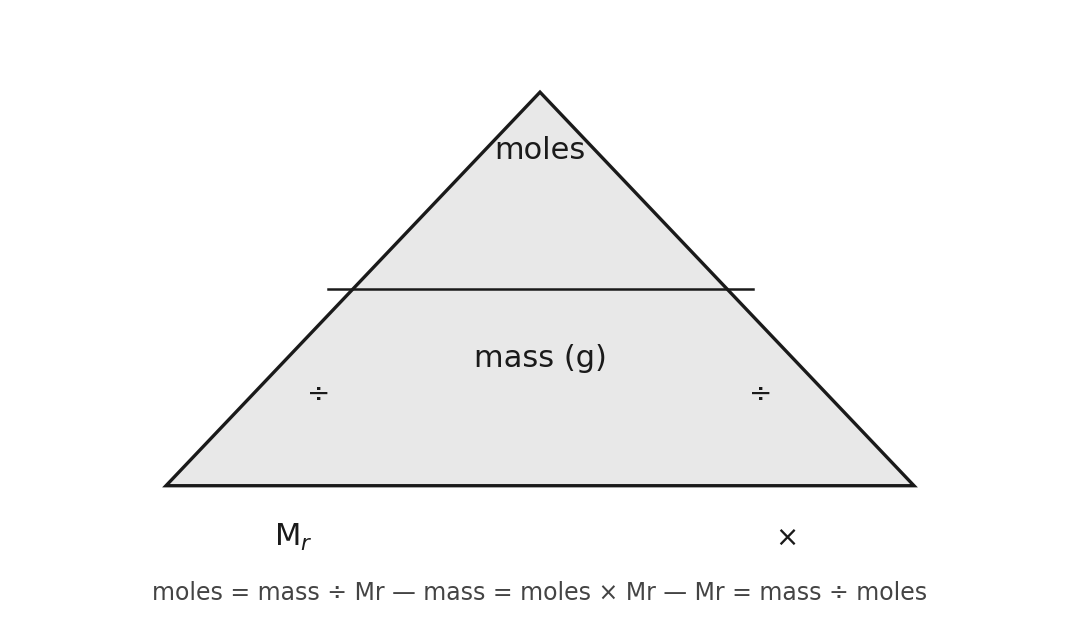
The mole 摩尔: the mass of one mole of a substance in grams is numerically its Mr. One mole contains the Avogadro constant 阿伏伽德罗常数 of particles — 6.02 × 10²³ — the same count of stated particles (atoms, molecules, ions) as a mole of any other substance.
$$\text{moles} = \frac{\text{mass (g)}}{M_r}$$
Equations as mole ratios: Mg + 2 HCl → MgCl₂ + H₂ reads "1 mol Mg reacts with 2 mol HCl → 1 mol MgCl₂ + 1 mol H₂". Given any one mass, calculate all others: mass → moles → ratio → moles → mass.
Balancing from masses: convert each mass to moles, divide by the smallest, clear fractions to whole numbers.
Limiting reactant 限量反应物: the reactant completely used up limits the product; an excess of the other ensures completion. Calculate the product from the limiting reactant's moles only.
Concentration 浓度: in g/dm³ for all tiers — mass of solute in a given volume; (HT) also mol/dm³: moles = concentration × volume(dm³), rearranged as needed.
Vocabulary
Train
| English |
|---|
| mole/məʊl/ |
| Avogadro constant/ˌævəˈɡædrəʊ ˈkɒnstənt/ |
| limiting reactant/ˈlɪmɪtɪŋ rɪˈæktənt/ |
| concentration/ˌkɒnsənˈtreɪʃn/ |
3.3
Yield and atom economy — chemistry only (4.3.3)
Syllabus
Yield and atom economy, chemistry only (AQA 8462 statement 4.3.3).
- Give the three reasons yield is below 100 percent.
- Calculate percentage yield, and (HT) the theoretical mass first.
- Calculate atom economy and explain its importance.
Source: Cambridge International syllabus
Percentage yield 产率 is below 100 % because: the reaction is reversible; product is lost on separation; reactants react in unwanted ways.
$$\%\ \text{yield} = \frac{\text{mass actually made}}{\text{maximum theoretical mass}} \times 100$$
Atom economy 原子经济 measures how much of the starting material ends up in the useful product — high atom economy matters for sustainability and cost:
$$\text{atom economy} = \frac{M_r \text{ of desired product}}{\text{sum of } M_r \text{ of all reactants}} \times 100\ \%$$
(HT) calculate the theoretical mass from the balanced equation, then the yield.
Vocabulary
Train
| English |
|---|
| percentage yield/pəˈsentɪdʒ jiːld/ |
| atom economy/ˈætəm ɪˈkɒnəmi/ |
3.4
Concentrations in mol/dm³ — chemistry only, HT (4.3.4)
Syllabus
Concentrations in mol/dm3, chemistry only, HT (AQA 8462 statement 4.3.4).
- Relate moles, mass, volume and concentration in mol/dm3.
- Calculate an unknown concentration from titration volumes and the equation ratio.
Source: Cambridge International syllabus
Concentration in mol/dm³ links moles, mass and volume: moles = C × V; from a titration 滴定, knowing the volumes of both solutions and one concentration gives the other — moles of acid = moles of alkali at neutralisation (respect the ratio in the equation).
Vocabulary
Train
| English |
|---|
| titration/taɪˈtreɪʃn/ |
3.5
Gas volumes — chemistry only, HT (4.3.5)
Syllabus
Gas volumes, chemistry only, HT (AQA 8462 statement 4.3.5).
- State that equal gas volumes contain equal moles at the same temperature and pressure.
- Use the equation ratio to relate gas volumes in reactions.
Source: Cambridge International syllabus
A given volume of gas contains the same number of moles at the same temperature and pressure — equal volumes = equal moles. The volumes of reacting gases (and products) follow the equation's ratio directly, e.g. 2 volumes of hydrogen react with 1 volume of oxygen.
3.5
Checklist before you call this topic done
- Balance equations; Mr and percentage-by-mass sums; explain apparent mass changes with gases.
- (HT) mole ↔ mass conversions, Avogadro constant, ratio chains, balancing from masses, limiting reactant.
- (Chem/HT) percentage yield with its three reasons; atom economy formula; titration concentration; gas-volume ratios.