Skip to content · ⁨コンテンツへスキップ⁩
Subjects · ⁨科目⁩

AP English Language and Composition · ⁨AP 英語言語と作文⁩

Tips · ⁨ヒント⁩

AP English Language and Composition is a course in rhetoric: how writers use language to act on a reader. Its required content is a set of skills, grouped under four big ideas - the rhetorical situation, claims and evidence, reasoning and organisation, and style.

Every skill comes in a reading half and a writing half. You learn to explain how another writer built an argument, and then to build one yourself using the same move. The two halves are taught together on purpose.

The rhetorical situation is the foundation. Exigence, audience, writer, purpose, context and message explain *why* a text makes the choices it makes - and "the writer uses this device" earns nothing until you say what it does for that audience.

Texts are mostly non-fiction - essays, speeches, letters, journalism. Because teachers choose their own texts and themes, the units are defined by the skills they develop rather than by set books.

The notes below follow the College Board framework unit by unit, with each skill and the essential knowledge behind it.

  • 1

    Claims, Evidence, and the Rhetorical Situation · ⁨主張、証拠、修辞的情境⁩

    Watch lesson · ⁨レッスンを視聴⁩
    1.1

    The Rhetorical Situation

    Syllabus · ⁨シラバス⁩
    English

    Enduring Understanding (RHS-1): Individuals write within a particular situation and make strategic writing choices based on that situation.

    Learning Objective 1.A: Reading – Identify and describe components of the rhetorical situation: the exigence, audience, writer, purpose, context, and message.

    • RHS-1.A The rhetorical situation of a text collectively refers to the exigence, purpose, audience, writer, context, and message.
    • RHS-1.B The exigence is the part of a rhetorical situation that inspires, stimulates, provokes, or prompts writers to create a text.
    • RHS-1.C The purpose of a text is what the writer hopes to accomplish with it. Writers may have more than one purpose in a text.
    • RHS-1.D An audience of a text has shared as well as individual beliefs, values, needs, and backgrounds.
    • RHS-1.E Writers create texts within a particular context that includes the time, place, and occasion.
    日本語

    永続的理解 (RHS-1): 個人は特定のシチュエーション内で書き、そのシチュエーションに基づき戦略的な書き choice を行う。

    学習目標 1.A: 読解 – レトリカル・シチュエーションの構成要素( exigence、聴衆、作家、目的、文脈、メッセージ)を特定し説明する。

    • RHS-1.A テキストのレトリカル・シチュエーションとは、exigence、目的、聴衆、作家、文脈、メッセージを包括的に指す。
    • RHS-1.B 必要( exigence)とは、修辞的状況のうちの、作家がテキストを作成するよう刺激し、促し、あるいは誘発する要素である。
    • RHS-1.C テキストの目的とは、作家がそれを活用して達成しようとする意図のことである。作家は一つのテキストに複数の目的を持つことがある。
    • RHS-1.D テキストの読者(オーディエンス)には、共有される信念や価値観、ニーズ、背景がある一方で、個々の差異も存在する。
    • RHS-1.E 作家は、時間、場所、出来事を含む特定の文脈の中でテキストを作成する。

    Source: College Board AP Course and Exam Description · ⁨出典: College Board AP コースおよび試験説明書⁩

    English

    AP English Language is not a literature course. It is a course in how texts do work on readers, and Unit 1 installs the two ideas everything else is built on: the rhetorical situation and the claim-plus-evidence paragraph.

    The CED defines the rhetorical situation 修辞情境 as the exigence, purpose, audience, writer, context, and message taken together. Each has a precise meaning, and using them precisely is what separates a strong answer from a vague one:

    • The exigence 促因 is the part of the situation that inspires, stimulates, provokes, or prompts a writer to create a text. It is the reason this text exists now.
    • The purpose 目的 is what the writer hopes to accomplish. A text may have more than one purpose.
    • The audience 受众 has shared as well as individual beliefs, values, needs, and backgrounds - so "the audience" is never a single uniform thing.
    • The context 语境 includes the time, place, and occasion in which the text was created.
    • The message is what the text actually says and does.

    The most common weak answer in this course names a device and stops. The rhetorical situation is what turns a device into an argument: this writer, prompted by this exigence, made this choice to move this audience toward this purpose.

    日本語

    AP English Language is not a literature course. It is a course in how texts do work on readers, and Unit 1 installs the two ideas everything else is built on: the rhetorical situation and the claim-plus-evidence paragraph.

    The six components, arranged so the causal order is visible
    Exigence prompts the writer; context surrounds everything - and every question about "choices" is answered from here

    The CED defines the rhetorical situation 修辞情境 as the exigence, purpose, audience, writer, context, and message taken together. Each has a precise meaning, and using them precisely is what separates a strong answer from a vague one:

    • The exigence 促因 is the part of the situation that inspires, stimulates, provokes, or prompts a writer to create a text. It is the reason this text exists now.
    • The purpose 目的 is what the writer hopes to accomplish. A text may have more than one purpose.
    • The audience 受众 has shared as well as individual beliefs, values, needs, and backgrounds - so "the audience" is never a single uniform thing.
    • The context 语境 includes the time, place, and occasion in which the text was created.
    • The message is what the text actually says and does.

    The most common weak answer in this course names a device and stops. The rhetorical situation is what turns a device into an argument: this writer, prompted by this exigence, made this choice to move this audience toward this purpose.

    Vocabulary · ⁨語彙⁩ Train · ⁨練習する⁩
    English 日本語
    rhetorical situation/reˈtɒrɪkl ˌsɪtʃuːˈeɪʃn/ 修辞的状況
    exigence/ˈeksɪdʒəns/ 緊急性(exigence)
    purpose/ˈpɜːpəs/ 目的(purpose)
    audience/ˈɔːdɪəns/ 読者(audience)
    context/ˈkɒntekst/ コンテキスト
    1.2

    Identifying Claims and Evidence

    Syllabus · ⁨シラバス⁩
    English

    Enduring Understanding (CLE-1): Writers make claims about subjects, rely on evidence that supports the reasoning that justifies the claim, and often acknowledge or respond to other, possibly opposing, arguments.

    Learning Objective 3.A: Reading – Identify and explain claims and evidence within an argument.

    • CLE-1.A Writers convey their positions through one or more claims that require a defense.
    • CLE-1.B Writers defend their claims with evidence and/or reasoning.
    • CLE-1.C Types of evidence may include facts, anecdotes, analogies, statistics, examples, details, illustrations, expert opinions, personal observations, personal experiences, testimonies, or experiments.
    • CLE-1.D Effective claims provoke interest and require a defense, rather than simply stating an obvious, known fact that requires no defense or justification.
    • CLE-1.E Writers relate source material to their own argument by syntactically embedding particular quoted, paraphrased, or summarized information from one or more sources into their own ideas.
    日本語

    持続的理解 (CLE-1): 作家は対象について主張を行い、その主張を正当化するための論理的推理を裏付ける根拠に依存し、また、他者による対立する可能性のある議論を認識したり、反論したりすることが多い。

    学習目標 3.A: 読解 – 議論における主張と根拠を特定し説明する。

    • CLE-1.A 作家は、防衛を要する一つ以上の主張を通じて、自らの立場を伝える。
    • CLE-1.B 作家は、根拠および/または論理的推理によって自らの主張を防御(防衛)する。
    • CLE-1.C 根拠の種類には、事実、逸話、類推、統計、例示、詳細、図表、専門家意見、個人的観察、個人的経験、証言、実験などが含まれる。
    • CLE-1.D 有効な主張は、単なる明らかな事実を述べるのではなく、関心を喚起し、かつ防衛を要するものである。
    • CLE-1.E 作家は、構文的に引用、要約、または要旨変換された特定の情報を一つの或多个のソースから自身の考えに組み込むことで、ソース資料を自身の議論に関連させる。

    Source: College Board AP Course and Exam Description · ⁨出典: College Board AP コースおよび試験説明書⁩

    English
    • Writers convey their positions through one or more claims 主张 that require a defence.
    • Writers defend their claims with evidence and/or reasoning 证据与推理.
    • Types of evidence include facts, anecdotes, analogies, statistics, examples, details, illustrations, expert opinions, and personal experience - a deliberately wide list, because recognising an anecdote or an analogy as evidence is itself a skill.
    • Effective claims provoke interest and require a defence, rather than stating an obvious, known fact that requires no proof.

    That fourth point is the most useful test you have. Ask of any sentence: could a reasonable person disagree? If not, it is not a claim - it is a fact, and building a paragraph on it produces writing with nothing to prove.

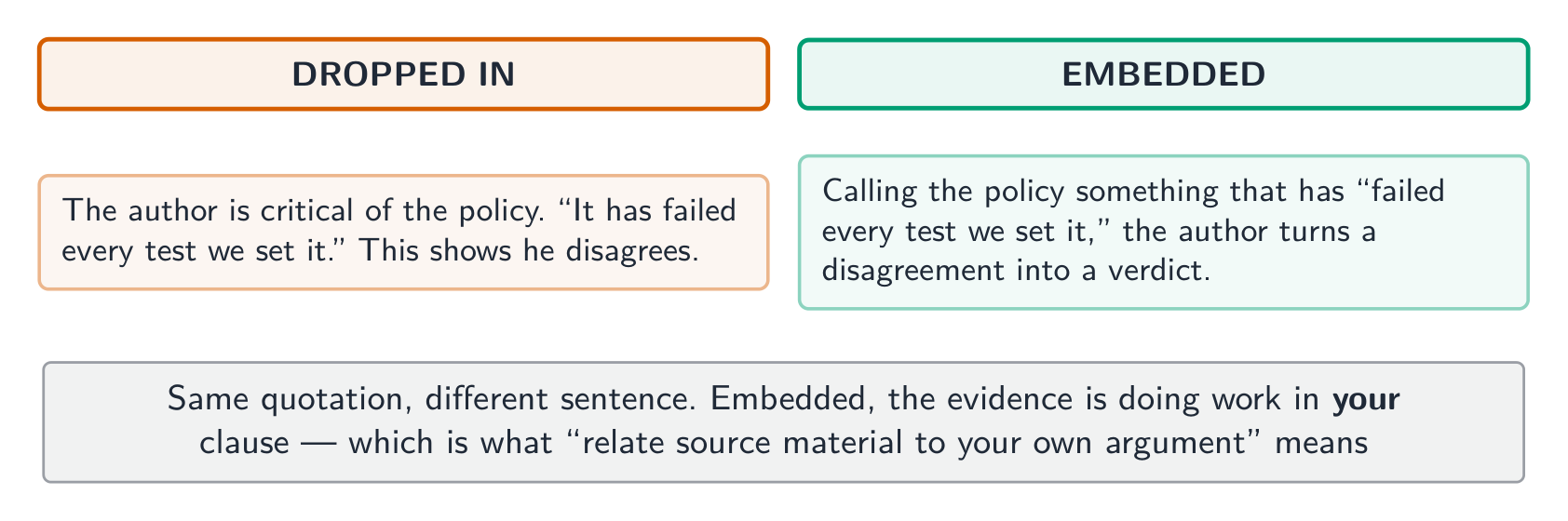
    Finally, writers relate source material to their own argument by syntactically embedding quoted, paraphrased, or summarised material into their own sentences. The evidence is not dropped in beside your sentence; it is built into it.

    日本語
    • Writers convey their positions through one or more claims 主张 that require a defence.
    • Writers defend their claims with evidence and/or reasoning 证据与推理.
    • Types of evidence include facts, anecdotes, analogies, statistics, examples, details, illustrations, expert opinions, and personal experience - a deliberately wide list, because recognising an anecdote or an analogy as evidence is itself a skill.
    • Effective claims provoke interest and require a defence, rather than stating an obvious, known fact that requires no proof.

    That fourth point is the most useful test you have. Ask of any sentence: could a reasonable person disagree? If not, it is not a claim - it is a fact, and building a paragraph on it produces writing with nothing to prove.

    Finally, writers relate source material to their own argument by syntactically embedding quoted, paraphrased, or summarised material into their own sentences. The evidence is not dropped in beside your sentence; it is built into it.

    The one test that separates a claim from a fact: could a reasonable person disagree?
    The same quotation dropped in, and embedded - only one of them does work in your sentence
    Explore · ⁨探索⁩

    Claim or fact? Run the test on each sentence · ⁨主張か事実か?各文に対してテストを実行する⁩

    The test is one question: could a reasonable person disagree? If not, it is not a claim and a paragraph on it has nothing to prove. · ⁨テストは一つの質問です:合理的な人が異論を唱え得るか?答えが「いいえ」であれば、それは主張ではなく、それに関する段落には証明すべきものがありません。⁩

    Vocabulary · ⁨語彙⁩ Train · ⁨練習する⁩
    English 日本語
    claims/kleɪmz/ 主張
    evidence and/or reasoning/ˈevɪdəns ænd ɔː ˈriːzənɪŋ/ 証拠および/または推論
    1.3

    Developing a Paragraph with Claim and Evidence

    Syllabus · ⁨シラバス⁩
    English

    Enduring Understanding (CLE-1): Writers make claims about subjects, rely on evidence that supports the reasoning that justifies the claim, and often acknowledge or respond to other, possibly opposing, arguments.

    Learning Objective 4.A: Writing – Develop a paragraph that includes a claim and evidence supporting the claim.

    • CLE-1.A Writers convey their positions through one or more claims that require a defense.
    • CLE-1.B Writers defend their claims with evidence and/or reasoning.
    • CLE-1.C Types of evidence may include facts, anecdotes, analogies, statistics, examples, details, illustrations, expert opinions, personal observations, personal experiences, testimonies, or experiments.
    • CLE-1.D Effective claims provoke interest and require a defense, rather than simply stating an obvious, known fact that requires no defense or justification.
    • CLE-1.E Writers relate source material to their own argument by syntactically embedding particular quoted, paraphrased, or summarized information from one or more sources into their own ideas.
    日本語

    持続的理解 (CLE-1): 作家は対象について主張を行い、その主張を正当化するための論理的推理を裏付ける根拠に依存し、また、他者による対立する可能性のある議論を認識したり、反論したりすることが多い。

    学習目標 4.A: 作文 – 主張とそれを支持する根拠を含む段落を構成する。

    • CLE-1.A 作家は、防衛を要する一つ以上の主張を通じて、自らの立場を伝える。
    • CLE-1.B 作家は、根拠および/または論理的推理によって自らの主張を防御(防衛)する。
    • CLE-1.C 根拠の種類には、事実、逸話、類推、統計、例示、詳細、図表、専門家意見、個人的観察、個人的経験、証言、実験などが含まれる。
    • CLE-1.D 有効な主張は、単なる明らかな事実を述べるのではなく、関心を喚起し、かつ防衛を要するものである。
    • CLE-1.E 作家は、構文的に引用、要約、または要旨変換された特定の情報を一つの或多个のソースから自身の考えに組み込むことで、ソース資料を自身の議論に関連させる。

    Source: College Board AP Course and Exam Description · ⁨出典: College Board AP コースおよび試験説明書⁩

    Unit 1's writing objective is deliberately small: write one paragraph containing a claim and evidence that supports it. Everything later in the course is an elaboration of this.

    A working shape:

    1. A claim that requires defence - arguable, specific, and narrower than the whole thesis.
    2. Evidence chosen because it supports this claim, embedded syntactically rather than dropped in.
    3. Commentary explaining how the evidence supports the claim - the step students skip, and the one that carries most of the marks on the exam.

    The single most common failure on the AP Language essays is a paragraph in which the evidence is present and the explanation is absent. The reader can see the quotation; what they cannot see is why you think it proves your point.

    The paragraph drawn to the proportions it should have - the widths are the point
    Explore · ⁨探索⁩

    Build a paragraph in proportion · ⁨バランスの取れたパラグラフを構成する⁩

    The commonest failure on these essays is a paragraph where the evidence is present and the explanation is absent. · ⁨これらのエッセイにおける最も一般的な失敗は、証拠はあるものの説明がないパラグラフである。⁩

    1.3

    What the Exam Actually Asks

    English

    The free-response section has three questions, and they use the same skills in different arrangements:

    • Question 1, Synthesis 综合写作: you are given several sources and must build your own argument, using the sources as evidence rather than summarising them.
    • Question 2, Rhetorical Analysis 修辞分析: you are given one text and must explain the choices the writer makes and how those choices contribute to purpose - which is the rhetorical situation applied.
    • Question 3, Argument 论证写作: you are given a claim or a scenario and must argue a position, using evidence from your own knowledge and experience.

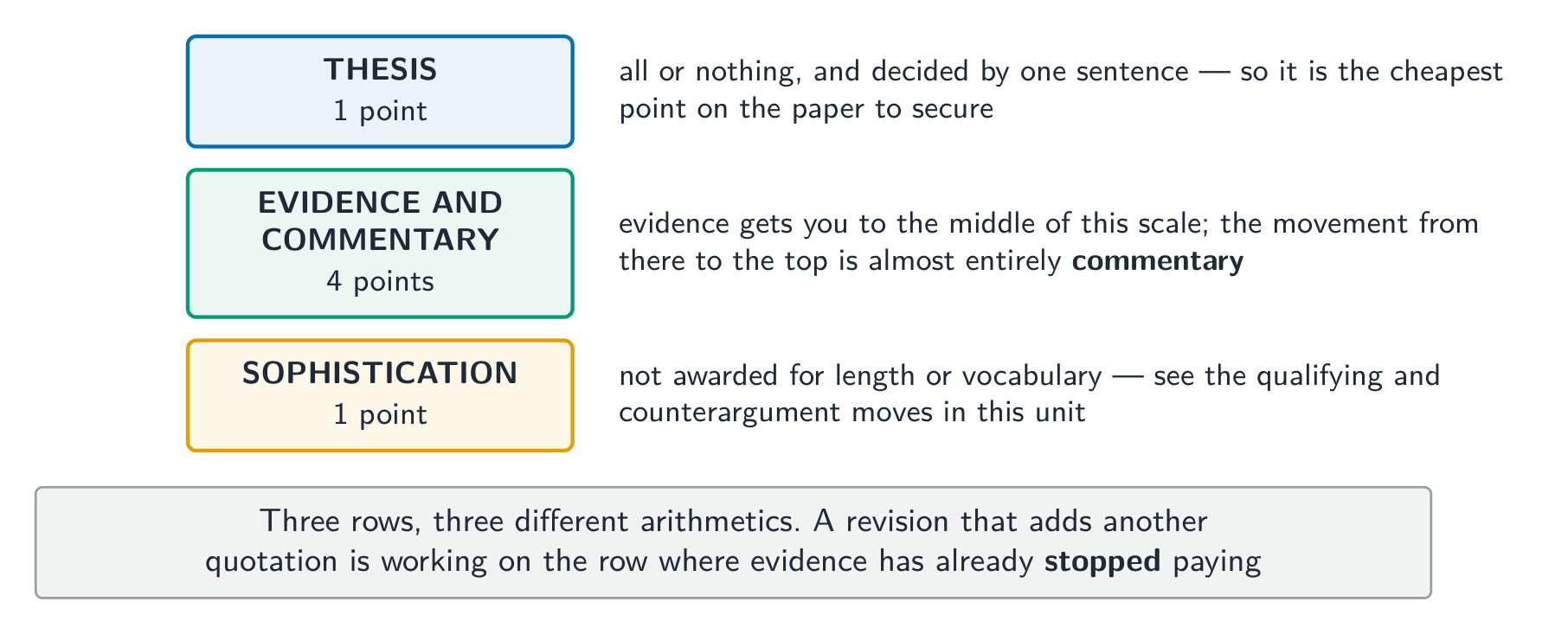
    All three are marked on a six-point rubric with the same three rows: thesis (1 point), evidence and commentary (4 points), and sophistication (1 point). Knowing that shape from Unit 1 tells you where the marks are: four of the six come from evidence and the commentary on it, so a plan that produces evidence without explanation caps you at low marks no matter how good the writing sounds.

    Worked example (a real AP exam task). A Rhetorical Analysis prompt asks you to "explain the writer's rhetorical choices" in a given passage. A row-scoring answer does not say "the writer uses a rhetorical question." It says: "Faced with an audience that already agrees on the problem but not on its urgency, the writer opens with a question rather than a statement, forcing readers to supply the answer themselves and so to feel the conclusion as their own rather than as one imposed on them." Notice what earns the points: the audience, the choice, and the effect on purpose - the rhetorical situation, used.

    日本語

    The free-response section has three questions, and they use the same skills in different arrangements:

    • Question 1, Synthesis 综合写作: you are given several sources and must build your own argument, using the sources as evidence rather than summarising them.
    • Question 2, Rhetorical Analysis 修辞分析: you are given one text and must explain the choices the writer makes and how those choices contribute to purpose - which is the rhetorical situation applied.
    • Question 3, Argument 论证写作: you are given a claim or a scenario and must argue a position, using evidence from your own knowledge and experience.

    All three are marked on a six-point rubric with the same three rows: thesis (1 point), evidence and commentary (4 points), and sophistication (1 point). Knowing that shape from Unit 1 tells you where the marks are: four of the six come from evidence and the commentary on it, so a plan that produces evidence without explanation caps you at low marks no matter how good the writing sounds.

    Worked example (a real AP exam task). A Rhetorical Analysis prompt asks you to "explain the writer's rhetorical choices" in a given passage. A row-scoring answer does not say "the writer uses a rhetorical question." It says: "Faced with an audience that already agrees on the problem but not on its urgency, the writer opens with a question rather than a statement, forcing readers to supply the answer themselves and so to feel the conclusion as their own rather than as one imposed on them." Notice what earns the points: the audience, the choice, and the effect on purpose - the rhetorical situation, used.

    Vocabulary · ⁨語彙⁩ Train · ⁨練習する⁩
    English 日本語
    Question 1, Synthesis/ˈkwestʃn wɒn ˈsɪnθəsɪs/ 問題1, 統合
    Question 2, Rhetorical Analysis/ˈkwestʃn tuː reˈtɒrɪkl əˈnæləsɪs/ 問題2, 修辞分析
    Question 3, Argument/ˈkwestʃn θriː ˈɑːɡjuːmənt/ 問題3, 主張
    1.3

    Exam tips

    • Learn the six components by name and use the names. Precision here is directly rewarded.
    • Exigence is not the same as purpose. Exigence is what prompted the text; purpose is what the writer wants to achieve.
    • Test every claim with could a reasonable person disagree? If not, it is a fact, not a claim.
    • Embed evidence in your own sentence. Dropped quotations read as unprocessed.
    • Four of six points are evidence and commentary. Write the commentary; it is where most lost marks live.
    • Never name a device without saying what it does to the audience. A device with no effect earns nothing.
  • 2

    Audience, Thesis, and Supporting Evidence · ⁨聴衆、中心的主張、および根拠⁩

    Watch lesson · ⁨レッスンを視聴⁩
    2.1

    Understanding an Audience's Beliefs and Needs

    Syllabus · ⁨シラバス⁩
    English

    Enduring Understanding (RHS-1): Individuals write within a particular situation and make strategic writing choices based on that situation.

    Learning Objective 1.B: Reading – Explain how an argument demonstrates understanding of an audience’s beliefs, values, or needs.

    • RHS-1.F Writers’ perceptions of an audience’s values, beliefs, needs, and background guide the choices they make.
    • RHS-1.G To achieve a purpose, writers make choices in an attempt to relate to an intended audience’s emotions and values.
    • RHS-1.H Arguments seek to persuade or motivate action through appeals—the modes of persuasion.
    日本語

    永続的理解 (RHS-1): 個人は特定のシチュエーション内で書き、そのシチュエーションに基づき戦略的な書き choice を行う。

    学習目標 1.B: 読解 – 議論が読者の信念、価値観、またはニーズへの理解をどのように示しているかを説明する。

    • RHS-1.F 作家の読者に対する価値観、信念、ニーズ、背景の認識は、彼らが下す選択を導く。
    • RHS-1.G 目的を達成するために、作家は、想定読者の感情や価値観に結びつけることを目指して選択を行う。
    • RHS-1.H 議論は、説得の手段である「訴え」を通じて、読者を説得したり、行動を促したりすることを狙う。

    Source: College Board AP Course and Exam Description · ⁨出典: College Board AP コースおよび試験説明書⁩

    English

    Unit 1 established that a text has an audience. Unit 2 makes that audience the engine of every choice a writer makes.

    • Writers' perceptions of an audience's values, beliefs, needs, and background guide the choices they make. Note the word perceptions: what steers the writing is the writer's picture of the audience, which may be accurate or not.
    • To achieve a purpose, writers make choices in an attempt to relate to an intended audience's emotions and values.
    • Arguments seek to persuade or motivate action through appeals 诉求 - the modes of persuasion 说服方式.
    日本語

    Unit 1 established that a text has an audience. Unit 2 makes that audience the engine of every choice a writer makes.

    • Writers' perceptions of an audience's values, beliefs, needs, and background guide the choices they make. Note the word perceptions: what steers the writing is the writer's picture of the audience, which may be accurate or not.
    • To achieve a purpose, writers make choices in an attempt to relate to an intended audience's emotions and values.
    • Arguments seek to persuade or motivate action through appeals 诉求 - the modes of persuasion 说服方式.
    Each appeal reaches for something different in the audience - and each can fail in its own way
    Naming the appeal is worth nothing on its own; naming what it reaches for is the analysis
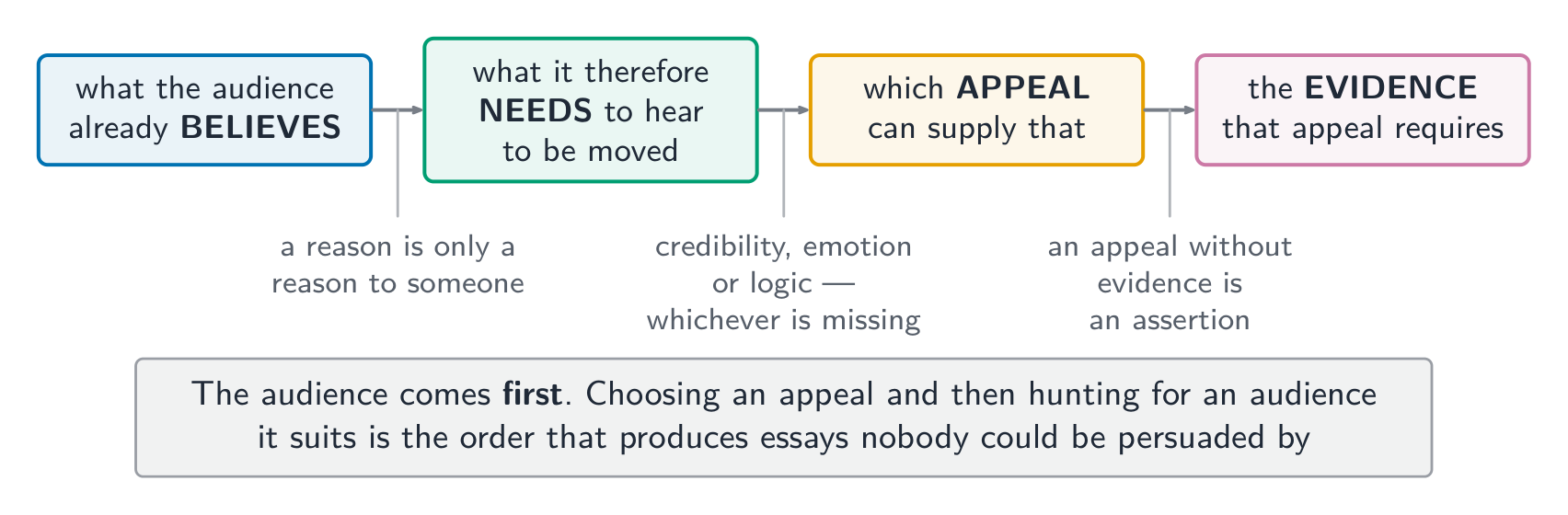
    The audience comes first: what it believes determines what will count as a reason
    Explore · ⁨探索⁩

    Start from the audience, not the appeal

    What the audience already believes determines what will count as a reason to them.

    Vocabulary · ⁨語彙⁩ Train · ⁨練習する⁩
    English 日本語
    appeals/əˈpiːlz/ 説得の訴求
    modes of persuasion/məʊdz ɒv pəˈsweɪʒn/ 説得の手法
    2.2

    Writing for an Audience's Beliefs and Needs

    Syllabus · ⁨シラバス⁩
    English

    Enduring Understanding (RHS-1): Individuals write within a particular situation and make strategic writing choices based on that situation.

    Learning Objective 2.B: Writing – Demonstrate an understanding of an audience’s beliefs, values, or needs.

    • RHS-1.F Writers’ perceptions of an audience’s values, beliefs, needs, and background guide the choices they make.
    • RHS-1.G To achieve a purpose, writers make choices in an attempt to relate to an intended audience’s emotions and values.
    • RHS-1.H Arguments seek to persuade or motivate action through appeals—the modes of persuasion.
    日本語

    永続的理解 (RHS-1): 個人は特定のシチュエーション内で書き、そのシチュエーションに基づき戦略的な書き choice を行う。

    学習目標 2.B: 作文 – 読者の信念、価値観、またはニーズへの理解を示す。

    • RHS-1.F 作家の読者に対する価値観、信念、ニーズ、背景の認識は、彼らが下す選択を導く。
    • RHS-1.G 目的を達成するために、作家は、想定読者の感情や価値観に結びつけることを目指して選択を行う。
    • RHS-1.H 議論は、説得の手段である「訴え」を通じて、読者を説得したり、行動を促したりすることを狙う。

    Source: College Board AP Course and Exam Description · ⁨出典: College Board AP コースおよび試験説明書⁩

    The same three statements now become a writing instruction. Before drafting, decide:

    • What does this audience already believe about the subject?
    • What do they need - information, reassurance, a reason to act?
    • What do they value, and which of those values can honestly be connected to my position?

    An argument that ignores these produces writing addressed to nobody. And the CED's framing gives you a useful test for your own drafts: if this paragraph would read identically to a completely different audience, it has not been shaped by one.

    2.3

    Identifying Claims and Evidence

    Syllabus · ⁨シラバス⁩
    English

    Enduring Understanding (CLE-1): Writers make claims about subjects, rely on evidence that supports the reasoning that justifies the claim, and often acknowledge or respond to other, possibly opposing, arguments.

    Learning Objective 3.A: Reading – Identify and explain claims and evidence within an argument.

    • CLE-1.F Writers use evidence strategically and purposefully to illustrate, clarify, set a mood, exemplify, associate, or amplify a point.
    • CLE-1.G Strategically selected evidence strengthens the validity and reasoning of the argument, relates to an audience’s emotions and values, and increases a writer’s credibility.
    • CLE-1.H An effective argument contains sufficient evidence; evidence is sufficient when its quantity and quality provide apt support for the argument.
    日本語

    持続的理解 (CLE-1): 作家は対象について主張を行い、その主張を正当化するための論理的推理を裏付ける根拠に依存し、また、他者による対立する可能性のある議論を認識したり、反論したりすることが多い。

    学習目標 3.A: 読解 – 議論における主張と根拠を特定し説明する。

    • CLE-1.F 作家は、点を説明・明確にする、雰囲気を作る、例示する、関連づける、あるいは強調するために、戦略的かつ意図的に根拠を用いる。
    • CLE-1.G 戦略的に選ばれた根拠は、議論の有効性と論理性を高め、読者の感情や価値観に関わり、作家の信頼性を高める。
    • CLE-1.H 有効な議論には十分な根拠が含まれており、根拠が十分であるとは、その量と質が議論に対して適切な支援を提供している場合をいう。

    Source: College Board AP Course and Exam Description · ⁨出典: College Board AP コースおよび試験説明書⁩

    English

    Unit 2 deepens Unit 1's treatment of evidence with three claims about how evidence works:

    • Writers use evidence strategically and purposefully to illustrate, clarify, set a mood, exemplify, associate, or amplify. Evidence does a job, and naming that job is analysis.
    • Strategically selected evidence strengthens the validity and reasoning of the argument, relates to an audience's emotions and values, and helps establish the writer's credibility 可信度.
    • An effective argument contains sufficient evidence 充分的证据 - sufficient when its quantity and quality provide apt support for the line of reasoning.

    That third point is often misread as "more is better". Sufficiency is quantity and quality together: three well-chosen pieces of evidence that bear directly on the claim beat six that only touch it.

    日本語

    Unit 2 deepens Unit 1's treatment of evidence with three claims about how evidence works:

    • Writers use evidence strategically and purposefully to illustrate, clarify, set a mood, exemplify, associate, or amplify. Evidence does a job, and naming that job is analysis.
    • Strategically selected evidence strengthens the validity and reasoning of the argument, relates to an audience's emotions and values, and helps establish the writer's credibility 可信度.
    • An effective argument contains sufficient evidence 充分的证据 - sufficient when its quantity and quality provide apt support for the line of reasoning.

    That third point is often misread as "more is better". Sufficiency is quantity and quality together: three well-chosen pieces of evidence that bear directly on the claim beat six that only touch it.

    Evidence types sorted by what each can and cannot establish
    Explore · ⁨探索⁩

    Match each evidence type to what it cannot prove

    A statistic and an anecdote are not interchangeable — each covers the other's gap.

    Vocabulary · ⁨語彙⁩ Train · ⁨練習する⁩
    English 日本語
    credibility/ˌkredɪˈbɪlɪti/ 信用性
    sufficient evidence/səˈfɪʃənt ˈevɪdəns/ 十分な証拠
    2.4

    Developing a Paragraph with Claim and Evidence

    Syllabus · ⁨シラバス⁩
    English

    Enduring Understanding (CLE-1): Writers make claims about subjects, rely on evidence that supports the reasoning that justifies the claim, and often acknowledge or respond to other, possibly opposing, arguments.

    Learning Objective 4.A: Writing – Develop a paragraph that includes a claim and evidence supporting the claim.

    • CLE-1.F Writers use evidence strategically and purposefully to illustrate, clarify, set a mood, exemplify, associate, or amplify a point.
    • CLE-1.G Strategically selected evidence strengthens the validity and reasoning of the argument, relates to an audience’s emotions and values, and increases a writer’s credibility.
    • CLE-1.H An effective argument contains sufficient evidence; evidence is sufficient when its quantity and quality provide apt support for the argument.
    日本語

    持続的理解 (CLE-1): 作家は対象について主張を行い、その主張を正当化するための論理的推理を裏付ける根拠に依存し、また、他者による対立する可能性のある議論を認識したり、反論したりすることが多い。

    学習目標 4.A: 作文 – 主張とそれを支持する根拠を含む段落を構成する。

    • CLE-1.F 作家は、点を説明・明確にする、雰囲気を作る、例示する、関連づける、あるいは強調するために、戦略的かつ意図的に根拠を用いる。
    • CLE-1.G 戦略的に選ばれた根拠は、議論の有効性と論理性を高め、読者の感情や価値観に関わり、作家の信頼性を高める。
    • CLE-1.H 有効な議論には十分な根拠が含まれており、根拠が十分であるとは、その量と質が議論に対して適切な支援を提供している場合をいう。

    Source: College Board AP Course and Exam Description · ⁨出典: College Board AP コースおよび試験説明書⁩

    Applying the above to your own writing, choose each piece of evidence for a stated reason. In practice this means being able to finish the sentence: I am using this piece because it ...

    • ... illustrates a claim that would otherwise stay abstract;
    • ... establishes my credibility on a subject where readers may doubt it;
    • ... connects my position to a value the audience already holds.

    Evidence chosen this way produces commentary almost automatically, because you already know what the evidence is doing. Evidence chosen because it was available produces the blank space where commentary should be.

    2.5

    Identifying the Overarching Thesis

    Syllabus · ⁨シラバス⁩
    English

    Enduring Understanding (CLE-1): Writers make claims about subjects, rely on evidence that supports the reasoning that justifies the claim, and often acknowledge or respond to other, possibly opposing, arguments.

    Learning Objective 3.B: Reading – Identify and describe the overarching thesis of an argument, and any indication it provides of the argument’s structure.

    • CLE-1.I A thesis is the main, overarching claim a writer is seeking to defend or prove by using reasoning supported by evidence.
    • CLE-1.J A writer’s thesis is not necessarily a single sentence or an explicit statement and may require a thorough reading of the text to identify, but when a thesis is directly expressed, it is called a thesis statement. [Note: While the texts you assign your students to analyze may not always contain obvious thesis statements, they should each have a thesis. It can be good practice for students to write a thesis statement for such texts. On the AP Exam, a clear communication of the thesis is required in students’ essays.]
    日本語

    持続的理解 (CLE-1): 作家は対象について主張を行い、その主張を正当化するための論理的推理を裏付ける根拠に依存し、また、他者による対立する可能性のある議論を認識したり、反論したりすることが多い。

    学習目標 3.B: 読解 – 議論の中心的な thesis を特定・記述し、それが議論の構造についてどのような示唆を提供しているかを確認する。

    • CLE-1.I thesis とは、作家が根拠で支えられた論理的推理を使って防衛または証明しようとしている主要かつ包括的な主張のことである。
    • CLE-1.J 作家の thesis は、必ずしも一文に限定されず、明示的な声明であるとは限らないため、テキストを精読することで特定する必要がある。しかし、thesis が直接的に表現されている場合は、thesis statement と呼ばれる。[注: 学生に分析させるテキストに必ずしも明瞭な thesis statement が含まれているわけではないが、各テキストには thesis が存在するはずである。そのようなテキストに対して学生が thesis statement を作成することは良い練習となる。AP試験において、学生のエッセイでは thesis の明確な伝達が必須である。]

    Source: College Board AP Course and Exam Description · ⁨出典: College Board AP コースおよび試験説明書⁩

    English
    • A thesis 论点 is the main, overarching claim a writer seeks to defend or prove by using reasoning supported by evidence.
    • A writer's thesis is not necessarily a single sentence or an explicit statement, and may require a thorough reading to identify.

    That second point matters for the reading side of the exam. On a rhetorical-analysis passage, the thesis may be distributed across the text or implied by its structure. Do not assume the first sentence of the second paragraph is the thesis because that is where you would put yours.

    日本語
    • A thesis 论点 is the main, overarching claim a writer seeks to defend or prove by using reasoning supported by evidence.
    • A writer's thesis is not necessarily a single sentence or an explicit statement, and may require a thorough reading to identify.

    That second point matters for the reading side of the exam. On a rhetorical-analysis passage, the thesis may be distributed across the text or implied by its structure. Do not assume the first sentence of the second paragraph is the thesis because that is where you would put yours.

    Vocabulary · ⁨語彙⁩ Train · ⁨練習する⁩
    English 日本語
    thesis/ˈθiːsɪs/ テーシス
    2.6

    Writing a Thesis Statement

    Syllabus · ⁨シラバス⁩
    English

    Enduring Understanding (CLE-1): Writers make claims about subjects, rely on evidence that supports the reasoning that justifies the claim, and often acknowledge or respond to other, possibly opposing, arguments.

    Learning Objective 4.B: Writing – Write a thesis statement that requires proof or defense and that may preview the structure of the argument.

    • CLE-1.I A thesis is the main, overarching claim a writer is seeking to defend or prove by using reasoning supported by evidence.
    • CLE-1.J A writer’s thesis is not necessarily a single sentence or an explicit statement and may require a thorough reading of the text to identify, but when a thesis is directly expressed, it is called a thesis statement. [Note: While the texts you assign your students to analyze may not always contain obvious thesis statements, they should each have a thesis. It can be good practice for students to write a thesis statement for such texts. On the AP Exam, a clear communication of the thesis is required in students’ essays.]
    日本語

    持続的理解 (CLE-1): 作家は対象について主張を行い、その主張を正当化するための論理的推理を裏付ける根拠に依存し、また、他者による対立する可能性のある議論を認識したり、反論したりすることが多い。

    学習目標 4.B: 作文 – 証明または防衛を要し、かつ議論の構造を予見する可能性がある thesis statement を作成する。

    • CLE-1.I thesis とは、作家が根拠で支えられた論理的推理を使って防衛または証明しようとしている主要かつ包括的な主張のことである。
    • CLE-1.J 作家の thesis は、必ずしも一文に限定されず、明示的な声明であるとは限らないため、テキストを精読することで特定する必要がある。しかし、thesis が直接的に表現されている場合は、thesis statement と呼ばれる。[注: 学生に分析させるテキストに必ずしも明瞭な thesis statement が含まれているわけではないが、各テキストには thesis が存在するはずである。そのようなテキストに対して学生が thesis statement を作成することは良い練習となる。AP試験において、学生のエッセイでは thesis の明確な伝達が必須である。]

    Source: College Board AP Course and Exam Description · ⁨出典: College Board AP コースおよび試験説明書⁩

    The writing objective is precise: write a thesis statement that requires proof or defence and that may preview the structure of the argument.

    Two independent requirements sit in that sentence:

    • It must require defence. Apply the Unit 1 test again: could a reasonable person disagree? A thesis that states a fact cannot be defended, only repeated.
    • It may preview the structure - optional, but useful, because a thesis that names the lines of reasoning it will pursue gives the essay its shape.

    On the exam, the thesis point is one of six and it is the cheapest point on the rubric: a defensible thesis in response to the prompt earns it. A restatement of the prompt does not.

    Worked example (a real AP exam task). For a Question 3 argument prompt asking you to take a position on the value of a proposed practice, compare two openings. "There are many arguments both for and against this practice." - that earns nothing, because nobody could disagree with it. "Because the practice rewards visible effort rather than actual improvement, it produces the appearance of progress while removing the incentive to seek it." - that earns the point: it is arguable, specific, and it previews the reasoning the essay will develop.

    Same subject, and only one of them can be disagreed with
    2.6

    Exam tips

    • The audience drives everything. If a paragraph would read the same to any audience, it has not been shaped for one.
    • Name what evidence does - illustrate, clarify, associate, amplify. That is analysis; listing evidence is not.
    • Sufficiency is quantity and quality, not volume. Three apt pieces beat six loose ones.
    • A thesis in a passage may be implied or distributed. Read the whole text before deciding.
    • Your own thesis must be arguable. Restating the prompt earns zero of the six points.
    • Previewing your line of reasoning in the thesis is optional but makes the rest of the essay easier to organise.
  • 3

    Line of Reasoning and Methods of Development · ⁨論理の筋道と展開方法⁩

    Watch lesson · ⁨レッスンを視聴⁩
    3.1

    Identifying Claims and Evidence

    Syllabus · ⁨シラバス⁩
    English

    Enduring Understanding (CLE-1): Writers make claims about subjects, rely on evidence that supports the reasoning that justifies the claim, and often acknowledge or respond to other, possibly opposing, arguments.

    Learning Objective 3.A: Reading – Identify and explain claims and evidence within an argument.

    • CLE-1.K Effective use of evidence uses commentary to establish a logical relationship between the evidence and the claim it supports.
    • CLE-1.L Writers introduce source material by using commentary to properly integrate it into their line of reasoning.
    • CLE-1.M Synthesis requires consideration, explanation, and integration of others’ arguments into one’s own argument.
    • CLE-1.N Writers must acknowledge words, ideas, images, texts, and other intellectual property of others through attribution, citation, or reference.
    日本語

    持続的理解 (CLE-1): 作家は対象について主張を行い、その主張を正当化するための論理的推理を裏付ける根拠に依存し、また、他者による対立する可能性のある議論を認識したり、反論したりすることが多い。

    学習目標 3.A: 読解 – 議論における主張と根拠を特定し説明する。

    • CLE-1.K 根拠の有効な使用には、根拠とそれを支持する主張との間に論理的关系を確立するための解説(commentary)が必要である。
    • CLE-1.L 作家は、解説を使用してソース資料を導入し、それを自身の論理の流れに適切に統合する。
    • CLE-1.M 合成(synthesis)とは、他者の議論を検討・説明し、自身の議論に統合することを要求する。
    • CLE-1.N 作家は、出典表示、引用、または参照を通じて、他者の言葉、思想、画像、テキスト、その他の知的財産権を認める必要がある。

    Source: College Board AP Course and Exam Description · ⁨出典: College Board AP コースおよび試験説明書⁩

    English

    Unit 3 is where the course stops being about parts and starts being about structure. Its subject is the line of reasoning 推理线索 - the path an argument takes from where it starts to what it proves.

    First, four claims about how evidence gets into an argument properly:

    • Effective use of evidence uses commentary 评述 to establish a logical relationship between the evidence and the claim.
    • Writers introduce source material using commentary to integrate it into their line of reasoning - so commentary comes before as well as after.
    • Synthesis 综合 requires consideration, explanation, and integration of others' arguments into one's own. That is the exact skill Question 1 tests, and the word integration rules out a paragraph that simply summarises each source in turn.
    • Writers must acknowledge the words, ideas, images, and texts of others through attribution and citation 归属与引用.
    日本語

    Unit 3 is where the course stops being about parts and starts being about structure. Its subject is the line of reasoning 推理线索 - the path an argument takes from where it starts to what it proves.

    First, four claims about how evidence gets into an argument properly:

    • Effective use of evidence uses commentary 评述 to establish a logical relationship between the evidence and the claim.
    • Writers introduce source material using commentary to integrate it into their line of reasoning - so commentary comes before as well as after.
    • Synthesis 综合 requires consideration, explanation, and integration of others' arguments into one's own. That is the exact skill Question 1 tests, and the word integration rules out a paragraph that simply summarises each source in turn.
    • Writers must acknowledge the words, ideas, images, and texts of others through attribution and citation 归属与引用.
    Vocabulary · ⁨語彙⁩ Train · ⁨練習する⁩
    English 日本語
    line of reasoning/laɪn ɒv ˈriːzənɪŋ/ 推論の道筋
    commentary/ˈkɒməntri/ 評論・解説
    Synthesis/ˈsɪnθəsɪs/ 統合
    attribution and citation/ətrɪˈbjuːʃn ænd saɪˈteɪʃn/ 出典表示と引用
    3.2

    Developing a Paragraph with Claim and Evidence

    Syllabus · ⁨シラバス⁩
    English

    Enduring Understanding (CLE-1): Writers make claims about subjects, rely on evidence that supports the reasoning that justifies the claim, and often acknowledge or respond to other, possibly opposing, arguments.

    Learning Objective 4.A: Writing – Develop a paragraph that includes a claim and evidence supporting the claim.

    • CLE-1.K Effective use of evidence uses commentary to establish a logical relationship between the evidence and the claim it supports.
    • CLE-1.L Writers introduce source material by using commentary to properly integrate it into their line of reasoning.
    • CLE-1.M Synthesis requires consideration, explanation, and integration of others’ arguments into one’s own argument.
    • CLE-1.N Writers must acknowledge words, ideas, images, texts, and other intellectual property of others through attribution, citation, or reference.
    日本語

    持続的理解 (CLE-1): 作家は対象について主張を行い、その主張を正当化するための論理的推理を裏付ける根拠に依存し、また、他者による対立する可能性のある議論を認識したり、反論したりすることが多い。

    学習目標 4.A: 作文 – 主張とそれを支持する根拠を含む段落を構成する。

    • CLE-1.K 根拠の有効な使用には、根拠とそれを支持する主張との間に論理的关系を確立するための解説(commentary)が必要である。
    • CLE-1.L 作家は、解説を使用してソース資料を導入し、それを自身の論理の流れに適切に統合する。
    • CLE-1.M 合成(synthesis)とは、他者の議論を検討・説明し、自身の議論に統合することを要求する。
    • CLE-1.N 作家は、出典表示、引用、または参照を通じて、他者の言葉、思想、画像、テキスト、その他の知的財産権を認める必要がある。

    Source: College Board AP Course and Exam Description · ⁨出典: College Board AP コースおよび試験説明書⁩

    Applied to your own writing, the change from Unit 2 is that commentary now has two jobs, not one: it introduces the evidence into the reasoning, and it explains the relationship afterwards.

    A paragraph that does both reads: claim - a sentence positioning the evidence - the evidence, embedded - commentary establishing the logical relationship - the link onward. The sentence before the quotation is doing as much work as the one after it, and most students write neither.

    Relevant and sufficient are two different failures with two opposite fixes
    Explore · ⁨探索⁩

    Diagnose the evidence problem

    Relevant and sufficient are two different failures with two opposite fixes.

    3.3

    Describing the Line of Reasoning

    Syllabus · ⁨シラバス⁩
    English

    Enduring Understanding (REO-1): Writers guide understanding of a text’s lines of reasoning and claims through that text’s organization and integration of evidence.

    Learning Objective 5.A: Reading – Describe the line of reasoning and explain whether it supports an argument’s overarching thesis.

    • REO-1.A Writers may lead readers through a line of reasoning and then arrive at a thesis.
    • REO-1.B Writers may express a claim and then develop a line of reasoning to justify the claim.
    • REO-1.C Writers explain their reasoning through commentary that connects chosen evidence to a claim.
    • REO-1.D Commentary explains the significance and relevance of evidence in relation to the line of reasoning.
    • REO-1.E The sequence of paragraphs in a text reveals the argument’s line of reasoning.
    • REO-1.F Flaws in a line of reasoning may render an argument specious or illogical.
    日本語

    持続的理解 (REO-1): 作家は、テキストの組織化と根拠の統合を通じて、テキスト内の論理の流れと主張の理解を導く。

    学習目標 5.A: 読解 – 論理の流れを記述し、それが議論の中心的な thesis を支持しているかどうかを説明する。

    • REO-1.A 作家は、読者を論理の流れに沿って引导し、最終的に thesis に至らせることができる。
    • REO-1.B 作家は、まず主張を提示し、その後、その主張を正当化するための論理の流れを展開することができる。
    • REO-1.C 作家は、選んだ根拠と主張をつなぐ解説を通じて、自身の論理を説明する。
    • REO-1.D 解説は、論理の流れとの関係において根拠 significance と関連性を説明する。
    • REO-1.E 文章の段落の順序は、論理展開の道筋を示している。
    • REO-1.F 論理展開の欠陥は、主張を虚飾的または非合理的なものにする可能性がある。

    Source: College Board AP Course and Exam Description · ⁨出典: College Board AP コースおよび試験説明書⁩

    Two legitimate orders, one requirement - and the requirement is the commentary
    The order is a choice; the connective tissue is not

    The CED allows two arrangements, and both are valid:

    • Writers may lead readers through a line of reasoning and then arrive at a thesis - the argument builds to its claim.
    • Writers may express a claim and then develop a line of reasoning to justify it - the argument declares and then defends.

    Whichever order is used, the same requirements hold:

    • Writers explain their reasoning through commentary that connects chosen evidence to a claim.
    • Commentary explains the significance and relevance of evidence in relation to the line of reasoning.
    • The sequence of paragraphs in a text reveals the argument's line of reasoning - which is the practical tool for reading. To find a writer's reasoning, write one sentence per paragraph and read the list.
    • Flaws in a line of reasoning may render an argument specious or illogical.
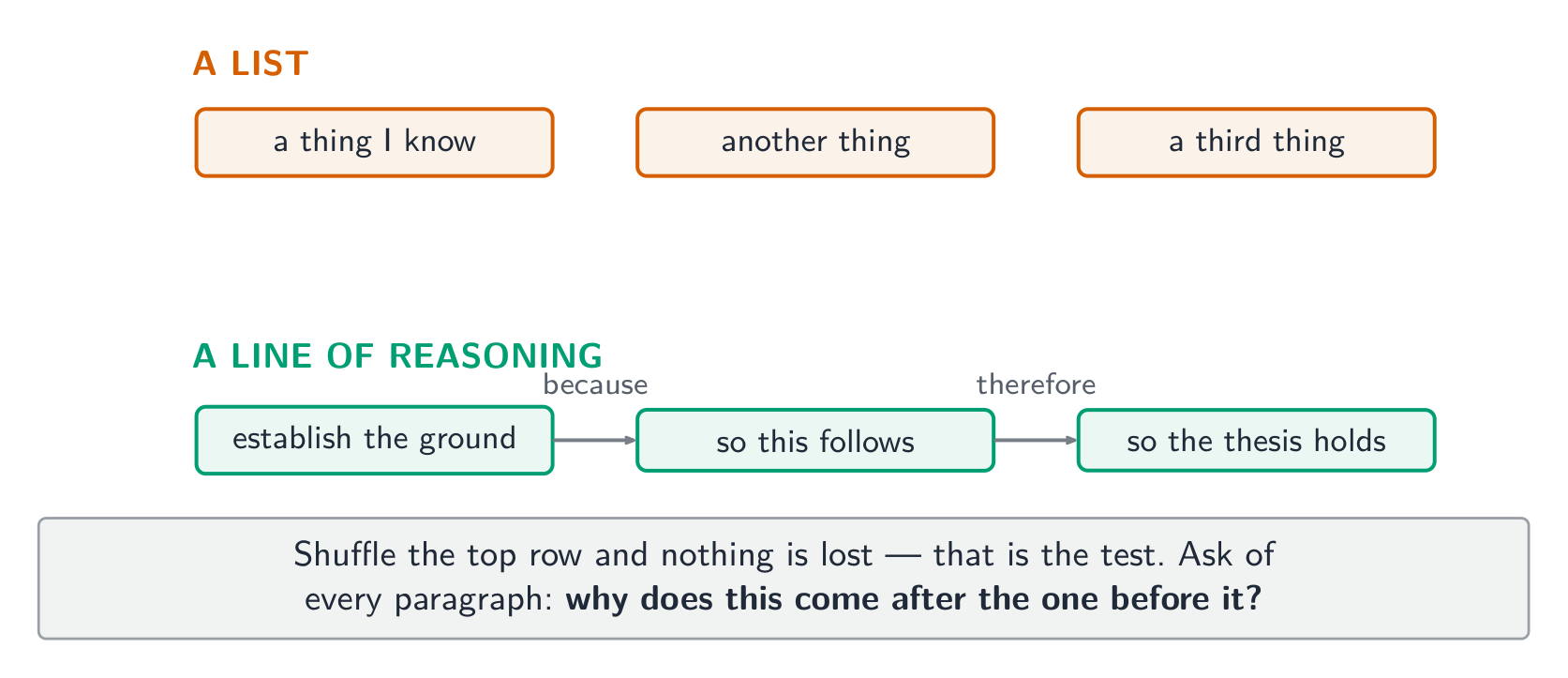
    The shuffle test: if the paragraphs can be reordered without loss, it is a list
    3.4

    Developing a Line of Reasoning and Commentary

    Syllabus · ⁨シラバス⁩
    English

    Enduring Understanding (REO-1): Writers guide understanding of a text’s lines of reasoning and claims through that text’s organization and integration of evidence.

    Learning Objective 6.A: Writing – Develop a line of reasoning and commentary that explains it throughout an argument.

    • REO-1.A Writers may lead readers through a line of reasoning and then arrive at a thesis.
    • REO-1.B Writers may express a claim and then develop a line of reasoning to justify the claim.
    • REO-1.C Writers explain their reasoning through commentary that connects chosen evidence to a claim.
    • REO-1.D Commentary explains the significance and relevance of evidence in relation to the line of reasoning.
    • REO-1.E The sequence of paragraphs in a text reveals the argument’s line of reasoning.
    • REO-1.F Flaws in a line of reasoning may render an argument specious or illogical.
    日本語

    持続的理解 (REO-1): 作家は、テキストの組織化と根拠の統合を通じて、テキスト内の論理の流れと主張の理解を導く。

    学習目標 6.A: 作文 – 論理展開と解説を構築し、主張全体を通じてその理由を説明する。

    • REO-1.A 作家は、読者を論理の流れに沿って引导し、最終的に thesis に至らせることができる。
    • REO-1.B 作家は、まず主張を提示し、その後、その主張を正当化するための論理の流れを展開することができる。
    • REO-1.C 作家は、選んだ根拠と主張をつなぐ解説を通じて、自身の論理を説明する。
    • REO-1.D 解説は、論理の流れとの関係において根拠 significance と関連性を説明する。
    • REO-1.E 文章の段落の順序は、論理展開の道筋を示している。
    • REO-1.F 論理展開の欠陥は、主張を虚飾的または非合理的なものにする可能性がある。

    Source: College Board AP Course and Exam Description · ⁨出典: College Board AP コースおよび試験説明書⁩

    For your own essays, the useful discipline is to decide the order of your claims before writing any of them. An essay whose paragraphs could be shuffled without loss has no line of reasoning - it has a list.

    Test a draft by asking of each paragraph: why does this come after the one before it? If the only answer is "it is another thing I know about the topic", the structure is a list and the reasoning point is at risk.

    Commentary as four rungs - the reasoning point is awarded for the last one
    Explore · ⁨探索⁩

    Climb the four rungs of commentary

    'Explain your evidence' is unusable. Four questions, each answerable in a sentence, make it a procedure.

    3.5

    Recognizing Methods of Development

    Syllabus · ⁨シラバス⁩
    English

    Enduring Understanding (REO-1): Writers guide understanding of a text’s lines of reasoning and claims through that text’s organization and integration of evidence.

    Learning Objective 5.C: Reading – Recognize and explain the use of methods of development to accomplish a purpose.

    • REO-1.G Methods of development are common approaches writers frequently use to develop and organize the reasoning of their arguments. A method of development provides an audience with the means to trace a writer’s reasoning in an argument.
    • REO-1.H Some typical methods of development are narration, cause-effect, comparison-contrast, definition, and description.
    • REO-1.I When developing ideas through narration, writers offer details about real-life experiences and offer reflections and insights on the significance of those experiences.
    • REO-1.J When developing ideas through cause-effect, writers present a cause, assert effects or consequences of that cause, or present a series of causes and the subsequent effect(s).
    日本語

    持続的理解 (REO-1): 作家は、テキストの組織化と根拠の統合を通じて、テキスト内の論理の流れと主張の理解を導く。

    学習目標 5.C: 読解 – 構成手法の使用方法を認識し、それがどのような目的達成に寄与するかを説明する。

    • REO-1.G 構成手法とは、著者が自身の主張の論理展开・組織化に頻繁に用いる一般的なアプローチである。構成手法は、読者に対して著者の論理展開をたどるための手段を提供する。
    • REO-1.H 代表的な構成手法には、叙事法、因果関係、比較対照法、定義法、描写法がある。
    • REO-1.I 叙事法によってアイデアを展開する場合、著者は現実の体験に関する詳細を提示し、それらの体験の意義に対する考察や洞察を述べる。
    • REO-1.J 因果関係によってアイデアを展開する場合、著者は原因を提示し、その原因による結果や帰結を主張するか、あるいは一連の原因とその後の結果を提示する。

    Source: College Board AP Course and Exam Description · ⁨出典: College Board AP コースおよび試験説明書⁩

    English

    Methods of development 展开方法 are common approaches writers use to develop and organise the reasoning of an argument. The CED's list: narration, cause-effect, comparison-contrast, definition, and description. This unit treats the first two.

    • Developing through narration 叙述: writers offer details about real-life experiences and reflections on them. The reflection is what makes narration an argument rather than a story - an anecdote with no reflection has supplied no reasoning.
    • Developing through cause-effect 因果: writers present a cause, then assert the effects or consequences of that cause - or begin from an effect and trace it back.
    日本語

    Methods of development 展开方法 are common approaches writers use to develop and organise the reasoning of an argument. The CED's list: narration, cause-effect, comparison-contrast, definition, and description. This unit treats the first two.

    • Developing through narration 叙述: writers offer details about real-life experiences and reflections on them. The reflection is what makes narration an argument rather than a story - an anecdote with no reflection has supplied no reasoning.
    • Developing through cause-effect 因果: writers present a cause, then assert the effects or consequences of that cause - or begin from an effect and trace it back.
    Vocabulary · ⁨語彙⁩ Train · ⁨練習する⁩
    English 日本語
    Methods of development/ˈmeθədz ɒv dɪˈveləpmənt/ 展開手法
    narration/nəˈreɪʃn/ 叙述
    cause-effect/kɔːz ɪˈfekt/ 因果関係
    3.6

    Using Methods of Development

    Syllabus · ⁨シラバス⁩
    English

    Enduring Understanding (REO-1): Writers guide understanding of a text’s lines of reasoning and claims through that text’s organization and integration of evidence.

    Learning Objective 6.C: Writing – Use appropriate methods of development to advance an argument.

    • REO-1.G Methods of development are common approaches writers frequently use to develop and organize the reasoning of their arguments. A method of development provides an audience with the means to trace a writer’s reasoning in an argument.
    • REO-1.H Some typical methods of development are narration, cause-effect, comparison-contrast, definition, and description.
    • REO-1.I When developing ideas through narration, writers offer details about real-life experiences and offer reflections and insights on the significance of those experiences.
    • REO-1.J When developing ideas through cause-effect, writers present a cause, assert effects or consequences of that cause, or present a series of causes and the subsequent effect(s).
    日本語

    持続的理解 (REO-1): 作家は、テキストの組織化と根拠の統合を通じて、テキスト内の論理の流れと主張の理解を導く。

    学習目標 6.C: 作文 – 主張を推進するために適切な構成手法を用いる。

    • REO-1.G 構成手法とは、著者が自身の主張の論理展开・組織化に頻繁に用いる一般的なアプローチである。構成手法は、読者に対して著者の論理展開をたどるための手段を提供する。
    • REO-1.H 代表的な構成手法には、叙事法、因果関係、比較対照法、定義法、描写法がある。
    • REO-1.I 叙事法によってアイデアを展開する場合、著者は現実の体験に関する詳細を提示し、それらの体験の意義に対する考察や洞察を述べる。
    • REO-1.J 因果関係によってアイデアを展開する場合、著者は原因を提示し、その原因による結果や帰結を主張するか、あるいは一連の原因とその後の結果を提示する。

    Source: College Board AP Course and Exam Description · ⁨出典: College Board AP コースおよび試験説明書⁩

    Choosing a method is a rhetorical decision, not a stylistic one. Narration works when the audience needs to feel the situation before they will accept a claim about it. Cause-effect works when the audience already accepts the facts but not the connection between them.

    Worked example (a real AP exam task). On a Question 1 synthesis prompt, compare two paragraphs using the same two sources. The weak version: "Source A says X. Source C says Y. Both discuss the issue." That is summary in sequence - no claim, no integration, no reasoning. The strong version: "The strongest objection to the proposal is not that it fails but that it succeeds too narrowly: Source A's data show the intended outcome improving, while Source C's account of the same programme records the second-order costs that the measurement in Source A was never designed to capture." Here the sources are integrated into the writer's own claim, and the commentary establishes the logical relationship - which is what the four evidence-and-commentary points are awarded for.

    3.6

    Exam tips

    • Commentary has two jobs: introducing evidence into the reasoning, and explaining the relationship afterwards. Write both sentences.
    • Synthesis means integration, not summary in sequence. A paragraph per source is the classic low-scoring shape.
    • To find a writer's line of reasoning, summarise each paragraph in one sentence and read the list.
    • Ask of your own paragraphs: why does this one follow that one? No answer means no line of reasoning.
    • Narration needs reflection. An anecdote without it has told a story, not made an argument.
    • Choose a method of development for a rhetorical reason and be able to say what it is.
  • 4

    Introductions, Conclusions, and Development · ⁨導入部、結論部、および展開⁩

    Watch lesson · ⁨レッスンを視聴⁩
    4.1

    Introductions and Conclusions in a Text

    Syllabus · ⁨シラバス⁩
    English

    Enduring Understanding (RHS-1): Individuals write within a particular situation and make strategic writing choices based on that situation.

    Learning Objective 1.A: Reading – Identify and describe components of the rhetorical situation: the exigence, audience, writer, purpose, context, and message.

    • RHS-1.I The introduction of an argument introduces the subject and/ or writer of the argument to the audience. An introduction may present the argument’s thesis. An introduction may orient, engage, and/or focus the audience by presenting quotations, intriguing statements, anecdotes, questions, statistics, data, contextualized information, or a scenario.
    • RHS-1.J The conclusion of an argument brings the argument to a unified end. A conclusion may present the argument’s thesis. It may engage and/or focus the audience by explaining the significance of the argument within a broader context, making connections, calling the audience to act, suggesting a change in behavior or attitude, proposing a solution, leaving the audience with a compelling image, explaining implications, summarizing the argument, or connecting to the introduction.
    日本語

    永続的理解 (RHS-1): 個人は特定のシチュエーション内で書き、そのシチュエーションに基づき戦略的な書き choice を行う。

    学習目標 1.A: 読解 – レトリカル・シチュエーションの構成要素( exigence、聴衆、作家、目的、文脈、メッセージ)を特定し説明する。

    • RHS-1.I 導入部は、著者に読者を対象とした主題および/または著者を紹介する。導入部は主張の中心的な论点(テーゼ)を提示することもある。導入部は、引用文、興味深い statements、逸話、質問、統計データ、数値情報、文脈付きの情報、またはシナリオを提示することで、読者を誘導し、関心を惹きつけたり、焦点を絞ったりすることができる。
    • RHS-1.J 結論部は、主張を統合された形で締めくくる。結論部は主張の中心的な论点(テーゼ)を提示することもある。また、より広い文脈における主張の意義を説明したり、関連性を示したりして読者の関心や焦点を維持したり、読者への行動呼びかけを行ったり、行動や態度の変更を提案したり、解決策を提示したり、読者に印象的なイメージを残したり、含意を説明したり、主張を要約したり、導入部との結びつきを示すことにより、読者の関心を維持したり焦点を絞ったりする。

    Source: College Board AP Course and Exam Description · ⁨出典: College Board AP コースおよび試験説明書⁩

    English

    Unit 4 covers the two positions in a text where a writer's choices are most visible - the beginning and the end - and completes the CED's list of methods of development.

    • The introduction 引言 of an argument introduces the subject and/or the writer to the audience. It may orient the reader, establish the exigence and context, and gain attention.
    • The conclusion 结论 brings the argument to a unified end. It may present the argument's thesis, explain its significance, or situate the argument in a broader context.

    Note the verb in the second: unified. A conclusion is not a summary; it is the point at which the parts are shown to have been one argument.

    日本語

    Unit 4 covers the two positions in a text where a writer's choices are most visible - the beginning and the end - and completes the CED's list of methods of development.

    • The introduction 引言 of an argument introduces the subject and/or the writer to the audience. It may orient the reader, establish the exigence and context, and gain attention.
    • The conclusion 结论 brings the argument to a unified end. It may present the argument's thesis, explain its significance, or situate the argument in a broader context.

    Note the verb in the second: unified. A conclusion is not a summary; it is the point at which the parts are shown to have been one argument.

    Neither paragraph exists to be present - ask what a reader gains from it
    Vocabulary · ⁨語彙⁩ Train · ⁨練習する⁩
    English 日本語
    introduction/ˌɪntrəˈdʌkʃn/ 導入期
    conclusion/kənˈkluːʒn/ 結論
    4.2

    Writing Introductions and Conclusions

    Syllabus · ⁨シラバス⁩
    English

    Enduring Understanding (RHS-1): Individuals write within a particular situation and make strategic writing choices based on that situation.

    Learning Objective 2.A: Writing – Write introductions and conclusions appropriate to the purpose and context of the rhetorical situation.

    • RHS-1.I The introduction of an argument introduces the subject and/ or writer of the argument to the audience. An introduction may present the argument’s thesis. An introduction may orient, engage, and/or focus the audience by presenting quotations, intriguing statements, anecdotes, questions, statistics, data, contextualized information, or a scenario.
    • RHS-1.J The conclusion of an argument brings the argument to a unified end. A conclusion may present the argument’s thesis. It may engage and/or focus the audience by explaining the significance of the argument within a broader context, making connections, calling the audience to act, suggesting a change in behavior or attitude, proposing a solution, leaving the audience with a compelling image, explaining implications, summarizing the argument, or connecting to the introduction.
    日本語

    永続的理解 (RHS-1): 個人は特定のシチュエーション内で書き、そのシチュエーションに基づき戦略的な書き choice を行う。

    学習目標 2.A: 作文 – レトリカル・シチュエーションの目的と文脈に適した導入部と結論部を作成する。
    • RHS-1.I 導入部は、著者に読者を対象とした主題および/または著者を紹介する。導入部は主張の中心的な论点(テーゼ)を提示することもある。導入部は、引用文、興味深い statements、逸話、質問、統計データ、数値情報、文脈付きの情報、またはシナリオを提示することで、読者を誘導し、関心を惹きつけたり、焦点を絞ったりすることができる。
    • RHS-1.J 結論部は、主張を統合された形で締めくくる。結論部は主張の中心的な论点(テーゼ)を提示することもある。また、より広い文脈における主張の意義を説明したり、関連性を示したりして読者の関心や焦点を維持したり、読者への行動呼びかけを行ったり、行動や態度の変更を提案したり、解決策を提示したり、読者に印象的なイメージを残したり、含意を説明したり、主張を要約したり、導入部との結びつきを示すことにより、読者の関心を維持したり焦点を絞ったりする。

    Source: College Board AP Course and Exam Description · ⁨出典: College Board AP コースおよび試験説明書⁩

    On the exam, both are worth writing well but neither is worth writing long. A useful discipline:

    • An introduction that positions the subject and states a defensible thesis in two or three sentences is complete. Everything else in a timed essay is better spent on evidence and commentary.
    • A conclusion that says what follows from the argument - its significance, or its wider implication - does more than one that restates the paragraphs.

    The weakest conclusion is the one that re-lists what the essay already said. The reader has just read it. Say instead what it means, or what it obliges.

    4.3

    Identifying the Overarching Thesis

    Syllabus · ⁨シラバス⁩
    English

    Enduring Understanding (CLE-1): Writers make claims about subjects, rely on evidence that supports the reasoning that justifies the claim, and often acknowledge or respond to other, possibly opposing, arguments.

    Learning Objective 3.B: Reading – Identify and describe the overarching thesis of an argument, and any indication it provides of the argument’s structure.

    • CLE-1.O A thesis statement may preview the line of reasoning of an argument. This is not to say that a thesis statement must list the points of an argument, aspects to be analyzed, or specific evidence to be used in an argument.
    日本語

    持続的理解 (CLE-1): 作家は対象について主張を行い、その主張を正当化するための論理的推理を裏付ける根拠に依存し、また、他者による対立する可能性のある議論を認識したり、反論したりすることが多い。

    学習目標 3.B: 読解 – 議論の中心的な thesis を特定・記述し、それが議論の構造についてどのような示唆を提供しているかを確認する。

    • CLE-1.O 中心的な论点(テーゼ)は、主張の論理展開を予言することがある。これは、中心的な论点(テーゼ)が必ずしも主張の要点、分析すべき側面、または使用される具体的な証拠を列挙しなければならないことを意味するものではない。

    Source: College Board AP Course and Exam Description · ⁨出典: College Board AP コースおよび試験説明書⁩

    The CED adds a precise refinement here: a thesis statement may preview the line of reasoning of an argument - and then, immediately, this is not to say that a thesis statement must list the reasons.

    That double statement is worth holding, because both errors are common. A thesis that previews nothing leaves the essay shapeless. A thesis mechanically listing three reasons is not required and often produces a rigid essay that cannot develop.

    4.4

    Writing a Thesis Statement

    Syllabus · ⁨シラバス⁩
    English

    Enduring Understanding (CLE-1): Writers make claims about subjects, rely on evidence that supports the reasoning that justifies the claim, and often acknowledge or respond to other, possibly opposing, arguments.

    Learning Objective 4.B: Writing – Write a thesis statement that requires proof or defense and that may preview the structure of the argument.

    • CLE-1.O A thesis statement may preview the line of reasoning of an argument. This is not to say that a thesis statement must list the points of an argument, aspects to be analyzed, or specific evidence to be used in an argument.
    日本語

    持続的理解 (CLE-1): 作家は対象について主張を行い、その主張を正当化するための論理的推理を裏付ける根拠に依存し、また、他者による対立する可能性のある議論を認識したり、反論したりすることが多い。

    学習目標 4.B: 作文 – 証明または防衛を要し、かつ議論の構造を予見する可能性がある thesis statement を作成する。

    • CLE-1.O 中心的な论点(テーゼ)は、主張の論理展開を予言することがある。これは、中心的な论点(テーゼ)が必ずしも主張の要点、分析すべき側面、または使用される具体的な証拠を列挙しなければならないことを意味するものではない。

    Source: College Board AP Course and Exam Description · ⁨出典: College Board AP コースおよび試験説明書⁩

    For your own writing, the practical version:

    • The thesis must be defensible. Non-negotiable, and it is the whole of the thesis point.
    • It may indicate the shape of the reasoning. Do it when the shape is genuinely load-bearing; do not do it as a formula.
    • It should be specific enough to constrain what follows. A thesis so broad that any paragraph could belong under it is not directing the essay.
    Three questions, run in this order, before the essay is written
    Explore · ⁨探索⁩

    Run the three thesis gates in order · ⁨3つの thesis のゲートを順に適用せよ。⁩

    A sentence can be beautifully arguable and still answer a prompt you were not set — which is why the order matters. · ⁨一文は非常に理屈立ての良い主張であっても、設問とは無関係な問いに答えてしまうことがある——そのため順序が重要である。⁩

    4.5

    Recognizing Methods of Development

    Syllabus · ⁨シラバス⁩
    English

    Enduring Understanding (REO-1): Writers guide understanding of a text’s lines of reasoning and claims through that text’s organization and integration of evidence.

    Learning Objective 5.C: Reading – Recognize and explain the use of methods of development to accomplish a purpose.

    • REO-1.G Methods of development are common approaches writers frequently use to develop and organize the reasoning of their arguments. A method of development provides an audience with the means to trace a writer’s reasoning in an argument.
    • REO-1.K When developing ideas through comparison-contrast, writers present a category of comparison and then examine the similarities and/or differences between the objects of the comparison. When analyzing similarities and/or differences, like categories of comparison must be used.
    • REO-1.L When developing ideas through a definition or description, writers relate the characteristics, features, or sensory details of an object or idea, sometimes using examples or illustrations.
    日本語

    持続的理解 (REO-1): 作家は、テキストの組織化と根拠の統合を通じて、テキスト内の論理の流れと主張の理解を導く。

    学習目標 5.C: 読解 – 構成手法の使用方法を認識し、それがどのような目的達成に寄与するかを説明する。

    • REO-1.G 構成手法とは、著者が自身の主張の論理展开・組織化に頻繁に用いる一般的なアプローチである。構成手法は、読者に対して著者の論理展開をたどるための手段を提供する。
    • REO-1.K 比較対照法によってアイデアを展開する場合、著者は比較のカテゴリを提示し、その後、比較対象間の類似点および/または相違点を検討する。類似点および/または相違点を分析する際は、同じカテゴリの比較を使用する必要がある。
    • REO-1.L 定義法または描写法によってアイデアを展開する場合、著者は対象物やアイデアの特徴、要素、または感覚的细节を提示し、場合によっては例示や図解を用いることもある。

    Source: College Board AP Course and Exam Description · ⁨出典: College Board AP コースおよび試験説明書⁩

    English

    Unit 3 covered narration and cause-effect. Unit 4 adds the rest:

    • Developing through comparison-contrast 比较对照: writers present a category of comparison and then examine similarities and differences within it. The category is the part students omit - a comparison without a stated basis is two descriptions side by side.
    • Developing through definition or description 定义与描写: writers relate the characteristics, features, or sensory details of a subject.

    Definition is more powerful than it looks. An argument that turns on what a word means - what counts as success, as fairness, as progress - is an argument that has moved to the ground where it can actually be won.

    日本語
    The five methods, with the job each one is right for
    Choose the method the reasoning needs, not the one the topic suggests

    Unit 3 covered narration and cause-effect. Unit 4 adds the rest:

    • Developing through comparison-contrast 比较对照: writers present a category of comparison and then examine similarities and differences within it. The category is the part students omit - a comparison without a stated basis is two descriptions side by side.
    • Developing through definition or description 定义与描写: writers relate the characteristics, features, or sensory details of a subject.

    Definition is more powerful than it looks. An argument that turns on what a word means - what counts as success, as fairness, as progress - is an argument that has moved to the ground where it can actually be won.

    Vocabulary · ⁨語彙⁩ Train · ⁨練習する⁩
    English 日本語
    comparison-contrast/kəmˈpærɪsn ˈkɒntræst/ 比較・対照
    definition or description/ˌdefɪˈnɪʃn ɔː dɪˈskrɪpʃn/ 定義または説明
    4.6

    Using Methods of Development

    Syllabus · ⁨シラバス⁩
    English

    Enduring Understanding (REO-1): Writers guide understanding of a text’s lines of reasoning and claims through that text’s organization and integration of evidence.

    Learning Objective 6.C: Writing – Use appropriate methods of development to advance an argument.

    • REO-1.G Methods of development are common approaches writers frequently use to develop and organize the reasoning of their arguments. A method of development provides an audience with the means to trace a writer’s reasoning in an argument.
    • REO-1.K When developing ideas through comparison-contrast, writers present a category of comparison and then examine the similarities and/or differences between the objects of the comparison. When analyzing similarities and/or differences, like categories of comparison must be used.
    • REO-1.L When developing ideas through a definition or description, writers relate the characteristics, features, or sensory details of an object or idea, sometimes using examples or illustrations.
    日本語

    持続的理解 (REO-1): 作家は、テキストの組織化と根拠の統合を通じて、テキスト内の論理の流れと主張の理解を導く。

    学習目標 6.C: 作文 – 主張を推進するために適切な構成手法を用いる。

    • REO-1.G 構成手法とは、著者が自身の主張の論理展开・組織化に頻繁に用いる一般的なアプローチである。構成手法は、読者に対して著者の論理展開をたどるための手段を提供する。
    • REO-1.K 比較対照法によってアイデアを展開する場合、著者は比較のカテゴリを提示し、その後、比較対象間の類似点および/または相違点を検討する。類似点および/または相違点を分析する際は、同じカテゴリの比較を使用する必要がある。
    • REO-1.L 定義法または描写法によってアイデアを展開する場合、著者は対象物やアイデアの特徴、要素、または感覚的细节を提示し、場合によっては例示や図解を用いることもある。

    Source: College Board AP Course and Exam Description · ⁨出典: College Board AP コースおよび試験説明書⁩

    The choice is rhetorical. Ask what the audience needs before they will accept your claim:

    • They need to see it, and abstraction is the obstacle: description.
    • They accept the facts but not the connection: cause-effect.
    • They are applying the wrong standard: definition.
    • They will judge better against something familiar: comparison-contrast.
    • They need to feel the situation: narration.

    Worked example (a real AP exam task). A Question 3 argument prompt asks you to take a position on whether a common practice is beneficial. A student who reaches for description writes a vivid paragraph nobody disputes. A student who reaches for definition writes: "Whether the practice is beneficial depends on what we count as benefit. If benefit means measurable short-term gain, the practice succeeds; if it means durable capability, the same evidence shows it failing." That paragraph has relocated the argument onto ground where the evidence actually decides something - which is the kind of move the sophistication point exists to reward.

    Read the middle column first: the method follows from what the paragraph must prove
    Explore · ⁨探索⁩

    Choose the method from the job · ⁨作業に基づいて手法を選ぶ⁩

    The method follows from what the paragraph has to prove, not from the order things happened in. · ⁨手法はパラグラフが証明しなければならない内容から導かれ、出来事の順序から導かれるわけではない。⁩

    4.6

    Exam tips

    • Introductions should be short and load-bearing: position the subject, state a defensible thesis, move on.
    • A conclusion that restates earns least. Say what the argument means or obliges.
    • A thesis may preview the reasoning; it is not required to list reasons. Both errors are common.
    • Comparison needs a stated category. Without one you have written two descriptions, not a comparison.
    • Definition is the strongest move available in an argument essay whose terms are contestable.
    • Pick a method of development from what the audience needs, not from what the topic suggests.
  • 5

    Organization, Coherence, and Style · ⁨構成、一貫性、およびスタイル⁩

    Watch lesson · ⁨レッスンを視聴⁩
    5.1

    Describing the Line of Reasoning

    Syllabus · ⁨シラバス⁩
    English

    Enduring Understanding (REO-1): Writers guide understanding of a text’s lines of reasoning and claims through that text’s organization and integration of evidence.

    Learning Objective 5.A: Reading – Describe the line of reasoning and explain whether it supports an argument’s overarching thesis.

    • REO-1.M The body paragraphs of a written argument make claims, support them with evidence, and provide commentary that explains how the paragraph contributes to the reasoning of the argument.
    日本語

    持続的理解 (REO-1): 作家は、テキストの組織化と根拠の統合を通じて、テキスト内の論理の流れと主張の理解を導く。

    学習目標 5.A: 読解 – 論理の流れを記述し、それが議論の中心的な thesis を支持しているかどうかを説明する。

    • REO-1.M 本文の段落は主張を行い、それを証拠で裏付け、さらにその段落が主張の論理展開にどのように貢献するかを説明する解説を提供する。

    Source: College Board AP Course and Exam Description · ⁨出典: College Board AP コースおよび試験説明書⁩

    English

    Unit 5 turns from what an argument contains to how it holds together. It has two subjects: coherence 连贯 and the beginnings of style 文体.

    The CED's statement of the body paragraph is exact and worth memorising: the body paragraphs of a written argument make claims, support them with evidence, and provide commentary that explains the relationship of the evidence to the claim.

    Three parts, in that order, in every body paragraph. When an AP essay loses evidence-and-commentary points, it is almost always because the third part is missing from paragraphs that have the first two.

    日本語

    Unit 5 turns from what an argument contains to how it holds together. It has two subjects: coherence 连贯 and the beginnings of style 文体.

    The CED's statement of the body paragraph is exact and worth memorising: the body paragraphs of a written argument make claims, support them with evidence, and provide commentary that explains the relationship of the evidence to the claim.

    Three parts, in that order, in every body paragraph. When an AP essay loses evidence-and-commentary points, it is almost always because the third part is missing from paragraphs that have the first two.

    Vocabulary · ⁨語彙⁩ Train · ⁨練習する⁩
    English 日本語
    coherence/kəʊˈhɪərəns/ 整合性
    style/staɪl/ style
    5.2

    Developing a Line of Reasoning and Commentary

    Syllabus · ⁨シラバス⁩
    English

    Enduring Understanding (REO-1): Writers guide understanding of a text’s lines of reasoning and claims through that text’s organization and integration of evidence.

    Learning Objective 6.A: Writing – Develop a line of reasoning and commentary that explains it throughout an argument.

    • REO-1.M The body paragraphs of a written argument make claims, support them with evidence, and provide commentary that explains how the paragraph contributes to the reasoning of the argument.
    日本語

    持続的理解 (REO-1): 作家は、テキストの組織化と根拠の統合を通じて、テキスト内の論理の流れと主張の理解を導く。

    学習目標 6.A: 作文 – 論理展開と解説を構築し、主張全体を通じてその理由を説明する。

    • REO-1.M 本文の段落は主張を行い、それを証拠で裏付け、さらにその段落が主張の論理展開にどのように貢献するかを説明する解説を提供する。

    Source: College Board AP Course and Exam Description · ⁨出典: College Board AP コースおよび試験説明書⁩

    Applied to your own writing: draft the claims first, as a list, before writing any paragraph. You then have the line of reasoning in front of you and can check that it moves.

    Then, for each claim, write the paragraph in its three parts deliberately. A useful habit under exam conditions is to make the commentary sentence begin with a word that forces a relationship - because, which means, so, the effect of this is - because those words cannot be followed by a restatement.

    5.3

    Organization, Unity, and Coherence

    Syllabus · ⁨シラバス⁩
    English

    Enduring Understanding (REO-1): Writers guide understanding of a text’s lines of reasoning and claims through that text’s organization and integration of evidence.

    Learning Objective 5.B: Reading – Explain how the organization of a text creates unity and coherence and reflects a line of reasoning.

    • REO-1.N Coherence occurs at different levels in a piece of writing. In a sentence, the idea in one clause logically links to an idea in the next. In a paragraph, the idea in one sentence logically links to an idea in the next. In a text, the ideas in one paragraph logically link to the ideas in the next.
    • REO-1.O Repetition, synonyms, pronoun references, and parallel structure may indicate or develop a relationship between elements of a text.
    • REO-1.P Transitional elements are words or other elements (phrases, clauses, sentences, or paragraphs) that assist in creating coherence among sentences, paragraphs, or sections in a text by showing relationships among ideas.
    • REO-1.Q Transitional elements can be used to introduce evidence or to indicate its relationship to other ideas or evidence in that paragraph or in the text as a whole.
    日本語

    持続的理解 (REO-1): 作家は、テキストの組織化と根拠の統合を通じて、テキスト内の論理の流れと主張の理解を導く。

    学習目標 5.B: 読解 – 文章の構成が統一性と整合性を生み出し、かつ論理展開を反映している方法を説明する。

    • REO-1.N 整合性は文章中の異なるレベルで発生する。文単位では、一つの節の idea が次の節の idea と論理的に結びつく。段落単位では、一つの文の idea が次の文の idea と論理的に結びつく。文章単位では、一つの段落の ideas が次の段落の ideas と論理的に結びつく。
    • REO-1.O 反復、同義語、代名詞の参照、平行構造は、文章の要素間の関係を示唆したり、発展させたりする手がかりとなることがある。
    • REO-1.P 接続語句とは、idea 間の関係を示すことで、文、段落、またはセクション間の整合性を生み出すのに役立つ言葉や他の要素(フレーズ、節、文、段落など)である。
    • REO-1.Q 接続語句は、証拠を導入するために使われたり、その証拠がその段落内や文章全体としての他の ideas や証拠とどのような関係にあるかを示すために使われたりする。

    Source: College Board AP Course and Exam Description · ⁨出典: College Board AP コースおよび試験説明書⁩

    English

    Coherence occurs at different levels in a piece of writing:

    • In a sentence, the idea in one clause logically links to the idea in another.
    • In a paragraph, each sentence builds on the one before it.
    • Across the whole text, each paragraph relates to the line of reasoning.

    The CED then names the devices that create those links:

    • Repetition 重复, synonyms 同义词, pronoun references 代词指代, and parallel structure 平行结构 may indicate or develop a relationship between ideas.
    • Transitional elements 过渡成分 are words or other elements - phrases, clauses, sentences, or whole paragraphs - that assist in creating coherence.
    日本語
    Coherence is built at three levels, and by five named devices
    The devices are examinable by name - and they are what a "structure" question is actually asking about

    Coherence occurs at different levels in a piece of writing:

    • In a sentence, the idea in one clause logically links to the idea in another.
    • In a paragraph, each sentence builds on the one before it.
    • Across the whole text, each paragraph relates to the line of reasoning.

    The CED then names the devices that create those links:

    • Repetition 重复, synonyms 同义词, pronoun references 代词指代, and parallel structure 平行结构 may indicate or develop a relationship between ideas.
    • Transitional elements 过渡成分 are words or other elements - phrases, clauses, sentences, or whole paragraphs - that assist in creating coherence.
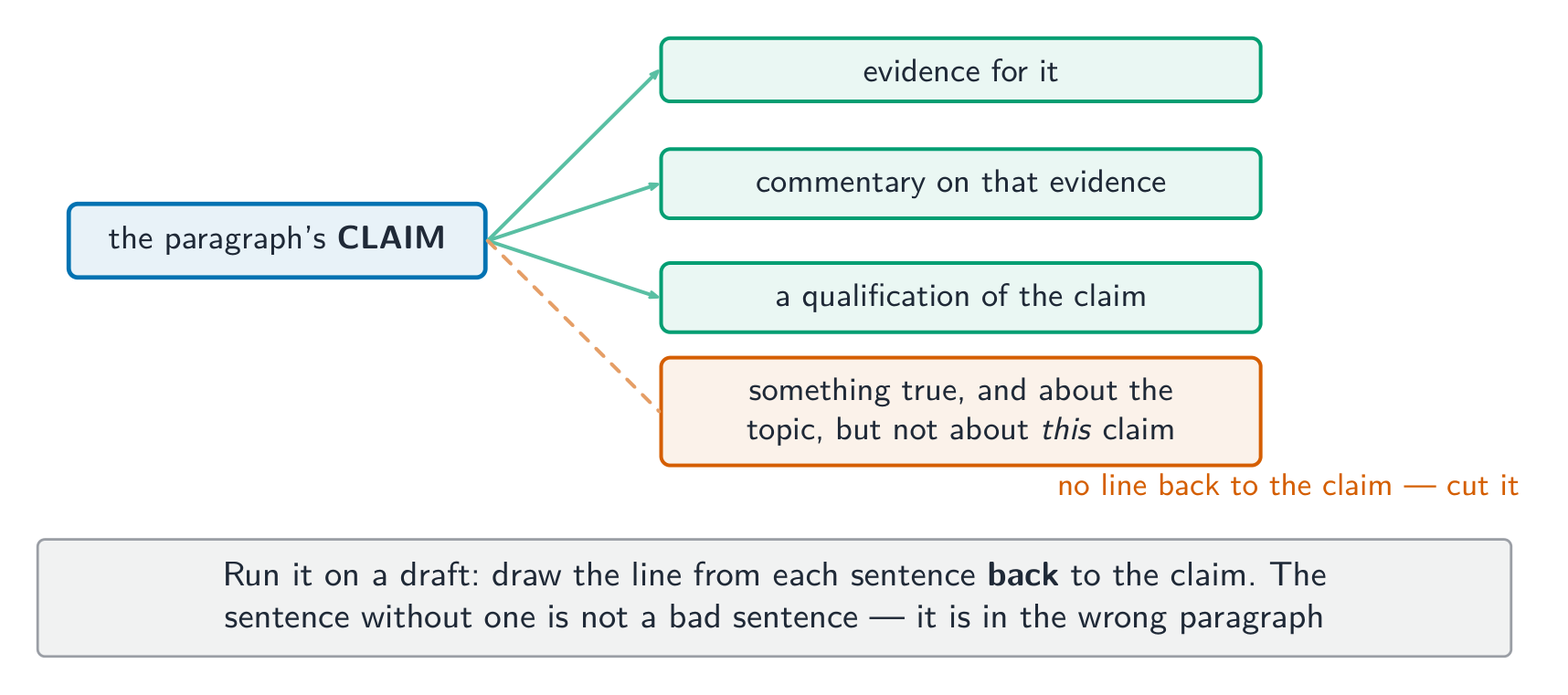
    The unity test: draw a line from each sentence back to the claim
    Vocabulary · ⁨語彙⁩ Train · ⁨練習する⁩
    English 日本語
    Repetition/ˌrepəˈtɪʃn/ 反復
    synonyms/ˈsɪnənɪmz/ 同義語
    pronoun references/ˈprəʊnaʊn ˈrefrənsɪz/ 代名詞の参照
    parallel structure/ˈpærəlel ˈstrʌktʃə/ 平行構造
    Transitional elements/trænˈsɪʃənl ˈelɪmənts/ 接続要素
    5.4

    Using Transitional Elements

    Syllabus · ⁨シラバス⁩
    English

    Enduring Understanding (REO-1): Writers guide understanding of a text’s lines of reasoning and claims through that text’s organization and integration of evidence.

    Learning Objective 6.B: Writing – Use transitional elements to guide the reader through the line of reasoning of an argument.

    • REO-1.N Coherence occurs at different levels in a piece of writing. In a sentence, the idea in one clause logically links to an idea in the next. In a paragraph, the idea in one sentence logically links to an idea in the next. In a text, the ideas in one paragraph logically link to the ideas in the next.
    • REO-1.O Repetition, synonyms, pronoun references, and parallel structure may indicate or develop a relationship between elements of a text.
    • REO-1.P Transitional elements are words or other elements (phrases, clauses, sentences, or paragraphs) that assist in creating coherence among sentences, paragraphs, or sections in a text by showing relationships among ideas.
    • REO-1.Q Transitional elements can be used to introduce evidence or to indicate its relationship to other ideas or evidence in that paragraph or in the text as a whole.
    日本語

    持続的理解 (REO-1): 作家は、テキストの組織化と根拠の統合を通じて、テキスト内の論理の流れと主張の理解を導く。

    学習目標 6.B: 作文 – 接続語句を使用して、読者が主張の論理展開をたどりやすくする。

    • REO-1.N 整合性は文章中の異なるレベルで発生する。文単位では、一つの節の idea が次の節の idea と論理的に結びつく。段落単位では、一つの文の idea が次の文の idea と論理的に結びつく。文章単位では、一つの段落の ideas が次の段落の ideas と論理的に結びつく。
    • REO-1.O 反復、同義語、代名詞の参照、平行構造は、文章の要素間の関係を示唆したり、発展させたりする手がかりとなることがある。
    • REO-1.P 接続語句とは、idea 間の関係を示すことで、文、段落、またはセクション間の整合性を生み出すのに役立つ言葉や他の要素(フレーズ、節、文、段落など)である。
    • REO-1.Q 接続語句は、証拠を導入するために使われたり、その証拠がその段落内や文章全体としての他の ideas や証拠とどのような関係にあるかを示すために使われたりする。

    Source: College Board AP Course and Exam Description · ⁨出典: College Board AP コースおよび試験説明書⁩

    Transitions have a second job the CED names explicitly: they introduce evidence or indicate its relationship to other ideas or evidence.

    That is the difference between decorative and functional transitions. Furthermore adds nothing - it says only "here is another sentence". Even in the cases where the effect is smallest tells the reader what relationship is coming. Choose transitions that carry information about the relationship, not ones that merely mark a boundary.

    Note also that a transitional element may be a whole paragraph. In a long argument, a short paragraph whose only job is to turn the reasoning is legitimate and often elegant.

    A transition is a promise about the next sentence - breaking it is a reasoning error
    Explore · ⁨探索⁩

    Match each transition to the promise it makes · ⁨各接続詞と、それが約束する意味を対応させる⁩

    A transition is a claim about how two ideas stand to each other. Breaking that promise is a reasoning error, not a style problem. · ⁨接続詞とは、2つの考え方の関係性に関する主張である。その約束を破ることはスタイルの問題ではなく、論理の誤りである。⁩

    5.5

    Word Choice, Comparisons, and Syntax

    Syllabus · ⁨シラバス⁩
    English

    Enduring Understanding (STL-1): The rhetorical situation informs the strategic stylistic choices that writers make.

    Learning Objective 7.A: Reading – Explain how word choice, comparisons, and syntax contribute to the specific tone or style of a text.

    • STL-1.A Words have both connotative and denotative meanings.
    • STL-1.B Descriptive words, such as adjectives and adverbs, not only qualify or modify the things they describe but also convey a perspective toward those things.
    • STL-1.C Precise word choice reduces confusion and may help the audience perceive the writer’s perspective.
    日本語

    持続的理解(STL-1): レトリカル・シチュエーションは、著者が行う戦略的な文体選択に影響を与える。

    学習目標 7.A: 読解 – 語彙選択、比喩表現、構文が、文章の特定のトーンやスタイルにどう寄与しているかを説明する。

    • STL-1.A 言葉には、連想的意味(connotative meaning)と辞書的意味(denotative meaning)の両方がある。
    • STL-1.B 形容詞や副詞などの修飾語は、自身が修飾する事物を限定または装飾するだけでなく、それらに対する見解も伝える。
    • STL-1.C 正確な語彙選択は混乱を減らし、読者が著者の見解を把握するのを助けることがある。

    Source: College Board AP Course and Exam Description · ⁨出典: College Board AP コースおよび試験説明書⁩

    English

    Unit 5 opens the course's treatment of style with three claims about diction:

    • Words have both connotative and denotative meanings 内涵义与外延义. Denotation is what a word refers to; connotation is what it carries.
    • Descriptive words - adjectives and adverbs - not only qualify or modify what they describe but convey a perspective toward it.
    • Precise word choice reduces confusion and helps the audience perceive the writer's perspective.

    The second is the analytically useful one. When a rhetorical-analysis passage calls a policy ambitious rather than expensive, no fact has changed and the reader's disposition has. That is a rhetorical choice, and it is exactly what the question asks you to explain.

    日本語

    Unit 5 opens the course's treatment of style with three claims about diction:

    • Words have both connotative and denotative meanings 内涵义与外延义. Denotation is what a word refers to; connotation is what it carries.
    • Descriptive words - adjectives and adverbs - not only qualify or modify what they describe but convey a perspective toward it.
    • Precise word choice reduces confusion and helps the audience perceive the writer's perspective.

    The second is the analytically useful one. When a rhetorical-analysis passage calls a policy ambitious rather than expensive, no fact has changed and the reader's disposition has. That is a rhetorical choice, and it is exactly what the question asks you to explain.

    Vocabulary · ⁨語彙⁩ Train · ⁨練習する⁩
    English 日本語
    connotative and denotative meanings/kɒnəˈtætɪv ænd dɪˈnəʊtətɪv ˈmiːnɪŋz/ 連想意味と辞書意味
    5.6

    Using Words and Syntax for Tone and Style

    Syllabus · ⁨シラバス⁩
    English

    Enduring Understanding (STL-1): The rhetorical situation informs the strategic stylistic choices that writers make.

    Learning Objective 8.A: Writing – Strategically use words, comparisons, and syntax to convey a specific tone or style in an argument.

    • STL-1.A Words have both connotative and denotative meanings.
    • STL-1.B Descriptive words, such as adjectives and adverbs, not only qualify or modify the things they describe but also convey a perspective toward those things.
    • STL-1.C Precise word choice reduces confusion and may help the audience perceive the writer’s perspective.
    日本語

    持続的理解(STL-1): レトリカル・シチュエーションは、著者が行う戦略的な文体選択に影響を与える。

    学習目標 8.A: 作文 – 論証において特定のトーンやスタイルを伝えるために、語彙、比較表現、構文を戦略的に活用する。

    • STL-1.A 言葉には、連想的意味(connotative meaning)と辞書的意味(denotative meaning)の両方がある。
    • STL-1.B 形容詞や副詞などの修飾語は、自身が修飾する事物を限定または装飾するだけでなく、それらに対する見解も伝える。
    • STL-1.C 正確な語彙選択は混乱を減らし、読者が著者の見解を把握するのを助けることがある。

    Source: College Board AP Course and Exam Description · ⁨出典: College Board AP コースおよび試験説明書⁩

    For your own writing, precision is worth more than range. A concrete rule: prefer the word that is exactly right to the word that is impressive. Examiners reward control, and an inflated word used slightly wrongly reads as loss of control.

    Worked example (a real AP exam task). In a rhetorical-analysis passage a writer describes a proposal's supporters as "determined" in one paragraph and "unyielding" in the next. A low-scoring answer notes that the writer uses "strong diction". A scoring answer explains the shift: "Both words denote persistence, but 'determined' carries approval and 'unyielding' carries obstruction. By moving from one to the other without changing the facts described, the writer withdraws sympathy from the supporters while appearing only to continue describing them - so the audience's judgement shifts before any counter-argument is made." That is connotation, tone, and effect on audience in one move.

    Name the shape, the effect and the risk - praise alone is description
    Explore · ⁨探索⁩

    Name the shape, the effect and the risk · ⁨形、効果、リスクを挙げよ⁩

    Analysis that only praises the effect is describing — and description does not earn commentary marks. · ⁨効果のみを称賛する分析は描写であり、描写はコメント点数を得られない。⁩

    5.6

    Exam tips

    • Every body paragraph: claim, evidence, commentary. Lost points are nearly always the third.
    • Draft your claims as a list first. It is the only way to see whether the reasoning moves.
    • Begin commentary with because, which means, so - words that cannot be followed by a restatement.
    • Know the coherence devices by name: repetition, synonyms, pronoun reference, parallel structure, transitions.
    • A transition should carry the relationship, not just mark a boundary. Furthermore usually carries nothing.
    • Connotation is where diction analysis lives. Same denotation, different disposition, is a rhetorical choice worth explaining.
  • 6

    Evidence, Thesis, and Stylistic Choices · ⁨根拠、中心的主張、および文体の選択⁩

    Watch lesson · ⁨レッスンを視聴⁩
    6.1

    Identifying Claims and Evidence

    Syllabus · ⁨シラバス⁩
    English

    Enduring Understanding (CLE-1): Writers make claims about subjects, rely on evidence that supports the reasoning that justifies the claim, and often acknowledge or respond to other, possibly opposing, arguments.

    Learning Objective 3.A: Reading – Identify and explain claims and evidence within an argument.

    • CLE-1.P When synthesizing, writers draw upon arguments from multiple sources, strategically select the most relevant information, and combine apt and specific source material as part of their own argument.
    • CLE-1.Q A source provides information for an argument, and some sources are more reliable or credible than others.
    • CLE-1.R A position and a perspective are different. Sources may have the same position on a subject, yet each comes from a different perspective based on their background, interests, and expertise.
    • CLE-1.S When incorporating evidence or sources into an argument, the strongest arguments recognize and acknowledge the biases and limitations of the material and account for those limitations in their reasoning.
    • CLE-1.T The degree to which a source does or does not consider other positions reflects the degree to which that source is biased.
    日本語

    持続的理解 (CLE-1): 作家は対象について主張を行い、その主張を正当化するための論理的推理を裏付ける根拠に依存し、また、他者による対立する可能性のある議論を認識したり、反論したりすることが多い。

    学習目標 3.A: 読解 – 議論における主張と根拠を特定し説明する。

    • CLE-1.P 統合を行う際、著者は複数の出典からの論証に言及し、最も関連性の高い情報を戦略的に選択し、自身の論証の一部として適切な具体的な出典素材を組み込む。
    • CLE-1.Q 出典は論証のための情報源を提供し、ある出典は他の出典よりも信頼性或信憑性が高い場合がある。
    • CLE-1.R 立場と視点は異なる。出典が同一のテーマについて同じ立場を取っていても、背景、関心、専門知識に基づいてそれぞれ異なる視点から来ていることがある。
    • CLE-1.S 論証に証拠や出典を取り入れる際、最も強力な論証は素材のバイアスと限界を認識し、認めた上で、その推理においてこれらの限界を考慮に入れる。
    • CLE-1.T 出典が他の立場をどの程度考慮しているか(していないか)は、その出典のバイアスの程度を反映している。

    Source: College Board AP Course and Exam Description · ⁨出典: College Board AP コースおよび試験説明書⁩

    Unit 6 is the synthesis unit, and it contains the single sharpest distinction in the course.

    • When synthesising, writers draw on arguments from multiple sources, strategically select the most relevant information, and integrate it into their own argument.
    • A source provides information for an argument, and some sources are more reliable or credible than others.
    • A position and a perspective are different. Sources may hold the same position on a subject and yet each come from a different perspective.
    • The strongest arguments recognise and acknowledge the other positions that exist.
    • The degree to which a source considers other positions reflects the degree to which that source is credible - a test you can apply to any source on the exam.
    The distinction the synthesis question is built on
    Two sources can agree and still be doing completely different work in your argument
    The verb positions the source before your commentary begins
    Explore · ⁨探索⁩

    Choose the attribution verb that positions the source

    The verb commits you to something about the source's status, before your commentary starts, and costs no extra words.

    6.2

    Developing a Paragraph with Claim and Evidence

    Syllabus · ⁨シラバス⁩
    English

    Enduring Understanding (CLE-1): Writers make claims about subjects, rely on evidence that supports the reasoning that justifies the claim, and often acknowledge or respond to other, possibly opposing, arguments.

    Learning Objective 4.A: Writing – Develop a paragraph that includes a claim and evidence supporting the claim.

    • CLE-1.P When synthesizing, writers draw upon arguments from multiple sources, strategically select the most relevant information, and combine apt and specific source material as part of their own argument.
    • CLE-1.Q A source provides information for an argument, and some sources are more reliable or credible than others.
    • CLE-1.R A position and a perspective are different. Sources may have the same position on a subject, yet each comes from a different perspective based on their background, interests, and expertise.
    • CLE-1.S When incorporating evidence or sources into an argument, the strongest arguments recognize and acknowledge the biases and limitations of the material and account for those limitations in their reasoning.
    • CLE-1.T The degree to which a source does or does not consider other positions reflects the degree to which that source is biased.
    日本語

    持続的理解 (CLE-1): 作家は対象について主張を行い、その主張を正当化するための論理的推理を裏付ける根拠に依存し、また、他者による対立する可能性のある議論を認識したり、反論したりすることが多い。

    学習目標 4.A: 作文 – 主張とそれを支持する根拠を含む段落を構成する。

    • CLE-1.P 統合を行う際、著者は複数の出典からの論証に言及し、最も関連性の高い情報を戦略的に選択し、自身の論証の一部として適切な具体的な出典素材を組み込む。
    • CLE-1.Q 出典は論証のための情報源を提供し、ある出典は他の出典よりも信頼性或信憑性が高い場合がある。
    • CLE-1.R 立場と視点は異なる。出典が同一のテーマについて同じ立場を取っていても、背景、関心、専門知識に基づいてそれぞれ異なる視点から来ていることがある。
    • CLE-1.S 論証に証拠や出典を取り入れる際、最も強力な論証は素材のバイアスと限界を認識し、認めた上で、その推理においてこれらの限界を考慮に入れる。
    • CLE-1.T 出典が他の立場をどの程度考慮しているか(していないか)は、その出典のバイアスの程度を反映している。

    Source: College Board AP Course and Exam Description · ⁨出典: College Board AP コースおよび試験説明書⁩

    The position-and-perspective distinction is what makes synthesis possible. If you sort the sources only by position, you get two piles - for and against - and a paragraph per pile. If you sort them by perspective, you can say things like:

    Both the economist and the teacher support the measure, but they support it for reasons that do not survive together: one values the measurable gain, the other the change in what students attempt.

    That sentence is synthesis. It uses two sources, is grounded in what each actually says, and produces a claim neither source makes.

    Also examinable: use the credibility test. A source that never acknowledges any other position is, by the CED's own standard, less credible - and saying so about a source is legitimate evidence in your essay.

    Three moves turn a source into evidence - the third is where synthesis happens
    Explore · ⁨探索⁩

    Turn a source into evidence in three moves

    A synthesis essay is not a tour of the sources. The third move is where the synthesis happens, and it is the one most often missing.

    6.3

    Identifying the Overarching Thesis

    Syllabus · ⁨シラバス⁩
    English

    Enduring Understanding (CLE-1): Writers make claims about subjects, rely on evidence that supports the reasoning that justifies the claim, and often acknowledge or respond to other, possibly opposing, arguments.

    Learning Objective 3.B: Reading – Identify and describe the overarching thesis of an argument, and any indication it provides of the argument’s structure.

    • CLE-1.U Consideration and use of new evidence may require revision of the thesis statement and/or changes to the line of reasoning.
    日本語

    持続的理解 (CLE-1): 作家は対象について主張を行い、その主張を正当化するための論理的推理を裏付ける根拠に依存し、また、他者による対立する可能性のある議論を認識したり、反論したりすることが多い。

    学習目標 3.B: 読解 – 議論の中心的な thesis を特定・記述し、それが議論の構造についてどのような示唆を提供しているかを確認する。

    • CLE-1.U 新たな証拠を検討・使用することは、中心论点の修正および/または推理の流れの変更を必要とする可能性がある。

    Source: College Board AP Course and Exam Description · ⁨出典: College Board AP コースおよび試験説明書⁩

    A short but load-bearing point: consideration and use of new evidence may require revision of the thesis statement and/or changes to the line of reasoning.

    Reading a text, this means a writer's thesis may be responsive - shaped by the evidence rather than imposed on it. Look for where an argument turns.

    6.4

    Writing a Thesis Statement

    Syllabus · ⁨シラバス⁩
    English

    Enduring Understanding (CLE-1): Writers make claims about subjects, rely on evidence that supports the reasoning that justifies the claim, and often acknowledge or respond to other, possibly opposing, arguments.

    Learning Objective 4.B: Writing – Write a thesis statement that requires proof or defense and that may preview the structure of the argument.

    • CLE-1.U Consideration and use of new evidence may require revision of the thesis statement and/or changes to the line of reasoning.
    日本語

    持続的理解 (CLE-1): 作家は対象について主張を行い、その主張を正当化するための論理的推理を裏付ける根拠に依存し、また、他者による対立する可能性のある議論を認識したり、反論したりすることが多い。

    学習目標 4.B: 作文 – 証明または防衛を要し、かつ議論の構造を予見する可能性がある thesis statement を作成する。

    • CLE-1.U 新たな証拠を検討・使用することは、中心论点の修正および/または推理の流れの変更を必要とする可能性がある。

    Source: College Board AP Course and Exam Description · ⁨出典: College Board AP コースおよび試験説明書⁩

    Writing under time pressure, this is permission you should use. If, while drafting, you find the evidence does not support the thesis you began with, change the thesis, not the evidence. Examiners reward an argument that fits its evidence; there are no marks for having predicted your own conclusion.

    In practice, spend the first minutes reading sources and sketching claims before fixing the thesis. A thesis written after the evidence is nearly always better than one written before it.

    6.5

    Word Choice, Comparisons, and Syntax

    Syllabus · ⁨シラバス⁩
    English

    Enduring Understanding (STL-1): The rhetorical situation informs the strategic stylistic choices that writers make.

    Learning Objective 7.A: Reading – Explain how word choice, comparisons, and syntax contribute to the specific tone or style of a text.

    • STL-1.D A writer’s tone is the writer’s attitude or feeling about a subject, conveyed through word choice and writing style.
    • STL-1.E Readers infer a writer’s tone from the writer’s word choice, and especially the positive, negative, or other connotations of those words.
    • STL-1.F A writer’s shifts in tone from one part of a text to another may suggest the writer’s qualification, refinement, or reconsideration of their perspective on a subject.
    日本語

    持続的理解(STL-1): レトリカル・シチュエーションは、著者が行う戦略的な文体選択に影響を与える。

    学習目標 7.A: 読解 – 語彙選択、比喩表現、構文が、文章の特定のトーンやスタイルにどう寄与しているかを説明する。

    • STL-1.D 著者のトーンとは、著者がテーマに対する態度や感情であり、語彙の選択や文章スタイルを通じて伝達される。
    • STL-1.E 読者は著者の語彙の選択、特にそれらの言葉の肯定的、否定的、あるいはその他の連想的意味から、著者のトーンを推測する。
    • STL-1.F テキスト内で著者のトーンが変わることは、著者がテーマに対する自らの視点の限定、精密化、または再考を示唆することがある。

    Source: College Board AP Course and Exam Description · ⁨出典: College Board AP コースおよび試験説明書⁩

    English
    • A writer's tone 语调 is the writer's attitude or feeling about a subject, conveyed through word choice and writing style.
    • Readers infer tone from word choice - especially from the positive, negative, or otherwise charged associations of the words chosen.
    • A writer's shifts in tone 语调转变 from one part of a text to another may suggest qualification, refinement, or a change in perspective.

    The third is the analytical gold. A tone shift is a visible event in a text: something changed at that point, and explaining what the writer wanted the reader to do differently after it is exactly the kind of answer that scores.

    日本語
    • A writer's tone 语调 is the writer's attitude or feeling about a subject, conveyed through word choice and writing style.
    • Readers infer tone from word choice - especially from the positive, negative, or otherwise charged associations of the words chosen.
    • A writer's shifts in tone 语调转变 from one part of a text to another may suggest qualification, refinement, or a change in perspective.

    The third is the analytical gold. A tone shift is a visible event in a text: something changed at that point, and explaining what the writer wanted the reader to do differently after it is exactly the kind of answer that scores.

    Same denotation, five judgements - which word was chosen is the analysis
    Vocabulary · ⁨語彙⁩ Train · ⁨練習する⁩
    English 日本語
    tone/təʊn/ トーン
    shifts in tone/ʃɪfts ɪn təʊn/ トーンの変化
    6.6

    Using Words and Syntax for Tone and Style

    Syllabus · ⁨シラバス⁩
    English

    Enduring Understanding (STL-1): The rhetorical situation informs the strategic stylistic choices that writers make.

    Learning Objective 8.A: Writing – Strategically use words, comparisons, and syntax to convey a specific tone or style in an argument.

    • STL-1.D A writer’s tone is the writer’s attitude or feeling about a subject, conveyed through word choice and writing style.
    • STL-1.E Readers infer a writer’s tone from the writer’s word choice, and especially the positive, negative, or other connotations of those words.
    • STL-1.F A writer’s shifts in tone from one part of a text to another may suggest the writer’s qualification, refinement, or reconsideration of their perspective on a subject.
    日本語

    持続的理解(STL-1): レトリカル・シチュエーションは、著者が行う戦略的な文体選択に影響を与える。

    学習目標 8.A: 作文 – 論証において特定のトーンやスタイルを伝えるために、語彙、比較表現、構文を戦略的に活用する。

    • STL-1.D 著者のトーンとは、著者がテーマに対する態度や感情であり、語彙の選択や文章スタイルを通じて伝達される。
    • STL-1.E 読者は著者の語彙の選択、特にそれらの言葉の肯定的、否定的、あるいはその他の連想的意味から、著者のトーンを推測する。
    • STL-1.F テキスト内で著者のトーンが変わることは、著者がテーマに対する自らの視点の限定、精密化、または再考を示唆することがある。

    Source: College Board AP Course and Exam Description · ⁨出典: College Board AP コースおよび試験説明書⁩

    In your own writing, tone should be consistent and controlled, and deliberately shifted only where the argument turns - for example when moving from stating your position to conceding part of an opposing one.

    Worked example (a real AP exam task). On a synthesis prompt, compare two uses of the same two sources. Weak: "Source B agrees with Source D that the policy should continue." That is position-sorting, and it produces nothing. Strong: "Sources B and D both defend the policy, but B defends it as an administrator measuring compliance while D defends it as a participant describing what it made possible - so the agreement is thinner than it appears, and the case rests on whether we are measuring the policy's operation or its effect." Same two sources, but the perspectives are doing the work, and the claim belongs to the writer.

    6.6

    Exam tips

    • Position and perspective are different. This one distinction lifts most synthesis essays out of the middle band.
    • Sort sources by perspective, not by side. Sorting by side produces a paragraph per pile and no argument.
    • Use the CED's credibility test: a source that ignores all other positions is weaker, and you may say so.
    • If the evidence does not fit the thesis, change the thesis. There are no marks for consistency with your first idea.
    • A tone shift is a visible event. Say what changed and what the reader was meant to do after it.
    • Keep your own tone controlled. Shift it only where the argument genuinely turns.
  • 7

    Qualifying Arguments, Syntax, and Conventions · ⁨主張の限定、構文、および慣習⁩

    Watch lesson · ⁨レッスンを視聴⁩
    7.1

    Introductions and Conclusions Revisited

    Syllabus · ⁨シラバス⁩
    English

    Enduring Understanding (RHS-1): Individuals write within a particular situation and make strategic writing choices based on that situation.

    Learning Objective 1.A: Reading – Identify and describe components of the rhetorical situation: the exigence, audience, writer, purpose, context, and message.

    • RHS-1.I The introduction of an argument introduces the subject and/ or writer of the argument to the audience. An introduction may present the argument’s thesis. An introduction may orient, engage, and/or focus the audience by presenting quotations, intriguing statements, anecdotes, questions, statistics, data, contextualized information, or a scenario.
    • RHS-1.J The conclusion of an argument brings the argument to a unified end. A conclusion may present the argument’s thesis. It may engage and/or focus the audience by explaining the significance of the argument within a broader context, making connections, calling the audience to act, suggesting a change in behavior or attitude, proposing a solution, leaving the audience with a compelling image, explaining implications, summarizing the argument, or connecting to the introduction.
    日本語

    永続的理解 (RHS-1): 個人は特定のシチュエーション内で書き、そのシチュエーションに基づき戦略的な書き choice を行う。

    学習目標 1.A: 読解 – レトリカル・シチュエーションの構成要素( exigence、聴衆、作家、目的、文脈、メッセージ)を特定し説明する。

    • RHS-1.I 導入部は、著者に読者を対象とした主題および/または著者を紹介する。導入部は主張の中心的な论点(テーゼ)を提示することもある。導入部は、引用文、興味深い statements、逸話、質問、統計データ、数値情報、文脈付きの情報、またはシナリオを提示することで、読者を誘導し、関心を惹きつけたり、焦点を絞ったりすることができる。
    • RHS-1.J 結論部は、主張を統合された形で締めくくる。結論部は主張の中心的な论点(テーゼ)を提示することもある。また、より広い文脈における主張の意義を説明したり、関連性を示したりして読者の関心や焦点を維持したり、読者への行動呼びかけを行ったり、行動や態度の変更を提案したり、解決策を提示したり、読者に印象的なイメージを残したり、含意を説明したり、主張を要約したり、導入部との結びつきを示すことにより、読者の関心を維持したり焦点を絞ったりする。

    Source: College Board AP Course and Exam Description · ⁨出典: College Board AP コースおよび試験説明書⁩

    English

    Unit 7 returns to introductions and conclusions with more experience behind you, then moves to the two things that most separate competent writing from strong writing: qualification 限定 and sentence structure.

    On introductions and conclusions, the CED's statements are unchanged - the introduction introduces subject and writer to the audience; the conclusion brings the argument to a unified end and may present the thesis, explain its significance, or situate the argument in a broader context.

    日本語

    Unit 7 returns to introductions and conclusions with more experience behind you, then moves to the two things that most separate competent writing from strong writing: qualification 限定 and sentence structure.

    On introductions and conclusions, the CED's statements are unchanged - the introduction introduces subject and writer to the audience; the conclusion brings the argument to a unified end and may present the thesis, explain its significance, or situate the argument in a broader context.

    Vocabulary · ⁨語彙⁩ Train · ⁨練習する⁩
    English 日本語
    qualification/ˌkwɒlɪfɪˈkeɪʃn/ 限定条件
    7.2

    Writing Introductions and Conclusions

    Syllabus · ⁨シラバス⁩
    English

    Enduring Understanding (RHS-1): Individuals write within a particular situation and make strategic writing choices based on that situation.

    Learning Objective 2.A: Writing – Write introductions and conclusions appropriate to the purpose and context of the rhetorical situation.

    • RHS-1.I The introduction of an argument introduces the subject and/ or writer of the argument to the audience. An introduction may present the argument’s thesis. An introduction may orient, engage, and/or focus the audience by presenting quotations, intriguing statements, anecdotes, questions, statistics, data, contextualized information, or a scenario.
    • RHS-1.J The conclusion of an argument brings the argument to a unified end. A conclusion may present the argument’s thesis. It may engage and/or focus the audience by explaining the significance of the argument within a broader context, making connections, calling the audience to act, suggesting a change in behavior or attitude, proposing a solution, leaving the audience with a compelling image, explaining implications, summarizing the argument, or connecting to the introduction.
    日本語

    永続的理解 (RHS-1): 個人は特定のシチュエーション内で書き、そのシチュエーションに基づき戦略的な書き choice を行う。

    学習目標 2.A: 作文 – レトリカル・シチュエーションの目的と文脈に適した導入部と結論部を作成する。

    • RHS-1.I 導入部は、著者に読者を対象とした主題および/または著者を紹介する。導入部は主張の中心的な论点(テーゼ)を提示することもある。導入部は、引用文、興味深い statements、逸話、質問、統計データ、数値情報、文脈付きの情報、またはシナリオを提示することで、読者を誘導し、関心を惹きつけたり、焦点を絞ったりすることができる。
    • RHS-1.J 結論部は、主張を統合された形で締めくくる。結論部は主張の中心的な论点(テーゼ)を提示することもある。また、より広い文脈における主張の意義を説明したり、関連性を示したりして読者の関心や焦点を維持したり、読者への行動呼びかけを行ったり、行動や態度の変更を提案したり、解決策を提示したり、読者に印象的なイメージを残したり、含意を説明したり、主張を要約したり、導入部との結びつきを示すことにより、読者の関心を維持したり焦点を絞ったりする。

    Source: College Board AP Course and Exam Description · ⁨出典: College Board AP コースおよび試験説明書⁩

    At this stage the useful upgrade is to make the conclusion do the work the CED permits. A conclusion may:

    • Explain the significance of the argument - why it matters that this is true;
    • Situate it in a broader context - what larger question it belongs to;
    • Present the thesis in its final, now-earned form.

    The third is the strongest under exam conditions: restate the thesis in language you could not have used in the introduction, because the argument had not yet been made.

    7.3

    How Claims Are Qualified

    Syllabus · ⁨シラバス⁩
    English

    Enduring Understanding (CLE-1): Writers make claims about subjects, rely on evidence that supports the reasoning that justifies the claim, and often acknowledge or respond to other, possibly opposing, arguments.

    Learning Objective 3.C: Reading – Explain ways claims are qualified through modifiers, counterarguments, and alternative perspectives.

    • CLE-1.V A lack of understanding of the complexities of a subject or an issue can lead to oversimplification or generalizations.
    • CLE-1.W Because arguments are usually part of ongoing discourse, effective arguments often avoid expressing claims, reasoning, and evidence in absolute terms.
    • CLE-1.X Writers may strategically use words, phrases, and clauses as modifiers to qualify or limit the scope of an argument.
    日本語

    持続的理解 (CLE-1): 作家は対象について主張を行い、その主張を正当化するための論理的推理を裏付ける根拠に依存し、また、他者による対立する可能性のある議論を認識したり、反論したりすることが多い。

    学習目標 3.C: 読解 – 修飾語、反説、代替視点を通じて主張がどのように限定されるかを説明する。

    • CLE-1.V テーマや問題の複雑さを理解できないことは、過度な単純化や一般化につながる可能性がある。
    • CLE-1.W 論証は通常継続的な議論の一部であるため、効果的な論証は、主張、推理、証拠を絶対的な言葉で表すことを避けることが多い。
    • CLE-1.X 著者は戦略的に、修飾語として語彙、フレーズ、節を使用して、論証の範囲を限定したり制限したりすることがある。

    Source: College Board AP Course and Exam Description · ⁨出典: College Board AP コースおよび試験説明書⁩

    English
    • A lack of understanding of the complexities of a subject can lead to oversimplification or generalisation 过度简化与以偏概全.
    • Because arguments are usually part of an ongoing discourse, effective arguments often avoid expressing claims in absolute terms.
    • Writers may strategically use words, phrases, and clauses as modifiers to qualify or limit the scope of an argument.

    This is counter-intuitive for many students, who assume that a stronger-sounding claim scores better. The opposite is true: an unqualified claim is easy to defeat with one counter-example, while a qualified claim survives it. Schools should ban phones invites a single exception. Schools should restrict phone use during instructional time, where the cost to attention is measurable does not.

    日本語
    • A lack of understanding of the complexities of a subject can lead to oversimplification or generalisation 过度简化与以偏概全.
    • Because arguments are usually part of an ongoing discourse, effective arguments often avoid expressing claims in absolute terms.
    • Writers may strategically use words, phrases, and clauses as modifiers to qualify or limit the scope of an argument.

    This is counter-intuitive for many students, who assume that a stronger-sounding claim scores better. The opposite is true: an unqualified claim is easy to defeat with one counter-example, while a qualified claim survives it. Schools should ban phones invites a single exception. Schools should restrict phone use during instructional time, where the cost to attention is measurable does not.

    Vocabulary · ⁨語彙⁩ Train · ⁨練習する⁩
    English 日本語
    oversimplification or generalisation/ˌəʊvəˌsɪmplɪfɪˈkeɪʃn ɔː ˌdʒenərəlaɪˈzeɪʃn/ 過度な単純化や一般化
    7.4

    Qualifying a Claim

    Syllabus · ⁨シラバス⁩
    English

    Enduring Understanding (CLE-1): Writers make claims about subjects, rely on evidence that supports the reasoning that justifies the claim, and often acknowledge or respond to other, possibly opposing, arguments.

    Learning Objective 4.C: Writing – Qualify a claim using modifiers, counterarguments, or alternative perspectives.

    • CLE-1.V A lack of understanding of the complexities of a subject or an issue can lead to oversimplification or generalizations.
    • CLE-1.W Because arguments are usually part of ongoing discourse, effective arguments often avoid expressing claims, reasoning, and evidence in absolute terms.
    • CLE-1.X Writers may strategically use words, phrases, and clauses as modifiers to qualify or limit the scope of an argument.
    日本語

    持続的理解 (CLE-1): 作家は対象について主張を行い、その主張を正当化するための論理的推理を裏付ける根拠に依存し、また、他者による対立する可能性のある議論を認識したり、反論したりすることが多い。

    学習目標 4.C: 作文 – 修飾語、反説、または代替視点を用いて主張を限定する。

    • CLE-1.V テーマや問題の複雑さを理解できないことは、過度な単純化や一般化につながる可能性がある。
    • CLE-1.W 論証は通常継続的な議論の一部であるため、効果的な論証は、主張、推理、証拠を絶対的な言葉で表すことを避けることが多い。
    • CLE-1.X 著者は戦略的に、修飾語として語彙、フレーズ、節を使用して、論証の範囲を限定したり制限したりすることがある。

    Source: College Board AP Course and Exam Description · ⁨出典: College Board AP コースおよび試験説明書⁩

    The tools are ordinary words used deliberately: in most cases, where X holds, for this population, unless, to the extent that. Each narrows the claim to the ground the evidence actually covers.

    Qualification is also what the sophistication point most often rewards. A student who states a position, then shows they know its limits and defends it anyway, has demonstrated exactly the control the rubric is looking for.

    A qualified claim is not a weaker claim - it is one you can hold for a whole essay
    Explore · ⁨探索⁩

    Place each claim on the qualification scale · ⁨各主張を修飾スケールに配置する⁩

    Each step left is stronger and easier to refute; each step right is safer and worth less. Aim for the scoped position. · ⁨左に移動するほど主張は強く、反証も容易になり、右に移動するほど安全だが価値は低くなる。範囲限定された立場を目指せ。⁩

    7.5

    Clauses and Relationships Between Ideas

    Syllabus · ⁨シラバス⁩
    English

    Enduring Understanding (STL-1): The rhetorical situation informs the strategic stylistic choices that writers make.

    Learning Objective 7.B: Reading – Explain how writers create, combine, and place independent and dependent clauses to show relationships between and among ideas. (Note: Students should be able to read and analyze these complexities but are not expected to write with them on timed essays.)

    • STL-1.G Writers express ideas in sentences. Sentences are made up of clauses, at least one of which must be independent.
    • STL-1.H The arrangement of sentences in a text can emphasize particular ideas.
    • STL-1.I Subordination and coordination are used to express the intended relationship between ideas in a sentence.
    • STL-1.J Writers frequently use coordination to illustrate a balance or equality between ideas.
    • STL-1.K Writers frequently use subordination to illustrate an imbalance or inequality between ideas.
    • STL-1.L The arrangement of clauses, phrases, and words in a sentence can emphasize ideas.
    日本語

    持続的理解(STL-1): レトリカル・シチュエーションは、著者が行う戦略的な文体選択に影響を与える。

    学習目標 7.B: 読解 – 著者が独立節と従属節を作成し、組み合わせ、配置して、意見間および複数意見間の関係性を示す方法を説明する。(注:学生はこれらの複雑さを読み分析できるべきだが、時間制限のある作文でそれらを使用することは期待されない。)

    • STL-1.G 著者は文の中で意見を表現する。文は節で構成されており、少なくとも一つは独立節である必要がある。
    • STL-1.H テキスト内の文の配置は、特定の意見を強調することがある。
    • STL-1.I 主従関係と並列関係は、文における意見間の意図された関係性を表現するために用いられる。
    • STL-1.J 著者は頻繁に並列関係を使用して、意見間のバランスや平等性を示す。
    • STL-1.K 著者は頻繁に主従関係を使用して、意見間の非均衡や不平等性を示す。
    • STL-1.L 文における節、フレーズ、語彙の配置は、意見を強調することがある。

    Source: College Board AP Course and Exam Description · ⁨出典: College Board AP コースおよび試験説明書⁩

    English
    • Writers express ideas in sentences, made up of clauses, at least one of which must be independent 独立分句.
    • The arrangement of sentences in a text can emphasise particular ideas.
    • Subordination and coordination 从属与并列 express the intended relationship between ideas in a sentence.
    • Writers use coordination to illustrate balance or equality between ideas.
    • Writers use subordination to illustrate imbalance or inequality between ideas.
    • The arrangement of clauses, phrases, and words within a sentence can emphasise ideas.

    Those two middle statements make sentence structure analysable rather than decorative. The measure was expensive, and it worked treats cost and effect as equals. Although the measure was expensive, it worked subordinates the cost - it is still true, but it has been ranked below the result. Same facts, different argument.

    日本語
    Two ways to join ideas, and they mean different things
    The CED is explicit: coordination shows balance, subordination shows imbalance
    • Writers express ideas in sentences, made up of clauses, at least one of which must be independent 独立分句.
    • The arrangement of sentences in a text can emphasise particular ideas.
    • Subordination and coordination 从属与并列 express the intended relationship between ideas in a sentence.
    • Writers use coordination to illustrate balance or equality between ideas.
    • Writers use subordination to illustrate imbalance or inequality between ideas.
    • The arrangement of clauses, phrases, and words within a sentence can emphasise ideas.

    Those two middle statements make sentence structure analysable rather than decorative. The measure was expensive, and it worked treats cost and effect as equals. Although the measure was expensive, it worked subordinates the cost - it is still true, but it has been ranked below the result. Same facts, different argument.

    Vocabulary · ⁨語彙⁩ Train · ⁨練習する⁩
    English 日本語
    independent/ˌɪndɪˈpendənt/ 独立である
    Subordination and coordination/ˌsʌbɔːdɪˈneɪʃn ænd kəʊˈɔːdɪneɪʃn/ 従属節と並列節
    7.6

    Writing Clear Sentences

    Syllabus · ⁨シラバス⁩
    English

    Enduring Understanding (STL-1): The rhetorical situation informs the strategic stylistic choices that writers make.

    Learning Objective 8.B: Writing – Write sentences that clearly convey ideas and arguments.

    • STL-1.G Writers express ideas in sentences. Sentences are made up of clauses, at least one of which must be independent.
    • STL-1.H The arrangement of sentences in a text can emphasize particular ideas.
    • STL-1.I Subordination and coordination are used to express the intended relationship between ideas in a sentence.
    • STL-1.J Writers frequently use coordination to illustrate a balance or equality between ideas.
    • STL-1.K Writers frequently use subordination to illustrate an imbalance or inequality between ideas.
    • STL-1.L The arrangement of clauses, phrases, and words in a sentence can emphasize ideas.
    日本語

    持続的理解(STL-1): レトリカル・シチュエーションは、著者が行う戦略的な文体選択に影響を与える。

    学習目標 8.B: 作文 – 意見を論証を明確に伝える文を書く。

    • STL-1.G 著者は文の中で意見を表現する。文は節で構成されており、少なくとも一つは独立節である必要がある。
    • STL-1.H テキスト内の文の配置は、特定の意見を強調することがある。
    • STL-1.I 主従関係と並列関係は、文における意見間の意図された関係性を表現するために用いられる。
    • STL-1.J 著者は頻繁に並列関係を使用して、意見間のバランスや平等性を示す。
    • STL-1.K 著者は頻繁に主従関係を使用して、意見間の非均衡や不平等性を示す。
    • STL-1.L 文における節、フレーズ、語彙の配置は、意見を強調することがある。

    Source: College Board AP Course and Exam Description · ⁨出典: College Board AP コースおよび試験説明書⁩

    For your own writing: decide the relationship first, then choose the structure that expresses it. If two ideas genuinely carry equal weight, coordinate them. If one is a concession and the other your point, subordinate the concession - and put your point in the independent clause, where the emphasis falls.

    All three faults are about where a sentence ends - the mark is for the repair
    Explore · ⁨探索⁩

    Identify the sentence fault, then the repair · ⁨文の誤りを特定し、その後修正を行う⁩

    All three faults are about where a sentence ends. Naming one is worth nothing — the mark is for the repair. · ⁨三つの欠陥すべては文の終端に関するものである。一つだけ名指すだけでは無意味であり、得点するのは修正部分のみである。⁩

    7.7

    Grammar, Mechanics, and Clarity

    Syllabus · ⁨シラバス⁩
    English

    Enduring Understanding (STL-1): The rhetorical situation informs the strategic stylistic choices that writers make.

    Learning Objective 7.C: Reading – Explain how grammar and mechanics contribute to the clarity and effectiveness of an argument.

    • STL-1.M Grammar and mechanics that follow established conventions of language enable clear communication.
    • STL-1.N Writers use punctuation strategically to demonstrate the relationships among ideas in a sentence.
    • STL-1.O Punctuation (commas, colons, semicolons, dashes, hyphens, parentheses, quotation marks, or end marks) advances a writer’s purpose by clarifying, organizing, emphasizing, indicating purpose, supplementing information, or contributing to tone.
    • STL-1.P Some design features, such as italics or boldface, create emphasis.
    日本語

    持続的理解(STL-1): レトリカル・シチュエーションは、著者が行う戦略的な文体選択に影響を与える。

    学習目標 7.C: 読解 – 文法と記号が論証の明瞭さと効果性にどのように寄与するかを説明する。

    • STL-1.M 確立された言語の慣習に従った文法と記号は、明瞭なコミュニケーションを可能にする。
    • STL-1.N 著者は戦略的に句点(ピリオドなど)を使用して、文内の意見間の関係性を示す。
    • STL-1.O 句点(コンマ、コロン、セミコロン、ダッシュ、ハイフン、括弧、引用符、終端符号)は、著者の目的を達成するために、明瞭化、整理、強調、目的の明示、情報の補足、トーンの形成に寄与する。
    • STL-1.P イタリック体や太字などのデザイン特徴は、強調を生み出す。

    Source: College Board AP Course and Exam Description · ⁨出典: College Board AP コースおよび試験説明書⁩

    • Grammar and mechanics that follow established conventions enable clear communication.
    • Writers use punctuation strategically to demonstrate relationships among ideas.
    • Punctuation - commas, colons, semicolons, dashes, hyphens, parentheses, quotation marks, end marks - advances the argument.
    • Design features such as italics or boldface create emphasis.
    7.8

    Conventions of Grammar and Mechanics

    Syllabus · ⁨シラバス⁩
    English

    Enduring Understanding (STL-1): The rhetorical situation informs the strategic stylistic choices that writers make.

    Learning Objective 8.C: Use established conventions of grammar and mechanics to communicate clearly and effectively.

    • STL-1.M Grammar and mechanics that follow established conventions of language enable clear communication.
    • STL-1.N Writers use punctuation strategically to demonstrate the relationships among ideas in a sentence.
    • STL-1.O Punctuation (commas, colons, semicolons, dashes, hyphens, parentheses, quotation marks, or end marks) advances a writer’s purpose by clarifying, organizing, emphasizing, indicating purpose, supplementing information, or contributing to tone.
    • STL-1.P Some design features, such as italics or boldface, create emphasis.
    日本語

    持続的理解(STL-1): レトリカル・シチュエーションは、著者が行う戦略的な文体選択に影響を与える。

    学習目標 8.C: 確立された文法と記号の慣習を使用して、明確かつ効果的にコミュニケーションする。

    • STL-1.M 確立された言語の慣習に従った文法と記号は、明瞭なコミュニケーションを可能にする。
    • STL-1.N 著者は戦略的に句点(ピリオドなど)を使用して、文内の意見間の関係性を示す。
    • STL-1.O 句点(コンマ、コロン、セミコロン、ダッシュ、ハイフン、括弧、引用符、終端符号)は、著者の目的を達成するために、明瞭化、整理、強調、目的の明示、情報の補足、トーンの形成に寄与する。
    • STL-1.P イタリック体や太字などのデザイン特徴は、強調を生み出す。

    Source: College Board AP Course and Exam Description · ⁨出典: College Board AP コースおよび試験説明書⁩

    The examinable framing is that punctuation is argumentative, not merely correct. A colon promises that what follows explains what preceded. A semicolon asserts that two independent statements belong together. A dash interrupts, and the interruption is the point.

    Worked example (a real AP exam task). A rhetorical-analysis passage reads: "The programme was popular; it was also, by every measure the department itself proposed, ineffective." A low answer notes "the writer uses a semicolon". A scoring answer explains the structure: "The semicolon presents the two facts as equal and simultaneous rather than as a contrast, so the reader cannot dismiss the failure as an objection to popularity - both are simply true at once. The parenthetical 'by every measure the department itself proposed' then removes the department's escape route before the word 'ineffective' arrives." That is syntax analysed as argument.

    Each mark is a promise about the second half of the sentence
    7.8

    Exam tips

    • Qualify your claims. An absolute claim is defeated by one counter-example; a qualified one is not.
    • Qualification is the most reliable route to the sophistication point.
    • Coordination = balance. Subordination = imbalance. The CED says so, and it makes syntax analysable.
    • Put your point in the independent clause. Concessions belong in the subordinate one.
    • Punctuation advances the argument. A colon explains, a semicolon joins as equals, a dash interrupts.
    • Never write "the writer uses a semicolon" without saying what relationship it asserts.
  • 8

    Audience, Tone, and Sentence Craft · ⁨聴衆、トーン、および文の技術⁩

    Watch lesson · ⁨レッスンを視聴⁩
    8.1

    Understanding an Audience's Beliefs and Needs

    Syllabus · ⁨シラバス⁩
    English

    Enduring Understanding (RHS-1): Individuals write within a particular situation and make strategic writing choices based on that situation.

    Learning Objective 1.B: Reading – Explain how an argument demonstrates understanding of an audience’s beliefs, values, or needs.

    • RHS-1.K Writers may make comparisons (e.g., similes, metaphors, analogies, or anecdotes) in an attempt to relate to an audience. Effective comparisons must be shared and understood by the audience to advance the writer’s purpose.
    • RHS-1.L Writers’ choices regarding syntax and diction influence how the writer is perceived by an audience and may influence the degree to which an audience accepts an argument.
    • RHS-1.M Word choice may reflect writers’ biases and may affect their credibility with a particular audience.
    • RHS-1.N Because audiences are unique and dynamic, writers must consider the perspectives, contexts, and needs of the intended audience when making choices of evidence, organization, and language in an argument.
    日本語

    永続的理解 (RHS-1): 個人は特定のシチュエーション内で書き、そのシチュエーションに基づき戦略的な書き choice を行う。

    学習目標 1.B: 読解 – 議論が読者の信念、価値観、またはニーズへの理解をどのように示しているかを説明する。

    • RHS-1.K 著者は、聴衆との親近感を図ろうとして、比喩(例: simile、metaphor、analogy、anecdote)などの比較を行うことがある。効果的な比較は、聴衆によって共有され理解されるものであり、著者の目的を推進するために不可欠である。
    • RHS-1.L 著者の構文と語彙の選択は、聴衆によって著者がどのように見なされるかに影響を与え、聴衆が論証をどの程度受け入れるかにも影響を与える可能性がある。
    • RHS-1.M 語彙の選択は著者のバイアスを反映することがあり、特定の聴衆に対する著者の信憑性に影響を与えることがある。
    • RHS-1.N 聴衆は個別的で動的であるため、著者は論証における証拠、組織、言語の選択を行う際に、想定される聴衆の視点、文脈、ニーズを考慮しなければならない。

    Source: College Board AP Course and Exam Description · ⁨出典: College Board AP コースおよび試験説明書⁩

    English

    Unit 8 is the course's most advanced treatment of style 文体 - the point at which word choice, syntax, and audience stop being separate topics.

    • Writers may make comparisons - similes, metaphors, analogies, or anecdotes - in an attempt to relate to an audience.
    • Writers' choices regarding syntax and diction 句法与措辞 influence how the writer is perceived by an audience.
    • Word choice may reflect a writer's biases and may affect their credibility with a particular audience.
    • Because audiences are unique and dynamic, writers must consider the perspectives, contexts, and needs of the intended audience.

    The third point is worth dwelling on. Diction does not only characterise the subject - it characterises the writer. A reader who notices loaded word choice starts to discount everything that follows, which is why an unqualified vocabulary is a credibility risk, not a strength.

    日本語

    Unit 8 is the course's most advanced treatment of style 文体 - the point at which word choice, syntax, and audience stop being separate topics.

    • Writers may make comparisons - similes, metaphors, analogies, or anecdotes - in an attempt to relate to an audience.
    • Writers' choices regarding syntax and diction 句法与措辞 influence how the writer is perceived by an audience.
    • Word choice may reflect a writer's biases and may affect their credibility with a particular audience.
    • Because audiences are unique and dynamic, writers must consider the perspectives, contexts, and needs of the intended audience.

    The third point is worth dwelling on. Diction does not only characterise the subject - it characterises the writer. A reader who notices loaded word choice starts to discount everything that follows, which is why an unqualified vocabulary is a credibility risk, not a strength.

    Vocabulary · ⁨語彙⁩ Train · ⁨練習する⁩
    English 日本語
    style/staɪl/ style
    syntax and diction/ˈsɪntæks ænd ˈdɪkʃn/ 文法と語彙選択
    8.2

    Writing for an Audience's Beliefs and Needs

    Syllabus · ⁨シラバス⁩
    English

    Enduring Understanding (RHS-1): Individuals write within a particular situation and make strategic writing choices based on that situation.

    Learning Objective 2.B: Writing – Demonstrate an understanding of an audience’s beliefs, values, or needs.

    • RHS-1.K Writers may make comparisons (e.g., similes, metaphors, analogies, or anecdotes) in an attempt to relate to an audience. Effective comparisons must be shared and understood by the audience to advance the writer’s purpose.
    • RHS-1.L Writers’ choices regarding syntax and diction influence how the writer is perceived by an audience and may influence the degree to which an audience accepts an argument.
    • RHS-1.M Word choice may reflect writers’ biases and may affect their credibility with a particular audience.
    • RHS-1.N Because audiences are unique and dynamic, writers must consider the perspectives, contexts, and needs of the intended audience when making choices of evidence, organization, and language in an argument.
    日本語

    永続的理解 (RHS-1): 個人は特定のシチュエーション内で書き、そのシチュエーションに基づき戦略的な書き choice を行う。

    学習目標 2.B: 作文 – 読者の信念、価値観、またはニーズへの理解を示す。

    • RHS-1.K 著者は、聴衆との親近感を図ろうとして、比喩(例: simile、metaphor、analogy、anecdote)などの比較を行うことがある。効果的な比較は、聴衆によって共有され理解されるものであり、著者の目的を推進するために不可欠である。
    • RHS-1.L 著者の構文と語彙の選択は、聴衆によって著者がどのように見なされるかに影響を与え、聴衆が論証をどの程度受け入れるかにも影響を与える可能性がある。
    • RHS-1.M 語彙の選択は著者のバイアスを反映することがあり、特定の聴衆に対する著者の信憑性に影響を与えることがある。
    • RHS-1.N 聴衆は個別的で動的であるため、著者は論証における証拠、組織、言語の選択を行う際に、想定される聴衆の視点、文脈、ニーズを考慮しなければならない。

    Source: College Board AP Course and Exam Description · ⁨出典: College Board AP コースおよび試験説明書⁩

    The instruction here is that audiences are dynamic: they change as they read. An argument that has just conceded something is being read by a slightly different audience than the one that began the essay.

    Practically, this means the ordering of concession and claim matters. Concede before you press, and you address a reader who now believes you are fair. Press first and concede afterwards, and the concession reads as retreat.

    Mentioning an objection is not answering it - the fourth box is the difference
    Explore · ⁨探索⁩

    Anticipate where the reader will refuse · ⁨読者が反発する箇所を予測する⁩

    Mentioning an objection is not answering it. The fourth step is the difference, and it is where the sophistication credit lives. · ⁨異論を挙げることはそれに対する回答ではない。四番目のステップが違いであり、こここそが洗練度の評価ポイントとなる場所だ。⁩

    8.3

    Word Choice, Comparisons, and Syntax

    Syllabus · ⁨シラバス⁩
    English

    Enduring Understanding (STL-1): The rhetorical situation informs the strategic stylistic choices that writers make.

    Learning Objective 7.A: Reading – Explain how word choice, comparisons, and syntax contribute to the specific tone or style of a text.

    • STL-1.Q A writer’s style is made up of the mix of word choice, syntax, and conventions employed by that writer.
    • STL-1.R Writers may signal a complex or ironic perspective through stylistic choices. Irony may emerge from the differences between an argument and the readers’ expectations or values.
    日本語

    持続的理解(STL-1): レトリカル・シチュエーションは、著者が行う戦略的な文体選択に影響を与える。

    学習目標 7.A: 読解 – 語彙選択、比喩表現、構文が、文章の特定のトーンやスタイルにどう寄与しているかを説明する。

    • STL-1.Q 作家のスタイルは、その作家が用いる語彙の選択、構文、および慣習の組み合わせによって構成される。
    • STL-1.R 作家は、スタイル上の選択を通じて複雑または皮肉な視点を示唆することがある。皮肉は、主張と読者の期待や価値観との間の差異から生じることがある。

    Source: College Board AP Course and Exam Description · ⁨出典: College Board AP コースおよび試験説明書⁩

    English
    • A writer's style is the mix of word choice, syntax, and conventions employed by that writer. Style is a composite, which is why "the writer's style is formal" is not analysis - it names the result without any of the components.
    • Writers may signal a complex or ironic perspective through stylistic choices. Irony 反讽 may emerge from the difference between what is said and what is meant, or between what is expected and what occurs.

    Irony is the hardest thing on this exam for a second-language reader, because it cannot be looked up. The workable method is structural rather than intuitive: find a sentence whose literal content does not match its surroundings - excessive praise beside damaging evidence, calm register beside an outrageous fact - and the mismatch is the signal.

    日本語
    • A writer's style is the mix of word choice, syntax, and conventions employed by that writer. Style is a composite, which is why "the writer's style is formal" is not analysis - it names the result without any of the components.
    • Writers may signal a complex or ironic perspective through stylistic choices. Irony 反讽 may emerge from the difference between what is said and what is meant, or between what is expected and what occurs.
    Irony is a gap, and analysis means naming both sides of it
    Say what the words claim, say what the writer means, and the gap is the argument

    Irony is the hardest thing on this exam for a second-language reader, because it cannot be looked up. The workable method is structural rather than intuitive: find a sentence whose literal content does not match its surroundings - excessive praise beside damaging evidence, calm register beside an outrageous fact - and the mismatch is the signal.

    Tone has two inputs, and most analyses name only one
    Vocabulary · ⁨語彙⁩ Train · ⁨練習する⁩
    English 日本語
    Irony/ˈaɪrəni/ 皮肉(Irony)
    8.4

    Using Words and Syntax for Tone and Style

    Syllabus · ⁨シラバス⁩
    English

    Enduring Understanding (STL-1): The rhetorical situation informs the strategic stylistic choices that writers make.

    Learning Objective 8.A: Writing – Strategically use words, comparisons, and syntax to convey a specific tone or style in an argument.

    • STL-1.Q A writer’s style is made up of the mix of word choice, syntax, and conventions employed by that writer.
    • STL-1.R Writers may signal a complex or ironic perspective through stylistic choices. Irony may emerge from the differences between an argument and the readers’ expectations or values.
    日本語

    持続的理解(STL-1): レトリカル・シチュエーションは、著者が行う戦略的な文体選択に影響を与える。

    学習目標 8.A: 作文 – 論証において特定のトーンやスタイルを伝えるために、語彙、比較表現、構文を戦略的に活用する。

    • STL-1.Q 作家のスタイルは、その作家が用いる語彙の選択、構文、および慣習の組み合わせによって構成される。
    • STL-1.R 作家は、スタイル上の選択を通じて複雑または皮肉な視点を示唆することがある。皮肉は、主張と読者の期待や価値観との間の差異から生じることがある。

    Source: College Board AP Course and Exam Description · ⁨出典: College Board AP コースおよび試験説明書⁩

    For your own writing, the safest use of irony is none. What the sophistication point actually rewards is control: a consistent register, a vocabulary that is precise rather than inflated, and syntax that ranks ideas deliberately.

    A tone word is a claim - if you cannot point at the third column, you have not made it
    Explore · ⁨探索⁩

    Match each tone to the evidence for it · ⁨各トーンをそれに対する証拠と対応させる⁩

    A tone word is a claim like any other. If you cannot point at the evidence, you have not established it. · ⁨トーンワードも他の主張と同様である。証拠を指し示すことができないなら、それは確立されていない。⁩

    8.5

    Clauses and Relationships Between Ideas

    Syllabus · ⁨シラバス⁩
    English

    Enduring Understanding (STL-1): The rhetorical situation informs the strategic stylistic choices that writers make.

    Learning Objective 7.B: Reading – Explain how writers create, combine, and place independent and dependent clauses to show relationships between and among ideas.

    • STL-1.S Modifiers—including words, phrases, or clauses—qualify, clarify, or specify information about the thing with which they are associated. To reduce ambiguity, modifiers should be placed closest to the word, phrase, or clause that they are meant to modify.
    • STL-1.T Parenthetical elements—though not essential to understanding what they are describing—interrupt sentences to provide additional information that may address an audience’s needs and/or advance a writer’s purpose.
    日本語

    持続的理解(STL-1): レトリカル・シチュエーションは、著者が行う戦略的な文体選択に影響を与える。

    学習目標 7.B: 読解 – 作家が独立節と従属節をどのように作成し、組み合わせ、配置して、意見間および複数の意見間の関係性を示しているかを説明する。

    • STL-1.S 修飾語(語、句、節を含む)は、関連する対象に関する情報を限定・明確化・具体化する。曖昧さを減らすため、修飾語は自身が修飾すべき語、句、節に最も近接して配置されるべきである。
    • STL-1.T 挿入語句は、説明対象を理解するために不可欠ではないが、文を中断して追加情報を提供し、読者のニーズに応えたり、作家の目的を促進したりすることがある。

    Source: College Board AP Course and Exam Description · ⁨出典: College Board AP コースおよび試験説明書⁩

    English
    • Modifiers 修饰成分 - words, phrases, or clauses - qualify, clarify, or specify information about the thing they modify.
    • Parenthetical elements 插入成分 - though not essential to understanding what they describe - interrupt the sentence to add information, comment, or emphasis.

    Both are stylistically rich and analytically useful. A modifier is where a writer's judgement hides: the long-delayed report has evaluated the report while appearing only to identify it. A parenthetical is an aside the writer chose to make - and the choice to interrupt is itself an emphasis.

    日本語
    • Modifiers 修饰成分 - words, phrases, or clauses - qualify, clarify, or specify information about the thing they modify.
    • Parenthetical elements 插入成分 - though not essential to understanding what they describe - interrupt the sentence to add information, comment, or emphasis.

    Both are stylistically rich and analytically useful. A modifier is where a writer's judgement hides: the long-delayed report has evaluated the report while appearing only to identify it. A parenthetical is an aside the writer chose to make - and the choice to interrupt is itself an emphasis.

    Vocabulary · ⁨語彙⁩ Train · ⁨練習する⁩
    English 日本語
    Modifiers/ˈmɒdɪfaɪəz/ 修飾語
    Parenthetical elements/pərənˈθetɪkl ˈelɪmənts/ 括弧内要素
    8.6

    Writing Clear Sentences

    Syllabus · ⁨シラバス⁩
    English

    Enduring Understanding (STL-1): The rhetorical situation informs the strategic stylistic choices that writers make.

    Learning Objective 8.B: Writing – Write sentences that clearly convey ideas and arguments.

    • STL-1.S Modifiers—including words, phrases, or clauses—qualify, clarify, or specify information about the thing with which they are associated. To reduce ambiguity, modifiers should be placed closest to the word, phrase, or clause that they are meant to modify.
    • STL-1.T Parenthetical elements—though not essential to understanding what they are describing—interrupt sentences to provide additional information that may address an audience’s needs and/or advance a writer’s purpose.
    日本語

    持続的理解(STL-1): レトリカル・シチュエーションは、著者が行う戦略的な文体選択に影響を与える。

    学習目標 8.B: 作文 – 意見を論証を明確に伝える文を書く。

    • STL-1.S 修飾語(語、句、節を含む)は、関連する対象に関する情報を限定・明確化・具体化する。曖昧さを減らすため、修飾語は自身が修飾すべき語、句、節に最も近接して配置されるべきである。
    • STL-1.T 挿入語句は、説明対象を理解するために不可欠ではないが、文を中断して追加情報を提供し、読者のニーズに応えたり、作家の目的を促進したりすることがある。

    Source: College Board AP Course and Exam Description · ⁨出典: College Board AP コースおよび試験説明書⁩

    A concrete discipline: place modifiers next to what they modify, and use parentheticals sparingly. One well-placed interruption creates emphasis; three in a paragraph destroy it, because a reader cannot tell which interruption mattered.

    Worked example (a real AP exam task). A rhetorical-analysis passage says of a policy: "The results, such as they were, arrived exactly on schedule." A low answer says the writer "uses a parenthetical phrase". A scoring answer explains both parts: "The parenthetical 'such as they were' dismisses the results in four words, without offering an argument against them - and placing it before 'arrived exactly on schedule' means the praise for punctuality lands on results the reader has just been told to discount. The sentence appears to compliment the programme and in fact withdraws the only thing it could be complimented for." Modifier, parenthetical, irony, and effect on audience, all in one.

    8.6

    Exam tips

    • Style is a composite - word choice, syntax, conventions. Naming the components is analysis; naming the result is not.
    • Loaded diction damages the writer's credibility. Say so; it is examinable.
    • Find irony structurally: a sentence whose literal content clashes with its surroundings.
    • Concede before you press. The audience that reads your claim will already have decided whether you are fair.
    • A modifier is where judgement hides. The long-delayed report has already evaluated it.
    • Use parentheticals sparingly in your own writing. Three in a paragraph cancel each other out.
  • 9

    Refining Qualified Arguments · ⁨限定された主張を洗練させる⁩

    Watch lesson · ⁨レッスンを視聴⁩
    9.1

    How Claims Are Qualified · ⁨主張の限定方法⁩

    Syllabus · ⁨シラバス⁩
    English

    Enduring Understanding (CLE-1): Writers make claims about subjects, rely on evidence that supports the reasoning that justifies the claim, and often acknowledge or respond to other, possibly opposing, arguments.

    Learning Objective 3.C: Reading – Explain ways claims are qualified through modifiers, counterarguments, and alternative perspectives.

    • CLE-1.AA Writers enhance their credibility when they refute, rebut, or concede opposing arguments and contradictory evidence.
    • CLE-1.AB When writers concede, they accept all or a portion of a competing position or claim as correct, agree that the competing position or claim is correct under a different set of circumstances, or acknowledge the limitations of their own argument.
    • CLE-1.AC When writers rebut, they offer a contrasting perspective on an argument and its evidence or provide alternative evidence to propose that all or a portion of a competing position or claim is invalid.
    • CLE-1.AD When writers refute, they demonstrate, using evidence, that all or a portion of a competing position or claim is invalid.
    • CLE-1.AE Transitions may be used to introduce counterarguments.
    • CLE-1.AF Not all arguments explicitly address a counterargument.
    • CLE-1.Y Effectively entering into an ongoing conversation about a subject means engaging the positions that have already been considered and argued about.
    • CLE-1.Z Evidence and sources will either support, complement, or contradict a writer’s thesis.
    日本語

    持続的理解 (CLE-1): 作家は対象について主張を行い、その主張を正当化するための論理的推理を裏付ける根拠に依存し、また、他者による対立する可能性のある議論を認識したり、反論したりすることが多い。

    学習目標 3.C: 読解 – 修飾語、反説、代替視点を通じて主張がどのように限定されるかを説明する。

    • CLE-1.AA 作家は、反対の主張や矛盾する証拠を反証、反論、または譲歩することで、信頼性を高める。
    • CLE-1.AB 作家が譲歩する場合、競合する立場や主張の全部または一部を正しいものとして受け入れ、異なる条件の下でそれが正しいことを認めるか、自身の主張の限界を認める。
    • CLE-1.AC 作家が反論する場合、主張とその証拠に対して対照的な視点を提供するか、あるいは競合する立場や主張の全部または一部が無効であると提案するために代替証拠を提供する。
    • CLE-1.AD 作家が反証する場合、証拠を用いて、競合する立場や主張の全部または一部が無効であることを示す。
    • CLE-1.AE 逆説的議論を導入するために接続詞を使用することができる。
    • CLE-1.AF すべての主張が逆説的議論を明示的に扱うわけではない。
    • CLE-1.Y あるテーマに関する継続的な対話に参加することは、すでに検討され議論されてきた立場に関与することを意味する。
    • CLE-1.Z 証拠と出典は、作家の thesis を支持し、補完する、あるいは contradict する。

    Source: College Board AP Course and Exam Description · ⁨出典: College Board AP コースおよび試験説明書⁩

    English

    Unit 9 is short and it is the course's final move: how to handle the arguments that oppose yours. Everything here is directly rewarded on the exam, and the three key verbs are constantly confused.

    The framing first:

    • Effectively entering an ongoing conversation about a subject means engaging the positions that have already been taken. An argument that ignores them is not participating in the discussion, only announcing into it.
    • Evidence and sources will either support, complement, or contradict 支持、补充或反驳 a writer's thesis. All three are usable - contradicting evidence is not a problem to be hidden but material to be handled.
    • Writers enhance their credibility when they refute, rebut, or concede opposing arguments and contradictory evidence.

    The three moves, in the CED's own definitions:

    • Concede 让步: writers accept all or a portion of a competing position or claim as correct, and agree that the opposing point has merit.
    • Rebut 反驳: writers offer a contrasting perspective on an argument and its evidence, or provide an alternative interpretation.
    • Refute 驳倒: writers demonstrate, using evidence, that all or a portion of a competing position or claim is incorrect.

    The distinction is what your evidence lets you do. Refuting requires evidence of error; if you do not have it, refuting is bluffing and a reader will see it. Rebutting requires only an alternative reading of the same facts, which is far more often available. Conceding requires honesty, and it costs nothing - the CED says explicitly that it enhances credibility.

    Two further points:

    • Transitions may be used to introduce counterarguments - and, as in Unit 5, the transition should signal the relationship. Critics argue announces one; the strongest objection to this is announces one and ranks it.
    • Not all arguments explicitly address a counterargument. True of texts you read, and worth noting when analysing - an argument that engages no opposition has told you something about its intended audience.
    日本語

    9単元は短く、このコースの最終的な目標です:あなたの主張に反対する議論如何处理するか。ここにあるすべては試験で直接評価され、3つの重要な動詞は常に混同されます。

    枠組みをまず確認しましょう:

    • 特定のテーマに関する継続的な対話に効果的に参加するとは、すでに表明されている立場に関与することを意味します。それらを無視する議論は対話に参加しているわけではなく、ただ単に中へ宣言しているに過ぎません。
    • 証拠や出典は、著者の提唱する主張に対して支持し、補完するか、あるいは反証するかのいずれかになります。これら3つはすべて利用可能であり、反証する証拠は隠すべき問題ではなく、处理すべき素材です。
    • 著者は、反対する議論や矛盾する証拠を反証し、反論したり、譲歩したりすることで信頼性を高めます。
    3つの異なるアプローチ、3つの異なる認め方 - 学生らはこれらを常に混同しています
    Concede(譲歩)は受け入れること、Rebut(反論)は反撃すること、Refute(反証)は誤りであることを証明することです。あなたの証拠が実際に裏付けられるものを選んでください。

    CED(College Board)の定義における3つのアプローチ:

    • Concede(让步):著者は競合する立場や主張の全部または一部を正しいと認め、反対の指摘にも妥当性があることを同意します。
    • Rebut(反論):著者は議論とその証拠に対して対照的な視点を提供するか、あるいは代替解釈を提示します。
    • Refute(反証):著者は証拠を用いて、競合する立場や主張の全部または一部が誤りであることを実証します。

    これらの違いは、あなたの証拠で何ができるかに依存します。反証するには誤りの証拠が必要です。それがなければ、反証は虚勢であり、読者にはそれと分かります。反論するには同じ事実の代替解釈が必要ですが、こちらはより頻繁に利用可能です。譲歩には誠実さが必要ですが、コストはかかりません——CEDは明確に、それは信頼性を高めると述べています。

    さらに2点:

    • 接続詞は対立する議論を紹介するために使用できます——5単元の例のように、接続詞はその関係性を示すべきです。Critics argue(批評家たちは主張する) は一つを示しますが、the strongest objection to this is(これに対する最も強い異論は) は一つを示し、かつそれを格付けします。
    • すべての議論が明確に対立する議論に言及しているわけではありません。 読むテキストでも同様であり、分析時に注記する価値があります。反対意見を提起しない議論は、その想定読者について何かを教えてくれます。
    3つの行、3つの異なる計算法 - まだ支払っている方を復習してください
    Explore · ⁨探索⁩

    Place the counterargument, and say what it signals · ⁨反論を配置し、それが何を示唆するかを述べる⁩

    Position carries meaning: early it frames the essay, late it can read as a box being ticked. · ⁨位置には意味がある:前半ではエッセイの枠組みを形成し、後半では単なるチェックボックスとして読まれることがある。⁩

    Vocabulary · ⁨語彙⁩ Train · ⁨練習する⁩
    English 日本語
    support, complement, or contradict/səˈpɔːt ˈkɒmplɪmənt ɔː ˌkɒntrəˈdɪkt/ 補完、支持、または否定する
    Concede/kənˈsiːd/ 譲歩
    Rebut/rɪˈbʌt/ 反論
    Refute/rɪˈfjuːt/ 否定
    9.2

    Qualifying a Claim · ⁨主張の限定⁩

    Syllabus · ⁨シラバス⁩
    English

    Enduring Understanding (CLE-1): Writers make claims about subjects, rely on evidence that supports the reasoning that justifies the claim, and often acknowledge or respond to other, possibly opposing, arguments.

    Learning Objective 4.C: Writing – Qualify a claim using modifiers, counterarguments, or alternative perspectives.

    • CLE-1.AA Writers enhance their credibility when they refute, rebut, or concede opposing arguments and contradictory evidence.
    • CLE-1.AB When writers concede, they accept all or a portion of a competing position or claim as correct, agree that the competing position or claim is correct under a different set of circumstances, or acknowledge the limitations of their own argument.
    • CLE-1.AC When writers rebut, they offer a contrasting perspective on an argument and its evidence or provide alternative evidence to propose that all or a portion of a competing position or claim is invalid.
    • CLE-1.AD When writers refute, they demonstrate, using evidence, that all or a portion of a competing position or claim is invalid.
    • CLE-1.AE Transitions may be used to introduce counterarguments.
    • CLE-1.AF Not all arguments explicitly address a counterargument.
    • CLE-1.Y Effectively entering into an ongoing conversation about a subject means engaging the positions that have already been considered and argued about.
    • CLE-1.Z Evidence and sources will either support, complement, or contradict a writer’s thesis.
    日本語

    持続的理解 (CLE-1): 作家は対象について主張を行い、その主張を正当化するための論理的推理を裏付ける根拠に依存し、また、他者による対立する可能性のある議論を認識したり、反論したりすることが多い。

    学習目標 4.C: 作文 – 修飾語、反説、または代替視点を用いて主張を限定する。

    • CLE-1.AA 作家は、反対の主張や矛盾する証拠を反証、反論、または譲歩することで、信頼性を高める。
    • CLE-1.AB 作家が譲歩する場合、競合する立場や主張の全部または一部を正しいものとして受け入れ、異なる条件の下でそれが正しいことを認めるか、自身の主張の限界を認める。
    • CLE-1.AC 作家が反論する場合、主張とその証拠に対して対照的な視点を提供するか、あるいは競合する立場や主張の全部または一部が無効であると提案するために代替証拠を提供する。
    • CLE-1.AD 作家が反証する場合、証拠を用いて、競合する立場や主張の全部または一部が無効であることを示す。
    • CLE-1.AE 逆説的議論を導入するために接続詞を使用することができる。
    • CLE-1.AF すべての主張が逆説的議論を明示的に扱うわけではない。
    • CLE-1.Y あるテーマに関する継続的な対話に参加することは、すでに検討され議論されてきた立場に関与することを意味する。
    • CLE-1.Z 証拠と出典は、作家の thesis を支持し、補完する、あるいは contradict する。

    Source: College Board AP Course and Exam Description · ⁨出典: College Board AP コースおよび試験説明書⁩

    English

    For your own writing, the strongest and most reliable shape on Question 3 is:

    1. State your position, qualified to the ground your evidence covers.
    2. Concede the part of the opposing position that is genuinely correct.
    3. Rebut or refute the rest - rebut if you have an alternative reading, refute only if you have evidence of error.
    4. Show why your position survives the concession.

    Step 4 is the one most students omit, and it is where the sophistication point lives. Conceding and then not returning to your own argument reads as having changed your mind.

    Worked example (a real AP exam question). On a Question 3 argument prompt, compare two treatments of the same objection. Weak: "Some people disagree, but they are wrong." That names an opposing position without engaging it - it is neither concession, rebuttal, nor refutation. Strong: "The objection that the policy is too costly is correct as far as it goes: the direct expenditure is higher than any alternative considered. But cost is only decisive if the alternatives achieve the same result, and the same report shows they do not - so the comparison the objection depends on is not available." That paragraph concedes the cost, refutes the comparison with evidence, and returns to the writer's own position. Three moves, and every one of them is on the rubric.

    日本語

    自身の文章において、Question 3で最も強力で確実な形は以下の通りです:

    1. あなたの立場を述べるが、証拠で裏付けられる範囲まで限定する(qualified)。
    2. 反対の立場の中で本当に正しい部分を譲歩する。
    3. 残りの部分を反論または反証する——代替解釈があれば反論し、誤りの証拠があればのみ反証する。
    4. なぜあなたの立場が譲歩によって存続できるかを示す。

    ステップ4は多くの学生が省略しがちな部分であり、ここで洗練された点が生まれます。譲歩した後に自分の議論に戻らないのは、心を変えたように読まれます。

    ** worked example(実際のAP試験問題).** Question 3の議論プロンプトにおいて、同じ異論に対する2つの処理方法を比較してください。弱い回答:「一部の人は異議を唱えるが、彼らは間違っている。」 これは反対の立場を名指しているだけで関与していません——これは譲歩でも反論でも反証でもありません。強い回答:「政策が高額すぎるという異論は、その範囲内では正しい:直接的な支出は検討されたどの代替案よりも高い。しかし、コストが決定要因となるのは、代替案が同じ結果を生み出す場合のみであり、同じ報告書は彼らがそうではないことを示している——したがって、異論が依存する比較自体が利用できない。」 この段落はコストを譲歩し、証拠によって比較を反証し、著者の立場に戻っています。3つのアプローチがあり、それぞれがルーブリックに記載されています。

    立場は修辞的な選択であり、テンプレートのスロットではない
    右側の項目はすべて、このコースの他の箇所でのべたアプローチである
    Explore · ⁨探索⁩

    Sort what earns the sophistication point · ⁨洗練度得点を獲得できる要素を整理する⁩

    It rewards a specific set of moves, all taught elsewhere in this course. None of them is a matter of vocabulary. · ⁨これは特定の一連の手法に対して報いるものであり、すべてこのコースで他箇所で習うものである。いずれも語彙の問題ではない。⁩

    9.2

    Exam tips · ⁨試験対策⁩

    English
    • Concede, rebut, refute are three different claims. Do not use the words interchangeably.
    • Refute only with evidence of error. Without it, rebut instead - an alternative interpretation is almost always available.
    • Conceding raises credibility, by the CED's own statement. It is not a weakness.
    • After conceding, come back. An unreturned concession reads as agreement with the other side.
    • Use a transition that ranks the counterargument: the strongest objection to this is beats some people say.
    • When analysing a text, notice when it addresses no counterargument. That absence tells you who it was written for.
    日本語
    • Concede, rebut, refute は3つの異なる主張です。これらを interchangeable に使わないでください。
    • 誤りの証拠がない限り、Refute only(反証のみ)は避ける。それがなければ Rebut(反論)を選ぶ——代替解釈はほぼ常に利用可能です。
    • CED自身の声明によれば、Conceding(譲歩)は信頼性を高める。弱みではありません。
    • 譲歩した後、必ず戻る。戻らない譲歩は相手の立場との同意として読まれます。
    • 対立する意見の重要性を順位付けする転換表現を使用します。この議論に対する最も強い反論はが、ある人々は言うよりも優れています。
    • 文章を分析する際、対立意見に一切触れていない箇所があるか注意してください。その欠如は、その文章が誰のために書かれたかを教えてくれます。

Log in or create account · ⁨ログインまたはアカウント作成⁩

IGCSE, A-Level & AP