Organic synthesis (A Level) · Synthèse organique (Niveau A)
| English | Français |
|---|---|
| acyl chloride/əˈkɪl ˈklɔːraɪd/ | chlorure d'acyle |
| functional group/ˈfʌŋkʃənl ɡruːp/ | groupe fonctionnel |
| diazonium salt/ˌdaɪəˈzəʊnɪəm sɒlt/ | sel de diazonium |
| reagent/rɪˈeɪdʒənt/ | réactif |
| by-product/baɪ ˈprɒdʌkt/ | sous-produit |
Designing a synthesis
- Like AS synthesis, you join up known reactions to build a target.
- Now you also have the reactions of arenes, phenol, amines, amides and acyl chlorides 酰氯.
- Identify the groups, use the map, plan backwards.
Concevoir une synthèse
- Comme en AS, vous devez ** assembler** des réactions connues pour construire une cible.
- Vous maîtrisez désormais aussi les réactions des arénes, phénols, amines, amides et chlorures d’acyle 酰氯.
- Identifier les groupes, utiliser la carte, planifier à rebours.
A-Level synthesis planner · Planificateur de synthèse Niveau A
Build a route by matching functional-group changes to reagents.
Planning an organic synthesis means choosing a sequence of reactions to convert a starting material into a target molecule.
Few steps and good yields are preferred.
Identifying functional groups 官能团
- decolourises bromine water with no catalyst (white precipitate) → a phenol or phenylamine (activated ring).
- reacts violently with cold water (HCl fumes) → an acyl chloride.
- purple colour with neutral $\text{FeCl}_3$ → a phenol.
A map of the A Level reactions
Identifier les groupes fonctionnels 官能团
- décolore l’eau bromée sans catalyseur (précipité blanc) → un phénol ou phénylamine (anneau activé).
- réagit violemment avec l’eau froide (fumées HCl) → un chlorure d’acyle.
- couleur violette avec $\text{FeCl}_3$ neutre → un phénol.

Une carte des réactions du niveau A
A purple colour with neutral iron(III) chloride identifies a:
Neutral FeCl₃ gives a purple colour with phenols.
A compound that reacts violently with cold water, giving fumes of HCl, is a:
Acyl chlorides hydrolyse vigorously with water, releasing HCl.
Match each term to its meaning.
Each item links the term to its correct meaning.
The A Level reaction map
- aromatic chain: benzene → nitrobenzene → phenylamine → diazonium salt 重氮盐 → phenol / azo dye.
- acyl chain: carboxylic acid → acyl chloride → ester / amide.
- plus: amide/nitrile → amine ($\text{LiAlH}_4$); halogenoalkane → nitrile (KCN, +1 carbon).
Identification tests added at A Level
La carte des réactions du niveau A
- chaîne aromatique : benzène → nitrobenzène → phénylamine → sel diazonium 重氮盐 → phénol / colorant azoïque.
- chaîne acyle : acide carboxylique → chlorure d’acyle → ester / amide.
- plus : amide/nitrile → amine ($\text{LiAlH}_4$) ; halogénure d’alkyle → nitrile (KCN, +1 carbone).
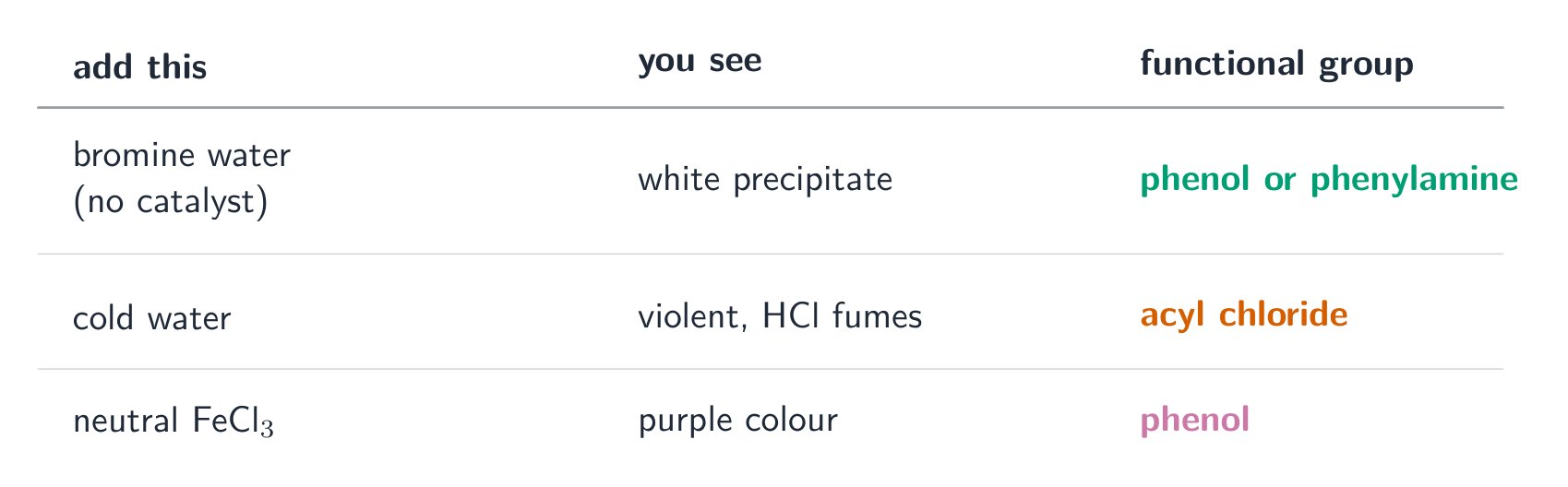
Tests d’identification ajoutés au niveau A
Phenylamine reacting with HNO₂ below 10 °C gives:
Cold HNO₂ forms a diazonium salt, which can then make phenol or couple to an azo dye.
Ethanoyl chloride reacts with excess ammonia to form the amide ____.
The acyl group stays as CH₃CO– and –NH₂ replaces –Cl, giving CH₃CONH₂.
Replacing a halogen with –CN adds one carbon to the organic molecule.
The carbon in the cyanide group joins the carbon skeleton; count it when planning the product.
Which reagent reduces an amide to an amine?
LiAlH₄ is the reducing agent on the reaction map. FeCl₃ and bromine water are identification tests.
Planning and analysing
- plan by working backwards from the target; write each step's reagent 试剂 and conditions.
- analyse by stating each step's reaction type (electrophilic substitution, addition–elimination, oxidation, reduction…) and watching for by-products 副产物.
Plan backwards from the target, one disconnection at a time, until you reach the starting materials
Planification et analyse
- planifier en partant à rebours de la cible ; noter les réactifs 试剂 et conditions de chaque étape.
- analyser en précisant le type de réaction de chaque étape (substitution électrophile, addition-élimination, oxydation, réduction…) et en surveillant les sous-produits 副产物.

Planifier à rebours depuis la cible, une déconnexion à la fois, jusqu’aux matériaux de départ
The best way to plan a multi-step synthesis is to:
Working backwards finds which reaction makes the target, and from what, step by step.
You've got it
- tests: neutral FeCl₃ → purple (phenol); violent with cold water (acyl chloride); bromine water, no catalyst (phenol/phenylamine)
- map: benzene → nitrobenzene → phenylamine → diazonium → phenol/azo; acid → acyl chloride → ester/amide
- plan backwards from the target; analyse each step's reaction type and by-products
Vous avez compris
- tests : FeCl₃ neutre → violet (phénol) ; violence avec l’eau froide (chlorure d’acyle) ; eau bromée, sans catalyseur (phénol/phénylamine)
- carte : benzène → nitrobenzène → phénylamine → diazonium → phénol/azoïde ; acide → chlorure d’acyle → ester/amide
- planifier à rebours depuis la cible ; analyser le type de réaction et les sous-produits de chaque étape