Amino acids · Acides aminés
| English | Français |
|---|---|
| amino acid/əˈmiːnəʊ ˈæsɪd/ | acide aminé |
| peptide bond/ˈpeptaɪd bɒnd/ | globulaire |
| zwitterion/zwɪˈtɪərɪən/ | zwitterion |
| isoelectric point/ˌaɪsəʊˈlektrɪk pɔɪnt/ | point isoélectrique |
| electrophoresis/ɪˌlektrəʊfɔːˈriːsɪs/ | électrophorèse |
The building blocks of proteins
- An amino acid 氨基酸 has both a basic –NH₂ group and an acidic –COOH group.
- Its charge depends on the pH.
- Amino acids join into proteins by peptide bonds 肽键.
Les blocs constitutifs des protéines
- Un acide aminé 氨基酸 possède à la fois un groupe basique –NH₂ et un groupe acide –COOH.
- Sa charge dépend du pH.
- Les acides aminés se lient pour former des protéines via des liaisons peptidiques 肽键.
Amino acid lab · Lab acides aminés
Classify amino acid behaviour by the group that reacts. · Classer le comportement de l'acide aminé selon le groupe qui réagit.
An amino acid contains: · Un acide aminé contient :
Having both groups is what makes amino acids behave as they do (zwitterions, peptide bonds). · Avoir les deux groupes fait que les acides aminés se comportent comme ils le font (zwitterions, liaisons peptidiques).
Amino acids contain both an amino group and a carboxylic acid group. · Les acides aminés contiennent à la fois un groupe amino et un groupe acide carboxylique.
They can act as both acid and base (zwitterions). · Ils peuvent agir comme acide et comme base (zwitterions).
Zwitterions 两性离子 and the isoelectric point 等电点
- The –COOH can give its $\text{H}^+$ to the –NH₂ in the same molecule → a zwitterion ($\text{H}_3\text{N}^+\text{–CHR–COO}^-$): both ends charged, no overall charge.
- in acid (low pH): gains $\text{H}^+$ → positive.
- in alkali (high pH): loses $\text{H}^+$ → negative.
- at the isoelectric point: mostly the zwitterion, no net charge.
An amino acid is positive, zwitterionic or negative with pH
Zwitterions 两性离子 et point isoélectrique 等电点
- Le –COOH peut céder son $\text{H}^+$ au –NH₂ de la même molécule → un zwitterion ($\text{H}_3\text{N}^+\text{–CHR–COO}^-$) : les deux extrémités chargées, pas de charge nette.
- en acide (pH bas) : gagne $\text{H}^+$ → positif.
- en base (pH élevé) : perd $\text{H}^+$ → négatif.
- au point isoélectrique : principalement le zwitterion, aucune charge nette.

Un acide aminé est positif, zwitterionique ou négatif selon le pH
A zwitterion is: · Un zwitterion est :
The –COOH gives H⁺ to the –NH₂, so both ends are charged but the molecule is overall neutral. · Le –COOH donne H⁺ au –NH₂, donc les deux extrémités sont chargées mais la molécule est globalement neutre.
In acidic solution (low pH), an amino acid is: · En solution acide (pH bas), un acide aminé est :
In acid it gains H⁺ (positive); in alkali it loses H⁺ (negative); at the isoelectric point it is neutral. · En milieu acide, il gagne H⁺ (positif) ; en milieu basique, il perd H⁺ (négatif) ; au point isoélectrique, il est neutre.
Match each term to its meaning. · Reliez chaque terme à sa signification.
Each item links the term to its correct meaning. · Chaque élément relie le terme à sa signification correcte.
Peptide bonds
- Two amino acids join by condensation (lose water) forming a peptide bond (an amide link) → a dipeptide.
- Repeating this builds a polypeptide, and then a protein.
Two amino acids condense to form a peptide bond
Liaisons peptidiques
- Deux acides aminés se joignent par condensation (perte d'eau) formant une liaison peptidique (une liaison amide) → un dipeptide.
- Répéter cela construit un polypeptide, puis une protéine.

Deux acides aminés condensent pour former une liaison peptidique
Two amino acids join by a: · Deux acides aminés se joignent par une :
Condensation between –COOH and –NH₂ forms a peptide (amide) bond and releases water. · La condensation entre –COOH et –NH₂ forme une liaison peptidique (amide) et libère de l'eau.
Worked example: electrophoresis 电泳
- Electrophoresis separates amino acids by charge at a chosen pH.
Glycine has an isoelectric point of about pH 6.
- At pH 2 (below pI): it is positive → moves to the negative electrode (cathode).
- At pH 11 (above pI): it is negative → moves to the positive electrode (anode).
- At pH 6 (its pI): no net charge → it stays put.
So the direction and distance moved identify the amino acid.
Electrophoresis separates amino acids by charge
Exemple résolu : électrophorèse 电泳
- L'électrophorèse sépare les acides aminés selon leur charge à un pH choisi.
La glycine a un point isoélectrique d'environ pH 6.
- À pH 2 (sous pI) : elle est positive → se déplace vers l'électrode négative (cathode).
- À pH 11 (au-dessus du pI) : il est négatif → se déplace vers l’électrode positive (anode).
- À pH 6 (son pI) : pas de charge nette → il reste immobile.
Ainsi, la direction et la distance parcourues identifient l’acide aminé.
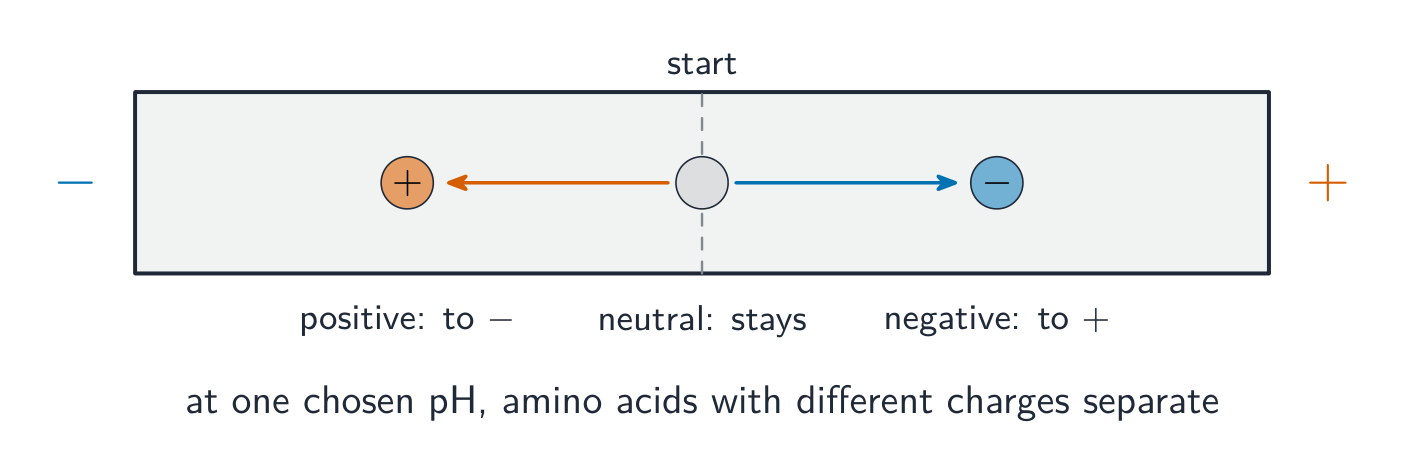
L’électrophorèse sépare les acides aminés selon leur charge
You've got it
- an amino acid has –NH₂ (basic) and –COOH (acidic)
- zwitterion = no net charge; positive in acid, negative in alkali; neutral at the isoelectric point
- two amino acids condense to form a peptide bond (amide link), losing water
- electrophoresis: below pI → moves to cathode; above pI → anode; at pI → stays put
Vous avez compris
- un acide aminé possède –NH₂ (basique) et –COOH (acide)
- zwitterion = pas de charge nette ; positif en milieu acide, négatif en milieu basique ; neutre au point isoélectrique
- deux acides aminés subissent une condensation pour former une liaison peptidique (liaison amide), avec perte d’eau
- électrophorèse : en dessous du pI → migration vers la cathode ; au-dessus du pI → anode ; au pI → reste immobile