Oxidation of alcohols and tests · Oxydation des alcools et tests
| English | Français |
|---|---|
| oxidation/ˌɒksɪˈdeɪʃn/ | oxydation |
| aldehyde/ˈældɪhaɪd/ | aldéhyde |
| distillation/dɪstɪˈleɪʃn/ | distillation |
| carboxylic acid/ˌkɑːbəkˈsɪlɪk ˈæsɪd/ | acide carboxylique |
| reflux/ˈriːflʌks/ | le reflux |
| ketone/ˈketəʊn/ | cétone |
| iodoform test/ˈaɪədɒfɔːm test/ | test de l'iodoforme |
Oxidation 氧化 and tests
- Alcohols come in three classes: primary, secondary, tertiary.
- Oxidation tells them apart.
- A couple of tests confirm structure.
Oxydation 氧化 et tests
- Les alcools se divisent en trois classes : primaires, secondaires, tertiaires.
- L'oxydation permet de les distinguer.
- Quelques tests confirment la structure.
Alcohol oxidation test lab · Lab test d'oxydation des alcools
Classify alcohols by oxidation product and observation. · Classifiez les alcools selon le produit d'oxydation et l'observation.
Oxidising a primary alcohol and distilling off the product gives an: · L'oxydation d'un alcool primaire et la distillation du produit donnent un :
Distilling removes the aldehyde before further oxidation. · La distillation retire l'aldéhyde avant toute oxydation supplémentaire.
Oxidation by class
| Class | Oxidation product |
|---|---|
| primary | aldehyde 醛 (by distillation 蒸馏), then carboxylic acid 羧酸 (by reflux 回流) |
| secondary | a ketone 酮 |
| tertiary | not oxidised |
- Acidified $\text{K}_2\text{Cr}_2\text{O}_7$ turns orange → green with a primary or secondary alcohol, but stays orange with a tertiary one.
Oxidation products of primary, secondary and tertiary alcohols
Oxydation par classe
| Classe | Produit d'oxydation |
|---|---|
| primaire | aldéhyde 醛 (par distillation 蒸馏), puis acide carboxylique 羧酸 (par reflux 回流) |
| secondaire | une cétone 酮 |
| tertiaire | non oxydé |
- Le $\text{K}_2\text{Cr}_2\text{O}_7$ acidifié passe du orange au vert avec un alcool primaire ou secondaire, mais reste orange avec un tertiaire.
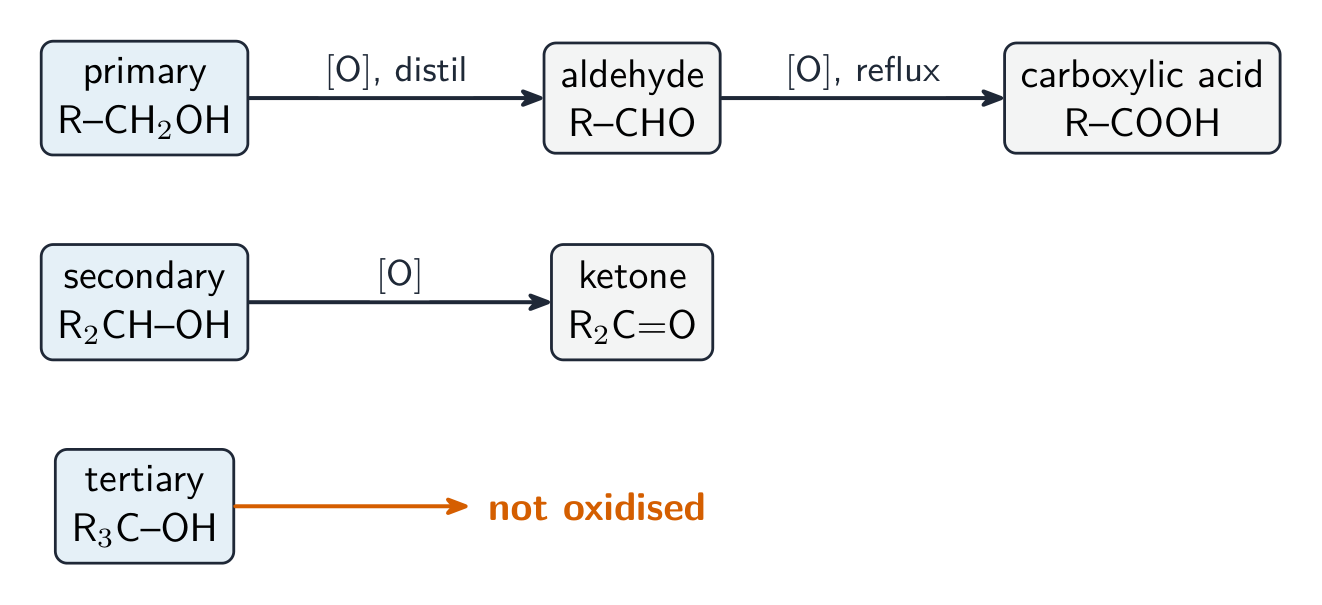
Produits d'oxydation des alcools primaires, secondaires et tertiaires
A primary alcohol can be oxidised to: · Un alcool primaire peut être oxydé en :
Primary → aldehyde (by distillation) → carboxylic acid (by reflux); secondary → ketone; tertiary → not oxidised. · Primaire → aldéhyde (par distillation) → acide carboxylique (par reflux) ; secondaire → cétone ; tertiaire → non oxydé.
With acidified dichromate, a tertiary alcohol: · Avec du dichromate acidifié, un alcool tertiaire :
Tertiary alcohols are not oxidised, so the dichromate stays orange; primary/secondary turn it green. · Les alcools tertiaires ne sont pas oxydés, donc le dichromate reste orange ; primaires/secondaires le rendent vert.
Match each oxidation fact. · Associez chaque fait sur l'oxydation.
Each item links the term to its correct meaning. · Chaque élément relie le terme à sa signification correcte.
To stop the oxidation of a primary alcohol at the aldehyde you distil the product off as it forms; refluxing instead gives the carboxylic acid. · Pour arrêter l'oxydation d'un alcool primaire à l'aldéhyde, on distille le produit au fur et à mesure qu'il se forme ; le reflux donne plutôt l'acide carboxylique.
Distilling removes the volatile aldehyde before it can be oxidised again; reflux keeps it in the mixture for full oxidation. · La distillation retire l'aldéhyde volatil avant qu'il ne puisse être ré-oxydé ; le reflux le maintient dans le mélange pour une oxydation complète.
Distillation, reflux and the iodoform test 碘仿试验
- distillation removes the aldehyde as it forms (before further oxidation).
- reflux keeps boiling and returning the vapour, so the alcohol is fully oxidised to the acid.
- iodoform test: an alcohol with the $\text{CH}_3\text{CH(OH)}-$ group, warmed with alkaline aqueous iodine, gives a pale-yellow precipitate of CHI₃.
Ethanol, the alcohol in hand sanitiser, kills microbes.
Distillation, reflux et test de l'iodoforme 碘仿试验
- La distillation élimine l'aldéhyde au fur et à mesure qu'il se forme (avant une oxydation supplémentaire).
- Le reflux maintient l'ébullition et retourne les vapeurs, permettant une oxydation complète de l'alcool en acide.
- test de l'iodoforme : un alcool portant le groupe $\text{CH}_3\text{CH(OH)}-$, chauffé avec de l'iode aqueux alcalin, donne un précipité jaune pâle de CHI₃.
L'éthanol, l'alcool présent dans les désinfectants pour les mains, tue les micro-organismes.
To stop oxidation of a primary alcohol at the aldehyde, you use: · Pour arrêter l'oxydation d'un alcool primaire à l'étape aldéhyde, vous utilisez :
Distillation removes the aldehyde before it oxidises further; reflux instead gives the carboxylic acid. · La distillation retire l'aldéhyde avant qu'il ne s'oxyde davantage ; le reflux donne plutôt l'acide carboxylique.
Acidity of alcohols
- Alcohols are very weakly acidic (they can lose $\text{H}^+$ to form $\text{RO}^-$).
- But they are less acidic than water: the alkyl group pushes electrons onto the oxygen, destabilising $\text{RO}^-$.
Distillation removes the aldehyde; reflux fully oxidises to the acid
Acidité des alcools
- Les alcools sont très faiblement acides (ils peuvent perdre $\text{H}^+$ pour former $\text{RO}^-$).
- Mais ils sont moins acides que l'eau : le groupe alkyle repousse des électrons vers l'oxygène, déstabilisant $\text{RO}^-$.
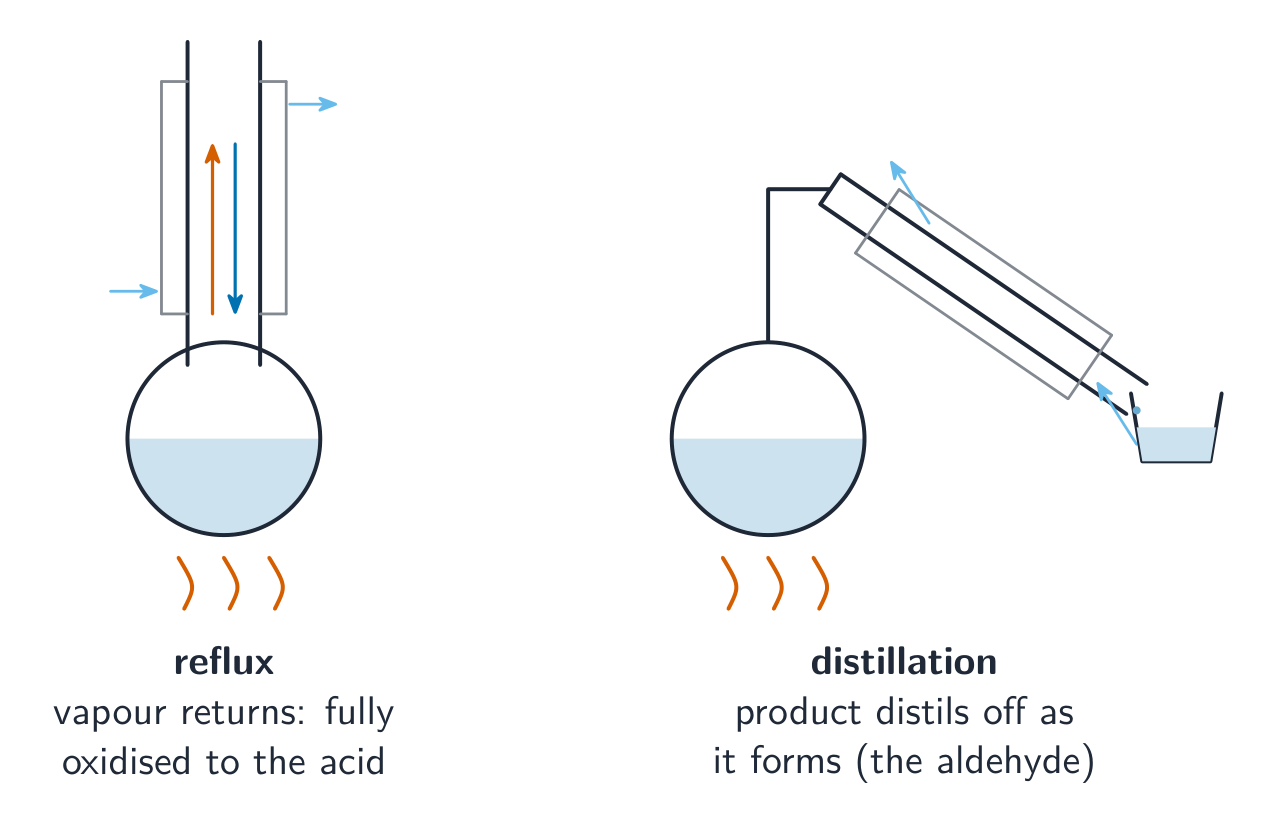
La distillation élimine l'aldéhyde ; le reflux oxyde complètement en acide
Compared with water, alcohols are: · Comparé à l'eau, les alcools sont :
The electron-pushing alkyl group makes RO⁻ less stable, so alcohols hold their H⁺ more tightly than water. · Le groupe alkyle repoussant électrons rend l'ion RO⁻ moins stable, donc les alcools retiennent leur H⁺ plus fermement que l'eau.
You've got it
- primary → aldehyde (distil) → carboxylic acid (reflux); secondary → ketone; tertiary → not oxidised
- acidified dichromate goes orange → green (primary/secondary), stays orange (tertiary)
- distillation stops at the aldehyde; reflux gives the acid; iodoform tests for $\text{CH}_3\text{CH(OH)}-$
- alcohols are less acidic than water
Vous avez compris
- primaire → aldéhyde (distiller) → acide carboxylique (reflux) ; secondaire → cétone ; tertiaire → non oxydé
- Le dichromate acidifié passe du orange au vert (primaire/secondaire), reste orange (tertiaire)
- La distillation s'arrête à l'aldéhyde ; le reflux donne l'acide ; l'iodoforme teste le groupe $\text{CH}_3\text{CH(OH)}-$
- les alcools sont moins acides que l'eau