Aldehydes and ketones · Aldéhydes et cétones
| English | Français |
|---|---|
| carbonyl compound/ˈkɑːbənaɪl ˈkɒmpaʊnd/ | composé carbonyle |
| aldehyde/ˈældɪhaɪd/ | aldéhyde |
| ketone/ˈketəʊn/ | cétone |
| reduction/rɪˈdʌkʃn/ | réduction |
| hydroxynitrile/haɪˈdrɒksɪnaɪtraɪl/ | hydroxynitrile |
| nucleophilic addition/ˌnjuːklɪəˈfɪlɪk əˈdɪʃn/ | addition nucléophile |
The carbonyl compounds 羰基化合物
- These are carbonyl compounds — they contain the C=O group.
- In an aldehyde 醛 the C=O is on the end of the chain (–CHO).
- In a ketone 酮 it is in the middle, between two carbons.
Les composés carbonyles 羰基化合物
- Ce sont des composés carbonyles — ils contiennent le groupe C=O.
- Dans un aldéhyde 醛, le C=O est à l'extrémité de la chaîne (–CHO).
- Dans une cétone 酮, il est au milieu, entre deux carbones.
Carbonyl compound lab · Lab composés carbonyles
Sort carbonyl reactions by what they reveal. · Triez les réactions carbonyles selon ce qu'elles révèlent.
The difference between an aldehyde and a ketone is that: · La différence entre un aldéhyde et une cétone est que :
Both have the carbonyl C=O; in an aldehyde it is terminal (–CHO), in a ketone it is between two carbons. · Les deux ont le carbonyle C=O ; dans un aldéhyde il est terminal (–CHO), dans une cétone il est entre deux carbones.
Aldehydes have the carbonyl group at the end of the carbon chain. · Les aldéhydes ont le groupe carbonyle à l'extrémité de la chaîne carbonée.
Ketones have it in the middle. · Les cétones l'ont au milieu.
Making them
- By oxidation of an alcohol (acidified $\text{K}_2\text{Cr}_2\text{O}_7$ or $\text{KMnO}_4$):
- a primary alcohol, with distillation, gives an aldehyde.
- a secondary alcohol gives a ketone.
In an aldehyde the C=O is on the end; in a ketone it is in the middle
Les fabriquer
- Par oxydation d'un alcool ($\text{K}_2\text{Cr}_2\text{O}_7$ acidifié ou $\text{KMnO}_4$) :
- un alcool primaire, avec distillation, donne un aldéhyde.
- un alcool secondaire donne une cétone.
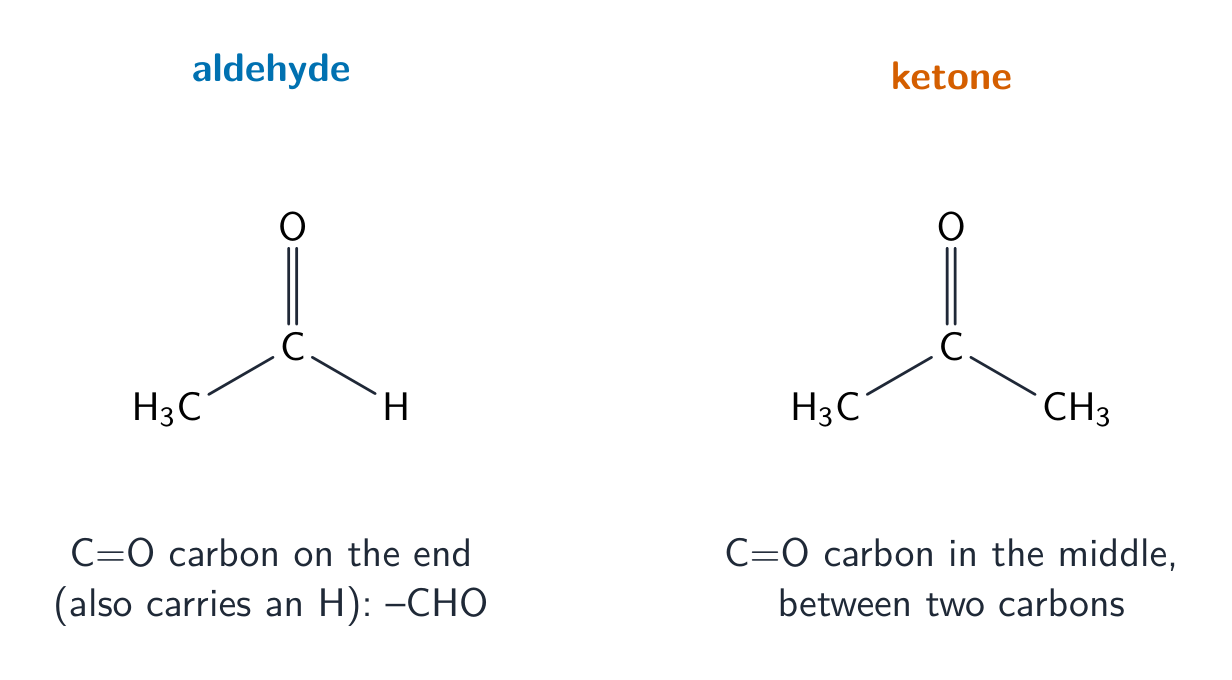
Dans un aldéhyde, le C=O est à l'extrémité ; dans une cétone, il est au milieu
Oxidising a secondary alcohol gives: · Oxyder un alcool secondaire donne :
Secondary alcohols oxidise to ketones; primary alcohols (with distillation) give aldehydes. · Les alcools secondaires s'oxydent en cétones ; les alcools primaires (avec distillation) donnent des aldéhydes.
Match each carbonyl fact. · Associez chaque fait sur les carbonyles.
Each item links the term to its correct meaning. · Chaque élément relie le terme à sa signification correcte.
Reactions
- reduction 还原 ($\text{NaBH}_4$ or $\text{LiAlH}_4$) → back to an alcohol (aldehyde → primary; ketone → secondary).
- HCN (with KCN catalyst) adds H and CN across the C=O → a hydroxynitrile 羟基腈 (adds one carbon).
Tollens' reagent gives a bright silver mirror with an aldehyde.
Réactions
- réduction 还原 ($\text{NaBH}_4$ ou $\text{LiAlH}_4$) → retour à un alcool (aldéhyde → primaire ; cétone → secondaire).
- HCN (avec catalyseur KCN) ajoute H et CN sur le C=O → une hydroxynitrile 羟基腈 (ajoute un carbone).
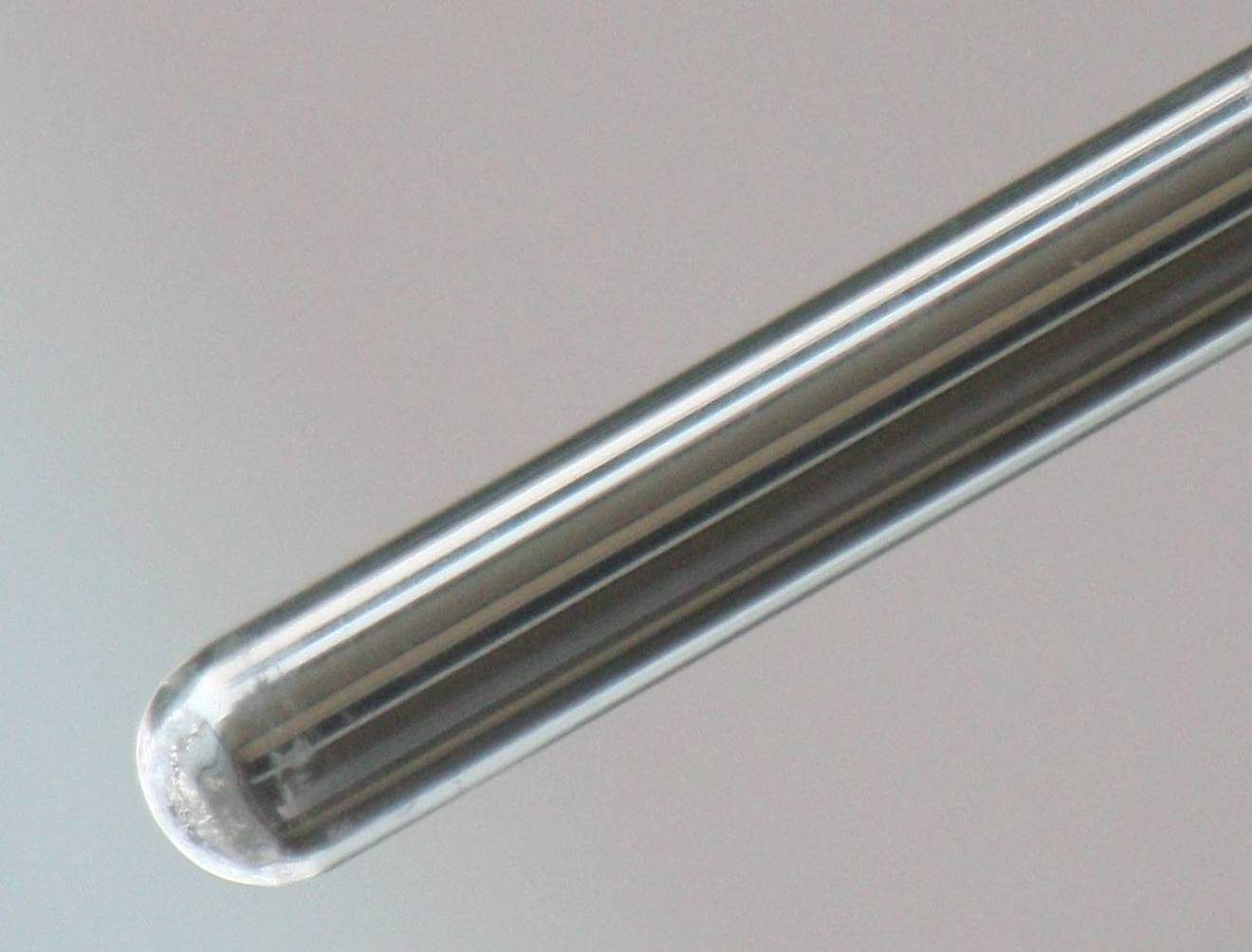
Le réactif de Tollens donne un miroir d'argent brillant avec un aldéhyde.
Reducing a carbonyl compound (with NaBH₄) gives: · Réduire un composé carbonyle (avec NaBH₄) donne :
Reduction turns a carbonyl back into an alcohol (aldehyde → primary, ketone → secondary). · La réduction reconvertit un carbonyle en alcool (aldéhyde → primaire, cétone → secondaire).
Nucleophilic addition 亲核加成
The HCN reaction is nucleophilic addition:
- $\text{CN}^-$ (a nucleophile) attacks the slightly positive carbonyl carbon.
- the C=O double bond breaks, leaving a negative oxygen ($\text{O}^-$).
- the $\text{O}^-$ takes an $\text{H}^+$ to finish the hydroxynitrile.
Propanone (acetone), the simplest ketone, is the solvent in nail-polish remover.
Addition nucléophile 亲核加成
La réaction avec HCN est une addition nucléophile :
- $\text{CN}^-$ (un nucléophile) attaque le carbone carbonyle légèrement positif.
- la double liaison C=O se brise, laissant un oxygène négatif ($\text{O}^-$).
- le $\text{O}^-$ capte un $\text{H}^+$ pour finaliser l'hydroxynitrile.
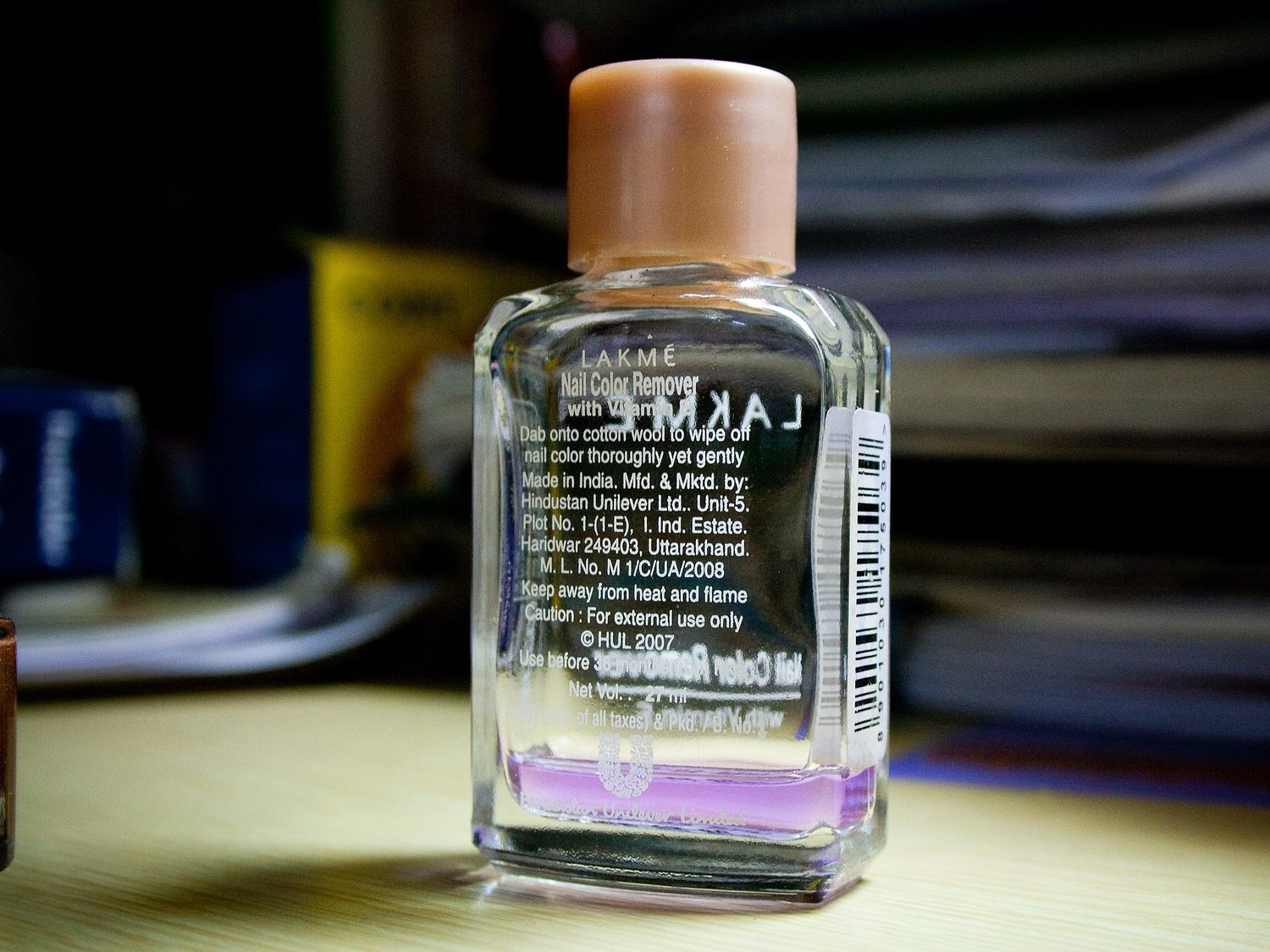
La propanone (acétone), la cétone la plus simple, est le solvant dans le dissolvant pour vernis à ongles.
In the nucleophilic addition of HCN, the first step is: · Dans l'addition nucléophile de HCN, la première étape est :
The cyanide nucleophile attacks the δ+ carbon, breaking the C=O; the O⁻ then takes an H⁺. · Le nucléophile cyanure attaque le carbone δ+, brisant le C=O ; l'O⁻ prend ensuite un H⁺.
You've got it
- carbonyl = C=O; aldehyde (end, –CHO) vs ketone (middle)
- made by oxidising an alcohol: primary + distillation → aldehyde; secondary → ketone
- reduction → alcohol; HCN → hydroxynitrile (+1 carbon)
- the HCN step is nucleophilic addition: $\text{CN}^-$ attacks the $\delta+$ carbon, C=O breaks, $\text{O}^-$ takes $\text{H}^+$
Vous avez compris
- carbonyle = C=O ; aldéhyde (extrémité, –CHO) vs cétone (milieu)
- obtenues en oxydant un alcool : primaire + distillation → aldéhyde ; secondaire → cétone
- réduction → alcool ; HCN → hydroxynitrile (+1 carbone)
- l'étape HCN est une addition nucléophile : $\text{CN}^-$ attaque le carbone $\delta+$, C=O se brise, $\text{O}^-$ capte $\text{H}^+$