English
Learning Objective 6.1.A: Explain the relationship between experimental observations and energy changes associated with a chemical or physical transformation.
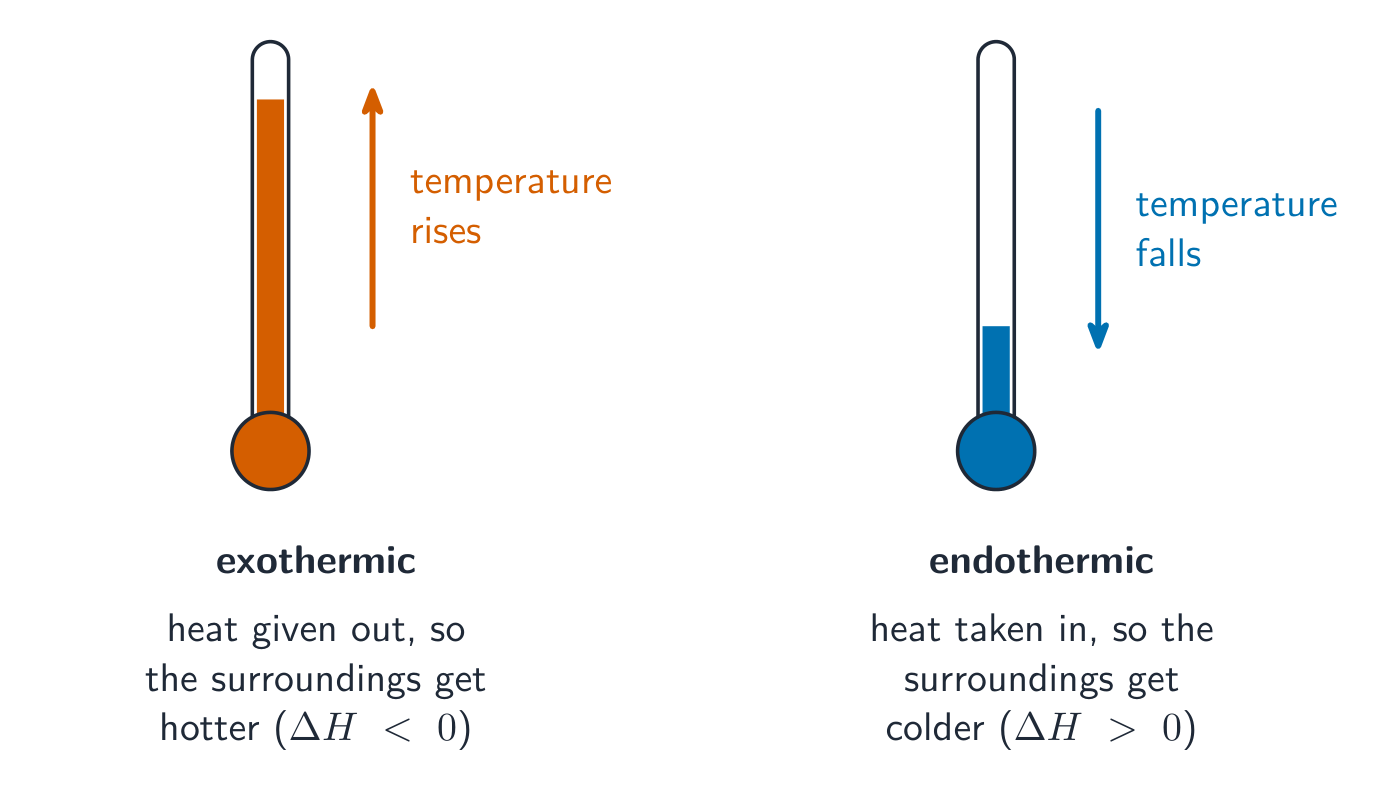
- 6.1.A.1 Temperature changes in a system indicate energy changes.
- 6.1.A.2 Energy changes in a system can be described as endothermic and exothermic processes such as the heating or cooling of a substance, phase changes, or chemical transformations.
- 6.1.A.3 When a chemical reaction occurs, the energy of the system either decreases (exothermic reaction), increases (endothermic reaction), or remains the same. For exothermic reactions, the energy lost by the reacting species (system) is gained by the surroundings, as heat transfer from or work done by the system. Likewise, for endothermic reactions, the system gains energy from the surroundings by heat transfer to or work done on the system.
- 6.1.A.4 The formation of a solution may be an exothermic or endothermic process, depending on the relative strengths of intermolecular/interparticle interactions before and after the dissolution process.
Français
Objectif d'apprentissage 6.1.A : Expliquer la relation entre les observations expérimentales et les changements d'énergie associés à une transformation chimique ou physique.
- 6.1.A.1 Les changements de température dans un système indiquent des changements d'énergie.
- 6.1.A.2 Les changements d'énergie dans un système peuvent être décrits comme des processus endothermiques et exothermiques tels que le chauffage ou le refroidissement d'une substance, les changements de phase ou les transformations chimiques.
- 6.1.A.3 Lorsqu'une réaction chimique se produit, l'énergie du système diminue (réaction exothermique), augmente (réaction endothermique) ou reste la même. Pour les réactions exothermiques, l'énergie perdue par les espèces réagissantes (système) est gagnée par l'environnement, par transfert de chaleur ou travail effectué par le système. De même, pour les réactions endothermiques, le système gagne de l'énergie de l'environnement par transfert de chaleur vers ou travail effectué sur le système.
- 6.1.A.4 La formation d'une solution peut être un processus exothermique ou endothermique, selon les forces relatives des interactions intermoléculaires/interparticulaires avant et après le processus de dissolution.