Electric Power · Potencia Eléctrica
| English | Español |
|---|---|
| power/ˈpaʊə/ | potencia |
| watt/wɒt/ | watt |
| dissipation/ˌdɪsɪˈpeɪʃn/ | disipación |
Where does a battery's energy go — and how fast?
- A battery hands energy to charges; the circuit spends it.
- Power 功率 is how fast that energy is delivered or used.
- A bright bulb spends energy quickly; a dim one spends it slowly.
- Power ties current and voltage to heat, light, and motion.
¿Adónde va la energía de una batería —y con qué rapidez?
- Una batería entrega energía a las cargas; el circuito la consume.
- Potencia 功率 es la rapidez con la que se entrega o utiliza esa energía.
- Una bombilla brillante consume energía rápidamente; una tenue, lo hace lentamente.
- La potencia vincula la corriente y el voltaje con el calor, la luz y el movimiento.
Power = current × voltage
- Each charge drops energy $qV$ as it crosses a component.
- Charges arrive at a rate $I$, so the energy per second is $P = IV$.
- Its unit is the watt 瓦特 (1 W $= 1$ J/s).
- Power is simply how many joules leave the source every second.
Potencia = corriente × voltaje
- Cada carga pierde energía $qV$ al atravesar un componente.
- Las cargas llegan a una tasa $I$, por lo que la energía por segundo es $P = IV$.
- Su unidad es el vatio 瓦特 (1 W $= 1$ J/s).
- La potencia es simplemente cuántos julios salen de la fuente cada segundo.
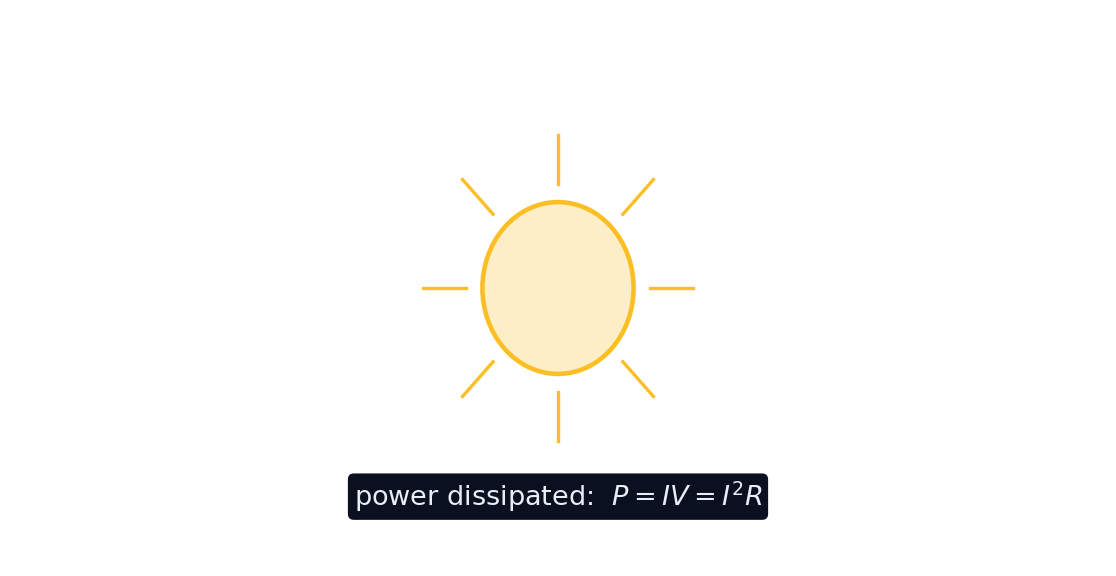
Power in a resistor · Potencia en una resistencia
Set the voltage and resistance and watch the current and power that result. · Establece el voltaje y la resistencia y observa la corriente y la potencia resultantes.
Electric power delivered to a component is: · La potencia eléctrica entregada a un componente es:
$P = IV$ — current times voltage, in watts. · $P = IV$ — corriente por voltaje, en vatios.
A device draws $4\ \text{A}$ at $12\ \text{V}$. Find its power (in W). · Un dispositivo consume $4\ \text{A}$ a $12\ \text{V}$. Encuentra su potencia (en W).
$P = IV = 4 \times 12 = 48\ \text{W}$.
The SI unit of power is the ____. · La unidad SI de potencia es el ____.
1 watt $= 1$ J/s. · 1 vatio $= 1$ J/s.
Three forms of the same law
- Combine with Ohm's law to get $P = I^2 R$ and $P = \dfrac{V^2}{R}$.
- Use whichever fits what you know: $I$ and $R$, or $V$ and $R$.
- All three give the same power for an ohmic resistor.
- $P = I^2 R$ shows why a big current heats a wire so strongly.
Tres formas de la misma ley
- Combinadas con la ley de Ohm, obtenemos $P = I^2 R$ y $P = \dfrac{V^2}{R}$.
- Usa la que se adapte a lo que sabes: $I$ y $R$, o $V$ y $R$.
- Las tres dan la misma potencia para una resistencia óhmica.
- $P = I^2 R$ muestra por qué una gran corriente calienta un alambre tan intensamente.
Which is not · no a correct form of electric power for a resistor? · ¿Cuál no es una forma correcta de potencia eléctrica para una resistencia?
The valid forms are $IV$, $I^2R$, $V^2/R$. $IR^2$ is wrong. · Las formas válidas son $IV$, $I^2R$, $V^2/R$. $IR^2$ es incorrecto.
Useful power and wasted heat
- In a resistor, all the power becomes heat — that is dissipation 耗散.
- In a motor, most becomes useful motion, with some lost to heat.
- Heaters and kettles are just resistors chosen to dissipate a lot.
- Thin wires with high current can overheat — a fire risk.
Potencia útil y calor desperdiciado
- En una resistencia, toda la potencia se convierte en calor; esto es disipación 耗散.
- En un motor, la mayor parte se convierte en movimiento útil, con alguna pérdida en forma de calor.
- Los calentadores y hervidores son simplemente resistencias diseñadas para disipar mucha energía.
- Los alambres delgados con alta corriente pueden sobrecalentarse —un riesgo de incendio.
Select all · todos true statements about electric power. · Selecciona todas las afirmaciones verdaderas sobre la potencia eléctrica.
P = IV, resistor power heats, energy = P×t. Power (rate) ≠ energy (total). · P = IV, la potencia en una resistencia genera calor, energía = P×t. Potencia (tasa) ≠ energía (total).
Paying for energy: the kilowatt-hour
- Your electricity bill charges for energy, not power.
- Energy $=$ power $\times$ time; one kilowatt-hour is $1\ \text{kW}$ for $1$ hour.
- A $2\ \text{kW}$ heater for $3$ hours uses $6\ \text{kWh}$.
- Power tells the rate; multiply by time to get the bill.
Pagando por la energía: el kilovatio-hora
- Tu factura eléctrica cobra por energía, no por potencia.
- Energía $=$ potencia $\times$ tiempo; un kilovatio-hora es $1\ \text{kW}$ durante $1$ hora.
- Un calentador de $2\ \text{kW}$ durante $3$ horas consume $6\ \text{kWh}$.
- La potencia indica la tasa; multiplícala por el tiempo para obtener el costo.
Your electricity bill charges for energy (power × time), not for power itself. · Tu factura eléctrica cobra por energía (potencia × tiempo), no por la potencia en sí.
Energy = power × time, billed in kilowatt-hours. · Energía = potencia × tiempo, facturada en kilovatios-hora.
A bulb runs at $0.5\ \text{A}$ from a $230\ \text{V}$ supply. Find its power.
- $P = IV = 0.5 \times 230 = 115\ \text{W}$.
- It converts $115$ joules of energy every second.
Una bombilla funciona con $0.5\ \text{A}$ desde una fuente de $230\ \text{V}$. Calcula su potencia.
- $P = IV = 0.5 \times 230 = 115\ \text{W}$.
- Convierte $115$ julios de energía cada segundo.
Keep power (rate, in watts) separate from energy (total, in joules or kWh). Your bill is for energy $=$ power $\times$ time, not for power. A high-power device used briefly can cost less than a low-power one left on for days.
Mantén separada la potencia (tasa, en vatios) de la energía (total, en julios o kWh). Tu factura es por energía $=$ potencia $\times$ tiempo, no por potencia. Un dispositivo de alta potencia usado brevemente puede costar menos que uno de baja potencia dejado encendido durante días.
Power is energy per second: $P = IV$ (watts), also $P = I^2R = V^2/R$ for a resistor. In a resistor it all becomes heat (dissipation). Energy $=$ power $\times$ time — billed as kilowatt-hours.
Potencia es energía por segundo: $P = IV$ (vatios), también $P = I^2R = V^2/R$ para una resistencia. En una resistencia, toda se convierte en calor (disipación). Energía $=$ potencia $\times$ tiempo —se factura en kilovatios-hora.