Artificial selection · Selección artificial
| English | Español |
|---|---|
| selective breeding/sɪˈlektɪv ˈbriːdɪŋ/ | cría selectiva |
| artificial selection/ˌɑːtɪˈfɪʃl sɪˈlekʃn/ | selección artificial |
| inbreeding/ˈɪnbriːdɪŋ/ | endogamia |
| hybridisation/ˌhaɪbrɪdaɪˈzeɪʃn/ | hibridación |
| gene pool/dʒiːn puːl/ | pool génico |
Selective breeding 选择育种
- In selective breeding (artificial selection 人工选择), humans — not nature — choose which organisms breed.
- This passes on useful features.
- It is how we shaped our crops and farm animals.
Selección selectiva 选择育种
- En la selección selectiva (selección artificial 人工选择), son los seres humanos —no la naturaleza— quienes eligen qué organismos se reproducen.
- Esto transmite rasgos útiles.
- Es así como hemos modificado nuestros cultivos y animales de granja.
Selective breeding (artificial selection) differs from natural selection because: · La cría selectiva (selección artificial) difiere de la selección natural porque:
In artificial selection, people choose the breeders to pass on useful features; in natural selection, the environment selects. · En la selección artificial, las personas eligen a los reproductores para transmitir características útiles; en la selección natural, es el entorno quien selecciona.
When humans choose which organisms breed to pass on useful features, it is called ______ selection. · Cuando los humanos eligen qué organismos reproducirse para transmitir características útiles, se llama selección ______.
Artificial selection (selective breeding) is the same mechanism as natural selection — but humans, not the environment, do the selecting. · La selección artificial (cría selectiva) es el mismo mecanismo que la selección natural, pero son los humanos, no el entorno, quienes realizan la selección.
Repeated artificial selection from a few individuals can reduce the gene pool and cause inbreeding problems. · La repetida selección artificial a partir de unos pocos individuos puede reducir el acervo génico y causar problemas de consanguinidad.
A narrow gene pool concentrates harmful recessive alleles and lowers the population's resilience. · Un acervo génico estrecho concentra alelos recesivos dañinos y reduce la resiliencia de la población.
Examples
- breeding disease resistance into varieties of wheat and rice.
- using inbreeding 近交 and hybridisation 杂交 (crossing different lines) to make vigorous, uniform maize.
- breeding dairy cattle to improve their milk yield.
Ejemplos
- desarrollar resistencia a enfermedades en variedades de trigo y arroz.
- utilizar endogamia 近交 e hibridación 杂交 (cruce de diferentes líneas) para obtener un maíz vigoroso y uniforme.
- criar ganado lechero para mejorar su rendimiento lácteo.
Selective breeding · Cría selectiva
Step through it. Humans take the role of the environment — choosing the breeders, generation after generation. · Paso a paso. Los humanos asumen el rol del entorno — eligiendo a los reproductores, generación tras generación.
Which is an example of selective breeding? · ¿Cuál es un ejemplo de cría selectiva?
Breeding cattle for milk yield (or disease-resistant crops) is humans choosing which organisms reproduce. · La reproducción de ganado para obtener mayor rendimiento de leche (o cultivos resistentes a enfermedades) implica que los humanos eligen qué organismos se reproducen.
Put selective breeding in order. · Ordena la cría selectiva.
Choose → breed → select offspring → repeat. Each round pushes the feature further. · Elegir → reproducir → seleccionar descendientes → repetir. Cada ronda empuja la característica más lejos.
Hybridisation in selective breeding means: · La hibridación en la cría selectiva significa:
Hybridisation crosses different lines (often with inbreeding) to make vigorous, uniform crops like maize. · La hibridación cruza diferentes líneas (a menudo con consanguinidad) para crear cultivos vigorosos y uniformes como el maíz.
How it is done
- Choose parents with the desired feature, breed them, and select the best offspring to breed again.
- Repeat over many generations until the feature is firmly established.
Choosing the best parents each generation makes a wanted feature more and more common
Cómo se realiza
- Elegir padres con el rasgo deseado, cruzarlos y seleccionar las mejores descendencias para volver a cruzar.
- Repetir durante muchas generaciones hasta que el rasgo esté firmemente establecido.
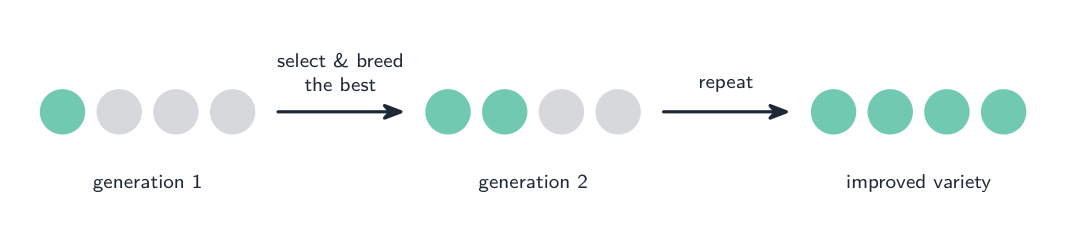
Elegir los mejores padres en cada generación hace que un rasgo deseado sea cada vez más frecuente
The problems with it
- Repeatedly breeding from a few "best" individuals shrinks the gene pool 基因库.
- This inbreeding can concentrate harmful alleles and leaves the population vulnerable to disease.
Los problemas de este método
- Cruzar repetidamente a partir de unos pocos individuos "mejores" reduce el acervo génico 基因库.
- Esta endogamia puede concentrar alelos dañinos y dejar a la población vulnerable a las enfermedades.
You've got it
- selective breeding (artificial selection) = humans choose which organisms reproduce
- examples: disease-resistant wheat/rice; inbreeding + hybridisation for maize; higher milk yield in cattle
- it passes on the features people find useful
Lo has entendido
- selección selectiva (selección artificial) = los seres humanos eligen qué organismos se reproducen
- ejemplos: trigo/arroz resistente a enfermedades; endogamia + hibridación para el maíz; mayor rendimiento lácteo en el ganado
- transmite los rasgos que las personas consideran útiles