Skip to content · ⁨Saltar al contenido⁩

Organización del organismo

IGCSE Biología · Topic 2 · ⁨Tema 2⁩

Train · ⁨Entrenar⁩
Video lesson for this topic · ⁨Lección de video para este tema⁩ Open the video page · ⁨Abrir la página de video⁩
13:41

Estructura celular

Acércate a una hoja, a tu piel, a una gota de agua estancada—y encontrarás lo mismo en todas partes: células. Una célula es la cosa más pequeña que puede llevar a cabo todas…

English narration · English + 中文 subtitles burned in · ⁨Narración en inglés · Subtítulos en inglés + 中文 quemados en pantalla⁩

2.1

Cells: the building blocks of life · ⁨Células: los bloques de construcción de la vida⁩

Syllabus
English
Core Supplement
1 Describe and compare the structure of a plant cell with an animal cell, limited to: cell wall, cell membrane, nucleus, cytoplasm, chloroplasts, ribosomes, mitochondria, vacuoles
2 Describe the structure of a bacterial cell, limited to: cell wall, cell membrane, cytoplasm, ribosomes, circular DNA, plasmids
3 Identify the cell structures listed in 2.1.1 and 2.1.2 in diagrams and images of plant, animal and bacterial cells
4 Describe the functions of the structures listed in 2.1.1 and 2.1.2 in plant, animal and bacterial cells
5 State that new cells are produced by division of existing cells
6 State that specialised cells have specific functions, limited to: (a) ciliated cells – movement of mucus in the trachea and bronchi (b) root hair cells – absorption (c) palisade mesophyll cells – photosynthesis (d) neurones – conduction of electrical impulses (e) red blood cells – transport of oxygen (f) sperm and egg cells (gametes) – reproduction
7 Describe the meaning of the terms: cell, tissue, organ, organ system and organism as illustrated by examples given in the syllabus
Español
Núcleo Complemento
1 Describir y comparar la estructura de una célula vegetal con la de una célula animal, limitándose a: pared celular, membrana celular, núcleo, citoplasma, cloroplastos, ribosomas, mitocondrias y vacuolas
2 Describir la estructura de una célula bacteriana, limitándose a: pared celular, membrana celular, citoplasma, ribosomas, ADN circular y plásmidos
3 Identificar las estructuras celulares enumeradas en 2.1.1 y 2.1.2 en diagramas e imágenes de células vegetales, animales y bacterianas
4 Describir las funciones de las estructuras enumeradas en 2.1.1 y 2.1.2 en células vegetales, animales y bacterianas
5 Indicar que las nuevas células se producen por división de células existentes
6 Indicar que las células especializadas tienen funciones específicas, limitándose a: (a) células ciliadas – movimiento del moco en la tráquea y los bronquios; (b) células pilosas radiculares – absorción; (c) células del mesófilo palisádico – fotosíntesis; (d) neuronas – conducción de impulsos eléctricos; (e) glóbulos rojos – transporte de oxígeno; (f) células espermáticas y ovocitos (gametos) – reproducción
7 Describir el significado de los términos: célula, tejido, órgano, sistema de órganos y organismo, ilustrado con ejemplos dados en el programa de estudios

Source: Cambridge International syllabus · ⁨Fuente: Plan de estudios Cambridge International⁩

English

Every living thing is made of cells 细胞. A cell is the smallest part that can carry out the life processes. In this topic you compare a plant 植物 cell, an animal 动物 cell and the cell of a bacterium 细菌. All new cells are made by the division 分裂 of cells that already exist.

Which structures are in each cell?

Structure Animal cell Plant cell Bacterial cell
cell membrane 细胞膜 yes yes yes
cytoplasm 细胞质 yes yes yes
ribosomes 核糖体 yes yes yes
nucleus 细胞核 yes yes no — has a loop of DNA instead
mitochondria 线粒体 yes yes no
cell wall 细胞壁 no yes yes (different material)
chloroplasts 叶绿体 no yes (only in green parts) no
large vacuole 液泡 no yes no
plasmids no no yes

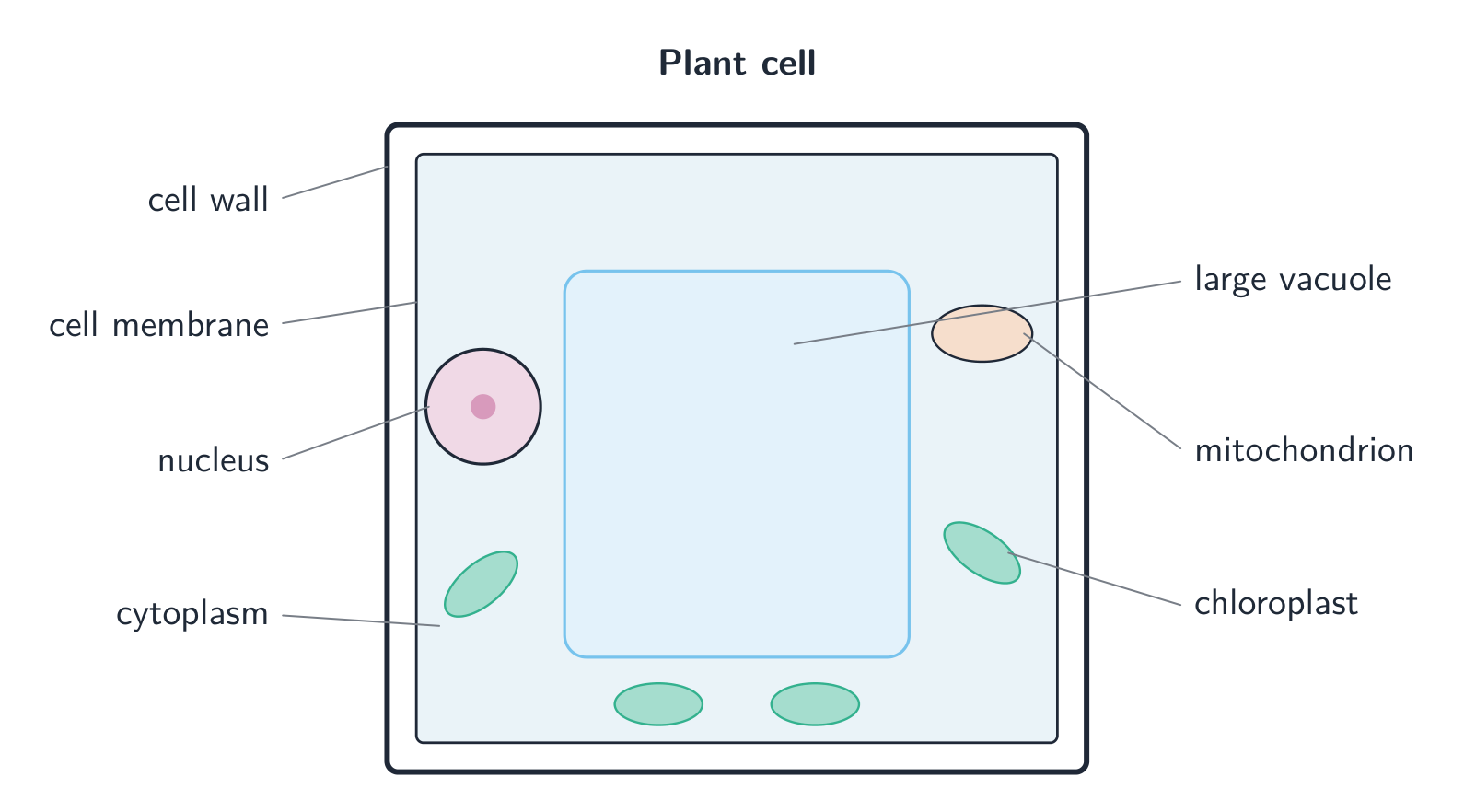
So plant and animal cells share five structures: cell membrane, cytoplasm, ribosomes, nucleus and mitochondria. A plant cell has three extra structures: a cell wall, a large vacuole and (in green parts) chloroplasts.

What each structure does

  • Cell membrane — controls which substances enter and leave the cell.
  • Cytoplasm — a jelly-like liquid where many chemical reactions happen.
  • Nucleus — controls the cell's activities and holds the genetic material 遗传物质.
  • Ribosomes — where proteins 蛋白质 are made.
  • Mitochondria — where respiration 呼吸作用 happens to release energy 能量.
  • Cell wall — made of cellulose 纤维素; it gives a plant cell strength and a fixed shape.
  • Chloroplasts — contain chlorophyll 叶绿素, a green substance that traps light for photosynthesis 光合作用.
  • Large vacuole — filled with cell sap 细胞液; it helps keep the plant cell firm.

Bacterial cells

A bacterium is a prokaryote 原核生物 — its cell has no nucleus. Instead its DNA is a single loop (a ring), loose in the cytoplasm. Bacteria also have small extra rings of DNA called plasmids 质粒. A bacterial cell has a cell wall and cell membrane, cytoplasm and ribosomes, but no mitochondria and no chloroplasts.

Español

Todo ser vivo está formado por células 细胞. Una célula es la parte más pequeña capaz de llevar a cabo las funciones vitales. En este tema se compara una célula de planta 植物, una célula animal 动物 y la célula de una bacteria 细菌. Todas las nuevas células se forman por la división 分裂 de células que ya existen.

¿Qué estructuras hay en cada tipo de célula?

Estructura Célula animal Célula vegetal Célula bacteriana
membrana celular 细胞膜 sí sí sí
citoplasma 细胞质 sí sí sí
ribosomas 核糖体 sí sí sí
núcleo 细胞核 sí sí no — tiene un bucle de ADN en su lugar
mitocondrias 线粒体 sí sí no
pared celular 细胞壁 no sí sí (material diferente)
cloroplastos 叶绿体 no sí (solo en partes verdes) no
gran vacuola 液泡 no sí no
plásmidos no no sí

Las células vegetales y animales comparten cinco estructuras: membrana celular, citoplasma, ribosomas, núcleo y mitocondrias. Una célula vegetal tiene tres estructuras adicionales: pared celular, una gran vacuola y (en las partes verdes) cloroplastos.

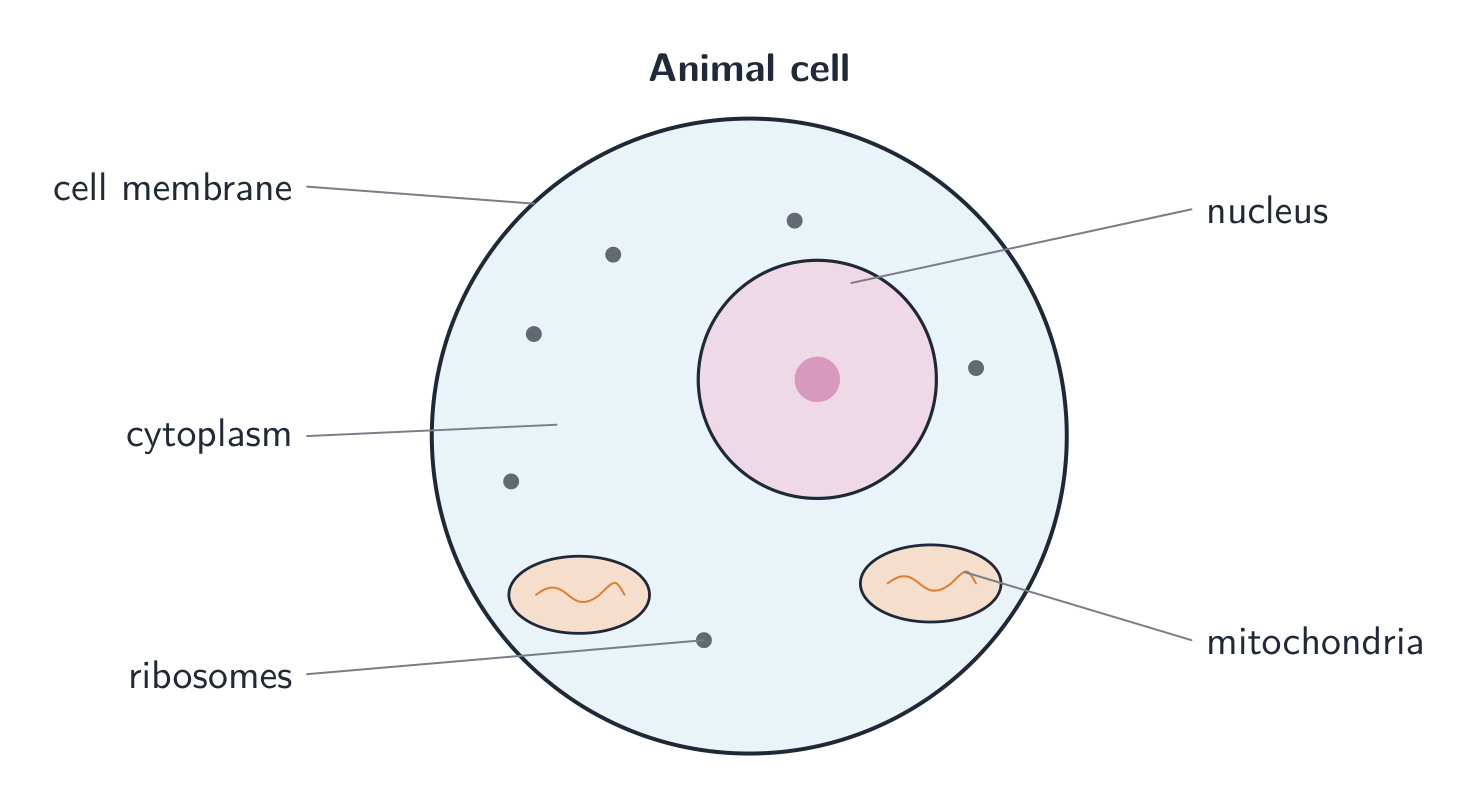
Una célula animal etiquetada: una membrana celular redonda que encierra citoplasma, un núcleo, mitocondrias y ribosomas
Una célula animal: membrana, citoplasma, núcleo, mitocondrias y ribosomas
Una célula vegetal etiquetada: una pared celular y membrana, citoplasma, un núcleo, una gran vacuola central, cloroplastos y una mitocondria
Una célula vegetal también tiene una pared celular, una gran vacuola y cloroplastos
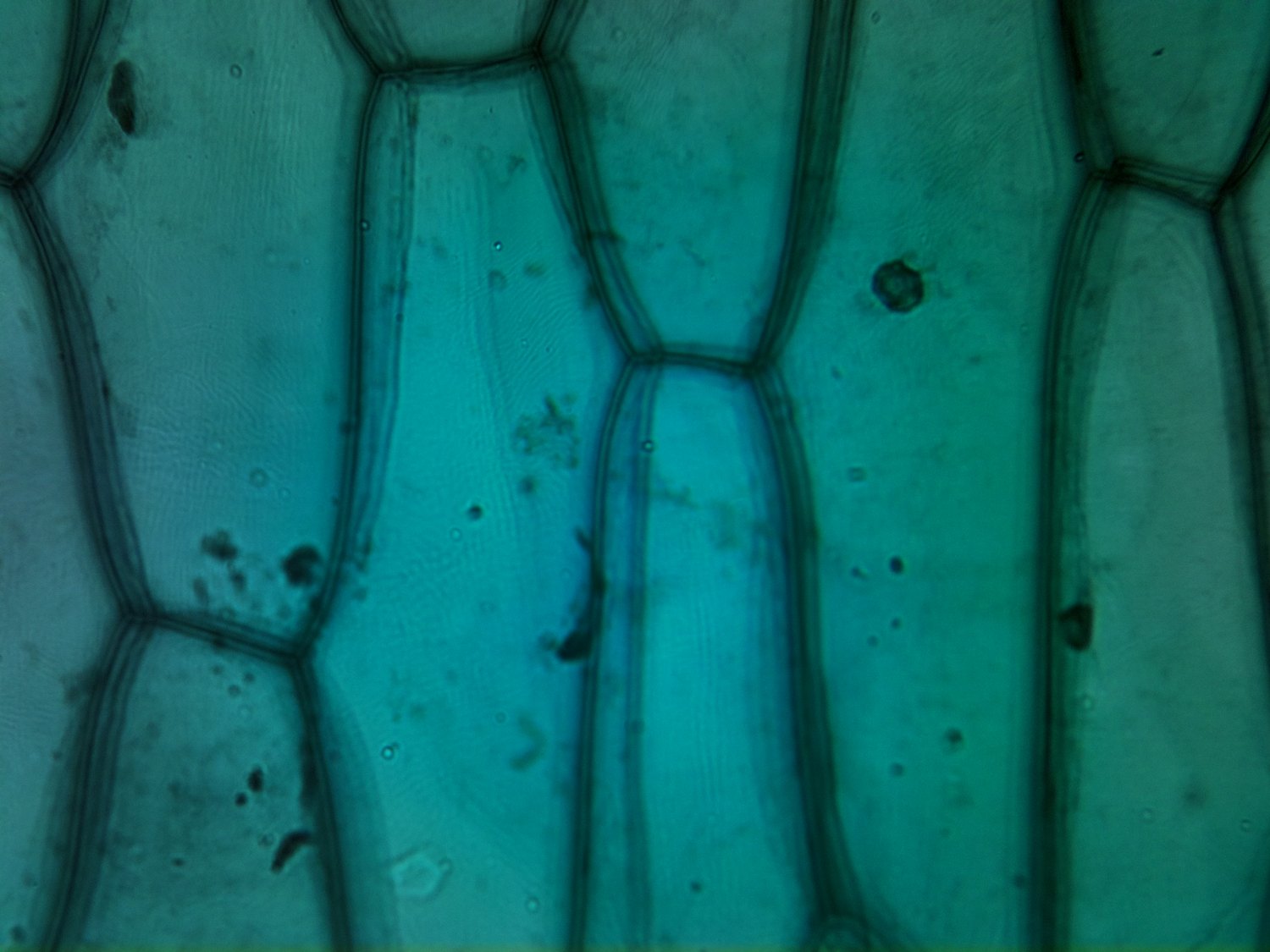
Una foto de microscopio óptico de células epidérmicas de cebolla, mostrando filas de células en forma de ladrillo con paredes celulares claras
Células de epidermis de cebolla bajo un microscopio óptico —cada célula tiene una pared celular clara

Función de cada estructura

  • Membrana celular: controla qué sustancias entran y salen de la célula.
  • Citooplasma — un líquido gelatinoso donde ocurren muchas reacciones químicas.
  • Núcleo — controla las actividades de la célula y contiene el material genético 遗传物质.
  • Ribosomas — donde se fabrican las proteínas 蛋白质.
  • Mitocondrias — donde ocurre la respiración 呼吸作用 para liberar energía 能量.
  • Pared celular — compuesta de celulosa 纤维素; proporciona resistencia y una forma fija a la célula vegetal.
  • Cloroplastos — contienen clorofila 叶绿素, una sustancia verde que atrapa la luz para la fotosíntesis 光合作用.
  • Gran vacuola — llena de jugo celular 细胞液; ayuda a mantener firme la célula vegetal.

Células bacterianas

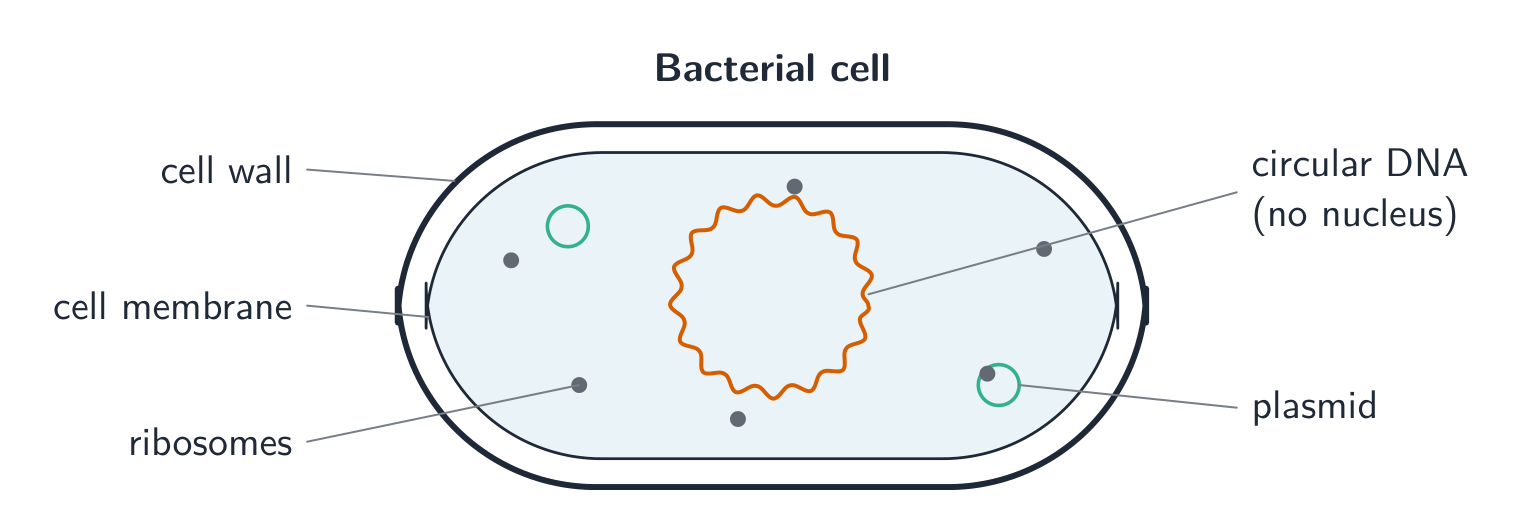
Una bacteria es un procariota 原核生物 — su célula no tiene núcleo. En su lugar, su ADN es un único bucle (un anillo), suelto en el citoplasma. Las bacterias también tienen pequeños anillos adicionales de ADN llamados plásmidos 质粒. Una célula bacteriana tiene pared celular y membrana celular, citoplasma y ribosomas, pero no mitocondrias ni cloroplastos.

Una célula bacteriana etiquetada: una pared celular y membrana alrededor del citoplasma que contiene un único bucle de ADN, pequeños plásmidos y ribosomas, sin núcleo
Una célula bacteriana no tiene núcleo — su ADN es un único bucle, además de pequeños plásmidos
Explore · ⁨Explorar⁩

Explora las partes de una célula

Toca cada parte de la célula para ver qué hace. Algunas partes (pared celular, cloroplasto, vacuola) se encuentran solo en células vegetales.

Vocabulary · ⁨Vocabulario⁩ Train · ⁨Entrenar⁩
English · ⁨Inglés⁩ Chinese · ⁨Chino⁩ Pinyin
cells/selz/ 细胞 xì bāo
plant/plænt/ 植物 zhí wù
animal/ˈænɪml/ 动物 dòng wù
bacterium/bækˈtɪərɪəm/ 细菌 xì jūn
division/dɪˈvɪʒn/ 分裂 fēn liè
cell membrane/sel ˈmembreɪn/ 细胞膜 xì bāo mó
cytoplasm/ˈsaɪtəplæzəm/ 细胞质 xì bāo zhì
ribosomes/ˈrɪbəsəʊmz/ 核糖体 hé táng tǐ
nucleus/ˈnjuːklɪəs/ 细胞核 xì bāo hé
mitochondria/ˌmaɪtəˈkɒndrɪə/ 线粒体 xiàn lì tǐ
cell wall/sel wɔːl/ 细胞壁 xì bāo bì
chloroplasts/ˈklɔːrəʊplæsts/ 叶绿体 yè lǜ tǐ
vacuole/ˈvækjuːəʊl/ 液泡 yè pào
genetic material/dʒɪˈnetɪk məˈtɪərɪəl/ 遗传物质 yí chuán wù zhì
proteins/ˈprəʊtiːnz/ 蛋白质 dàn bái zhì
respiration/ˌrespɪˈreɪʃn/ 呼吸作用 hū xī zuò yòng
energy/ˈenədʒi/ 能量 néng liàng
cellulose/ˈseljuːləʊs/ 纤维素 xiān wéi sù
chlorophyll/ˌklɔːrəʊˈfɪl/ 叶绿素 yè lǜ sù
photosynthesis/ˌfəʊtəʊˈsɪnθəsɪs/ 光合作用 guāng hé zuò yòng
cell sap/sel sæp/ 细胞液 xì bāo yè
prokaryote/ˈprɒkərɪəʊt/ 原核生物 yuán hé shēng wù
plasmids/ˈplæzmɪdz/ 质粒 zhì lì
2.1

Specialised cells · ⁨Células especializadas⁩

English

Most cells are specialised cells 特化细胞 — their shape and parts suit one special job.

Cell Job How its shape helps
ciliated cells 纤毛细胞 move mucus 黏液 along the trachea 气管 and bronchi 支气管 tiny hairs (cilia) on top sweep the mucus along
root hair cells 根毛细胞 absorption 吸收 of water and minerals from the soil a long, thin "hair" gives a large surface
palisade mesophyll cells 栅栏叶肉细胞 photosynthesis packed with chloroplasts, near the top of the leaf
neurones 神经元 carry electrical impulses 电脉冲 very long, to reach far across the body
red blood cells 红细胞 transport oxygen 氧气 no nucleus and a dish shape, to carry more oxygen
sperm 精子 and egg cells 卵细胞 reproduction the sperm can swim; the egg cell stores food

Sperm and egg cells are the sex cells, called gametes 配子.

Español

La mayoría de las células son células especializadas 特化细胞 — su forma y partes se adaptan a un trabajo especial.

Tres células especializadas: un glóbulo rojo, una célula pilifera radicular y una neurona, cada una adaptada a su función
Las células especializadas tienen formas adaptadas a sus funciones
Célula Función Cómo su forma ayuda
células ciliadas 纤毛细胞 mover moco 黏液 a lo largo de la tráquea 气管 y los bronquios 支气管 diminutos pelos (cilios) en la parte superior barren el moco hacia adelante
células de la raíz pilífera 根毛细胞 absorción 吸收 de agua y minerales del suelo un "pelo" largo y fino proporciona una gran superficie
células del mesófilo en palisada 栅栏叶肉细胞 fotosíntesis repletas de cloroplastos, cerca de la parte superior de la hoja
neuronas 神经元 transportan impulsos eléctricos 电脉冲 muy largas, para alcanzar grandes distancias a través del cuerpo
glóbulos rojos 红细胞 transportan oxígeno 氧气 sin núcleo y con forma de disco, para transportar más oxígeno
espermatozoides 精子和 óvulos 卵细胞 reproducción el espermatozoide puede nadar; el óvulo almacena alimentos

Los espermatozoides y los óvulos son las células sexuales, llamadas gametos 配子.

Vocabulary · ⁨Vocabulario⁩ Train · ⁨Entrenar⁩
English · ⁨Inglés⁩ Chinese · ⁨Chino⁩ Pinyin
specialised cells/ˈspeʃəlaɪzd selz/ 特化细胞 tè huà xì bāo
ciliated cells/ˈsɪlɪeɪtɪd selz/ 纤毛细胞 xiān máo xì bāo
mucus/ˈmjuːkəs/ 黏液 nián yè
trachea/trəˈkɪə/ 气管 qì guǎn
bronchi/ˈbrɒŋkaɪ/ 支气管 zhī qì guǎn
root hair cells/ruːt heə selz/ 根毛细胞 gēn máo xì bāo
absorption/əbˈsɔːpʃn/ 吸收 xī shōu
palisade mesophyll cells/ˈpælɪseɪd ˈmesəfɪl selz/ 栅栏叶肉细胞 zhà lán yè ròu xì bāo
neurones/ˈnjuːrəʊnz/ 神经元 shén jīng yuán
electrical impulses/ɪˈlektrɪkl ˈɪmpʌlsɪz/ 电脉冲 diàn mài chōng
red blood cells/red blʌd selz/ 红细胞 hóng xì bāo
oxygen/ˈɒksɪdʒn/ 氧气 yǎng qì
sperm/spɜːm/ 精子 jīng zi
egg cells/eɡ selz/ 卵细胞 luǎn xì bāo
gametes/ˈɡæmiːts/ 配子 pèi zi
2.1

Levels of organisation · ⁨Niveles de organización⁩

English

An organism 生物体 made of many cells is built up in levels, from small to large:

  • cell — the smallest unit of life (for example a red blood cell).
  • tissue 组织 — a group of similar cells that work together (for example muscle 肌肉).
  • organ 器官 — several different tissues that work together to do a job (for example the heart, or a leaf).
  • organ system 器官系统 — several organs that work together (for example the digestive system 消化系统, which breaks down food).
  • organism — all the organ systems together make one whole living thing.
Español

Un organismo 生物体 compuesto por muchas células se estructura en niveles, desde lo pequeño hasta lo grande:

  • célula — la unidad más pequeña de la vida (por ejemplo, un glóbulo rojo).
  • tejido 组织 — un grupo de células similares que trabajan juntas (por ejemplo músculo 肌肉).
  • órgano 器官 — varios tejidos diferentes que trabajan juntos para realizar una función (por ejemplo, el corazón o una hoja).
  • sistema de órganos 器官系统 — varios órganos que trabajan juntos (por ejemplo el sistema digestivo 消化系统, que descompone los alimentos).
  • organismo — todos los sistemas de órganos juntos forman un ser vivo completo.
Una cadena de cajas enlazadas por flechas: célula, luego tejido, luego órgano, luego sistema de órganos, luego organismo
Desde una sola célula hasta todo el organismo
Explore · ⁨Explorar⁩

Laboratorio de organización celular

Ver cómo las células construyen tejidos, órganos y sistemas.

Vocabulary · ⁨Vocabulario⁩ Train · ⁨Entrenar⁩
English · ⁨Inglés⁩ Chinese · ⁨Chino⁩ Pinyin
organism/ˈɔːɡənɪzəm/ 生物体 shēng wù tǐ
tissue/ˈtɪʃuː/ 组织 zǔ zhī
muscle/ˈmʌsl/ 肌肉 jī ròu
organ/ˈɔːɡən/ 器官 qì guān
organ system/ˈɔːɡən ˈsɪstəm/ 器官系统 qì guān xì tǒng
digestive system/daɪˈdʒestɪv ˈsɪstəm/ 消化系统 xiāo huà xì tǒng
2.2

The size of cells: magnification · ⁨El tamaño de las células: aumento⁩

Syllabus
English
Core Supplement
1 State and use the formula: magnification = image size ÷ actual size
2 Calculate magnification and size of biological specimens using millimetres as units 3 Convert measurements between millimetres (mm) and micrometres (μm)
Español
Núcleo Complementario
1 Enunciar y utilizar la fórmula: aumento = tamaño de la imagen ÷ tamaño real
2 Calcular el aumento y el tamaño de las muestras biológicas utilizando milímetros como unidad 3 Convertir medidas entre milímetros (mm) y micrómetros (μm)

Source: Cambridge International syllabus · ⁨Fuente: Plan de estudios Cambridge International⁩

English

Cells are tiny, so you look at them under a microscope 显微镜, which makes them appear much larger. How many times larger the image is, is called the magnification 放大倍数.

$$\text{magnification} = \frac{\text{image size}}{\text{actual size}}$$
  • image size = the size in the drawing or photo.
  • actual size = the real size of the specimen 标本.

Magnification has no unit — it is just a number, for example ×250. You can rearrange the formula:

$$\text{actual size} = \frac{\text{image size}}{\text{magnification}}, \qquad \text{image size} = \text{actual size} \times \text{magnification}$$

Worked example. A structure is shown at a magnification of 250. Its image size is 5.00 mm. So the actual size = 5.00 ÷ 250 = 0.02 mm. Always put both sizes in the same unit before you divide.

Changing units (Supplement)

Cells are often measured in micrometres 微米 (μm), which are smaller than millimetres (mm):

$$1\ \text{mm} = 1000\ \mu\text{m}, \qquad 1\ \mu\text{m} = 0.001\ \text{mm}$$

So 0.02 mm = 20 μm. To change mm into μm, multiply by 1000. To change μm into mm, divide by 1000.

Worked example. A cell is drawn 60 mm wide, and its real width is 30 μm. Find the magnification. First make the units match: image size = 60 mm = 60 × 1000 = 60,000 μm. Then magnification = image ÷ actual = 60,000 ÷ 30 = ×2000. If you forget to convert and divide 60 ÷ 30, you get ×2 — a thousand times too small. This is the most common mistake in the whole topic.

Español

Las células son diminutas, por lo que se observan bajo un microscopio 显微镜, que hace que parezcan mucho más grandes. Cuántas veces más grande es la imagen se denomina aumento 放大倍数.

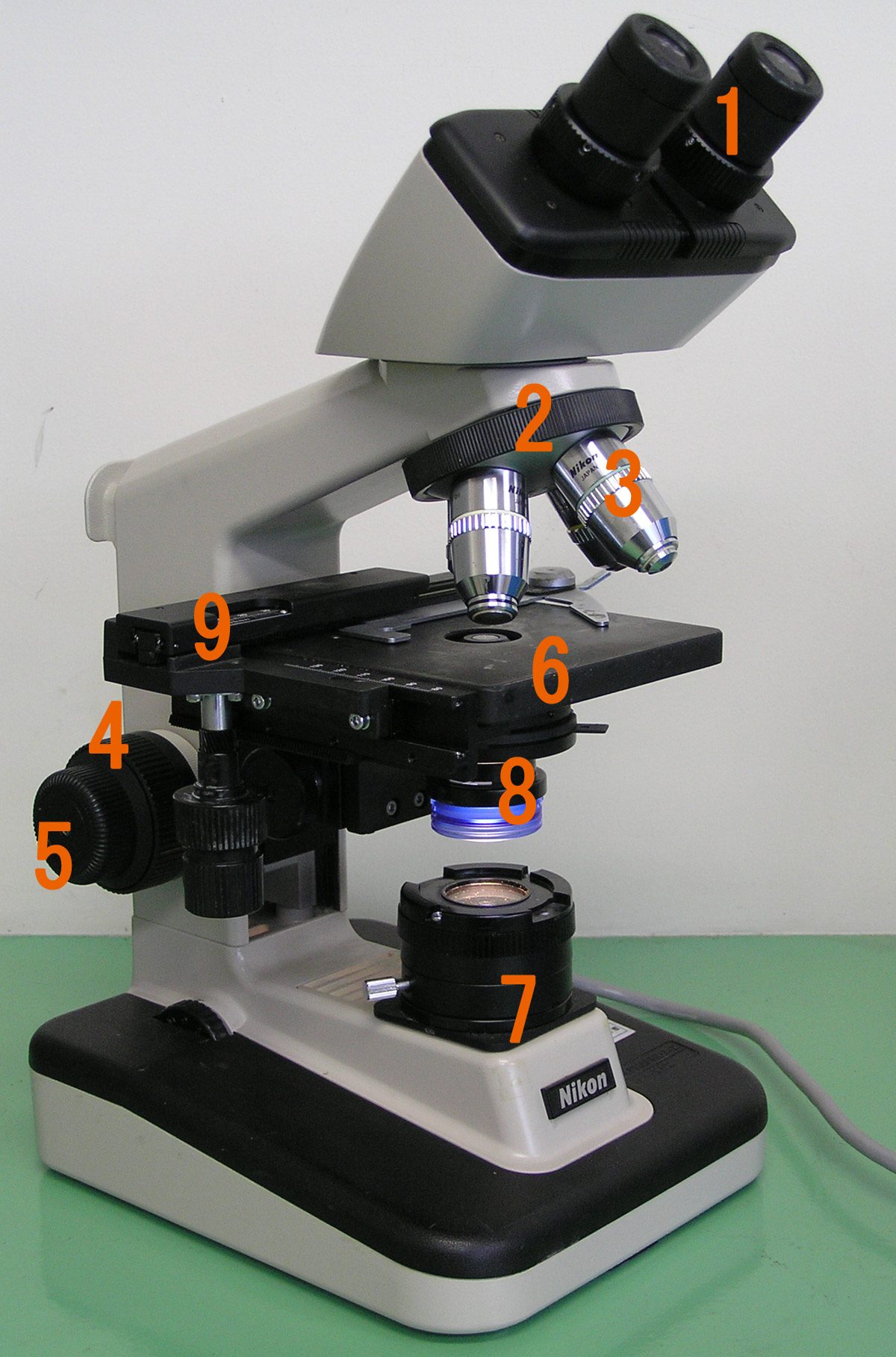
Un microscopio compuesto de luz con partes numeradas: dos oculares en la parte superior, lentes objetivos en una torreta, un escenario plano para sostener la lámina, perillas de enfoque en el lateral y una lámpara y condensador debajo del escenario
Un microscopio óptico, utilizado para observar células
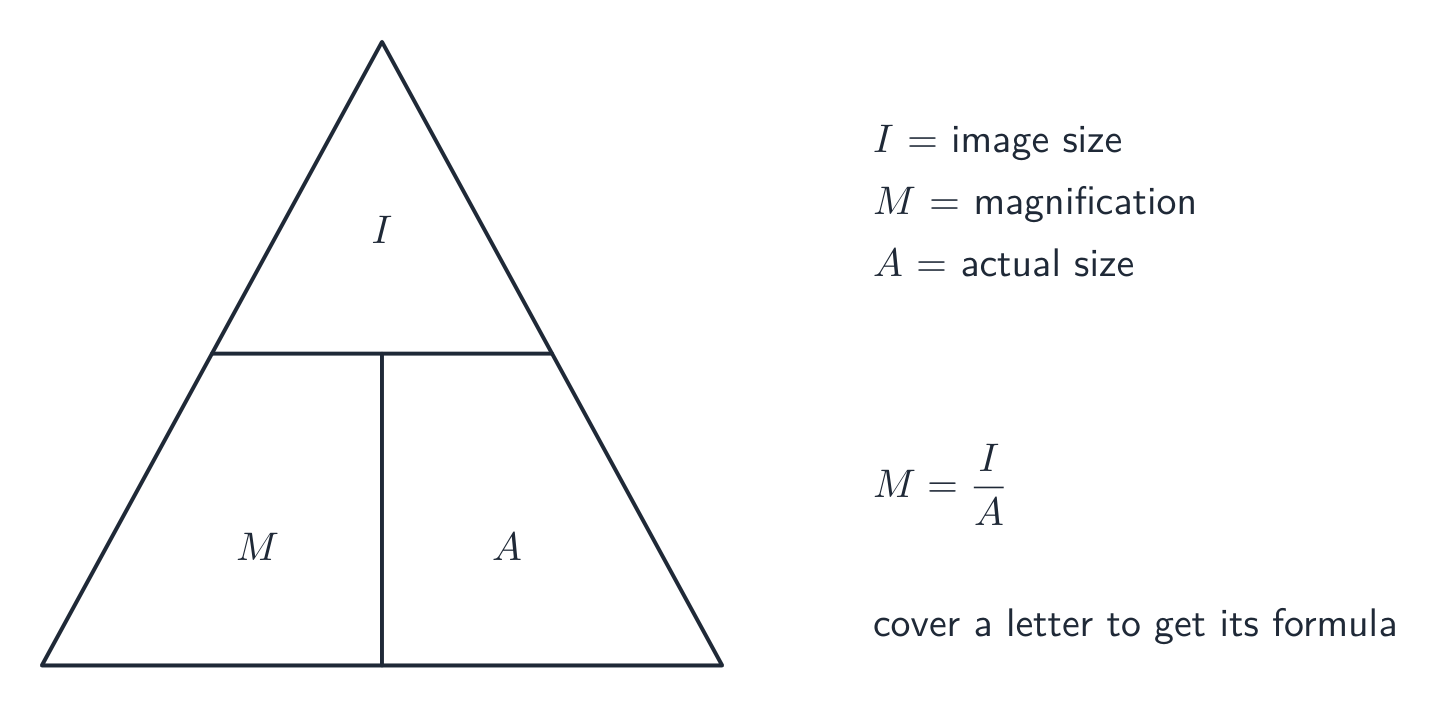
$$\text{magnification} = \frac{\text{image size}}{\text{actual size}}$$
Un triángulo de fórmula con tamaño de imagen arriba y aumento y tamaño real abajo; cubra la cantidad que desea leer de su fórmula
Cubre la cantidad que deseas despejar en el triángulo para obtener su fórmula
  • tamaño de la imagen = el tamaño en el dibujo o foto.
  • tamaño real = el tamaño verdadero del especimen 标本.

La ampliación no tiene unidad — es simplemente un número, por ejemplo ×250. Puedes reorganizar la fórmula:

$$\text{actual size} = \frac{\text{image size}}{\text{magnification}}, \qquad \text{image size} = \text{actual size} \times \text{magnification}$$

Ejemplo resuelto. Se muestra una estructura con una ampliación de 250. Su tamaño en la imagen es de 5.00 mm. Por lo tanto, el tamaño real = 5.00 ÷ 250 = 0.02 mm. Asegúrate de que ambos tamaños estén en la misma unidad antes de dividir.

Cambio de unidades (Suplemento)

Las células suelen medirse en micrómetros 微米 (μm), que son más pequeños que los milímetros (mm):

$$1\ \text{mm} = 1000\ \mu\text{m}, \qquad 1\ \mu\text{m} = 0.001\ \text{mm}$$

Por lo tanto, 0.02 mm = 20 μm. Para convertir mm a μm, multiplica por 1000. Para convertir μm a mm, divide por 1000.

Ejemplo resuelto. Una célula se dibuja con un ancho de 60 mm, y su ancho real es de 30 μm. Calcula la aumentación. Primero iguala las unidades: tamaño de imagen = 60 mm = 60 × 1000 = 60,000 μm. Luego, aumentación = imagen ÷ real = 60,000 ÷ 30 = ×2000. Si olvidas convertir y divides 60 ÷ 30, obtienes ×2 — mil veces más pequeño. Este es el error más común en todo el tema.

Explore · ⁨Explorar⁩

Laboratorio de ampliación

ampliación = tamaño de la imagen / tamaño real

Cambiar el tamaño real y ver cómo el tamaño de la imagen se relaciona con la ampliación.

Vocabulary · ⁨Vocabulario⁩ Train · ⁨Entrenar⁩
English · ⁨Inglés⁩ Chinese · ⁨Chino⁩ Pinyin
microscope/ˈmaɪkrəskəʊp/ 显微镜 xiǎn wēi jìng
magnification/ˌmæɡnɪfɪˈkeɪʃn/ 放大倍数 fàng dà bèi shù
specimen/ˈspesɪmən/ 标本 biāo běn
micrometres/ˈmaɪkrəʊmiːtəz/ 微米 wēi mǐ
2.2

Exam tips · ⁨Consejos para el examen⁩

English
  • A plant cell has a cell wall, a large vacuole and chloroplasts; an animal cell has none of these. Both have a nucleus, cytoplasm, cell membrane, mitochondria and ribosomes.
  • A cell with no nucleus but with plasmids and a loop of DNA is a bacterium.
  • For magnification, cover the quantity you want: magnification = image ÷ actual; actual = image ÷ magnification.
  • Always convert to the same unit before you calculate. Remember 1 mm = 1000 μm.
  • For a specialised cell, link its job to the one feature that suits it (for example a red blood cell has no nucleus, so it can hold more oxygen).
Español
  • Una célula vegetal tiene pared celular, una gran vacuola y cloroplastos; una célula animal no posee ninguno de estos. Ambas tienen núcleo, citoplasma, membrana plasmática, mitocondrias y ribosomas.
  • Una célula con sin núcleo pero con plásmidos y un bucle de ADN es una bacteria.
  • Para la ampliación, cubre la cantidad que desees: ampliación = imagen ÷ real; real = imagen ÷ ampliación.
  • Convierte siempre a la misma unidad antes de calcular. Recuerda 1 mm = 1000 μm.
  • Para una célula especializada, vincula su función con la única característica que la adapta (por ejemplo, un glóbulo rojo no tiene núcleo, por lo que puede transportar más oxígeno).

Interactive lessons on this topic · ⁨Lecciones interactivas sobre este tema⁩

Work through it step by step, with instant-check exercises. · ⁨Trátalo paso a paso, con ejercicios de verificación instantánea.⁩

Past Papers · ⁨Exámenes Anteriores⁩

More topics in IGCSE Biología · ⁨Más temas en IGCSE Biología⁩

Log in or create account · ⁨Iniciar sesión o crear cuenta⁩

IGCSE, A-Level & AP