Cells
Introduced| English | Meaning |
|---|---|
| cells/selz/ | The smallest structural and functional unit of a living organism. |
| cell membrane/sel ˈmembreɪn/ | The selectively permeable boundary surrounding a cell and controlling movement of substances into and out of it. |
| cytoplasm/ˈsaɪtəplæzəm/ | The contents of a cell inside its membrane and outside the nucleus, where many chemical reactions occur. |
| nucleus/ˈnjuːklɪəs/ | A membrane-bound organelle in eukaryotic cells that contains most of the genetic material. |
| mitochondria/ˌmaɪtəˈkɒndrɪə/ | Organelles in eukaryotic cells where most aerobic respiration and ATP production occur. |
| ribosomes/ˈrɪbəsəʊmz/ | A cellular structure that joins amino acids into a polypeptide using information from messenger RNA. |
| cell wall/sel wɔːl/ | A supportive layer outside the cell membrane in plants, fungi and many microorganisms. |
| cellulose/ˈseljuːləʊs/ | A structural polysaccharide made of glucose units, forming a major component of plant cell walls. |
| chloroplasts/ˈklɔːrəʊplæsts/ | Organelles in plants and algae that contain photosynthetic pigments and carry out photosynthesis. |
| chlorophyll/ˌklɔːrəʊˈfɪl/ | A green pigment that absorbs light energy for photosynthesis. |
| vacuole/ˈvækjuːəʊl/ | A membrane-bound compartment containing fluid and dissolved substances, often large and permanent in plant cells. |
The building blocks of life
- Every living thing — from a blade of grass to a blue whale — is built from cells 细胞.
- They are tiny, but inside each one is a busy world of parts that keep it alive.
Parts of an animal cell
- Cell membrane 细胞膜: controls what enters and leaves.
- Cytoplasm 细胞质: jelly where reactions happen.
- Nucleus 细胞核: contains DNA and controls the cell.
- Mitochondria 线粒体: site of aerobic respiration, which releases energy.
- Ribosomes 核糖体: make proteins; plant and animal cells both have them.
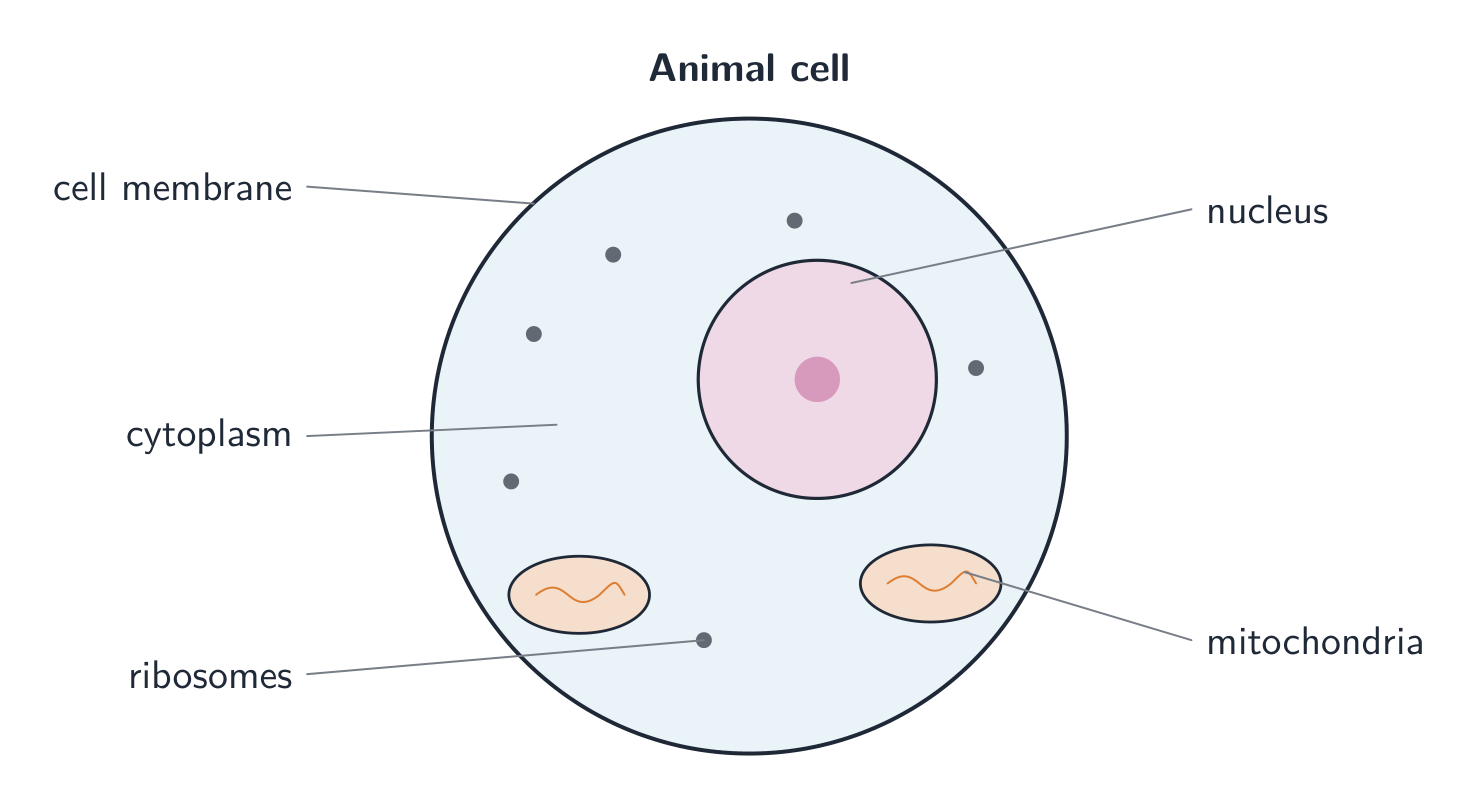
An animal cell: membrane, cytoplasm, nucleus, mitochondria and ribosomes
Explore the parts of a cell
Compare structures in typical plant and animal cells. Use the bacterial-cell section to check which features also occur in bacteria.
Which part of the cell contains DNA and controls the cell?
Difficulty 1/5 · 100 coins + a small bonus on first completion today
The nucleus holds DNA and controls the cell.
Which part releases energy by respiration?
Difficulty 1/5 · 100 coins + a small bonus on first completion today
Mitochondria are the site of aerobic respiration.
The cell membrane's main job is to:
Difficulty 1/5 · 100 coins + a small bonus on first completion today
The membrane controls movement in and out.
Extra parts in a plant cell
- Cell wall 细胞壁: made of cellulose 纤维素, gives support and shape.
- Chloroplasts 叶绿体: contain chlorophyll 叶绿素 for photosynthesis.
- Large vacuole 液泡: filled with cell sap, keeps the cell firm.
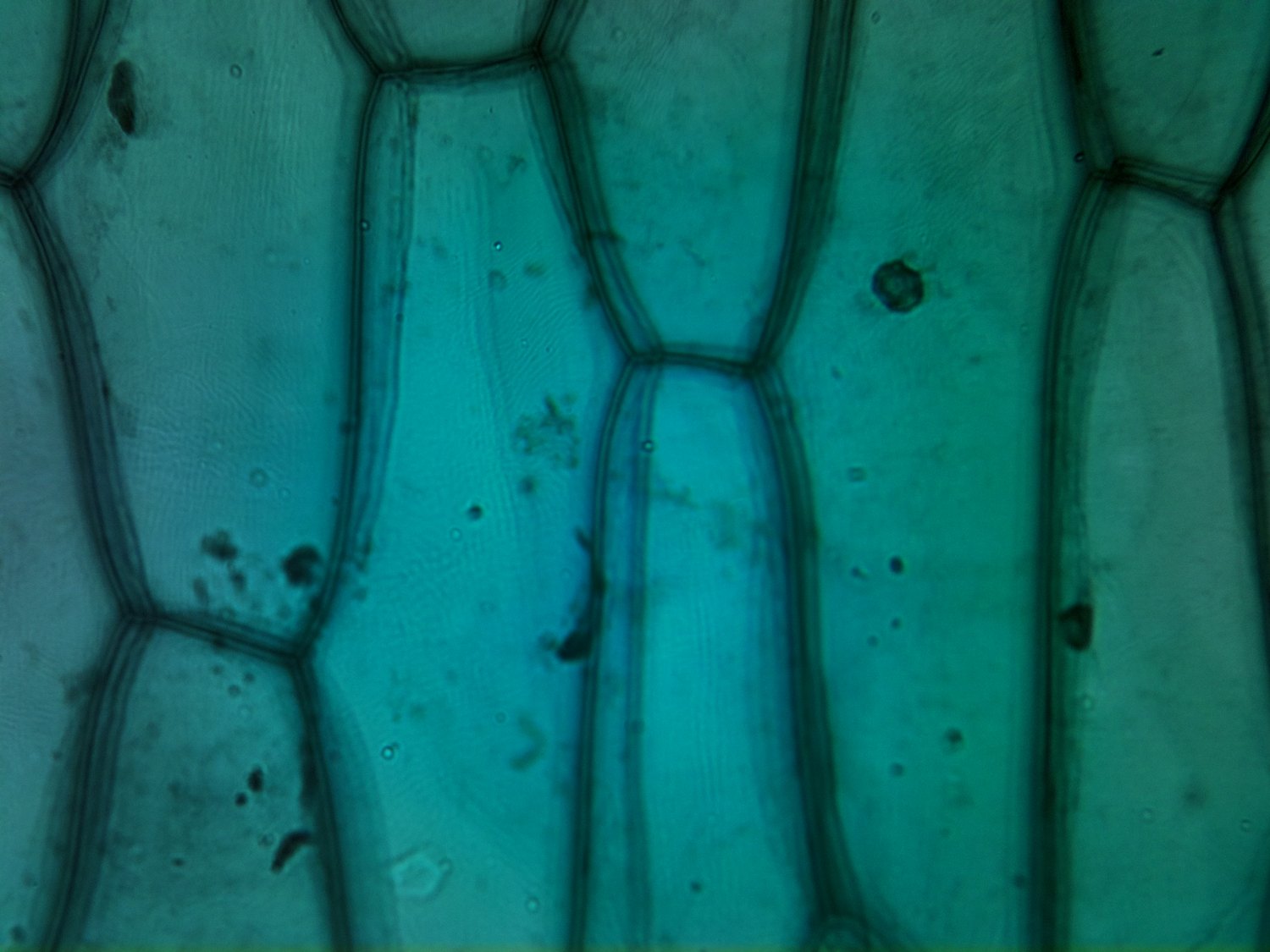
Onion epidermis cells under a light microscope — each cell has a clear cell wall
Compared with a typical animal cell, which extra structures are shown in a typical photosynthetic plant cell? Select all that apply.
Difficulty 2/5 · 140 coins + a small bonus on first completion today
A photosynthetic plant cell has a cellulose wall, chloroplasts and a large permanent vacuole. The nucleus is shared with a typical animal cell. This comparison does not claim that bacteria lack cell walls.
The plant cell part made of cellulose that gives support is the cell ______.
Difficulty 1/5 · 100 coins + a small bonus on first completion today
The cellulose cell wall supports and shapes plant cells.
Animal vs plant cells
- Typical plant and animal cells both have a membrane, cytoplasm, nucleus, mitochondria and ribosomes.
- Compared with animal cells, plant cells have a cellulose cell wall and a large permanent vacuole; photosynthetic plant cells also have chloroplasts.
A cell wall does not prove that a cell has chloroplasts. A typical root hair cell absorbs water and mineral ions; it does not photosynthesise and has no chloroplasts. Mature mammalian red blood cells also show why a typical animal-cell diagram is not a list of parts present in every animal cell: they have no nucleus.

A plant cell also has a cell wall, a large vacuole and chloroplasts
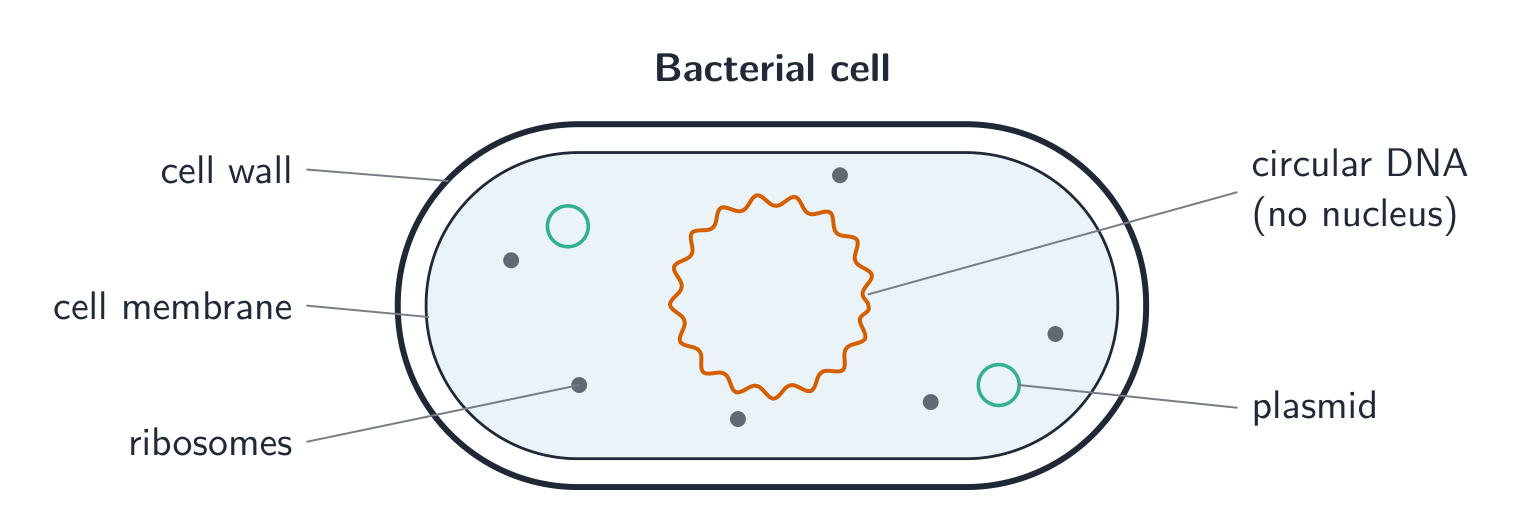
A bacterial cell is different
- A bacterial cell has a cell wall, cell membrane, cytoplasm and ribosomes. Its circular DNA is in the cytoplasm, not inside a nucleus; plasmids are small additional circles of DNA.
- It has no mitochondria. Its membrane controls movement of substances, its ribosomes make proteins and its DNA carries genetic information. New cells are produced when existing cells divide.
How are new cells produced?
Difficulty 1/5 · 100 coins + a small bonus on first completion today
New cells arise by cell division. Individual organelles are not independent cells.
Use a combination of evidence
- A cell has a cellulose wall, a nucleus and a large permanent vacuole, but no chloroplasts. These observations fit a non-photosynthetic plant cell, such as a root hair cell.
- No chloroplasts does not mean animal cell. A wall alone does not mean plant cell either: bacterial cells also have walls, but their walls are not made of cellulose and they have no nucleus.
A student sees a cell wall and concludes, “This must be a plant cell.” Explain why the evidence is insufficient and name one further observation that would distinguish a typical plant cell from a bacterial cell.
Bacterial cells also have walls, so a wall alone is insufficient. A nucleus would support a typical plant cell rather than a bacterial cell; bacterial DNA is not enclosed in a nucleus. Alternatively, establishing that the wall contains cellulose supports plant rather than bacterial identity.
You've got it
- typical plant and animal cells share a membrane, cytoplasm, nucleus, mitochondria and ribosomes
- plant cells have a cellulose cell wall and a large vacuole; photosynthetic cells also have chloroplasts
- bacterial cells have no nucleus or mitochondria; cell structures must be identified from the cell type
- the nucleus controls the cell; mitochondria release energy
Cell A has a nucleus, a cellulose wall and a large permanent vacuole but no chloroplasts. Cell B has circular DNA in its cytoplasm and ribosomes but no nucleus. Identify each cell type and justify your decisions.
A is a non-photosynthetic plant cell: its cellulose wall and large permanent vacuole support this, and lack of chloroplasts does not rule it out. B is a bacterial cell: its DNA is not enclosed in a nucleus. Ribosomes alone do not distinguish B because plant and animal cells also have them.
A typical animal cell needs to make proteins for growth. Which structure carries out protein synthesis?
Difficulty 1/5 · 100 coins + a small bonus on first completion today
Ribosomes make proteins. Mitochondria release energy through aerobic respiration; the membrane controls movement into and out of the cell.