Skip to content · ⁨Saltar al contenido⁩

Matemáticas Puras Avanzadas 1

A-Level Matemáticas Avanzadas · Topic 1 · ⁨Tema 1⁩

Train · ⁨Entrenar⁩
Video lesson for this topic · ⁨Lección de video para este tema⁩ Open the video page · ⁨Abrir la página de video⁩
14:28

Matemáticas Puras Adicionales 1

Aquí hay una ecuación cúbica, cruzando el eje en tres raíces. Encontrar esas raíces exactamente puede ser difícil —o incluso imposible a mano. Pero aquí hay una hermosa…

English narration · English + 中文 subtitles burned in · ⁨Narración en inglés · Subtítulos en inglés + 中文 quemados en pantalla⁩

English

This handout covers Topic 1: Further Pure Mathematics 进阶纯数学 1. It adds new algebra, matrices, polar coordinates, more vectors, and proof by induction.

Español

Este folleto cubre el Tema 1: Matemáticas Puras Avanzadas 进阶纯数学 1. Añade nueva álgebra, matrices, coordenadas polares, más vectores y demostración por inducción.

1.1

Roots of polynomial equations · ⁨Raíces de ecuaciones polinómicas⁩

Syllabus
English
Candidates should be able to: Notes and examples
• recall and use the relations between the roots and coefficients of polynomial equations e.g. to evaluate symmetric functions of the roots or to solve problems involving unknown coefficients in equations; restricted to equations of degree 2, 3 or 4 only.
• use a substitution to obtain an equation whose roots are related in a simple way to those of the original equation Substitutions will not be given for the easiest cases, e.g. where the new roots are reciprocals or squares or a simple linear function of the old roots.
Español
Los candidatos deben ser capaces de: Notas y ejemplos
• recordar y utilizar las relaciones entre las raíces y los coeficientes de las ecuaciones polinómicas p. ej., para evaluar funciones simétricas de las raíces o para resolver problemas que involucran coeficientes desconocidos en ecuaciones; restringido únicamente a ecuaciones de grado 2, 3 o 4.
• utilizar una sustitución para obtener una ecuación cuyas raíces estén relacionadas de manera simple con las de la ecuación original No se proporcionarán sustituciones para los casos más sencillos, p. ej., cuando las nuevas raíces son recíprocas, cuadrados o una función lineal simple de las raíces antiguas.

Source: Cambridge International syllabus · ⁨Fuente: Plan de estudios Cambridge International⁩

English

For a polynomial equation, the roots 根 are linked to the coefficients 系数. For $ax^2 + bx + c = 0$ with roots $\alpha, \beta$:

$$\alpha + \beta = -\frac{b}{a}, \qquad \alpha\beta = \frac{c}{a}.$$
For a cubic $ax^3 + bx^2 + cx + d = 0$ with roots $\alpha, \beta, \gamma$:
$$\sum\alpha = -\frac{b}{a}, \qquad \sum\alpha\beta = \frac{c}{a}, \qquad \alpha\beta\gamma = -\frac{d}{a}.$$
Sums like $\sum\alpha$ and $\sum\alpha\beta$ are symmetric functions 对称函数 of the roots (unchanged if the roots are swapped). To find an equation whose roots are changed in a simple way, use a substitution 代换 (for example, put $w = \alpha + 1$).

Worked example. The equation $x^2 - 5x + 6 = 0$ has roots $\alpha, \beta$. Find the equation with roots $\alpha + 1, \beta + 1$.

Here $\alpha + \beta = 5$ and $\alpha\beta = 6$. The new sum is $(\alpha + 1) + (\beta + 1) = 7$, and the new product is $(\alpha + 1)(\beta + 1) = \alpha\beta + \alpha + \beta + 1 = 6 + 5 + 1 = 12$. So the new equation is

$$x^2 - 7x + 12 = 0.$$

Español

Para una ecuación polinómica, las raíces 根 están vinculadas a los coeficientes 系数. Para $ax^2 + bx + c = 0$ con raíces $\alpha, \beta$:

$$\alpha + \beta = -\frac{b}{a}, \qquad \alpha\beta = \frac{c}{a}.$$
Para un cúbico $ax^3 + bx^2 + cx + d = 0$ con raíces $\alpha, \beta, \gamma$:
$$\sum\alpha = -\frac{b}{a}, \qquad \sum\alpha\beta = \frac{c}{a}, \qquad \alpha\beta\gamma = -\frac{d}{a}.$$
Las sumas como $\sum\alpha$ y $\sum\alpha\beta$ son funciones simétricas 对称函数 de las raíces (no cambian si se intercambian las raíces). Para encontrar una ecuación cuyas raíces cambien de forma sencilla, utilice una sustitución 代换 (por ejemplo, ponga $w = \alpha + 1$).

Ejemplo resuelto. La ecuación $x^2 - 5x + 6 = 0$ tiene raíces $\alpha, \beta$. Encuentre la ecuación con raíces $\alpha + 1, \beta + 1$.

Aquí $\alpha + \beta = 5$ y $\alpha\beta = 6$. La nueva suma es $(\alpha + 1) + (\beta + 1) = 7$, y el nuevo producto es $(\alpha + 1)(\beta + 1) = \alpha\beta + \alpha + \beta + 1 = 6 + 5 + 1 = 12$. Por lo tanto, la nueva ecuación es

$$x^2 - 7x + 12 = 0.$$

Explore · ⁨Explorar⁩

Raíces de un polinomio

y = ax³ + bx² + cx + d

Las raíces son los puntos donde la curva intersecta el eje x — su suma y producto se relacionan con los coeficientes.

1.2

Rational functions and graphs · ⁨Funciones racionales y gráficas⁩

Syllabus
English
Candidates should be able to: Notes and examples
• sketch graphs of simple rational functions, including the determination of oblique asymptotes, in cases where the degree of the numerator and the denominator are at most 2 Including determination of the set of values taken by the function, e.g. by the use of a discriminant. Detailed plotting of curves will not be required, but sketches will generally be expected to show significant features, such as turning points, asymptotes and intersections with the axes.
• understand and use relationships between the graphs of $y = f(x)$, $y^2 = f(x)$, $y = \frac{1}{f(x)}$, $y = |f(x)|$ and $y = f(|x|)$ Including use of such sketch graphs in the course of solving equations or inequalities.
Español
Los candidatos deben ser capaces de: Notas y ejemplos
• dibujar a mano alzada las gráficas de funciones racionales simples, incluida la determinación de asíntotas oblicuas, en casos en que el grado del numerador y del denominador sea como máximo 2 Incluye la determinación del conjunto de valores tomados por la función, p. ej., mediante el uso de un discriminante. No se requerirá una representación detallada de las curvas, pero generalmente se esperará que los bocetos muestren características significativas, tales como puntos de giro, asíntotas e intersecciones con los ejes.
• comprender y utilizar las relaciones entre las gráficas de $y = f(x)$, $y^2 = f(x)$, $y = \frac{1}{f(x)}$, $y = |f(x)|$ y $y = f(|x|)$ Incluye el uso de dichas gráficas a mano alzada durante la resolución de ecuaciones o inecuaciones.

Source: Cambridge International syllabus · ⁨Fuente: Plan de estudios Cambridge International⁩

English

A rational function 有理函数 is a fraction of two polynomials. When the top has degree exactly one higher than the bottom, the graph has an oblique asymptote 斜渐近线 (a slanted line the curve approaches); find it by dividing out. You should also be able to relate the graph of $y = f(x)$ to those of $y^2 = f(x)$, $y = \dfrac{1}{f(x)}$, $y = |f(x)|$ and $y = f(|x|)$. Find the set of values the function can take using the discriminant 判别式, and locate its turning points 驻点.

Worked example. Find the oblique asymptote of $y = \dfrac{x^2 + x + 1}{x + 1}$.

Divide out the fraction: $\dfrac{x^2 + x + 1}{x + 1} = x + \dfrac{1}{x + 1}$. As $x \to \pm\infty$ the remainder $\dfrac{1}{x+1} \to 0$, so the curve approaches the line $y = x$ — the oblique asymptote.

Español

Una función racional 有理函数 es una fracción de dos polinomios. Cuando el numerador tiene un grado exactamente uno mayor que el denominador, la gráfica tiene una asíntota oblicua 斜渐近线 (una línea inclinada a la que se aproxima la curva); ábrala mediante división larga. También debe ser capaz de relacionar la gráfica de $y = f(x)$ con las de $y^2 = f(x)$, $y = \dfrac{1}{f(x)}$, $y = |f(x)|$ y $y = f(|x|)$. Encuentre el conjunto de valores que puede tomar la función usando el discriminante 判别式, y localice sus puntos de inflexión 驻点.

Una curva racional en dos ramas corriendo junto a una línea punteada inclinada
Lejos del origen, la curva se adhiere a la línea oblicua $y=x$; cerca de $x=0$, se aleja a lo largo de la asíntota vertical.

Ejemplo resuelto. Encuentre la asíntota oblicua de $y = \dfrac{x^2 + x + 1}{x + 1}$.

Divida la fracción: $\dfrac{x^2 + x + 1}{x + 1} = x + \dfrac{1}{x + 1}$. Cuando $x \to \pm\infty$, el residuo $\dfrac{1}{x+1} \to 0$, por lo que la curva se acerca a la línea $y = x$ —la asíntota oblicua.

Explore · ⁨Explorar⁩

Funciones racionales

y = a/(x − b) + c

Una función racional tiene asíntotas, la curva se acerca pero nunca las toca.

Vocabulary · ⁨Vocabulario⁩ Train · ⁨Entrenar⁩
English · ⁨Inglés⁩ Chinese · ⁨Chino⁩ Pinyin
Further Pure Mathematics/ˈfɜːðə pjʊə ˌmæθɪˈmætɪks/ 进阶纯数学 jìn jiē chún shù xué
roots/ruːts/ 根 gēn
coefficients/ˌkəʊɪˈfɪʃənts/ 系数 xì shù
substitution/ˌsʌbstɪˈtjuːʃn/ 代换 dài huàn
rational function/ˈræʃənl ˈfʌŋkʃn/ 有理函数 yǒu lǐ hán shù
oblique asymptote/əˈbliːk ˈæsɪmptəʊt/ 斜渐近线 xié jiàn jìn xiàn
method of differences/ˈmeθəd ɒv ˈdɪfrənsɪz/ 差分法 chā fēn fǎ
discriminant/dɪˈskrɪmɪnənt/ 判别式 pàn bié shì
turning points/ˈtɜːnɪŋ pɔɪnts/ 驻点 zhù diǎn
partial fractions/ˈpɑːʃl ˈfrækʃnz/ 部分分式 bù fèn fēn shì
rotation/rəʊˈteɪʃn/ 旋转 xuán zhuǎn
reflection/rɪˈflekʃn/ 反射 fǎn shè
enlargement/enˈlɑːdʒmənt/ 放大 fàng dà
stretch/stretʃ/ 拉伸 lā shēn
shear/ʃɪə/ 切变 qiē biàn
1.3

Summation of series · ⁨Suma de series⁩

Syllabus
English
Candidates should be able to: Notes and examples
• use the standard results for $\sum r$, $\sum r^2$, $\sum r^3$ to find related sums
• use the method of differences to obtain the sum of a finite series Use of partial fractions to express a general term in a suitable form may be required.
• recognise, by direct consideration of a sum to $n$ terms, when a series is convergent, and find the sum to infinity in such cases
Español
Los candidatos deben ser capaces de: Notas y ejemplos
• utilizar los resultados estándar para $\sum r$, $\sum r^2$, $\sum r^3$ para encontrar sumas relacionadas
• utilizar el método de diferencias para obtener la suma de una serie finita Puede ser necesario el uso de fracciones parciales para expresar un término general en una forma adecuada.
• reconocer, mediante la consideración directa de una suma hasta $n$ términos, cuándo una serie es convergente, y hallar la suma al infinito en tales casos

Source: Cambridge International syllabus · ⁨Fuente: Plan de estudios Cambridge International⁩

English

Learn the standard results:

$$\sum_{r=1}^{n} r = \tfrac12 n(n+1), \qquad \sum_{r=1}^{n} r^2 = \tfrac16 n(n+1)(2n+1), \qquad \sum_{r=1}^{n} r^3 = \tfrac14 n^2(n+1)^2.$$
The method of differences 差分法 sums a series by cancelling middle terms: if partial fractions 部分分式 write each term as $f(r) - f(r+1)$, almost everything cancels. From the sum to $n$ terms you can see whether a series is convergent 收敛 and, if so, find its sum to infinity 无穷和.

Worked example. Find $\displaystyle\sum_{r=1}^{n} (2r + 1)$.

$$\sum_{r=1}^{n}(2r + 1) = 2\sum_{r=1}^{n} r + \sum_{r=1}^{n} 1 = 2\cdot\tfrac12 n(n+1) + n = n(n+1) + n = n(n+2).$$

Español

Aprende los resultados estándar:

$$\sum_{r=1}^{n} r = \tfrac12 n(n+1), \qquad \sum_{r=1}^{n} r^2 = \tfrac16 n(n+1)(2n+1), \qquad \sum_{r=1}^{n} r^3 = \tfrac14 n^2(n+1)^2.$$
El método de diferencias 差分法 suma una serie cancelando los términos intermedios: si las fracciones parciales 部分分式 escriben cada término como $f(r) - f(r+1)$, casi todo se cancela. A partir de la suma hasta $n$ términos puedes ver si una serie es convergente 收敛 y, si lo es, hallar su suma al infinito 无穷和.

Ejemplo resuelto. Halla $\displaystyle\sum_{r=1}^{n} (2r + 1)$.

$$\sum_{r=1}^{n}(2r + 1) = 2\sum_{r=1}^{n} r + \sum_{r=1}^{n} 1 = 2\cdot\tfrac12 n(n+1) + n = n(n+1) + n = n(n+2).$$

Explore · ⁨Explorar⁩

Secuencias y sus sumas

Recorre los términos y el total acumulado: la idea detrás de una serie y su suma hasta n términos.

Vocabulary · ⁨Vocabulario⁩ Train · ⁨Entrenar⁩
English · ⁨Inglés⁩ Chinese · ⁨Chino⁩ Pinyin
convergent/kənˈvɜːdʒənt/ 收敛 shōu liǎn
sum to infinity/sʌm tʊ ɪnˈfɪnɪti/ 无穷和 wú qióng hé
1.4

Matrices

Syllabus
English
Candidates should be able to: Notes and examples
carry out operations of matrix addition, subtraction and multiplication, and recognise the terms zero matrix and identity (or unit) matrix Including non-square matrices. Matrices will have at most 3 rows and columns.
recall the meaning of the terms singular and non-singular as applied to square matrices and, for $2 \times 2$ and $3 \times 3$ matrices, evaluate determinants and find inverses of non-singular matrices The notations $\det \mathbf{M}$ for the determinant of a matrix $\mathbf{M}$, and $\mathbf{I}$ for the identity matrix, will be used.
understand and use the result, for non-singular matrices, $(\mathbf{AB})^{-1} = \mathbf{B}^{-1}\mathbf{A}^{-1}$ Extension to the product of more than two matrices may be required.
understand the use of $2 \times 2$ matrices to represent certain geometric transformations in the $x$-$y$ plane, in particular: – understand the relationship between the transformations represented by $\mathbf{A}$ and $\mathbf{A}^{-1}$ – recognise that the matrix product $\mathbf{AB}$ represents the transformation that results from the transformation represented by $\mathbf{B}$ followed by the transformation represented by $\mathbf{A}$ – recall how the area scale factor of a transformation is related to the determinant of the corresponding matrix – find the matrix that represents a given transformation or sequence of transformations Understanding of the terms rotation, reflection, enlargement, stretch and shear for 2D transformations will be required. Other 2D transformations may be included, but no particular knowledge of them is expected.
understand the meaning of invariant as applied to points and lines in the context of transformations represented by matrices, and solve simple problems involving invariant points and invariant lines. e.g. to locate the invariant points of the transformation represented by $\begin{pmatrix} 6 & 5 \\ 2 & 3 \end{pmatrix}$, or to find the invariant lines through the origin for $\begin{pmatrix} 4 & -1 \\ 2 & 1 \end{pmatrix}$, or to show that any line with gradient 1 is invariant for $\begin{pmatrix} 2 & 0 \\ 1 & 1 \end{pmatrix}$.
Español
Los candidatos deben ser capaces de: Notas y ejemplos
realizar operaciones de suma, resta y multiplicación de matrices, y reconocer los términos matriz nula y matriz identidad (o unidad) Incluyendo matrices no cuadradas. Las matrices tendrán como máximo 3 filas y columnas.
recordar el significado de los términos singular y no singular aplicados a matrices cuadradas, y para matrices $2 \times 2$ y $3 \times 3$, evaluar determinantes y hallar las inversas de matrices no singulares Se utilizarán las notaciones $\det \mathbf{M}$ para el determinante de una matriz $\mathbf{M}$, e $\mathbf{I}$ para la matriz identidad.
comprender y usar el resultado, para matrices no singulares, $(\mathbf{AB})^{-1} = \mathbf{B}^{-1}\mathbf{A}^{-1}$ Puede requerirse la extensión al producto de más de dos matrices.
comprender el uso de matrices $2 \times 2$ para representar ciertas transformaciones geométricas en el plano $x$-$y$, en particular: – comprender la relación entre las transformaciones representadas por $\mathbf{A}$ y $\mathbf{A}^{-1}$ – reconocer que el producto matricial $\mathbf{AB}$ representa la transformación resultante de aplicar primero la transformación representada por $\mathbf{B}$ y luego la transformación representada por $\mathbf{A}$ – recordar cómo se relaciona el factor de escala de área de una transformación con el determinante de la matriz correspondiente – hallar la matriz que representa una transformación dada o una secuencia de transformaciones Se requerirá comprensión de los términos rotación, reflexión, agrandamiento, estiramiento y cizallamiento para transformaciones 2D. Pueden incluirse otras transformaciones 2D, pero no se espera conocimiento específico de ellas.
comprender el significado de invariante aplicado a puntos y líneas en el contexto de transformaciones representadas por matrices, y resolver problemas sencillos que involucren puntos invariantes y líneas invariantes. p. ej., localizar los puntos invariantes de la transformación representada por $\begin{pmatrix} 6 & 5 \\ 2 & 3 \end{pmatrix}$, o hallar las líneas invariantes que pasan por el origen para $\begin{pmatrix} 4 & -1 \\ 2 & 1 \end{pmatrix}$, o demostrar que cualquier recta con pendiente 1 es invariante para $\begin{pmatrix} 2 & 0 \\ 1 & 1 \end{pmatrix}$.

Source: Cambridge International syllabus · ⁨Fuente: Plan de estudios Cambridge International⁩

English
A matrix moves the plane

A matrix 矩阵 is a rectangular block of numbers. Matrix addition adds entries in matching positions; you can also subtract and multiply matrices (multiplication is row $\times$ column). The zero matrix 零矩阵 has every entry $0$, and the identity matrix 单位矩阵 (or unit matrix) $I$ leaves any matrix unchanged under multiplication.

For a $2\times 2$ matrix $A = \begin{pmatrix} a & b \\ c & d \end{pmatrix}$, the determinant 行列式 is $\det A = ad - bc$. If $\det A \neq 0$ the matrix is non-singular (otherwise it is a singular matrix 奇异矩阵), and the inverse matrix 逆矩阵 is

$$A^{-1} = \frac{1}{ad - bc}\begin{pmatrix} d & -b \\ -c & a \end{pmatrix}.$$
For a product, $(AB)^{-1} = B^{-1}A^{-1}$. A $2\times 2$ matrix can represent a geometric transformation 几何变换 of the plane — a rotation 旋转, reflection 反射, enlargement 放大, stretch 拉伸 or shear 切变: the determinant gives the area scale factor, and a product $AB$ means "do $B$, then $A$". Points or lines that do not move are called invariant points 不变点 and invariant lines 不变直线.

Worked example. Find the inverse of $A = \begin{pmatrix} 3 & 1 \\ 2 & 4 \end{pmatrix}$.

$\det A = 3\times 4 - 1\times 2 = 10$, so

$$A^{-1} = \frac{1}{10}\begin{pmatrix} 4 & -1 \\ -2 & 3 \end{pmatrix}.$$

Español
Una matriz mueve el plano

Una matriz 矩阵 es un bloque rectangular de números. La suma de matrices añade entradas en posiciones coincidentes; también puedes restar y multiplicar matrices (la multiplicación es fila $\times$ columna). La matriz nula 零矩阵 tiene todas sus entradas $0$, y la matriz identidad 单位矩阵 (o matriz unitaria) $I$ deja cualquier matriz sin cambios bajo la multiplicación.

Para una matriz $2\times 2$ $A = \begin{pmatrix} a & b \\ c & d \end{pmatrix}$, el determinante 行列式 es $\det A = ad - bc$. Si $\det A \neq 0$ la matriz es no singular (de lo contrario es una matriz singular 奇异矩阵), y la matriz inversa 逆矩阵 es

$$A^{-1} = \frac{1}{ad - bc}\begin{pmatrix} d & -b \\ -c & a \end{pmatrix}.$$
Para un producto, $(AB)^{-1} = B^{-1}A^{-1}$. Una matriz $2\times 2$ puede representar una transformación geométrica 几何变换 del plano — una rotación 旋转, reflexión 反射, agrandamiento 放大, estiramiento 拉伸 o cizalladura 切变: el determinante da el factor de escala del área, y un producto $AB$ significa "hacer $B$, luego hacer $A$". Los puntos o líneas que no se mueven se llaman puntos invariantes 不变点 y líneas invariantes 不变直线.

Un cuadrado unitario y el paralelogramo más grande al que mapea bajo una matriz
La matriz envía el cuadrado unitario a un paralelogramo cuya área es el determinante.

Ejemplo resuelto. Halla la inversa de $A = \begin{pmatrix} 3 & 1 \\ 2 & 4 \end{pmatrix}$.

$\det A = 3\times 4 - 1\times 2 = 10$, por lo tanto

$$A^{-1} = \frac{1}{10}\begin{pmatrix} 4 & -1 \\ -2 & 3 \end{pmatrix}.$$

Explore · ⁨Explorar⁩

Matrices como transformaciones

Cambia las cuatro entradas y observa cómo el cuadrado unitario se mapea a una nueva forma. El determinante es el factor de escala de área.

Vocabulary · ⁨Vocabulario⁩ Train · ⁨Entrenar⁩
English · ⁨Inglés⁩ Chinese · ⁨Chino⁩ Pinyin
matrix/ˈmeɪtrɪks/ 矩阵 jǔ zhèn
zero matrix/ˈzɪərəʊ ˈmeɪtrɪks/ 零矩阵 líng jǔ zhèn
identity matrix/aɪˈdentɪti ˈmeɪtrɪks/ 单位矩阵 dān wèi jǔ zhèn
determinant/dɪˈtɜːmɪnənt/ 行列式 háng liè shì
singular matrix/ˈsɪŋɡjʊlə ˈmeɪtrɪks/ 奇异矩阵 qí yì jǔ zhèn
inverse matrix/ɪnˈvɜːs ˈmeɪtrɪks/ 逆矩阵 nì jǔ zhèn
geometric transformation/ˌdʒiːəʊˈmetrɪk trænsfɔːˈmeɪʃn/ 几何变换 jǐ hé biàn huàn
invariant points/ɪnˈveərɪənt pɔɪnts/ 不变点 bù biàn diǎn
invariant lines/ɪnˈveərɪənt laɪnz/ 不变直线 bù biàn zhí xiàn
polar coordinates/ˈpəʊlə kəʊˈɔːdɪnəts/ 极坐标 jí zuò biāo
Cartesian coordinates/kɑːˈtiːzɪən kəʊˈɔːdɪnəts/ 直角坐标 zhí jiǎo zuò biāo
polar curves/ˈpəʊlə kɜːvz/ 极坐标曲线 jí zuò biāo qū xiàn
plane/pleɪn/ 平面 píng miàn
Watch lesson · ⁨Ver lección⁩
1.5

Polar coordinates · ⁨Coordenadas polares⁩

Syllabus
English
Candidates should be able to: Notes and examples
understand the relations between Cartesian and polar coordinates, and convert equations of curves from Cartesian to polar form and vice versa The convention $r \geqslant 0$ will be used.
sketch simple polar curves, for $0 \leqslant \theta < 2\pi$ or $-\pi < \theta \leqslant \pi$ or a subset of either of these intervals Detailed plotting of curves will not be required, but sketches will generally be expected to show significant features, such as symmetry, coordinates of intersections with the initial line, the form of the curve at the pole and least/greatest values of $r$.
recall the formula $\frac{1}{2} \int r^2 \mathrm{d}\theta$ for the area of a sector, and use this formula in simple cases.
Español
Los candidatos deben ser capaces de: Notas y ejemplos
comprender las relaciones entre coordenadas cartesianas y coordenadas polares, y convertir ecuaciones de curvas de forma cartesiana a polar y viceversa Se utilizará la convención $r \geqslant 0$.
esbozar curvas polares simples, para $0 \leqslant \theta < 2\pi$ o $-\pi < \theta \leqslant \pi$ o un subconjunto de cualquiera de estos intervalos No se requerirá el trazado detallado de curvas, pero generalmente se esperará que los esbozos muestren características significativas, como simetría, coordenadas de intersección con la línea inicial, la forma de la curva en el polo y los valores mínimo/máximo de $r$.
recordar la fórmula $\frac{1}{2} \int r^2 \mathrm{d}\theta$ para el área de un sector, y utilizar esta fórmula en casos sencillos.

Source: Cambridge International syllabus · ⁨Fuente: Plan de estudios Cambridge International⁩

English
Tracing a polar curve: the cardioid

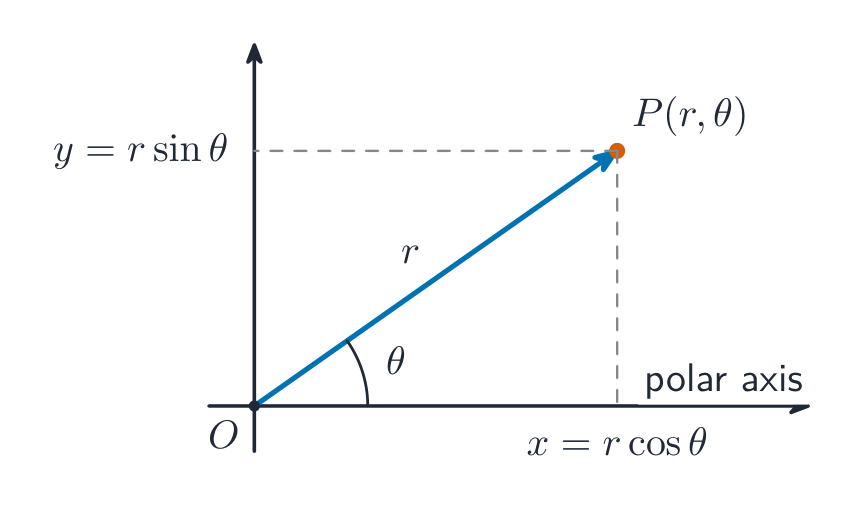
Polar coordinates 极坐标 give a point by its distance $r$ from the origin and its angle $\theta$. They link to Cartesian coordinates 直角坐标 by

$$x = r\cos\theta, \qquad y = r\sin\theta, \qquad r^2 = x^2 + y^2.$$

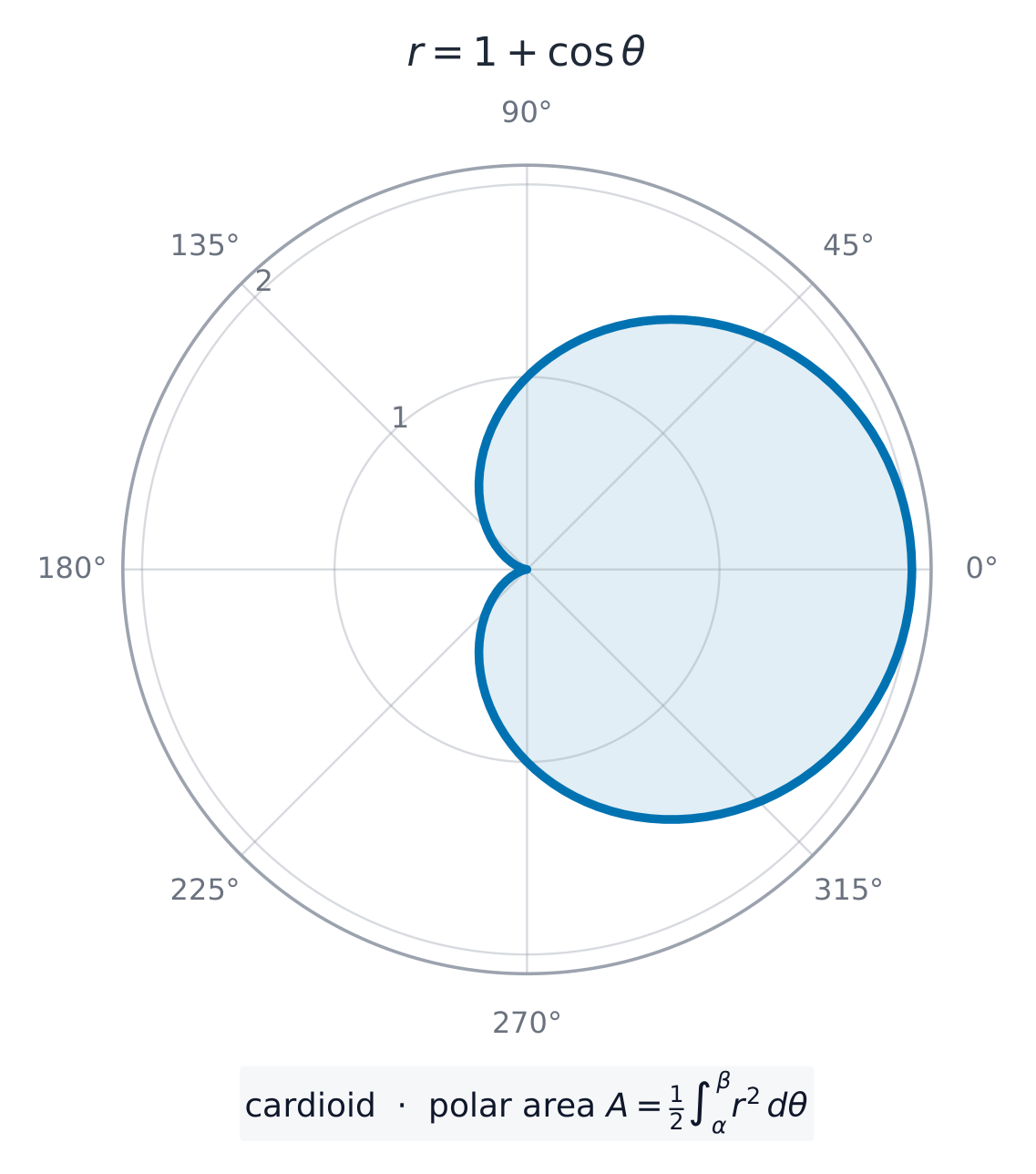
You should sketch simple polar curves 极坐标曲线, and find the area of a sector with

$$\text{area} = \tfrac12\int r^2\,d\theta.$$

Worked example. Convert the polar equation $r = 4\cos\theta$ to Cartesian form.

Multiply both sides by $r$: $r^2 = 4r\cos\theta$, so $x^2 + y^2 = 4x$. Completing the square gives $(x - 2)^2 + y^2 = 4$, a circle of radius $2$ centred at $(2, 0)$.

Español
Trazado de una curva polar: el cardioide
Looking down a grand spiral staircase
Una escalera de caracol: las espirales se describen naturalmente usando coordenadas polares.

Las coordenadas polares 极坐标 dan un punto por su distancia $r$ al origen y su ángulo $\theta$. Se relacionan con las coordenadas cartesianas 直角坐标 mediante

$$x = r\cos\theta, \qquad y = r\sin\theta, \qquad r^2 = x^2 + y^2.$$

Un punto alcanzado por una distancia r en un ángulo theta, con sus componentes x e y
Las coordenadas polares $(r,\theta)$ se convierten en cartesianas mediante $x=r\cos\theta$ y $y=r\sin\theta$.

Debes dibujar a mano curvas polares simples 极坐标曲线, y hallar el área de un sector con

$$\text{area} = \tfrac12\int r^2\,d\theta.$$

Un cardioides en forma de corazón dibujado en una rejilla polar
La cardiode $r=1+\cos\theta$, graficada directamente desde $r$ como función de $\theta$.

Ejemplo resuelto. Convierta la ecuación polar $r = 4\cos\theta$ a forma cartesiana.

Multiplique ambos lados por $r$: $r^2 = 4r\cos\theta$, por lo tanto $x^2 + y^2 = 4x$. Completar el cuadrado da como resultado $(x - 2)^2 + y^2 = 4$, un círculo de radio $2$ centrado en $(2, 0)$.

Explore · ⁨Explorar⁩

Curvas polares

Elige una curva y cambia a. En forma polar, un punto se define por su distancia r y ángulo θ: eso dibuja rosas, cardioides y espirales.

Watch lesson · ⁨Ver lección⁩
1.6

Vectors · ⁨Vectores⁩

Syllabus
English
Candidates should be able to: Notes and examples
use the equation of a plane in any of the forms $ax + by + cz = d$ or $\mathbf{r.n} = p$ or $\mathbf{r} = \mathbf{a} + \lambda\mathbf{b} + \mu\mathbf{c}$ and convert equations of planes from one form to another as necessary in solving problems
recall that the vector product $\mathbf{a} \times \mathbf{b}$ of two vectors can be expressed either as $|\mathbf{a}||\mathbf{b}|\sin\theta\hat{\mathbf{n}}$, where $\hat{\mathbf{n}}$ is a unit vector, or in component form as $(a_2b_3 - a_3b_2)\mathbf{i} + (a_3b_1 - a_1b_3)\mathbf{j} + (a_1b_2 - a_2b_1)\mathbf{k}$
use equations of lines and planes, together with scalar and vector products where appropriate, to solve problems concerning distances, angles and intersections, including: – determining whether a line lies in a plane, is parallel to a plane or intersects a plane, and finding the point of intersection of a line and a plane when it exists – finding the foot of the perpendicular from a point to a plane – finding the angle between a line and a plane, and the angle between two planes – finding an equation for the line of intersection of two planes – calculating the shortest distance between two skew lines – finding an equation for the common perpendicular to two skew lines.
Español
Los candidatos deben ser capaces de: Notas y ejemplos
usar la ecuación de un plano en cualquiera de las formas $ax + by + cz = d$ o $\mathbf{r.n} = p$ o $\mathbf{r} = \mathbf{a} + \lambda\mathbf{b} + \mu\mathbf{c}$ y convertir ecuaciones de planos de una forma a otra según sea necesario para resolver problemas
recordar que el producto vectorial $\mathbf{a} \times \mathbf{b}$ de dos vectores puede expresarse bien como $|\mathbf{a}||\mathbf{b}|\sin\theta\hat{\mathbf{n}}$, donde $\hat{\mathbf{n}}$ es un vector unitario, o en forma de componentes como $(a_2b_3 - a_3b_2)\mathbf{i} + (a_3b_1 - a_1b_3)\mathbf{j} + (a_1b_2 - a_2b_1)\mathbf{k}$
usar ecuaciones de rectas y planos, junto con productos escalares y vectoriales cuando corresponda, para resolver problemas relacionados con distancias, ángulos e intersecciones, incluyendo: – determinar si una recta se encuentra en un plano, es paralela a un plano o intersecta un plano, y encontrar el punto de intersección de una recta y un plano cuando existe – encontrar el pie de la perpendicular desde un punto a un plano – encontrar el ángulo entre una recta y un plano, y el ángulo entre dos planos – encontrar una ecuación para la recta de intersección de dos planos – calcular la distancia más corta entre dos rectas alabeadas – encontrar una ecuación para la perpendicular común a dos rectas alabeadas.

Source: Cambridge International syllabus · ⁨Fuente: Plan de estudios Cambridge International⁩

English

In three dimensions a plane 平面 can be written as $ax + by + cz = d$, or $\mathbf{r}\cdot\mathbf{n} = p$, or $\mathbf{r} = \mathbf{a} + \lambda\mathbf{b} + \mu\mathbf{c}$. Besides the scalar product, there is the vector product 向量积 of two vectors 向量:

$$\mathbf{a}\times\mathbf{b} = |\mathbf{a}|\,|\mathbf{b}|\sin\theta\;\hat{\mathbf{n}},$$
which gives a vector at right angles to both. With scalar and vector products you can find distances, angles, and where lines and planes meet — including the shortest distance between skew lines 异面直线.

Worked example. Find $\mathbf{a}\times\mathbf{b}$ for $\mathbf{a} = \mathbf{i} + \mathbf{j}$ and $\mathbf{b} = \mathbf{j} + \mathbf{k}$.

$$\mathbf{a}\times\mathbf{b} = \begin{vmatrix} \mathbf{i} & \mathbf{j} & \mathbf{k} \\ 1 & 1 & 0 \\ 0 & 1 & 1 \end{vmatrix} = \mathbf{i}(1) - \mathbf{j}(1) + \mathbf{k}(1) = \mathbf{i} - \mathbf{j} + \mathbf{k}.$$

Español
A sailing boat with a full spinnaker sail
Fuerzas como el viento y el agua son vectores — tienen magnitud y dirección.

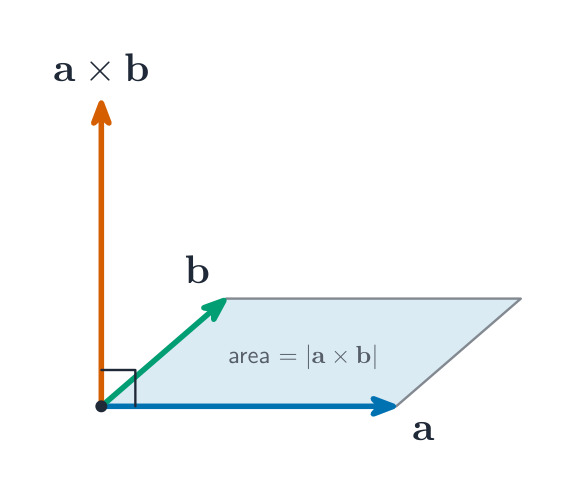
En tres dimensiones un plano 平面 se puede escribir como $ax + by + cz = d$, o $\mathbf{r}\cdot\mathbf{n} = p$, o $\mathbf{r} = \mathbf{a} + \lambda\mathbf{b} + \mu\mathbf{c}$. Además del producto escalar, existe el producto vectorial 向量积 de dos vectores 向量:

$$\mathbf{a}\times\mathbf{b} = |\mathbf{a}|\,|\mathbf{b}|\sin\theta\;\hat{\mathbf{n}},$$
que produce un vector perpendicular a ambos. Con productos escalares y vectoriales se pueden encontrar distancias, ángulos y puntos de intersección entre líneas y planos — incluyendo la distancia más corta entre líneas alabeadas 异面直线.

Dos vectores abarcando un paralelogramo con su producto vectorial apuntando recto hacia arriba
$\mathbf{a}\times\mathbf{b}$ es perpendicular a ambos vectores; su longitud es igual al área del paralelogramo que abarcan.

Ejemplo resuelto. Encuentre $\mathbf{a}\times\mathbf{b}$ para $\mathbf{a} = \mathbf{i} + \mathbf{j}$ y $\mathbf{b} = \mathbf{j} + \mathbf{k}$.

$$\mathbf{a}\times\mathbf{b} = \begin{vmatrix} \mathbf{i} & \mathbf{j} & \mathbf{k} \\ 1 & 1 & 0 \\ 0 & 1 & 1 \end{vmatrix} = \mathbf{i}(1) - \mathbf{j}(1) + \mathbf{k}(1) = \mathbf{i} - \mathbf{j} + \mathbf{k}.$$

Explore · ⁨Explorar⁩

Vectores

a · b = |a||b|cos θ

El producto escalar es cero exactamente cuando dos vectores son perpendiculares.

Vocabulary · ⁨Vocabulario⁩ Train · ⁨Entrenar⁩
English · ⁨Inglés⁩ Chinese · ⁨Chino⁩ Pinyin
vector product/ˈvektə ˈprɒdʌkt/ 向量积 xiàng liàng jī
vectors/ˈvektəz/ 向量 xiàng liàng
skew lines/skjuː laɪnz/ 异面直线 yì miàn zhí xiàn
mathematical induction/ˌmæθɪˈmætɪkl ɪnˈdʌkʃn/ 数学归纳法 shù xué guī nà fǎ
conjecture/kənˈdʒektʃə/ 猜想 cāi xiǎng
inductive proof/ɪnˈdʌktɪv pruːf/ 归纳证明 guī nà zhèng míng
symmetric functions/sɪˈmetrɪk ˈfʌŋkʃnz/ 对称函数 duì chèn hán shù
Watch lesson · ⁨Ver lección⁩
1.7

Proof by induction · ⁨Demostración por inducción⁩

Syllabus
English
Candidates should be able to: Notes and examples
use the method of mathematical induction to establish a given result e.g. $\sum_{r=1}^{n} r^4 = \frac{1}{4}n^2(n+1)^2$, $u_n = \frac{1}{2}(1 + 3^{n-1})$ for the sequence given by $u_{n+1} = 3u_n - 1$ and $u_1 = 1$, $\begin{pmatrix} 4 & -1 \\ 6 & -1 \end{pmatrix}^n = \begin{pmatrix} 3 \times 2^n - 2 & 1 - 2^n \\ 3 \times 2^{n+1} - 6 & 3 - 2^{n+1} \end{pmatrix}$, $3^{2n} + 2 \times 5^n - 3$ is divisible by 8.
recognise situations where conjecture based on a limited trial followed by inductive proof is a useful strategy, and carry this out in simple cases. e.g. find the $n$th derivative of $x e^x$, find $\sum_{r=1}^{n} r \times r!$.
Español
Los candidatos deben ser capaces de: Notas y ejemplos
utilizar el método de inducción matemática para establecer un resultado dado ej. $\sum_{r=1}^{n} r^4 = \frac{1}{4}n^2(n+1)^2$, $u_n = \frac{1}{2}(1 + 3^{n-1})$ para la secuencia dada por $u_{n+1} = 3u_n - 1$ y $u_1 = 1$, $\begin{pmatrix} 4 & -1 \\ 6 & -1 \end{pmatrix}^n = \begin{pmatrix} 3 \times 2^n - 2 & 1 - 2^n \\ 3 \times 2^{n+1} - 6 & 3 - 2^{n+1} \end{pmatrix}$, $3^{2n} + 2 \times 5^n - 3$ es divisible por 8.
reconocer situaciones donde una conjetura basada en una prueba limitada seguida de una demostración inductiva es una estrategia útil, y llevarla a cabo en casos simples. ej. encontrar la derivada $n$-ésima de $x e^x$, encontrar $\sum_{r=1}^{n} r \times r!$.

Source: Cambridge International syllabus · ⁨Fuente: Plan de estudios Cambridge International⁩

English
Induction: the domino proof

Mathematical induction 数学归纳法 proves a result for every positive integer $n$ in two steps:

  1. Base case: show the result is true for $n = 1$.
  2. Inductive step: assume it is true for $n = k$, then prove it for $n = k + 1$.

If both steps work, the result is true for all $n$. Often you first make a conjecture 猜想 (a sensible guess) from a few cases, then confirm it by inductive proof 归纳证明.

Worked example. Prove that $\displaystyle\sum_{r=1}^{n} r = \tfrac12 n(n+1)$.

Base case $n = 1$: the left side is $1$ and the right side is $\tfrac12(1)(2) = 1$. True. Inductive step: assume $\displaystyle\sum_{r=1}^{k} r = \tfrac12 k(k+1)$. Then

$$\sum_{r=1}^{k+1} r = \tfrac12 k(k+1) + (k+1) = (k+1)\left(\tfrac{k}{2} + 1\right) = \tfrac12 (k+1)(k+2).$$
This is the formula with $n = k + 1$, so by induction it holds for all $n$.

Español
Inducción: la demostración de las fichas de dominó

La inducción matemática 数学归纳法 demuestra un resultado para cada entero positivo $n$ en dos pasos:

  1. Caso base: demuestra que el resultado es verdadero para $n = 1$.
  2. Paso inductivo: asume que es verdadero para $n = k$, luego demuestra que lo es para $n = k + 1$.

Si ambos pasos funcionan, el resultado es verdadero para todos los $n$. A menudo primero haces una conjetura 猜想 (una suposición razonable) a partir de unos pocos casos, y luego la confirmas mediante una demostración por inducción 归纳证明.

Una fila de dominós: el primero se está cayendo (el caso base), y las flechas muestran cómo cada uno derriba al siguiente (el paso inductivo), así que todos se caen
La inducción es como dominós: el caso base derriba al primero, y el paso inductivo hace que cada uno derribe al siguiente — así el resultado se mantiene para todo n

Ejemplo resuelto. Demuestra que $\displaystyle\sum_{r=1}^{n} r = \tfrac12 n(n+1)$.

Caso base $n = 1$: el lado izquierdo es $1$ y el lado derecho es $\tfrac12(1)(2) = 1$. Cierto. Paso inductivo: asume $\displaystyle\sum_{r=1}^{k} r = \tfrac12 k(k+1)$. Entonces

$$\sum_{r=1}^{k+1} r = \tfrac12 k(k+1) + (k+1) = (k+1)\left(\tfrac{k}{2} + 1\right) = \tfrac12 (k+1)(k+2).$$
Esta es la fórmula con $n = k + 1$, por lo tanto, por inducción, se cumple para todos los $n$.

Explore · ⁨Explorar⁩

Ruta de demostración por inducción

Ver la inducción como una primera ficha de dominó más una regla que empuja cada caso siguiente.

Watch lesson · ⁨Ver lección⁩
1.7

Exam tips · ⁨Consejos para el examen⁩

English
  • Use the relationships between roots and coefficients (sum, sum of pairs, product) instead of solving the polynomial.
  • For proof by induction, set out the base case, assume the result for $n = k$, prove it for $n = k+1$, and write a clear closing statement.
  • Sketch rational-function graphs with their asymptotes and turning points; use the method of differences for a summation.
  • For matrices, know the determinant, inverse and invariant lines, and interpret each transformation geometrically.
Español
  • Usa las relaciones entre raíces y coeficientes (suma, suma de pares, producto) en lugar de resolver el polinomio.
  • Para la demostración por inducción, presenta el caso base, asume el resultado para $n = k$, demuéstralo para $n = k+1$, y escribe una conclusión clara.
  • Dibuja gráficos de funciones racionales con sus asíntotas y puntos de giro; utiliza el método de diferencias para una sumatoria.
  • Para las matrices, conoce el determinante, la inversa y las líneas invariantes, e interpreta cada transformación geométricamente.

Interactive lessons on this topic · ⁨Lecciones interactivas sobre este tema⁩

Work through it step by step, with instant-check exercises. · ⁨Trátalo paso a paso, con ejercicios de verificación instantánea.⁩

Past Papers · ⁨Exámenes Anteriores⁩

More topics in A-Level Matemáticas Avanzadas · ⁨Más temas en A-Level Matemáticas Avanzadas⁩

Log in or create account · ⁨Iniciar sesión o crear cuenta⁩

IGCSE, A-Level & AP