Mira tres cosas muy diferentes. Un dulce, teñido de naranja brillante. Una tableta analgésica. Y la proteína en tus músculos. Comparten casi nada —excepto uno…
English narration · English + 中文 subtitles burned in · Narración en inglés · Subtítulos en inglés + 中文 quemados en pantalla
34.1
Primary and secondary amines · Aminas primarias y secundarias
Syllabus
English
recall the reactions (reagents and conditions) by which primary and secondary amines are produced: (a) reaction of halogenoalkanes with $\text{NH}_3$ in ethanol heated under pressure (b) reaction of halogenoalkanes with primary amines in ethanol, heated in a sealed tube/under pressure (c) the reduction of amides with $\text{LiAlH}_4$ (d) the reduction of nitriles with $\text{LiAlH}_4$ or $\text{H}_2/\text{Ni}$
describe the condensation reaction of ammonia or an amine with an acyl chloride at room temperature to give an amide
describe and explain the basicity of aqueous solutions of amines
Español
Recordar las reacciones (reactivos y condiciones) mediante las cuales se producen las aminas primarias y secundarias: (a) reacción de halogenoalcanos con $\text{NH}_3$ en etanol, calentado bajo presión (b) reacción de halogenoalcanos con aminas primarias en etanol, calentadas en un tubo sellado/bajo presión (c) la reducción de amidas con $\text{LiAlH}_4$ (d) la reducción de nitrilos con $\text{LiAlH}_4$ o $\text{H}_2/\text{Ni}$
Describir la reacción de condensación del amoniaco o una amina con un cloruro de acilo a temperatura ambiente para dar lugar a una amida
Describir y explicar la basicidad de las soluciones acuosas de aminas
Source: Cambridge International syllabus · Fuente: Plan de estudios Cambridge International
English
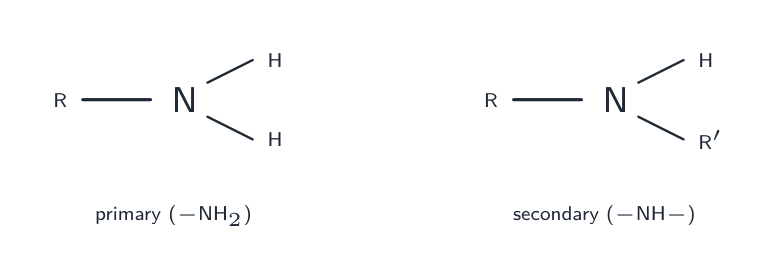
An amine 胺 has an $\text{–NH}_2$ (primary) or $\text{–NH}$ (secondary) group.
Making amines
a halogenoalkane 卤代烷 with $\text{NH}_3$ in ethanol, heated under pressure → a primary amine.
a halogenoalkane with a primary amine, heated under pressure → a secondary amine.
reduction 还原 of an amide 酰胺 with $\text{LiAlH}_4$.
reduction of a nitrile 腈 with $\text{LiAlH}_4$ or $\text{H}_2/\text{Ni}$.
An amine (or ammonia 氨) reacts with an acyl chloride in a condensation 缩合 reaction to give an amide. The reagent is an acyl chloride 酰氯.
Basicity of amines
The basicity 碱性 of an amine comes from the lone pair on its nitrogen, which can accept an $\text{H}^+$ from water.
Español
Una amina 胺 tiene un grupo $\text{–NH}_2$ (primaria) o un grupo $\text{–NH}$ (secundaria).
Una amina primaria tiene -NH2; una amina secundaria tiene -NH-
Síntesis de aminas
Un haloalcano 卤代烷 con $\text{NH}_3$ en etanol, calentado a presión → produce una amina primaria.
Un haloalcano con una amina primaria, calentado a presión → produce una amina secundaria.
Reducción 还原 de una amida 酰胺 con $\text{LiAlH}_4$.
Reducción de un nitrilo 腈 con $\text{LiAlH}_4$ o $\text{H}_2/\text{Ni}$.
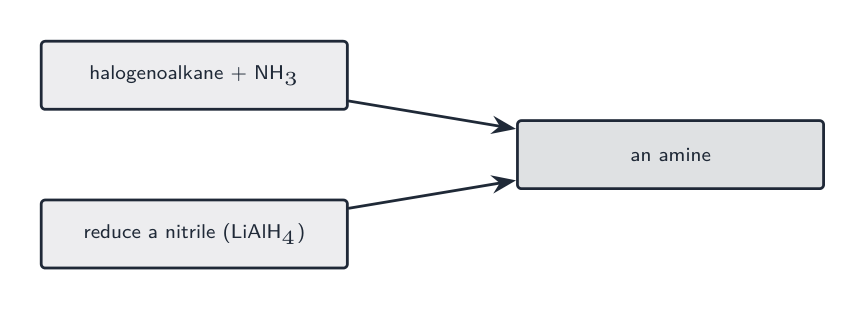
Dos rutas para obtener una amina: desde un haloalcano o reduciendo un nitrilo
Una amina (o amoníaco 氨) reacciona con un cloruro acilo en una reacción de condensación 缩合 para dar una amida. El reactivo es un cloruro acilo 酰氯.
Basicidad de las aminas
La basicidad 碱性 de una amina proviene del par solitario de su nitrógeno, el cual puede aceptar un $\text{H}^+$ del agua.
Explore · Explorar
Laboratorio de tipo de amina
Clasificar aminas según la sustitución en nitrógeno y su comportamiento básico.
34.2
Phenylamine and azo compounds · Fenilamina y compuestos azoicos
Syllabus
English
describe the preparation of phenylamine via the nitration of benzene to form nitrobenzene followed by reduction with hot Sn/concentrated $\text{HCl}$ followed by $\text{NaOH(aq)}$
describe: (a) the reaction of phenylamine with $\text{Br}_2\text{(aq)}$ at room temperature (b) the reaction of phenylamine with $\text{HNO}_2$ or $\text{NaNO}_2$ and dilute acid below $10\text{ }^\circ\text{C}$ to produce the diazonium salt; further warming of the diazonium salt with $\text{H}_2\text{O}$ to give phenol
describe and explain the relative basicities of aqueous ammonia, ethylamine and phenylamine
recall the following about azo compounds: (a) describe the coupling of benzenediazonium chloride with phenol in $\text{NaOH(aq)}$ to form an azo compound (b) identify the azo group (c) state that azo compounds are often used as dyes (d) that other azo dyes can be formed via a similar route
Español
Describir la preparación de fenilamina mediante la nitración del benceno para formar nitrobenceno, seguida de reducción con Sn caliente/ácido $\text{HCl}$ concentrado y posterior tratamiento con $\text{NaOH(aq)}$.
Describir: (a) la reacción de la fenilamina con $\text{Br}_2\text{(aq)}$ a temperatura ambiente; (b) la reacción de la fenilamina con $\text{HNO}_2$ o $\text{NaNO}_2$ y ácido diluido por debajo de $10\text{ }^\circ\text{C}$ para producir una sal de diazonio; calentar posteriormente la sal de diazonio con $\text{H}_2\text{O}$ para obtener fenol.
Describir y explicar las basicidades relativas de la amoníaco acuoso, la etilamina y la fenilamina.
Recordar lo siguiente sobre los compuestos azo: (a) describir el acoplamiento del cloruro de benzenediazonio con fenol en $\text{NaOH(aq)}$ para formar un compuesto azo; (b) identificar el grupo azo; (c) indicar que los compuestos azo se utilizan frecuentemente como colorantes; (d) que otros colorantes azo pueden formarse mediante una ruta similar.
Source: Cambridge International syllabus · Fuente: Plan de estudios Cambridge International
English
Making phenylamine
Make phenylamine 苯胺 from benzene in two steps: nitrate benzene to nitrobenzene, then reduce it with hot $\text{Sn}$ and concentrated $\text{HCl}$, followed by $\text{NaOH(aq)}$.
Reactions
with bromine water at room temperature → 2,4,6-tribromophenylamine (a white precipitate). The ring is activated, like phenol.
with $\text{HNO}_2$ (from $\text{NaNO}_2$ and dilute acid) below $10\,°\text{C}$ → a diazonium salt; warming this with water gives phenol.
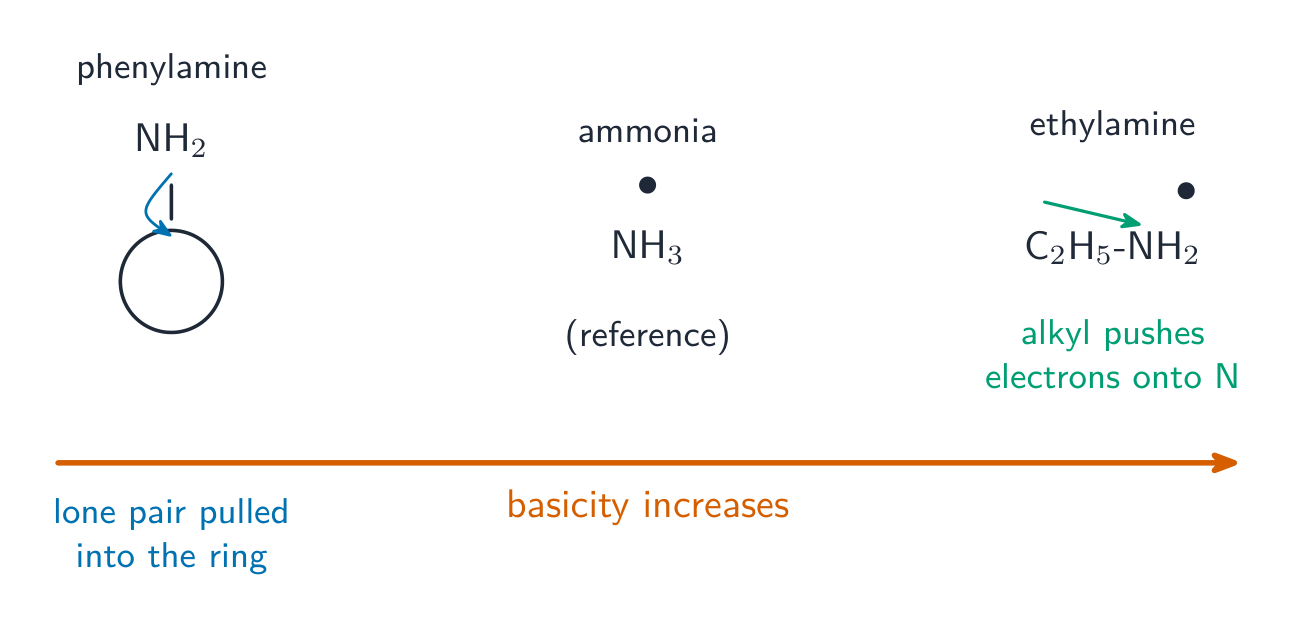
Ethylamine is the strongest base: its alkyl group pushes electron density onto the nitrogen, making the lone pair more available. Phenylamine is the weakest, because its lone pair is delocalised 离域 into the benzene ring, so it is less available to accept an $\text{H}^+$.
Azo compounds
A diazonium salt 重氮盐 (benzenediazonium chloride) couples with phenol 苯酚 in $\text{NaOH(aq)}$ to form an azo compound 偶氮化合物. The azo group is $\text{–N=N–}$. Azo compounds are brightly coloured and are often used as dye 染料s; many other azo dyes are made the same way.
Worked example. An amino acid has an isoelectric point of pH 6.0. Give its charge, and the electrode it moves towards in electrophoresis, at pH 2, at pH 6.0 and at pH 11. Compare the solution's pH with the isoelectric point each time. At pH 2, well below it, the solution is acidic, so the $\text{–NH}_2$ gains an $\text{H}^{+}$: the amino acid is positive and moves to the cathode (negative electrode). At pH 6.0, exactly its isoelectric point, it is the zwitterion with no net charge, so it does not move. At pH 11, well above it, the $\text{–COOH}$ loses its $\text{H}^{+}$: the amino acid is negative and moves to the anode. Compare the pH with the isoelectric point, never with 7 - and note the zwitterion still carries both charges, it simply has no net charge.
Español
Síntesis de fenilamina
Obtenga fenilamina 苯胺 a partir del benceno en dos pasos: nitré el benceno hasta nitrobenceno, luego redúzcalo con caliente $\text{Sn}$ y concentrado $\text{HCl}$, seguido de $\text{NaOH(aq)}$.
Reacciones
Con agua bromada a temperatura ambiente → 2,4,6-tribromofenilamina (un precipitado blanco). El anillo está activado, similar al fenol.
Con $\text{HNO}_2$ (obtenido de $\text{NaNO}_2$ y ácido diluido) por debajo de $10\,°\text{C}$ → produce una sal diazonio; calentar esto con agua da fenol.
La etilamina es la base más fuerte: su grupo alquilo empuja densidad electrónica hacia el nitrógeno, haciendo que el par solitario esté más disponible. La fenilamina es la más débil, porque su par solitario se deslocaliza 离域 hacia el anillo de benceno, por lo que está menos disponible para aceptar un $\text{H}^+$.
La basicidad depende del par solitario del nitrógeno: un grupo alquilo lo hace más disponible (etilamina es la más fuerte), mientras que un anillo de benceno lo aleja (fenilamina es la más débil)
Compuestos azoicos
Una sal diazonio 重氮盐 (cloruro de benzenediazonio) se acopla con fenol 苯酚 en $\text{NaOH(aq)}$ para formar un compuesto azoico 偶氮化合物. El grupo azo es $\text{–N=N–}$. Los compuestos azoicos son intensamente coloreados y a menudo se utilizan como colorantes 染料; muchos otros colorantes azoicos se fabrican de manera similar.
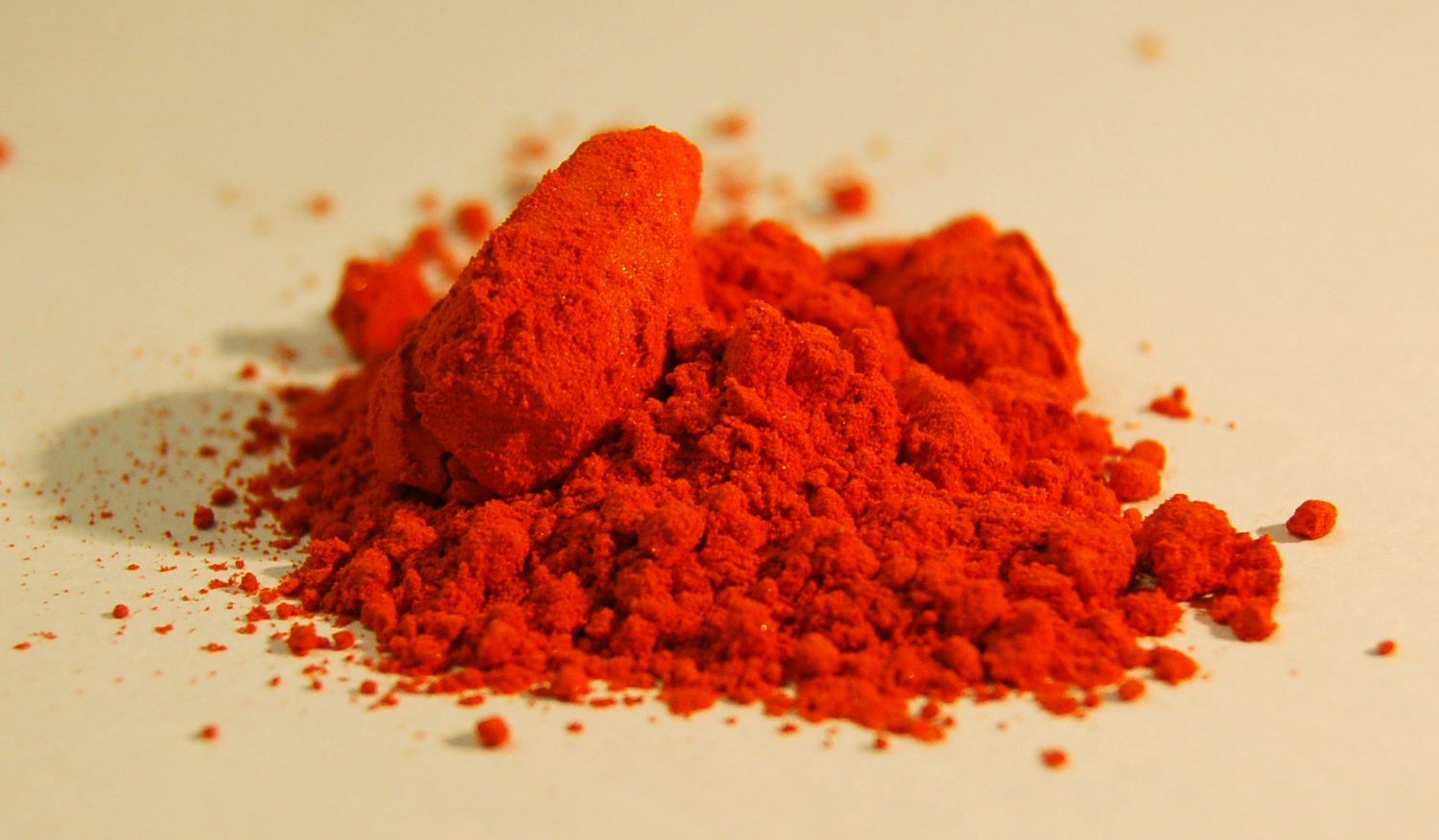
El naranja de metilo, un colorante azoico de color naranja brillante; el intenso color proviene del grupo azoic $\text{–N=N–}$, razón por la cual los compuestos azoicos se usan tan ampliamente como colorantes
Ejemplo resuelto. Un aminoácido tiene un punto isoeléctrico de pH 6.0. Da su carga, y el electrodo hacia el que se mueve en electroforesis, a pH 2, a pH 6.0 y a pH 11. Compara el pH de la solución con el punto isoeléctrico cada vez. A pH 2, muy por debajo de él, la solución es ácida, por lo que el $\text{–NH}_2$ gana un $\text{H}^{+}$: el aminoácido es positivo y se mueve hacia el cátodo (electrodo negativo). A pH 6.0, exactamente su punto isoeléctrico, es el zwitterión sin carga neta, por lo que no se mueve. A pH 11, muy por encima de él, el $\text{–COOH}$ pierde su $\text{H}^{+}$: el aminoácido es negativo y se mueve hacia el ánodo. Compara el pH con el punto isoeléctrico, nunca con 7 - y ten en cuenta que el zwitterión aún lleva ambas cargas, simplemente no tiene una carga neta.
Explore · Explorar
Ruta de fenilamina a colorante azo
Seguir la fenilamina desde la diazotación hasta el compuesto azo coloreado.
recall the reactions (reagents and conditions) by which amides are produced: (a) the reaction between ammonia and an acyl chloride at room temperature (b) the reaction between a primary amine and an acyl chloride at room temperature
describe the reactions of amides: (a) hydrolysis with aqueous alkali or aqueous acid (b) the reduction of the CO group in amides with $\text{LiAlH}_4$ to form an amine
state and explain why amides are much weaker bases than amines
Español
Recuerda las reacciones (reactivos y condiciones) mediante las cuales se producen las amidas: (a) la reacción entre amoníaco y un cloruro de acilo a temperatura ambiente; (b) la reacción entre una amina primaria y un cloruro de acilo a temperatura ambiente
Describe las reacciones de las amidas: (a) hidrólisis con base acuosa o ácido acuoso; (b) la reducción del grupo CO en las amidas con $\text{LiAlH}_4$ para formar una amina
Explica y justifica por qué las amidas son bases mucho más débiles que las aminas
Source: Cambridge International syllabus · Fuente: Plan de estudios Cambridge International
English
An amide is made from ammonia or a primary amine with an acyl chloride at room temperature.
Its reactions:
hydrolysis with aqueous acid or alkali, giving the carboxylic acid (or its salt) and the amine (or ammonium).
reduction of the C=O group with $\text{LiAlH}_4$ to give an amine.
An amide is a much weaker base than an amine, because the nitrogen lone pair is delocalised onto the neighbouring C=O group, so it is not available to accept an $\text{H}^+$.
Español
Una amida se forma a partir de amoníaco o una amina primaria con un cloruro acilo a temperatura ambiente.
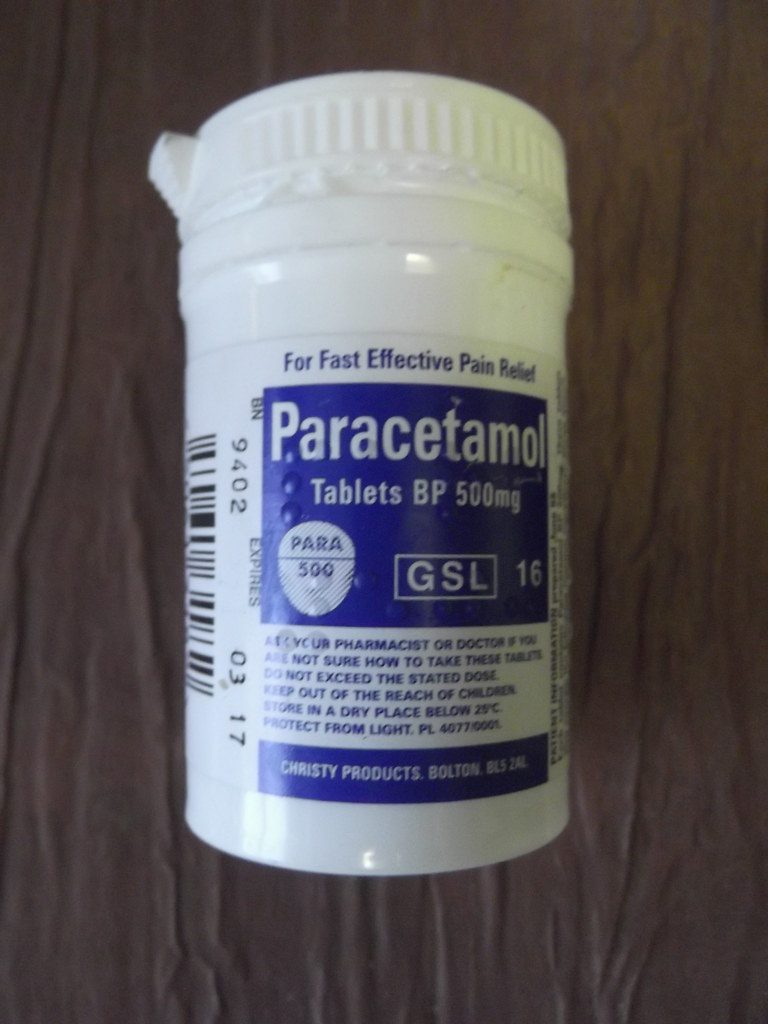
El paracetamol es un analgésico común que contiene el grupo amida (–CONH–)
Sus reacciones:
Hidrólisis con ácido o álcali acuoso, produciendo el ácido carboxílico (o su sal) y la amina (o amonio).
Reducción del grupo C=O con $\text{LiAlH}_4$ para producir una amina.
Una amida es una base mucho más débil que una amina, porque el par solitario del nitrógeno se deslocaliza sobre el grupo C=O vecino, por lo que no está disponible para aceptar un $\text{H}^+$.
Explore · Explorar
Ruta de formación de amida
Seguir un cloruro de acilo o derivado ácido hasta una amida.
34.4
Amino acids · Aminoácidos
Syllabus
English
describe the acid/base properties of amino acids and the formation of zwitterions, to include the isoelectric point
describe the formation of amide (peptide) bonds between amino acids to give di- and tripeptides
interpret and predict the results of electrophoresis on mixtures of amino acids and dipeptides at varying pHs (the assembling of the apparatus will not be tested)
Español
describir las propiedades ácido/base de los aminoácidos y la formación de zwitteriones, incluyendo el punto isoeléctrico
describir la formación de enlaces amida (peptídicos) entre aminoácidos para dar lugar a di- y tri péptidos
interpretar y predecir los resultados de la electroforesis en mezclas de aminoácidos y di péptidos a distintos valores de pH (no se evaluará el montaje del aparato)
Source: Cambridge International syllabus · Fuente: Plan de estudios Cambridge International
English
An amino acid 氨基酸 has both a basic $\text{–NH}_2$ group and an acidic $\text{–COOH}$ group.
Zwitterions and the isoelectric point
The $\text{–COOH}$ can give its $\text{H}^+$ to the $\text{–NH}_2$ in the same molecule, forming a zwitterion 两性离子 ($\text{H}_3\text{N}^+\text{–CHR–COO}^-$) — an ion with both a positive and a negative end but no overall charge.
in acid (low pH), the amino acid gains $\text{H}^+$ and becomes positive.
in alkali (high pH), it loses $\text{H}^+$ and becomes negative.
at one special pH, the isoelectric point 等电点, it is mostly the zwitterion with no net charge.
Peptide bonds
Two amino acids join in a condensation reaction: the $\text{–COOH}$ of one and the $\text{–NH}_2$ of the other react, losing water and forming a peptide bond 肽键 (an amide link). Two amino acids give a dipeptide 二肽, three give a tripeptide.
Electrophoresis
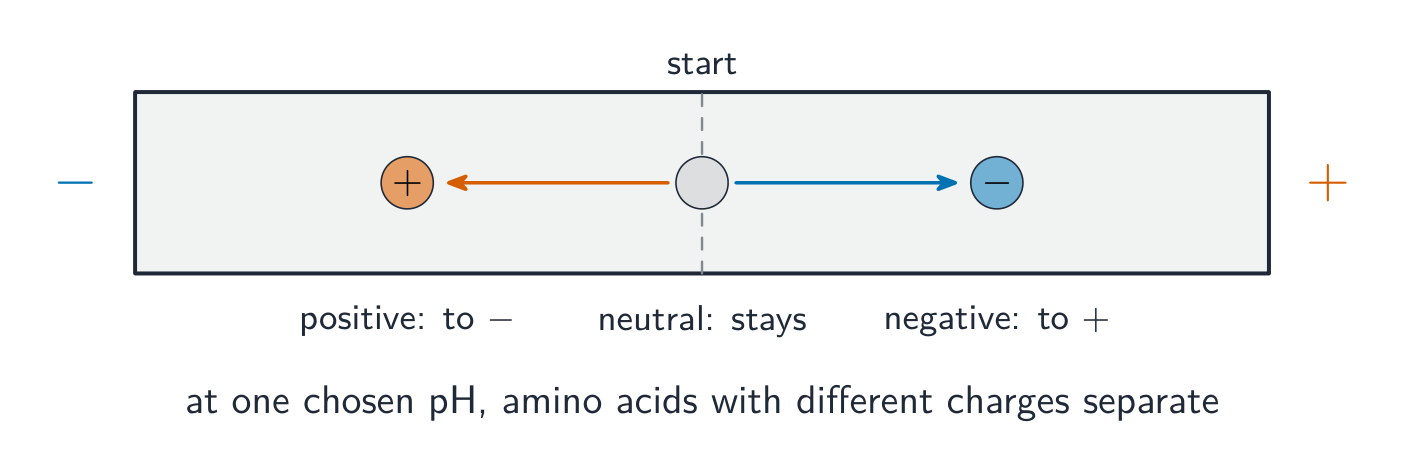
In electrophoresis 电泳, a mixture is placed in an electric field at a chosen pH:
above its isoelectric point, an amino acid is negative and moves to the positive electrode.
below its isoelectric point, it is positive and moves to the negative electrode.
at its isoelectric point, it does not move. So different amino acids separate.
Español
Un aminoácido 氨基酸 posee tanto un grupo básico $\text{–NH}_2$ como un grupo ácido $\text{–COOH}$.
Zwitteriones y punto isoeléctrico
El $\text{–COOH}$ puede ceder su $\text{H}^+$ al $\text{–NH}_2$ en la misma molécula, formando un zwitterión 两性离子 ($\text{H}_3\text{N}^+\text{–CHR–COO}^-$) — un ion con extremos positivo y negativo pero sin carga global.
En medio ácido (pH bajo), el aminoácido gana $\text{H}^+$ y se vuelve positivo.
En medio alcalino (pH alto), pierde $\text{H}^+$ y se vuelve negativo.
En un pH especial, el punto isoeléctrico 等电点, existe mayoritariamente como zwitterión sin carga neta.
Carga de un aminoácido según el pH: positiva en medio ácido, zwitterión neutro en el punto isoeléctrico, negativa en medio alcalino
Puentes peptídicos
Dos aminoácidos se unen mediante una reacción de condensación: el $\text{–COOH}$ de uno y el $\text{–NH}_2$ del otro reaccionan, perdiendo agua y formando un enlace peptídico 肽键 (un enlace amida). Dos aminoácidos dan un dipéptido 二肽; tres dan un tripeptido.
Dos aminoácidos se condensan: el –OH de un –COOH y el –H de otro –NH$_2$ salen como agua, formando el enlace peptídico (amida)
Electrofóresis
En la electrofóresis 电泳, una mezcla se coloca en un campo eléctrico a un pH elegido:
por encima de su punto isoeléctrico, un aminoácido es negativo y se mueve hacia el electrodo positivo.
por debajo de su punto isoeléctrico, es positivo y se mueve hacia el electrodo negativo.
en su punto isoeléctrico, no se mueve. Así, los diferentes aminoácidos se separan.
Electrofóresis a un pH elegido: un aminoácido positivo se mueve hacia el electrodo negativo, uno negativo hacia el positivo, y uno neutro permanece — así se separan
Explore · Explorar
Laboratorio de aminoácidos
Clasificar el comportamiento de los aminoácidos según el grupo que reacciona.
Phenylamine is a weaker base than aliphatic amines because the N lone pair delocalises into the ring.
Diazotisation ($\text{NaNO}_2$/HCl, below $10\ ^\circ\text{C}$) then coupling gives azo dyes — learn the conditions and the coloured product.
Amino acids are zwitterions (both $-\text{NH}_2$ and $-\text{COOH}$), so they are amphoteric; describe behaviour either side of the isoelectric point.
Español
La fenilamina es una base más débil que las aminas alifáticas porque el par libre del N se deslocaliza en el anillo.
La diazotización ($\text{NaNO}_2$/HCl, por debajo de $10\ ^\circ\text{C}$) seguida de acoplamiento da colorantes azoicos — aprende las condiciones y el producto coloreado.
Los aminoácidos son zwitteriones (con ambos $-\text{NH}_2$ y $-\text{COOH}$), por lo que son anfotéricos; describe su comportamiento a ambos lados del punto isoeléctrico.
Interactive lessons on this topic · Lecciones interactivas sobre este tema
Work through it step by step, with instant-check exercises. · Trátalo paso a paso, con ejercicios de verificación instantánea.
Pick one and the site follows you — notes, papers, videos and practice all open on it. · Selecciona uno y el sitio te sigue — notas, documentos, videos y práctica se abren en él.
Type to search notes, lessons, code, vocabulary and past-paper questions across every subject. · Escribe para buscar notas, lecciones, código, vocabulario y preguntas de exámenes anteriores en todas las materias.