Aquí hay un problema. Una cucharadita de agua contiene unas doscientas mil billones de billones de moléculas. Nunca podrías contarlas —ni en toda una vida, ni…
English narration · English + 中文 subtitles burned in · Narración en inglés · Subtítulos en inglés + 中文 quemados en pantalla
2.1
Masas relativas de átomos y moléculas
Syllabus
English
define the unified atomic mass unit as one twelfth of the mass of a carbon-12 atom
define relative atomic mass, $A_r$, relative isotopic mass, relative molecular mass, $M_r$, and relative formula mass in terms of the unified atomic mass unit
Español
Definir la unidad de masa atómica unificada como una doceava parte de la masa de un átomo de carbono-12.
Definir la masa atómica relativa, $A_r$, la masa isotópica relativa, la masa molecular relativa, $M_r$, y la masa de fórmula relativa en términos de la unidad de masa atómica unificada.
Source: Cambridge International syllabus · Fuente: Plan de estudios Cambridge International
English
Atoms 原子 are far too light to weigh in grams, so we compare every mass to one standard. The standard is the unified atomic mass unit 统一原子质量单位 (symbol u), defined as exactly one twelfth of the mass of one carbon-12 atom.
Using this unit, we state masses as simple numbers:
the relative atomic mass 相对原子质量$A_r$ of an element is the average mass of its atoms compared with $\tfrac{1}{12}$ of a carbon-12 atom. It is an average over all the isotopes 同位素, weighted by how common each one is.
the relative isotopic mass 相对同位素质量 is the mass of one atom of a single isotope, compared with $\tfrac{1}{12}$ of a carbon-12 atom.
the relative molecular mass 相对分子质量$M_r$ of a molecule 分子 is the sum of the relative atomic masses of all its atoms.
the relative formula mass 相对式量 is the same idea for a substance that is not made of molecules (such as an ionic compound). Add up the relative atomic masses shown in the formula.
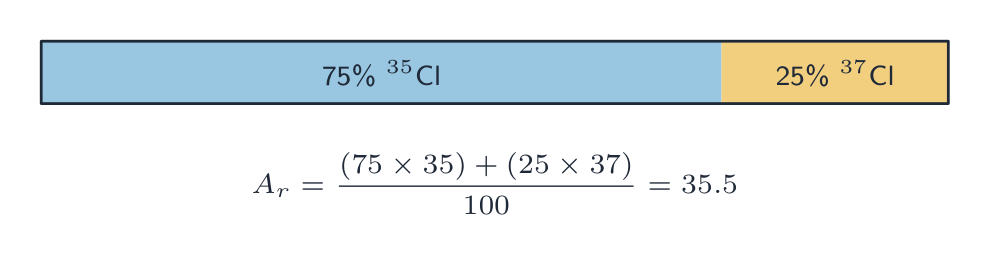
To find $A_r$ from isotope data, multiply each isotope mass by its percentage, add these up, and divide by 100.
Worked example. Chlorine is $75\%$${}^{35}\text{Cl}$ and $25\%$${}^{37}\text{Cl}$. Find its relative atomic mass.
Los átomos 原子 son demasiado ligeros para pesar en gramos, así que comparamos cada masa con una estándar. La estándar es la unidad de masa atómica unificada 统一原子质量单位 (símbolo u), definida como exactamente una doceava parte de la masa de un átomo de carbono-12.
Usando esta unidad, expresamos las masas como números simples:
la masa atómica relativa$A_r$ de un elemento es la masa promedio de sus átomos comparada con $\tfrac{1}{12}$ de un átomo de carbono-12. Es un promedio de todos los isótopos, ponderado por la frecuencia de cada uno.
la masa isotópica relativa es la masa de un átomo de un isótopo individual, comparada con $\tfrac{1}{12}$ de un átomo de carbono-12.
la masa molecular relativa$M_r$ de una molécula es la suma de las masas atómicas relativas de todos sus átomos.
la masa fórmula relativa es el mismo concepto para una sustancia que no está compuesta por moléculas (como un compuesto iónico). Sumar las masas atómicas relativas indicadas en la fórmula.
La masa atómica relativa es un promedio ponderado: los dos isótopos del cloro (75% ³⁵Cl, 25% ³⁷Cl) promedian a Aᵣ = 35.5
Para encontrar $A_r$ a partir de datos de isótopos, multiplique cada masa isotópica por su porcentaje, sume estos valores y divida por 100.
Worked example. Chlorine is $75\%$${}^{35}\text{Cl}$ and $25\%$${}^{37}\text{Cl}$. Find its relative atomic mass.
Ejemplo resuelto. Un espectrómetro de masas muestra que el cobre es $69.2\%$${}^{63}\text{Cu}$ y $30.8\%$${}^{65}\text{Cu}$. Encuentre su masa atómica relativa.
unified atomic mass unit/ˈjuːnɪfaɪd əˈtɒmɪk mæs ˈjuːnɪt/
统一原子质量单位
tǒng yī yuán zi zhì liàng dān wèi
relative atomic mass/ˈrelətɪv əˈtɒmɪk mæs/
相对原子质量
xiāng duì yuán zi zhì liàng
isotope/ˈaɪsətəʊp/
同位素
tóng wèi sù
relative isotopic mass/ˈrelətɪv ˌaɪsəˈtɒpɪk mæs/
相对同位素质量
xiāng duì tóng wèi sù zhì liàng
relative molecular mass/ˈrelətɪv məˈlekjʊlə mæs/
相对分子质量
xiāng duì fèn zǐ zhì liàng
molecule/ˈmɒlɪkjuːl/
分子
fèn zǐ
relative formula mass/ˈrelətɪv ˈfɔːmjʊlə mæs/
相对式量
xiāng duì shì liàng
mole/məʊl/
摩尔
mó ěr
Avogadro constant/ˌævəˈɡædrəʊ ˈkɒnstənt/
阿伏伽德罗常量
ā fú gā dé luó cháng liàng
2.2
El mol y la constante de Avogadro
Syllabus
English
define and use the term mole in terms of the Avogadro constant
Español
definir y utilizar el término mol en términos de la constante de Avogadro
Source: Cambridge International syllabus · Fuente: Plan de estudios Cambridge International
English
Chemists count particles in groups called moles, just as we count eggs in dozens.
One mole 摩尔 (symbol mol) is the amount of substance that contains the same number of particles as there are atoms in exactly 12 g of carbon-12. That number is the Avogadro constant 阿伏伽德罗常量:
$$N_A = 6.02 \times 10^{23}\ \text{mol}^{-1}$$
So one mole of anything contains $6.02 \times 10^{23}$ particles. The particles may be atoms, molecules or ions 离子 — always say which.
The mass of one mole in grams equals the relative mass ($A_r$ or $M_r$). This is the molar mass 摩尔质量, with units $\text{g mol}^{-1}$. The key equation is:
$$n = \frac{m}{M}$$
where $n$ is the amount in moles, $m$ is the mass in grams, and $M$ is the molar mass.
Worked example. How many moles are in $8.0\ \text{g}$ of methane, $\text{CH}_4$? ($A_r$: C $= 12$, H $= 1$.)
The molar mass is $M = 12 + 4(1) = 16\ \text{g mol}^{-1}$, so
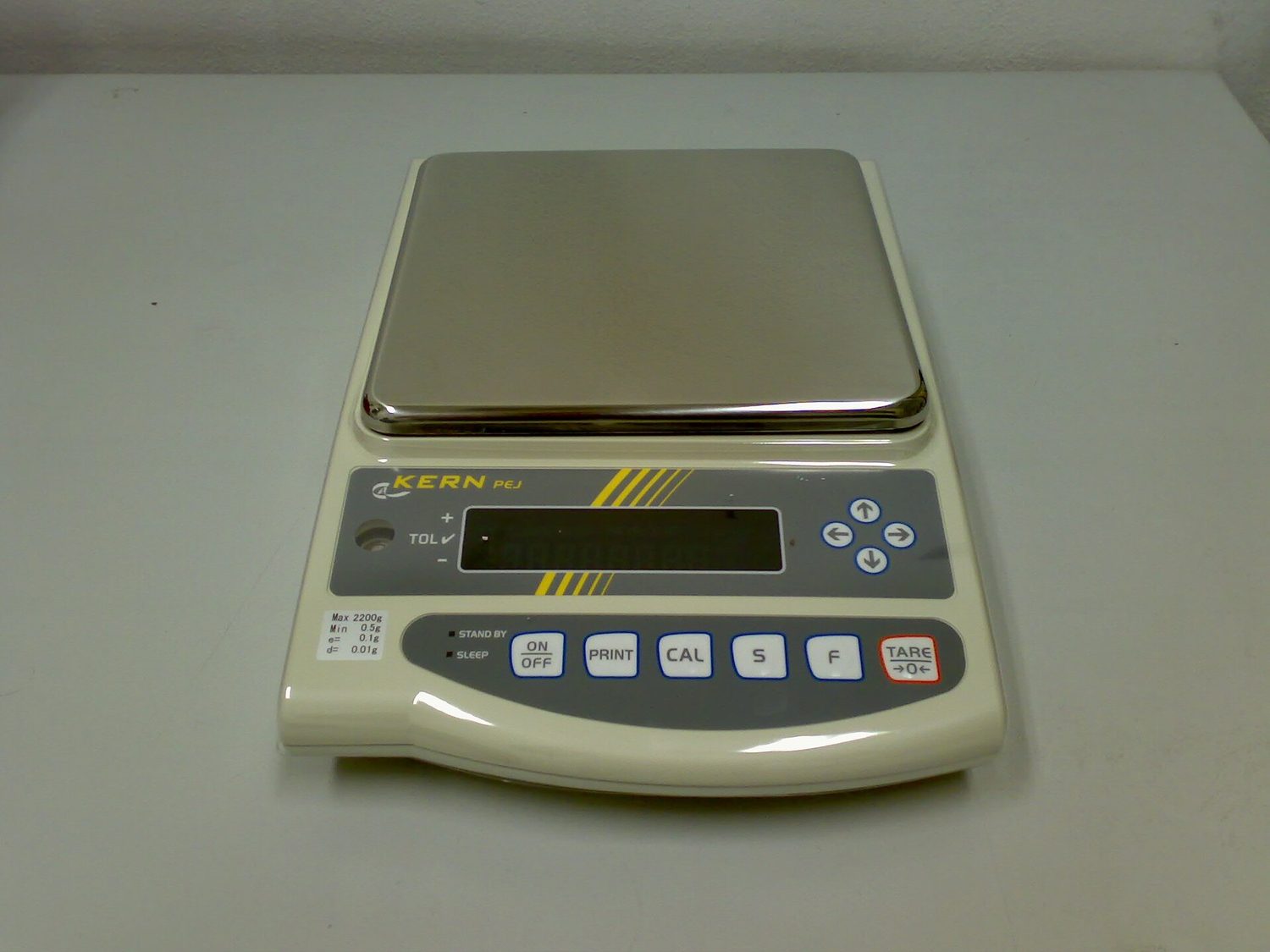
Una balanza electrónica moderna mide la masa — la base de los cálculos de mol.
Los químicos cuentan partículas en grupos llamados moles, igual que contamos huevos en docenas.
Un mol 摩尔 (símbolo mol) es la cantidad de sustancia que contiene el mismo número de partículas que átomos hay en exactamente 12 g de carbono-12. Ese número es la constante de Avogadro 阿伏伽德罗常量:
$$N_A = 6.02 \times 10^{23}\ \text{mol}^{-1}$$
Así que un mol de cualquier cosa contiene $6.02 \times 10^{23}$ partículas. Las partículas pueden ser átomos, moléculas o iones — siempre diga cuáles.
La masa de un mol en gramos es igual a la masa relativa ($A_r$ o $M_r$). Esta es la masa molar 摩尔质量, con unidades $\text{g mol}^{-1}$. La ecuación clave es:
$$n = \frac{m}{M}$$
donde $n$ es la cantidad en moles, $m$ es la masa en gramos, y $M$ es la masa molar.
Worked example. How many moles are in $8.0\ \text{g}$ of methane, $\text{CH}_4$? ($A_r$: C $= 12$, H $= 1$.)
The molar mass is $M = 12 + 4(1) = 16\ \text{g mol}^{-1}$, so
write formulas of ionic compounds from ionic charges and oxidation numbers (shown by a Roman numeral), including: (a) the prediction of ionic charge from the position of an element in the Periodic Table (b) recall of the names and formulas for the following ions: $\text{NO}_3^-$, $\text{CO}_3^{2-}$, $\text{SO}_4^{2-}$, $\text{OH}^-$, $\text{NH}_4^+$, $\text{Zn}^{2+}$, $\text{Ag}^+$, $\text{HCO}_3^-$, $\text{PO}_4^{3-}$
(a) write and construct equations (which should be balanced), including ionic equations (which should not include spectator ions) (b) use appropriate state symbols in equations
define and use the terms empirical and molecular formula
understand and use the terms anhydrous, hydrated and water of crystallisation
calculate empirical and molecular formulas, using given data
Español
escribir fórmulas de compuestos iónicos a partir de las cargas iónicas y los números de oxidación (indicados por un numeral romano), incluyendo: (a) la predicción de la carga iónica a partir de la posición de un elemento en la Tabla Periódica (b) el recuerdo de los nombres y fórmulas de los siguientes iones: $\text{NO}_3^-$, $\text{CO}_3^{2-}$, $\text{SO}_4^{2-}$, $\text{OH}^-$, $\text{NH}_4^+$, $\text{Zn}^{2+}$, $\text{Ag}^+$, $\text{HCO}_3^-$, $\text{PO}_4^{3-}$
(a) escribir y construir ecuaciones (que deben estar balanceadas), incluyendo ecuaciones iónicas (que no deben incluir iones espectadores) (b) usar símbolos de estado apropiados en las ecuaciones
definir y utilizar los términos fórmula empírica y molecular
comprender y utilizar los términos anhidro, hidratado y agua de cristalización
calcular fórmulas empíricas y moleculares, utilizando datos proporcionados
Source: Cambridge International syllabus · Fuente: Plan de estudios Cambridge International
English
A compound 化合物 is a substance made of two or more elements chemically joined.
Charges and formulas of ionic compounds
In an ionic compound 离子化合物 the total positive charge balances the total negative charge, so the compound is neutral overall.
You can predict the charge of many ions from the element's position in the Periodic Table:
Group
1
2
13
15
16
17
Usual ion charge
$+1$
$+2$
$+3$
$-3$
$-2$
$-1$
Hydrogen forms $\text{H}^+$, and the Group 18 noble gases do not normally form ions.
Some ions you must know by name and formula:
Name
Formula
nitrate
$\text{NO}_3^{-}$
carbonate
$\text{CO}_3^{2-}$
sulfate
$\text{SO}_4^{2-}$
hydroxide
$\text{OH}^{-}$
ammonium
$\text{NH}_4^{+}$
zinc
$\text{Zn}^{2+}$
silver
$\text{Ag}^{+}$
hydrogencarbonate
$\text{HCO}_3^{-}$
phosphate
$\text{PO}_4^{3-}$
For a metal that can have more than one charge, a Roman numeral shows the oxidation number 氧化数. For example, iron(II) is $\text{Fe}^{2+}$ and iron(III) is $\text{Fe}^{3+}$. To write a formula, balance the charges: iron(III) oxide is $\text{Fe}_2\text{O}_3$, because two $\text{Fe}^{3+}$ balance three $\text{O}^{2-}$.
Equations and state symbols
A chemical equation must be balanced 配平 — the same number of each kind of atom on both sides. Add state symbols 状态符号 to show the state of each species: (s) solid, (l) liquid, (g) gas, and (aq) aqueous 水溶液 (dissolved in water).
An ionic equation 离子方程式 shows only the ions and molecules that actually change. The ions that do not change are spectator ions 旁观离子, and you leave them out. For example, the reaction that forms silver chloride is:
The empirical formula 实验式 is the simplest whole-number ratio of the atoms of each element in a compound. The molecular formula 分子式 shows the actual number of atoms of each element in one molecule.
For example, ethane has empirical formula $\text{CH}_3$ but molecular formula $\text{C}_2\text{H}_6$.
Hydrated and anhydrous solids
Some solids hold water inside their crystals. This water is the water of crystallisation 结晶水. A solid that contains it is hydrated 水合的; the same solid with the water removed is anhydrous 无水的.
For example, hydrated copper(II) sulfate is $\text{CuSO}_4 \cdot 5\text{H}_2\text{O}$. Heating it drives off the water to leave anhydrous $\text{CuSO}_4$.
Calculating empirical and molecular formulas
To find the empirical formula from masses (or percentages by mass):
divide each element's mass by its $A_r$ to get the moles.
divide all the mole values by the smallest one.
round to the nearest whole numbers — that ratio is the empirical formula.
To get the molecular formula, you also need $M_r$. Find how many times the empirical formula mass fits into $M_r$, then multiply the formula by that number.
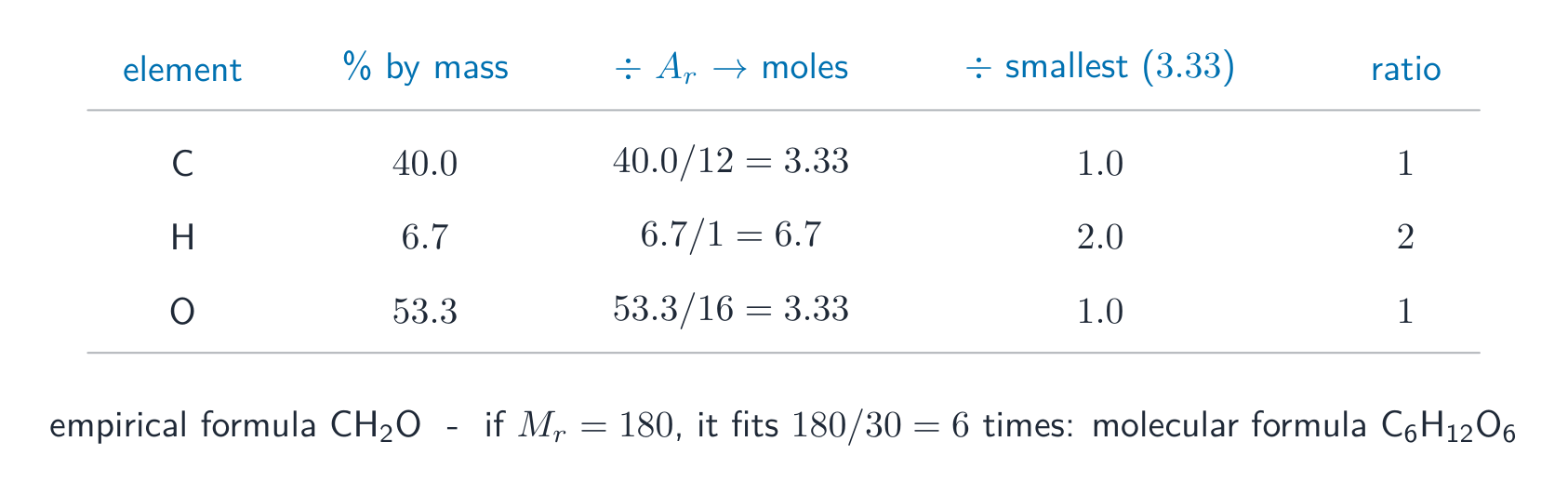
Worked example. A compound is $40.0\%$ carbon, $6.7\%$ hydrogen and $53.3\%$ oxygen by mass. Find its empirical formula. ($A_r$: C $= 12$, H $= 1$, O $= 16$.)
Take $100\ \text{g}$ and divide each mass by its $A_r$ to get moles: C $= 40.0/12 = 3.33$, H $= 6.7/1 = 6.7$, O $= 53.3/16 = 3.33$. Dividing through by the smallest ($3.33$) gives a ratio C : H : O $= 1 : 2 : 1$, so the empirical formula is $\text{CH}_2\text{O}$.
Español
Un compuesto es una sustancia hecha de dos o más elementos químicamente unidos.
Charges and formulas of ionic compounds
En un compuesto iónico 离子化合物 la carga positiva total equilibra la carga negativa total, por lo que el compuesto es neutro en general.
Puedes predecir la carga de muchos iones a partir de la posición del elemento en la Tabla Periódica:
Grupo
1
2
13
15
16
17
Usual ion charge
$+1$
$+2$
$+3$
$-3$
$-2$
$-1$
El hidrógeno forma $\text{H}^+$, y los gases nobles del Grupo 18 normalmente no forman iones.
Algunos iones que debe conocer por nombre y fórmula:
Name
Formula
nitrate
$\text{NO}_3^{-}$
carbonate
$\text{CO}_3^{2-}$
sulfate
$\text{SO}_4^{2-}$
hydroxide
$\text{OH}^{-}$
ammonium
$\text{NH}_4^{+}$
zinc
$\text{Zn}^{2+}$
silver
$\text{Ag}^{+}$
hydrogencarbonate
$\text{HCO}_3^{-}$
phosphate
$\text{PO}_4^{3-}$
Para un metal que puede tener más de una carga, un numeral romano muestra el número de oxidación 氧化数. Por ejemplo, hierro(II) es $\text{Fe}^{2+}$ y hierro(III) es $\text{Fe}^{3+}$. Para escribir una fórmula, equilibrar las cargas: el óxido de hierro(III) es $\text{Fe}_2\text{O}_3$, porque dos $\text{Fe}^{3+}$ equilibran tres $\text{O}^{2-}$.
Equations and state symbols
Una ecuación química debe estar balanceada — el mismo número de cada tipo de átomo en ambos lados. Añada símbolos de estado para mostrar el estado de cada especie: (s) sólido, (l) líquido, (g) gas, y (aq) acuoso (disuelto en agua).
Una ecuación iónica 离子方程式 muestra solo los iones y moléculas que realmente cambian. Los iones que no cambian son iones espectadores 旁观离子, y los omites. Por ejemplo, la reacción que forma cloruro de plata es:
La fórmula empírica 实验式 es la relación simple de números enteros de los átomos de cada elemento en un compuesto. La fórmula molecular 分子式 muestra el número real de átomos de cada elemento en una molécula.
Por ejemplo, el etano tiene fórmula empírica $\text{CH}_3$ pero fórmula molecular $\text{C}_2\text{H}_6$.
Hydrated and anhydrous solids
Algunos sólidos retienen agua dentro de sus cristales. Esta agua es el agua de cristalización 结晶水. Un sólido que la contiene es hidratado 水合的; el mismo sólido sin el agua es anhidro 无水的.
Por ejemplo, el sulfato de cobre(II) hidratado es $\text{CuSO}_4 \cdot 5\text{H}_2\text{O}$. Calentarlo elimina el agua para dejar anhidro $\text{CuSO}_4$.
Calculating empirical and molecular formulas
Para encontrar la fórmula empírica a partir de masas (o porcentajes en masa):
divida la masa de cada elemento por su $A_r$ para obtener los moles.
divida todos los valores de moles por el más pequeño.
redondee a los números enteros más cercanos — esa proporción es la fórmula empírica.
Para obtener la fórmula molecular, también necesitas $M_r$. Encuentra cuántas veces cabe la masa de la fórmula empírica en $M_r$, luego multiplica la fórmula por ese número.
Ejemplo resuelto. Un compuesto es $40.0\%$ carbono, $6.7\%$ hidrógeno y $53.3\%$ oxígeno en masa. Encuentre su fórmula empírica. ($A_r$: C $= 12$, H $= 1$, O $= 16$.)
Toma $100\ \text{g}$ y divide cada masa por su $A_r$ para obtener moles: C $= 40.0/12 = 3.33$, H $= 6.7/1 = 6.7$, O $= 53.3/16 = 3.33$. Dividiendo todo por el más pequeño ($3.33$) da una relación C : H : O $= 1 : 2 : 1$, por lo que la fórmula empírica es $\text{CH}_2\text{O}$.
La receta de la fórmula empírica: divide por Ar, divide por el más pequeño, lee la relación
Explore · Explorar
Ruta de balanceo de ecuaciones
Siga los átomos a través de una ecuación química para que ambos lados coincidan.
perform calculations including use of the mole concept, involving: (a) reacting masses (from formulas and equations) including percentage yield calculations (b) volumes of gases (e.g. in the burning of hydrocarbons) (c) volumes and concentrations of solutions (d) limiting reagent and excess reagent (When performing calculations, candidates’ answers should reflect the number of significant figures given or asked for in the question. When rounding up or down, candidates should ensure that significant figures are neither lost unnecessarily nor used beyond what is justified (see also Mathematical requirements section).) (e) deduce stoichiometric relationships from calculations such as those in 2.4.1(a)–(d)
Español
Realizar cálculos que incluyan el uso del concepto de mol, abarcando: (a) masas de reactivos (a partir de fórmulas y ecuaciones), incluyendo cálculos del rendimiento porcentual; (b) volúmenes de gases (p. ej., en la combustión de hidrocarburos); (c) volúmenes y concentraciones de disoluciones; (d) reactivo limitante y reactivo en exceso. (Al realizar los cálculos, las respuestas de los candidatos deben reflejar el número de cifras significativas indicadas o solicitadas en el enunciado de la pregunta. Al redondear hacia arriba o hacia abajo, los candidatos deben asegurarse de no perder innecesariamente cifras significativas ni utilizar más de las justificadas (véase también la sección Requisitos matemáticos).) (e) Deducir relaciones estequiométricas a partir de cálculos como los descritos en 2.4.1(a)–(d).
Source: Cambridge International syllabus · Fuente: Plan de estudios Cambridge International
English
Reacting masses and percentage yield
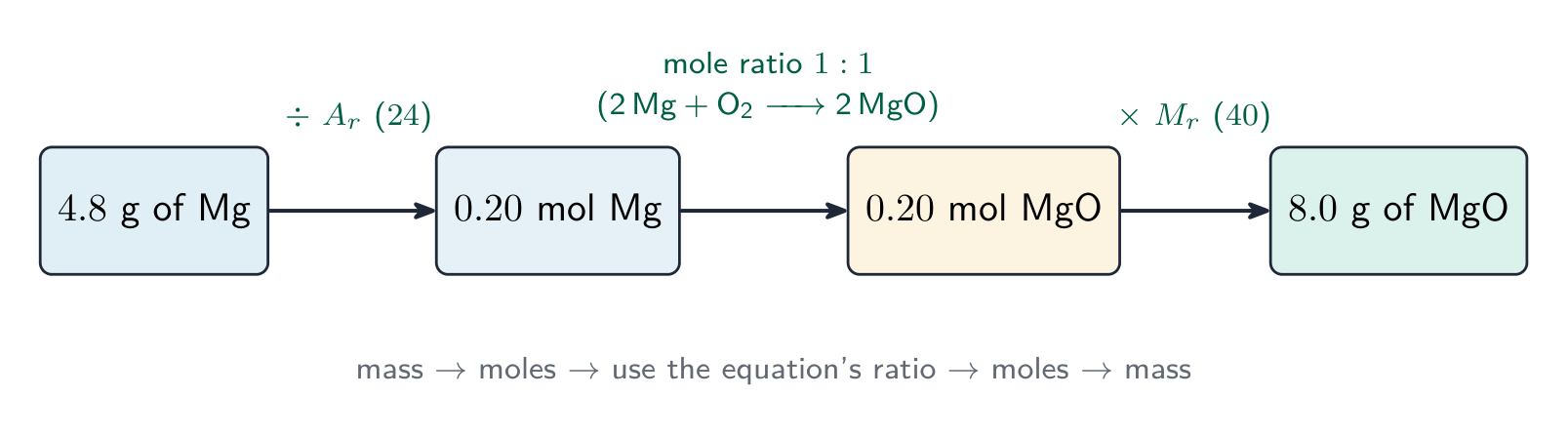
The numbers in front of each species in a balanced equation give the mole ratio — this is the stoichiometry 化学计量. To find a reacting mass: change the known mass to moles, use the mole ratio to find the moles you want, then change back to mass.
Worked example. What mass of magnesium oxide forms when $4.8\ \text{g}$ of magnesium burns completely? $2\text{Mg} + \text{O}_2 \rightarrow 2\text{MgO}$. ($A_r$: Mg $= 24$, O $= 16$.)
Moles of Mg $= 4.8/24 = 0.20\ \text{mol}$. The ratio Mg : MgO is $1 : 1$, so $0.20\ \text{mol}$ of MgO forms. Its molar mass is $24 + 16 = 40\ \text{g mol}^{-1}$, so
$$m = nM = 0.20 \times 40 = 8.0\ \text{g}.$$
In real reactions you usually get less product than the maximum. The percentage yield 产率 compares the amount you actually made with the most you could make:
$$\text{percentage yield} = \frac{\text{actual amount of product}}{\text{maximum possible amount}} \times 100\%$$
Limiting and excess reagent
When two reactants are mixed, one usually runs out first. The limiting reagent 限量试剂 is the one that runs out — it decides how much product forms. The other is the excess reagent 过量试剂, because there is more than enough of it. Always base the calculation on the limiting reagent.
To find it: work out the moles of each reactant, divide each by its number in the equation, and the smallest result is the limiting reagent.
Volumes of gases
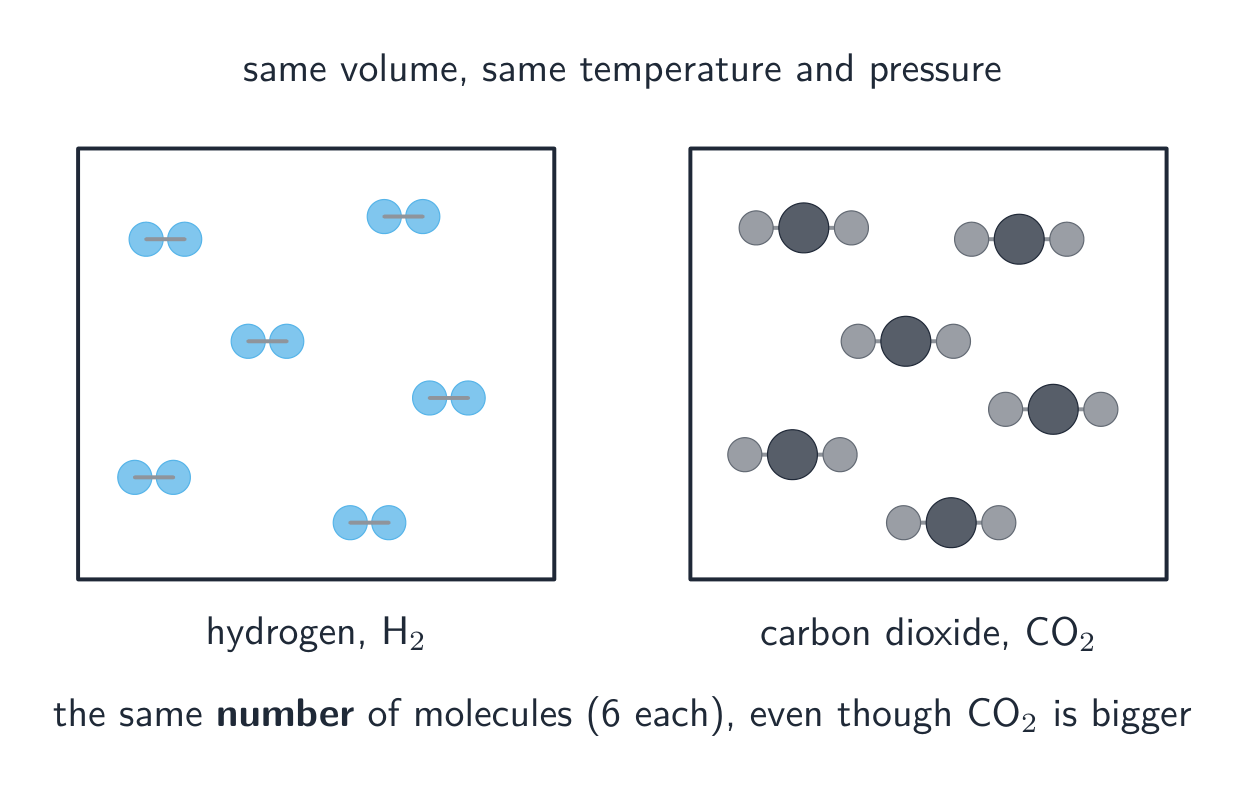
At the same temperature and pressure, equal volumes of any gases contain equal numbers of molecules. At room temperature and pressure (r.t.p.), one mole of any gas takes up $24.0\ \text{dm}^3$, so:
$$n = \frac{V}{24.0}\qquad (V \text{ in } \text{dm}^3 \text{ at r.t.p.})$$
This is used when burning hydrocarbons 碳氢化合物 (compounds of only carbon and hydrogen), where you compare gas volumes.
Volumes and concentrations of solutions
The concentration 浓度 of a solution is the amount of solute 溶质 in each cubic decimetre of solution 溶液, measured in $\text{mol dm}^{-3}$:
$$n = c \times V$$
where $c$ is the concentration and $V$ is the volume in $\text{dm}^3$. Remember that $1000\ \text{cm}^3 = 1\ \text{dm}^3$.
Worked example. In a titration, $25.0\ \text{cm}^3$ of sodium hydroxide solution is exactly neutralised by $20.0\ \text{cm}^3$ of $0.100\ \text{mol dm}^{-3}$ hydrochloric acid: $\text{NaOH} + \text{HCl} \rightarrow \text{NaCl} + \text{H}_2\text{O}$. Find the concentration of the sodium hydroxide.
Moles of HCl $= cV = 0.100 \times \dfrac{20.0}{1000} = 2.00 \times 10^{-3}\ \text{mol}$. The ratio is $1 : 1$, so there are $2.00 \times 10^{-3}\ \text{mol}$ of NaOH in $25.0\ \text{cm}^3$:
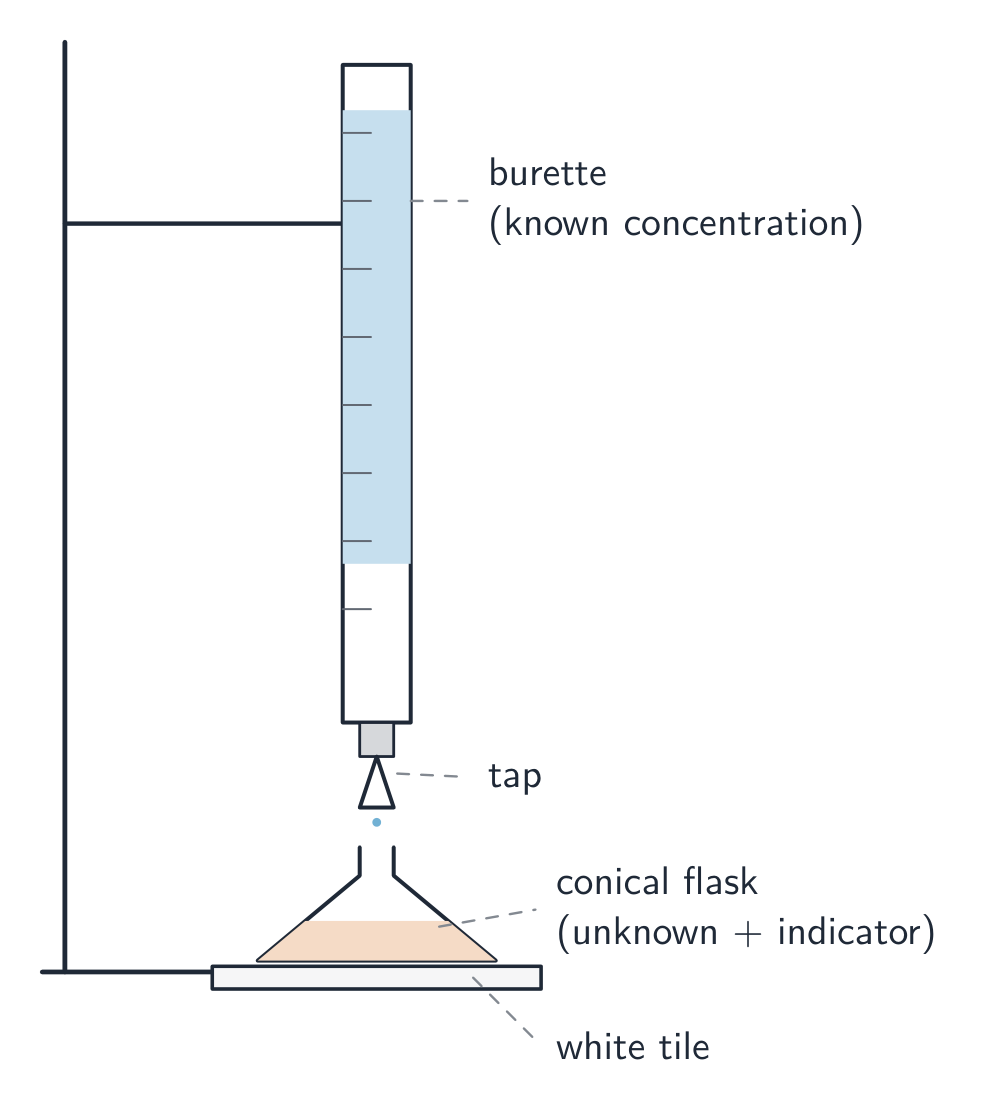
This is the basis of a titration 滴定, where you find an unknown concentration by reacting it with a solution whose concentration you already know.
Significant figures
Give your answer to a sensible number of significant figures 有效数字 — usually match the data in the question. Do not write more digits than the data supports, and do not round so early that you lose accuracy.
Español
A titration finds reacting volumes precisely.
Reacting masses and percentage yield
Los números delante de cada especie en una ecuación balanceada dan la relación molar — esto es la estequiometría 化学计量. Para encontrar una masa reaccionante: cambia la masa conocida a moles, usa la relación molar para encontrar los moles que deseas, luego vuelve a cambiar a masa.
Ejemplo resuelto. ¿Qué masa de óxido de magnesio se forma cuando $4.8\ \text{g}$ de magnesio se quema completamente? $2\text{Mg} + \text{O}_2 \rightarrow 2\text{MgO}$. ($A_r$: Mg $= 24$, O $= 16$.)
Moles de Mg $= 4.8/24 = 0.20\ \text{mol}$. La relación Mg : MgO es $1 : 1$, así que se forman $0.20\ \text{mol}$ de MgO. Su masa molar es $24 + 16 = 40\ \text{g mol}^{-1}$, por lo tanto
$$m = nM = 0.20 \times 40 = 8.0\ \text{g}.$$
El puente del mol: masa a moles, proporción, y luego de vuelta a masa
En reacciones reales usualmente obtienes menos producto que el máximo. El rendimiento porcentual 产率 compara la cantidad que realmente hiciste con la máxima que podrías haber hecho:
$$\text{percentage yield} = \frac{\text{actual amount of product}}{\text{maximum possible amount}} \times 100\%$$
Limiting and excess reagent
Cuando se mezclan dos reactivos, uno usualmente se agota primero. El reactivo limitante 限量试剂 es el que se agota — decide cuánto producto se forma. El otro es el reactivo en exceso 过量试剂, porque hay más de lo necesario. Siempre basa el cálculo en el reactivo limitante.
Para encontrarlo: calcula los moles de cada reactivo, divide cada uno por su número en la ecuación, y el resultado más pequeño es el reactivo limitante.
El reactivo limitante se agota primero y decide cuántos productos se forman; el reactivo sobrante está en exceso
Volumes of gases
A la misma temperatura y presión, volúmenes iguales de cualquier gas contienen números iguales de moléculas. A temperatura y presión ambiente (r.t.p.), un mol de cualquier gas ocupa $24.0\ \text{dm}^3$, por lo tanto:
$$n = \frac{V}{24.0}\qquad (V \text{ in } \text{dm}^3 \text{ at r.t.p.})$$
Volúmenes iguales de gases a la misma temperatura y presión contienen números iguales de moléculas, sea cual sea el gas
Esto se utiliza al quemar hidrocarburos (compuestos de solo carbono e hidrógeno), donde compara volúmenes de gas.
Volumes and concentrations of solutions
La concentración de una solución es la cantidad de soluto en cada decímetro cúbico de solución, medida en $\text{mol dm}^{-3}$:
$$n = c \times V$$
donde $c$ es la concentración y $V$ es el volumen en $\text{dm}^3$. Recuerda que $1000\ \text{cm}^3 = 1\ \text{dm}^3$.
Ejemplo resuelto. En una titulación, $25.0\ \text{cm}^3$ de solución de hidróxido de sodio es exactamente neutralizado por $20.0\ \text{cm}^3$ de ácido clorhídrico $0.100\ \text{mol dm}^{-3}$: $\text{NaOH} + \text{HCl} \rightarrow \text{NaCl} + \text{H}_2\text{O}$. Encuentre la concentración del hidróxido de sodio.
Moles de HCl $= cV = 0.100 \times \dfrac{20.0}{1000} = 2.00 \times 10^{-3}\ \text{mol}$. La relación es $1 : 1$, así que hay $2.00 \times 10^{-3}\ \text{mol}$ de NaOH en $25.0\ \text{cm}^3$:
Esta es la base de una titulación 滴定, donde encuentras una concentración desconocida reaccionándola con una solución cuya concentración ya conoces.
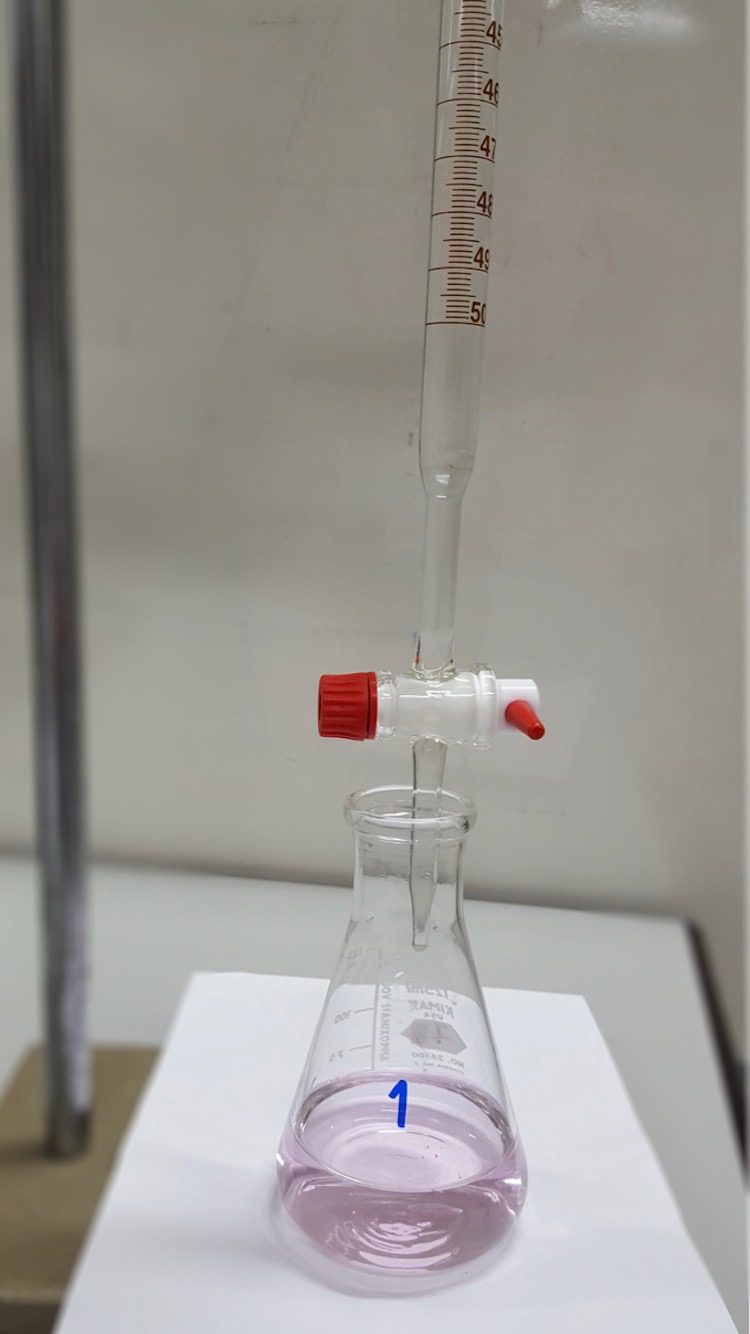
En una titulación una bureta añade una solución de concentración conocida a la desconocida en el matraz cónico, hasta que el indicador cambia
Significant figures
Da tu respuesta a un número sensato de cifras significativas 有效数字 — usualmente coincide con los datos en la pregunta. No escribas más dígitos de los que apoyan los datos, y no redondees tan temprano que pierdas precisión.
Explore · Explorar
Ruta de masa reactiva
Seguir una ecuación balanceada desde una masa conocida hasta la masa del producto predicho.
Explore · Explorar
Laboratorio de volumen de gas
n = V / 24 dm3
Cambiar el volumen del gas y ver cómo escalan los moles a condiciones ambientales.
Convert volumes to $\text{dm}^3$before using concentration ($25.0\ \text{cm}^3 = 0.0250\ \text{dm}^3$); the missing $\div 1000$ is the most common titration error.
Use the balancing numbers as the mole ratio between species — never the $M_r$ values.
Empirical formula: divide each mass/percentage by $A_r$, then by the smallest, then scale to whole numbers; use $M_r$ to reach the molecular formula.
For gases at r.t.p. use $\text{volume} = \text{moles} \times 24\ \text{dm}^3$; quote the equation you use every time.
Give the answer to the same significant figures as the data (usually 3) and always include units.
Español
Convierta volúmenes a $\text{dm}^3$antes de usar la concentración ($25.0\ \text{cm}^3 = 0.0250\ \text{dm}^3$); el faltante $\div 1000$ es el error de titulación más común.
Utilizar los números de balanceo como la relación molar entre especies, nunca los valores $M_r$.
Fórmula empírica: divida cada masa/porcentaje por $A_r$, luego por el más pequeño, luego escale a números enteros; use $M_r$ para llegar a la fórmula molecular.
Para gases a r.t.p. use $\text{volume} = \text{moles} \times 24\ \text{dm}^3$; cite la ecuación que use cada vez.
Dar la respuesta con el mismo número de cifras significativas que los datos (usualmente 3) e incluir siempre las unidades.
Interactive lessons on this topic · Lecciones interactivas sobre este tema
Work through it step by step, with instant-check exercises. · Trátalo paso a paso, con ejercicios de verificación instantánea.
Pick one and the site follows you — notes, papers, videos and practice all open on it. · Selecciona uno y el sitio te sigue — notas, documentos, videos y práctica se abren en él.
Type to search notes, lessons, code, vocabulary and past-paper questions across every subject. · Escribe para buscar notas, lecciones, código, vocabulario y preguntas de exámenes anteriores en todas las materias.