Skip to content · ⁨الانتقال إلى المحتوى⁩

Electric Charges, Fields, and Gauss's Law · ⁨الشحنات الكهربائية والمجالات وقانون غاوس⁩

AP Physics C: Electricity and Magnetism · ⁨AP الفيزياء C: الكهرباء والمغناطيسية⁩ · Topic 8 · ⁨الموضوع 8⁩

Video lesson for this topic · ⁨درس فيديو لهذا الموضوع⁩ Open the video page · ⁨افتح صفحة الفيديو⁩
9:52

الشحنات الكهربائية والمجالات وقانون غاوس

يُصطدم البرق بسيارة. داخلها، لا يشعر الأشخاص بأي شيء على الإطلاق. لماذا؟ الغلاف المعدني المحيط بهم موصل. تتسارع الشحنة فوق سطحه الخارجي…

English narration · English + 中文 subtitles burned in · ⁨سرد باللغة الإنجليزية · ترجمة مدمجة بالإنجليزية + الصينية⁩

8.1

Electric Charge and Electric Force · ⁨الشحنة الكهربائية والقوة الكهربائية⁩

Syllabus · ⁨المنهج⁩
English

Learning Objective 8.1.A: Describe the electric force that results from the interactions between charged objects or systems.

  • 8.1.A.1 Charge is a fundamental property of all matter.
    • 8.1.A.1.i Charge is a scalar quantity and is described as positive or negative.
    • 8.1.A.1.ii The magnitude of the charge of a single electron or proton, the elementary charge $e$, can be considered to be the smallest indivisible amount of charge.
    • 8.1.A.1.iii The charge of an electron is $-e$ and the charge of a proton is $+e$, and a neutron has no electric charge.
    • 8.1.A.1.iv A point charge is a model in which the physical size of a charged object or system is negligible in the context of the situation being analyzed.
  • 8.1.A.2 Coulomb's law describes the electrostatic force between two charged objects as directly proportional to the magnitude of each of the charges and inversely proportional to the square of the distance between the objects.
    • Relevant equation: $\left| \vec{F}_E \right| = \dfrac{1}{4\pi\varepsilon_0} \dfrac{|q_1 q_2|}{r^2} = k \dfrac{|q_1 q_2|}{r^2}$
  • 8.1.A.3 The direction of the electrostatic force depends on the signs of the charges of the interacting objects and is along the line of separation between the objects.
    • 8.1.A.3.i Two objects with charges of the same sign exert repulsive forces on each other.
    • 8.1.A.3.ii Two objects with charges of opposite signs exert attractive forces on each other.
  • 8.1.A.4 Electric forces are responsible for some of the macroscopic properties of objects in everyday experiences. However, the large number of particle interactions that occur make it more convenient to treat everyday forces in terms of nonfundamental forces called contact forces, such as normal force, friction, and tension.

Learning Objective 8.1.B: Describe the electric and gravitational forces that result from interactions between charged objects with mass.

  • 8.1.B.1 Electrostatic forces can be attractive or repulsive, while gravitational forces are always attractive.
  • 8.1.B.2 For any two objects that have mass and electric charge, the magnitude of the gravitational force is usually much smaller than the magnitude of the electrostatic force.
  • 8.1.B.3 Gravitational forces dominate at larger scales even though they are weaker than electrostatic forces, because systems at large scales tend to be electrically neutral.

Learning Objective 8.1.C: Describe the electric permittivity of a material or medium.

  • 8.1.C.1 Electric permittivity is a measurement of the degree to which a material or medium is polarized in the presence of an electric field.
  • 8.1.C.2 Electric polarization can be modeled as the induced rearrangement of electrons by an external electric field, resulting in a separation of positive and negative charges within a material or medium.
  • 8.1.C.3 Free space has a constant value of electric permittivity, $\varepsilon_0$, that appears in physical relationships.
  • 8.1.C.4 The permittivity of matter has a value different from that of free space that arises from the matter's composition and arrangement.
    • 8.1.C.4.i In a given material, electric permittivity is determined by the ease with which electrons can change configurations within the material.
    • 8.1.C.4.ii Conductors are made from electrically conducting materials in which charge carriers move easily; insulators are made from electrically nonconducting materials in which charge carriers cannot move easily.

Boundary statement: AP Physics C: Electricity & Magnetism only expects students to make calculations of the electric force between four or fewer interacting charged objects or systems. The analysis of the resulting electric force from more charges is allowed in situations of high symmetry. Note that students are expected to calculate the electric fields of charge distributions, as described in Topics 8.4 and 8.6.

العربية

هدف التعلم 8.1.A: وصف القوة الكهربائية الناتجة عن التفاعلات بين الأجسام أو الأنظمة المشحونة.

  • 8.1.A.1 الشحنة خاصية أساسية لجميع المواد.
    • 8.1.A.1.i الشحنة كمية قياسية وتُوصف بأنها موجبة أو سالبة.
    • 8.1.A.1.ii مقدار شحنة الإلكترون الواحد أو البروتون، وهو الشحنة الابتدائية $e$، يمكن اعتباره أصغر كمية غير قابلة للتقسيم من الشحنة.
    • 8.1.A.1.iii شحنة الإلكترون هي $-e$ وشحنة البروتون هي $+e$، ولا تمتلك النيوترون أي شحنة كهربائية.
    • 8.1.A.1.iv شحنة النقطة هي نموذج يكون فيه الحجم الفيزيائي للجسم أو النظام المشحون مهملاً في سياق الموقف قيد التحليل.
  • 8.1.A.2 تنص قانون كولوم على أن القوة الكهروستاتية بين جسمين مشحونين تتناسب طردياً مع مقدار كل منهما من الشحنات وعكسياً مع مربع المسافة بينهما.
    • المعادلة ذات الصلة: $\left| \vec{F}_E \right| = \dfrac{1}{4\pi\varepsilon_0} \dfrac{|q_1 q_2|}{r^2} = k \dfrac{|q_1 q_2|}{r^2}$
  • 8.1.A.3 يعتمد اتجاه القوة الكهروستاتية على إشارات شحنات الأجسام المتفاعلة ويكون على طول خط الفصل بينهما.
    • 8.1.A.3.i جسمان لهما شحنات من نفس النوع يمارسان قوى تنافر على بعضهما البعض.
    • 8.1.A.3.ii جسمان لهما شحنات من أنواع مختلفة يمارسان قوى تجاذب على بعضهما البعض.
  • 8.1.A.4 القوى الكهربائية مسؤولة عن بعض الخصائص المجهرية للأجسام في التجارب اليومية. ومع ذلك، فإن العدد الكبير من تفاعلات الجسيمات التي تحدث يجعل من الملائم التعامل مع القوى اليومية بدلالة قوى غير أساسية تُعرف بالقوى التلامسية، مثل القوة العمودية والاحتكاك والتوتر.

هدف التعلم 8.1.B: وصف القوى الكهربائية والجاذبية الناتجة عن التفاعلات بين الأجسام المشحونة ذات الكتلة.

  • 8.1.B.1 القوى الكهروستاتية قد تكون تجاذبية أو تنافرية، بينما القوى الجاذبية دائماً تجاذبية.
  • 8.1.B.2 لأي جسمين لهما كتلة وشحنة كهربائية، يكون مقدار القوة الجاذبية عادة أصغر بكثير من مقدار القوة الكهروستاتية.
  • 8.1.B.3 القوى الجاذبية تهيمن على النطاقات الكبيرة على الرغم من أنها أضعف من القوى الكهروستاتية، لأن الأنظمة على النطاقات الكبيرة تميل إلى أن تكون متعادلة كهربائياً.

هدف التعلم 8.1.C: وصف السماحية الكهربائية لمادة أو وسط.

  • 8.1.C.1 السماحية الكهربائية هي مقياس لدرجة استقطاب مادة أو وسط في وجود مجال كهربائي.
  • 8.1.C.2 يمكن نمذجة الاستقطاب الكهربائي على أنه إعادة ترتيب مستحثة للإلكترونات بواسطة مجال كهربائي خارجي، مما يؤدي إلى فصل الشحنات الموجبة والسالبة داخل المادة أو الوسط.
  • 8.1.C.3 الفراغ له قيمة ثابتة للسماحية الكهربائية، $\varepsilon_0$، تظهر في العلاقات الفيزيائية.
  • 8.1.C.4 سماحية المادة لها قيمة مختلفة عن قيمة الفراغ وتنشأ من تركيب المادة وترتيبها.
    • 8.1.C.4.i في مادة معينة، يتم تحديد السماحية الكهربائية بسهولة قدرة الإلكترونات على تغيير التكوينات داخل المادة.
    • 8.1.C.4.ii الموصلات مصنوعة من مواد موصلة للكهرباء حيث تتحرك حاملات الشحنة بسهولة؛ والعوازل مصنوعة من مواد غير موصلة للكهرباء حيث لا يمكن لحاملات الشحنة التحرك بسهولة.

عبارة الحدود: يتوقع امتحان AP Physics C: الكهرباء والمغناطيسية من الطلاب فقط إجراء حسابات لقوة الكهربائية بين أربعة أجسام أو أنظمة مشحونة متفاعلة أو أقل. يُسمح بتحليل قوة الكهرباء الناتجة عن شحنات أكثر في حالات التماثل العالي. لاحظ أن الطلاب متوقعين حساب مجالات الكهرباء لتوزيعات الشحنات، كما هو موضح في الموضوعين 8.4 و 8.6.
Source: College Board AP Course and Exam Description · ⁨المصدر: وصف دورة وامتحان College Board AP⁩

English

Electric charge 电荷 comes in positive and negative; like charges repel, opposites attract. Charge is quantized 量子化 – every charge is a whole-number multiple of the elementary charge 基本电荷 $e=1.6\times10^{-19}\ \text{C}$ – and obeys conservation of charge 电荷守恒: charge is never created or destroyed, only moved. The force between two point charges 点电荷 is Coulomb's law 库仑定律:

$$\vec{F}=\frac{1}{4\pi\varepsilon_0}\frac{q_1 q_2}{r^2}\,\hat{r},$$

an inverse-square 平方反比 force along the line joining them, with $\dfrac{1}{4\pi\varepsilon_0}=k=9.0\times10^{9}\ \text{N}\cdot\text{m}^2/\text{C}^2$. For several charges (AP uses four or fewer, unless symmetry helps), add the force vectors on the charge you care about – superposition 叠加.

Charge is a fundamental property 基本属性 of matter, and a point charge is a model that ignores the size of a charged object. The constant $\varepsilon_0$ is the permittivity of free space 真空介电常数 – a material property of the vacuum. The permittivity of matter differs from $\varepsilon_0$, set by how easily the material polarizes, which is why a dielectric between charges weakens the force. Note too that although the electric force is far stronger than gravity, gravity dominates at astronomical scales because large bodies are nearly neutral.

Worked example. Two $+2.0\ \mu\text{C}$ charges sit $0.30\ \text{m}$ apart: $F=\dfrac{kq_1q_2}{r^2}=\dfrac{9.0\times10^{9}(2.0\times10^{-6})^2}{(0.30)^2}=0.40\ \text{N}$, repulsive.

Worked example (vectors). Charges $+3.0\ \mu\text{C}$ and $-3.0\ \mu\text{C}$ sit at two corners of a right angle, each $0.30\ \text{m}$ from a $+1.0\ \mu\text{C}$ charge at the corner. Each exerts $F=\dfrac{(9.0\times10^{9})(3.0\times10^{-6})(1.0\times10^{-6})}{0.09}=0.30\ \text{N}$ – one a push, one a pull, at right angles to each other. The net force is $F_{\text{net}}=\sqrt{0.30^2+0.30^2}=0.42\ \text{N}$, pointing between them. Never add magnitudes blindly: components first.

العربية

الشحنة الكهربائية تأتي موجبة وسالبة؛ الشحنات المتشابهة تتنافر والمختلفة تتجاذب. الشحنة كمّية – كل شحنة هي مضاعف عدد صحيح من الشحنة الأولية $e=1.6\times10^{-19}\ \text{C}$ – وتخضع لـ حفظ الشحنة: لا تُخلق ولا تُفنى، بل تُنقل فقط. القوة بين شحنتين نقطيتين تحكمها قانون كولوم:

$$\vec{F}=\frac{1}{4\pi\varepsilon_0}\frac{q_1 q_2}{r^2}\,\hat{r},$$

قوة عكسية مربع المسافة على الخط الواصل بينهما، مع $\dfrac{1}{4\pi\varepsilon_0}=k=9.0\times10^{9}\ \text{N}\cdot\text{m}^2/\text{C}^2$. بالنسبة لعدة شحنات (يستخدم AP أربعة أو أقل، إلا إذا ساعدتنا التماثلات)، نجمع المتجهات المؤثرة على الشحنة المعنية – التراكب.

الشحنة خاصية أساسية للمادة، والشحنة النقطية نموذج يتجاهل حجم الجسم المشحون. الثابت $\varepsilon_0$ هو السماحية المطلقة للفراغ – خاصية مادية للفضاء. تختلف سماحية المادة عن $\varepsilon_0$، حيث تحدد مدى سهولة استقطاب المادة، ولهذا السبب تقلل العازل الكهربائي بين الشحنات من القوة. لاحظ أيضًا أنه على الرغم من أن القوة الكهربائية أقوى بكثير من الجاذبية، فإن الجاذبية تهيمن على المستويات الفلكية لأن الأجسام الكبيرة تكون تقريبًا متعادل كهربائيًا.

مثال محلول. شحنتان $+2.0\ \mu\text{C}$ تقعان على مسافة $0.30\ \text{m}$: $F=\dfrac{kq_1q_2}{r^2}=\dfrac{9.0\times10^{9}(2.0\times10^{-6})^2}{(0.30)^2}=0.40\ \text{N}$، تنافرية.

مثال محلول (متجهات). شحنتان $+3.0\ \mu\text{C}$ و$-3.0\ \mu\text{C}$ تقعدان عند زاويتين لمثلث قائم الزاوية، كلتاهما على مسافة $0.30\ \text{m}$ من شحنة $+1.0\ \mu\text{C}$ عند الرأس. كل منهما يؤثر بقوة $F=\dfrac{(9.0\times10^{9})(3.0\times10^{-6})(1.0\times10^{-6})}{0.09}=0.30\ \text{N}$ – إحداهما تدفع والأخرى تسحب، ومتعامدتان. المحصلة تساوي $F_{\text{net}}=\sqrt{0.30^2+0.30^2}=0.42\ \text{N}$، وت pointing بينهما. لا تجمع المقدارات بشكل أعمى: حلّ المكوّنات أولاً.

Explore · ⁨استكشف⁩

Explore the field of a source charge · ⁨استكشف حقل شحنة المصدر⁩

Change the charge's sign and size. Lines point away from positive and toward negative, and their $1/r^2$ crowding near the charge mirrors why Coulomb's force $F = k\,|q_1 q_2|/r^2$ weakens with distance. · ⁨غيّر إشارة وشحنة. الخطوط تتجه ابتعاداً عن الموجب ونحو السالب، وتكرار $1/r^2$ لها بالقرب من الشحنة يعكس لماذا قوة كولوم $F = k\,|q_1 q_2|/r^2$ تضعف مع المسافة.⁩

8.2

Electric Charge and the Process of Charging · ⁨الشحنة الكهربائية وعملية الشحن⁩

Syllabus · ⁨المنهج⁩
Learning ObjectiveEssential Knowledge

8.2.A
Describe the behavior of a system using conservation of charge.

  • 8.2.A.1 The net charge or charge distribution of a system can change in response to the presence of, or changes in, the net charge or charge distribution of other systems.
    • 8.2.A.1.i The net charge of a system can change due to friction or contact between systems.
    • 8.2.A.1.ii Induced charge separation occurs when the electrostatic force between two systems alters the distribution of charges within the systems, resulting in the polarization of one or both systems.
    • 8.2.A.1.iii Induced charge separation can occur in neutral systems.
  • 8.2.A.2 Any change to a system's net charge is due to a transfer of charge between the system and its surroundings.
    • 8.2.A.2.i The charging of a system typically involves the transfer of electrons to and from the system.
    • 8.2.A.2.ii The net charge of a system will be constant unless there is a transfer of charge to or from the system.
  • 8.2.A.3 Grounding involves electrically connecting a charged object to a much larger and approximately neutral system (e.g., Earth).

Source: College Board AP Course and Exam Description · ⁨المصدر: وصف دورة وامتحان College Board AP⁩

English

A conductor 导体 lets charge move freely; an insulator 绝缘体 holds it in place. Objects gain net charge three ways:

  • Charging by friction 摩擦起电: rubbing transfers electrons from one surface to the other.
  • Charging by conduction 传导起电: touching a charged object shares charge of the same sign.
  • Charging by induction 感应起电: a nearby charge pushes the conductor's charge apart; ground 接地 the far side, remove the ground wire first, and the conductor is left with the opposite sign – all without contact.

An insulator cannot pass charge, but it can develop polarization 极化: its molecules stretch or turn so one face is slightly positive and the other slightly negative. That is why a charged comb picks up neutral paper scraps. An electroscope 验电器 shows net charge by its leaves repelling; on any isolated conductor the excess charge sits entirely on the outer surface.

العربية

الموصل يسمح للشحنة بالحركة بحرية؛ العازل يحافظ عليها في مكانها. تكتسب الأجسام شحنة صافية بثلاث طرق:

  • الشحن بالاحتكاك: يفرك ناقل الإلكترونات من سطح إلى آخر.
  • الشحن بالتوصيل: لمس جسم مشحون يشارك شحنة من نفس الإشارة.
  • الشحن بالاستحاثه: شحنة قريبة تدفع شحنات الموصل لتتباعد؛ أرضِ الجانب البعيد، وأزل سلك الأرضية أولاً، وسيبقى الموصل بشحنة من إشارة معاكسة – كل ذلك دون تلامس.

لا يمكن للعازل نقل الشحنة، لكنه قد يُظهر استقطاباً: تمتد جزيئاته أو تدور بحيث تصبح وجهته一侧 موجبة قليلاً والأخرى سالبة قليلاً. وهذا هو سبب أن المشط المشحون يرفع رقائق الورق المحايدة. يُظهر الكشاف الكهربائي الشحنة الصافية بتنافر ورقتيه؛ في أي موصل معزول، تستقر الشحنة الزائدة بالكامل على السطح الخارجي.

Explore · ⁨استكشف⁩

Explore charging by rubbing · ⁨استكشف الشحن بالاحتكاك⁩

Rubbing transfers electrons onto the object, leaving it negative. A charged object then attracts a neutral wall or hair (by polarization) but repels another like-charged object — the same electron transfer behind friction, conduction, and induction. · ⁨ينقل الاحتكاك الإلكترونات إلى الجسم، مما يجعله سالباً. afterward attracts a neutral wall or hair (by polarization) but repels another like-charged object — the same electron transfer behind friction, conduction, and induction.⁩

8.3

Electric Fields · ⁨المجالات الكهربائية⁩

Syllabus · ⁨المنهج⁩
English

Learning Objective 8.3.A: Describe the electric field produced by a charged object or configuration of point charges.

  • 8.3.A.1 Electric fields may originate from charged objects.
  • 8.3.A.2 The electric field at a given point is the ratio of the electric force exerted on a test charge at the point to the charge of the test charge.
    • Relevant equation: $\vec{E} = \dfrac{\vec{F}_E}{q}$
    • 8.3.A.2.i A test charge is a point charge of small enough magnitude such that its presence does not significantly affect an electric field in its vicinity.
    • 8.3.A.2.ii An electric field points away from isolated positive charges and toward isolated negative charges.
    • 8.3.A.2.iii The electric force exerted on a positive test charge by an electric field is in the same direction as the electric field.
  • 8.3.A.3 The electric field is a vector quantity and can be represented in space using vector field maps.
    • 8.3.A.3.i The net electric field at a given location is the vector sum of individual electric fields created by nearby charged objects.
    • 8.3.A.3.ii Electric field maps use vectors to depict the magnitude and direction of the electric field at many locations within a given region.
    • 8.3.A.3.iii Electric field line diagrams are simplified models of electric field maps and can be used to determine the relative magnitude and direction of the electric field at any position in the diagram.

Learning Objective 8.3.B: Describe the electric field generated by charged conductors or insulators.

  • 8.3.B.1 While in electrostatic equilibrium, the excess charge of a conductor is distributed on the surface of the conductor, and the electric field within the conductor is zero.
    • 8.3.B.1.i At the surface of a charged conductor, the electric field is perpendicular to the surface.
    • 8.3.B.1.ii The electric field outside an isolated sphere with spherically symmetric charge distribution is the same as the electric field due to a point charge with the same net charge as the sphere located at the center of the sphere.
  • 8.3.B.2 While in electrostatic equilibrium, the excess charge of an insulator is distributed throughout the interior of the insulator as well as at the surface, and the electric field within the insulator may have a nonzero value.
العربية

الهدف التعليمي 8.3.A: وصف المجال الكهربائي الناتج عن جسم مشحون أو تكوين لشحنات نقطية.

  • 8.3.A.1 قد تنشأ المجالات الكهربائية من أجسام مشحونة.
  • 8.3.A.2 المجال الكهربائي عند نقطة معينة هو نسبة القوة الكهربائية المؤثرة على شحنة اختبار عند تلك النقطة إلى شحنة شحنة الاختبار.
    • المعادلة ذات الصلة: $\vec{E} = \dfrac{\vec{F}_E}{q}$
    • 8.3.A.2.i شحنة الاختبار هي شحنة نقطية ذات مقدار صغير بما يكفي بحيث لا يؤثر وجودها بشكل كبير على مجال كهربائي في محيطها.
    • 8.3.A.2.ii يتجه المجال الكهربائي بعيداً عن الشحنات الموجبة المعزولة نحو الشحنات السالبة المعزولة.
    • 8.3.A.2.iii القوة الكهربائية المؤثرة على شحنة اختبار موجبة بواسطة مجال كهربائي تكون في نفس اتجاه المجال الكهربائي.
  • 8.3.A.3 المجال الكهربائي كمية متجهة ويمكن تمثيله في الفضاء باستخدام خرائط الحقول المتجهة.
    • 8.3.A.3.i المجال الكهربائي الصافي عند موقع معين هو المجموع المتجهي للحقول الكهربائية الفردية التي تنشأ عن أجسام مشحونة قريبة.
    • 8.3.A.3.ii تستخدم خرائط الحقول الكهربائية متجهات لتمثيل مقدار واتجاه المجال الكهربائي في مواقع عديدة داخل منطقة محددة.
    • 8.3.A.3.iii مخططات خطوط المجال الكهربائي هي نماذج مبسطة لخرائط الحقول الكهربائية ويمكن استخدامها لتحديد المقدار النسبي واتجاه المجال الكهربائي عند أي موضع في المخطط.

الهدف التعليمي 8.3.B: وصف المجال الكهربائي الذي تولده الموصلات المشحونة أو العوازل.

  • 8.3.B.1 أثناء التوازن الكهروستاتيكي، تتوزع الشحنة الزائدة للموصل على سطحه، ويكون المجال الكهربائي داخله مساويًا للصفر.
    • 8.3.B.1.i عند سطح موصل مشحون، يكون المجال الكهربائي عمودياً على السطح.
    • 8.3.B.1.ii المجال الكهربائي خارج كرة معزولة ذات توزيع شحنة كروي التماثل هو نفسه المجال الكهربائي الناتج عن شحنة نقطية تحمل نفس الشحنة الصافية للكرة وتقع في مركزها.
  • 8.3.B.2 أثناء التوازن الكهروستاتيكي، تتوزع الشحنة الزائدة للعازل عبر الداخل وكذلك على السطح، وقد يأخذ المجال الكهربائي داخل العازل قيمة غير صفرية.

Source: College Board AP Course and Exam Description · ⁨المصدر: وصف دورة وامتحان College Board AP⁩

English
The electric field of a dipole

The electric field 电场 at a point is the force per unit charge that a small positive test charge 检验电荷 would feel there:

$$\vec{E}=\frac{\vec{F}}{q},\qquad \vec{E}=\frac{1}{4\pi\varepsilon_0}\frac{q}{r^2}\,\hat{r}\ \text{(point charge)}.$$

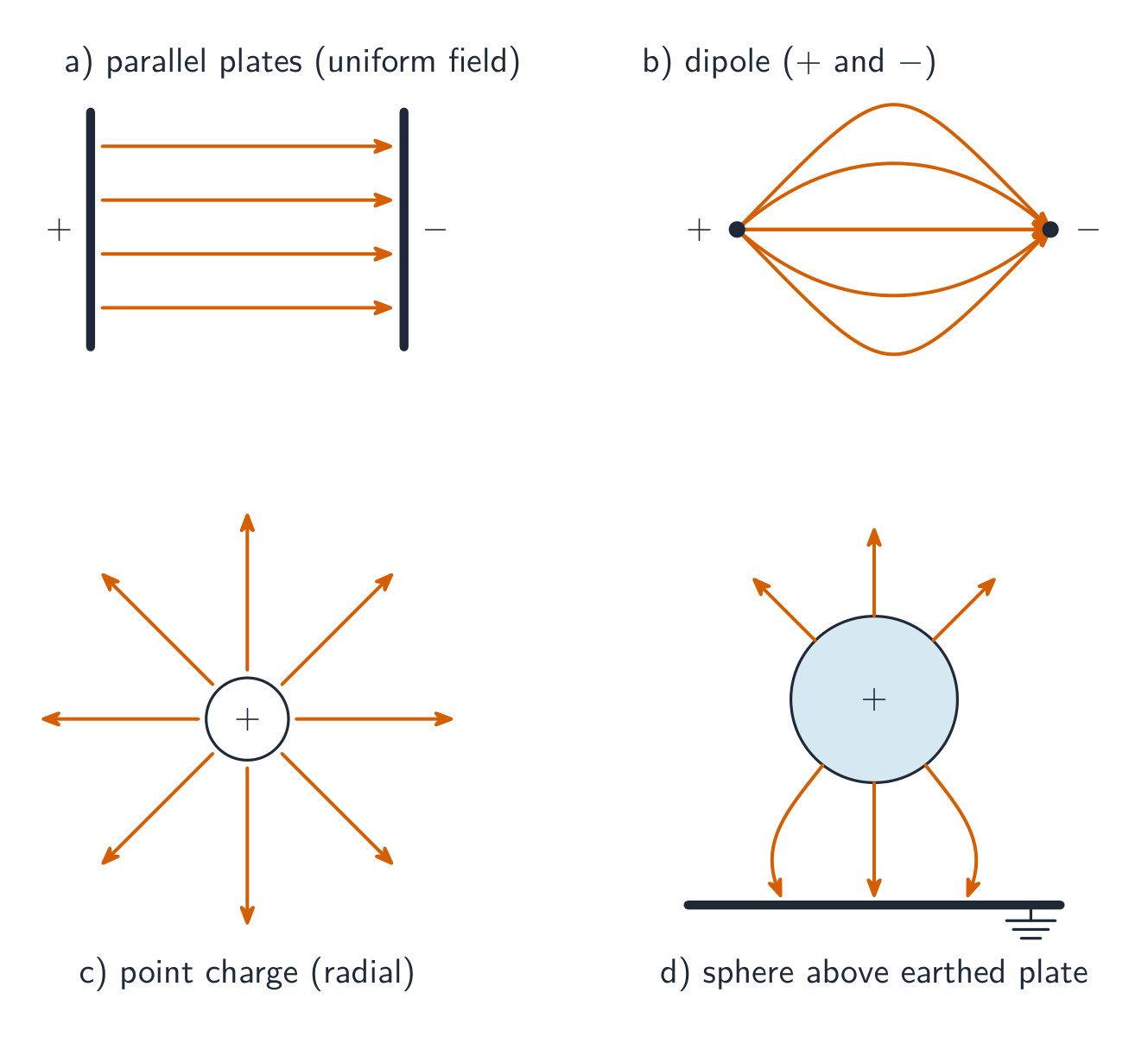
A charge placed in a field feels $\vec{F}=q\vec{E}$ – positive charges along the field, negative charges against it. Fields from several sources add as vectors (superposition again). Field lines 电场线 make the field visible: they point away from positive charge and toward negative, their density shows the strength, and they never cross.

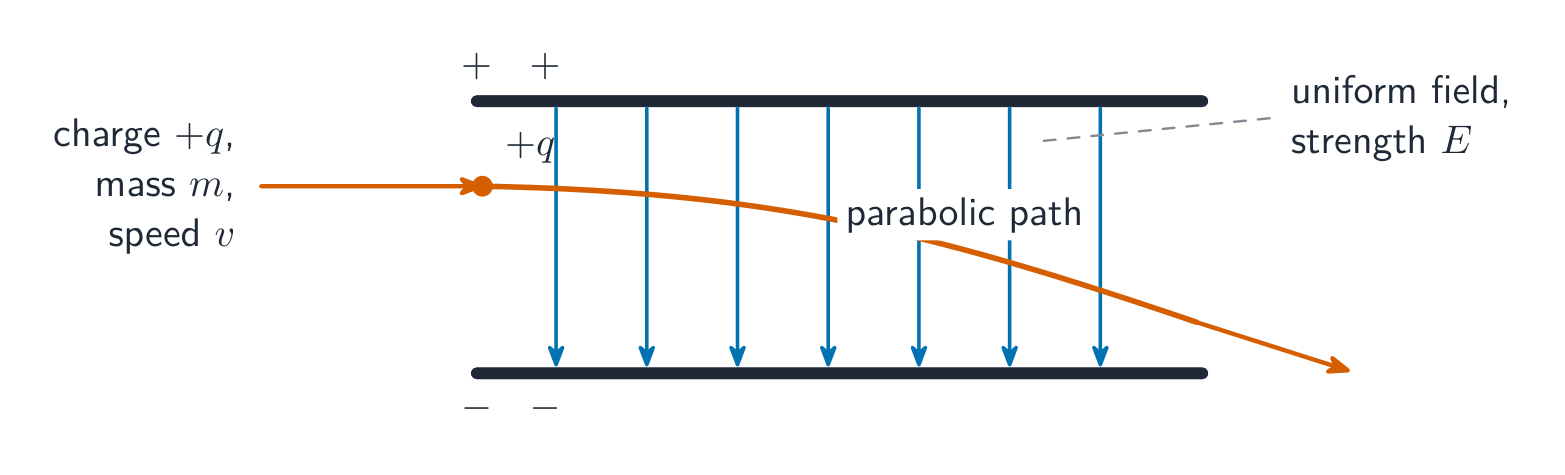
In a uniform 均匀 field a charge feels a constant force, so it accelerates uniformly – launched sideways, it follows a parabola, just like a projectile in gravity.

العربية
الحقل الكهربائي لثنائي قطب
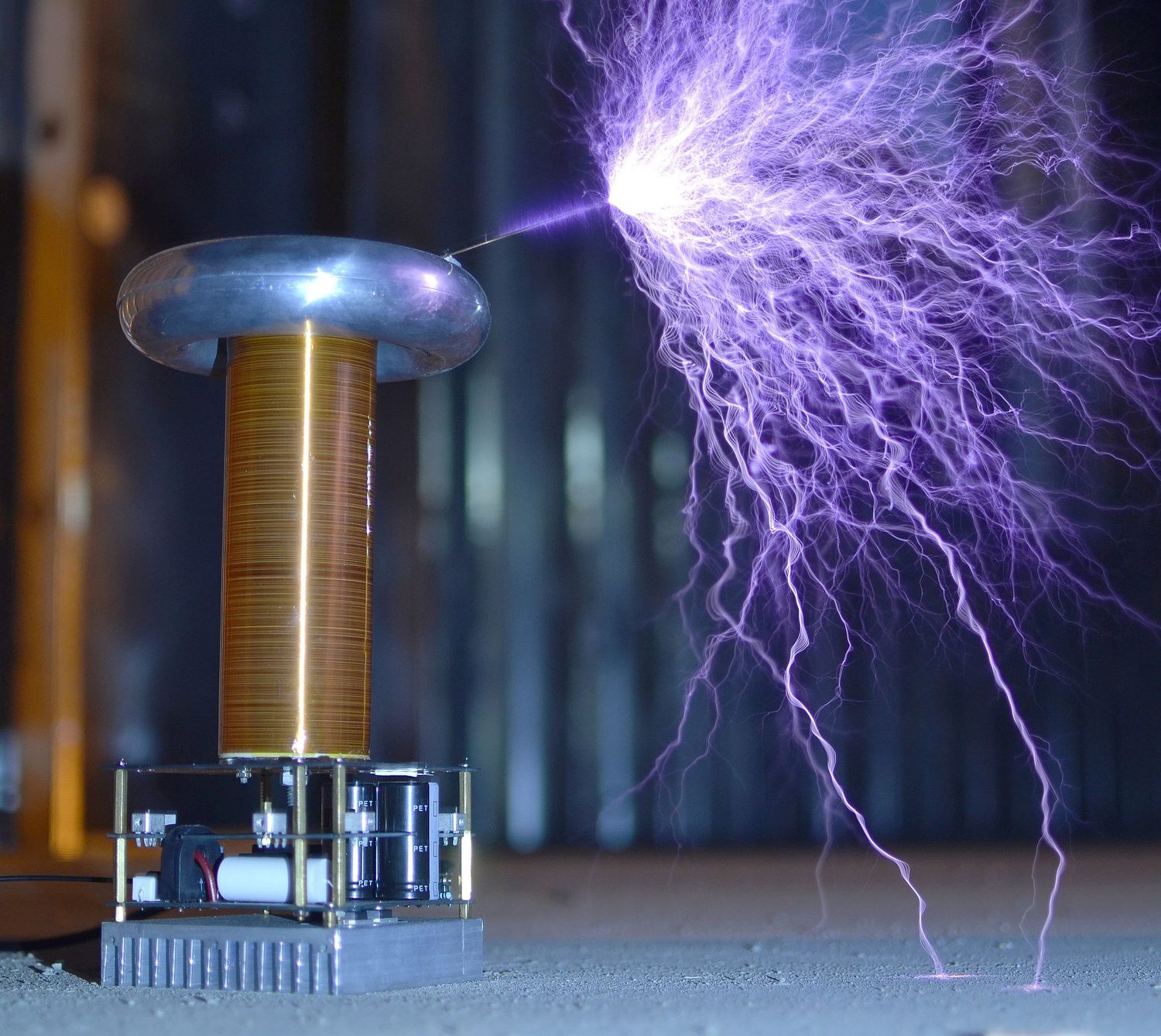
ملف تيسلا تعلوه حلقة معدنية، يقذف شرارات بنفسجية طويلة في الهواء
ملف تيسلا يقذف الشرارات: يرفع الجهد إلى حد كبير جداً بحيث يقوم المجال الكهربائي بتمزيق هواء المحيط، وتتجاوز الشحنة كانهيار مرئي

المجال الكهربائي عند نقطة ما هو القوة لكل وحدة شحنة التي ستشعر بها شحنة اختبار موجبة صغيرة هناك:

$$\vec{E}=\frac{\vec{F}}{q},\qquad \vec{E}=\frac{1}{4\pi\varepsilon_0}\frac{q}{r^2}\,\hat{r}\ \text{(point charge)}.$$

تُوضع شحنة في مجال فتشعر بـ$\vec{F}=q\vec{E}$ – الشحنات الموجبة على طول المجال، والشحنات السالبة ضده. تُضاف المجالات من مصادر متعددة كمتجهات (التراكب مرة أخرى). خطوط المجال تجعل المجال مرئياً: تشير بعيداً عن الشحنة الموجبة نحو السالبة، وكثافتها تبين القوة، ولا تتقاطع أبداً.

أنماط خطوط المجال الكهربائي للألواح المتوازية، والثنائي القطب، وشحنة نقطية *أنماط خطوط المجال الكهربائي للألواح المتوازية، والثنائي، والشحنة النقطية
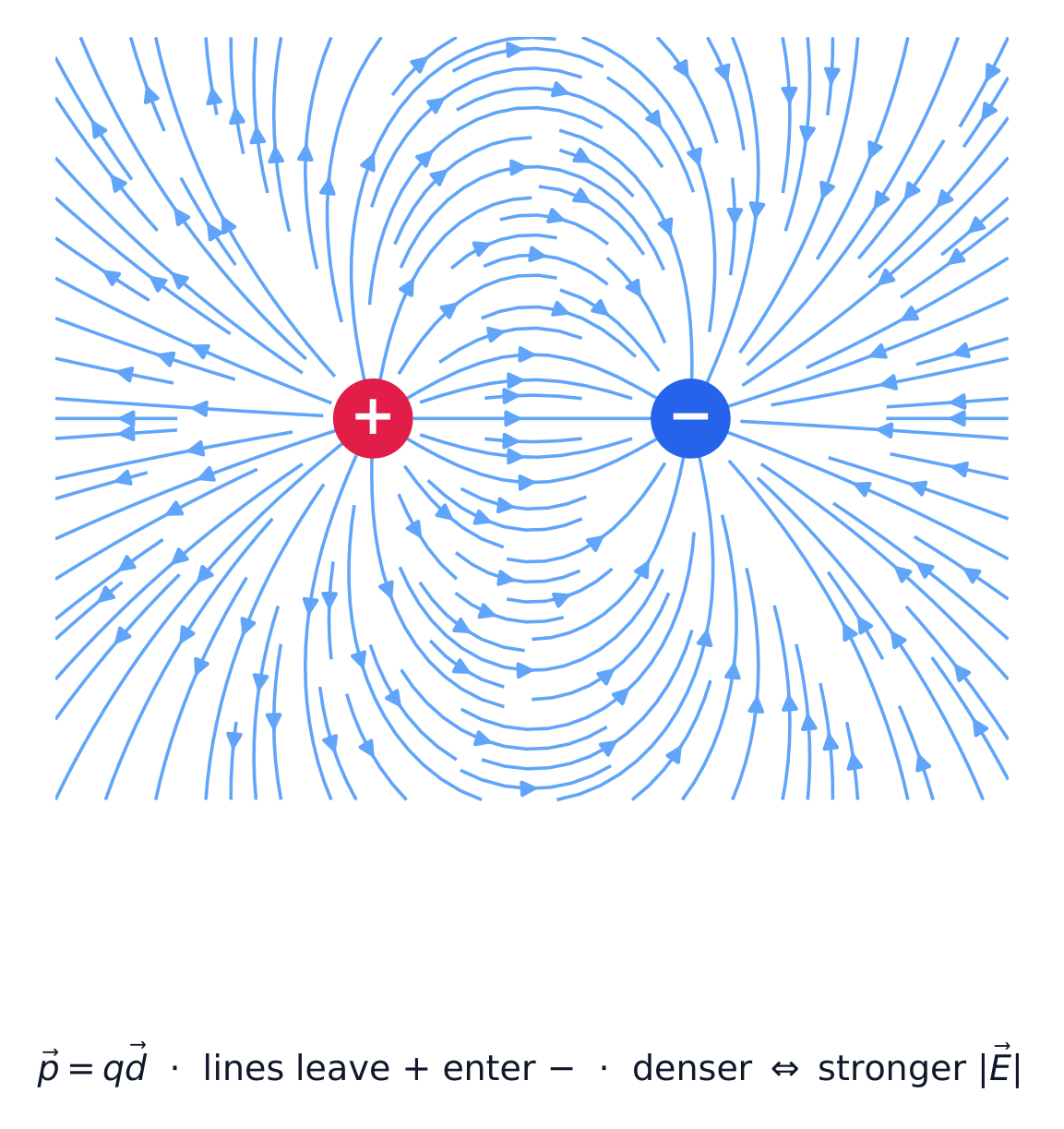
خطوط المجال الكهربائي لقطب ثنائي تشير من الشحنة الموجبة إلى السالبة

في مجال منتظم، تشعر الشحنة بقوة ثابتة، فتتسارع بانتظام – إذا أطلقت أفقياً، تتبع مساراً قطعياً، تماماً كالجسم المقذوف في الجاذبية.

شحنة تعبر مجالاً منتظماً تتبع مساراً قطعياً
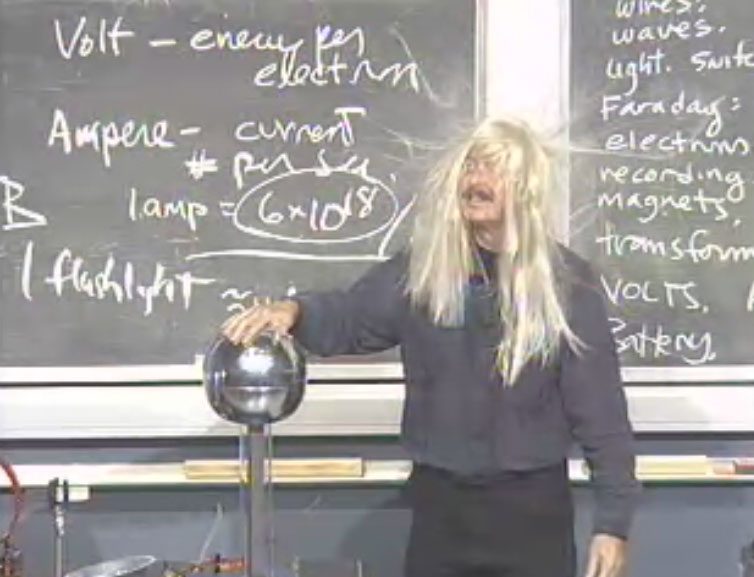
شخص يلمس مولد فان دي غراف بشعره واقفًا عموديًا
تنتشر الشحنة على القبة وعلى الشعر؛ الشحنات المتشابهة تتنافر، لذا تتباعد الخيوط
Explore · ⁨استكشف⁩

Explore field lines of a point charge · ⁨استكشف خطوط الحقل لشحنة نقطية⁩

Set the charge positive or negative. Field lines start on positive and end on negative charge, never cross, and crowd together where $\vec{E}$ is strongest — the line density is proportional to the field magnitude. · ⁨حدد الشحنة لتكون موجبة أو سالبة. تبدأ خطوط المجال من الشحنة الموجبة وتنتهي عند الشحنة السالبة، ولا تتقاطع أبدًا، وتتجمع في المناطق التي يكون فيها $\vec{E}$ الأقوى — حيث تكون كثافة الخطوط متناسبة مع مقدار المجال.⁩

Vocabulary · ⁨مفردات⁩ Train · ⁨تدريب⁩
English العربية
Electric charge/ɪˈlektrɪk tʃɑːdʒ/ الشحنة الكهربائية
quantized/ˈkwɒntaɪzd/ كمية
elementary charge/ˌelɪˈmentəri tʃɑːdʒ/ شحنة أولية
conservation of charge/ˌkɒnsəˈveɪʃn ɒv tʃɑːdʒ/ حفظ الشحنة
point charges/pɔɪnt ˈtʃɑːdʒɪz/ الشحنات النقطية
Coulomb's law/ˈkuːlɒmz lɔː/ قانون كولوم
inverse-square/ɪnˈvɜːs skweə/ عكسي تربيعي
superposition/ˌsuːpəpəˈzɪʃn/ التراكب
fundamental property/ˌfʌndəˈmentl ˈprɒpəti/ خاصية جوهرية
permittivity of free space/ˌpɜːmɪˈtɪvəti ɒv friː speɪs/ سماحية الفراغ
conductor/kənˈdʌktə/ موصل
insulator/ˈɪnsjuːleɪtə/ عازل
Charging by friction/ˈtʃɑːdʒɪŋ baɪ ˈfrɪkʃn/ الشحن بالاحتكاك
Charging by conduction/ˈtʃɑːdʒɪŋ baɪ kənˈdʌkʃn/ الشحن بالتلامس
Charging by induction/ˈtʃɑːdʒɪŋ baɪ ɪnˈdʌkʃn/ الشحن بالاستحاث
ground/ɡraʊnd/ الأرضية
polarization/ˌpəʊləraɪˈzeɪʃn/ الاستقطاب
electroscope/ɪˌlektrəʊˈskəʊp/ الكشاف الكهربائي
electric field/ɪˈlektrɪk fiːld/ مجال كهربائي
test charge/test tʃɑːdʒ/ شحنة اختبار
Field lines/fiːld laɪnz/ خطوط المجال
uniform/ˈjuːnɪfɔːm/ موحد
continuous charge distribution/kənˈtɪnjuːəs tʃɑːdʒ ˌdɪstrɪˈbjuːʃn/ توزيع شحن مستمر
linear charge density/ˈlɪnɪə tʃɑːdʒ ˈdensɪti/ كثافة الشحن الخطية
surface charge density/ˈsɜːfɪs tʃɑːdʒ ˈdensɪti/ كثافة الشحنة السطحية
volume charge density/ˈvɒljuːm tʃɑːdʒ ˈdensɪti/ كثافة الشحن الحجمية
symmetry/ˈsɪmətri/ التناظر
8.4

Electric Fields of Charge Distributions · ⁨مجالات الشحن توزيعات الشحن⁩

Syllabus · ⁨المنهج⁩
English

Learning Objective 8.4.A: Describe the electric field resulting from a given charge distribution.

  • 8.4.A.1 Expressions for the electric field of specified charge distributions can be found using integration and the principle of superposition.
    • Relevant equation: $\vec{E} = \dfrac{1}{4\pi\varepsilon_0} \displaystyle\int \dfrac{dq}{r^2} \hat{r}$
  • 8.4.A.2 Symmetry considerations of certain charge distributions can simplify analysis of the electric field resulting from those charge distributions.

Boundary statement: AP Physics C: Electricity & Magnetism only expects students to use calculus to find the electric field resulting from the following charge distributions and locations: an infinitely long, uniformly charged wire or cylinder at a distance from its central axis, a thin ring of charge at a location along the axis of the ring, a semicircular arc or part of a semicircular arc at its center, and a finite wire or line charge at a point collinear with the line charge or at a location along its perpendicular bisector.

العربية

الهدف التعليمي 8.4.A: وصف المجال الكهربائي الناتج عن توزيع شحنة محدد.

  • 8.4.A.1 يمكن إيجاد تعبيرات المجال الكهربائي لتوزيعات الشحنات المحددة باستخدام التكامل ومبدأ التراكب.
    • المعادلة ذات الصلة: $\vec{E} = \dfrac{1}{4\pi\varepsilon_0} \displaystyle\int \dfrac{dq}{r^2} \hat{r}$
  • 8.4.A.2 يمكن أن تبسط اعتبارات التماثل لتوزيعات الشحنات معينة تحليل المجال الكهربائي الناتج عن تلك التوزيعات.

عبارة الحدود: يترتب من AP Physics C: الكهرباء والمغناطيسية فقط استخدام الطلاب للتفاضل والتكامل لإيجاد المجال الكهربائي الناتج عن توزيعات الشحنات والمواقع التالية: سلك أو أسطوانة مشحونة بانتظام وبطول لا نهائي على مسافة من محورها المركزي، وحلقة رقيقة من الشحنات على طول محور الحلقة، وقوس نصف دائري أو جزء من قوس نصف دائري في مركزه، وسلك محدود أو شحنة خطية عند نقطة مستقيمة مع الشحنة الخطية أو عند موقع على طول منصف العمود عليها.

Source: College Board AP Course and Exam Description · ⁨المصدر: وصف دورة وامتحان College Board AP⁩

English

For a continuous charge distribution 连续电荷分布, cut the object into pieces $dq$ and integrate their point-charge fields:

$$\vec{E}=\frac{1}{4\pi\varepsilon_0}\int \frac{dq}{r^2}\,\hat{r}.$$

Write $dq$ using the right density: $\lambda\,dl$ with the linear charge density 线电荷密度 (a line or ring), $\sigma\,dA$ with the surface charge density 面电荷密度, or $\rho\,dV$ with the volume charge density 体电荷密度. Then use symmetry 对称性 to cancel components before integrating – that sentence is usually a scored step. AP's calculus cases: a finite line (collinear point or perpendicular bisector), an infinite wire or cylinder, a ring on its axis, and an arc at its centre.

Worked example (ring, on axis). A ring of radius $R$ carries charge $Q$. At a point $z$ along the axis, each element is a distance $\sqrt{R^2+z^2}$ away, and by symmetry the sideways components cancel, leaving only the axial part ($\cos\alpha=z/\sqrt{R^2+z^2}$):

$$E_z=\frac{1}{4\pi\varepsilon_0}\int\frac{dq}{R^2+z^2}\cdot\frac{z}{\sqrt{R^2+z^2}}=\frac{1}{4\pi\varepsilon_0}\frac{Qz}{(R^2+z^2)^{3/2}}.$$

Check the limits: $E=0$ at the centre ($z=0$), and far away ($z\gg R$) it becomes $kQ/z^2$ – a point charge, as it must.

العربية

لتوزيع شحنة مستمر، قسّم الجسم إلى أجزاء $dq$ وأدمج مجالات الشحن النقطية:

$$\vec{E}=\frac{1}{4\pi\varepsilon_0}\int \frac{dq}{r^2}\,\hat{r}.$$

اكتب $dq$ باستخدام الكثافة المناسبة: $\lambda\,dl$ مع كثافة الشحنة الطولية (خط أو حلقة)، $\sigma\,dA$ مع كثافة الشحنة السطحية، أو $\rho\,dV$ مع كثافة الشحنة الحجمية. ثم استخدم التماثل لإلغاء المكوّنات قبل التكامل – هذه الجملة عادة ما تكون خطوة مُدرَّجة. حالات التفاضل والتكامل في AP: خط محدود (نقطة على امتداده أو عمود منصف)، سلك أو أسطوانة لا نهائية، حلقة على محورها، وقوس عند مركزه.

مثال محلول (حلقة، على المحور). حلقة نصف قطرها $R$ تحمل شحنة $Q$. عند نقطة $z$ على طول المحور، يكون كل عنصر على مسافة $\sqrt{R^2+z^2}$، وبسبب التماثل تلغي المكوّنات الأفقية، ويتبقى الجزء المحوري فقط ($\cos\alpha=z/\sqrt{R^2+z^2}$):

$$E_z=\frac{1}{4\pi\varepsilon_0}\int\frac{dq}{R^2+z^2}\cdot\frac{z}{\sqrt{R^2+z^2}}=\frac{1}{4\pi\varepsilon_0}\frac{Qz}{(R^2+z^2)^{3/2}}.$$

تحقق من الحدود: $E=0$ عند المركز ($z=0$)، وفي المسافات البعيدة ($z\gg R$) تصبح $kQ/z^2$ – شحنة نقطية، كما يجب أن تكون.

8.5

Electric Flux · ⁨التدفق الكهربائي⁩

Syllabus · ⁨المنهج⁩
English

Learning Objective 8.5.A: Describe the electric flux through an arbitrary area or geometric shape.

  • 8.5.A.1 Flux describes the amount of a given quantity that passes through a given area.
  • 8.5.A.2 For an electric field $\vec{E}$ that is constant across an area $\vec{A}$, the electric flux through the area is defined as $\Phi_E = \vec{E} \bullet \vec{A}$.
    • 8.5.A.2.i The direction of the area vector is defined as perpendicular to the plane of the surface and outward from a closed surface.
    • 8.5.A.2.ii The sign of flux is given by the dot product of the electric field vector and the area vector.
  • 8.5.A.3 The total electric flux passing through a surface is defined by the surface integral of the electric field over the surface.
    • Relevant equation: $\Phi_E = \displaystyle\int \vec{E} \cdot d\vec{A}$
العربية

الهدف التعليمي 8.5.A: وصف التدفق الكهربائي عبر مساحة أو شكل هندسي عشوائي.

  • 8.5.A.1 يصف التدفق كمية معينة من كمية ما تمر عبر مساحة محددة.
  • 8.5.A.2 بالنسبة لمجال كهربائي $\vec{E}$ ثابت عبر مساحة $\vec{A}$، يُعرف التدفق الكهربائي عبر المساحة بأنه $\Phi_E = \vec{E} \bullet \vec{A}$.
    • 8.5.A.2.i يُعرّف اتجاه متجه المساحة بأنه عمودي على مستوى السطح وخرجياً من سطح مغلق.
    • 8.5.A.2.ii تُعطى إشارة التدفق بضرب النقطي لمتجه المجال الكهربائي ومتجه المساحة.
  • 8.5.A.3 يُعرف التدفق الكهربائي الكلي المار عبر سطح بالتكامل السطحي للمجال الكهربائي على طول السطح.
    • المعادلة ذات الصلة: $\Phi_E = \displaystyle\int \vec{E} \cdot d\vec{A}$

Source: College Board AP Course and Exam Description · ⁨المصدر: وصف دورة وامتحان College Board AP⁩

English
Electric flux & Gauss's law

Electric flux 电通量 measures how much field passes through a surface:

$$\Phi_E=\int \vec{E}\cdot d\vec{A}.$$

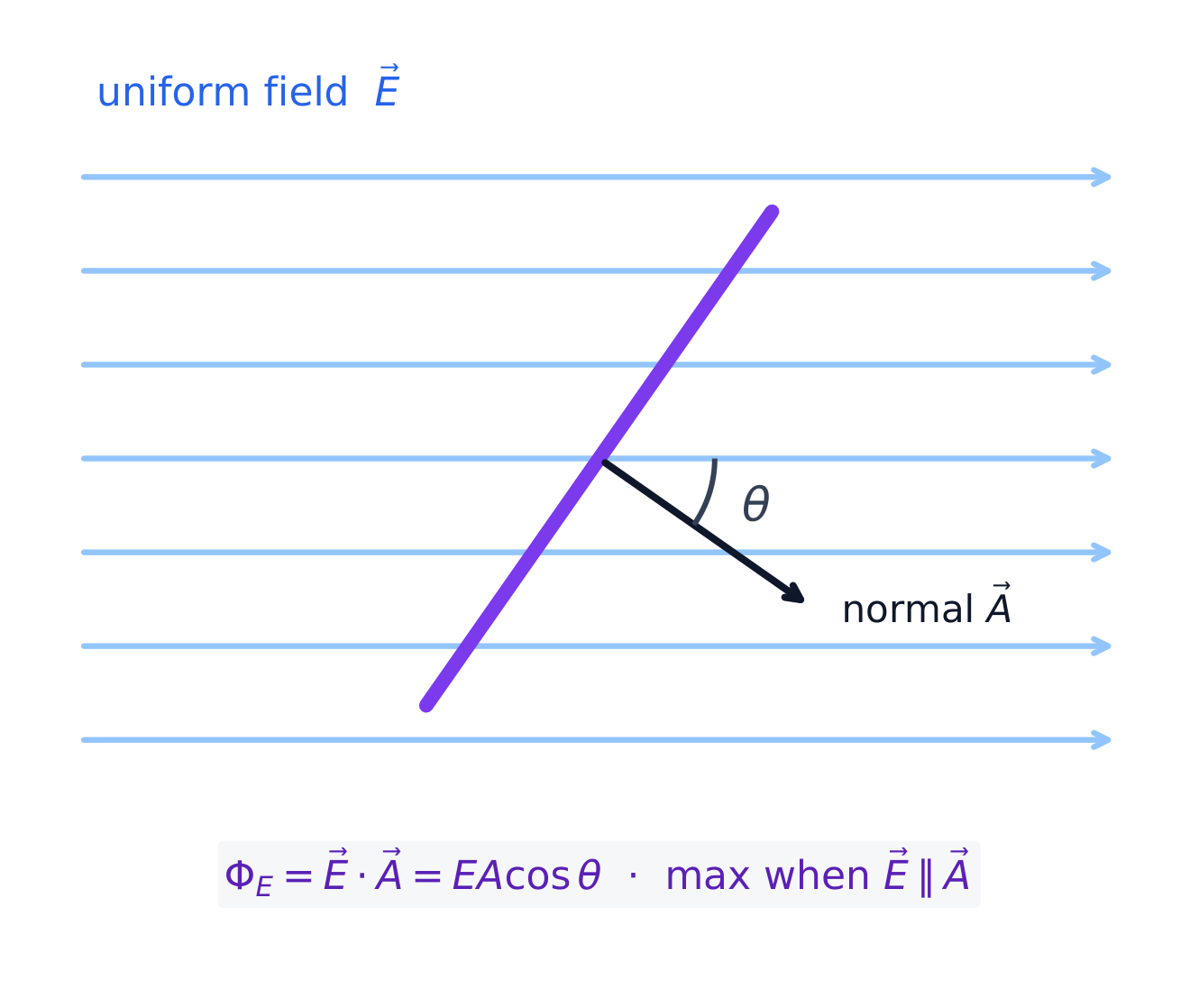
For a uniform field through a flat area, $\Phi_E=EA\cos\theta$, where the area vector 面积矢量 is perpendicular to the surface. Flux is positive where field lines exit a closed surface and negative where they enter – only the perpendicular component of $\vec{E}$ counts.

العربية
التدفق الكهربائي وقانون غاوس

التدفق الكهربائي يقيس مقدار مرور المجال عبر سطح:

$$\Phi_E=\int \vec{E}\cdot d\vec{A}.$$

لمجال منتظم عبر مساحة مستوية، $\Phi_E=EA\cos\theta$، حيث متجه المساحة عمودي على السطح. التدفق موجب حيث تخرج خطوط المجال من سطح مغلق وسالب حيث تدخل – فقط المكوّن العمودي من $\vec{E}$ يُحسب.

التدفق الكهربائي عبر سطح يعتمد على الزاوية بين المجال وعمود السطح
Vocabulary · ⁨مفردات⁩ Train · ⁨تدريب⁩
English العربية
Electric flux/ɪˈlektrɪk flʌks/ التدفق الكهربائي
area vector/ˈeərɪə ˈvektə/ متجه المساحة
Gauss's law/ˈɡaʊsɪz lɔː/ قانون غاوس
8.6

Gauss's Law · ⁨قانون غاوس⁩

Syllabus · ⁨المنهج⁩
English

Learning Objective 8.6.A: Describe the properties of a charge distribution by applying Gauss's law.

  • 8.6.A.1 Gauss's law relates electric flux through a Gaussian surface to the charge enclosed by that surface.
    • Relevant equations: $\Phi_E = \dfrac{q_{\text{enc}}}{\varepsilon_0}$ and $\displaystyle\oint \vec{E} \cdot d\vec{A} = \dfrac{q_{\text{enc}}}{\varepsilon_0}$
  • 8.6.A.2 A Gaussian surface is a three-dimensional, closed surface.
  • 8.6.A.3 The total electric flux through a Gaussian surface is independent of the size of the Gaussian surface if the amount of enclosed charge remains constant.
  • 8.6.A.4 Gaussian surfaces are typically constructed such that the electric field generated by the enclosed charge is either perpendicular or parallel to different regions of the Gaussian surface, resulting in a simplified surface integral.
  • 8.6.A.5 If a function of charge density is given for a charge distribution, the total charge can be determined by integrating the charge density over the length (one dimension), area (two dimensions), or volume (three dimensions) of the charge distribution. For example: $Q_{\text{total}} = \displaystyle\int \rho(\vec{r})\, dV$
  • 8.6.A.6 Maxwell's equations are the collection of equations that fully describe electromagnetism. Gauss's law is Maxwell's first equation.
    • Relevant equation: $\displaystyle\oint \vec{E} \cdot d\vec{A} = \dfrac{q_{\text{enc}}}{\varepsilon_0}$

Boundary statement: AP Physics C: Electricity & Magnetism only expects students to quantitatively apply Gauss's law to point charges and charge distributions that have spherical, cylindrical, or planar symmetry.

العربية

الهدف التعليمي 8.6.A: وصف خصائص توزيع الشحنة بتطبيق قانون غاوس.

  • 8.6.A.1 يرتبط قانون غاوس التدفق الكهربائي عبر سطح غاوس بالشحنة المحصورة داخل ذلك السطح.
    • المعادلات ذات الصلة: $\Phi_E = \dfrac{q_{\text{enc}}}{\varepsilon_0}$ و$\displaystyle\oint \vec{E} \cdot d\vec{A} = \dfrac{q_{\text{enc}}}{\varepsilon_0}$
  • 8.6.A.2 سطح غاوس هو سطح ثلاثي الأبعاد مغلق.
  • 8.6.A.3 التدفق الكهربائي الكلي عبر سطح غاوس مستقل عن حجم سطح غاوس إذا بقيت كمية الشحنة المحصورة ثابتة.
  • 8.6.A.4 تُبنى أسطح غاوس عادةً بحيث يكون المجال الكهربائي الناتج عن الشحنة المحصورة إما عمودياً أو موازياً لمناطق مختلفة من سطح غاوس، مما يؤدي إلى تكامل سطحي مبسط.
  • 8.6.A.5 إذا تم إعطاء دالة لكثافة الشحنة لتوزيع شحني، يمكن تحديد الشحنة الكلية عن طريق تكامل كثافة الشحنة على الطول (بعد واحد)، أو المساحة (بعدينين)، أو الحجم (ثلاثة أبعاد) للتوزيع الشحني. مثال: $Q_{\text{total}} = \displaystyle\int \rho(\vec{r})\, dV$
  • 8.6.A.6 معادلات ماكسويل هي مجموعة المعادلات التي تصف الكهرومغناطيسية بشكل كامل. قانون غاوس هو المعادلة الأولى لماكسويل.
    • المعادلة ذات الصلة: $\displaystyle\oint \vec{E} \cdot d\vec{A} = \dfrac{q_{\text{enc}}}{\varepsilon_0}$

عبارة الحدود: في امتحان الفيزياء AP C: الكهرباء والمغناطيسية، يُتوقع من الطلاب فقط التطبيق الكمي لقانون غاوس على الشحنات النقطية وتوزيعات الشحنات ذات التماثل الكروي أو الأسطواني أو المستوي.

Source: College Board AP Course and Exam Description · ⁨المصدر: وصف دورة وامتحان College Board AP⁩

English

Gauss's law 高斯定律 – the first of Maxwell's equations – relates the flux through any closed surface to the charge inside it:

$$\oint \vec{E}\cdot d\vec{A}=\frac{Q_{\text{enc}}}{\varepsilon_0}.$$

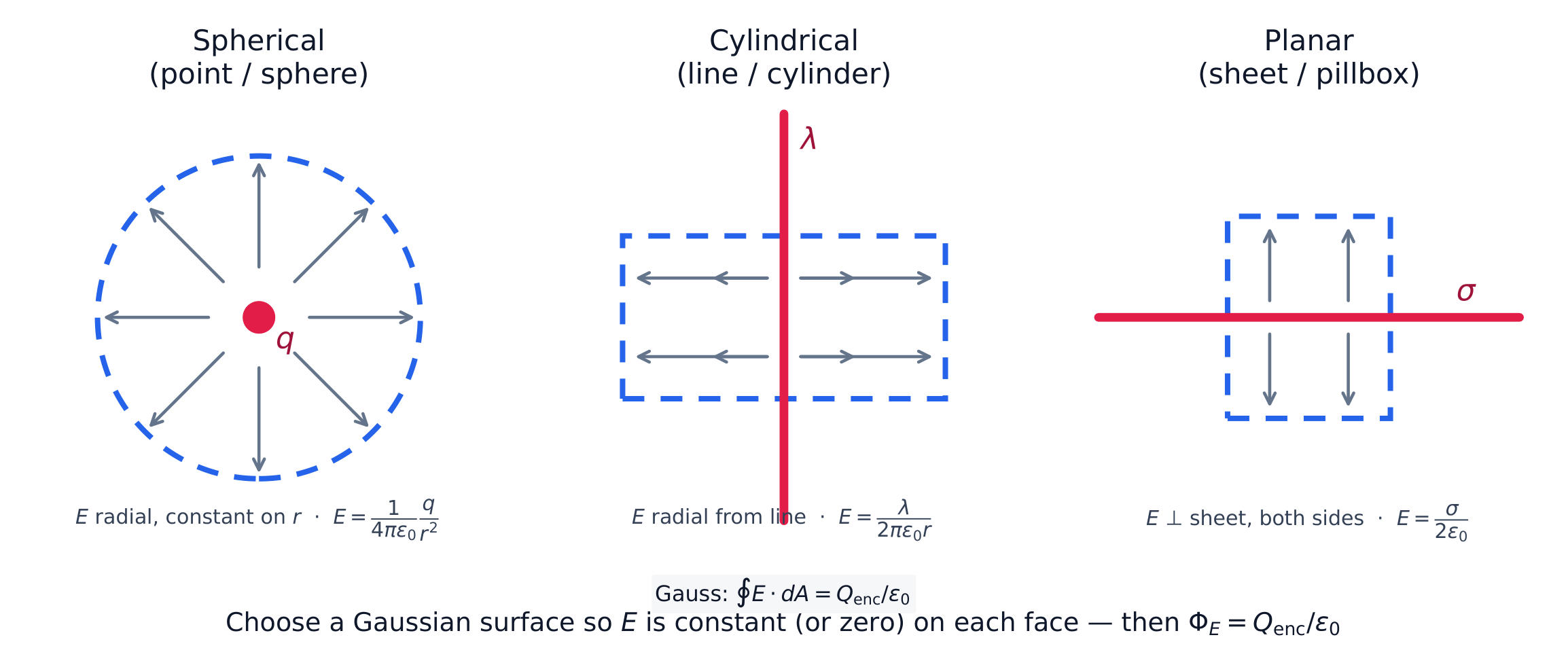
It is true for any closed surface, but it solves for $E$ only when symmetry lets you choose a Gaussian surface 高斯面 on which $E$ is constant and perpendicular (or parallel, contributing zero). The three symmetries AP tests: spherical symmetry 球对称 (concentric sphere), cylindrical symmetry 柱对称 (coaxial cylinder), and planar symmetry 平面对称 (a straddling "pillbox").

Worked example (sphere). Outside a sphere of total charge $Q$, a spherical Gaussian surface of radius $r$ gives $E(4\pi r^2)=Q/\varepsilon_0$, so $E=\dfrac{kQ}{r^2}$ – identical to a point charge at the centre. Inside a uniformly charged solid sphere of radius $R$, the surface encloses only $Q_{\text{enc}}=Q\,r^3/R^3$, so $E=\dfrac{kQr}{R^3}$: zero at the centre, growing linearly to the surface.

Worked example (wire). For an infinite wire with charge per length $\lambda$, take a coaxial cylinder of radius $r$ and length $L$. The ends contribute nothing ($\vec{E}\perp d\vec{A}$), so $E(2\pi rL)=\dfrac{\lambda L}{\varepsilon_0}$ and $E=\dfrac{\lambda}{2\pi\varepsilon_0 r}$. The same pillbox method gives an infinite sheet's field, $E=\dfrac{\sigma}{2\varepsilon_0}$, uniform on both sides.

Exam skill. A full-credit Gauss's-law answer has four parts: name the surface, state the symmetry argument (why $E$ is constant and perpendicular on it), count $Q_{\text{enc}}$, then solve. Skipping the symmetry sentence loses the reasoning point – and remember Gauss's law also explains why $E=0$ inside any conductor in equilibrium.

العربية

قانون غاوس – أول معادلات ماكسويل – يربط التدفق عبر أي سطح مغلق بالشحنة بداخله:

$$\oint \vec{E}\cdot d\vec{A}=\frac{Q_{\text{enc}}}{\varepsilon_0}.$$

يُطبق هذا على أي سطح مغلق، لكنه يُحسب $E$ فقط عندما تسمح لك التماثل باختيار سطح غاوسي يكون عليه $E$ ثابتًا وعموديًا (أو موازيًا، مما يساهم بصفر). يختبر امتحان AP ثلاثة أنواع من التماثل: التماثل الكروي (كرة متحدة المركز)، والتماثل الأسطواني (أسطوانة محورية)، والتماثل المستوي (صندوق حبوب "pillbox" يقطع السطح).

تم اختيار سطح غاوسي ليتوافق مع تماثل الشحنة

مثال محلول (كرة). خارج كرة شحنتها الكلية $Q$، يعطي سطح غاوسي كروي نصف قطره $r$ قيمة $E(4\pi r^2)=Q/\varepsilon_0$، وبالتالي $E=\dfrac{kQ}{r^2}$ – وهو مطابق لشحنة نقطية في المركز. داخل كرة صلبة مشحونة بانتظام نصف قطرها $R$، يحيط السطح بـ $Q_{\text{enc}}=Q\,r^3/R^3$ فقط، لذا $E=\dfrac{kQr}{R^3}$: صفري عند المركز، ويتزايد خطيًا حتى السطح.

مثال محلول (سلك). لسلك لا نهائي يحمل شحنة لكل وحدة طول $\lambda$، خذ أسطوانة محورية نصف قطرها $r$ وطولها $L$. الأطراف لا تساهم بشيء ($\vec{E}\perp d\vec{A}$)، لذا $E(2\pi rL)=\dfrac{\lambda L}{\varepsilon_0}$ و$E=\dfrac{\lambda}{2\pi\varepsilon_0 r}$. نفس طريقة صندوق الحبوب تعطي مجال الصفيحة اللانهائية، $E=\dfrac{\sigma}{2\varepsilon_0}$، منتظمًا على كلا الجانبين.

مهارة الامتحان. إجابة قانون غاوس التي تحصل على الدرجة الكاملة تتكون من أربعة أجزاء: تسمية السطح، وتوضيح حجة التماثل (لماذا $E$ ثابت وعمودي عليه)، وحساب $Q_{\text{enc}}$، ثم الحل. skipping الجملة المتعلقة بالتماثل يفقد نقطة البرهان – وتذكر أن قانون غاوس يفسر أيضًا سبب $E=0$ داخل أي موصل في حالة توازن.

Vocabulary · ⁨مفردات⁩ Train · ⁨تدريب⁩
English العربية
Gaussian surface/ˈɡaʊʃn ˈsɜːfɪs/ سطح غاوسي
spherical symmetry/sˈferɪkl ˈsɪmətri/ تناظر كروي
cylindrical symmetry/sɪˈlɪndrɪkl ˈsɪmətri/ تناظر أسطواني
planar symmetry/ˈpleɪnə ˈsɪmətri/ تناظر مستوي
8.6

Exam tips · ⁨نصائح للامتحان⁩

English
  • Use Coulomb's law $F=\tfrac{1}{4\pi\varepsilon_0}\tfrac{q_1 q_2}{r^2}$ and superpose forces as vectors (components, not magnitudes).
  • For a continuous charge, integrate $d\vec E$ over $dq=\lambda\,dl,\ \sigma\,dA,\ \rho\,dV$; use symmetry to cancel components.
  • The field points away from positive and toward negative charge; draw field lines correctly.
  • Distinguish the force on a charge ($\vec F=q\vec E$) from the field the charge creates.
  • Keep the constant $k=\tfrac{1}{4\pi\varepsilon_0}$ straight and check units.
العربية
  • استخدم قانون كولوم $F=\tfrac{1}{4\pi\varepsilon_0}\tfrac{q_1 q_2}{r^2}$ واجمع القوى كـ متجهات (مكونات، وليس مقادير).
  • للشحنة المستمرة، قم بتكامل $d\vec E$ عبر $dq=\lambda\,dl,\ \sigma\,dA,\ \rho\,dV$؛ استخدم التماثل لإلغاء المكونات.
  • يشير المجال ابتعاداً عن الشحنة الموجبة ونحو الشحنة السالبة؛ ارسم خطوط المجال بشكل صحيح.
  • فرّق بين القوة المؤثرة على شحنة ($\vec F=q\vec E$) والمجال الذي تنشئه هذه الشحنة.
  • احتفظ بالثابت $k=\tfrac{1}{4\pi\varepsilon_0}$ واضحاً وتحقق من الوحدات.

Interactive lessons on this topic · ⁨دروس تفاعلية حول هذا الموضوع⁩

Work through it step by step, with instant-check exercises. · ⁨ا-working عليه خطوة بخطوة، مع تمارين تحقق فوري.⁩

Past Papers · ⁨أوراق الامتحانات السابقة⁩

More topics in AP Physics C: Electricity and Magnetism · ⁨AP الفيزياء C: الكهرباء والمغناطيسية⁩ · ⁨المزيد من المواضيع في AP Physics C: Electricity and Magnetism · ⁨AP الفيزياء C: الكهرباء والمغناطيسية⁩⁩

Log in or create account · ⁨تسجيل الدخول أو إنشاء حساب⁩

IGCSE, A-Level & AP