Skip to content

波

AQA · GCSE · 物理 · 知识点 6

6.1

Waves: energy that travels

Ripples on a pond, the sound of a voice, the light of a distant star — all are waves carrying energy from a source to an absorber. This reference covers AQA GCSE Physics 8463, topic 4.6 Waves.

How the exam treats this topic:

  • Paper 2 carries this topic. $T = 1/f$, $v = f\lambda$ and magnification are on the enclosed sheet.
  • Reflection (RP9), sound, detection waves, lenses, visible light and black-body radiation are physics only; sound and detection are also HT only; parts of EM properties are HT only.
  • Required practicals: RP8 (wave speed in a ripple tank and a solid) and RP9 (reflection and refraction, physics only).
  • You must construct ray diagrams for reflection, refraction and lenses.
6.1

横波与纵波;波的性质 (4.6.1.1–4.6.1.2, RP8)

教学大纲

空气、流体和固体中的波(AQA 8463 陈述 4.6.1.1-4.6.1.2,RP8)。

  1. 描述横波与纵波的区别并举例说明。
  2. 描述证明波而非介质本身发生传播的证据。
  3. 使用振幅、波长、频率和周期;应用公式:周期 = 1/频率,波速 = 频率 × 波长。
  4. 描述测量空气中声速及水面涟漪速度的方法。
  5. 必做实践 8:在水槽和固体中测量频率、波长和波速。
  6. (仅限物理学科)解释声波在不同介质间传播时速度、频率和波长的变化关系。

来源:Cambridge International 教学大纲

Type Vibration direction Examples
transverse 横波 across the travel direction water ripples, all electromagnetic waves
longitudinal 纵波 along the travel direction sound in air

Longitudinal waves show compressions 密部 (particles squashed) and rarefactions 疏部 (particles spread).

A transverse displacement graph and a longitudinal density pattern.

Evidence that the wave travels, not the material: a ripple moves across a pond but the water itself just bobs up and down (a ball on the surface stays put); sound reaches you but the air does not travel from source to ear.

词汇 训练
English 中文 拼音
transverse/trænsˈvɜːs/ 横波 héng bō
longitudinal/ˌlɒŋɡɪˈtjuːdɪnl/ 纵波 zòng bō
compressions/kəmˈpreʃnz/ 密部 mì bù
rarefactions/ˌreərɪˈfækʃnz/ 疏部 shū bù
6.1

横波与纵波;波的性质 (4.6.1.1–4.6.1.2, RP8)

教学大纲

空气、流体和固体中的波(AQA 8463 陈述 4.6.1.1-4.6.1.2,RP8)。

  1. 描述横波与纵波的区别并举例说明。
  2. 描述证明波而非介质本身发生传播的证据。
  3. 使用振幅、波长、频率和周期;应用公式:周期 = 1/频率,波速 = 频率 × 波长。
  4. 描述测量空气中声速及水面涟漪速度的方法。
  5. 必做实践 8:在水槽和固体中测量频率、波长和波速。
  6. (仅限物理学科)解释声波在不同介质间传播时速度、频率和波长的变化关系。

来源:Cambridge International 教学大纲

Quantity Meaning Unit
amplitude 振幅 maximum displacement from the undisturbed position m
wavelength 波长 distance from a point on one wave to the equivalent point on the next m
frequency 频率 number of waves passing a point each second Hz
period 周期 time for one wave s
$$T = \frac{1}{f} \qquad v = f\lambda$$
  • Wave speed is the speed at which energy is transferred through the medium.
  • Read amplitude and wavelength straight off a labelled diagram.

Worked example. A water wave has frequency 2.0 Hz and wavelength 0.35 m.

$$v = f\lambda = 2.0 \times 0.35 = 0.70\ \text{m/s}$$

Worked example (kHz and μm). Sound of frequency 4.0 kHz travels at 330 m/s.

  • Convert: $f = 4000$ Hz.
    $$\lambda = \frac{v}{f} = \frac{330}{4000} = 0.0825 \approx 8.3\times10^{-2}\ \text{m}$$

Measuring wave speeds (RP8)

RP8: ripple tank with bar motor, lamp and screen.
  • Ripples: darkened ripple tank, straight-bar motor makes continuous waves; photograph/measure the wavelength with a ruler on the screen, count waves passing a point in 10 s for frequency; $v = f\lambda$.
  • Waves in a solid: a vibration generator sends waves along a stretched string; adjust the frequency until a clear whole number of loops appears — measure the length and count loops for $\lambda$; $f$ is read from the signal generator.
  • Speed of sound: stand a known distance from a wall, clap and time the echo for many claps, divide (or use two people with a stopwatch over a large distance; electronic timing is better).

(Physics only) Sound changing medium: if speed changes, either frequency or wavelength (or both) change with it — $v = f\lambda$ links all three.

词汇 训练
English 中文 拼音
amplitude/ˈæmplɪtjuːd/ 振幅 zhèn fú
wavelength/ˈweɪvleŋθ/ 波长 bō cháng
frequency/ˈfriːkwənsi/ 频率 pín lǜ
period/ˈpɪərɪəd/ 周期 zhōu qī
6.2

反射、声波与探测用波 — 仅物理 (4.6.1.3–4.6.1.5)

教学大纲

反射、声波及探测波,仅限物理学科(AQA 8463 陈述 4.6.1.3-4.6.1.5,RP9)。

  1. 绘制表面反射的光路图;描述界面处的吸收和透射现象。
  2. 必修实践 9:探究不同表面的反射及不同物质的折射。
  3. (HT) 描述声音转换为固体振动、人耳感知过程,以及 20 Hz 至 20 kHz 的人耳听觉范围。
  4. (HT) 解释超声成像中的边界部分反射原理,以及地震P波/S波勘探技术。

来源:Cambridge International 教学大纲

At a boundary a wave may be reflected, absorbed or transmitted:

  • specular reflection 镜面反射: from a smooth surface, one direction;
  • diffuse reflection 漫反射: from a rough surface, scattered;
  • absorption: energy stays in the material; transmission: passes through.

Construct the reflection ray diagram: the normal at right angles to the surface at the point of incidence; the angle of incidence equals the angle of reflection — both measured from the normal.

Reflection ray diagram with the normal and equal angles.

RP9: shine a ray box at plane mirror / rough surfaces; trace incident and reflected rays with a pencil, measure angles with a protractor; for refraction, pass light through a glass block and trace the bent path at each boundary.

词汇 训练
English 中文 拼音
specular reflection/ˈspekjʊlə rɪˈflekʃn/ 镜面反射 jìng miàn fǎn shè
diffuse reflection/dɪˈfjuːz rɪˈflekʃn/ 漫反射 màn fǎn shè
6.2

反射、声波与探测用波 — 仅物理 (4.6.1.3–4.6.1.5)

教学大纲

反射、声波及探测波,仅限物理学科(AQA 8463 陈述 4.6.1.3-4.6.1.5,RP9)。

  1. 绘制表面反射的光路图;描述界面处的吸收和透射现象。
  2. 必修实践 9:探究不同表面的反射及不同物质的折射。
  3. (HT) 描述声音转换为固体振动、人耳感知过程,以及 20 Hz 至 20 kHz 的人耳听觉范围。
  4. (HT) 解释超声成像中的边界部分反射原理,以及地震P波/S波勘探技术。

来源:Cambridge International 教学大纲

Sound travels through solids as vibrations. In the ear, sound waves vibrate the ear drum and other parts — the sensation of sound is vibration converted. This works only over a limited frequency range: human hearing spans 20 Hz to 20 kHz. Examples of conversion: a microphone's diaphragm, a drum skin, windows rattling near a bass speaker.

6.2

反射、声波与探测用波 — 仅物理 (4.6.1.3–4.6.1.5)

教学大纲

反射、声波及探测波,仅限物理学科(AQA 8463 陈述 4.6.1.3-4.6.1.5,RP9)。

  1. 绘制表面反射的光路图;描述界面处的吸收和透射现象。
  2. 必修实践 9:探究不同表面的反射及不同物质的折射。
  3. (HT) 描述声音转换为固体振动、人耳感知过程,以及 20 Hz 至 20 kHz 的人耳听觉范围。
  4. (HT) 解释超声成像中的边界部分反射原理,以及地震P波/S波勘探技术。

来源:Cambridge International 教学大纲

  • Ultrasound: frequency above 20 kHz; partially reflected at boundaries between media; the echo time gives the distance to a boundary ($s = vt$, with the path often there-and-back). Uses: medical prenatal scanning (safe, non-ionising), industrial flaw detection.
  • Seismic waves: earthquakes produce P-waves (longitudinal) and S-waves (transverse), travelling at different speeds through the Earth; P-waves pass through liquids, S-waves do not — the shadow zones reveal the Earth's layered structure. Echo sounding with ultrasound/sound pulses maps seabeds.
6.3

电磁波 (4.6.2.1–4.6.2.4)

教学大纲

电磁波(AQA 8463 陈述 4.6.2.1-4.6.2.4)。

  1. 描述电磁波为横波,构成连续光谱,在真空中或空气中速度相同。
  2. 按波长和频率顺序列出从无线电波到伽马射线的能谱排序。
  3. 说明各频段的用途,并(HT)解释其适用性。
  4. 阐述紫外线、X射线和伽马射线的危害;解读辐射剂量数据。
  5. (HT) 解释物质如何随波长不同而吸收、透射、折射或反射电磁波;绘制折射光线图和波前图。

来源:Cambridge International 教学大纲

All EM waves are transverse, transferring energy from source to absorber. They form a continuous spectrum and all travel at the same speed in vacuum or air ($3\times10^8$ m/s). From long to short wavelength:

$$\text{radio} \to \text{microwave} \to \text{infrared} \to \text{visible (red to violet)} \to \text{ultraviolet} \to \text{X-ray} \to \text{gamma}$$

Eyes detect only visible light — a tiny band.

The EM spectrum bands from radio to gamma with uses.
Wave Typical use Why (HT)
radio TV and radio long wavelength, diffracts around hills; (HT) produced by oscillations in circuits, absorbed to induce matching alternating currents
microwave satellite TV, cooking passes through the atmosphere; absorbed by water in food
infrared heaters, night vision, remote controls emitted by warm bodies; absorbed as heat
visible vision, fibre optics, photography detected by eyes and cameras
ultraviolet fluorescence lamps, tanning, sterilising energises chemicals;
X-ray medical imaging of bones penetrates flesh, absorbed by bone
gamma sterilising medical equipment, cancer treatment kills bacteria and cells

Hazards: UV ages skin prematurely and raises skin-cancer risk; X-rays and gamma rays are ionising — they can mutate genes and cause cancer. Radiation dose in sieverts measures the risk of harm (1000 mSv = 1 Sv; recall of the unit not required). Draw conclusions from dose data.

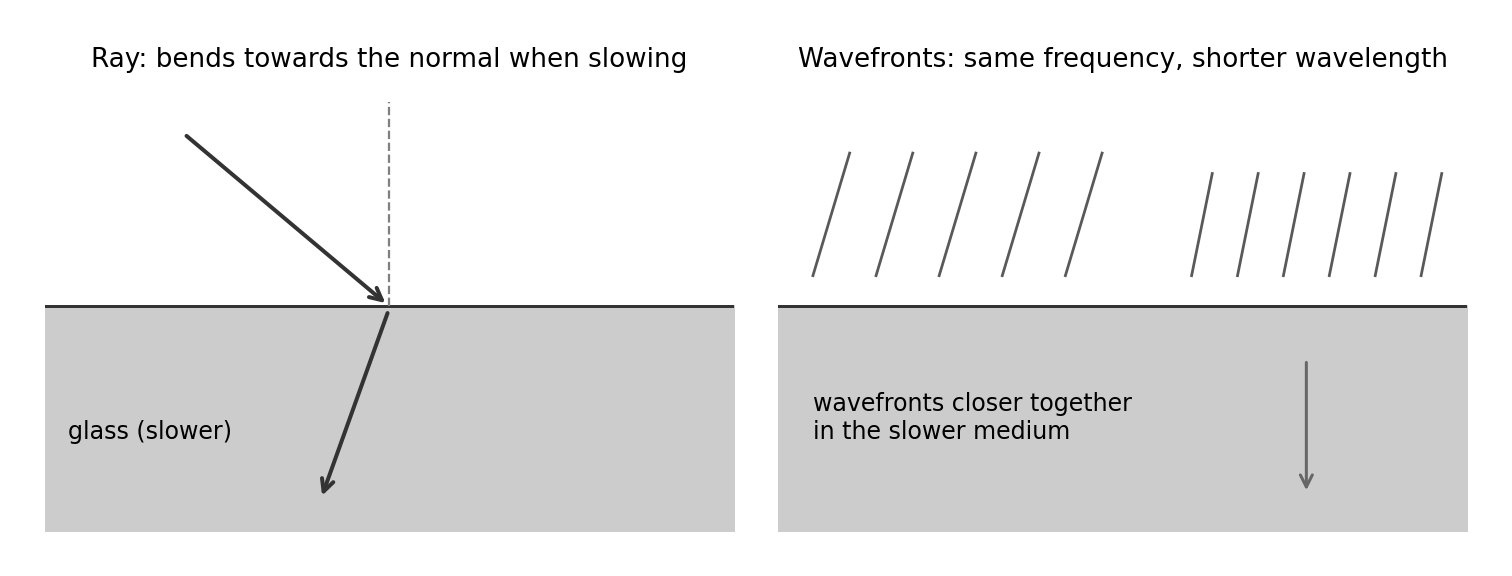
(HT) Substances absorb, transmit, refract or reflect EM waves in ways that vary with wavelength; refraction comes from the change of speed between substances. Show refraction on a ray diagram (bending towards the normal when slowing) and on wavefront diagrams (wavefronts closer together in the slower medium).

Refraction as a ray and as bunched wavefronts.
6.4

透镜与可见光 — 仅物理 (4.6.2.5–4.6.2.6)

教学大纲

透镜与可见光,仅限物理学科(AQA 8463 陈述 4.6.2.5-4.6.2.6)。

  1. 绘制凸透镜和凹透镜的光路图;区分实像与虚像。
  2. 使用放大率 = 像高 / 物高作为无量纲比值进行计算。
  3. 通过选择性反射与吸收解释颜色;通过透射解释滤光片作用;区分镜面反射与漫反射。

来源:Cambridge International 教学大纲

A lens forms an image by refracting light:

  • convex 凸透镜: parallel rays converge at the principal focus; focal length = lens-to-focus distance; images real or virtual.
  • concave 凹透镜: rays spread; image always virtual.

Ray-diagram rules (two rays locate the image): a ray parallel to the axis refracts through the focus (convex) or appears to come from it (concave); a ray through the centre of the lens goes straight on.

A convex lens ray diagram forming a real inverted image.
$$\text{magnification} = \frac{\text{image height}}{\text{object height}}$$
  • A ratio, no units; both heights in mm or both in cm.

Worked example. An object 5.0 mm high forms an image 20 mm high.

$$m = \frac{20}{5.0} = 4.0\ (\text{no unit})$$
词汇 训练
English 中文 拼音
convex/kɒnˈveks/ 凸透镜 tū tòu jìng
concave/kɒnˈkeɪv/ 凹透镜 āo tòu jìng
6.4

透镜与可见光 — 仅物理 (4.6.2.5–4.6.2.6)

教学大纲

透镜与可见光,仅限物理学科(AQA 8463 陈述 4.6.2.5-4.6.2.6)。

  1. 绘制凸透镜和凹透镜的光路图;区分实像与虚像。
  2. 使用放大率 = 像高 / 物高作为无量纲比值进行计算。
  3. 通过选择性反射与吸收解释颜色;通过透射解释滤光片作用;区分镜面反射与漫反射。

来源:Cambridge International 教学大纲

Each colour is its own narrow band of wavelength (red longest, violet shortest in the visible band).

  • Filters absorb some wavelengths and transmit others (a red filter transmits red).
  • An opaque object's colour = the wavelengths it strongly reflects; the rest are absorbed. All reflected → white; all absorbed → black.
  • Transparent/translucent objects transmit light.
  • Specular vs diffuse reflection (from the reflection section) explains why a smooth red surface looks glossy but paper looks matt.
6.5

黑体辐射 — 仅物理 (4.6.3, RP9)

教学大纲

黑体辐射,仅限物理学科(AQA 8463 陈述 4.6.3.1-4.6.3.2)。

  1. 说明所有物体都会发射和吸收红外辐射,温度越高辐射越强。
  2. 将理想黑体定义为完全吸收体和最佳发射体。
  3. 阐明发射强度与波长分布同温度的关系。
  4. (HT) 解释热平衡状态下吸收与发射相等维持恒温的原理,并将其应用于地球温度因素分析。

来源:Cambridge International 教学大纲

All bodies, at any temperature, emit and absorb infrared. The hotter the body, the more radiation it emits per second.

A perfect black body absorbs all incident radiation — no reflection, no transmission — and (good absorber = good emitter) is also the best possible emitter.

The intensity and wavelength distribution of the emitted radiation depend on the body's temperature: hotter → more intense, and the peak shifts to shorter wavelength.

(HT) A body at constant temperature absorbs at the same rate as it emits.

The Earth's radiation balance. Absorbing faster than emitting → temperature rises. The Earth's temperature depends on the balance of absorbed and emitted radiation and on reflection back to space — use it to explain warming and ice-albedo style examples, and read the standard diagram.

6.5

Checklist before you call this topic done

  • Define amplitude, wavelength, frequency, period; use $T = 1/f$ and $v = f\lambda$ with prefixes.
  • Describe RP8 in a ripple tank and on a string; describe a speed-of-sound method.
  • (physics only) Draw reflection and refraction ray diagrams with the normal; RP9.
  • Recite the EM spectrum order; match uses and hazards with reasons; compare dose data.
  • (physics only) Draw lens ray diagrams (convex/concave); magnification as a unitless ratio.
  • (physics only) Explain colour by reflection, filters by transmission.
  • (physics only) Black-body emission, absorption and the Earth's radiation balance (HT).

更多 AQA · GCSE · 物理 知识点

登录或创建账户

IGCSE、A-Level 与 AP