Skip to content

力

AQA · GCSE · 物理 · 知识点 5

5.1

Forces: pushes, pulls and their effects

A bridge, a brake, a bungee cord, a planet in orbit: engineers analyse them all with forces. This reference covers AQA GCSE Physics 8463, topic 4.5 Forces — the largest topic of Paper 2.

How the exam treats this topic:

  • Paper 2 (4.5–4.8) carries this topic, and it may also draw on energy and electricity ideas. Equation-sheet support depends on the examination series. Practise choosing an equation, rearranging it and using SI units; check the sheet supplied for your examination.
  • Moments, levers and gears and fluid pressure are physics only. Interpreting terminal-velocity graphs is also physics only. Momentum is Higher Tier; collision calculations and changes in momentum are physics only.
  • Free-body diagrams, vector diagrams (scale drawing) and resolution of forces are HT only.
  • Required practicals: RP6 (force–extension of a spring) and RP7 (force and mass effect on acceleration).
5.1

标量、矢量、力的类型及合力(4.5.1.1–4.5.1.4)

教学大纲

标量、矢量、接触力与重力(AQA 8463 陈述 4.5.1.1-4.5.1.4)。

  1. 区分标量和矢量,并各举一例。
  2. 用带长度的箭头表示矢量,长度代表大小。
  3. 分类接触力与非接触力,并举例说明。
  4. 使用重量 = 质量 × 重力场强度公式,回忆质心概念及测力计(牛顿计)的使用。
  5. 计算共线力的合力;(高中)使用受力分析图,分解力并通过比例尺作图求合力。

来源:Cambridge International 教学大纲

Scalar 标量: magnitude only — distance, speed, mass, energy. Vector 矢量: magnitude and direction — displacement, velocity, force, weight, momentum. A vector is drawn as an arrow: length = magnitude, direction = direction.

A force is a push or pull from the interaction with another object:

  • contact 接触 forces (touching): friction, air resistance, tension, normal contact force;
  • non-contact 非接触 forces (separated): gravitational, electrostatic, magnetic.

Gravity: weight 重力 is the force on an object due to gravity; it acts at the centre of mass 质心 and is measured with a calibrated spring-balance (newtonmeter):

$$W = mg$$
  • $W$ weight in N; $m$ mass in kg; $g$ gravitational field strength in N/kg (given, usually 9.8 near Earth).
  • Weight and mass are directly proportional ($W \propto m$).

Resultant force 合力: the single force replacing several forces with the same effect. Collinear: add same-direction forces, subtract opposite ones. (HT) Use free-body diagrams 自由体图 (only the forces on the chosen object), resolve a force into perpendicular components, and find resultants by scale drawing.

Worked example. A 65 kg person stands on Mars where $g = 3.7$ N/kg.

$$W = mg = 65 \times 3.7 = 240\ \text{N (2 s.f.)}$$
HT: add 30 N north and 40 N east using a scale drawing.

Worked scale drawing (HT; teacher-written). Use 1 cm for 10 N. Draw 4.0 cm east, then 3.0 cm north. The resultant joins the first tail to the last head: 5.0 cm represents 50 N, about 37° north of east. The equilibrant has equal magnitude in the opposite direction.

Exam demand. AQA June2025 8463/2H Q05.5 uses 240 N upwards and 200 N left. A scale triangle or parallelogram gives about 310 N, 40° left of vertical (official ranges 300–320 N and 38–42°). The diagram, arrow directions and scale are part of the method.

词汇 训练
English 中文 拼音
scalar/ˈskeɪlə/ 标量 biāo liàng
vector/ˈvektə/ 矢量 shǐ liàng
contact/ˈkɒntækt/ 接触 jiē chù
non-contact/nɒn ˈkɒntækt/ 非接触 fēi jiē chù
weight/weɪt/ 重力 zhòng lì
centre of mass/ˈsentə ɒv mæs/ 质心 zhì xīn
resultant force/rɪˈzʌltənt fɔːs/ 合力 hé lì
free-body diagrams/friː ˈbɒdi ˈdaɪəɡræmz/ 自由体图 zì yóu tǐ tú
5.2

功与能量传递 (4.5.2)

教学大纲

功与能量转移(AQA 8463 陈述 4.5.2)。

  1. 利用功 = 力 × 沿力方向移动的距离。
  2. 记住 1 焦耳 = 1 牛顿·米,并进行单位换算。
  3. 描述做功时的能量转移过程,包括克服摩擦做功导致的温度升高。

来源:Cambridge International 教学大纲

A force does work when it moves its point of application through a distance:

$$W = Fs$$
  • $W$ work done in J; $F$ force in N; $s$ distance moved along the line of action of the force, in m.
  • 1 J = 1 N·m: one joule is the work of one newton over one metre.
  • Work done against friction raises the object's temperature — the energy transfers to thermal stores.

Worked example. A child pushes a baby walker 2.8 m with a horizontal force of 25 N.

$$W = Fs = 25\ \text{N} \times 2.8\ \text{m} = 70\ \text{J}$$
5.3

力与弹性 (4.5.3, RP6)

教学大纲

力与弹性(AQA 8463 陈述 4.5.3,RP6)。

  1. 解释为何拉伸、弯曲或压缩静止物体时至少需要两个力。
  2. 区分弹性形变与塑性形变。
  3. 在比例极限内使用公式:力 = 劲度系数 × 伸长量,以及 E = 0.5 k e²。
  4. 解读力-伸长量数据及图像;通过斜率计算弹簧的劲度系数。
  5. 必做实践 6:探究弹簧的力与伸长量之间的关系。

来源:Cambridge International 教学大纲

More than one force is needed to stretch, bend or compress a stationary object (a single force would just move it). Elastic deformation 弹性形变 is recovered when the forces are removed; inelastic 非弹性 is not.

Below the limit of proportionality:

$$F = ke \qquad E_e = \tfrac12 ke^2$$
  • $k$ spring constant in N/m (stiff spring → large $k$); $e$ extension = stretched length − original length (or compression).
  • Work done on the spring = elastic energy stored (if not inelastically deformed).

Required practical 6: hang masses on a spring, measure extension for each (ruler at eye level), plot force against extension. The linear section's gradient is $k$; beyond the limit of proportionality the line curves. Hooke's-law reasoning: doubling the force doubles the extension only below the limit.

Force against extension for the sheet 5.3 measurements; use metres for the gradient.

Worked example (AQA June2025 Q02.7). A force of 4.0 N produces extension 0.064 m. Choose $F=ke$ in the proportional region, then rearrange:

$$k=\frac{F}{e}=\frac{4.0\ \text{N}}{0.064\ \text{m}}=62.5\ \text{N/m}$$

A plot of total length has a non-zero intercept because the unloaded spring has a non-zero length. A curve away from the proportional line means $F$ and $e$ are no longer proportional; unload the spring to test for permanent deformation. Secure the stand, limit loading, keep the ruler vertical and close, and use a pointer at eye level.

词汇 训练
English 中文 拼音
Elastic/ɪˈlæstɪk/ 弹性形变 tán xìng xíng biàn
inelastic/ɪnɪˈlæstɪk/ 非弹性 fēi tán xìng
5.4

力矩、杠杆和齿轮 — 仅物理 (4.5.4)

教学大纲

力矩、杠杆和齿轮,物理部分(AQA 8463 陈述 4.5.4)。

  1. 使用力矩 = 力 × 到支点的垂直距离。
  2. 应用顺时针力矩与逆时针力矩的平衡原理。
  3. 解释杠杆和齿轮如何传递力的转动效应。

来源:Cambridge International 教学大纲

$$M = Fd$$
  • $M$ moment 力矩 in N·m; $d$ is the perpendicular distance from the pivot to the line of action of the force.
  • Balance: total clockwise moment = total anticlockwise moment.

Levers and gears transmit the rotational effect of a force. A longer lever arm produces a larger moment for the same perpendicular force. In an ideal pair of meshed gears, the teeth exert equal forces at the contact: a larger driven gear turns more slowly with a larger moment. The meshed gears turn in opposite directions.

A 300 N load at 2.0 m balances 150 N at 4.0 m.

Worked example. Choose the pivot and equate clockwise and anticlockwise moments:

$$F_Rd_R=F_Ld_L$$
$$F_R=\frac{F_Ld_L}{d_R}=\frac{300\ \text{N}\times2.0\ \text{m}}{4.0\ \text{m}}=150\ \text{N}$$

For AQA June2024 Q02.6, convert the perpendicular distance 7.5 cm to 0.075 m: $M=Fd=2.0\ \text{N}\times0.075\ \text{m}=0.15\ \text{N\,m}$. In a pair of meshed gears, the teeth produce a force and moment on the other gear; adjacent gears rotate in opposite directions.

词汇 训练
English 中文 拼音
moment/ˈməʊmənt/ 力矩 lì jǔ
5.5

流体中的压强及压强差 — 仅物理 (4.5.5)

教学大纲

流体中的压强及压强差,物理部分(AQA 8463 陈述 4.5.5)。

  1. 使用压强 = 垂直作用于表面的力 / 表面积。
  2. (高阶)使用液体柱压强公式 = 高度 × 密度 × g。
  3. 解释浮力以及物体漂浮和下沉的因素。
  4. 解释大气压随高度增加而降低的原因。

来源:Cambridge International 教学大纲

$$p = \frac{F}{A} \qquad \text{(HT only)} \qquad p = h\rho g$$
  • $p$ pressure in Pa; $F$ force normal to the surface; $A$ area in m².
  • (HT) $h$ column height in m, $\rho$ liquid density in kg/m³. Pressure grows with depth and density.
  • A submerged object feels greater pressure on its bottom than its top → a resultant upthrust 浮力. Floating at rest: upthrust = weight. If weight initially exceeds upthrust, a released object accelerates downwards; a sinking object can later move at constant speed when upthrust plus drag balances its weight.
  • Atmospheric pressure decreases with height: fewer air molecules above a surface as you climb, so less weight of air; the atmosphere gets less dense with altitude.
Liquid pressure is greater on the bottom of a submerged object than its top.

Worked example (teacher-written; HT). A 2.0 m water column has density 1000 kg/m³; $g=9.8$ N/kg. Its pressure, additional to that at the free surface, is:

$$p=h\rho g=2.0\ \text{m}\times1000\ \text{kg/m}^3\times9.8\ \text{N/kg}=19600\ \text{Pa}$$

Floating at rest requires a complete force balance. A sinking object can reach constant velocity when upthrust + drag = weight; sinking does not always mean downward acceleration.

词汇 训练
English 中文 拼音
upthrust/ˈʌpθrʌst/ 浮力 fú lì
5.6

描述直线运动 (4.5.6.1.1–4.5.6.1.5, RP7)

教学大纲

描述直线运动(AQA 8463 陈述 4.5.6.1)。

  1. 区分路程与位移、速率与速度。
  2. 回忆步行、跑步、骑行及空气中声速的典型数值。
  3. 使用 s = vt 及平均速率;通过斜率读取路程-时间图像,(高阶)结合切线分析。
  4. 使用 a = 速度变化量 / 时间;速度-时间图像的斜率与(高阶)面积;v² - u² = 2as。
  5. 描述流体中物体达到终端速度的运动过程。

来源:Cambridge International 教学大纲

  • Distance 路程 (scalar): how far. Displacement 位移 (vector): straight-line distance and direction.
  • Speed 速率 (scalar) — typical values: walking ≈ 1.5 m/s, running ≈ 3 m/s, cycling ≈ 6 m/s, sound in air ≈ 330 m/s. Velocity 速度 (vector): speed in a given direction.
  • $s = vt$ (constant speed); average speed = total distance ÷ total time.
  • Distance–time graph: gradient = speed; (HT) a tangent gives instantaneous speed of an accelerating object.
  • Acceleration 加速度: $a = \Delta v / t$, in m/s²; deceleration means slowing down. With the initial direction chosen positive, its acceleration is negative. Estimate everyday accelerations.
  • Velocity–time graph: gradient = acceleration; (HT) signed area gives displacement. Add the magnitudes of areas above and below zero to find total distance. If velocity stays positive, area also gives distance.
  • Uniform acceleration: $v^2 - u^2 = 2as$. Free fall near Earth: $a \approx 9.8$ m/s².

Worked example (graph). A v–t graph rises straight from 0 to 20 m/s in 8 s, then stays flat for 12 s.

  • Acceleration (gradient): $a=\Delta v/\Delta t=(20-0)/8=2.5$ m/s².
  • (HT) Positive-velocity areas: $s=s_1+s_2=\tfrac12\Delta t_1v+v\Delta t_2=\tfrac12\times8\times20+20\times12=320$ m.

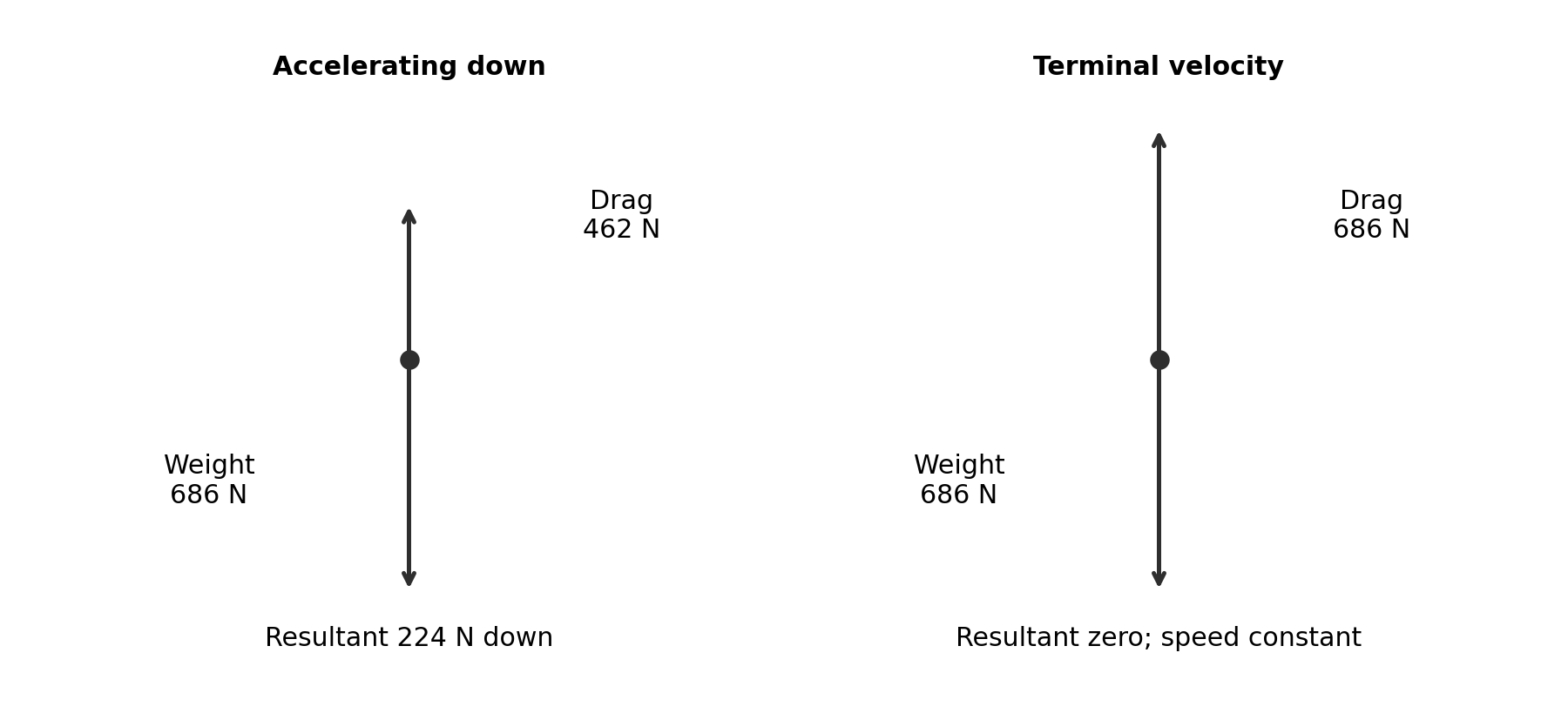
Terminal velocity 末速度: a falling object accelerates (weight > drag 空气阻力); as speed grows, drag grows until resultant force = 0 — constant speed = terminal velocity. Skydiver: fast terminal before the chute, slow after; interpret the v–t curve shape.

Read the axes: distance–time gradient gives speed; velocity–time gradient gives acceleration.
Teacher example: drag is less than weight while accelerating down; equal at terminal velocity.

Worked tangent example (HT; teacher-written). At a chosen instant, a tangent to a distance–time curve passes through (2 s, 3 m) and (6 s, 15 m):

$$v=\frac{\Delta s}{\Delta t}=\frac{(15-3)\ \text{m}}{(6-2)\ \text{s}}=3.0\ \text{m/s}$$

This is instantaneous speed at the point of tangency. A chord over a time interval instead gives an average rate.

Exam demand. AQA June2025 Q05.2 gives mean acceleration 0.64 m/s² from rest for 2.5 minutes. Convert time to 150 s, then:

$$v=u+a\Delta t=0+0.64\ \text{m/s}^2\times150\ \text{s}=96\ \text{m/s}$$

Q05.3 needs the linked terminal-velocity explanation: speed rises → drag rises → drag equals weight → resultant and acceleration become zero. On opening a parachute, drag initially exceeds weight: upward acceleration slows the still downward-moving skydiver.

词汇 训练
English 中文 拼音
Distance/ˈdɪstəns/ 路程 lù chéng
Displacement/dɪˈspleɪsmənt/ 位移 wèi yí
Speed/spiːd/ 速率 sù lǜ
Velocity/vəˈlɒsɪti/ 速度 sù dù
Acceleration/əkˌseləˈreɪʃn/ 加速度 jiā sù dù
terminal velocity/ˈtɜːmɪnl vəˈlɒsɪti/ 末速度 mò sù dù
drag/dræɡ/ 空气阻力 kōng qì zǔ lì
5.7

力、加速度与牛顿定律 (4.5.6.2)

教学大纲

力、加速度与牛顿定律(AQA 8463 陈述 4.5.6.2,必做实践7)。

  1. 陈述并应用牛顿第一定律,包括(高阶)惯性概念。
  2. 使用合力 = 质量 × 加速度;(高阶)惯性质量。
  3. 陈述并应用牛顿第三定律于平衡情境中。
  4. 必做实践 7:探究在质量恒定时力对加速度的影响,以及在力恒定时力对质量的影响。

来源:Cambridge International 教学大纲

  • First law: zero resultant force → stationary stays stationary; moving keeps the same velocity. For motion in a straight line at steady speed, driving force = resistive forces. (HT) Inertia 惯性: the tendency to keep the state of motion.
  • Second law: $a \propto F$, $a \propto 1/m$, so:
$$F = ma$$

(HT) Inertial mass = force ÷ acceleration — resistance to change of velocity.

Required practical 7: trolley on a runway — vary the driving force by transferring masses from the trolley to its hanging holder, keeping the total moving mass constant. For the combined trolley–hanger system, the driving force is the hanger's weight when resistance is negligible or compensated; the string tension on the trolley is a different force. Then keep hanger mass constant and add mass to the trolley. Measure acceleration with light gates; plot $a$ against driving force at fixed total mass, or $a$ against $1/m$ where $m$ is total moving mass.

  • Third law: two interacting objects exert equal and opposite forces on each other — same type, opposite directions, on different objects.
RP7: the combined moving system includes trolley, hanger and all moving loads.

Worked uncertainty example (AQA June2024 Q05.4). Three accelerations are 1.36, 1.39 and 1.33 m/s². The range is 0.06 m/s²; using half the range, report uncertainty ±0.03 m/s². Repeats reveal spread; a mean reduces random variation but does not remove a common calibration error.

From rest under uniform acceleration, acceleration can also be found from distance and time: average speed is $s/t$, final speed is twice the average, and acceleration is final speed divided by time. State the rest/uniform-acceleration assumptions.

词汇 训练
English 中文 拼音
Inertia/ɪˈnɜːʃə/ 惯性 guàn xìng
5.8

力与制动 (4.5.6.3)

教学大纲

力与制动(AQA 8463 陈述 4.5.6.3)。

  1. 定义停车距离为反应距离加上制动距离。
  2. 解释影响反应时间的因素;测量人的反应时间。
  3. 解释速度、道路/天气状况和车辆状况如何影响制动距离。
  4. 将制动解释为对动能储存库的摩擦做功,以及过大减速度带来的危险。

来源:Cambridge International 教学大纲

Stopping distance = thinking distance + braking distance.

  • Thinking (reaction) distance = reaction time × speed. Reaction time 0.2–0.9 s typically; affected by tiredness, drugs, alcohol, distractions. Measure it: drop a ruler between a partner's fingers — distance fallen → time from $s = \tfrac12 at^2$ (or electronic timers).
  • Braking distance: grows with speed (for a given braking force); wet or icy roads, worn brakes or tyres lengthen it.
  • Braking physics: friction between brake and wheel does work on the kinetic energy store; the brakes' temperature rises; a higher speed or shorter stop → larger force needed → larger deceleration → overheating brakes, loss of control. (HT) Estimate deceleration forces with $F = ma$.

Worked example. A 1500 kg car brakes from 30 m/s to rest in 60 m.

  • Choose initial motion positive. From $v^2-u^2=2as$, $a=(v^2-u^2)/(2s)=(0-30^2)/(2\times60)=-7.5$ m/s².
  • Braking-force magnitude: $|F|=m|a|=1500\times7.5=11250\approx11000$ N, opposite the initial motion.
Thinking distance and braking distance are consecutive parts of the stop.

Worked exam example (AQA June2025 Q06.3). A 1400 kg car slows uniformly from 18 m/s to rest over 24 m of braking. Choose the initial direction positive:

$$a=\frac{v^2-u^2}{2s}=\frac{0-(18\ \text{m/s})^2}{2\times24\ \text{m}}=-6.75\ \text{m/s}^2$$
$$F=ma=1400\ \text{kg}\times(-6.75\ \text{m/s}^2)=-9450\ \text{N}$$

The force has magnitude 9450 N, opposite the initial motion. Do not insert thinking distance into the braking equation.

5.9

动量 — 仅高阶 (4.5.7)

教学大纲

动量,仅限高中物理(AQA 8463 陈述 4.5.7)。

  1. 使用公式:动量 = 质量 × 速度。
  2. 将动量守恒定律应用于封闭系统中的碰撞。
  3. 使用公式:力 = 动量变化量 / 时间。
  4. 通过延长作用时间来减小力的原理,解释安全装置的作用。

来源:Cambridge International 教学大纲

$$p = mv \qquad F = \frac{m\Delta v}{\Delta t}$$
  • $p$ momentum in kg m/s (a vector); conservation: in a closed system, total momentum before = total momentum after an event (collisions).
  • $F = m\Delta v/\Delta t$: force = rate of change of momentum (this is $F = ma$ restated).
  • Safety features explained by it: air bags, seat belts, crash mats, cycle helmets, cushioned playgrounds — all increase the time over which momentum changes, so $\Delta v/\Delta t$ falls and the force falls.

Worked example. A 1000 kg car at 20 m/s hits a barrier and stops in 0.25 s.

  • Magnitude of momentum change: $|\Delta p| = m|\Delta v| = 1000 \times 20 = 20\,000$ kg m/s.
  • Mean force magnitude: $|\bar F| = |\Delta p| / \Delta t = 20\,000/0.25 = 80\,000$ N, opposite the motion. With a crumple zone ($\Delta t = 0.50$ s), the mean force magnitude halves to 40 000 N for the same momentum change.

Worked collision example (sheet 5.9). A 2.0 kg trolley moving right at 3.0 m/s sticks to a stationary 1.0 kg trolley. With negligible external horizontal impulse, take right positive:

$$p_i=m_Au_A+m_Bu_B=2.0\times3.0+1.0\times0=6.0\ \text{kg\,m/s}$$
$$v=\frac{p_i}{m_A+m_B}=\frac{6.0\ \text{kg\,m/s}}{3.0\ \text{kg}}=2.0\ \text{m/s}\ \text{right}$$

Momentum conservation does not require kinetic energy conservation. For a rebound, keep signed velocities: a 0.16 kg ball changes from +12 to −8.0 m/s, so $\Delta p=m(v-u)=-3.2$ kg m/s. Over 0.020 s, mean force is $\bar F=\Delta p/\Delta t=-160$ N (160 N left). The wall experiences the equal, opposite mean force.

Air-bag explanation (AQA June2025 Q06.2). For the same driver and momentum change, the bag lengthens stopping time, reducing the rate of momentum change and mean force. This reduces injury risk; it does not guarantee a harmless collision.

5.9

Checklist before you call this topic done

  • Classify scalar/vector, contact/non-contact; compute $W = mg$; find collinear resultants; (HT) draw free-body and scale-diagram resultants.
  • $W = Fs$ with energy transfer story; $F = ke$, $E_e = \tfrac12 ke^2$; RP6 with gradient = $k$.
  • (physics only) Moments balance; levers and gears trade force for distance; $p = F/A$, (HT) $p = h\rho g$; upthrust and floating; atmospheric pressure vs height.
  • Distance vs displacement; typical speeds; read d–t and v–t graphs (gradient, tangent, area); $v^2 - u^2 = 2as$; terminal velocity story.
  • Newton's three laws with examples; RP7 method and graphs.
  • Stopping distance split; reaction-time measurement; braking energy and deceleration dangers.
  • (HT) $p = mv$, conservation in collisions, $F = m\Delta v/\Delta t$, safety features via longer $\Delta t$.

更多 AQA · GCSE · 物理 知识点

登录或创建账户

IGCSE、A-Level 与 AP