English
| Core | Supplement |
|---|---|
| 1 Identify physical and chemical changes, and describe the differences between them |
ไทย
| แก่น | เพิ่มเติม |
|---|---|
| 1 ระบุการเปลี่ยนแปลงทางกายภาพและการเปลี่ยนแปลงทางเคมี และอธิบายความแตกต่างระหว่างทั้งสอง |
IGCSE Chemistry · Chemistry IGCSE · Topic 6 · หัวข้อ 6
 15:53
15:53
อัตราการปฏิกิริยา & สมดุล
นมบนโต๊ะเน่าเสียในวันเดียว. ในตู้เย็น lasts为一สัปดาห์. นมเดียวกัน — แต่ปฏิกิริยาเกิดขึ้นด้วยความเร็วต่างกัน. ตรวจสอบด่วน: เคมี…
English narration · English + 中文 subtitles burned in · การบรรยายภาษาอังกฤษ · คำบรรยายภาษาอังกฤษ + 中文 ลอยตัวบนภาพ

| Core | Supplement |
|---|---|
| 1 Identify physical and chemical changes, and describe the differences between them |
| แก่น | เพิ่มเติม |
|---|---|
| 1 ระบุการเปลี่ยนแปลงทางกายภาพและการเปลี่ยนแปลงทางเคมี และอธิบายความแตกต่างระหว่างทั้งสอง |
Source: Cambridge International syllabus · แหล่งที่มา: หลักสูตร Cambridge International
A physical change 物理变化 does not make a new substance. The substance only changes its state or shape, and the change can usually be reversed. Melting ice and dissolving sugar are physical changes.
A chemical change 化学变化 (a chemical reaction) makes one or more new substances and is usually hard to reverse. Signs of a chemical change include a colour change, a gas being given off, an energy change, or a precipitate 沉淀 (a solid) forming.
| Physical change | Chemical change |
|---|---|
| no new substance made | new substance(s) made |
| easy to reverse | usually hard to reverse |
| e.g. melting, boiling, dissolving | e.g. burning, rusting |
การเปลี่ยนแปลงทางกายภาพ ไม่ทำให้เกิดสารใหม่ สารนั้นเพียงเปลี่ยนสถานะหรือรูปร่าง และการเปลี่ยนแปลงนี้มักสามารถย้อนกลับได้ การละลายน้ำแข็งและการละลายน้ำตาลเป็นการเปลี่ยนแปลงทางกายภาพ
การเปลี่ยนแปลงทางเคมี (ปฏิกิริยาเคมี) ทำให้เกิดสารใหม่หนึ่งหรือหลายชนิด และมักจะยากที่จะย้อนกลับได้ สัญญาณของการเปลี่ยนแปลงทางเคมี ได้แก่ การเปลี่ยนสี การปล่อยแก๊ส การเปลี่ยนแปลงพลังงาน หรือการเกิด ตะกอน (ของแข็ง)
| การเปลี่ยนแปลงทางกายภาพ | การเปลี่ยนแปลงทางเคมี |
|---|---|
| ไม่เกิดสารใหม่ | เกิดสารใหม่(s) |
| ย้อนกลับได้ง่าย | มักจะยากที่จะย้อนกลับ |
| เช่น การละลาย, การเดือด, การละลาย | เช่น การเผาไหม้, การเป็นสนิม |
Step through the difference. A physical change makes no new substance and is usually easy to reverse; a chemical change makes a new substance and is hard to undo. · ขั้นตอนความแตกต่าง: การเปลี่ยนแปลงทางกายภาพไม่เกิดสารใหม่และมักแก้ไขได้ง่าย; การเปลี่ยนแปลงทางเคมีเกิดสารใหม่และยากที่จะย้อนกลับ
| Core | Supplement |
|---|---|
| 5 Describe collision theory in terms of: (a) number of particles per unit volume (b) frequency of collisions between particles (c) kinetic energy of particles (d) activation energy, $E_a$ | |
| 1 Describe the effect on the rate of reaction of: (a) changing the concentration of solutions (b) changing the pressure of gases (c) changing the surface area of solids (d) changing the temperature (e) adding or removing a catalyst, including enzymes | 6 Describe and explain the effect on the rate of reaction of: (a) changing the concentration of solutions (b) changing the pressure of gases (c) changing the surface area of solids (d) changing the temperature (e) adding or removing a catalyst, including enzymes using collision theory |
| 2 State that a catalyst increases the rate of a reaction and is unchanged at the end of a reaction | 7 State that a catalyst decreases the activation energy, $E_a$, of a reaction |
| 3 Describe practical methods for investigating the rate of a reaction including change in mass of a reactant or a product and the formation of a gas | 8 Evaluate practical methods for investigating the rate of a reaction including change in mass of a reactant or a product and the formation of a gas |
| 4 Interpret data, including graphs, from rate of reaction experiments |
| แก่น | เพิ่มเติม |
|---|---|
| 5 อธิบายทฤษฎีการชนในแง่ของ: (ก) จำนวนอนุภาคต่อหน่วยปริมาตร (ข) ความถี่ของการชนระหว่างอนุภาค (ค) พลังงานจลน์ของอนุภาค (ง) พลังงานกระตุ้น, $E_a$ | |
| 1 อธิบายผลกระทบต่อการเกิดปฏิกิริยาของ: (ก) การเปลี่ยนความเข้มข้นของสารละลาย (ข) การเปลี่ยนความดันของแก๊ส (ค) การเปลี่ยนพื้นที่ผิวของของแข็ง (ง) การเปลี่ยนอุณหภูมิ (จ) การเพิ่มหรือลดตัวเร่งปฏิกิริยา รวมถึงเอนไซม์ | 6 อธิบายและอธิบายผลกระทบต่อการเกิดปฏิกิริยาของ: (ก) การเปลี่ยนความเข้มข้นของสารละลาย (ข) การเปลี่ยนความดันของแก๊ส (ค) การเปลี่ยนพื้นที่ผิวของของแข็ง (ง) การเปลี่ยนอุณหภูมิ (จ) การเพิ่มหรือลดตัวเร่งปฏิกิริยา รวมถึงเอนไซม์ โดยใช้ทฤษฎีการชน |
| 2 ระบุว่าตัวเร่งปฏิกิริยาช่วยเพิ่มอัตราการเกิดปฏิกิริยาและไม่เปลี่ยนแปลงเมื่อปฏิกิริยาดำเนินไปจนสิ้นสุด | 7 ระบุว่าตัวเร่งปฏิกิริยาลดพลังงานกระตุ้น, $E_a$, ของปฏิกิริยา |
| 3 อธิบายวิธีการทางปฏิบัติในการศึกษาอัตราการเกิดปฏิกิริยา รวมถึงการเปลี่ยนแปลงมวลของสารตั้งต้นหรือผลิตภัณฑ์ และการเกิดแก๊ส | 8 ประเมินวิธีการทางปฏิบัติในการศึกษาอัตราการเกิดปฏิกิริยา รวมถึงการเปลี่ยนแปลงมวลของสารตั้งต้นหรือผลิตภัณฑ์ และการเกิดแก๊ส |
| 4 ตีความข้อมูล รวมถึงกราฟ, จากผลการทดลองอัตราการเกิดปฏิกิริยา |
Source: Cambridge International syllabus · แหล่งที่มา: หลักสูตร Cambridge International
The rate of reaction 反应速率 tells you how fast the reactants 反应物 change into products 生成物.
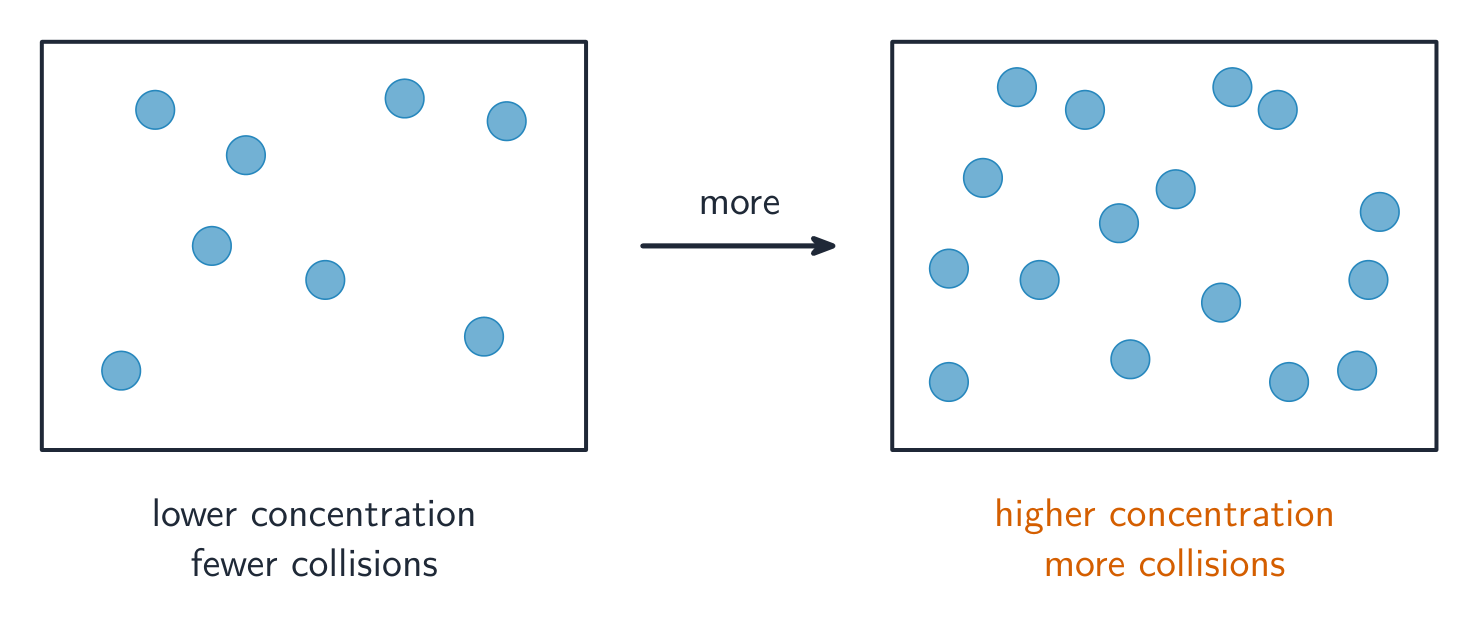
Collision theory 碰撞理论 explains what controls the rate. For a reaction to happen, the particles 粒子 must collide 碰撞, and they must collide with enough energy. The least energy they need is the activation energy 活化能 ($E_a$). A faster rate happens when the particles have successful collisions more often.
| Change | Effect | Reason (collision theory) |
|---|---|---|
| increase concentration 浓度 of a solution | faster | more particles in the same volume, so collisions happen more often |
| increase pressure 压强 of gases | faster | particles are pushed closer, so collisions happen more often |
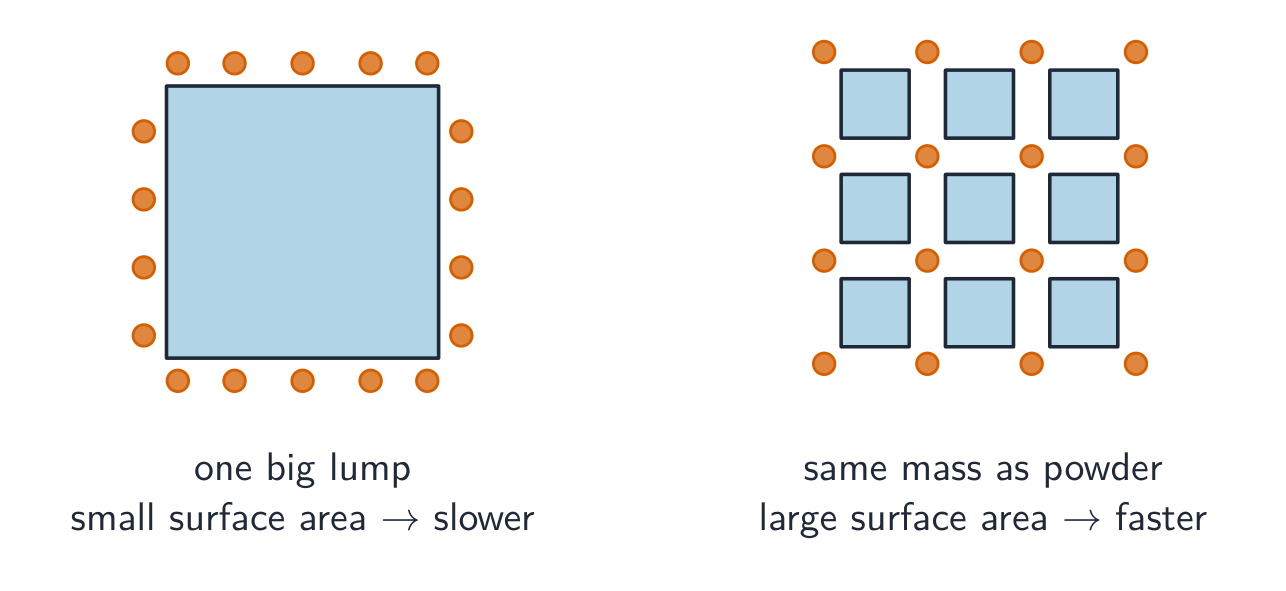
| increase surface area 表面积 of a solid | faster | more particles are exposed, so collisions happen more often |
| increase temperature | faster | particles gain kinetic energy 动能 and move faster, so collisions are more frequent and more of them have enough energy |
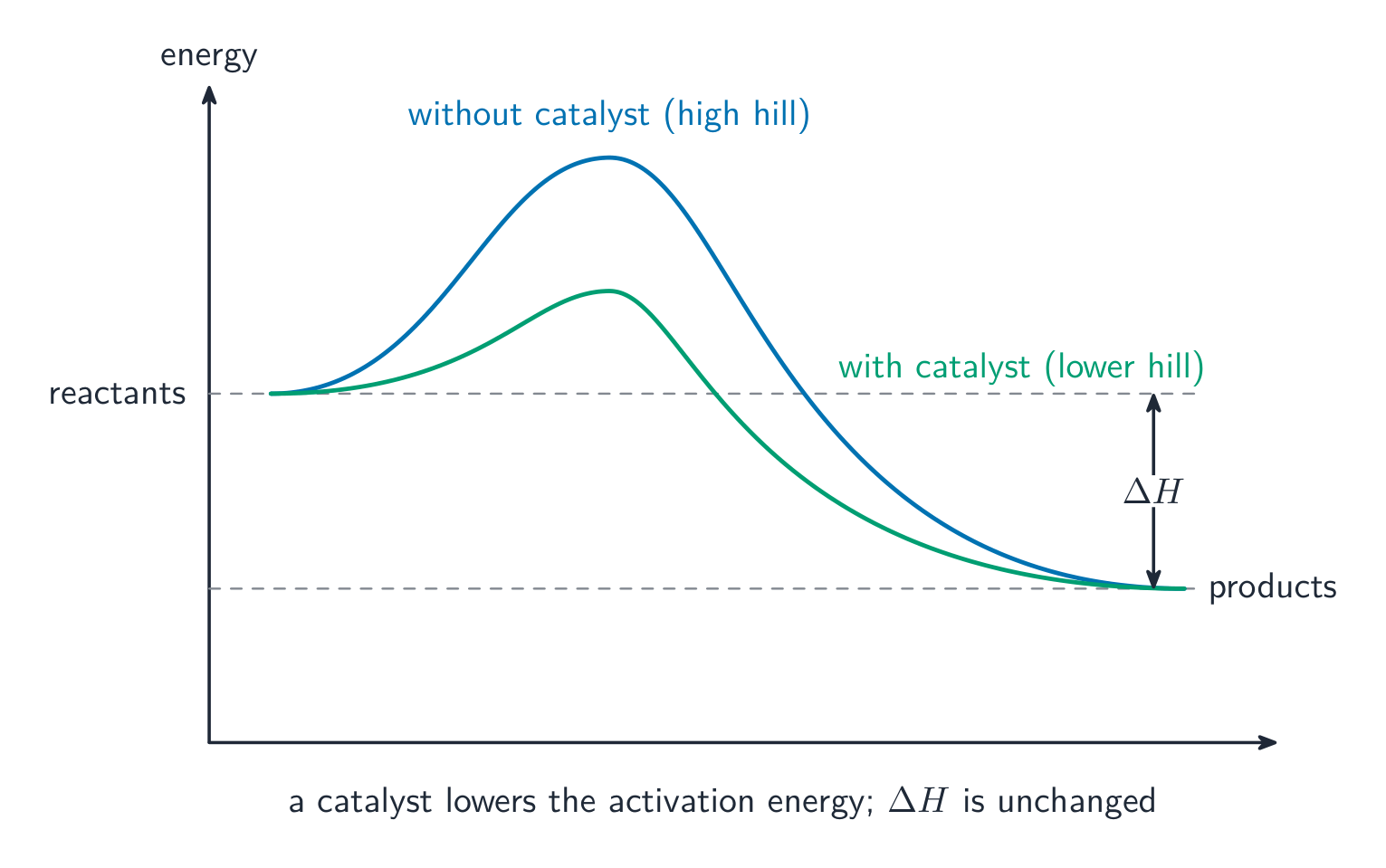
| add a catalyst 催化剂 | faster | the catalyst lowers the activation energy, so more collisions are successful |
A catalyst speeds up a reaction but is not used up — it is unchanged at the end. It works by lowering the activation energy. Enzymes 酶 are biological catalysts (catalysts that work in living things).
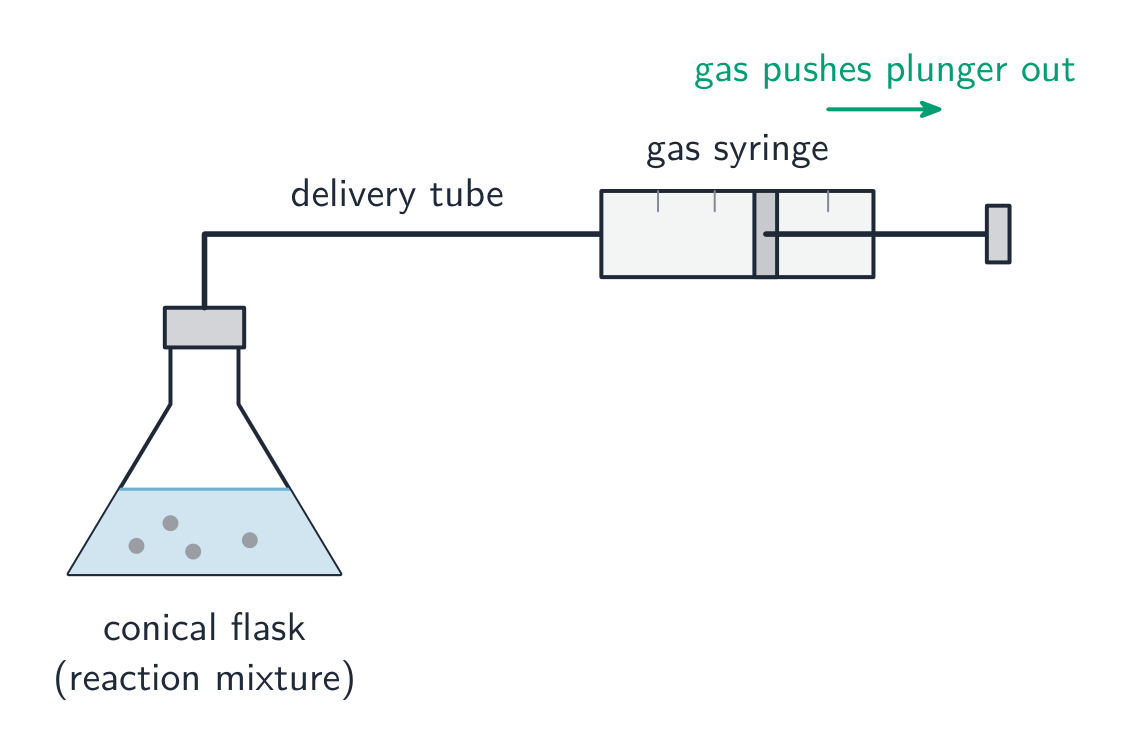
You can follow a reaction over time in these ways:
On a graph of product against time, the line is steepest at the start (fastest rate), becomes less steep as reactants are used up, and goes flat when the reaction has finished.
อัตราการเกิดปฏิกิริยา บอกให้คุณทราบว่า สารตั้งต้น เปลี่ยนไปเป็น ผลิตภัณฑ์ ได้เร็วเพียงใด
ทฤษฎีการชนกัน อธิบายถึงปัจจัยที่ควบคุมอัตราการเกิดปฏิกิริยา เพื่อให้ปฏิกิริยาเกิดขึ้น อนุภาค ต้อง ชนกัน และต้องชนกันด้วยพลังงานที่เพียงพอ พลังงานขั้นต่ำที่จำเป็นคือ พลังงานกัมมันตภาพ ($E_a$) อัตราการเกิดปฏิกิริยาจะเร็วขึ้นเมื่ออนุภาคมีการชนกันอย่างมีผลสำเร็จบ่อยครั้งขึ้น
| การเปลี่ยนแปลง | ผลกระทบ | เหตุผล (ตามทฤษฎีการชนกัน) |
|---|---|---|
| เพิ่ม ความเข้มข้น ของสารละลาย | เร็วขึ้น | มีอนุภาคมากขึ้นในปริมาตรเท่าเดิม ดังนั้นการชนกันจึงเกิดบ่อยขึ้น |
| เพิ่ม ความดัน ของแก๊ส | เร็วขึ้น | อนุภาคถูกอัดเข้าใกล้กันมากขึ้น จึงเกิดการชนกันบ่อยขึ้น |
| เพิ่ม พื้นที่ผิว ของของแข็ง | เร็วขึ้น | มีอนุภาคที่ถูกเปิดเผยออกมามากขึ้น จึงเกิดการชนกันบ่อยขึ้น |
| เพิ่มอุณหภูมิ | เร็วขึ้น | อนุภาคได้รับ พลังงานจลน์ และเคลื่อนที่เร็วขึ้น จึงเกิดการชนกันบ่อยขึ้น และมีจำนวนที่พอมีพลังงานเพียงพอมากขึ้น |
| เพิ่ม ตัวเร่งปฏิกิริยา | เร็วขึ้น | ตัวเร่งปฏิกิริยาลดพลังงานกัมมันตภาพลง จึงทำให้การชนกันประสบความสำเร็จมากขึ้น |
ตัวเร่งปฏิกิริยาช่วยให้ปฏิกิริยาเร็วขึ้นแต่ไม่ถูกใช้ไป - มันไม่เปลี่ยนแปลงเมื่อสิ้นสุดปฏิกิริยา มันทำงานโดยการลดพลังงานกัมมันตภาพ เอนไซม์ เป็นตัวเร่งปฏิกิริยาชีวภาพ (ตัวเร่งปฏิกิริยาที่ทำงานในสิ่งมีชีวิต)
คุณสามารถติดตามปฏิกิริยาตามเวลาได้ด้วยวิธีเหล่านี้:
บนกราฟของผลิตภัณฑ์เทียบกับเวลา เส้นจะ ชันที่สุดที่จุดเริ่มต้น (อัตราเร็วที่สุด), จะค่อยๆ ค่อนข้างลงเมื่อสารตั้งต้นถูกใช้ไป, และจะ ราบ เมื่อปฏิกิริยาสิ้นสุด
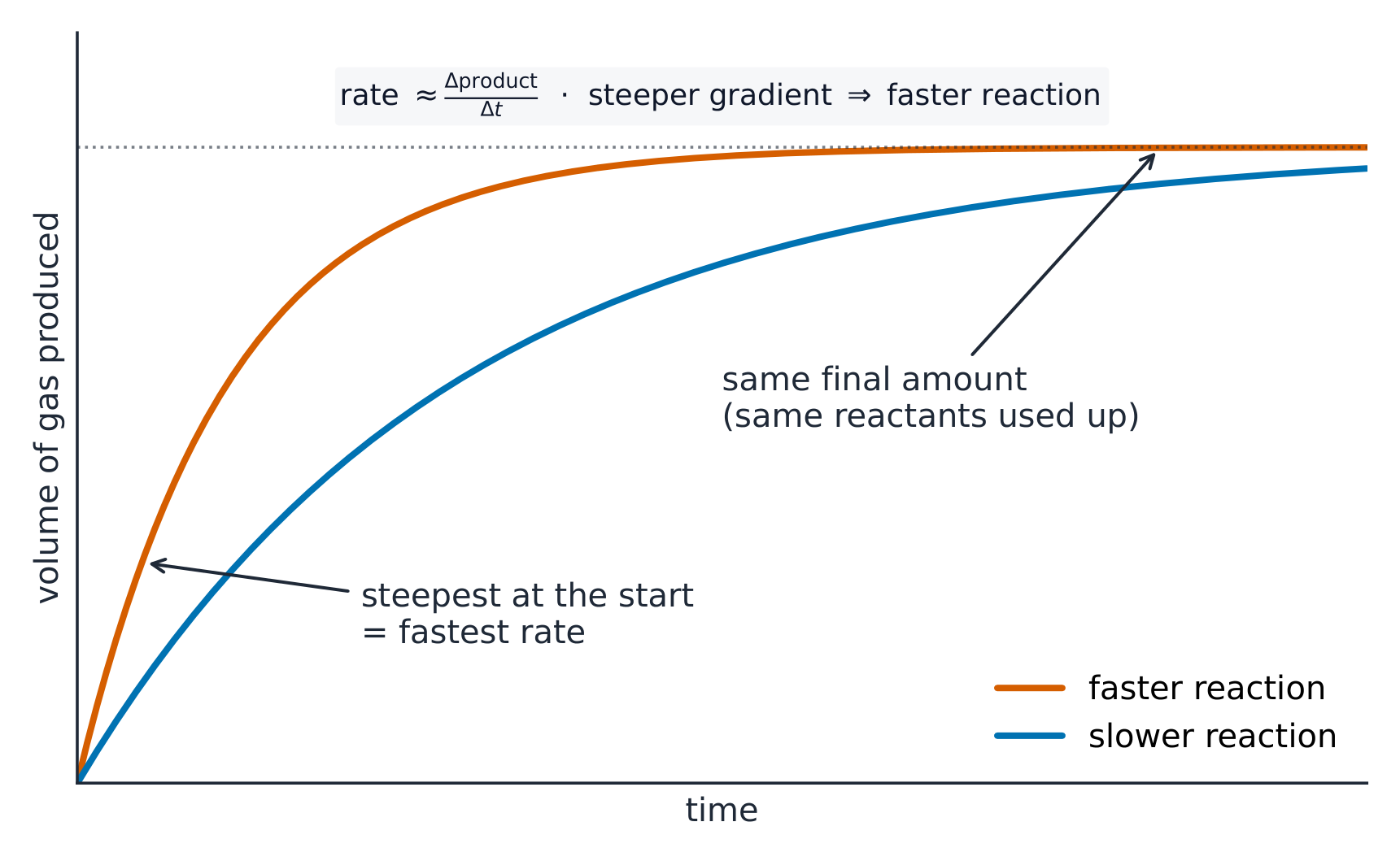 *อัตราการเกิดปฏิกิริยาเร็วที่สุดที่จุดเริ่มต้น (ชันที่สุด) และเส้นจะราบลงเมื่อปฏิกิริยาสิ้นสุด
The gradient of the volume–time curve is the rate; it is steepest at the start and flattens as reactants run out. · ความชันของเส้นโค้งปริมาตร–เวลาคืออัตรา; จะชันที่สุดตอนต้นและแบนลงเมื่อสารตั้งต้นหมดไป
conc = c₀·bᵗ
Concentration falls over time — fast at first, then slower. · ความเข้มข้น ลดลง ตามเวลา — เร็วในตอนแรก แล้วช้าลง
Watch the particles collide. Heat speeds them up so they collide more often and harder; more particles or a catalyst give more successful collisions — the rate climbs. · สังเกตอนุภาคที่ชนกัน ความร้อนทำให้เคลื่อนที่เร็วขึ้น จึงชนกันบ่อยและรุนแรงมากขึ้น การมีอนุภาคมากขึ้นหรือการใช้ตัวเร่งปฏิกิริยาจะทำให้เกิดปฏิกิริยาสफलได้มากกว่า — อัตราการเพิ่มขึ้นของปฏิกิริยาก็สูงขึ้นตามไปด้วย
| English | ไทย |
|---|---|
| physical change/ˈfɪzɪkl tʃeɪndʒ/ | การเปลี่ยนแปลงทางกายภาพ |
| chemical change/ˈkemɪkl tʃeɪndʒ/ | การเปลี่ยนแปลงทางเคมี |
| precipitate/prɪˈsɪpɪteɪt/ | ตะกอน |
| rate of reaction/reɪt ɒv rɪˈækʃn/ | อัตราของปฏิกิริยา |
| reactants/rɪˈæktənts/ | สารตั้งต้น |
| products/ˈprɒdʌkts/ | ผลิตภัณฑ์ |
| collision theory/kəˈlɪʒn ˈθɪəri/ | ทฤษฎีการชนกัน |
| particles/ˈpɑːtɪklz/ | อนุภาค |
| collide/kəˈlaɪd/ | ชนกัน |
| activation energy/ˌæktɪˈveɪʃn ˈenədʒi/ | พลังงานก่อกวน (activation energy) |
| concentration/ˌkɒnsənˈtreɪʃn/ | ความเข้มข้น |
| pressure/ˈpreʃə/ | ความดัน |
| surface area/ˈsɜːfɪs ˈeərɪə/ | พื้นที่ผิว |
| kinetic energy/kɪˈnetɪk ˈenədʒi/ | พลังงานจลน์ |
| catalyst/ˈkætəlɪst/ | ตัวเร่งปฏิกิริยา |
| enzymes/ˈenzaɪmz/ | เอนไซม์ |
| syringe/sɪˈrɪndʒ/ | ฉีดยา |
| reversible reaction/rɪˈvɜːsɪbl rɪˈækʃn/ | ปฏิกิริยาที่ย้อนกลับได้ |
| hydrated/haɪˈdreɪtɪd/ | ไฮเดรต |
| anhydrous/ænˈhaɪdrəs/ | แอนไฮดรัส (ไร้สารละลาย) |
| closed system/kləʊzd ˈsɪstəm/ | ระบบปิด |
| Core | Supplement |
|---|---|
| 1 State that some chemical reactions are reversible as shown by the symbol $\rightleftharpoons$ | 3 State that a reversible reaction in a closed system is at equilibrium when: (a) the rate of the forward reaction is equal to the rate of the reverse reaction (b) the concentrations of reactants and products are no longer changing |
| 2 Describe how changing the conditions can change the direction of a reversible reaction for: (a) the effect of heat on hydrated compounds (b) the addition of water to anhydrous compounds limited to copper(II) sulfate and cobalt(II) chloride | 4 Predict and explain, for a reversible reaction, how the position of equilibrium is affected by: (a) changing temperature (b) changing pressure (c) changing concentration (d) using a catalyst using information provided |
| 5 State the symbol equation for the production of ammonia in the Haber process, $\text{N}_2\text{(g)} + 3\text{H}_2\text{(g)} \rightleftharpoons 2\text{NH}_3\text{(g)}$ | |
| 6 State the sources of the hydrogen (methane) and nitrogen (air) in the Haber process | |
| 7 State the typical conditions in the Haber process as $450\text{ }^{\circ}\text{C}$, $20\,000\text{ kPa}/200\text{ atm}$ and an iron catalyst | |
| 8 State the symbol equation for the conversion of sulfur dioxide to sulfur trioxide in the Contact process, $2\text{SO}_2\text{(g)} + \text{O}_2\text{(g)} \rightleftharpoons 2\text{SO}_3\text{(g)}$ | |
| 9 State the sources of the sulfur dioxide (burning sulfur or roasting sulfide ores) and oxygen (air) in the Contact process | |
| 10 State the typical conditions for the conversion of sulfur dioxide to sulfur trioxide in the Contact process as $450\text{ }^{\circ}\text{C}$, $200\text{ kPa}/2\text{ atm}$ and a vanadium(V) oxide catalyst | |
| 11 Explain, in terms of rate of reaction and position of equilibrium, why the typical conditions stated are used in the Haber process and in the Contact process, including safety considerations and economics |
| แก่น | เพิ่มเติม |
|---|---|
| 1 ระบุว่าปฏิกิริยาเคมีบางชนิดเป็นปฏิกิริยาย้อนกลับตามที่แสดงโดยสัญลักษณ์ $\rightleftharpoons$ | 3 ระบุว่าปฏิกิริยาย้อนกลับในระบบปิดจะอยู่ในสถานะสมดุลเมื่อ: (ก) อัตราการเกิดปฏิกิริยาก้าวหน้าเท่ากับการเกิดปฏิกิริยาก้าวถอยหลัง (ข) ความเข้มข้นของสารตั้งต้นและผลิตภัณฑ์ไม่เปลี่ยนแปลงอีกต่อไป |
| 2 อธิบายว่าการเปลี่ยนสภาพแวดล้อมสามารถทำให้ทิศทางของปฏิกิริยาย้อนกลับเปลี่ยนแปลงได้อย่างไร สำหรับ: (ก) ผลของความร้อนต่อสารประกอบที่มีน้ำผลึก (ข) การเติมน้ำลงไปในสารประกอบไร้ผลึก น้ำ limited to copper(II) sulfate และ cobalt(II) chloride | 4 ทำนายและอธิบาย, สำหรับปฏิกิริยาย้อนกลับ, ว่าตำแหน่งสมดุลได้รับผลกระทบอย่างไรจาก: (ก) การเปลี่ยนอุณหภูมิ (ข) การเปลี่ยนความดัน (ค) การเปลี่ยนความเข้มข้น (ง) การใช้ตัวเร่งปฏิกิริยา โดยใช้ข้อมูลที่ให้มา |
| 5 ระบุสมการสัญลักษณ์สำหรับการผลิตแอมโมเนียในกระบวนการ Haber, $\text{N}_2\text{(g)} + 3\text{H}_2\text{(g)} \rightleftharpoons 2\text{NH}_3\text{(g)}$ | |
| 6 ระบุแหล่งกำเนิดของไฮโดรเจน (มีเทน) และไนโตรเจน (อากาศ) ในกระบวนการ Haber | |
| 7 ระบุสภาพแวดล้อมทั่วไปในกระบวนการ Haber เป็น $450\text{ }^{\circ}\text{C}$, $20\,000\text{ kPa}/200\text{ atm}$ และมีตัวเร่งปฏิกิริยาเหล็ก | |
| 8 ระบุสมการสัญลักษณ์สำหรับการเปลี่ยนซัลเฟอร์ไดออกไซด์เป็นซัลเฟอร์ไตรออกไซด์ในกระบวนการ Contact, $2\text{SO}_2\text{(g)} + \text{O}_2\text{(g)} \rightleftharpoons 2\text{SO}_3\text{(g)}$ | |
| 9 ระบุแหล่งกำเนิดของซัลเฟอร์ไดออกไซด์ (การเผาไหม้ซัลเฟอร์หรือการคั่วแร่ซัลไฟด์) และออกซิเจน (อากาศ) ในกระบวนการ Contact | |
| 10 ระบุสภาพแวดล้อมทั่วไปสำหรับการเปลี่ยนซัลเฟอร์ไดออกไซด์เป็นซัลเฟอร์ไตรออกไซด์ในกระบวนการ Contact เป็น $450\text{ }^{\circ}\text{C}$, $200\text{ kPa}/2\text{ atm}$ และมีตัวเร่งปฏิกิริยาวานาเดียม(V) ออกไซด์ | |
| 11 อธิบาย, ในแง่ของอัตราการเกิดปฏิกิริยาและตำแหน่งสมดุล, ทำไมสภาพแวดล้อมทั่วไปที่ระบุถึงจึงถูกใช้ในกระบวนการ Haber และในกระบวนการ Contact รวมถึงข้อพิจารณาด้านความปลอดภัยและเศรษฐกิจ |
Source: Cambridge International syllabus · แหล่งที่มา: หลักสูตร Cambridge International
Some reactions are reversible 可逆反应: the products can react to form the reactants again. We show this with the symbol $\rightleftharpoons$.
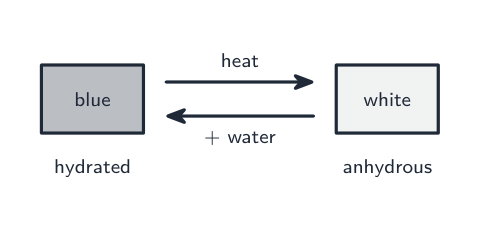
A clear example uses hydrated 水合 and anhydrous 无水 compounds:
Adding water to the anhydrous solid (and seeing the colour return) is used as a test for water.
In a closed system 密闭系统 (where nothing enters or leaves), a reversible reaction reaches equilibrium 平衡 when:
The position of equilibrium 平衡位置 tells you whether there are more reactants or more products. You can move it:
The Haber process 哈伯法 makes ammonia:
The Contact process 接触法 turns sulfur dioxide into sulfur trioxide:
The conditions are a compromise 折中:
ปฏิกิริยาบางชนิดเป็น ปฏิกิริยาย้อนกลับ: ผลิตภัณฑ์สามารถทำปฏิกิริยากันเพื่อสร้างสารตั้งต้นขึ้นมาใหม่อีกครั้ง เราแสดงสิ่งนี้ด้วยสัญลักษณ์ $\rightleftharpoons$
ตัวอย่างที่ชัดเจนใช้สารประกอบ ไฮเดรต และ ไม่มีน้ำ :
การเพิ่มน้ำลงในของแข็งที่ไม่มีน้ำ (และการเห็นสีกลับมา) ใช้เป็นการทดสอบหาไอน้ำ
ในระบบ ปิด (ซึ่งไม่มีอะไรเข้าไปหรือออก) ปฏิกิริยาย้อนกลับจะเข้าสู่ ความสมดุล เมื่อ:
ตำแหน่งความสมดุล บอกให้คุณรู้ว่ามีการสารตั้งต้นมากกว่าหรือผลิตภัณฑ์มากกว่า คุณสามารถย้ายตำแหน่งได้:
กระบวนการ Haber ผลิตแอมโมเนีย:
กระบวนการคอนแทค เปลี่ยนซัลเฟอร์ไดออกไซด์เป็นซัลเฟอร์ไตรออกไซด์:
สภาวะเหล่านี้เป็น จุดกึ่งกลาง:
Change temperature, pressure or concentration and watch a reversible reaction shift to a new balance. · เปลี่ยนอุณหภูมิ ความดัน หรือความเข้มข้นและดูปฏิกิริยากลับตัว เลื่อน ไปสู่สมดุลใหม่
| English | ไทย |
|---|---|
| equilibrium/ˌiːkwɪˈlɪbrɪəm/ | จุดดุลยภาพ |
| forward reaction/ˈfɔːwəd rɪˈækʃn/ | ปฏิกิริยาไปข้างหน้า |
| reverse reaction/rɪˈvɜːs rɪˈækʃn/ | ปฏิกิริยากลับด้าน |
| position of equilibrium/pəˈzɪʃn ɒv ˌiːkwɪˈlɪbrɪəm/ | ตำแหน่งสมดุล |
| endothermic/ˌendəʊˈθɜːmɪk/ | ดูดความร้อน |
| exothermic/eɡzəˈðɜːmɪk/ | คายความร้อน |
| Haber process/ˈheɪbə ˈprəʊses/ | กระบวนการฮาเบอร์ |
| hydrogen/ˈhaɪdrədʒn/ | ไฮโดรเจน |
| methane/ˈmiːθeɪn/ | มีเทน |
| nitrogen/ˈnaɪtrədʒn/ | ไนโตรเจน |
| iron/ˈaɪən/ | เหล็ก |
| Contact process/ˈkɒntækt ˈprəʊses/ | กระบวนการคอนแทค |
| sulfur/ˈsʌlfɜː/ | กำมะถัน |
| oxygen/ˈɒksɪdʒn/ | ออกซิเจน |
| vanadium(V) oxide/væˈneɪdɪəm ˈɒksaɪd/ | วานาเดียม(V) ออกไซด์ |
| compromise/ˈkɒmprəmaɪz/ | การประนีประนอม |
| Core | Supplement |
|---|---|
| 1 Use a Roman numeral to indicate the oxidation number of an element in a compound | |
| 2 Define redox reactions as involving simultaneous oxidation and reduction | |
| 3 Define oxidation as gain of oxygen and reduction as loss of oxygen | 6 Define oxidation in terms of: (a) loss of electrons (b) an increase in oxidation number |
| 7 Define reduction in terms of: (a) gain of electrons (b) a decrease in oxidation number | |
| 4 Identify redox reactions as reactions involving gain and loss of oxygen | 8 Identify redox reactions as reactions involving gain and loss of electrons |
| 5 Identify oxidation and reduction in redox reactions | 9 Identify redox reactions by changes in oxidation number using: (a) the oxidation number of elements in their uncombined state is zero (b) the oxidation number of a monatomic ion is the same as the charge on the ion (c) the sum of the oxidation numbers in a compound is zero (d) the sum of the oxidation numbers in an ion is equal to the charge on the ion |
| 10 Identify redox reactions by the colour changes involved when using acidified aqueous potassium manganate(VII) or aqueous potassium iodide | |
| 11 Define an oxidising agent as a substance that oxidises another substance and is itself reduced | |
| 12 Define a reducing agent as a substance that reduces another substance and is itself oxidised | |
| 13 Identify oxidising agents and reducing agents in redox reactions |
| แก่น | เพิ่มเติม |
|---|---|
| 1 ใช้เลขโรมันเพื่อระบุเลขออกซิเดชันของธาตุในสารประกอบ | |
| 2 นิยามปฏิกิริยา redox ว่าเป็นปฏิกิริยาที่เกี่ยวข้องกับการเกิดออกซิเดชันและการเกิดรีดักชันไปพร้อมกัน | |
| 3 นิยามออกซิเดชันเป็นการรับออกซิเจนและการเกิดรีดักชันเป็นการสูญเสียออกซิเจน | 6 นิยามออกซิเดชันในแง่ของ: (ก) การสูญเสียอิเล็กตรอน (ข) การเพิ่มขึ้นของเลขออกซิเดชัน |
| 7 นิยามการเกิดรีดักชันในแง่ของ: (ก) การรับอิเล็กตรอน (ข) การลดลงของเลขออกซิเดชัน | |
| 4 ระบุปฏิกิริยา redox ว่าเป็นปฏิกิริยาที่เกี่ยวข้องกับการรับและสูญเสียออกซิเจน | 8 ระบุปฏิกิริยา redox ว่าเป็นปฏิกิริยาที่เกี่ยวข้องกับการรับและสูญเสียอิเล็กตรอน |
| 5 ระบุออกซิเดชันและการเกิดรีดักชันในปฏิกิริยา redox | 9 ระบุปฏิกิริยา redox โดยการเปลี่ยนแปลงของเลขออกซิเดชันโดยใช้: (ก) เลขออกซิเดชันของธาตุในรูปอิสระคือศูนย์ (ข) เลขออกซิเดชันของไอออนอะตอมเดียวเท่ากับประจุของไอออนนั้น (ค) ผลรวมของเลขออกซิเดชันในสารประกอบเป็นศูนย์ (ง) ผลรวมของเลขออกซิเดชันในไอออนเท่ากับประจุของไอออนนั้น |
| 10 ระบุปฏิกิริยา redox จากการเปลี่ยนแปลงสีที่เกี่ยวข้องเมื่อใช้กรดที่เจือจางด้วยสารละลายโพแทสเซียมแมงกานีส(VII) หรือสารละลายโพแทสเซียมไอโอไดด์ | |
| 11 นิยามสารออกซิไดซ์ว่าเป็นสารที่ทำให้ออกซิไดซ์สารอื่นและ自己被 reduce | |
| 12 นิยามสารรีดิวซ์ว่าเป็นสารที่ทำให้รีดิวซ์สารอื่นและ自己被 oxidize | |
| 13 ระบุสารออกซิไดซ์และสารรีดิวซ์ในปฏิกิริยา redox |
Source: Cambridge International syllabus · แหล่งที่มา: หลักสูตร Cambridge International
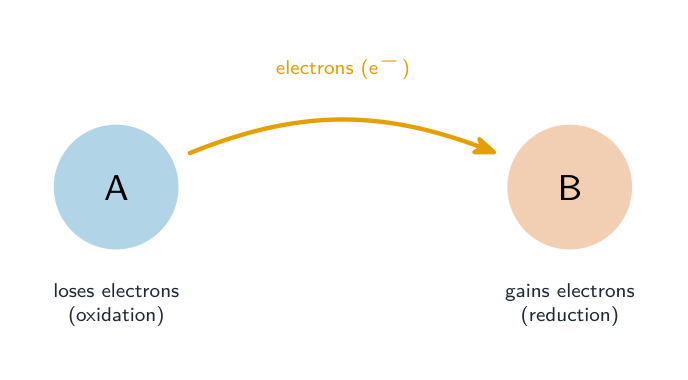
Oxidation 氧化 and reduction 还原 always happen at the same time, in what is called a redox reaction 氧化还原反应. ('Redox' is short for reduction–oxidation.)
There are three ways to describe oxidation and reduction:
A useful memory aid is OIL RIG: Oxidation Is Loss, Reduction Is Gain — of electrons.
The oxidation number is shown by a Roman numeral, as in iron(II) and iron(III). The rules are:
Worked example. Find the oxidation number of manganese in the manganate(VII) ion, $\text{MnO}_4^{-}$. Each oxygen is $-2$, and there are four of them, giving $4 \times (-2) = -8$. The oxidation numbers in an ion must add up to the charge on the ion, which here is $-1$. So if manganese is $x$, then $x + (-8) = -1$, giving $x = +7$ - exactly what the (VII) in the name tells you. Set the total to the ion's charge, not to zero: zero is only for a neutral compound.
Some redox reactions show clear colour changes:
ออกซิเดชัน และ รีดักชัน เกิดขึ้นพร้อมกันเสมอ ในสิ่งที่เรียกว่า ปฏิกิริยารีดอกซ์ ('Redox' ย่อมาจาก reduction–oxidation.)
มีสามวิธีในการอธิบายออกซิเดชันและรีดักชัน:
คำทบทจำที่มีประโยชน์คือ OIL RIG: Oxidation Is Loss, Reduction Is Gain — ของอิเล็กตรอน
เลขออกซิเดชันแสดงด้วยตัวเลขโรมัน เช่น的铁(II) และ铁(III). กฎมีดังนี้:
ตัวอย่างฝึกหัด. หาเลขออกซิเดชันของแมงกานีสในไอออนแมงกาเนต(VII), $\text{MnO}_4^{-}$. ออกซิเจนแต่ละตัวมีค่า $-2$ และมีทั้งหมดสี่ตัว รวมได้ $4 \times (-2) = -8$. เลขออกซิเดชันใน ไอออน ต้องรวมกันได้เท่ากับประจุของไอออน ซึ่งในที่นี้คือ $-1$. ดังนั้นถ้าแมงกานีสมีค่า $x$ แล้ว $x + (-8) = -1$ จะได้ผลรวม $x = +7$ - พอดีกับ (VII) ที่ปรากฏในชื่อ กำหนดให้ผลรวมเท่ากับ ประจุของไอออน ไม่ใช่ศูนย์: ศูนย์ใช้ได้เฉพาะสารประกอบที่เป็นกลางเท่านั้น
ปฏิกิริยารีดอกซ์บางชนิดมีการเปลี่ยนแปลงสีที่ชัดเจน:
Step through a redox reaction. One substance loses electrons while another gains them — you can never have one without the other. · พิจารณาปฏิกิริยาออกซิเดชัน-รีดักชัน หนึ่งสารจะสูญเสียอิเล็กตรอนในขณะที่อีกสารรับอิเล็กตรอน — คุณไม่สามารถมีอย่างใดอย่างหนึ่งโดยไม่ได้อีกอย่างได้
| English | ไทย |
|---|---|
| oxidation/ˌɒksɪˈdeɪʃn/ | การออกซิเดชัน |
| reduction/rɪˈdʌkʃn/ | การลดรูป (reduction) |
| redox reaction/rɪˈdɒks rɪˈækʃn/ | ปฏิกิริยารีดอกซ์ |
| potassium manganate(VII)/pəˈtæsɪəm ˈmæŋɡəneɪt/ | โพแทสเซียมแมงกานีน(VII) ออกไซด์ |
| potassium iodide/pəˈtæsɪəm ˈaɪədaɪd/ | โพแทสเซียมไอโอดाइด์ |
| iodine/ˈaɪədiːn/ | ไอโอดีน |
| English | ไทย |
|---|---|
| electrons/ɪˈlektrɒnz/ | อิเล็กตรอน |
| oxidation number/ˌɒksɪˈdeɪʃn ˈnʌmbə/ | เลขออกซิเดชัน |
| oxidising agent/ˈɒksɪdaɪzɪŋ ˈeɪdʒənt/ | สารออกซิไดซ์ |
| reducing agent/rɪˈdjuːsɪŋ ˈeɪdʒənt/ | สารลด |
Work through it step by step, with instant-check exercises. · ทำทีละขั้นตอน พร้อมแบบฝึกหัดตรวจสอบผลทันที
Past Papers · ข้อสอบย้อนหลัง
Loading subjects… · กำลังโหลดวิชา…