Skip to content · ⁨ข้ามไปยังเนื้อหา⁩

Pure Mathematics 2 · ⁨คณิตศาสตร์บริสุทธิ์ 2⁩

A-Level Mathematics · ⁨Mathematics A-Level⁩ · Topic 2 · ⁨หัวข้อ 2⁩

Video lesson for this topic · ⁨บทเรียนวิดีโอสำหรับหัวข้อนี้⁩ Open the video page · ⁨เปิดหน้าวิดีโอ⁩
12:32

คณิตศาสตร์บริสุทธิ์ 2

ในปีสองพันสิบเอ็ด โลกสั่นสะเทือน off Japan วัดได้เก้าบนมาตราส่วนริคเตอร์ โลกสั่นสะเทือนเล็กกว่าอาจวัดได้หก ห่างกันเพียงสามจุด — แต่ครั้งแรก…

English narration · English + 中文 subtitles burned in · ⁨การบรรยายภาษาอังกฤษ · คำบรรยายภาษาอังกฤษ + 中文 ลอยตัวบนภาพ⁩

English

This handout covers Topic 2: Pure Mathematics 纯数学 2. It adds the modulus and polynomial algebra, logarithms 对数 and the exponential function 指数函数, more trigonometry, and new ways to differentiate and integrate.

ไทย

เอกสารฉบับนี้ครอบคลุมหัวข้อที่ 2: Pure Mathematics 2 เติมเต็มเนื้อหาเรื่อง modulus และพีชคณิตพหุนาม logarithms และ exponential function, ตรีโกณมิติเพิ่มเติม และวิธีการ differentiation และ integration แบบใหม่

2.1

Algebra · ⁨พีชคณิต⁩

Syllabus · ⁨หลักสูตร⁩
English
Candidates should be able to: Notes and examples
understand the meaning of $|x|$, sketch the graph of $y = |ax + b|$ and use relations such as $|a| = |b| \iff a^2 = b^2$ and $|x - a| < b \iff a - b < x < a + b$ when solving equations and inequalities Graphs of $y = |f(x)|$ and $y = f(|x|)$ for non-linear functions $f$ are not included. e.g. $|3x - 2| = |2x + 7|$, $2x + 5 < |x + 1|$
divide a polynomial, of degree not exceeding 4, by a linear or quadratic polynomial, and identify the quotient and remainder (which may be zero)
use the factor theorem and the remainder theorem. e.g. to find factors and remainders, solve polynomial equations or evaluate unknown coefficients. Including factors of the form $(ax + b)$ in which the coefficient of $x$ is not unity, and including calculation of remainders.
ไทย
ผู้เข้าสอบควรสามารถ: หมายเหตุและตัวอย่าง
เข้าใจความหมายของ $|x|$, วาดกราฟของ $y = |ax + b|$ และใช้ความสัมพันธ์เช่น $|a| = |b| \iff a^2 = b^2$ และ $|x - a| < b \iff a - b < x < a + b$ เมื่อแก้สมการและอสมการ กราฟของ $y = |f(x)|$ และ $y = f(|x|)$ สำหรับฟังก์ชันไม่เชิงเส้น $f$ ไม่รวมอยู่ เช่น primer $|3x - 2| = |2x + 7|$, $2x + 5 < |x + 1|$
หาร พหุนาม, ที่มีดีกรีไม่เกิน 4, ด้วย พหุนาม เชิงเส้นหรือเชิงคู่, และระบุ ผลหาร และ เศษ (ซึ่งอาจเป็นศูนย์)
ใช้ ทฤษฎีบทตัวประกอบ และ ทฤษฎีบทเศษ เช่น primeหาตัวประกอบและเศษ, แก้สมการพหุนามหรือหาค่าสัมประสิทธิ์ที่ไม่ทราบค่า รวมถึงตัวประกอบในรูป $(ax + b)$ ที่สัมประสิทธิ์ของ $x$ ไม่ใช่เอกนิยม, และรวมถึงการคำนวณเศษ

Source: Cambridge International syllabus · ⁨แหล่งที่มา: หลักสูตร Cambridge International⁩

English

The modulus

The modulus 绝对值 $|x|$ is the size of a number with its sign removed, so $|x| \geqslant 0$ always. The graph of $y = |ax + b|$ is a "V" shape that bounces off the $x$-axis. Two useful rules for solving equations and inequalities are

$$|a| = |b| \;\Leftrightarrow\; a^2 = b^2, \qquad |x - a| < b \;\Leftrightarrow\; a - b < x < a + b.$$

Worked example. Solve $|3x + 8| < 9$.

Using the second rule with the inequality written as $-9 < 3x + 8 < 9$:

$$-9 < 3x + 8 < 9 \;\Rightarrow\; -17 < 3x < 1 \;\Rightarrow\; -\tfrac{17}{3} < x < \tfrac13.$$

Polynomial division and the factor and remainder theorems

A polynomial 多项式 is a sum of powers of $x$, such as $2x^4 + 3x^2 - 5$. Its degree 次数 is the highest power. When you divide one polynomial by another you get a quotient 商 and a remainder 余数.

  • Remainder theorem 余数定理: the remainder when $p(x)$ is divided by $(x - a)$ is $p(a)$.
  • Factor theorem 因式定理: $(x - a)$ is a factor of $p(x)$ exactly when $p(a) = 0$.

Worked example. The polynomial $p(x) = 2x^4 + kx^3 + kx^2 + 17x + 18$ has factor $(x + 2)$. Find $k$.

By the factor theorem $p(-2) = 0$:

$$2(16) + k(-8) + k(4) + 17(-2) + 18 = 0 \;\Rightarrow\; 16 - 4k = 0 \;\Rightarrow\; k = 4.$$

ไทย

The modulus

The modulus $|x|$ คือขนาดของตัวเลขโดยไม่考虑เครื่องหมาย ดังนั้น $|x| \geqslant 0$ เสมอ กราฟของ $y = |ax + b|$ มีรูปร่าง "V" ที่สะท้อนกลับจากแกน $x$ กฎที่สำคัญสองอย่างสำหรับการแก้สมการและอสมการคือ

$$|a| = |b| \;\Leftrightarrow\; a^2 = b^2, \qquad |x - a| < b \;\Leftrightarrow\; a - b < x < a + b.$$

เส้นตรงที่ลดต่ำลงต่ำกว่าแกน x แล้วพับส่วนนั้นขึ้นเป็นรูป V
การนำ modulus มาใช้จะพับส่วนของเส้นที่อยู่ใต้แกนขึ้นไปเป็นรูป V

ตัวอย่างวิธีทำ. แก้ $|3x + 8| < 9$

ใช้กฎที่สองร่วมกับอสมการที่เขียนในรูป $-9 < 3x + 8 < 9$:

$$-9 < 3x + 8 < 9 \;\Rightarrow\; -17 < 3x < 1 \;\Rightarrow\; -\tfrac{17}{3} < x < \tfrac13.$$

การหารพหุนามและทฤษฎีบทตัวประกอบและเศษเหลือ

Polynomial คือผลบวกของกำลังของ $x$ เช่น $2x^4 + 3x^2 - 5$ Degree ของมันคือกำลังสูงสุด เมื่อคุณหาร polynomial หนึ่งด้วยอีกตัวหนึ่งจะได้ quotient และ remainder

  • Remainder theorem: เศษเหลือเมื่อ $p(x)$ หารด้วย $(x - a)$ คือ $p(a)$
  • Factor theorem: $(x - a)$ เป็น factor ของ $p(x)$ ก็ต่อเมื่อ $p(a) = 0$

ตัวอย่างที่คำนวณแล้ว. Polynomial $p(x) = 2x^4 + kx^3 + kx^2 + 17x + 18$ มี factor คือ $(x + 2)$. หา $k$

ตามทฤษฎีบทตัวประกอบ $p(-2) = 0$:

$$2(16) + k(-8) + k(4) + 17(-2) + 18 = 0 \;\Rightarrow\; 16 - 4k = 0 \;\Rightarrow\; k = 4.$$

Explore · ⁨สำรวจ⁩

The modulus function · ⁨ฟังก์ชันค่าสัมบูรณ์⁩

y = a|x − b| + c

The modulus makes a V-shape. Move its vertex with b and c; change how steep the arms are with a. · ⁨ฟังก์ชันค่าสัมบูรณ์ทำให้เกิดรูป ตัว V เลื่อน จุดยอด ด้วย b และ c; เปลี่ยนความชันของ แขน ด้วย a⁩

Vocabulary · ⁨คำศัพท์⁩ Train · ⁨ฝึกฝน⁩
English ไทย
modulus/ˈmɒdjʊləs/ โมดูลัส
polynomial/ˌpɒlɪˈnəʊmɪəl/ พหุนาม
degree/dɪˈɡriː/ ดีกรี
quotient/ˈkwəʊʃənt/ ผลหาร
remainder/rɪˈmeɪndə/ เศษ
remainder theorem/rɪˈmeɪndə ˈθɪərəm/ ทฤษฎีบทเศษเหลือ
factor theorem/ˈfæktə ˈθɪərəm/ ทฤษฎีบทตัวประกอบ
2.2

Logarithmic and exponential functions · ⁨ฟังก์ชัน logaritมิกและเอกซ์โพเนนเชียล⁩

Syllabus · ⁨หลักสูตร⁩
English
Candidates should be able to: Notes and examples
understand the relationship between logarithms and indices, and use the laws of logarithms (excluding change of base)
understand the definition and properties of $e^x$ and $\ln x$, including their relationship as inverse functions and their graphs Including knowledge of the graph of $y = e^{kx}$ for both positive and negative values of $k$.
use logarithms to solve equations and inequalities in which the unknown appears in indices e.g. $2^x < 5$, $3 \times 2^{3x-1} < 5$, $3^{x+1} = 4^{2x-1}$
use logarithms to transform a given relationship to linear form, and hence determine unknown constants by considering the gradient and/or intercept. e.g. $y = kx^n$ gives $\ln y = \ln k + n \ln x$ which is linear in $\ln x$ and $\ln y$ $y = k(a^x)$ gives $\ln y = \ln k + x \ln a$ which is linear in $x$ and $\ln y$.
ไทย
ผู้เข้าสอบควรสามารถ: หมายเหตุและตัวอย่าง
เข้าใจความสัมพันธ์ระหว่าง ลอการิทึม และ เลขชี้กำลัง, และใช้กฎของ ลอการิทึม (ยกเว้นการเปลี่ยนฐาน)
เข้าใจนิยามและคุณสมบัติของ $e^x$ และ $\ln x$, รวมถึงความสัมพันธ์ שלהกันเป็น ฟังก์ชันนาม역 และกราฟ שלה它们 รวมถึงความรู้关于กราฟของ $y = e^{kx}$ สำหรับค่าบวกและลบของ $k$
ใช้ ลอการิทึม เพื่อแก้สมการและอสมการที่ตัวแปร未知的ปรากฏใน เลขชี้กำลัง เช่น primer $2^x < 5$, $3 \times 2^{3x-1} < 5$, $3^{x+1} = 4^{2x-1}$
ใช้ ลอการิทึม เพื่อแปลงความสัมพันธ์ที่กำหนดให้ให้อยู่ในรูปเชิงเส้น และดังนั้นจึงหาค่าคงที่ที่ไม่ทราบค่าได้โดยการพิจารณาความชันและ/หรือจุดตัดแกน เช่น $y = kx^n$ ให้ $\ln y = \ln k + n \ln x$ ซึ่งเป็นเชิงเส้นใน $\ln x$ และ $\ln y$ $y = k(a^x)$ ให้ $\ln y = \ln k + x \ln a$ ซึ่งเป็นเชิงเส้นใน $x$ และ $\ln y$.

Source: Cambridge International syllabus · ⁨แหล่งที่มา: หลักสูตร Cambridge International⁩

English

A logarithm answers the question "what power?". If $a^x = y$ then $x = \log_a y$. Logarithms and indices 指数 (powers) are reverse ideas. The laws of logarithms 对数定律 are

$$\log(mn) = \log m + \log n, \qquad \log\!\frac{m}{n} = \log m - \log n, \qquad \log(m^k) = k\log m.$$

The exponential function $e^x$ and the natural logarithm 自然对数 $\ln x$ are inverse functions, so $\ln(e^x) = x$ and $e^{\ln x} = x$. When the unknown is in the power, take logs of both sides.

Worked example. Solve $4^x < 0.05$.

$$4^x < 0.05 \;\Rightarrow\; x\ln 4 < \ln 0.05 \;\Rightarrow\; x < \frac{\ln 0.05}{\ln 4} = -2.16 \ (\text{3 s.f.}).$$

Linear form 线性形式: a relationship like $y = Ax^n$ becomes a straight line if you take logs: $\ln y = \ln A + n\ln x$. Plotting $\ln y$ against $\ln x$ gives a line with gradient $n$ and intercept $\ln A$, so you can find the unknown constants.

ไทย
เครื่องบันทึกคลื่นสั่นสะเทือนจากแผ่นดินไหว
ความแรงของแผ่นดินวัดได้ด้วยสเกล Richter แบบ logaritมิก
กลุ่มคนหนาแน่น
ประชากรสามารถเติบโตแบบเอกซ์โพเนนเชียลเมื่อมีทรัพยากรเพียงพอ

Logarithm ตอบคำถามว่า "ยกกำลังเท่าไหร่?" ถ้า $a^x = y$ แล้ว $x = \log_a y$ Logarithms และ indices (powers) เป็นแนวคิดตรงกันข้าม กฎของ logarithms คือ

$$\log(mn) = \log m + \log n, \qquad \log\!\frac{m}{n} = \log m - \log n, \qquad \log(m^k) = k\log m.$$

ฟังก์ชันเอกซ์โพเนนเชียล $e^x$ และ natural logarithm $\ln x$ เป็น inverse functions ดังนั้น $\ln(e^x) = x$ และ $e^{\ln x} = x$. เมื่อตัวแปรที่ไม่ทราบค่าอยู่ในกำลัง ให้ทำ logs ทั้งสองข้าง

กราฟของ e^x และ ln x สะท้อนกันผ่านเส้นตรง y = x
$e^x$ และ $\ln x$ ทำลายล้างกันและกัน ดังนั้นแต่ละตัวจึงเป็นการสะท้อนของอีกตัวใน $y=x$

ตัวอย่างวิธีทำ. แก้ $4^x < 0.05$

$$4^x < 0.05 \;\Rightarrow\; x\ln 4 < \ln 0.05 \;\Rightarrow\; x < \frac{\ln 0.05}{\ln 4} = -2.16 \ (\text{3 s.f.}).$$

รูปแบบเชิงเส้น: ความสัมพันธ์เช่น $y = Ax^n$ จะกลายเป็นเส้นตรงหากคุณทำ logs: $\ln y = \ln A + n\ln x$. การพล็อต $\ln y$ เทียบกับ $\ln x$ จะได้เส้นที่มีความชัน $n$ และจุดตัดแกน $\ln A$ ดังนั้นคุณสามารถหาค่าคงตัวที่ไม่ทราบค่าได้

Explore · ⁨สำรวจ⁩

Exponential growth · ⁨การเติบโตแบบเอกซ์โพเนนเชียล⁩

y = a·bˣ

Change the base b: when b > 1 the curve grows, when 0 < b < 1 it decays — and it always passes through (0, a). · ⁨เปลี่ยน ฐาน b: เมื่อ b > 1 เส้นโค้งจะ เติบโต, เมื่อ 0 < b < 1 จะ ลดลง — และมันจะผ่านจุด (0, a) เสมอ⁩

Vocabulary · ⁨คำศัพท์⁩ Train · ⁨ฝึกฝน⁩
English ไทย
Pure Mathematics/pjʊə ˌmæθɪˈmætɪks/ คณิตศาสตร์บริสุทธิ์
logarithms/ˈlɒɡərɪθəmz/ ลอการิทึม
exponential function/ˌekspəˈnenʃl ˈfʌŋkʃn/ ฟังก์ชันเอ็กซ์โพเนนเชียล
indices/ˈɪndɪsiːz/ เลขชี้กำลัง
laws of logarithms/lɔːz ɒv ˈlɒɡərɪθəmz/ กฎของลอการิทึม
natural logarithm/ˈnætʃərəl ˈlɒɡərɪθəm/ ลอการิทึมธรรมชาติ
linear form/ˈlɪnɪə fɔːm/ รูปแบบเชิงเส้น
2.3

Trigonometry · ⁨ตรีโกณมิติ⁩

Syllabus · ⁨หลักสูตร⁩
English
Candidates should be able to: Notes and examples
understand the relationship of the secant, cosecant and cotangent functions to cosine, sine and tangent, and use properties and graphs of all six trigonometric functions for angles of any magnitude
use trigonometrical identities for the simplification and exact evaluation of expressions, and in the course of solving equations, and select an identity or identities appropriate to the context, showing familiarity in particular with the use of: – $\sec^2 \theta \equiv 1 + \tan^2 \theta$ and $\csc^2 \theta \equiv 1 + \cot^2 \theta$ – the expansions of $\sin(A \pm B)$, $\cos(A \pm B)$ and $\tan(A \pm B)$ – the formulae for $\sin 2A$, $\cos 2A$ and $\tan 2A$ – the expression of $a \sin \theta + b \cos \theta$ in the forms $R \sin(\theta \pm \alpha)$ and $R \cos(\theta \pm \alpha)$. e.g. simplifying $\cos(x - 30^\circ) - 3 \sin(x - 60^\circ)$. e.g. solving $\tan \theta + \cot \theta = 4$, $2 \sec^2 \theta - \tan \theta = 5$, $3 \cos \theta + 2 \sin \theta = 1$.
ไทย
ผู้เข้าสอบควรสามารถ: หมายเหตุและตัวอย่าง
เข้าใจความสัมพันธ์ของฟังก์ชัน เซกแทนต์, โคเซกแทนต์ และ โคแทงเจนต์ กับ cos, sin และ tan และใช้สมบัติและกราฟของฟังก์ชันตรีโกณมิติทั้งหกสำหรับมุมทุกขนาด
ใช้เอกลักษณ์ตรีโกณมิติเพื่อจัดรูปและหาค่าที่แน่นอนของนิพจน์ รวมถึงในการแก้สมการ และเลือกเอกลักษณ์หรือเอกลักษณ์ที่เหมาะสมกับบริบท โดยแสดงความคุ้นเคยเป็นพิเศษกับการใช้: – $\sec^2 \theta \equiv 1 + \tan^2 \theta$ และ $\csc^2 \theta \equiv 1 + \cot^2 \theta$ – การกระจายของ $\sin(A \pm B)$, $\cos(A \pm B)$ และ $\tan(A \pm B)$ – สูตรสำหรับ $\sin 2A$, $\cos 2A$ และ $\tan 2A$ – การแสดง $a \sin \theta + b \cos \theta$ ในรูป $R \sin(\theta \pm \alpha)$ และ $R \cos(\theta \pm \alpha)$. เช่น การจัดรูป $\cos(x - 30^\circ) - 3 \sin(x - 60^\circ)$. เช่น การแก้ $\tan \theta + \cot \theta = 4$, $2 \sec^2 \theta - \tan \theta = 5$, $3 \cos \theta + 2 \sin \theta = 1$.

Source: Cambridge International syllabus · ⁨แหล่งที่มา: หลักสูตร Cambridge International⁩

English

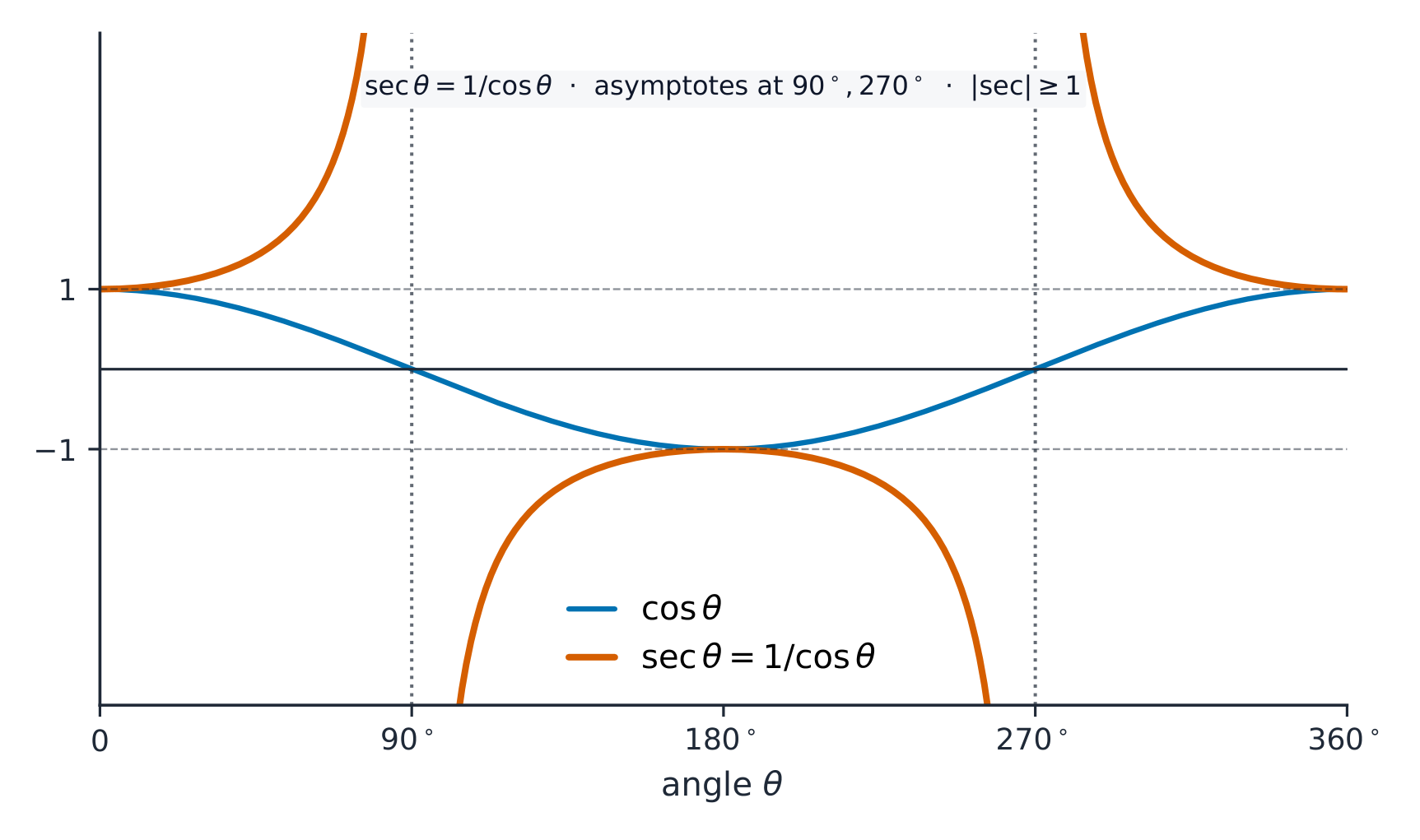
There are three more functions, each the reciprocal of one you know: the secant 正割 $\sec\theta = \dfrac{1}{\cos\theta}$, the cosecant 余割 $\csc\theta = \dfrac{1}{\sin\theta}$, and the cotangent 余切 $\cot\theta = \dfrac{1}{\tan\theta}$.

You must know these trigonometric identities 三角恒等式 and choose the right one for each problem:

$$\sec^2\theta \equiv 1 + \tan^2\theta, \qquad \csc^2\theta \equiv 1 + \cot^2\theta.$$
You also use the compound angle 复合角 formulae for $\sin(A \pm B)$, $\cos(A \pm B)$, $\tan(A \pm B)$, the double angle 二倍角 formulae
$$\sin 2A = 2\sin A\cos A, \quad \cos 2A = 2\cos^2 A - 1, \quad \tan 2A = \frac{2\tan A}{1 - \tan^2 A},$$
and the R-formula 辅助角公式 $a\sin\theta + b\cos\theta = R\sin(\theta + \alpha)$, where $R = \sqrt{a^2 + b^2}$ and $\tan\alpha = \dfrac{b}{a}$.

Worked example. Solve $2\tan^2\theta + 3\sec\theta = 18$ for $-180^\circ < \theta < 180^\circ$.

Replace $\tan^2\theta$ with $\sec^2\theta - 1$ to get one function:

$$2(\sec^2\theta - 1) + 3\sec\theta = 18 \;\Rightarrow\; 2\sec^2\theta + 3\sec\theta - 20 = 0 \;\Rightarrow\; (2\sec\theta - 5)(\sec\theta + 4) = 0.$$
So $\sec\theta = \tfrac52$ or $\sec\theta = -4$, giving $\cos\theta = \tfrac25$ or $\cos\theta = -\tfrac14$. The solutions are $\theta = \pm 66.4^\circ$ and $\theta = \pm 104.5^\circ$.

ไทย

มีฟังก์ชันอีกสามตัว ซึ่งเป็น reciprocal ของที่คุณรู้จักอยู่แล้ว: secant $\sec\theta = \dfrac{1}{\cos\theta}$, cosecant $\csc\theta = \dfrac{1}{\sin\theta}$, และ cotangent $\cot\theta = \dfrac{1}{\tan\theta}$

กราฟ cosinus และ reciprocal ของมันคือ secant ซึ่งพุ่งขึ้นสู่ asymptote
$\sec\theta=1/\cos\theta$ พุ่งขึ้นสู่ asymptote ทุกครั้งที่ $\cos\theta=0$

คุณต้องรู้ trigonometric identities เหล่านี้และเลือกอันที่เหมาะสมสำหรับแต่ละปัญหา:

$$\sec^2\theta \equiv 1 + \tan^2\theta, \qquad \csc^2\theta \equiv 1 + \cot^2\theta.$$
คุณยังใช้สูตร compound angle สำหรับ $\sin(A \pm B)$, $\cos(A \pm B)$, $\tan(A \pm B)$, สูตร double angle
$$\sin 2A = 2\sin A\cos A, \quad \cos 2A = 2\cos^2 A - 1, \quad \tan 2A = \frac{2\tan A}{1 - \tan^2 A},$$
และ R-formula $a\sin\theta + b\cos\theta = R\sin(\theta + \alpha)$, โดยที่ $R = \sqrt{a^2 + b^2}$ และ $\tan\alpha = \dfrac{b}{a}$

ตัวอย่างวิธีทำ แก้ $2\tan^2\theta + 3\sec\theta = 18$ สำหรับ $-180^\circ < \theta < 180^\circ$

แทนที่ $\tan^2\theta$ ด้วย $\sec^2\theta - 1$ เพื่อให้ได้ฟังก์ชันเดียว:

$$2(\sec^2\theta - 1) + 3\sec\theta = 18 \;\Rightarrow\; 2\sec^2\theta + 3\sec\theta - 20 = 0 \;\Rightarrow\; (2\sec\theta - 5)(\sec\theta + 4) = 0.$$
ดังนั้น $\sec\theta = \tfrac52$ หรือ $\sec\theta = -4$, ทำให้ได้ $\cos\theta = \tfrac25$ หรือ $\cos\theta = -\tfrac14$. คำตอบคือ $\theta = \pm 66.4^\circ$ และ $\theta = \pm 104.5^\circ$

Explore · ⁨สำรวจ⁩

The unit circle · ⁨วงกลมหน่วย⁩

Drag the angle to see how $\sin$, $\cos$ and $\tan$ relate — the key to solving trig equations. · ⁨ลากมุมเพื่อดูความสัมพันธ์ระหว่าง $\sin$, $\cos$ และ $\tan$ — กุญแจสำคัญในการแก้สมการตรีโกณมิติ⁩

Vocabulary · ⁨คำศัพท์⁩ Train · ⁨ฝึกฝน⁩
English ไทย
secant/ˈsiːkənt/ เส้นสัมผัส
cosecant/ˈkəʊsekənt/ คอสีกัน
cotangent/ˈkəʊtændʒənt/ โคแทนเจนต์
trigonometric identities/ˌtrɪɡənəʊˈmetrɪk aɪˈdentɪtiz/ เอกลักษณ์ตรีโกณมิติ
compound angle/ˈkɒmpaʊnd ˈæŋɡl/ มุมรวม
double angle/ˈdʌbl ˈæŋɡl/ มุมสองเท่า
R-formula/ɑː ˈfɔːmjʊlə/ R-formula
2.4

Differentiation · ⁨การหาอนุพันธ์ (Differentiation)⁩

Syllabus · ⁨หลักสูตร⁩
English
Candidates should be able to: Notes and examples
use the derivatives of $e^x$, $\ln x$, $\sin x$, $\cos x$, $\tan x$, together with constant multiples, sums, differences and composites
differentiate products and quotients e.g. $\frac{2x - 4}{3x + 2}$, $x^2 \ln x$, $x e^{1 - x^2}$.
find and use the first derivative of a function which is defined parametrically or implicitly. e.g. $x = t - e^{2t}$, $y = t + e^{2t}$. e.g. $x^2 + y^2 = xy + 7$. Including use in problems involving tangents and normals.
ไทย
ผู้เข้าสอบควรสามารถ: หมายเหตุและตัวอย่าง
ใช้ผลต่างของ $e^x$, $\ln x$, $\sin x$, $\cos x$, $\tan x$ ร่วมกับค่าคงตัวคูณ ผลบวก ผลลบ และฟังก์ชันประกอบ
หาอนุพันธ์ของผลคูณและผลหาร เช่น $\frac{2x - 4}{3x + 2}$, $x^2 \ln x$, $x e^{1 - x^2}$.
หาและใช้ผลต่างอันดับหนึ่งของฟังก์ชันที่นิยามโดยพารามิเตอร์หรือโดยนัย เช่น $x = t - e^{2t}$, $y = t + e^{2t}$. เช่น $x^2 + y^2 = xy + 7$. รวมถึงการใช้ในโจทย์ที่เกี่ยวข้องกับเส้นสัมผัสและเส้นปกติ

Source: Cambridge International syllabus · ⁨แหล่งที่มา: หลักสูตร Cambridge International⁩

English

Learn these standard derivatives:

$$\frac{d}{dx}e^x = e^x, \quad \frac{d}{dx}\ln x = \frac{1}{x}, \quad \frac{d}{dx}\sin x = \cos x, \quad \frac{d}{dx}\cos x = -\sin x, \quad \frac{d}{dx}\tan x = \sec^2 x.$$

For a product or a quotient of two functions, use:

  • the product rule 乘积法则: $(uv)' = u'v + uv'$;
  • the quotient rule 商法则: $\left(\dfrac{u}{v}\right)' = \dfrac{u'v - uv'}{v^2}$.

When a curve is given by parametric equations 参数方程 $x = x(t)$, $y = y(t)$, the gradient is $\dfrac{dy}{dx} = \dfrac{dy/dt}{dx/dt}$. When $y$ is defined implicitly 隐式 (not made the subject), differentiate every term with respect to $x$, using the chain rule on the $y$ terms, then solve for $\dfrac{dy}{dx}$.

Worked example. Given $y = 6x\cos(x^2 + 1)$, find $\dfrac{dy}{dx}$.

Use the product rule with $u = 6x$ and $v = \cos(x^2 + 1)$ (and the chain rule for $v$):

$$\frac{dy}{dx} = 6\cos(x^2 + 1) + 6x\cdot\big(-2x\sin(x^2 + 1)\big) = 6\cos(x^2 + 1) - 12x^2\sin(x^2 + 1).$$

ไทย

จำ standard derivatives เหล่านี้ได้:

$$\frac{d}{dx}e^x = e^x, \quad \frac{d}{dx}\ln x = \frac{1}{x}, \quad \frac{d}{dx}\sin x = \cos x, \quad \frac{d}{dx}\cos x = -\sin x, \quad \frac{d}{dx}\tan x = \sec^2 x.$$

สำหรับ product หรือ quotient ของฟังก์ชันสองตัว ให้ใช้:

  • product rule: $(uv)' = u'v + uv'$;
  • quotient rule: $\left(\dfrac{u}{v}\right)' = \dfrac{u'v - uv'}{v^2}$.

เมื่อเส้นโค้งถูกกำหนดโดย parametric equations $x = x(t)$, $y = y(t)$, ความชันคือ $\dfrac{dy}{dx} = \dfrac{dy/dt}{dx/dt}$. เมื่อ $y$ ถูกกำหนดแบบ implicitly (ไม่ได้ทำให้เป็นตัวเอก),.tolist ทุกพจน์เทียบกับ $x$, ใช้ chain rule กับ $y$ พจน์, แล้วแก้หา $\dfrac{dy}{dx}$

ตัวอย่างที่คำนวณแล้ว. กำหนด $y = 6x\cos(x^2 + 1)$, หา $\dfrac{dy}{dx}$

ใช้ product rule กับ $u = 6x$ และ $v = \cos(x^2 + 1)$ (และ chain rule สำหรับ $v$):

$$\frac{dy}{dx} = 6\cos(x^2 + 1) + 6x\cdot\big(-2x\sin(x^2 + 1)\big) = 6\cos(x^2 + 1) - 12x^2\sin(x^2 + 1).$$

Explore · ⁨สำรวจ⁩

Tangent and gradient · ⁨เส้นสัมผัสและความชัน⁩

y = ax³ + bx² + cx + d

Move the point: the tangent line is the derivative at that x. Where the curve turns, the gradient is zero. · ⁨เคลื่อนจุด: เส้นสัมผัส คืออนุพันธ์ที่ค่า x นั้น เมื่อเส้นโค้งเปลี่ยนทิศทาง ความชันจะเป็นศูนย์⁩

Vocabulary · ⁨คำศัพท์⁩ Train · ⁨ฝึกฝน⁩
English ไทย
product rule/ˈprɒdʌkt ruːl/ กฎผลคูณ
quotient rule/ˈkwəʊʃənt ruːl/ กฎผลหาร
parametric equations/ˌpærəˈmetrɪk ɪˈkweɪʒnz/ สมการพารามิเตอร์
implicitly/ɪmˈplɪsɪtli/ โดยนัยยะ
2.5

Integration · ⁨การหาอินทิกรัล (Integration)⁩

Syllabus · ⁨หลักสูตร⁩
English
Candidates should be able to: Notes and examples
• extend the idea of ‘reverse differentiation’ to include the integration of $e^{ax + b}$, $\frac{1}{ax + b}$, $\sin(ax + b)$, $\cos(ax + b)$ and $\sec^2(ax + b)$ Knowledge of the general method of integration by substitution is not required.
• use trigonometrical relationships in carrying out integration e.g. use of double-angle formulae to integrate $\sin^2 x$ or $\cos^2(2x)$.
• understand and use the trapezium rule to estimate the value of a definite integral. Including use of sketch graphs in simple cases to determine whether the trapezium rule gives an over-estimate or an under-estimate.
ไทย
ผู้เข้าสอบควรสามารถ: หมายเหตุและตัวอย่าง
• ขยายแนวคิดเรื่อง 'การหาอนุพันธ์ย้อนกลับ' ให้รวมถึงการหาอินทิกรัลของ $e^{ax + b}$, $\frac{1}{ax + b}$, $\sin(ax + b)$, $\cos(ax + b)$ และ $\sec^2(ax + b)$ ไม่จำเป็นต้องรู้วิธีการทั่วไปของ การหาอินทิกรัลด้วยการแทนตัวแปร
• ใช้ความสัมพันธ์ตรีโกณมิติในการหาอินทิกรัล เช่น การใช้สูตรมุมสองเท่าในการหาอินทิกรัลของ $\sin^2 x$ หรือ $\cos^2(2x)$.
• เข้าใจและใช้ กฎสี่เหลี่ยมคางหมู เพื่อประมาณค่าของอินทิกรัล_examples. รวมถึงการใช้กราฟสเก็ตช์ในกรณีง่ายๆ เพื่อกำหนดว่ากฎสี่เหลี่ยมคางหมูจะให้ค่าประมาณเกินจริงหรือน้อยจริง

Source: Cambridge International syllabus · ⁨แหล่งที่มา: หลักสูตร Cambridge International⁩

English

Integration is reverse differentiation — reverse each new derivative; harder integrals may need integration by substitution 换元积分 (developed in Pure 3). For a linear inside function $(ax + b)$:

$$\int e^{ax+b}\,dx = \frac{1}{a}e^{ax+b} + C, \qquad \int \frac{1}{ax+b}\,dx = \frac{1}{a}\ln|ax + b| + C,$$
$$\int \sin(ax+b)\,dx = -\frac{1}{a}\cos(ax+b) + C, \qquad \int \cos(ax+b)\,dx = \frac{1}{a}\sin(ax+b) + C, \qquad \int \sec^2(ax+b)\,dx = \frac{1}{a}\tan(ax+b) + C.$$
To integrate a power of $\sin$ or $\cos$, first use an identity to remove the power. When you cannot integrate exactly, the trapezium rule 梯形法则 estimates a definite integral:
$$\int_a^b y\,dx \approx \tfrac{h}{2}\big[y_0 + y_n + 2(y_1 + y_2 + \cdots + y_{n-1})\big].$$

Worked example. Find $\displaystyle\int 6\sin^2 x\,dx$.

Use $\sin^2 x = \tfrac12(1 - \cos 2x)$:

$$\int 6\sin^2 x\,dx = \int (3 - 3\cos 2x)\,dx = 3x - \tfrac32\sin 2x + C.$$

ไทย

Integration คือ reverse differentiation — กลับด้านของแต่ละ derivative ใหม่; อินทิกรัลที่ซับซ้อนอาจต้องใช้ integration by substitution (พัฒนาใน Pure 3). สำหรับฟังก์ชันภายในที่เป็นเชิงเส้น $(ax + b)$:

$$\int e^{ax+b}\,dx = \frac{1}{a}e^{ax+b} + C, \qquad \int \frac{1}{ax+b}\,dx = \frac{1}{a}\ln|ax + b| + C,$$
$$\int \sin(ax+b)\,dx = -\frac{1}{a}\cos(ax+b) + C, \qquad \int \cos(ax+b)\,dx = \frac{1}{a}\sin(ax+b) + C, \qquad \int \sec^2(ax+b)\,dx = \frac{1}{a}\tan(ax+b) + C.$$
ในการอินทิเกรตกำลังของ $\sin$ หรือ $\cos$ ให้ใช้เอกลักษณ์เพื่อลดกำลังออกก่อน เมื่อไม่สามารถอินทิเกรตได้ตรงๆ กฎสี่เหลี่ยมคางหมู จะประมาณค่าอินทิกรัล_examples:
$$\int_a^b y\,dx \approx \tfrac{h}{2}\big[y_0 + y_n + 2(y_1 + y_2 + \cdots + y_{n-1})\big].$$

พื้นที่ใต้เส้นโค้งแบ่งเป็น 4 สี่เหลี่ยมคางหมูที่มีความกว้าง h เท่ากัน
แต่ละแถบมีความกว้าง $h$ เป็นสี่เหลี่ยมคางหมู; ผลรวมพื้นที่ของแถบเหล่านี้ใช้ประมาณค่าอินทิกรัล

ตัวอย่างมีคำตอบ. หา $\displaystyle\int 6\sin^2 x\,dx$.

ใช้ $\sin^2 x = \tfrac12(1 - \cos 2x)$:

$$\int 6\sin^2 x\,dx = \int (3 - 3\cos 2x)\,dx = 3x - \tfrac32\sin 2x + C.$$

Explore · ⁨สำรวจ⁩

The area under the curve · ⁨พื้นที่ใต้กราฟ⁩

area = ∫ f(x) dx

The integral still measures area — drag a and b to total the strip under the curve. · ⁨อินทิกรัลยังคงวัด พื้นที่ — ลาก a และ b เพื่อรวมแถบใต้กราฟ⁩

Vocabulary · ⁨คำศัพท์⁩ Train · ⁨ฝึกฝน⁩
English ไทย
trapezium rule/trəˈpiːzɪəm ruːl/ กฎ трапеция
root/ruːt/ ราก
integration by substitution/ˌɪntɪˈɡreɪʃn baɪ ˌsʌbstɪˈtjuːʃn/ การอินทิเกรตด้วยการแทนตัวแปร
2.6

Numerical solution of equations · ⁨การแก้สมการด้วยวิธีเชิงตัวเลข⁩

Syllabus · ⁨หลักสูตร⁩
English
Candidates should be able to: Notes and examples
• locate approximately a root of an equation, by means of graphical considerations and/or searching for a sign change e.g. finding a pair of consecutive integers between which a root lies.
• understand the idea of, and use the notation for, a sequence of approximations which converges to a root of an equation
• understand how a given simple iterative formula of the form $x_{n + 1} = \text{F}(x_n)$ relates to the equation being solved, and use a given iteration, or an iteration based on a given rearrangement of an equation, to determine a root to a prescribed degree of accuracy. Knowledge of the condition for convergence is not included, but an understanding that an iteration may fail to converge is expected.
ไทย
ผู้เข้าสอบควรสามารถ: หมายเหตุและตัวอย่าง
• ประมาณตำแหน่งรากของสมการ โดยใช้ consideration จากกราฟและ/หรือการค้นหา การเปลี่ยนสัญญาณ เช่น การหาคู่ของจำนวนเต็มติดกันที่มีรากอยู่ระหว่างกลาง
• เข้าใจแนวคิดและใช้สัญลักษณ์สำหรับลำดับของการประมาณค่าซึ่งลู่เข้าสู่รากของสมการ
• เข้าใจว่าสูตร iterative แบบง่ายที่กำหนดให้ในรูป $x_{n + 1} = \text{F}(x_n)$ มีความสัมพันธ์กับสมการที่กำลังแก้อย่างไร และใช้กระบวนการ iterativity ที่กำหนดให้ หรือกระบวนการ iterativity ที่เกิดจากการจัดรูปสมการที่กำหนดให้ เพื่อดูรากจนได้ความแม่นยำตามที่กำหนด ไม่รวมความรู้เกี่ยวกับเงื่อนไขของ การลู่เข้า แต่ควรเข้าใจว่าการ iterativity อาจไม่ลู่เข้าได้

Source: Cambridge International syllabus · ⁨แหล่งที่มา: หลักสูตร Cambridge International⁩

English
Iterating to a root: ride the tangent

Many equations cannot be solved exactly. Two ideas help you find a root 根 (a solution).

  • Sign change 变号: if $f(a)$ and $f(b)$ have opposite signs (and the graph has no break between them), a root lies between $a$ and $b$.
  • Iteration 迭代: rearrange the equation into the form $x = F(x)$, then use the iterative formula 迭代公式 $x_{n+1} = F(x_n)$. Start from a first guess $x_0$ and repeat. If the values are convergent they settle down and converge 收敛 to a root. Keep going until the answer is steady to the accuracy asked for.

Worked example. A root $\beta$ of an equation satisfies $x = \sqrt[3]{-2x - 4.5}$, and $-1.4 < \beta < -1.0$. Use the iteration $x_{n+1} = \sqrt[3]{-2x_n - 4.5}$ with $x_0 = -1.2$.

$$x_1 = \sqrt[3]{-2(-1.2) - 4.5} = \sqrt[3]{-2.1} = -1.281, \qquad x_2 = \sqrt[3]{-2(-1.281) - 4.5} = -1.247, \quad \ldots$$
The values settle near $-1.26$, so $\beta = -1.26$ (3 s.f.).

ไทย
การทำซ้ำเพื่อหาคำตอบราก: ล่องไปตามเส้นสัมผัส

หลายสมการไม่สามารถแก้ได้แม่นยำ มีสองแนวคิดที่ช่วยคุณหา คำตอบราก (หรือทางแก้):

  • การเปลี่ยนสัญญาณ: ถ้า $f(a)$ และ $f(b)$ มีเครื่องหมายตรงข้าม (และกราฟไม่ขาดตอนระหว่างจุดนั้น) จะมีคำตอบรากอยู่ระหว่าง $a$ และ $b$
  • การทำซ้ำ: จัดรูปสมการให้อยู่ในรูป $x = F(x)$ จากนั้นใช้ สูตรการทำซ้ำ $x_{n+1} = F(x_n)$ เริ่มต้นด้วยการเดาค่าแรก $x_0$ แล้วทำซ้ำ หากค่าที่ได้ ลู่เข้า它们的จะคงที่และ ลู่เข้า ไปยังคำตอบราก ทำต่อไปจนกว่าคำตอบจะคงที่ตามความละเอียดที่ต้องการ
เส้นโค้งที่ผ่านจากด้านล่างแกน x ที่ a ขึ้นไปด้านบนที่ b
$f(a)$ และ $f(b)$ มีเครื่องหมายตรงข้าม ดังนั้นคำตอบรากจึงถูกกักขังอยู่ระหว่าง $a$ และ $b$
บันไดขั้นบันไดระหว่างเส้นโค้ง y = F(x) กับเส้น y = x ที่ค่อยๆ เข้าใกล้จุดตัด
แต่ละขั้นจะขึ้นไปยัง $y=F(x)$ แล้วข้ามไป $y=x$; บันได้นี้ค่อยๆ เข้าใกล้คำตอบราก

ตัวอย่างมีคำตอบ. คำตอบราก $\beta$ ของสมการใดสมการหนึ่งสอดคล้องกับ $x = \sqrt[3]{-2x - 4.5}$ และ $-1.4 < \beta < -1.0$ ใช้การทำซ้ำ $x_{n+1} = \sqrt[3]{-2x_n - 4.5}$ ด้วย $x_0 = -1.2$

$$x_1 = \sqrt[3]{-2(-1.2) - 4.5} = \sqrt[3]{-2.1} = -1.281, \qquad x_2 = \sqrt[3]{-2(-1.281) - 4.5} = -1.247, \quad \ldots$$
ค่าต่างๆ ค่อนข้างเข้าใกล้ $-1.26$ ดังนั้น $\beta = -1.26$ (3 หลักสำคัญ).

Explore · ⁨สำรวจ⁩

Where is the root? · ⁨รากอยู่ที่ไหน?⁩

y = ax³ + bx² + cx + d

A root is where the curve crosses zero. A sign change in f(x) traps a root between two x-values. · ⁨ราก คือจุดที่กราฟตัดแกนศูนย์ การเปลี่ยนเครื่องหมาย ของ f(x) บ่งบอกว่ามีรากอยู่ระหว่างค่า x สองค่า⁩

Vocabulary · ⁨คำศัพท์⁩ Train · ⁨ฝึกฝน⁩
English ไทย
sign change/saɪn tʃeɪndʒ/ การเปลี่ยนแปลงเครื่องหมาย
iteration/ˌɪtəˈreɪʃn/ การวนซ้ำ
iterative formula/ˈɪtərətɪv ˈfɔːmjʊlə/ สูตรซ้ำ
converge/kənˈvɜːdʒ/ ลู่เข้า
2.6

Exam tips · ⁨ข้อแนะนำสำหรับการสอบ⁩

English
  • Use the laws of logarithms to solve equations; remember $\ln$ and $e^x$ are inverses.
  • For numerical methods, show a sign change to locate a root, set out the iteration clearly, and give the answer to the stated accuracy.
  • Learn the chain, product and quotient rules and identify which the function needs.
  • Solve modulus equations $|f(x)| = g(x)$ by considering both the positive and negative cases, and sketch to check.
ไทย
  • ใช้ กฎลอการิทึม ในการแก้สมการ; จำไว้ว่า $\ln$ และ $e^x$ เป็นฟังก์ชันผกผัน
  • สำหรับ วิธีเชิงตัวเลข แสดงให้เห็นถึงการเปลี่ยนแปลงสัญญาณเพื่อระบุตำแหน่งคำตอบราก ตั้งค่าการทำซ้ำอย่างชัดเจน และให้คำตอบตามความละเอียดที่กำหนด
  • ทักษะ กฎลูกโซ่ กฎคูณ และกฎหาร และระบุได้ว่าฟังก์ชันใดต้องใช้กฎใด
  • แก้สมการโมดูลัส $|f(x)| = g(x)$ โดยพิจารณาทั้งกรณีบวกและลบ พร้อมวาดกราฟเพื่อตรวจสอบ

Interactive lessons on this topic · ⁨บทเรียนเชิงโต้ตอบสำหรับหัวข้อนี้⁩

Work through it step by step, with instant-check exercises. · ⁨ทำทีละขั้นตอน พร้อมแบบฝึกหัดตรวจสอบผลทันที⁩

Past Papers · ⁨ข้อสอบย้อนหลัง⁩

More topics in A-Level Mathematics · ⁨Mathematics A-Level⁩ · ⁨หัวข้อเพิ่มเติมใน A-Level Mathematics · ⁨Mathematics A-Level⁩⁩

Log in or create account · ⁨เข้าสู่ระบบหรือสร้างบัญชี⁩

IGCSE, A-Level & AP