This handout covers Topic 1: Pure Mathematics 纯数学 1. It is the algebra 代数 and calculus 微积分 core of the course. Each ## section is one syllabus subtopic.
Pure Mathematics 1
A-Level Mathematics · Topic 1
 28:42
Pure Mathematics 1
Look at a great suspension bridge. Its huge cable is not a random shape — it hangs in a perfect parabola, a curve you can write with a single equation. The…
English narration · English + 中文 subtitles burned in
1.1
Quadratics

Syllabus
| Candidates should be able to: | Notes and examples |
|---|---|
| carry out the process of completing the square for a quadratic polynomial $ax^2 + bx + c$ and use a completed square form | e.g. to locate the vertex of the graph of $y = ax^2 + bx + c$ or to sketch the graph |
| find the discriminant of a quadratic polynomial $ax^2 + bx + c$ and use the discriminant | e.g. to determine the number of real roots of the equation $ax^2 + bx + c = 0$. Knowledge of the term ‘repeated root’ is included. |
| solve quadratic equations, and quadratic inequalities, in one unknown | By factorising, completing the square and using the formula. |
| solve by substitution a pair of simultaneous equations of which one is linear and one is quadratic | e.g. $x + y + 1 = 0$ and $x^2 + y^2 = 25$, $2x + 3y = 7$ and $3x^2 = 4 + 4xy$. |
| recognise and solve equations in $x$ which are quadratic in some function of $x$. | e.g. $x^4 - 5x^2 + 4 = 0$, $6x + \sqrt{x} - 1 = 0$, $\tan^2 x = 1 + \tan x$. |
Source: Cambridge International syllabus
Completing the square finds the vertex 顶点
A quadratic 二次式 is an expression of the form $ax^2 + bx + c$, where $a \neq 0$. The letters $a$, $b$, $c$ are the coefficients 系数 (the fixed numbers). Much of this section is about solving the equation $ax^2 + bx + c = 0$.
Completing the square
To complete the square 配方 means to write the quadratic in the form
$$a(x + p)^2 + q.$$
This form is useful: it shows the vertex (turning point) of the curve at $(-p,\ q)$, and it gives a quick way to solve the equation.
Worked example. Write $9x^2 - 36x + 8$ in the form $p(x + q)^2 + r$.
Take the factor $9$ out of the first two terms 项, then complete the square inside:
$$\begin{aligned}
9x^2 - 36x + 8 &= 9\left(x^2 - 4x\right) + 8 \\
&= 9\left((x - 2)^2 - 4\right) + 8 \\
&= 9(x - 2)^2 - 36 + 8 = 9(x - 2)^2 - 28.
\end{aligned}$$
So $p = 9$, $q = -2$, $r = -28$.

The discriminant 判别式
The discriminant of $ax^2 + bx + c$ is
$$\Delta = b^2 - 4ac.$$
It tells you how many real roots 实根 (real solutions) the equation $ax^2 + bx + c = 0$ has:
| Discriminant | Roots |
|---|---|
| $b^2 - 4ac > 0$ | two distinct 相异 real roots |
| $b^2 - 4ac = 0$ | one repeated real root |
| $b^2 - 4ac < 0$ | no real roots |

Worked example. Find the values of the constant $k$ for which $3kx^2 + (k + 8)x + 3 = 0$ has two distinct real roots.
Here $a = 3k$, $b = k + 8$, $c = 3$. For two distinct real roots you need $b^2 - 4ac > 0$:
$$(k + 8)^2 - 4(3k)(3) > 0 \;\Rightarrow\; k^2 + 16k + 64 - 36k > 0 \;\Rightarrow\; k^2 - 20k + 64 > 0.$$
Factorise: $(k - 4)(k - 16) > 0$, so $k < 4$ or $k > 16$. You also need $a \neq 0$, so $k \neq 0$.
Quadratic equations 二次方程 and inequalities
To solve a quadratic equation, factorise, complete the square, or use the formula
$$x = \frac{-b \pm \sqrt{b^2 - 4ac}}{2a}.$$
To solve a quadratic inequality 二次不等式 such as $(k - 4)(k - 16) > 0$, find the two roots, then decide which side of each root makes the statement true. A sketch of the parabola helps: an upward-opening curve with two distinct roots is above the $x$-axis (positive) outside the roots and below it (negative) between them.
Worked inequality. Solve $-x^2+4x-3\geq0$. Multiplying by $-1$ reverses the inequality:
$$x^2-4x+3\leq0\quad\Rightarrow\quad(x-1)(x-3)\leq0.$$
The factors have opposite signs between the roots, so $1\leq x\leq3$. Equality is allowed at both endpoints. Testing $x=2$ in the original expression gives $-1$, which satisfies the inequality; a point outside, such as $x=0$, gives $3$, which does not. Do not automatically choose the outside intervals when the original leading coefficient is negative.
For a negative leading coefficient, the completed-square constant is a maximum: $-2x^2+12x-11=-2(x-3)^2+7$ has maximum $7$ at $x=3$. Completing the square still works; the sign changes the interpretation.
Simultaneous equations 联立方程
To solve a pair of simultaneous equations where one is linear and one is quadratic, use substitution 代入: rearrange the linear equation for one letter, then put that into the quadratic. This gives a single quadratic to solve.
Worked substitution. Solve $x+2y=7$ and $x^2+4y^2=25$. The linear equation gives $x=7-2y$, so
$$(7-2y)^2+4y^2=25\quad\Rightarrow\quad2y^2-7y+6=0.$$
Factorising gives $(2y-3)(y-2)=0$, hence $y=\tfrac32$ or $2$. Recover the matching values of $x$: the solutions are $(4,\tfrac32)$ and $(3,2)$. Each pair gives $x+2y=7$ and $x^2+4y^2=25$. Keep the pairing when presenting answers.
When finding intersections, form the common equation first. For $y=x^2-2x+3$ and $y=x+k$, the intersection equation is $x^2-3x+3-k=0$ and its discriminant is $4k-3$. It has no real intersection for $k<\tfrac34$, a repeated intersection for $k=\tfrac34$, and two for $k>\tfrac34$. The boundary point is $(\tfrac32,\tfrac94)$.
Equations that are quadratic in disguise
Some equations are quadratic in some function 函数 of $x$. For example $x^4 - 5x^2 + 4 = 0$ is quadratic in $x^2$: let $u = x^2$, solve $u^2 - 5u + 4 = 0$, then go back to $x$. You will use this idea again in trigonometry.
Here $(u-1)(u-4)=0$, so $x^2=1$ or $4$ and $x=\pm1,\pm2$. Always return from the substitute to the original variable.
Worked square-root substitution. For $6x+\sqrt{x}-1=0$, let $v=\sqrt{x}\geq0$. Then
$$6v^2+v-1=(3v-1)(2v+1)=0.$$
Only $v=\tfrac13$ is allowed; $v=-\tfrac12$ cannot be a square root. Thus $x=v^2=\tfrac19$, which satisfies the original equation. Squaring a rejected negative value is not a valid way to recover another solution.
Using given roots to find constants
A root is an input giving zero. Substitute each stated root into the original polynomial to obtain simultaneous conditions, or expand its root form and compare coefficients. If the roots are $\alpha$ and $\beta$, then
$$a(x-\alpha)(x-\beta)=ax^2-a(\alpha+\beta)x+a\alpha\beta.$$
Worked example. Suppose $px^2+6x-8$ has roots $2m$ and $-4m$, with $p,m\ne0$. Expanding $p(x-2m)(x+4m)$ gives $px^2+2pmx-8pm^2$. Hence $pm=3$ and $pm^2=1$, giving $m=\tfrac13$ and $p=9$. Both actual roots $\tfrac23$ and $-\tfrac43$ satisfy $9x^2+6x-8=0$. Do not assume a parameter is positive unless the question states that condition.
Explore
The shape of a quadratic
y = ax² + bx + c
Drag a, b and c. Watch the vertex, the line of symmetry and the roots (where it cuts the x-axis) move as the coefficients change.
Vocabulary
Train
| English |
|---|
| Pure Mathematics/pjʊə ˌmæθɪˈmætɪks/ |
| quadratic/kwɒˈdrætɪk/ |
| complete the square/kəmˈpliːt ðə skweə/ |
| vertex/ˈvɜːteks/ |
| discriminant/dɪˈskrɪmɪnənt/ |
| real roots/rɪəl ruːts/ |
| distinct/dɪˈstɪŋkt/ |
| quadratic equation/kwɒˈdrætɪk ɪˈkweɪʒn/ |
| quadratic inequality/kwɒˈdrætɪk ɪniːˈkwɒlɪti/ |
| simultaneous equations/ˌsɪməlˈteɪnɪəs ɪˈkweɪʒnz/ |
| substitution/ˌsʌbstɪˈtjuːʃn/ |
| function/ˈfʌŋkʃn/ |
| term/tɜːm/ |
| coefficient/ˌkəʊɪˈfɪʃənt/ |
| parabola/pəˈræbələ/ |
1.2
Functions

Syllabus
| Candidates should be able to: | Notes and examples |
|---|---|
| understand the terms function, domain, range, one-one function, inverse function and composition of functions | |
| identify the range of a given function in simple cases, and find the composition of two given functions | e.g. range of $f : x \mapsto \frac{1}{x}$ for $x \geqslant 1$ and range of $g : x \mapsto x^2 + 1$ for $x \in \mathbb{R}$. Including the condition that a composite function $gf$ can only be formed when the range of $f$ is within the domain of $g$. |
| determine whether or not a given function is one-one, and find the inverse of a one-one function in simple cases | e.g. finding the inverse of $h : x \mapsto (2x + 3)^2 - 4$ for $x < -\frac{3}{2}$. |
| illustrate in graphical terms the relation between a one-one function and its inverse | Sketches should include an indication of the mirror line $y = x$. |
| understand and use the transformations of the graph of $y = f(x)$ given by $y = f(x) + a$, $y = f(x + a)$, $y = af(x)$, $y = f(ax)$ and simple combinations of these. | Including use of the terms ‘translation’, ‘reflection’ and ‘stretch’ in describing transformations. Questions may involve algebraic or trigonometric functions, or other graphs with given features. |
Source: Cambridge International syllabus
Transforming graphs: shift and stretch 伸缩
A function is a rule that sends each input to exactly one output. Write it as $f(x)$. The composition of functions 复合函数 $fg(x)$ means apply $g$ first, then apply $f$ to the result.
- The domain 定义域 is the set of allowed inputs $x$.
- The range 值域 is the set of outputs the function actually produces.
A function is one-one 一一对应 if different inputs always give different outputs. (No output is repeated.) Only a one-one function has an inverse function 反函数 $f^{-1}$, which reverses the rule.
The composition 复合 of two functions means doing one after the other. $fg(x)$ means "do $g$ first, then $f$": $fg(x) = f(g(x))$. The composite function $fg$ exists only when the range of $g$ lies inside the domain of $f$.
This condition applies to the whole stated domain of the inner function. If $f(x)=\sqrt x$ for $x\geq0$ and $g(x)=x-3$ for all real $x$, $fg(x)=\sqrt{x-3}$ is not defined on all of that inner domain. A new restriction $x\geq3$ makes the formula valid there; state that change explicitly.
To find a range, check whether a boundary is attained. For $x\geq1$, the range of $1/x$ is $0<y\leq1$; zero is approached but never attained. A restricted quadratic also needs its actual domain: $(x-1)^2+2$ for $x\geq3$ has range $y\geq6$, since its vertex input is excluded.
An open-endpoint condition. Let $F(x)=1/(x-2)$ for $x>2$ and $G(x)=3x+2$ for $x>a$. The range of $G$ is $(3a+2,\infty)$. It lies wholly in the domain of $F$ when $3a+2\geq2$, so $a\geq0$. Equality is allowed because the lower endpoint of that range is not attained. For $a<0$, the allowed input $0$ gives the forbidden output $G(0)=2$.
Finding an inverse
To find $f^{-1}$: write $y = f(x)$, make $x$ the subject, then swap letters.
Worked example. The function $f(x) = (x + 3)^2 - 12$ is defined for $x \geqslant 0$. Find $f^{-1}(x)$.
Write $y = (x + 3)^2 - 12$ and solve for $x$:
$$(x + 3)^2 = y + 12 \;\Rightarrow\; x + 3 = \sqrt{y + 12} \;\Rightarrow\; x = \sqrt{y + 12} - 3.$$
You take the positive square root because $x \geqslant 0$ means $x + 3 \geqslant 3 > 0$. So
$$f^{-1}(x) = \sqrt{x + 12} - 3.$$
The original range is $[-3,\infty)$, attained from original inputs $x\geq0$. Therefore the inverse has domain $x\geq-3$ and range $f^{-1}(x)\geq0$. Merely requiring the radical to be real would give the larger, incorrect inverse domain $x\geq-12$.
A different restriction can require the negative square-root branch. For $h(x)=(x+1)^2-5$ with $x\leq-1$, solve $y+5=(x+1)^2$ using $x+1\leq0$:
$$h^{-1}(x)=-1-\sqrt{x+5},\qquad x\geq-5.$$
Its range is $h^{-1}(x)\leq-1$. The endpoint $(-1,-5)$ reflects to $(-5,-1)$ and the point $(-3,-1)$ reflects to $(-1,-3)$. A $\pm$ answer would not define a one-one inverse function. The inverse is also different from the reciprocal $1/h(x)$.
To invert a composite of compatible one-one functions, reverse their order: $(gf)^{-1}=f^{-1}g^{-1}$. Alternatively form the composite rule first, then invert it with the original domain restriction.
For example, $f(x)=(x-1)^2+2$ for $x\leq1$ and $g(x)=5-x$ give $H(x)=gf(x)=3-(x-1)^2$, with range $H(x)\leq3$. Solving $y=3-(x-1)^2$ using $x-1\leq0$ gives $H^{-1}(x)=1-\sqrt{3-x}$ for $x\leq3$, with range $H^{-1}(x)\leq1$. Composing and then inverting keeps the whole branch condition visible.
Graphs of inverses and transformations
The graph of $y = f^{-1}(x)$ is the reflection of $y = f(x)$ in the line $y = x$.
You should know these transformations 变换 of $y = f(x)$: In the stretch descriptions below take $a>0$. Negative multipliers also require a reflection 反射: $-f(x)$ reflects in the $x$-axis and $f(-x)$ reflects in the $y$-axis.
| New equation | Effect on the graph |
|---|---|
| $y = f(x) + a$ | translation 平移 up by $a$ |
| $y = f(x + a)$ | translation left by $a$ |
| $y = a\,f(x)$ | stretch in the $y$-direction, scale factor $a$ |
| $y = f(ax)$ | stretch in the $x$-direction, scale factor $\tfrac{1}{a}$ |
When two transformations are combined, the order can matter. State each one fully (type, direction, and amount).
For $g(x)=2f(x+3)-1$, use two transformations: stretch vertically by factor $2$, then translate by $(-3,-1)$ (left $3$ and down $1$ together). A point $(4,5)$ becomes $(4,10)$, then $(1,9)$. Reversing these same operations gives $2(f(x+3)-1)=2f(x+3)-2$, a different graph. If two transformations are required, combine the horizontal and vertical shifts into one translation. For a horizontal multiplier $f(ax)$, a point $(s,t)$ moves to $(s/a,t)$; the scale factor is reciprocal, not $a$.

Explore
Explore a function
y = ax³ + bx² + cx + d
A function turns each input into exactly one output — drag the coefficients and watch where the curve rises and falls.
Vocabulary
Train
| English |
|---|
| composition of functions/ˌkɒmpəˈzɪʃn ɒv ˈfʌŋkʃnz/ |
| domain/dəˈmeɪn/ |
| range/reɪndʒ/ |
| one-one/wʌn wʌn/ |
| inverse function/ɪnˈvɜːs ˈfʌŋkʃn/ |
| composition/ˌkɒmpəˈzɪʃn/ |
| reflection/rɪˈflekʃn/ |
| transformations/trænsfɔːˈmeɪʃnz/ |
| translation/trænˈsleɪʃn/ |
| stretch/stretʃ/ |
1.3
Coordinate geometry

Syllabus
| Candidates should be able to: | Notes and examples |
|---|---|
| find the equation of a straight line given sufficient information | e.g. given two points, or one point and the gradient. |
| interpret and use any of the forms $y = mx + c$, $y - y_1 = m(x - x_1)$, $ax + by + c = 0$ in solving problems | Including calculations of distances, gradients, midpoints, points of intersection and use of the relationship between the gradients of parallel and perpendicular lines. |
| understand that the equation $(x - a)^2 + (y - b)^2 = r^2$ represents the circle with centre $(a, b)$ and radius $r$ | Including use of the expanded form $x^2 + y^2 + 2gx + 2fy + c = 0$. |
| use algebraic methods to solve problems involving lines and circles | Including use of elementary geometrical properties of circles, e.g. tangent perpendicular to radius, angle in a semicircle, symmetry. Implicit differentiation is not included. |
| understand the relationship between a graph and its associated algebraic equation, and use the relationship between points of intersection of graphs and solutions of equations. | e.g. to determine the set of values of $k$ for which the line $y = x + k$ intersects, touches or does not meet a quadratic curve. |
Source: Cambridge International syllabus
Coordinate geometry 坐标几何 connects positions, distances and intersections with algebra. A straight path can cross a circular boundary twice, touch it once or miss it. Solve their equations together to distinguish these cases exactly.
Choose and check a line equation
For two points with different $x$-coordinates, the gradient 斜率 is
$$m=\frac{y_2-y_1}{x_2-x_1}.$$
Useful forms of an equation of a straight line 直线方程 are
$$y=mx+c,\qquad y-y_1=m(x-x_1),\qquad ax+by+c=0.$$
For example, through $(2,3)$ and $(6,11)$ the gradient is $2$. The same line is $y-3=2(x-2)$, $y=2x-1$, or $2x-y-1=0$. Substitute each given point to check. In $2x-3y+6=0$, rearranging gives $y=\tfrac23x+2$, so the gradient is $2/3$, not $2$.
Distinct non-vertical parallel 平行 lines have equal gradients. For perpendicular 垂直 lines with finite gradients, $m_1m_2=-1$. Horizontal lines $y=h$ have gradient zero; vertical lines $x=k$ have undefined gradient. They are perpendicular, but the product rule cannot be used for a vertical line. Through $(4,-2)$, the horizontal and vertical lines are $y=-2$ and $x=4$.
Distances, midpoints 中点 and perpendicular bisectors 垂直平分线
Pythagoras gives the distance between two points:
$$PQ=\sqrt{(x_2-x_1)^2+(y_2-y_1)^2}.$$
The midpoint is
$$M=\left(\frac{x_1+x_2}{2},\frac{y_1+y_2}{2}\right).$$
A perpendicular bisector passes through this midpoint at right angles to the segment. Every point on it is equally far from the two ends.
Worked example. For $P(-1,2)$ and $Q(5,6)$, $PQ=\sqrt{6^2+4^2}=2\sqrt{13}$ and $M=(2,4)$. The segment gradient is $2/3$, so the bisector gradient is $-3/2$. Its equation is
$$y-4=-\frac32(x-2)\quad\Longrightarrow\quad 3x+2y=14.$$
The midpoint alone is not an equation, and a perpendicular through an endpoint is not a bisector. If $PQ$ is horizontal, its bisector is the vertical line through $M$; do not take a reciprocal of zero.
Read a circle 圆 in two forms
A circle with centre 圆心 $(a,b)$ and positive radius 半径 $r$ has equation
$$(x-a)^2+(y-b)^2=r^2.$$
An expanded equation needs both squares completed:
$$\begin{aligned}
x^2+y^2-6x+10y-27&=0,\\
(x-3)^2-9+(y+5)^2-25&=27,\\
(x-3)^2+(y+5)^2&=61.
\end{aligned}$$
The centre is $(3,-5)$ and radius $\sqrt{61}$. More generally, $x^2+y^2+2gx+2fy+c=0$ gives centre $(-g,-f)$ and $r^2=g^2+f^2-c$. Check that $r^2>0$ for a real circle of positive radius. If it is negative there are no real points; if zero there is only one point. Substitute a proposed point into the equation to test it.
Use a diameter 直径, a semicircle or symmetry
Worked example. The points $P(1,1)$ and $Q(7,11)$ are the ends of a diameter. Its midpoint is $(4,6)$ and its half-length is
$$r=\frac12\sqrt{6^2+10^2}=\sqrt{34}.$$
The circle is $(x-4)^2+(y-6)^2=34$. A general chord's 弦 midpoint is not necessarily the centre: the diameter condition matters.
The angle formed at any other point on this circle by lines to $P$ and $Q$ is $90^\circ$: it is an angle in a semicircle. For a non-diameter chord, the line from the centre to its midpoint is perpendicular to the chord and is a symmetry line. Use this to recover a reflected intersection point or a missing coordinate.
For instance, $(x-2)^2+(y-1)^2=5$ has diameter ends $A(0,0)$ and $B(4,2)$. Point $D(4,0)$ lies on it and $\angle ADB=90^\circ$. The chord $AD$ has midpoint $(2,0)$, so its perpendicular bisector $x=2$ passes through the centre and reflects $A$ onto $D$.
Tangents 切线: known and unknown contact points
A tangent is perpendicular to the radius at the contact point.
For the circle centred at $(2,1)$ above, the radius to $B(4,2)$ has gradient $1/2$. The tangent has gradient $-2$, so $y-2=-2(x-4)$, or $2x+y=10$. Use $B$ in this equation, not the centre. At the top and bottom the tangents are horizontal, $y=1\pm\sqrt5$; at the left and right they are vertical, $x=2\pm\sqrt5$.
Worked example: unknown contact points. Find both points on this circle where the tangent gradient is $-2$. The radius gradient must be $1/2$, and the radius line through the centre is $y-1=\tfrac12(x-2)$. Put $u=x-2$ and substitute:
$$u^2+\frac{u^2}{4}=5\quad\Longrightarrow\quad u=\pm2.$$
The contact points are $(4,2)$ and $(0,0)$, with tangent equations $2x+y=10$ and $2x+y=0$. A given tangent direction normally gives two opposite contact points. Keep exact square roots when the solutions are not integers. Radius geometry and substitution suffice; circle differentiation 微分 is not required here.
Intersections and parameter boundaries
Substitute a line into a circle to get a quadratic, solve for one coordinate and recover the other. In $(x-2)^2+(y-1)^2=5$, the line $y=0$ gives $(x-2)^2=4$, hence the points $(0,0)$ and $(4,0)$.
For the family $y=k$, the same circle gives
$$(x-2)^2=5-(k-1)^2.$$
There are two points when $1-\sqrt5<k<1+\sqrt5$, one tangent point at each boundary, and no points outside that interval. At either boundary $x=2$. For a general sloping line, the resulting quadratic's discriminant is positive, zero or negative in the same three cases. A repeated root is one point.
For a line and a quadratic curve, equate the two expressions for $y$. For $y=x^2$ and $y=2x+k$:
$$x^2-2x-k=0,\qquad \Delta=4+4k.$$
Thus there are two intersections for $k>-1$, one for $k=-1$ at $(1,1)$, and none for $k<-1$. Show the algebraic condition; a sketch alone does not prove an exact boundary. Some families have a positive discriminant for every real parameter, so they always intersect twice. Check separately if a parameter could make the quadratic coefficient zero.
Build a circle from axis gaps
A circle entirely in the first quadrant has centre $(a,b)$ and radius $r$. Its least distances from the $y$-axis and $x$-axis are $a-r$ and $b-r$, respectively.
Worked example. The gap from the $y$-axis is $1$, the gap from the $x$-axis is $3$, and the distance from the origin to the centre is $\sqrt{34}$. Then the centre is $(r+1,r+3)$, so
$$\begin{aligned}
(r+1)^2+(r+3)^2&=34,\\
r^2+4r-12&=0,\\
(r+6)(r-2)&=0.
\end{aligned}$$
Reject the negative radius. Therefore $r=2$, centre $(3,5)$, and equation $(x-3)^2+(y-5)^2=4$. The point furthest from the origin lies along the ray from the origin through the centre: its radius has gradient $5/3$, so its tangent gradient is $-3/5$.
Independent check. A different circle's least gaps from the $x$- and $y$-axes are $6$ and $2$, and its centre is $4\sqrt5$ from the origin. Find the radius, centre, circle equation and tangent gradient at its furthest point from the origin. Set up the centre coordinates before calculating.
Check after attempting: centre $(r+2,r+6)$ gives $(r+2)^2+(r+6)^2=80$. Thus $(r+10)(r-2)=0$, $r=2$, centre $(4,8)$ and equation $(x-4)^2+(y-8)^2=4$. The radius direction has gradient $2$, so the tangent gradient is $-1/2$.
Explore
The straight line
y = ax + b
The gradient a tilts the line; the intercept b slides it up and down.
Vocabulary
Train
| English |
|---|
| Coordinate geometry/kəʊˈɔːdɪnət dʒiˈɒmətri/ |
| gradient/ˈɡreɪdɪənt/ |
| equation of a straight line/ɪˈkweɪʒn əvə streɪt laɪn/ |
| parallel/ˈpærəlel/ |
| perpendicular/ˌpɜːpənˈdɪkjʊlə/ |
| circle/ˈsɜːkl/ |
| centre/ˈsentə/ |
| radius/ˈreɪdɪəs/ |
| tangent/ˈtændʒənt/ |
| diameter/daɪˈæmɪtə/ |
| chord/kɔːd/ |
| Differentiation/ˌdɪfəˌrenʃɪˈeɪʃn/ |
| algebra/ˈældʒɪbrə/ |
| calculus/ˈkælkjʊləs/ |
| midpoint/ˈmɪdpɔɪnt/ |
| perpendicular bisector/ˌpɜːpənˈdɪkjʊlə baɪˈsektə/ |
1.4
Circular measure

Syllabus
| Candidates should be able to: | Notes and examples |
|---|---|
| understand the definition of a radian, and use the relationship between radians and degrees | |
| use the formulae $s = r\theta$ and $A = \frac{1}{2}r^2\theta$ in solving problems concerning the arc length and sector area of a circle. | Including calculation of lengths and angles in triangles and areas of triangles. |
Source: Cambridge International syllabus
A curved boundary may contain an arc 弧 and several straight edges. Identify every piece before calculating. A sector 扇形, a triangle and a circular segment 弓形 have different areas and perimeters.
Define a radian 弧度 and convert angles
One radian is the angle at the centre that cuts off an arc equal in length to the radius. Since $\theta=s/r$, a full turn is $(2\pi r)/r=2\pi$ radians. Therefore
$$\pi\text{ radians}=180^\circ.$$
Multiply degrees 度 by $\pi/180$ to get radians, or radians by $180/\pi$ to get degrees. For example, $150^\circ=5\pi/6$ radians and $7\pi/4$ radians is $315^\circ$. Angles can exceed one turn: $450^\circ=5\pi/2$ radians.
Sector formulas, perimeter and reverse problems
For a sector with radius $r$ and angle $\theta$ in radians,
$$s=r\theta,\qquad A=\frac12r^2\theta.$$
Here $s$ is arc length and $A$ is sector area. A sector's full perimeter is $s+2r$. Distinguish linear units from square units. Convert a degree angle before using these formulas, and use radian calculator mode for its sine 正弦 or cosine 余弦.
If the arc length and area are given, eliminate the angle: $A=rs/2$, so $r=2A/s$ and then $\theta=s/r$.
Worked example. Arc length $8\text{ cm}$ and sector area $24\text{ cm}^2$ give $r=6\text{ cm}$, $\theta=4/3$ radians and full perimeter $20\text{ cm}$. The arc alone is not the perimeter.
Chords and minor circular segments
For a minor central angle $0<\theta<\pi$, bisect the isosceles triangle formed by two radii and their chord. This gives
$$c=2r\sin(\theta/2),\qquad A_{\text{triangle}}=\frac12r^2\sin\theta.$$
The circular segment lies between the chord and arc. The minor segment is the minor sector minus the triangle:
$$A_{\text{minor}}=\frac12r^2(\theta-\sin\theta).$$
Its perimeter is $r\theta+c$, not $r\theta+2r$.
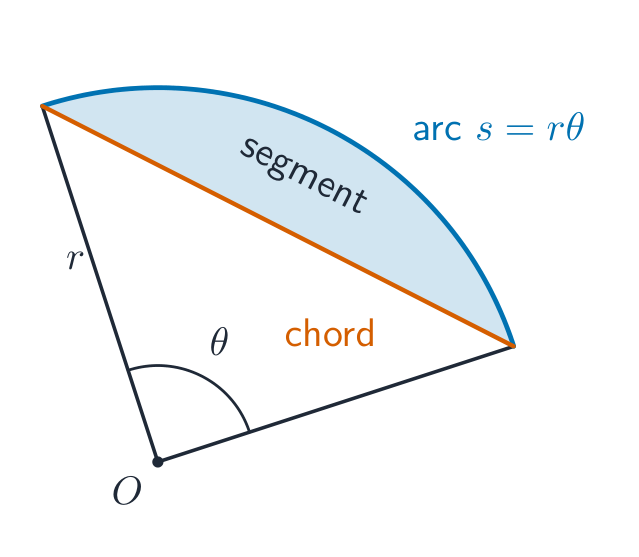
For $r=5\text{ cm}$ and $\theta=2$ radians, the arc length is $10\text{ cm}$, the sector area is $25\text{ cm}^2$, and the minor segment area is $12.5(2-\sin2)\approx13.6\text{ cm}^2$. The minor segment perimeter is $10+10\sin1\approx18.4\text{ cm}$.
Major segments
The major segment is the rest of the circle after removing the minor segment:
$$A_{\text{major}}=\pi r^2-A_{\text{minor}}.$$
Its arc uses angle $2\pi-\theta$, so its perimeter is $r(2\pi-\theta)+c$.
Worked example. Radius $4\text{ cm}$ and chord $4\sqrt3\text{ cm}$ give $\sin(\theta/2)=\sqrt3/2$. The minor angle is $2\pi/3$, the triangle area is $4\sqrt3$, and
$$\begin{aligned}
A_{\text{minor}}&=\frac{16\pi}{3}-4\sqrt3,\\
A_{\text{major}}&=\frac{32\pi}{3}+4\sqrt3.
\end{aligned}$$
The major arc length is $16\pi/3\text{ cm}$. Add the chord for its segment perimeter. The major region 区域 includes the triangle; it is not just the major sector.
Compound boundaries: name the pieces
Worked example. Let $OA=OB=10\text{ cm}$, $\angle AOB=1$ radian. Remove the sector of radius $4\text{ cm}$, centred at $O$, from triangle $OAB$. The remaining boundary contains two straight gaps of length $6$, the outer chord $AB=20\sin(1/2)$, and an inner arc of length $4$.
$$\begin{aligned}
P&=6+6+20\sin(1/2)+4\approx25.6\text{ cm},\\
A&=\frac12(10)^2\sin1-\frac12(4)^2(1)\approx34.1\text{ cm}^2.
\end{aligned}$$
There is no outer circular arc: $AB$ is straight. If instead a region lies between two concentric sector arcs, its area is the difference of sector areas, but its perimeter includes both arcs and both radial gaps. For radii $9$ and $5$ and angle $1.4$ radians, the area is $39.2$ square units and perimeter is $27.6$ units. Subtracting areas does not mean subtracting lengths.
Use two conditions to find an unknown circle
If a sector has area $8\theta\text{ cm}^2$, then $(1/2)r^2\theta=8\theta$. Since $\theta>0$, $r=4\text{ cm}$. If the triangle area is $4\text{ cm}^2$, then $8\sin\theta=4$. The restriction $0<\theta<\pi/2$ selects $\theta=\pi/6$, giving minor segment area $4\pi/3-4\text{ cm}^2$.
If a later part replaces the sector-area condition, start again. A chord-to-radius ratio can determine $\theta$ using $c=2r\sin(\theta/2)$, then triangle area determines $r$. Do not keep a radius or angle whose original condition no longer applies.
Different circles, different radii and angles
The diagram shows a circle with centre $O$ and radius $3$, meeting a circle with centre $C$ and radius $5$. Here $OC=4$ and $PQ$ is the small circle's diameter, perpendicular to $OC$.
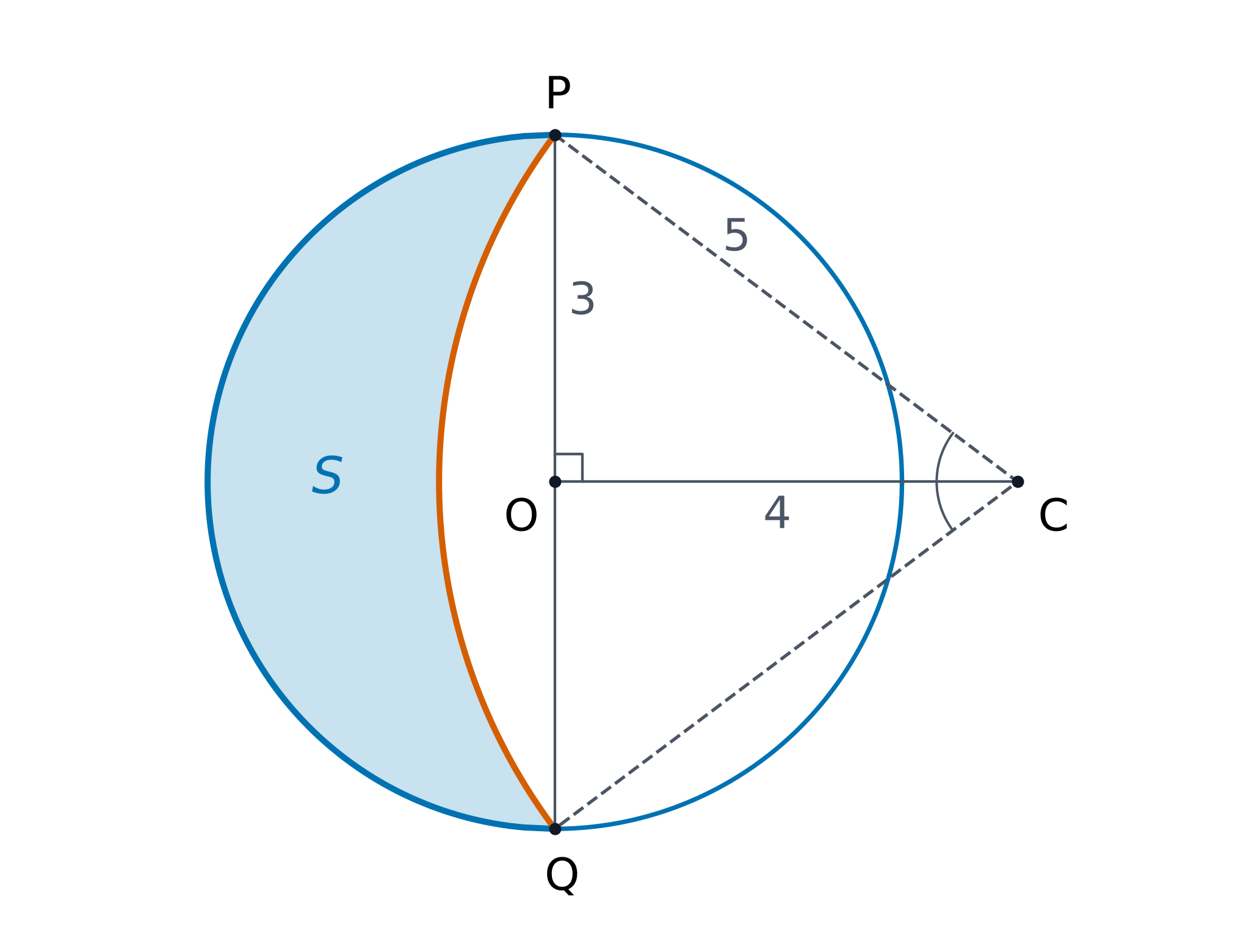
Let $\phi=\angle PCQ=2\tan^{-1}(3/4)\approx1.287$ radians. Triangle $PCQ$ has area $\tfrac12(6)(4)=12$. The large circle's minor segment has area $\tfrac{25}{2}\phi-12$. Subtract it from the small left semicircle:
$$\begin{aligned}
A_S&=\frac92\pi-\frac{25}{2}\phi+12\approx10.0,\\
P_S&=3\pi+5\phi\approx15.9.
\end{aligned}$$
The perimeter uses two curved pieces. The lines $PQ$ and $OC$ are construction lines inside the picture, not outside edges.
A shared chord can split another two-circle region into two circular segments. Sketch the required side of the chord for each circle. Calculate each sector and triangle with its own radius and central angle before combining their areas. For example, two circles of radius $6$, with centres $6$ apart, overlap in two equal minor segments. Equilateral triangles give each central angle $2\pi/3$. The overlap area is $2(12\pi-9\sqrt3)=24\pi-18\sqrt3$ and its perimeter is the two minor arcs, $8\pi$. The shared chord is internal.
Independent check. Replace the small radius by $4$, set $OC=3$, and keep the larger radius $5$, with the same perpendicular-diameter geometry. Find the crescent area and perimeter to three significant figures.
Check after attempting: $\phi=2\tan^{-1}(4/3)$. The large triangle still has area $12$. Thus area $=8\pi-\tfrac{25}{2}\phi+12\approx14.0$ square units and perimeter $=4\pi+5\phi\approx21.8$ units.
Explore
Radians, arcs and sectors
Change the angle (in radians) and radius. See the arc length $s = r\theta$ and the sector area $\tfrac12 r^2\theta$ update.
Vocabulary
Train
| English |
|---|
| radian/ˈreɪdɪən/ |
| arc/ɑːk/ |
| degrees/dɪˈɡriːz/ |
| sector/ˈsektə/ |
| circular segment/ˈsɜːkjələ ˈseɡmənt/ |
| sine/saɪn/ |
| cosine/ˈkəʊsaɪn/ |
| region/ˈriːdʒn/ |
| arc length/ɑːk leŋθ/ |
1.5
Trigonometry

Syllabus
| Candidates should be able to: | Notes and examples |
|---|---|
| sketch and use graphs of the sine, cosine and tangent functions (for angles of any size, and using either degrees or radians) | Including e.g. $y = 3 \sin x$, $y = 1 - \cos 2x$, $y = \tan(x + \frac{1}{4}\pi)$. |
| use the exact values of the sine, cosine and tangent of $30^\circ$, $45^\circ$, $60^\circ$, and related angles | e.g. $\cos 150^\circ = -\frac{1}{2}\sqrt{3}$, $\sin \frac{3}{4}\pi = \frac{1}{\sqrt{2}}$. |
| use the notations $\sin^{-1} x$, $\cos^{-1} x$, $\tan^{-1} x$ to denote the principal values of the inverse trigonometric relations | No specialised knowledge of these functions is required, but understanding of them as examples of inverse functions is expected. |
| use the identities $\frac{\sin \theta}{\cos \theta} \equiv \tan \theta$ and $\sin^2 \theta + \cos^2 \theta \equiv 1$ | e.g. in proving identities, simplifying expressions and solving equations. |
| find all the solutions of simple trigonometrical equations lying in a specified interval (general forms of solution are not included). | e.g. solve $3 \sin 2x + 1 = 0$ for $-\pi < x < \pi$, $3 \sin^2 \theta - 5 \cos \theta - 1 = 0$ for $0^\circ \leqslant \theta \leqslant 360^\circ$. |
Source: Cambridge International syllabus
A point on a turning wheel rises and falls. A trigonometric model describes that cycle, but its graph must have the correct height scale and timing. One calculator angle may miss another valid position in the same interval.
Exact values and signs
On the unit circle a point has coordinates $(\cos\theta,\sin\theta)$. Signs follow the quadrant, including negative angles and turns beyond $360^\circ$. The sine and cosine graphs have range $[-1,1]$ and period 周期 $2\pi$ radians or $360^\circ$. The tangent function 正切 repeats after $\pi$ radians or $180^\circ$ and is undefined where $\cos\theta=0$.
| $\theta$ | $30^\circ$ | $45^\circ$ | $60^\circ$ |
|---|---|---|---|
| $\sin\theta$ | $1/2$ | $1/\sqrt2$ | $\sqrt3/2$ |
| $\cos\theta$ | $\sqrt3/2$ | $1/\sqrt2$ | $1/2$ |
| $\tan\theta$ | $1/\sqrt3$ | $1$ | $\sqrt3$ |
Use the reference angle 参考角, the acute angle to the $x$-axis, to get the size. Then choose the sign. For example, $\cos150^\circ=-\sqrt3/2$, $\sin(-\pi/6)=-1/2$ and $\sin(3\pi/4)=1/\sqrt2$. The notation $\sin^2\theta$ means $(\sin\theta)^2$.

Transformed graphs
For $y=d+a\sin(bx+c)$ or $d+a\cos(bx+c)$, with $a,b\ne0$, the midline is $y=d$, amplitude 振幅 is $|a|$, and period is $2\pi/|b|$ radians or $360^\circ/|b|$. Find key points by setting the angle inside the function to familiar values.
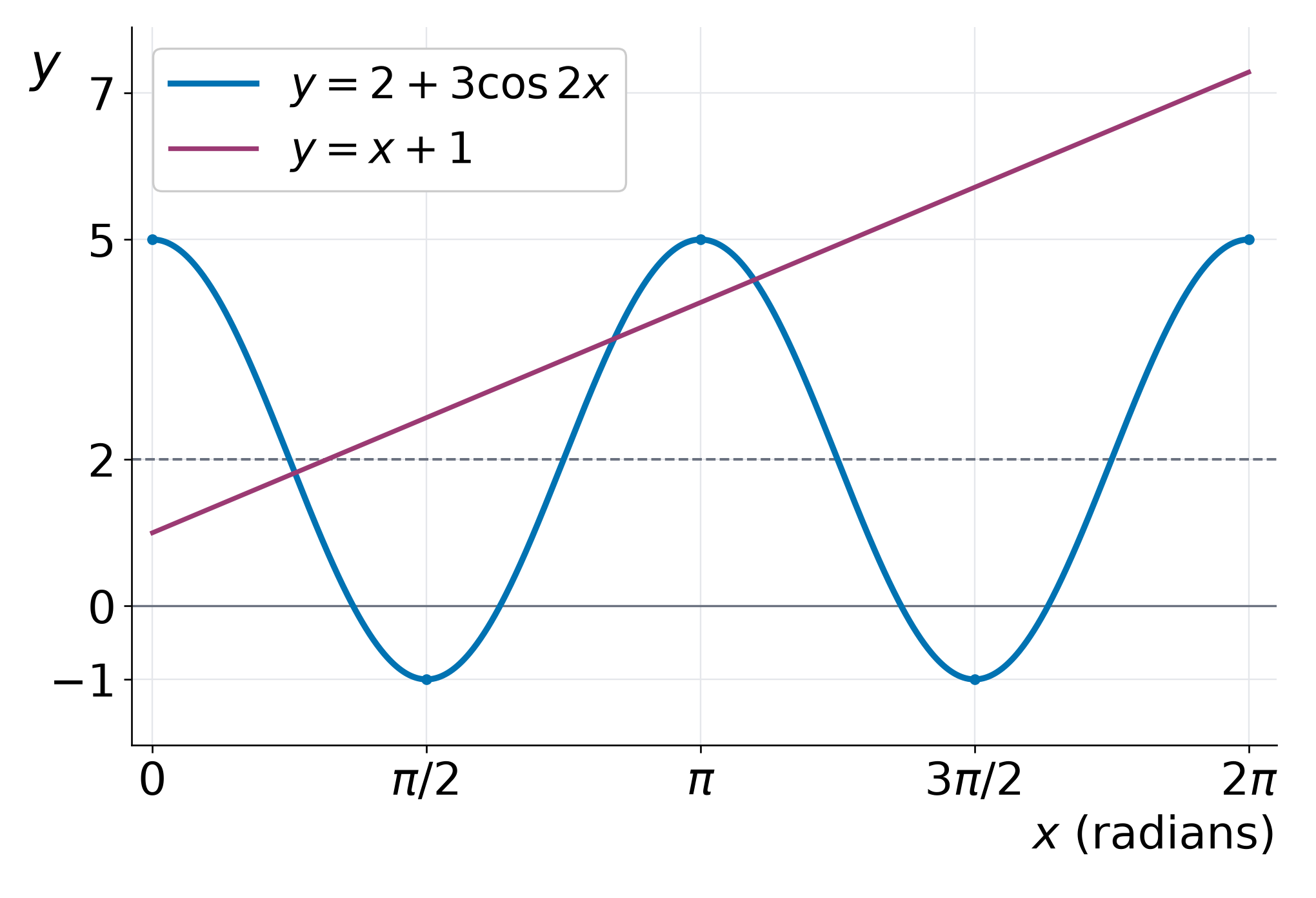
For $y=2+3\cos2x$, the range is $[-1,5]$ and period is $\pi$. On $[0,2\pi]$, maxima occur at $x=0,\pi,2\pi$ and minima at $x=\pi/2,3\pi/2$. There are two complete cycles.
For $y=\tan(x+\pi/4)$, shift the base tangent graph left by $\pi/4$. In $[-\pi,\pi]$, asymptotes are $x=-3\pi/4,\pi/4$, zeros are $-\pi/4,3\pi/4$ and the $y$-intercept is $1$. Its period is $\pi$ and it has no finite amplitude. Draw separate increasing branches; never join through an asymptote.
Principal values 主值 and inverse notation
The notations $\sin^{-1}u$, $\cos^{-1}u$ and $\tan^{-1}u$ return a principal value, an angle in the stated inverse range:
| Inverse | Principal range in radians | In degrees |
|---|---|---|
| Sine | $[-\pi/2,\pi/2]$ | $[-90^\circ,90^\circ]$ |
| Cosine | $[0,\pi]$ | $[0^\circ,180^\circ]$ |
| Tangent | $(-\pi/2,\pi/2)$ | $(-90^\circ,90^\circ)$ |
Sine/cosine inverse require an input in $[-1,1]$; tangent inverse accepts every real input. The superscript $-1$ means inverse here, not reciprocal. Thus $\sin^{-1}(\sin150^\circ)=30^\circ$, but $\sin\theta=1/2$ has both $30^\circ$ and $150^\circ$ in $[0^\circ,360^\circ]$.
To solve $\tan^{-1}(2x-1)=-\pi/4$, take tangent: $2x-1=-1$, so $x=0$. The given inverse output is inside the principal range.
Prove identities with valid algebra
The two core identities are
$$\tan\theta\equiv\frac{\sin\theta}{\cos\theta},\qquad \sin^2\theta+\cos^2\theta\equiv1.$$
An identity 恒等式 holds wherever both sides are defined. State denominator restrictions, and start from one side rather than assuming the equality you must prove. For example, where $\sin\theta\ne0$:
$$\begin{aligned}
\frac{1-\cos\theta}{\sin\theta}
&=\frac{(1-\cos\theta)(1+\cos\theta)}{\sin\theta(1+\cos\theta)}\\
&=\frac{\sin^2\theta}{\sin\theta(1+\cos\theta)}\\
&=\frac{\sin\theta}{1+\cos\theta}.
\end{aligned}$$
The condition also excludes $\cos\theta=-1$, so the cancelled factor is non-zero. Do not confuse $\sin^2\theta+\cos^2\theta$ with $(\sin\theta+\cos\theta)^2$.
A trigonometric equation 三角方程 asks for all angles in its stated interval.
Reduce equations to one trig function
Worked example. Solve $2\cos^2\theta-\sin\theta-1=0$ on $[0,2\pi]$. Substitute $\cos^2\theta=1-\sin^2\theta$:
$$2\sin^2\theta+\sin\theta-1=0\quad\Longrightarrow\quad(2\sin\theta-1)(\sin\theta+1)=0.$$
Therefore $\sin\theta=1/2$ or $-1$. The full answer is $\theta=\pi/6,5\pi/6,3\pi/2$. The principal value $-\pi/2$ is not in this interval, so use $3\pi/2$ instead. Reject sine/cosine values outside $[-1,1]$. If solving for $\sin^2\theta$, recover both square-root signs before finding the angles.
Change the inner interval
For $\sin2x=1/2$ and $-\pi<x<\pi$, let $u=2x$. Search the whole interval $-2\pi<u<2\pi$, not just one turn. Its solutions are $u=-11\pi/6,-7\pi/6,\pi/6,5\pi/6$. Dividing by $2$ gives
$$x=-11\pi/12,-7\pi/12,\pi/12,5\pi/12.$$
For a shifted angle such as $2x-\pi/6$, transform both interval endpoints first, then convert every inner-angle solution back to $x$. Check open/closed endpoints in the original equation.
Keep zero factors and exclude undefined angles
Dividing by a trig expression can lose roots. Write $\sin\theta\cos\theta=\sin\theta$ as $\sin\theta(\cos\theta-1)=0$, retaining the case $\sin\theta=0$.
For a fractional equation, first state the denominator restriction. For example, solve $6\sin\theta=1+2/\sin\theta$ for $-180^\circ<\theta<180^\circ$. Since $\sin\theta\ne0$, multiplication gives
$$(3\sin\theta-2)(2\sin\theta+1)=0.$$
The value $2/3$ gives $41.8^\circ,138.2^\circ$ and $-1/2$ gives $-150^\circ,-30^\circ$. All four are valid in the original equation. Keep calculator precision until the final angles.
Independent graph and equation checks
Sketch $y=1+\sin x$ and $y=x/2$ together for $0\le x\le2\pi$. Label the sine curve's five key points and count solutions of $1+\sin x=x/2$.
Check after attempting: the curve passes through $(0,1),(\pi/2,2),(\pi,1),(3\pi/2,0),(2\pi,1)$. There is one intersection, between $\pi/2$ and $\pi$. There the curve falls and the line rises. Before $\pi/2$ the curve is at least $1$ and the line below $1$; after $\pi$ the curve is at most $1$ and the line above $1$.
Also solve $\sin(2x-\pi/6)=-1/2$ on $[-\pi,\pi]$. The inner interval is $[-13\pi/6,11\pi/6]$, giving $x=-\pi,-\pi/3,0,2\pi/3,\pi$. Both endpoints are valid. A correct list of properties does not replace an actual graph, and one principal inverse value does not replace all equation solutions.
Explore
Sine & cosine graphs
Drag the amplitude, period and shifts of y = a·sin(bx + c) + d and watch the curve change against the base wave.
Explore
Sine and cosine on the unit circle
Drag the angle round the unit circle. The height is $\sin\theta$, the across-distance is $\cos\theta$ — that's where the graphs come from.
Vocabulary
Train
| English |
|---|
| tangent function/ˈtændʒənt ˈfʌŋkʃn/ |
| principal value/ˈprɪnsɪpl ˈvæljuː/ |
| identity/aɪˈdentɪti/ |
| trigonometric equation/ˌtrɪɡənəʊˈmetrɪk ɪˈkweɪʒn/ |
| reference angle/ˈrefrəns ˈæŋɡl/ |
| amplitude/ˈæmplɪtjuːd/ |
| period/ˈpɪərɪəd/ |
1.6
Series

Syllabus
| Candidates should be able to: | Notes and examples |
|---|---|
| use the expansion of $(a + b)^n$, where $n$ is a positive integer | Including the notations $\begin{pmatrix} n \\ r \end{pmatrix}$ and $n!$ Knowledge of the greatest term and properties of the coefficients are not required. |
| recognise arithmetic and geometric progressions | |
| use the formulae for the $n$th term and for the sum of the first $n$ terms to solve problems involving arithmetic or geometric progressions | Including knowledge that numbers $a$, $b$, $c$ are 'in arithmetic progression' if $2b = a + c$ (or equivalent) and are 'in geometric progression' if $b^2 = ac$ (or equivalent). Questions may involve more than one progression. |
| use the condition for the convergence of a geometric progression, and the formula for the sum to infinity of a convergent geometric progression. |
Source: Cambridge International syllabus
The binomial expansion 二项展开式
For a positive integer $n$, the binomial expansion is
$$(a + b)^n = a^n + \binom{n}{1}a^{n-1}b + \binom{n}{2}a^{n-2}b^2 + \cdots + b^n,$$
where $\binom{n}{r} = \dfrac{n!}{r!\,(n - r)!}$ is a binomial coefficient 二项式系数.
Worked example. Find the first three terms, in ascending powers of $x$, of $(2 - px)^5$.
$$(2 - px)^5 = 2^5 + \binom{5}{1}2^4(-px) + \binom{5}{2}2^3(-px)^2 + \cdots = 32 - 80px + 80p^2x^2 + \cdots$$
Arithmetic and geometric progressions 等比数列
A progression 数列 (sequence) is a list of terms following a rule.
- An arithmetic progression 等差数列 (AP) adds a fixed common difference 公差 $d$ each step. The $n$th term is $u_n = a + (n - 1)d$, and the sum of the first $n$ terms is $S_n = \tfrac{n}{2}\big(2a + (n - 1)d\big)$.
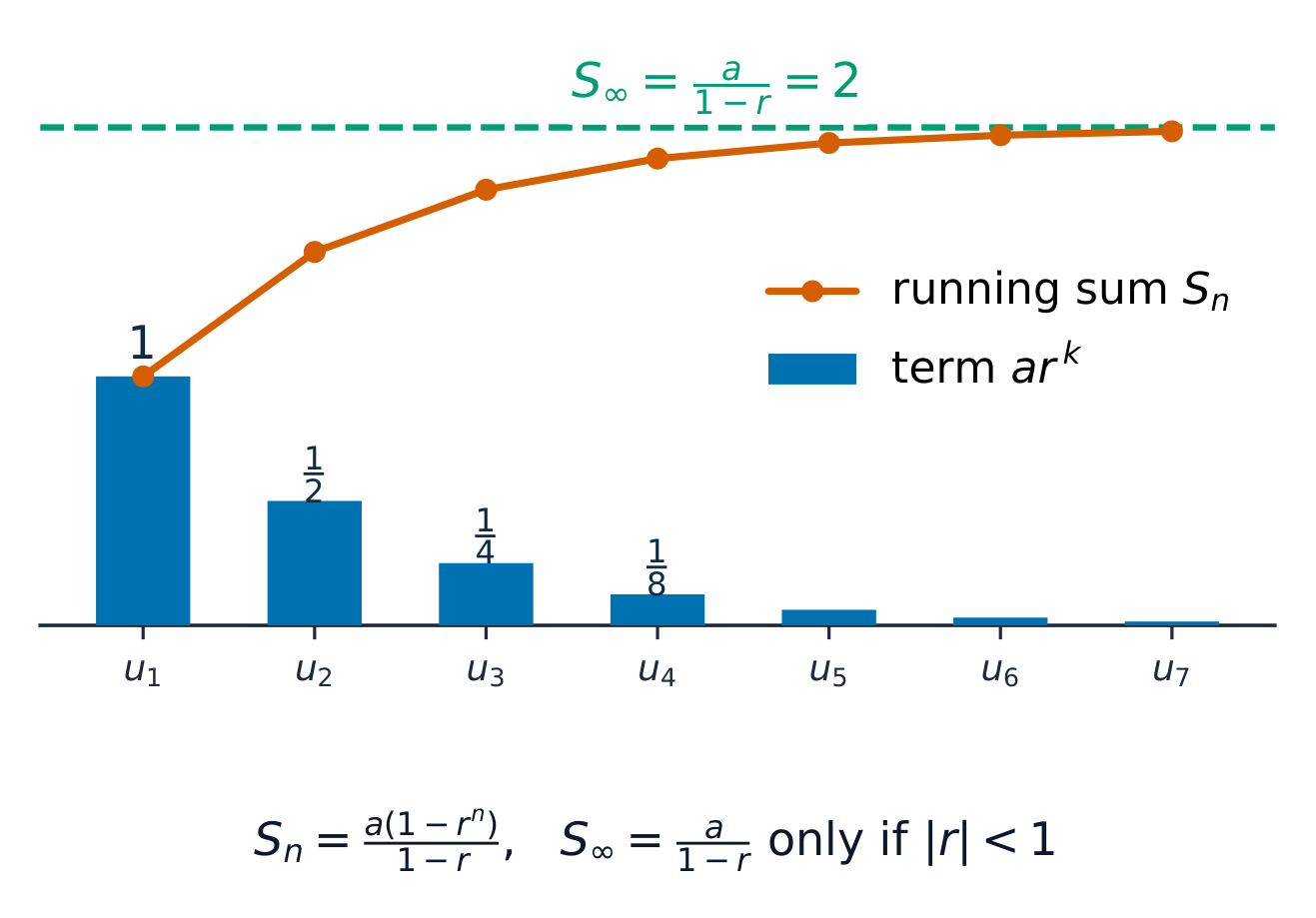
- A geometric progression (GP) multiplies by a fixed common ratio 公比 $r$ each step. The $n$th term is $u_n = ar^{\,n-1}$, and $S_n = \dfrac{a(1 - r^n)}{1 - r}$.
For a nonzero first term, a geometric series is convergent — its partial sums converge 收敛 (settle to a limit 极限) — exactly when $|r| < 1$. Then it has a sum to infinity
$$S_\infty = \frac{a}{1 - r}.$$
Worked example. The third term of a GP is $18$ and the sum of the first three terms is $26$. The common ratio is negative. Find the sum to infinity.
From $ar^2 = 18$ you get $a = \dfrac{18}{r^2}$. Put this into $a(1 + r + r^2) = 26$:
$$18(1 + r + r^2) = 26r^2 \;\Rightarrow\; 8r^2 - 18r - 18 = 0 \;\Rightarrow\; (4r + 3)(r - 3) = 0.$$
The ratio is negative, so $r = -\tfrac34$ and $a = \dfrac{18}{(3/4)^2} = 32$. Then
$$S_\infty = \frac{32}{1 - (-\tfrac34)} = \frac{32}{\tfrac74} = \frac{128}{7}.$$
Select a binomial term or a coefficient in a product
The term numbered $k+1$ in $(a+b)^n$ is $\binom nk a^{n-k}b^k$, with $k=0,\ldots,n$ and $0!=1$. The power $n$ is a positive integer here. Keep the sign inside the powered second part.
Worked example. In $(x^2+2/x)^6$, the general term is $\binom6k2^kx^{12-3k}$. The constant term needs $12-3k=0$, so $k=4$ and the answer is $15\times16=240$.
For the coefficient of $x^2$ in $(1+3x)(2-x)^4$, only two pairings contribute: the constant 1 times $24x^2$, and $3x$ times $-32x$. The coefficient is $24-96=-72$. When negative powers occur, list every possible pairing before selecting the terms.
Find an unknown AP and select its terms
If $u_3=13$ and $u_8=33$, then $a+2d=13$ and $a+7d=33$. Subtraction gives $d=4$ and $a=5$. Hence $u_{10}=41$ and $S_{10}=\frac{10}{2}(5+41)=230$.
For $a=4,d=3$, the terms strictly between 20 and 41 satisfy $20<3n+1<41$. Their positions are 7 through 13: there are $13-7+1=7$ terms, from 22 to 40. The sum is $\frac72(22+40)=217$, also $S_{13}-S_6$. Check whether the endpoints are included in the question.
Connect progressions and check convergence
Three consecutive AP terms $p,q,s$ satisfy $2q=p+s$. Three consecutive GP terms satisfy $q^2=ps$. If $p,q,s$ are GP terms while $p,q,-2s$ are AP terms, substitute $q=pr,s=pr^2$ into $2q=p-2s$. For $p\ne0$, this gives $2r^2+2r-1=0$. Solve, then apply any sign or convergence restrictions.
For a finite GP with $r=1$, use $S_n=na$; the fraction formula has a zero denominator. For a non-zero first term, an infinite geometric series has a finite sum exactly when $|r|<1$. A negative ratio can converge: signs alternate and the partial sums approach a limit from both sides. For $r=-1$ they keep oscillating instead.
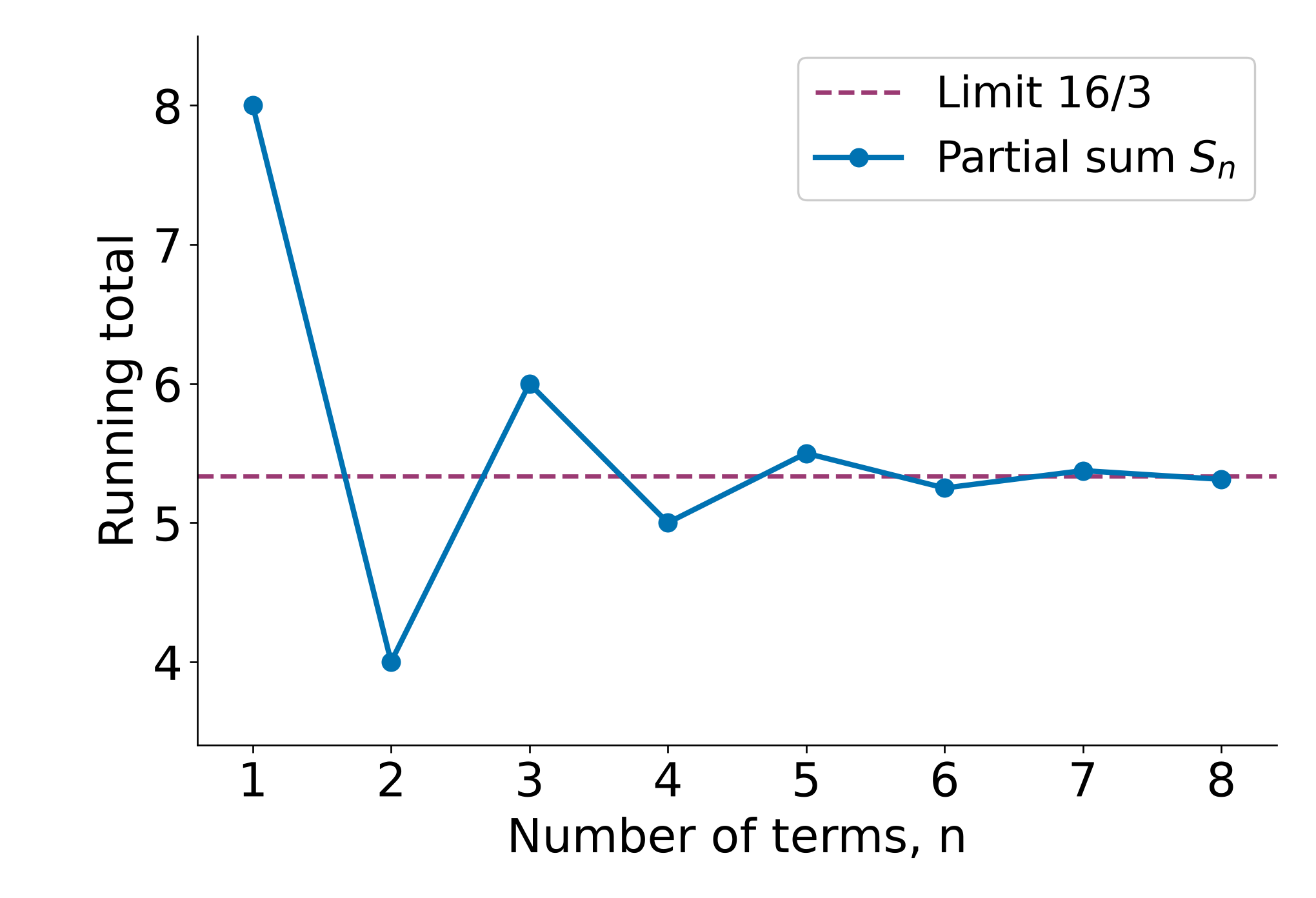
After the first $n$ terms are removed, the remaining sum is
$$S_\infty-S_n=\frac{ar^n}{1-r}.$$
Worked example. A second term of $-12$ and infinite sum 16 give $ar=-12$ and $a=16(1-r)$. Thus $4r^2-4r-3=0$. Reject $r=3/2$ because it cannot converge, leaving $r=-1/2,a=24$. After three terms the remaining infinite sum is $24(-1/2)^3/(3/2)=-2$. A negative tail is valid: the finite total was above the limiting sum.
Explore
Arithmetic and geometric sequences
Switch between an arithmetic (add d) and a geometric (multiply by r) sequence and watch the terms and their sum build up.
Vocabulary
Train
| English |
|---|
| binomial expansion/baɪˈnəʊmɪəl ekˈspænʃn/ |
| binomial coefficient/baɪˈnəʊmɪəl ˌkəʊɪˈfɪʃənt/ |
| progression/prəˈɡreʃn/ |
| arithmetic progression/əˈrɪθmətɪk prəˈɡreʃn/ |
| common difference/ˈkɒmən ˈdɪfrəns/ |
| geometric progression/ˌdʒiːəʊˈmetrɪk prəˈɡreʃn/ |
| common ratio/ˈkɒmən ˈreɪʃɪəʊ/ |
| converges/kənˈvɜːdʒɪz/ |
| sum to infinity/sʌm tʊ ɪnˈfɪnɪti/ |
| limit/ˈlɪmɪt/ |
1.7
Differentiation
Syllabus
| Candidates should be able to: | Notes and examples |
|---|---|
| understand the gradient of a curve at a point as the limit of the gradients of a suitable sequence of chords, and use the notations $f'(x)$, $f''(x)$, $\frac{\text{d}y}{\text{d}x}$, and $\frac{\text{d}^2y}{\text{d}x^2}$ for first and second derivatives | Only an informal understanding of the idea of a limit is expected. e.g. includes consideration of the gradient of the chord joining the points with $x$ coordinates $2$ and $(2 + h)$ on the curve $y = x^3$. Formal use of the general method of differentiation from first principles is not required. |
| use the derivative of $x^n$ (for any rational $n$), together with constant multiples, sums and differences of functions, and of composite functions using the chain rule | e.g. find $\frac{\text{d}y}{\text{d}x}$, given $y = \sqrt{2x^3 + 5}$. |
| apply differentiation to gradients, tangents and normals, increasing and decreasing functions and rates of change | Including connected rates of change, e.g. given the rate of increase of the radius of a circle, find the rate of increase of the area for a specific value of one of the variables. |
| locate stationary points and determine their nature, and use information about stationary points in sketching graphs. | Including use of the second derivative for identifying maxima and minima; alternatives may be used in questions where no method is specified. Knowledge of points of inflexion is not included. |
Source: Cambridge International syllabus
Differentiation finds the gradient of a curve 曲线斜率 at each point. The gradient is the limit of the gradients of shorter and shorter chords, called the derivative 导数.
The rules
Write the derivative as $f'(x)$ or $\dfrac{dy}{dx}$. The basic rule is
$$\frac{d}{dx}\left(x^n\right) = n x^{n-1} \quad \text{for any rational } n.$$
Differentiate sums term by term, and use the chain rule 链式法则 for a function inside a function:
$$\frac{d}{dx}\,f(g(x)) = f'(g(x)) \cdot g'(x).$$
Differentiating again gives the second derivative 二阶导数 $f''(x)$ or $\dfrac{d^2y}{dx^2}$.
Using the derivative
- Tangent and normal 法线. The gradient of the curve at a point is the gradient of the tangent there. The normal is perpendicular to the tangent, so its gradient is $-\dfrac{1}{\text{(tangent gradient)}}$ when the tangent gradient is non-zero. A horizontal tangent has a vertical normal.
- Increasing or decreasing. The function is an increasing function 增函数 where $\dfrac{dy}{dx} > 0$, and a decreasing function 减函数 where $\dfrac{dy}{dx} < 0$.
- Rate of change 变化率. A derivative is a rate of change. Linked rates use the chain rule, e.g. $\dfrac{dy}{dt} = \dfrac{dy}{dx}\cdot\dfrac{dx}{dt}$.
Stationary points 驻点
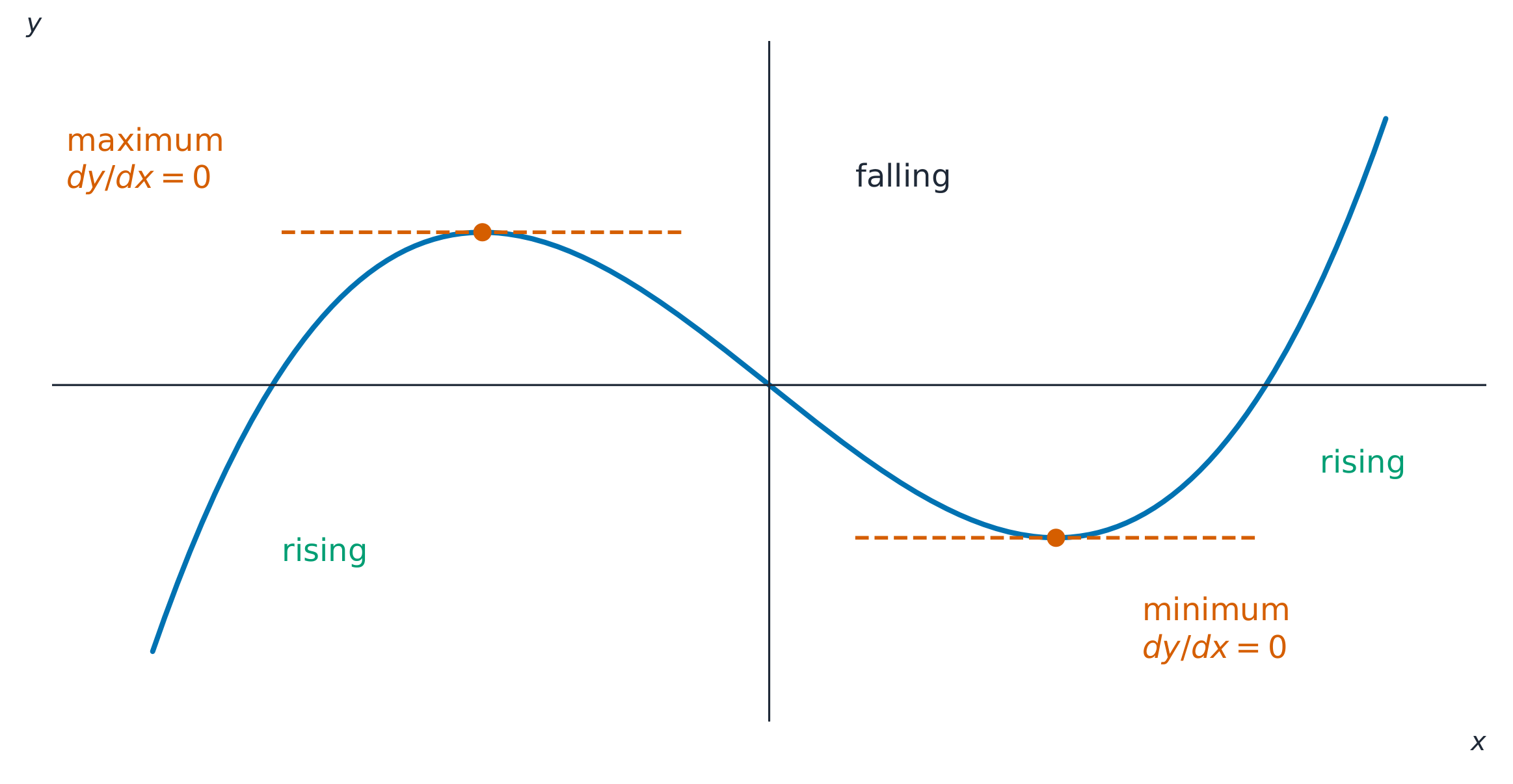
A stationary point is where $\dfrac{dy}{dx} = 0$. Test its nature with the second derivative: $f''(x) > 0$ gives a minimum point 极小值点, and $f''(x) < 0$ gives a maximum point 极大值点. When $f''(x) = 0$ the test is inconclusive. Check the sign of the first derivative on both sides: negative to positive proves a minimum, and positive to negative proves a maximum. For example, $y=x^4$ has a minimum at zero despite both derivatives being zero there.
Worked example. The curve $y = 4x^{1/2} - x$ has a maximum point at $x = a$. Find $a$.
$$\frac{dy}{dx} = 2x^{-1/2} - 1 = 0 \;\Rightarrow\; \frac{2}{\sqrt{x}} = 1 \;\Rightarrow\; \sqrt{x} = 2 \;\Rightarrow\; x = 4.$$
So $a = 4$.
Chords, rational powers and a nested root
For $y=x^3$, the gradient of the chord from $x=2$ to $x=2+h$ is $[(2+h)^3-8]/h=12+6h+h^2$ for $h\ne0$. As $h\to0$, this tends to 12, the tangent gradient. This is an informal explanation of the derivative; do not substitute zero into the original quotient.
For $x>0$, $f=3\sqrt x+2/x$ gives $f'=\frac32x^{-1/2}-2x^{-2}$ and $f''=-\frac34x^{-3/2}+4x^{-3}$. For a nested function $y=\sqrt{2x^3+5}$, use the chain rule to obtain $dy/dx=3x^2/\sqrt{2x^3+5}$ where the root's argument is positive.
Write the tangent and the normal
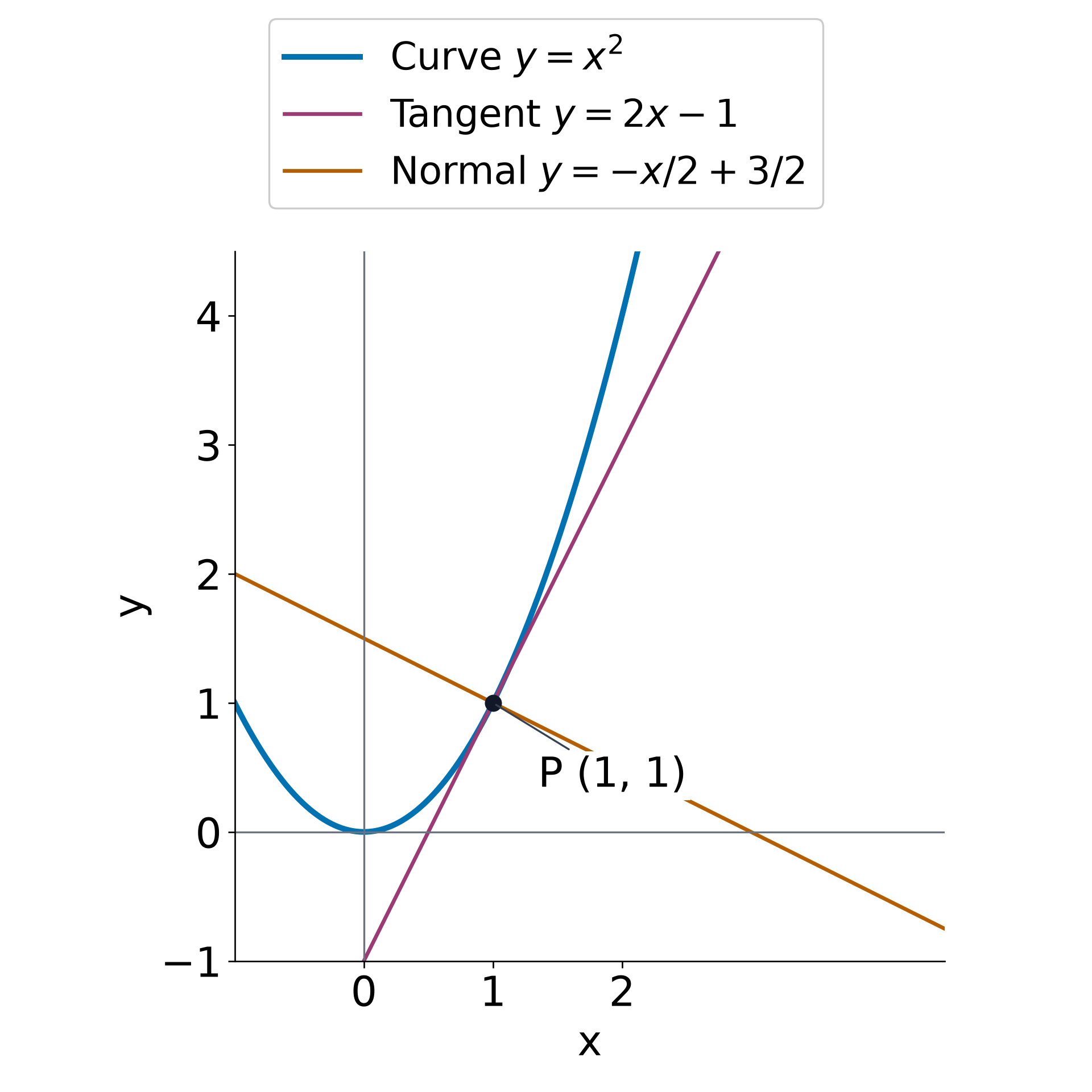
Find the point as well as the gradient. On $y=x^2$ at $(1,1)$, $dy/dx=2$, giving tangent $y-1=2(x-1)$ and normal $y-1=-\frac12(x-1)$. If a point $(p,q)$ has gradient zero, its tangent is $y=q$ and its normal is $x=p$.
From stationary points to a sketch
For $f=x^3-6x^2+9x+2$, $f'=3(x-1)(x-3)$, so stationary points have $x=1,3$. Substitute into the original function: $(1,6)$ is a maximum because $f''(1)=-6$; $(3,2)$ is a minimum because $f''(3)=6$. The derivative is positive for $x<1$ and $x>3$, and negative for $1<x<3$. A sketch also needs intercepts and any domain restrictions.
Connected rates and optimisation
If $A=\pi r^2$, then $dA/dt=(dA/dr)(dr/dt)=2\pi r\,dr/dt$. At $r=5$ cm and $dr/dt=0.3$ cm/s, $dA/dt=3\pi$ cm²/s. Start with a negative rate for a decreasing quantity. Derivatives with respect to a length and with respect to time are different rates.
For a rectangle beside a wall, 60 m of fence covers two widths $x$ and a length $y$. The constraint is $2x+y=60$. Therefore $A=x(60-2x)$ with $0<x<30$. Solve $A'=60-4x=0$, giving $x=15,y=30$. Since $A''=-4<0$, the maximum area is $450$ m². Check the physical domain and its boundaries before accepting an optimum.
Explore
The gradient at a point
y = ax³ + bx² + cx + d
Slide the point along the curve. The tangent shows the gradient $\frac{dy}{dx}$ there — steeper where the curve bends more.
Vocabulary
Train
| English |
|---|
| gradient of a curve/ˈɡreɪdɪənt əvə kɜːv/ |
| derivative/dɪˈrɪvətɪv/ |
| chain rule/tʃeɪn ruːl/ |
| second derivative/ˈsekənd dɪˈrɪvətɪv/ |
| normal/ˈnɔːml/ |
| increasing function/ɪnˈkriːsɪŋ ˈfʌŋkʃn/ |
| decreasing function/ˈdiːkriːsɪŋ ˈfʌŋkʃn/ |
| rate of change/reɪt ɒv tʃeɪndʒ/ |
| stationary point/ˈsteɪʃənəri pɔɪnt/ |
| minimum point/ˈmɪnɪməm pɔɪnt/ |
| maximum point/ˈmæksɪməm pɔɪnt/ |
1.8
Integration
Syllabus
| Candidates should be able to: | Notes and examples |
|---|---|
| understand integration as the reverse process of differentiation, and integrate $(ax + b)^n$ (for any rational $n$ except $-1$), together with constant multiples, sums and differences | e.g. $\int (2x^3 - 5x + 1) \text{d}x$, $\int \frac{1}{(2x + 3)^2} \text{d}x$. |
| solve problems involving the evaluation of a constant of integration | e.g. to find the equation of the curve through $(1, -2)$ for which $\frac{\text{d}y}{\text{d}x} = \sqrt{2x + 1}$. |
| evaluate definite integrals | Including simple cases of 'improper' integrals, such as $\int_{0}^{1} x^{-\frac{1}{2}} \text{d}x$ and $\int_{1}^{\infty} x^{-2} \text{d}x$. |
| use definite integration to find: - the area of a region bounded by a curve and lines parallel to the axes, or between a curve and a line or between two curves - a volume of revolution about one of the axes. | A volume of revolution may involve a region not bounded by the axis of rotation, e.g. the region between $y = 9 - x^2$ and $y = 5$ rotated about the $x$-axis. |
Source: Cambridge International syllabus
Integration 积分 is the reverse of differentiation. Reversing the power rule gives
$$\int (ax + b)^n \, dx = \frac{(ax + b)^{n+1}}{a(n + 1)} + C \quad (n \neq -1,\ a\ne0).$$
The $+\,C$ is the constant of integration 积分常数. If you know one point on the curve, substitute it to find $C$.
Definite integrals 定积分 and area
A definite integral has limits and gives a number:
$$\int_p^q f(x)\, dx = \big[F(x)\big]_p^q = F(q) - F(p).$$
For $p<q$, a definite integral counts contributions above the $x$-axis positively and those below negatively. It equals geometric area only when the curve is nonnegative throughout. For total area, split at the roots and add the magnitudes of each integral. For the area between two curves, integrate (top curve $-$ bottom curve), splitting wherever their order changes. Reversing the limits reverses the sign of the integral.
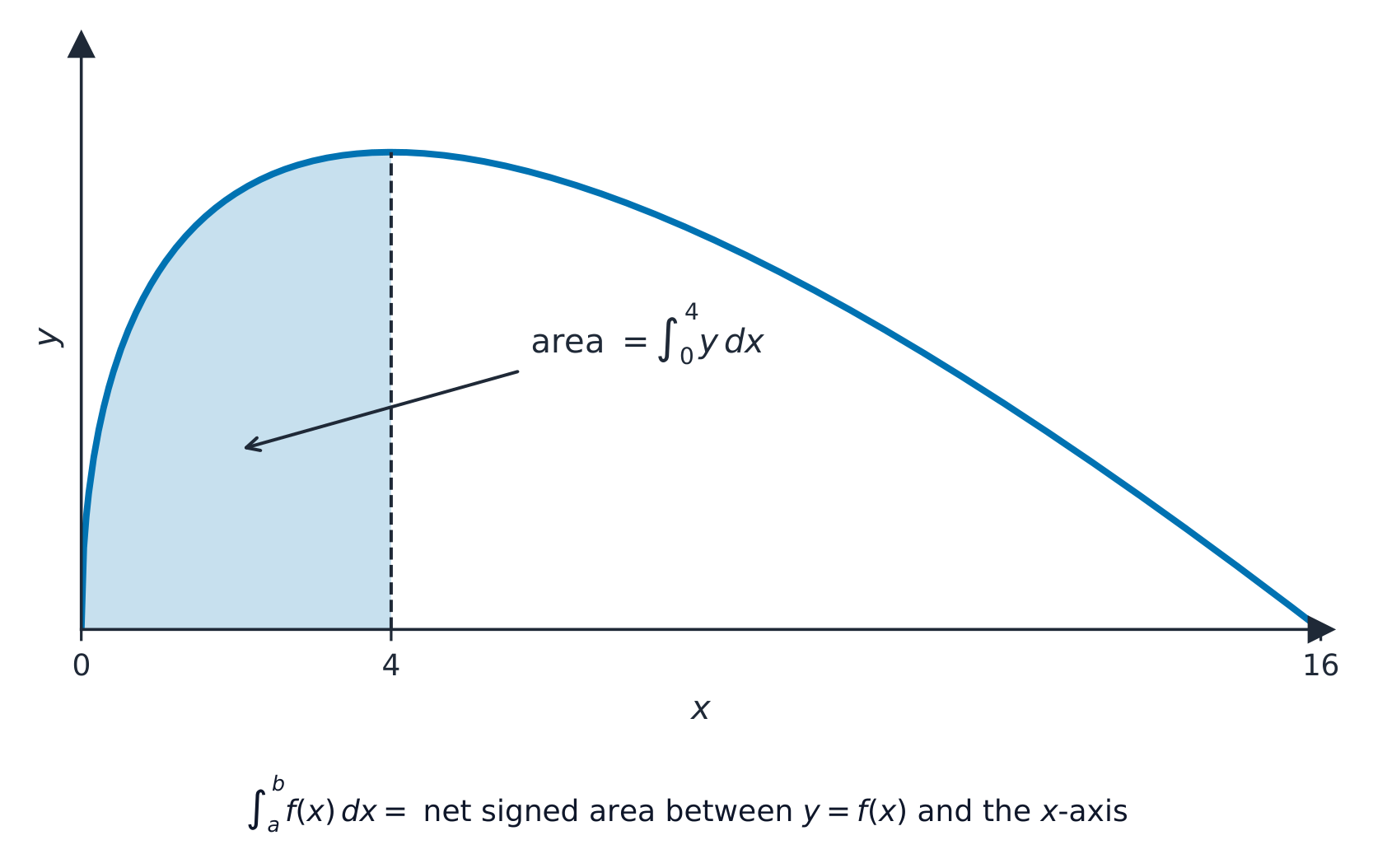
Worked example. The curve $y = 4x^{1/2} - x$ meets the $x$-axis again at $x = 16$. Find the area between the curve and the $x$-axis from $x = 0$ to $x = 4$.
$$\int_0^4 \left(4x^{1/2} - x\right) dx = \left[\frac{8}{3}x^{3/2} - \frac{x^2}{2}\right]_0^4 = \frac{8}{3}(8) - \frac{16}{2} = \frac{64}{3} - 8 = \frac{40}{3}.$$
An improper integral 广义积分 has an infinite limit or an endpoint where the integrand is undefined; evaluate it as a limit. For example,
$$\int_1^{\infty}x^{-2}\, dx=\lim_{b\to\infty}\left[-\frac1x\right]_1^{b}=\lim_{b\to\infty}\left(1-\frac1b\right)=1,$$
and $\displaystyle\int_0^{1}x^{-1/2}\, dx=\lim_{a\to0^+}\left[2x^{1/2}\right]_a^{1}=2$, which is finite even though the integrand blows up at $x=0$.
Volume of revolution 旋转体体积
When a region is turned all the way around an axis it sweeps out a solid. The volume of revolution about the $x$-axis is
$$V = \pi \int_p^q y^2 \, dx,$$
and about the $y$-axis it is $V = \pi \displaystyle\int x^2 \, dy$. For example, the region under $y = \sqrt{x}$ from $x = 0$ to $x = 4$, turned about the $x$-axis, has volume $\pi\displaystyle\int_0^4 x\, dx = \pi\big[\tfrac{x^2}{2}\big]_0^4 = 8\pi$.

A curve from two conditions
If $y''=6x$ and $(1,4)$ is a stationary point, integrate once to $y'=3x^2+A$. The gradient is zero there, so $A=-3$. Integrate again to $y=x^3-3x+B$; using the point gives $B=6$. Two integrations need two separately determined constants. Check the result by differentiating.
Signed total and geometric area
For $y=x^2-1$ from $x=-1$ to 2, the signed integral is zero. Split at $x=1$: the contribution on $[-1,1]$ is $-4/3$, and the contribution on $[1,2]$ is $4/3$. The geometric area is $4/3+4/3=8/3$ square units.

An improper integral is finite only if its limiting value exists as a real number. For example, $\int_0^1x^{-2}dx=\lim_{a\to0^+}(1/a-1)$ has no finite value. The infinity symbol is a bound described by a limit, not a number to substitute.
A gap between curves or a tangent and a curve
The curves $y=2x$ and $y=x^2$ intersect at $x=0,2$. The line is above the parabola between them, so the enclosed area is $\int_0^2(2x-x^2)dx=4/3$ square units. If the upper and lower curves exchange places, split the integral at that intersection.
For $y=2x-x^2$, the tangent at $(1,1)$ is $y=1$. On $0\le x\le1$, the area under the curve is $2/3$ and the rectangle beneath the tangent has area 1. The gap is $1-2/3=1/3$. Find a tangent's equation and relevant intercepts before selecting the bounds in a compound area question.
Rotation with a hole and rotation about either axis
A region need not touch the axis of rotation. A slice then has outer radius $R$ and inner radius $r$; its cross-sectional area is $\pi(R^2-r^2)$, not $\pi(R-r)^2$.
Between $y=4-x^2$ and $y=1$, intersections occur at $x=\pm\sqrt3$. Rotating about the $x$-axis gives
$$V=\pi\int_{-\sqrt3}^{\sqrt3}[(4-x^2)^2-1]dx=\frac{88\pi\sqrt3}{5}.$$
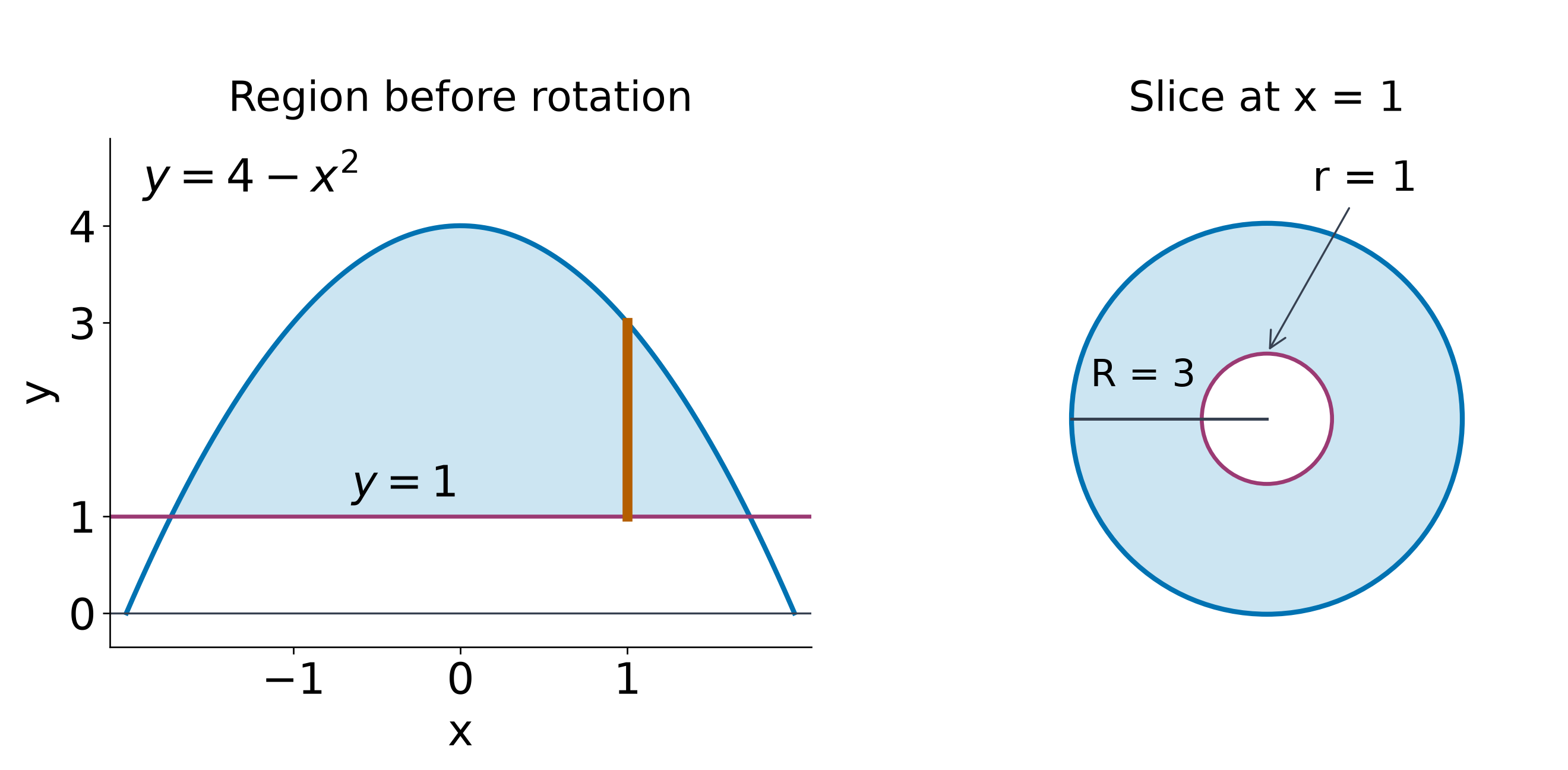
About the $y$-axis, use horizontal slices and express radii in terms of $y$: $V=\pi\int(R(y)^2-r(y)^2)dy$. The region $0\le x\le\sqrt y$, $0\le y\le4$, produces $V=\pi\int_0^4y\,dy=8\pi$. Bounds must be $y$ values when integrating with respect to $y$. Include any inner radius, and state cubic units.
Explore
Area under a curve
y = ax³ + bx² + cx + d
Drag the limits. The definite integral is the shaded area between the curve and the x-axis.
Vocabulary
Train
| English |
|---|
| Integration/ˌɪntɪˈɡreɪʃn/ |
| constant of integration/ˈkɒnstənt ɒv ˌɪntɪˈɡreɪʃn/ |
| definite integral/ˈdefɪnət ˈɪntɪɡrəl/ |
| improper integral/ɪmˈprɒpə ˈɪntɪɡrəl/ |
| volume of revolution/ˈvɒljuːm ɒv ˌrevəˈluːʃn/ |
1.8
Exam tips
- Show every line of algebra — method marks are lost by jumping steps; use the discriminant $b^2 - 4ac$ to decide the number of real roots.
- Work in radians for circular measure (arc $= r\theta$, sector area $= \frac{1}{2}r^2\theta$).
- For differentiation, set $\frac{dy}{dx} = 0$ for stationary points and use the second derivative to classify them.
- For integration, add $+ c$ to an indefinite integral and use limits for area; an area below the axis gives a negative integral.
Interactive lessons on this topic
Work through it step by step, with instant-check exercises.