Skip to content · ⁨ข้ามไปยังเนื้อหา⁩

Group 2 · ⁨กลุ่มที่ 2⁩

A-Level Chemistry · ⁨Chemistry A-Level⁩ · Topic 27 · ⁨หัวข้อ 27⁩

Video lesson for this topic · ⁨บทเรียนวิดีโอสำหรับหัวข้อนี้⁩ Open the video page · ⁨เปิดหน้าวิดีโอ⁩
8:06

กลุ่มที่ 2 (A2)

นี่คือปริศนา ลงไปตามกลุ่มที่ 2 จากแมกนีเซียมถึงแบเรียม ไฮดรอกไซด์จะละลายได้มากขึ้น ลงไปในกลุ่มเดียวกัน ซัลเฟตจะละลายได้น้อยลง…

English narration · English + 中文 subtitles burned in · ⁨การบรรยายภาษาอังกฤษ · คำบรรยายภาษาอังกฤษ + 中文 ลอยตัวบนภาพ⁩

27.1

Thermal stability of the nitrates and carbonates · ⁨ความเสถียรต่อความร้อนของไนเตรตและคาร์บอเนต⁩

Syllabus · ⁨หลักสูตร⁩
English
  1. describe and explain qualitatively the trend in the thermal stability of the nitrates and carbonates including the effect of ionic radius on the polarisation of the large anion
  2. describe and explain qualitatively the variation in solubility and of enthalpy change of solution, $\Delta H^{\ominus}_{\text{sol}}$, of the hydroxides and sulfates in terms of relative magnitudes of the enthalpy change of hydration and the lattice energy
ไทย
  1. อธิบายและอธิบายโดยสังเขบถึงแนวโน้มความเสถียรทางความร้อนของไนเตรตและคาร์บอเนต รวมถึงผลของรัศมีไอออนต่อการโพลาไรซ์ของอนไอออนขนาดใหญ่
  2. อธิบายและอธิบายโดยสังเขบถึงความแปรปรวนของความละลายและการเปลี่ยนแปลงเอนทาลปีของการละลาย $\Delta H^{\ominus}_{\text{sol}}$ ของไฮดรอกไซด์และซัลเฟต ตามขนาดสัมพัทธ์ของการเปลี่ยนแปลงเอนทาลปีของการ hydratation และพลังงานแลตติส
Source: Cambridge International syllabus · ⁨แหล่งที่มา: หลักสูตร Cambridge International⁩

English

The thermal stability 热稳定性 of the Group 2 nitrates 硝酸盐 and carbonates 碳酸盐 increases down the group. Here is the reason, in terms of how the ions affect each other.

A small cation 阳离子 with a small ionic radius 离子半径 has a high charge density. It pulls on the electrons of the nearby anion and distorts its shape — this is polarisation 极化. Distorting the large anion 阴离子 (the carbonate or nitrate ion) weakens a bond inside it, so the compound breaks down more easily.

Going down the group, the cation gets larger. Its charge density drops, so it polarises the anion less. The anion is less distorted, so the compound is harder to break down — it is more thermally stable and needs a higher temperature to decompose.

Worked example. Down Group 2 the hydroxides become more soluble while the sulfates become less soluble. Explain why the two trends run in opposite directions. Solubility is a contest between the lattice energy holding the solid together and the hydration energy rewarding the ions for dissolving. Both get less exothermic as the cation grows, so whichever falls faster decides the trend. With the small hydroxide ion, the lattice energy depends strongly on the cation's size, so it falls faster than the hydration energy: the lattice gets relatively easier to break and solubility rises. With the large sulfate ion, the lattice energy is already dominated by that big anion and barely changes down the group, while the cation's hydration energy still falls - so solubility falls. Name both energies and say which one falls faster; simply restating the trends earns no explanation marks.

ไทย

ความเสถียรต่อความร้อน ของ ไนเตรต และ คาร์บอเนต ของกลุ่มที่ 2 เพิ่มขึ้น ลงไปตามกลุ่ม นี่คือเหตุผล โดยพิจารณาจากอิทธิพลของไอออนที่มีต่อกัน

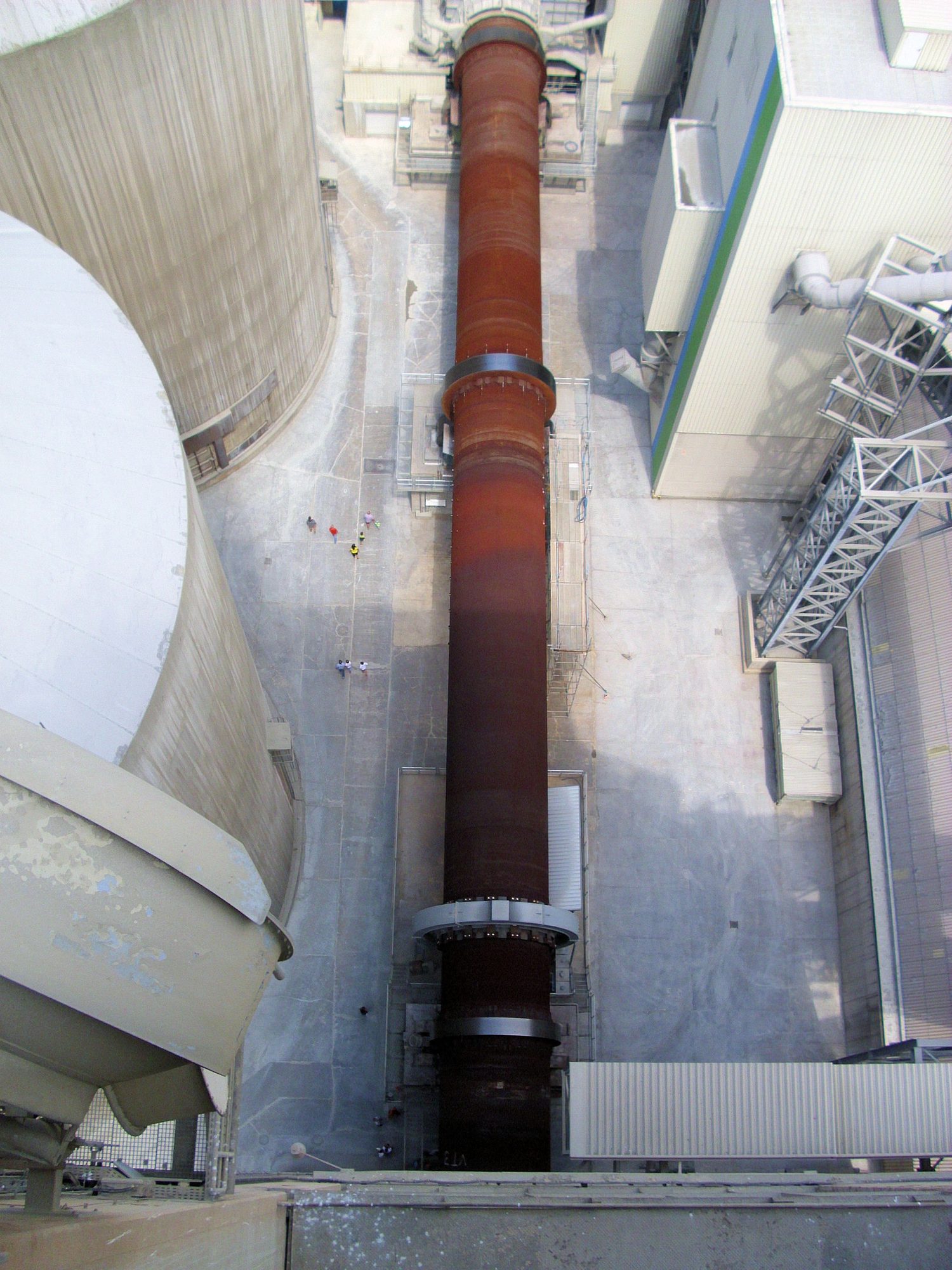
เตาหมุนในโรงงานผลิตปูนขาว *การให้ความร้อนหินปูน (แคลเซียมคาร์บอเนต) ในเตาทำให้สลายตัวเป็นแคลเซียมออกไซด์ — ซึ่งเป็นปฏิกิริยาสลายตัวด้วยความร้อน

แคทไอออนขนาดเล็กที่มีรัศมีไอออนเล็กจะมีความหนาแน่นประจุสูง มันจะดึงอิเล็กตรอนของแอนไอออนใกล้เคียงและทำให้รูปร่างของมันบิดเบี้ยว — นี่คือ การขั้ว (polarisation) การบิดเบี้ยวของ แอนไอออน ขนาดใหญ่ (ไอออนคาร์บอเนตหรือไนเตรต) ทำให้พันธะภายในอ่อนลง ดังนั้นสารประกอบจึงสลายตัวได้ง่ายขึ้น

เมื่อเคลื่อนลงกลุ่ม แคทไอออนจะมีขนาดใหญ่ขึ้น ความหนาแน่นประจุลดลง จึงทำให้ขั้วต่อแอนไอออน น้อยลง แอนไอออนถูกบิดเบี้ยวน้อยลง สารประกอบจึงสลายตัวยากขึ้น — มีความเสถียรทางความร้อนมากขึ้น และต้องใช้อุณหภูมิสูงขึ้นในการสลายตัว

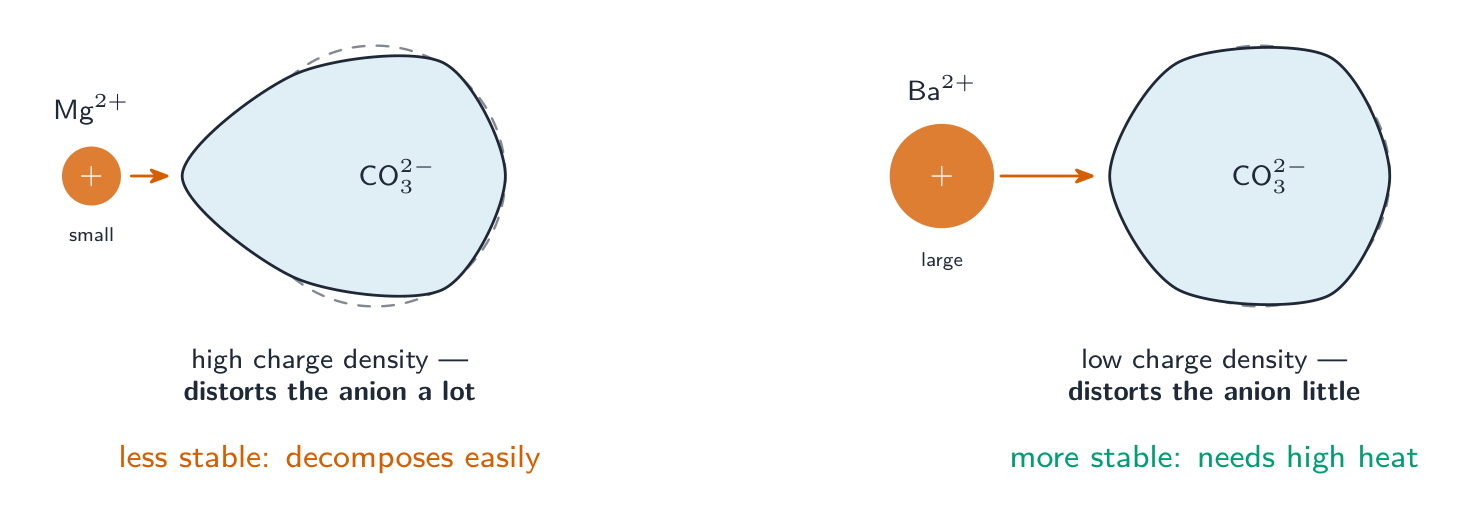
สองสถานการณ์: แคทไอออนแมกนีเซียมขนาดเล็กบิดเบี้ยวเมฆอิเล็กตรอนของแอนไอออนคาร์บอเนตให้เป็นรูปหยดน้ำอย่างมาก ในขณะที่แคทไอออนบาร์เลียมขนาดใหญ่แทบไม่มีการบิดเบี้ยวเลย
แคทไอออนขนาดเล็กมีความหนาแน่นประจุสูง จึงบิดเบี้ยว (ทำให้ขั้ว) แอนไอออนขนาดใหญ่ได้มากกว่า — ทำให้พันธะอ่อนลง สารประกอบจึงไม่เสถียร

ตัวอย่างวิธีทำ. เมื่อเคลื่อนลงกลุ่มที่ 2 ไฮดรอกไซด์ จะละลายได้ มากขึ้น ในขณะที่ ซัลเฟต จะละลายได้ น้อยลง อธิบายว่าทำไมแนวโน้มทั้งสองถึงเป็นไปในทิศทางตรงกันข้าม การละลายเป็นการแข่งขันระหว่าง พลังงานแลตทิซ ที่ยึดเนื้อแข็งไว้ด้วยกันกับ พลังงานไฮเดรต ที่ให้รางวัลแก่ไอออนสำหรับการละลาย ทั้งสองค่าจะลดความคายความร้อนลงเมื่อแคทไอออนมีขนาดเพิ่มขึ้น ดังนั้นค่าใดที่ลดลง เร็วกว่า จึงกำหนดแนวโน้ม สำหรับ ไอออนไฮดรอกไซด์ขนาดเล็ก พลังงานแลตทิซขึ้นอยู่กับขนาดของแคทไอออนมาก จึงลดลงเร็วกว่าพลังงานไฮเดรต: แลตทิซแตกหักได้ง่ายขึ้นในเชิงสัมพัทธ์และการละลาย เพิ่มขึ้น สำหรับ ไอออนซัลเฟตขนาดใหญ่ พลังงานแลตทิซถูกควบคุมโดยแอนไอออนใหญ่นี้อยู่แล้วแทบไม่เปลี่ยนแปลงเมื่อเคลื่อนลงกลุ่ม ในขณะที่พลังงานไฮเดรตของแคทไอออนยังคงลดลง — ดังนั้นการละลายจึง ลดลง ระบุชื่อ ทั้งสอง พลังงานและระบุว่าอันไหนลดลงเร็วกว่า; การทบทวนแนวโน้มเพียงอย่างเดียวโดยไม่อธิบายจะไม่ได้รับคะแนน

Explore · ⁨สำรวจ⁩

Group 2 thermal stability ladder · ⁨บันไดความเสถียรทางความร้อนกลุ่ม 2⁩

Move down Group 2 and see why carbonates become harder to decompose. · ⁨ขยับลงกลุ่ม 2 และดูว่าทำไมคาร์บอเนตถึงแยกตัวได้ยากขึ้น⁩

Explore · ⁨สำรวจ⁩

Group 2 solubility lab · ⁨ห้องปฏิบัติการความละลายกลุ่ม 2⁩

Classify Group 2 compounds by solubility trend. · ⁨จำแนกสารกลุ่ม 2 ตามแนวโน้มความละลาย⁩

Vocabulary · ⁨คำศัพท์⁩ Train · ⁨ฝึกฝน⁩
English ไทย
thermal stability/ˈθɜːml stəˈbɪlɪti/ ความเสถียรทางความร้อน
nitrate/ˈnaɪtreɪt/ ไนเตรต
carbonate/ˈkɑːbəneɪt/ คาร์บอเนต
cation/ˈkætaɪən/ แคทไอออน
ionic radius/aɪˈɒnɪk ˈreɪdɪəs/ รัศมีไอออน
polarisation/ˌpəʊləraɪˈzeɪʃn/ การทำให้มีขั้ว
anion/ˈænaɪən/ แอนไอออน
enthalpy change of solution/enˈθælpi tʃeɪndʒ ɒv səˈluːʃn/ การเปลี่ยนแปลงเอนثالปีของการละลาย
lattice energy/ˈlætɪs ˈenədʒi/ พลังงานแลตทิซ
enthalpy change of hydration/enˈθælpi tʃeɪndʒ ɒv haɪˈdreɪʃn/ การเปลี่ยนแปลงเอนثالปีของการละลายน้ำ
27.1

Solubility of the hydroxides and sulfates · ⁨การละลายของไฮดรอกไซด์และซัลเฟต⁩

English

When an ionic solid dissolves, two energy changes compete. The enthalpy change of solution 溶解焓变 is the sum of them:

$$\Delta H^{\ominus}_{\text{sol}} = -\Delta H_{\text{latt}} + \Delta H_{\text{hyd}}$$
  • you must first pull the lattice apart (this needs the lattice energy 晶格能).
  • then water surrounds the ions (this releases the enthalpy change of hydration 水合焓变).

If the energy released on hydration roughly matches (or beats) the energy needed to break the lattice, the solid dissolves easily.

Going down the group, both the lattice energy and the hydration enthalpy get smaller (less negative), because the cation is larger. But they shrink at different rates, and this explains the opposite trends:

Compound Trend in solubility 溶解度 down the group Why
hydroxides 氢氧化物 increases the $\text{OH}^-$ ion is small, so the lattice energy falls a lot down the group; this change outweighs the fall in hydration energy
sulfates 硫酸盐 decreases the $\text{SO}_4^{2-}$ ion is large, so the lattice energy stays almost the same; the fall in hydration energy then dominates, so dissolving becomes less favourable
ไทย

เมื่อสารประกอบไอออนิกละลาย会发生两股能量变化相竞争。เอนثالปีของการละลาย คือผลรวมของทั้งสอง:

เมื่อเคลื่อนลงกลุ่มที่ 2 ไฮดรอกไซด์ละลายได้มากขึ้นแต่ซัลเฟตละลายได้น้อยลง
ลงตามกลุ่มที่ 2 ไฮดรอกไซด์ละลายได้ดีขึ้นแต่ซัลเฟตแย่ลง
$$\Delta H^{\ominus}_{\text{sol}} = -\Delta H_{\text{latt}} + \Delta H_{\text{hyd}}$$
  • คุณต้องแยกแลตทิซออกจากกันก่อน (สิ่งนี้ต้องใช้ พลังงานแลตทิซ)。
  • จากนั้นน้ำล้อมรอบไอออน (สิ่งนี้จะปล่อย เอนทัลปีของการไฮเดรต)。

หากพลังงานที่ปล่อยออกมาจากการไฮเดรตสอดคล้องกับ (หรือชนะ) พลังงานที่ใช้ในการแตกแลตทิซ เนื้อแข็งจะละลายได้ง่าย

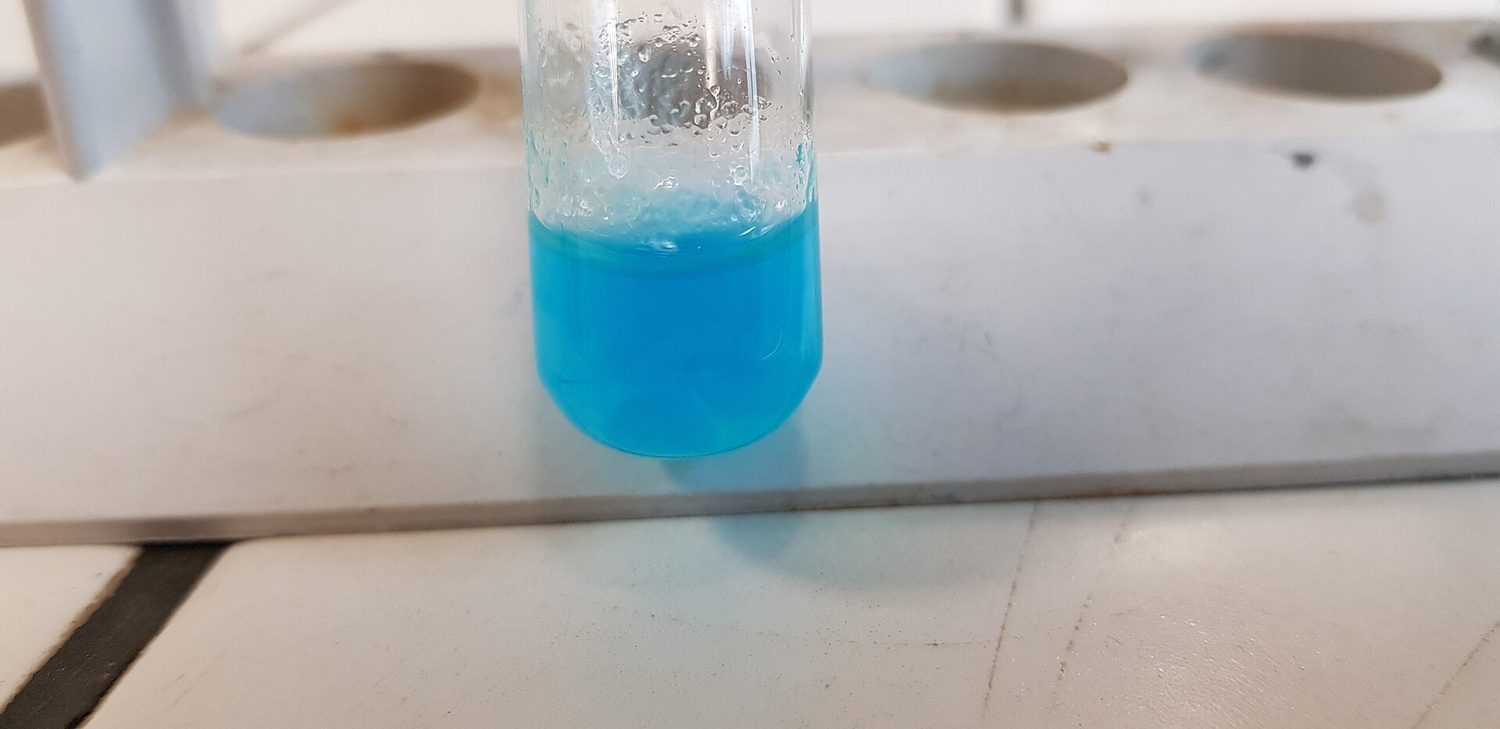
ตะกอนไฮดรอกไซด์ทองแดง(II) สีฟ้าจางลักษณะเจลatinous
ไฮดรอกไซด์โลหะที่ไม่ละลายจะเกิดเป็นตะกอนเจลatinous เมื่อพลังงานแลตทิซ它有太大而无法被水合补偿

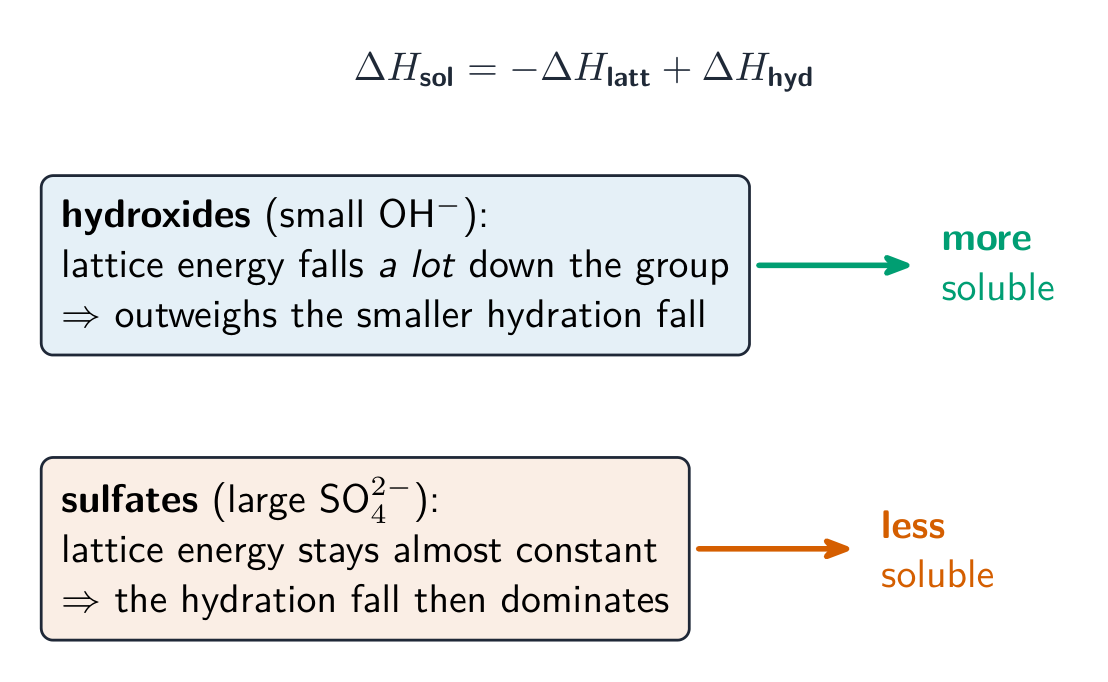
เมื่อเคลื่อนลงกลุ่ม ทั้งพลังงานแลตทิซและเอนทัลปีของการไฮเดรตจะ เล็กลง (มีค่าน้อยลง/เป็นลบน้อยลง) เนื่องจากแคทไอออนมีขนาดใหญ่ขึ้น แต่พวกมันหดตัวด้วยอัตราที่ต่างกัน และนี่คือเหตุผลที่ทำให้แนวโน้มตรงกันข้าม:

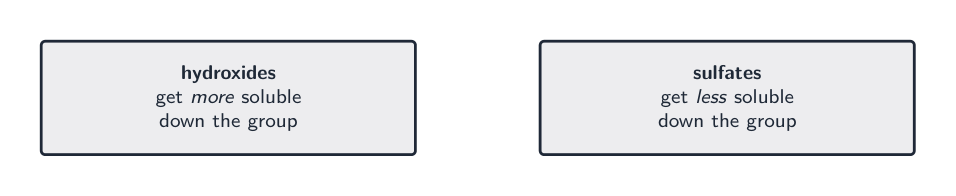
กล่องสองใบเปรียบเทียบไฮดรอกไซด์และซัลเฟต: สำหรับไฮดรอกไซด์พลังงานแลตทิซลดลงมาก สำหรับซัลเฟตคงที่ ซึ่งให้แนวโน้มการละลายที่ตรงกันข้าม
ทำไมแนวโน้มถึงตรงกันข้าม: พลังงานแลตทิซของ OH$^-$ ขนาดเล็กลดลงมากเมื่อเคลื่อนลงกลุ่ม (ไฮดรอกไซด์ละลายได้มากขึ้น) แต่พลังงานแลตทิซของ SO$_4^{2-}$ ขนาดใหญ่แทบไม่เปลี่ยนแปลง (ซัลเฟตละลายได้น้อยลง)
สารประกอบ แนวโน้ม การละลาย เมื่อเคลื่อนลงกลุ่ม เหตุผล
ไฮดรอกไซด์ เพิ่มขึ้น ไอออน $\text{OH}^-$ มีขนาดเล็ก พลังงานแลตทิซจึงลดลงมากเมื่อเคลื่อนลงกลุ่ม; การเปลี่ยนแปลงนี้战胜了การลดลงของพลังงานไฮเดรต
ซัลเฟต ลดลง ไอออน $\text{SO}_4^{2-}$ มีขนาดใหญ่ พลังงานแลตทิซจึงเกือบคงที่; การลดลงของพลังงานไฮเดรตจึงมีอิทธิพลเหนือกว่า ทำให้น้ำละลายได้ยากขึ้น
Vocabulary · ⁨คำศัพท์⁩ Train · ⁨ฝึกฝน⁩
English ไทย
solubility/ˌsɒljuːˈbɪlɪti/ ความละลาย
hydroxide/haɪˈdrɒksaɪd/ ไฮดรอกไซด์
sulfate/ˈsʌlfeɪt/ ซัลเฟต
27.1

Exam tips · ⁨ข้อแนะนำสำหรับการสอบ⁩

English
  • Thermal stability of carbonates and nitrates increases down the group — larger cations polarise the anion less.
  • Give the decomposition products: carbonates → oxide + $\text{CO}_2$; nitrates → oxide + $\text{NO}_2$ + $\text{O}_2$ (brown gas).
  • Hydroxides get more soluble and sulfates less soluble down the group.
  • Explain trends with cation charge density (polarising power), not just size.
ไทย
  • ความเสถียรทางความร้อนของคาร์บอเนตและไนเตรต เพิ่มขึ้นเมื่อเคลื่อนลง กลุ่ม — แคทไอออนขนาดใหญ่ทำให้ขั้วต่อแอนไอออนน้อยลง
  • ระบุ ผลิตภัณฑ์จากการสลายตัว: คาร์บอเนต → ออกไซด์ + $\text{CO}_2$; ไนเตรต → ออกไซด์ + $\text{NO}_2$ + $\text{O}_2$ (แก๊สสีน้ำตาล)。
  • ไฮดรอกไซด์ละลายได้ มากขึ้น และซัลเฟตละลายได้ น้อยลง เมื่อเคลื่อนลงกลุ่ม
  • อธิบายแนวโน้มโดยใช้ ความหนาแน่นประจุของแคทไอออน (กำลังขั้ว) ไม่ใช่แค่ขนาด

Interactive lessons on this topic · ⁨บทเรียนเชิงโต้ตอบสำหรับหัวข้อนี้⁩

Work through it step by step, with instant-check exercises. · ⁨ทำทีละขั้นตอน พร้อมแบบฝึกหัดตรวจสอบผลทันที⁩

Past Papers · ⁨ข้อสอบย้อนหลัง⁩

More topics in A-Level Chemistry · ⁨Chemistry A-Level⁩ · ⁨หัวข้อเพิ่มเติมใน A-Level Chemistry · ⁨Chemistry A-Level⁩⁩

Log in or create account · ⁨เข้าสู่ระบบหรือสร้างบัญชี⁩

IGCSE, A-Level & AP