- explain and use the terms rate equation, order of reaction, overall order of reaction, rate constant, half-life, rate-determining step and intermediate
- (a) understand and use rate equations of the form $\text{rate} = k [\text{A}]^m[\text{B}]^n$ (for which $m$ and $n$ are 0, 1 or 2) (b) deduce the order of a reaction from concentration–time graphs or from experimental data relating to the initial rates method and half-life method (c) interpret experimental data in graphical form, including concentration–time and rate–concentration graphs (d) calculate an initial rate using concentration data (e) construct a rate equation
- (a) show understanding that the half-life of a first-order reaction is independent of concentration (b) use the half-life of a first-order reaction in calculations
- calculate the numerical value of a rate constant, for example by: (a) using the initial rates and the rate equation (b) using the half-life, $t_{\frac{1}{2}}$, and the equation $k = 0.693/t_{\frac{1}{2}}$
- for a multi-step reaction: (a) suggest a reaction mechanism that is consistent with the rate equation and the equation for the overall reaction (b) predict the order that would result from a given reaction mechanism and rate-determining step (c) deduce a rate equation using a given reaction mechanism and rate-determining step for a given reaction (d) identify an intermediate or catalyst from a given reaction mechanism (e) identify the rate determining step from a rate equation and a given reaction mechanism
- describe qualitatively the effect of temperature change on the rate constant and hence the rate of a reaction
Reaction kinetics
A-Level Chemistry · Topic 26
 8:01
Reaction kinetics (A2)
Here is a real reaction: hydrogen peroxide reacting with iodide ions in acid. Look at the balanced equation. It uses two iodide ions and two hydrogen ions…
English narration · English + 中文 subtitles burned in
26.1
Rate equations and orders
Syllabus
Source: Cambridge International syllabus
A rate equation 速率方程 shows how the rate depends on the concentrations 浓度 of the reactants 反应物:
$$\text{rate} = k\,[\text{A}]^m[\text{B}]^n$$
- $m$ is the order of reaction 反应级数 with respect to A, and $n$ the order with respect to B. Each is $0$, $1$ or $2$.
- the overall order of reaction 总反应级数 is $m + n$.
- $k$ is the rate constant 速率常数. The rate equation can only be found by experiment, not from the balanced equation 配平方程式.
Finding the order
- initial rates method 初始速率法: change one concentration at a time and see how the starting rate changes. If doubling $[\text{A}]$ doubles the rate, the order in A is 1; if it quadruples the rate, the order is 2; if the rate is unchanged, the order is 0.
Worked example. In experiments on $\text{A} + \text{B} \rightarrow$ products, doubling $[\text{A}]$ (with $[\text{B}]$ fixed) doubles the rate, and doubling $[\text{B}]$ (with $[\text{A}]$ fixed) quadruples the rate. Write the rate equation and give the overall order.
Doubling $[\text{A}]$ doubles the rate, so first order 一级 in A. Doubling $[\text{B}]$ quadruples ($2^2$) the rate, so second order 二级 in B. Hence
$$\text{rate} = k[\text{A}][\text{B}]^2, \qquad \text{overall order} = 1 + 2 = 3.$$
Units of $k$. Rearrange the rate equation so that $k$ is alone, then put in the units: rate in $\text{mol dm}^{-3}\,\text{s}^{-1}$, each concentration in $\text{mol dm}^{-3}$. For the example above:
$$k = \frac{\text{rate}}{[\text{A}][\text{B}]^2} \;\Rightarrow\; \frac{\text{mol dm}^{-3}\,\text{s}^{-1}}{(\text{mol dm}^{-3})^3} = \text{mol}^{-2}\,\text{dm}^{6}\,\text{s}^{-1}$$
| Overall order | Units of $k$ |
|---|---|
| 0 | $\text{mol dm}^{-3}\,\text{s}^{-1}$ |
| 1 | $\text{s}^{-1}$ |
| 2 | $\text{mol}^{-1}\,\text{dm}^{3}\,\text{s}^{-1}$ |
| 3 | $\text{mol}^{-2}\,\text{dm}^{6}\,\text{s}^{-1}$ |
Each extra order adds one $\text{mol}^{-1}\,\text{dm}^{3}$. Work the units out each time rather than learning the table: a mistake in the algebra shows up at once.
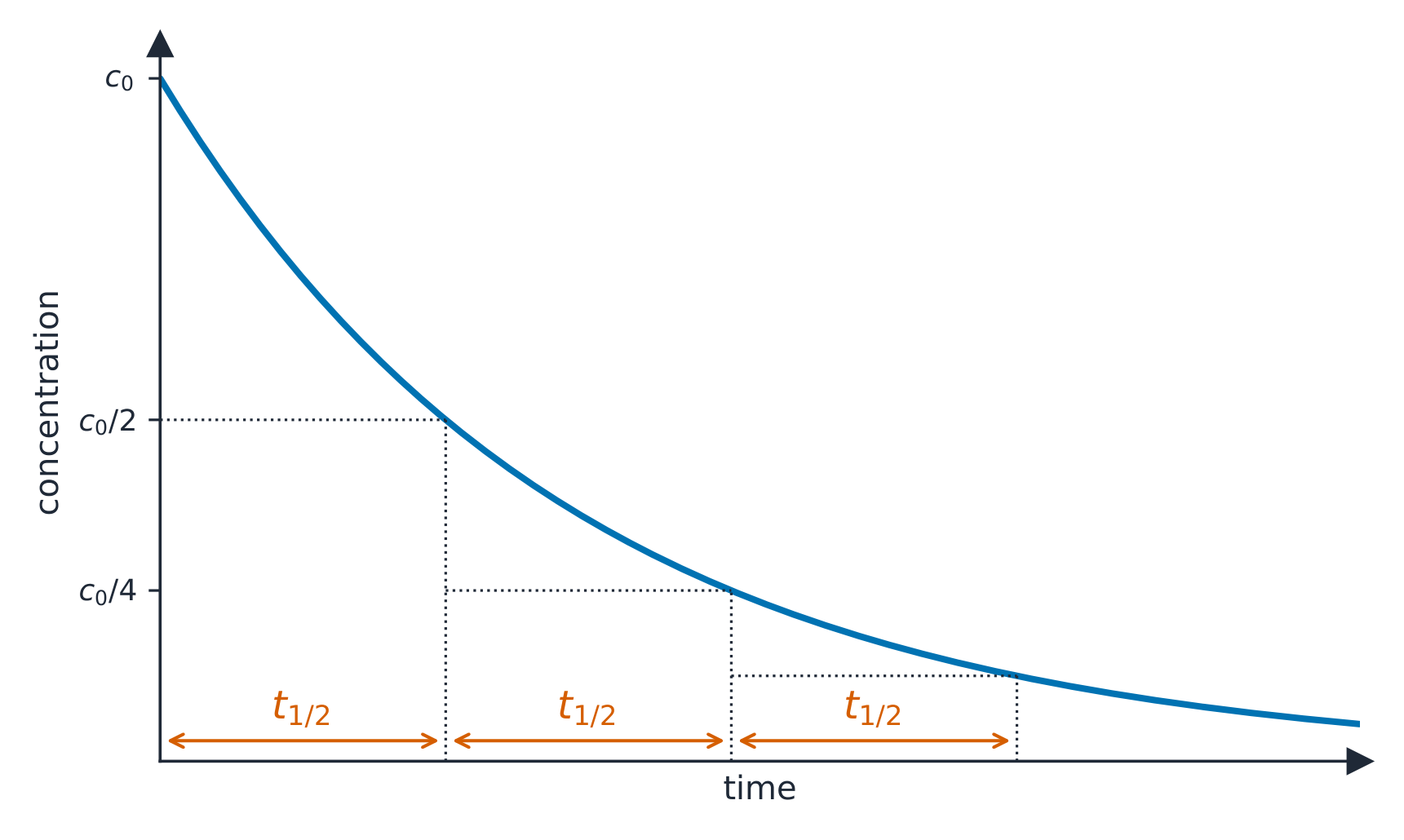
- graphs: a concentration–time graph 浓度–时间图 for a first-order reaction has a constant half-life 半衰期 (the time for the concentration to halve). A rate–concentration graph is a straight line through the origin 原点 for first order, and a curve for second order.

Half-life and the rate constant
For a first-order reaction the half-life is constant — it does not depend on the concentration. You can find the rate constant from it:
$$k = \frac{0.693}{t_{\frac{1}{2}}}$$
Worked example. A first-order reaction has a half-life of $120\ \text{s}$. Find its rate constant.
$$k = \frac{0.693}{t_{1/2}} = \frac{0.693}{120} = 5.8 \times 10^{-3}\ \text{s}^{-1}.$$
You can also find $k$ by putting initial-rate data into the rate equation.
Explore
Rate equations & orders
[A] = [A]₀·bᵗ
A first-order reaction decays exponentially — equal half-lives.
Vocabulary
Train
| English |
|---|
| rate equation/reɪt ɪˈkweɪʒn/ |
| concentrations |
| reactants/rɪˈæktənts/ |
| order of reaction/ˈɔːdə ɒv rɪˈækʃn/ |
| overall order of reaction/ˌəʊvəˈrɔːl ˈɔːdə ɒv rɪˈækʃn/ |
| rate constant/reɪt ˈkɒnstənt/ |
| balanced equation |
| initial rates method |
| first order |
| second order |
| concentration–time graph |
| half-life/hɑːf laɪf/ |
| origin/ˈɒrɪdʒɪn/ |
26.1
Reaction mechanisms

Most reactions happen in several steps 步骤. The slowest step is the rate-determining step 决速步骤, and it controls the overall rate. Only the species 微粒 involved up to and including this step appear in the rate equation.
- an intermediate 中间体 is a species made in one step and then used up in a later step. It is not in the overall equation.
- you can suggest a mechanism 反应机理 that fits both the rate equation and the overall equation, predict the order from a given mechanism, or pick out the rate-determining step.
If you compare the initial rate of different mixtures, you can deduce the rate equation, and from that work out the mechanism.
Worked example (mechanism from a rate equation). For $2\text{NO}_2 + \text{F}_2 \rightarrow 2\text{NO}_2\text{F}$ the rate equation is $\text{rate} = k[\text{NO}_2][\text{F}_2]$. Suggest a two-step mechanism.
- The rate equation has one $\text{NO}_2$ and one $\text{F}_2$, so the rate-determining step uses exactly one of each: $\text{NO}_2 + \text{F}_2 \rightarrow \text{NO}_2\text{F} + \text{F}$ (slow).
- The second $\text{NO}_2$ must react in a later, fast step, with the F atom made in step 1: $\text{NO}_2 + \text{F} \rightarrow \text{NO}_2\text{F}$ (fast).
- Check: adding the steps and cancelling F gives the overall equation. F is the intermediate.
The same reasoning explains the hydrolysis of 2-bromo-2-methylpropane, $\text{rate} = k[(\text{CH}_3)_3\text{CBr}]$. Hydroxide ions are not in the rate equation, so they react after the slow step: the C–Br bond breaks first to give a carbocation, which $\text{OH}^-$ then attacks. This is the $\text{S}_\text{N}1$ mechanism. A reactant that is zero order is still used up; it just reacts after the rate-determining step.
Effect of temperature
Raising the temperature increases the rate constant $k$ (more molecules pass the activation energy 活化能), so the rate goes up.
Explore
Organic mechanism route
Trace electron-pair movement from reagent to product.
Vocabulary
Train
| English |
|---|
| steps/steps/ |
| rate-determining step/reɪt dɪˈtɜːmɪnɪŋ step/ |
| species/ˈspiːsiːz/ |
| intermediate/ˌɪntəˈmiːdɪət/ |
| mechanism/ˈmekənɪzəm/ |
| activation energy/ˌæktɪˈveɪʃn ˈenədʒi/ |
26.2
Catalysts
Syllabus
- explain that catalysts can be homogeneous or heterogeneous
- describe the mode of action of a heterogeneous catalyst to include adsorption of reactants, bond weakening and desorption of products, for example: (a) iron in the Haber process (b) palladium, platinum and rhodium in the catalytic removal of oxides of nitrogen from the exhaust gases of car engines
- describe the mode of action of a homogeneous catalyst by being used in one step and reformed in a later step, for example: (a) atmospheric oxides of nitrogen in the oxidation of atmospheric sulfur dioxide (b) $\text{Fe}^{2+}$ or $\text{Fe}^{3+}$ in the $\text{I}^- / \text{S}_2\text{O}_8^{2-}$ reaction
Source: Cambridge International syllabus
Catalysts 催化剂 can be homogeneous or heterogeneous.
Heterogeneous catalysts
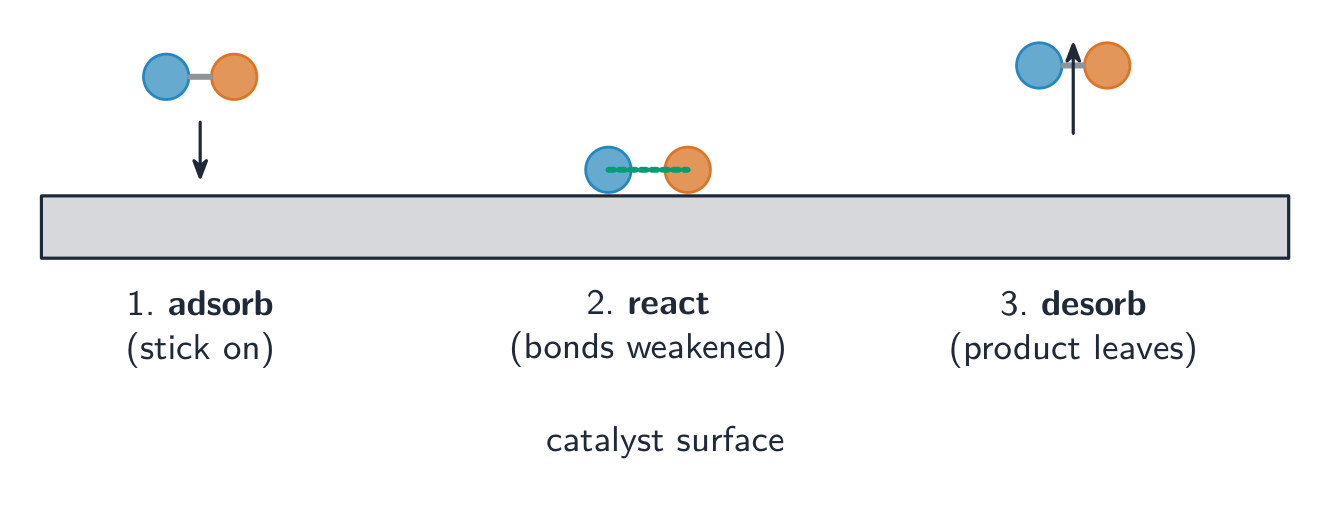
A heterogeneous catalyst 多相催化剂 is in a different physical state 物态 from the reactants (usually a solid with gases). It works in three stages:
- adsorption 吸附: reactant molecules stick to the catalyst surface.
- the bonds in the reactants are weakened 削弱, so they react more easily.
- desorption 脱附: the product molecules leave the surface.

Examples are iron in the Haber process 哈伯法, and platinum, palladium and rhodium in a catalytic converter 催化转化器.
Homogeneous catalysts
A homogeneous catalyst 均相催化剂 is in the same physical state as the reactants. It is used up in one step and then reformed 再生 in a later step, so it comes back unchanged. Examples are oxides of nitrogen helping to oxidise 氧化 atmospheric 大气中的 sulfur dioxide, and $\text{Fe}^{2+}$ or $\text{Fe}^{3+}$ speeding up the reaction between $\text{I}^-$ and $\text{S}_2\text{O}_8^{2-}$.
How the iron ions work. The reaction $\text{S}_2\text{O}_8^{2-} + 2\text{I}^- \rightarrow 2\text{SO}_4^{2-} + \text{I}_2$ is slow because both reactants are negative ions, which repel 互相排斥 each other, so the activation energy is high. With iron ions it goes in two steps:
$$\text{S}_2\text{O}_8^{2-} + 2\text{Fe}^{2+} \rightarrow 2\text{SO}_4^{2-} + 2\text{Fe}^{3+}$$
$$2\text{Fe}^{3+} + 2\text{I}^- \rightarrow 2\text{Fe}^{2+} + \text{I}_2$$
Each step is between a positive and a negative ion, which attract, so each has a lower activation energy. The $\text{Fe}^{2+}$ used in the first step is made again in the second, and the steps can run in either order, which is why $\text{Fe}^{3+}$ works as well as $\text{Fe}^{2+}$. Iron can do this because it has two stable oxidation states, $+2$ and $+3$.
Nitrogen oxides do the same for sulfur dioxide in the air:
$$\text{SO}_2 + \text{NO}_2 \rightarrow \text{SO}_3 + \text{NO}$$
$$\text{NO} + \tfrac{1}{2}\text{O}_2 \rightarrow \text{NO}_2$$
$\text{NO}_2$ is used in the first step and made again in the second; adding the steps gives $\text{SO}_2 + \tfrac{1}{2}\text{O}_2 \rightarrow \text{SO}_3$.
Common mistakes.
- Taking the orders from the balanced equation. In the $\text{NO}_2$ example above the equation has $2\text{NO}_2$, but the order in $\text{NO}_2$ is 1. Orders come only from experiment.
- Saying a zero-order reactant "is not needed" or "does not react". It is used up, but after the rate-determining step.
- Using the half-life to find $k$ for a reaction that is not first order. Only a first-order reaction has a constant half-life.
- Saying $k$ changes when a concentration changes. $k$ changes only with temperature (or a catalyst); a change of concentration changes the rate.
- Mixing up a catalyst and an intermediate. A catalyst is there at the start and made again at the end; an intermediate is made in one step and used up in a later one.
Explore
How a catalyst speeds a reaction
Turn the catalyst on and watch the rate jump — it gives more successful collisions per second by offering a lower-energy path.
Vocabulary
Train
| English |
|---|
| Catalysts/ˈkætəlɪsts/ |
| heterogeneous catalyst/ˌhetrəˈdʒiːnɪəs ˈkætəlɪst/ |
| physical state |
| adsorption/ədˈsɔːpʃn/ |
| weakened |
| desorption/dɪˈsɔːpʃn/ |
| Haber process/ˈheɪbə ˈprəʊses/ |
| catalytic converter/ˌkætəˈlɪtɪk kənˈvɜːtə/ |
| homogeneous catalyst/həˈməʊdʒnɪəs ˈkætəlɪst/ |
| reformed |
| oxidise/ˈɒksɪdaɪz/ |
| atmospheric |
| repel/rɪˈpel/ |
26.2
Exam tips
- Find orders from initial-rate data: doubling a concentration that doubles the rate is first order, quadruples it is second order, no change is zero order 零级.
- Write $\text{rate} = k[\text{A}]^m[\text{B}]^n$ and work out the units of $k$ from it.
- The rate-determining step contains the species (and orders) in the rate equation — use this to test a mechanism.
- A constant half-life means first order.
Vocabulary
Train
| English |
|---|
| zero order |
Interactive lessons on this topic
Work through it step by step, with instant-check exercises.