English
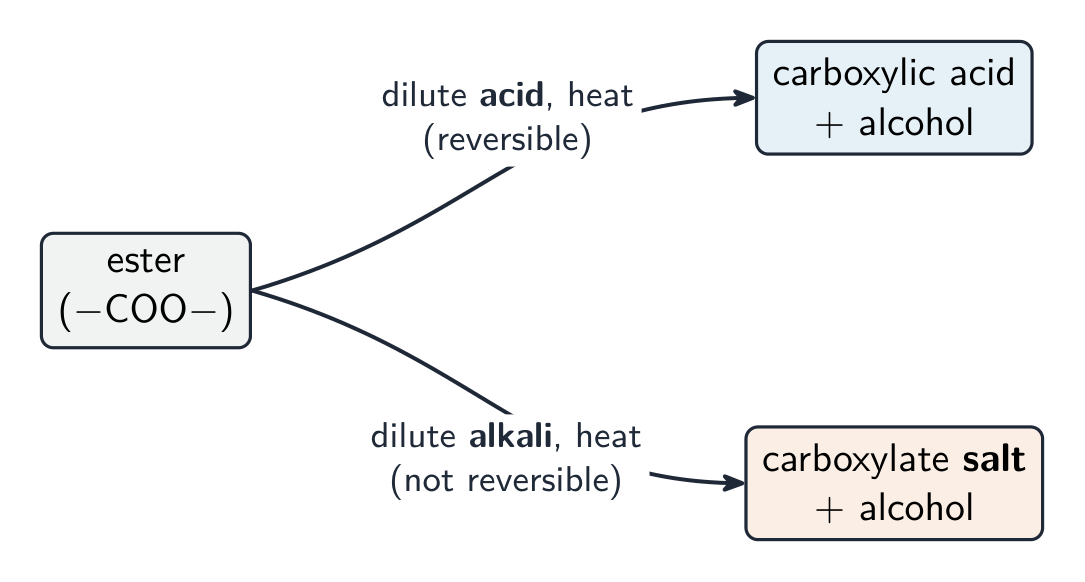
- recall the reactions by which carboxylic acids can be produced: (a) oxidation of primary alcohols and aldehydes with acidified $\text{K}_2\text{Cr}_2\text{O}_7$ or acidified $\text{KMnO}_4$ and refluxing (b) hydrolysis of nitriles with dilute acid or dilute alkali followed by acidification (c) hydrolysis of esters with dilute acid or dilute alkali and heat followed by acidification
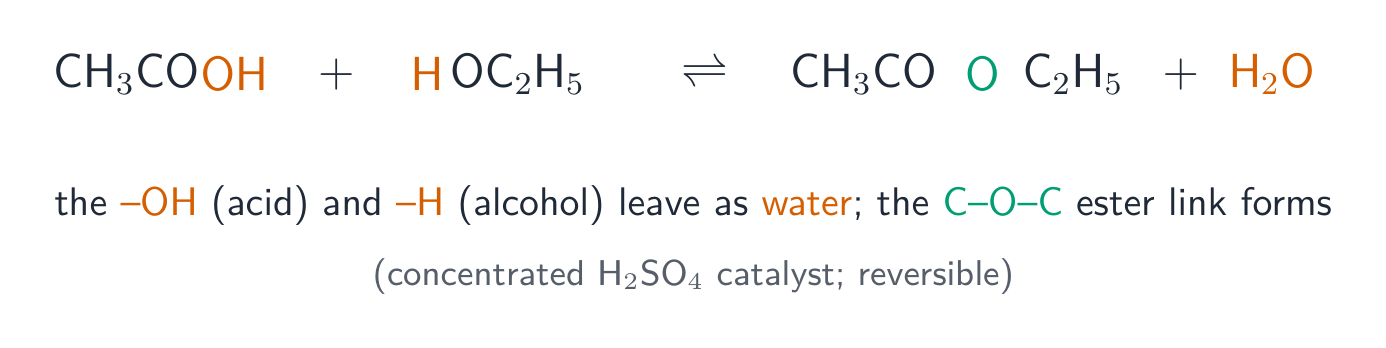
- describe: (a) the redox reaction with reactive metals to produce a salt and $\text{H}_2(\text{g})$ (b) the neutralisation reaction with alkalis to produce a salt and $\text{H}_2\text{O}(\text{l})$ (c) the acid–base reaction with carbonates to produce a salt and $\text{H}_2\text{O}(\text{l})$ and $\text{CO}_2(\text{g})$ (d) esterification with alcohols with concentrated $\text{H}_2\text{SO}_4$ as catalyst (e) reduction by $\text{LiAlH}_4$ to form a primary alcohol
ไทย
- ทบทวนปฏิกิริยาที่สามารถผลิตกรดคาร์บอกซิลิกได้: (a) การออกซิเดชันของแอลกอฮอล์ปฐมและอัลดีไฮด์ด้วย $\text{K}_2\text{Cr}_2\text{O}_7$ หรือ $\text{KMnO}_4$ ที่ทำให้เป็นกรดและการ回流 (b) การไฮโดรไลซิสของไนไตรล์ด้วยกรดเจือจางหรือเบสเจือจางตามด้วยการทำให้เป็นกรด (c) การไฮโดรไลซิสของเอสเทอร์ด้วยกรดเจือจางหรือเบสเจือจางและความร้อนตามด้วยการทำให้เป็นกรด
- อธิบาย: (a) ปฏิกิริยารีดอกซ์กับโลหะที่มีปฏิกิริยาสูงเพื่อผลิตเกลือและ $\text{H}_2(\text{g})$ (b) ปฏิกิริยาการกลางกับเบสเพื่อผลิตเกลือและ $\text{H}_2\text{O}(\text{l})$ (c) ปฏิกิริยากรด-เบสกับคาร์บอเนตเพื่อผลิตเกลือและ $\text{H}_2\text{O}(\text{l})$ และ $\text{CO}_2(\text{g})$ (d) การสร้างเอสเทอร์กับแอลกอฮอล์ด้วย $\text{H}_2\text{SO}_4$ แบบเข้มข้นเป็นตัวเร่งปฏิกิริยา (e) การรีดิวซ์โดย $\text{LiAlH}_4$ เพื่อสร้างแอลกอฮอล์ปฐม
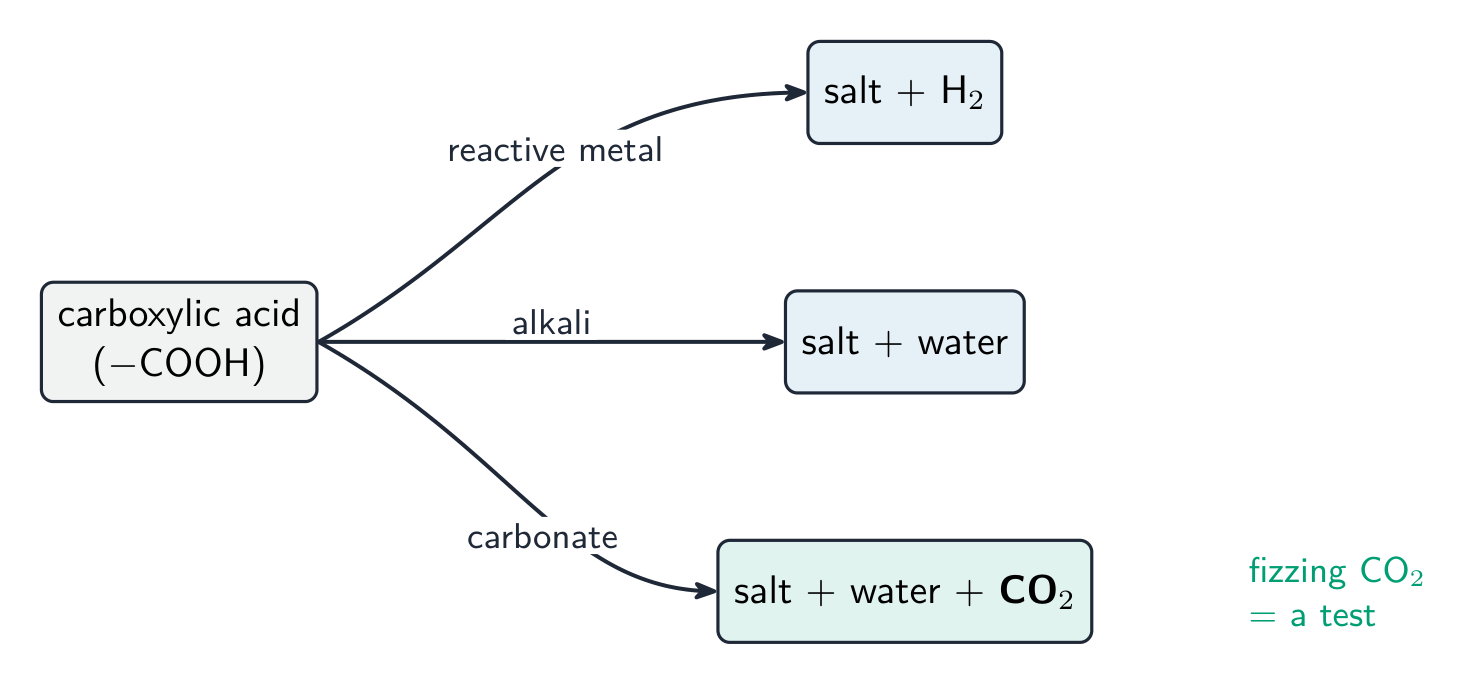 กรดคาร์บอกซิลิก behaves เป็นกรด: เกลือกับโลหะ (+ H