- recall the reactions (reagents and conditions) by which aldehydes and ketones can be produced: (a) the oxidation of primary alcohols using acidified $\text{K}_2\text{Cr}_2\text{O}_7$ or acidified $\text{KMnO}_4$ and distillation to produce aldehydes (b) the oxidation of secondary alcohols using acidified $\text{K}_2\text{Cr}_2\text{O}_7$ or acidified $\text{KMnO}_4$ and distillation to produce ketones
- describe: (a) the reduction of aldehydes and ketones using $\text{NaBH}_4$ or $\text{LiAlH}_4$ to produce alcohols (b) the reaction of aldehydes and ketones with $\text{HCN}$, $\text{KCN}$ as catalyst, and heat to produce hydroxynitriles as exemplified by ethanal and propanone
- describe the mechanism of the nucleophilic addition reactions of hydrogen cyanide with aldehydes and ketones in 17.1.2(b)
- describe the use of 2,4-dinitrophenylhydrazine (2,4-DNPH reagent) to detect the presence of carbonyl compounds
- deduce the nature (aldehyde or ketone) of an unknown carbonyl compound from the results of simple tests (Fehling's and Tollens' reagents; ease of oxidation)
- deduce the presence of a $\text{CH}_3\text{CO}-$ group in an aldehyde or ketone, $\text{CH}_3\text{CO}-\text{R}$, from its reaction with alkaline $\text{I}_2(\text{aq})$ to form a yellow precipitate of tri-iodomethane and an ion, $\text{RCO}_2^-$
Carbonyl compounds
A-Level Chemistry · Topic 17
 8:03
Carbonyl compounds
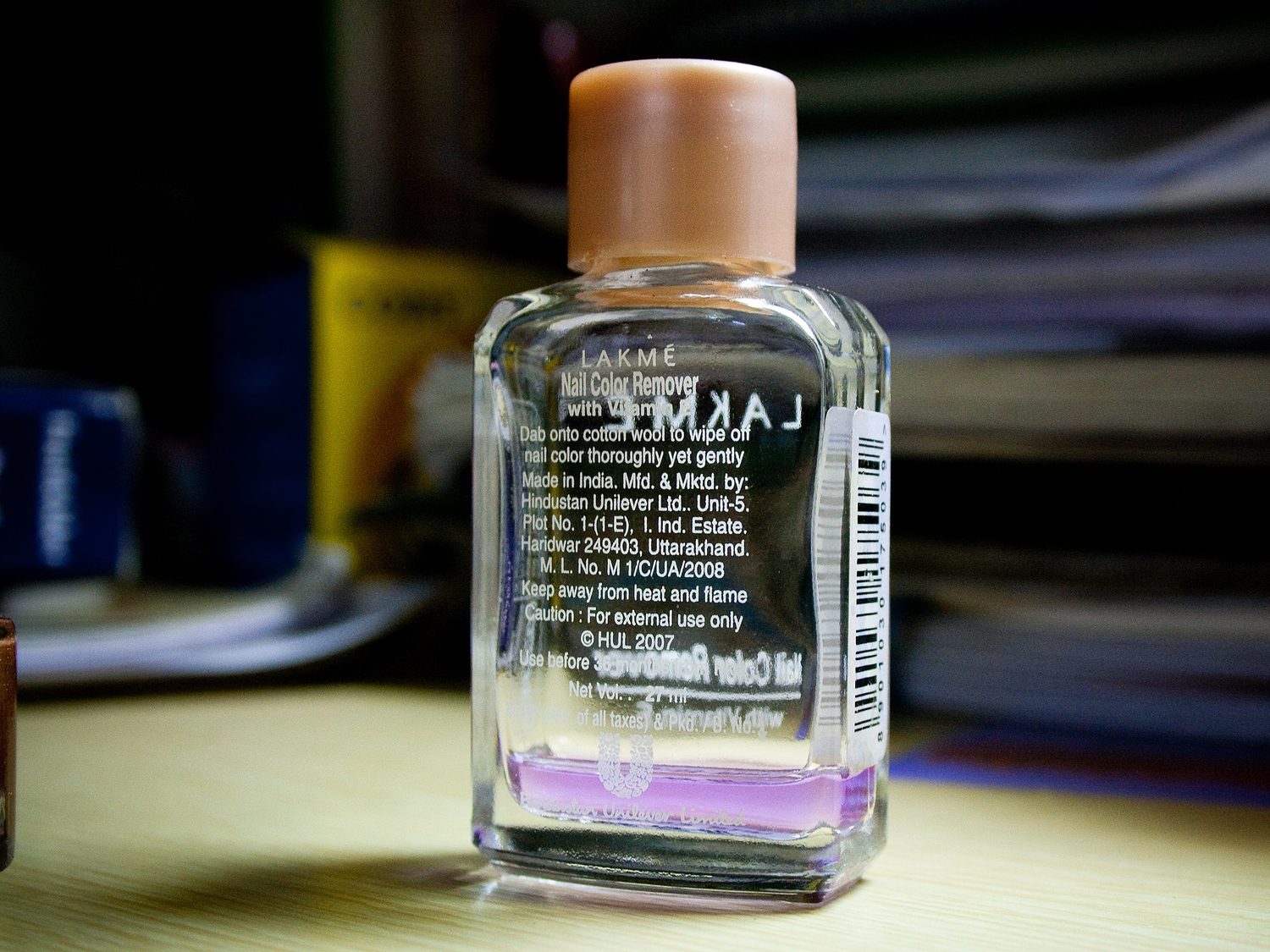
Open a bottle of nail polish remover, and that sharp smell is propanone. Your own body makes a little of it every day. All of that comes from one small group…
English narration · English + 中文 subtitles burned in
17.1
Aldehydes and ketones
Syllabus
Source: Cambridge International syllabus
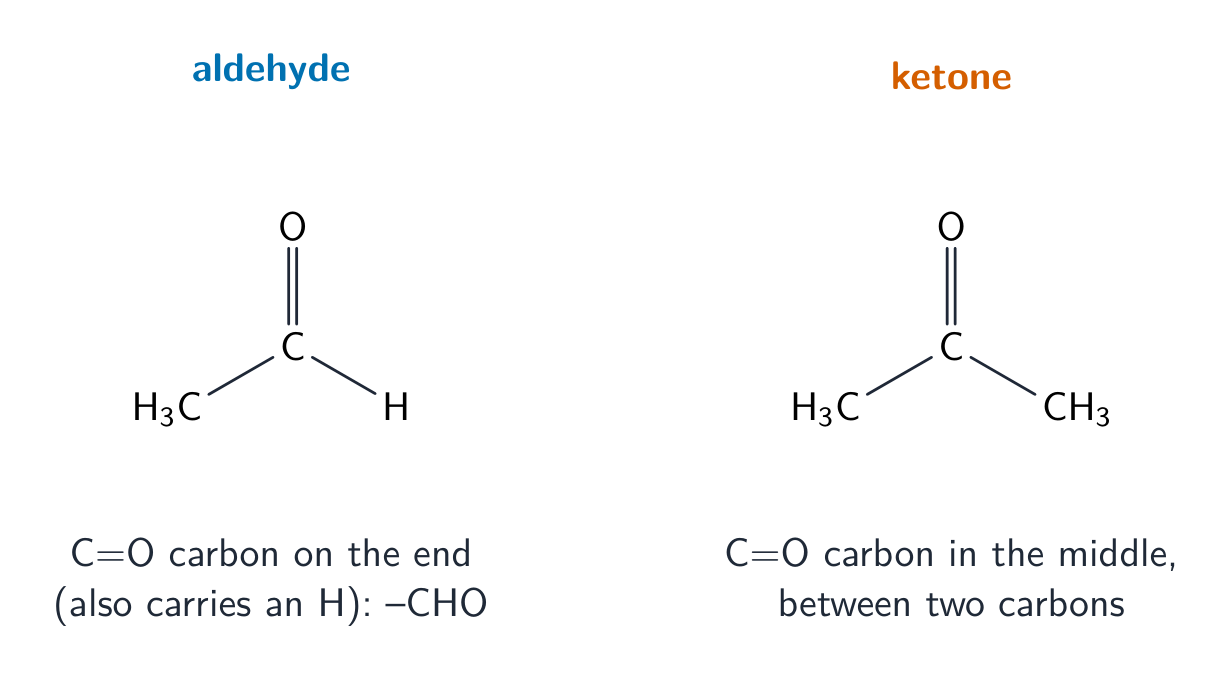
Aldehydes and ketones are carbonyl compounds 羰基化合物 — they contain the C=O carbonyl 羰基 group.
- in an aldehyde 醛 the carbonyl carbon is on the end of the chain (it also carries an H), written $\text{–CHO}$.
- in a ketone 酮 the carbonyl carbon is in the middle, between two other carbons.
Making aldehydes and ketones
Both are made by the oxidation 氧化 of an alcohol 醇 with acidified $\text{K}_2\text{Cr}_2\text{O}_7$ or $\text{KMnO}_4$:
- a primary alcohol, with distillation 蒸馏, gives an aldehyde.
- a secondary alcohol gives a ketone.
Reactions
- reduction 还原 with $\text{NaBH}_4$ or $\text{LiAlH}_4$ turns a carbonyl compound back into an alcohol (an aldehyde gives a primary alcohol; a ketone gives a secondary alcohol).
- reaction with hydrogen cyanide 氰化氢 ($\text{HCN}$), with $\text{KCN}$ as catalyst 催化剂 and heat, adds $\text{H}$ and $\text{CN}$ across the C=O to make a hydroxynitrile 羟基腈. This adds one carbon to the chain.
The mechanism: nucleophilic addition
The reaction with $\text{HCN}$ is a nucleophilic addition 亲核加成. Oxygen is more electronegative than carbon, so the C=O bond is polar and the carbonyl carbon is $\delta+$. $\text{HCN}$ is a weak acid and gives very few $\text{CN}^-$ ions, so a little $\text{KCN}$ is added to supply them. The steps are:
- a lone pair 孤对电子 on the carbon of $\text{CN}^-$ attacks the $\delta+$ carbonyl carbon.
- at the same time, one pair of the C=O double bond moves onto the oxygen, which becomes $\text{O}^-$.
- the $\text{O}^-$ uses a lone pair to take $\text{H}^+$ from an $\text{HCN}$ molecule. This makes the hydroxynitrile and gives back a $\text{CN}^-$ ion. Because $\text{CN}^-$ is used and then given back, $\text{KCN}$ acts as a catalyst.

With propanone the same steps give 2-hydroxy-2-methylpropanenitrile. The product has one more carbon atom than the aldehyde or ketone, which makes this reaction useful for making longer carbon chains.
Common mistakes.
- Starting the first arrow at the N of $\text{CN}^-$. The lone pair that attacks is on the carbon, which is why the new bond is C–C.
- Drawing the arrow from the oxygen to the carbon. The C=O pair moves towards the more electronegative O.
- Calling this electrophilic addition, as in alkenes. The C=O carbon is $\delta+$, so it is attacked by a nucleophile, not an electrophile.
- Leaving the product as $\text{O}^-$: the mechanism is only finished when the O gains an H.
Explore
Carbonyl compound lab
Sort carbonyl reactions by what they reveal.
Vocabulary
Train
| English |
|---|
| carbonyl compound/ˈkɑːbənaɪl ˈkɒmpaʊnd/ |
| carbonyl/ˈkɑːbənaɪl/ |
| aldehyde/ˈældɪhaɪd/ |
| ketone/ˈketəʊn/ |
| oxidation/ˌɒksɪˈdeɪʃn/ |
| alcohol/ˈælkəhɒl/ |
| distillation/dɪstɪˈleɪʃn/ |
| reduction/rɪˈdʌkʃn/ |
| hydrogen cyanide/ˈhaɪdrədʒn ˈsaɪənaɪd/ |
| catalyst/ˈkætəlɪst/ |
| hydroxynitrile/haɪˈdrɒksɪnaɪtraɪl/ |
| nucleophilic addition/ˌnjuːklɪəˈfɪlɪk əˈdɪʃn/ |
| lone pair/ləʊn peə/ |
17.1
Tests for carbonyl compounds
Detecting any carbonyl
Add 2,4-DNPH reagent (2,4-dinitrophenylhydrazine). An orange precipitate confirms that the compound is an aldehyde or a ketone.
Telling an aldehyde from a ketone
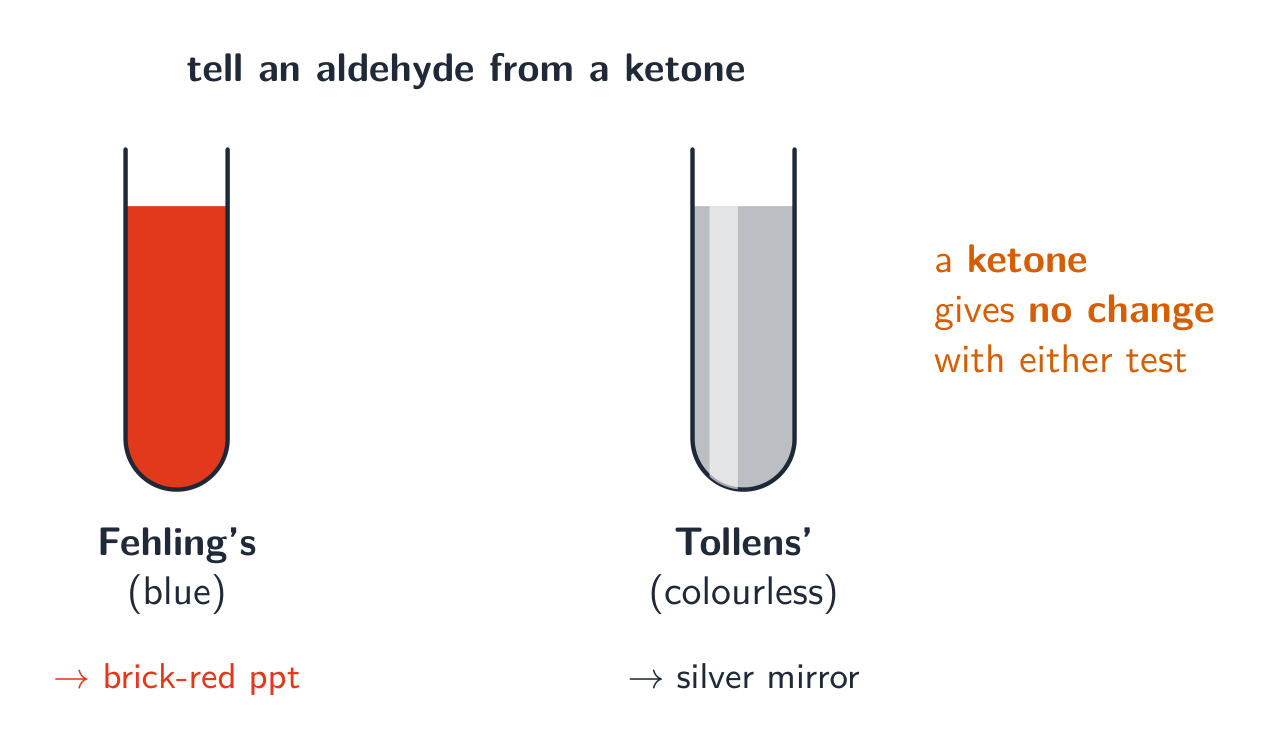
Aldehydes are easily oxidised to carboxylic acids, but ketones are not. Two tests use this difference:
| Test | Aldehyde | Ketone |
|---|---|---|
| Fehling's reagent 斐林试剂 (blue solution) | turns to a brick-red precipitate | no change |
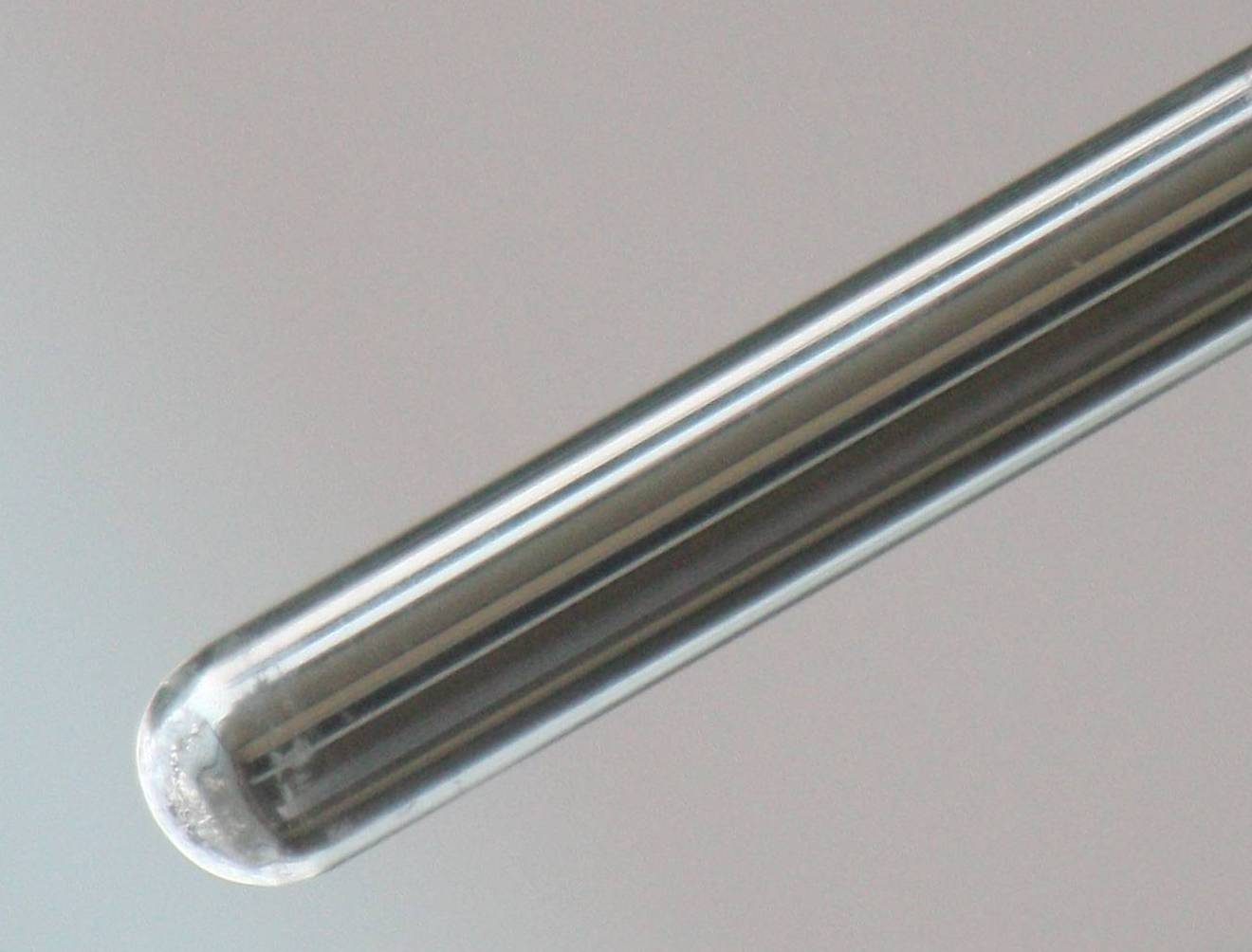
| Tollens' reagent 托伦试剂 (colourless) | gives a silver mirror | no change |
The iodoform test
If the compound has the $\text{CH}_3\text{CO}-$ group, warming it with alkaline aqueous iodine gives a pale yellow precipitate of tri-iodomethane 三碘甲烷 ($\text{CHI}_3$) and the ion $\text{RCO}_2^-$.
Worked example. A liquid gives an orange precipitate with 2,4-DNPH, gives no silver mirror with Tollens' reagent, and gives a yellow precipitate with alkaline aqueous iodine. Identify it. Take the tests one at a time, using each for exactly what it proves. The orange precipitate with 2,4-DNPH proves a carbonyl group is present - an aldehyde or a ketone, nothing else. No silver mirror with Tollens' rules out an aldehyde, so it must be a ketone. The yellow precipitate in the iodoform test proves a $\text{CH}_3\text{CO}-$ group: a methyl group joined directly to the carbonyl carbon. The simplest compound satisfying all three is propanone, $\text{CH}_3\text{COCH}_3$. Keep the roles straight: 2,4-DNPH finds any carbonyl, Tollens' separates aldehyde from ketone, and iodoform detects the methyl group beside the C=O.
Explore
Carbonyl test lab
Match observations to aldehydes and ketones.
Vocabulary
Train
| English |
|---|
| Fehling's reagent/ˈfeɪlɪŋz rɪˈeɪdʒənt/ |
| Tollens' reagent/ˈtəʊlənz rɪˈeɪdʒənt/ |
| tri-iodomethane/traɪ ˈaɪədəʊmθeɪn/ |
17.1
Exam tips
- 2,4-DNPH gives an orange precipitate with any carbonyl — it tests for $\text{C}=\text{O}$.
- Tollens' (silver mirror) and Fehling's (brick-red) are positive for aldehydes only — this is how you tell aldehydes from ketones.
- Nucleophilic addition of HCN adds one carbon (→ hydroxynitrile); show the curly arrows.
- The iodoform (tri-iodomethane) test is positive for $\text{CH}_3\text{CO}-$ groups.
Interactive lessons on this topic
Work through it step by step, with instant-check exercises.