- define microeconomics and macroeconomics
- explain how the market (price mechanism) allocates resources through the signalling, incentive and rationing functions of price
资源的配置
IGCSE 经济学 · 第 2 主题
 21:51
21:51
The Allocation of Resources
Nobody in the world is in charge of deciding how many coffee beans to grow. No committee meets. No plan is written. And yet, most mornings, there is coffee.…
英文讲解 · 内嵌中英文字幕
2.1
市场在资源配置中的作用
大纲
来源:剑桥国际大纲
经济学分成两部分:
- 微观经济学(microeconomics)——研究经济的单个部分,例如一个行业或一个产品。
- 宏观经济学(macroeconomics)——研究整个经济,像总的就业、价格和增长。
一个市场(market)是买者和卖者相遇进行交易的任何地方或系统。它不需要一栋建筑——它可以在网上或通过电话。
当一个市场自由时,没有人负责决定制造什么。相反,价格机制(price mechanism)(价格的自由移动)配置(allocates)资源(resources)——它决定制造什么、如何制造、为谁制造。价格做三件工作:
- 信号(signalling)功能——一个价格变化告诉买者和卖者正在发生什么。一个上升的价格发出信号"制造更多";一个下降的价格发出信号"制造更少"。
- 激励(incentive)功能——一个更高的价格给企业(firms)一个生产更多的理由,因为它们能赚更多。
- 配给(rationing)功能——当一个产品稀缺时,它的价格上升。高价格把有限的数量分给那些愿意付钱的人。
探索
How markets allocate resources
Price moves to where demand meets supply. That equilibrium price signals firms what to produce and rations goods to buyers.
词汇表
训练
| 英文 | 中文 | 拼音 |
|---|---|---|
| microeconomics | 微观经济学 | wēi guān jīng jì xué |
| macroeconomics | 宏观经济学 | hóng guān jīng jì xué |
| market | 市场 | shì chǎng |
| price mechanism | 价格机制 | jià gé jī zhì |
| allocate | 配置 | pèi zhì |
| resources | 资源 | zī yuán |
| signalling | 信号 | xìn hào |
| incentive | 激励 | jī lì |
| firms | 企业 | qǐ yè |
| rationing | 配给 | pèi jǐ |
2.2
需求
大纲
- define demand and explain the law of demand (inverse relationship with price), ceteris paribus
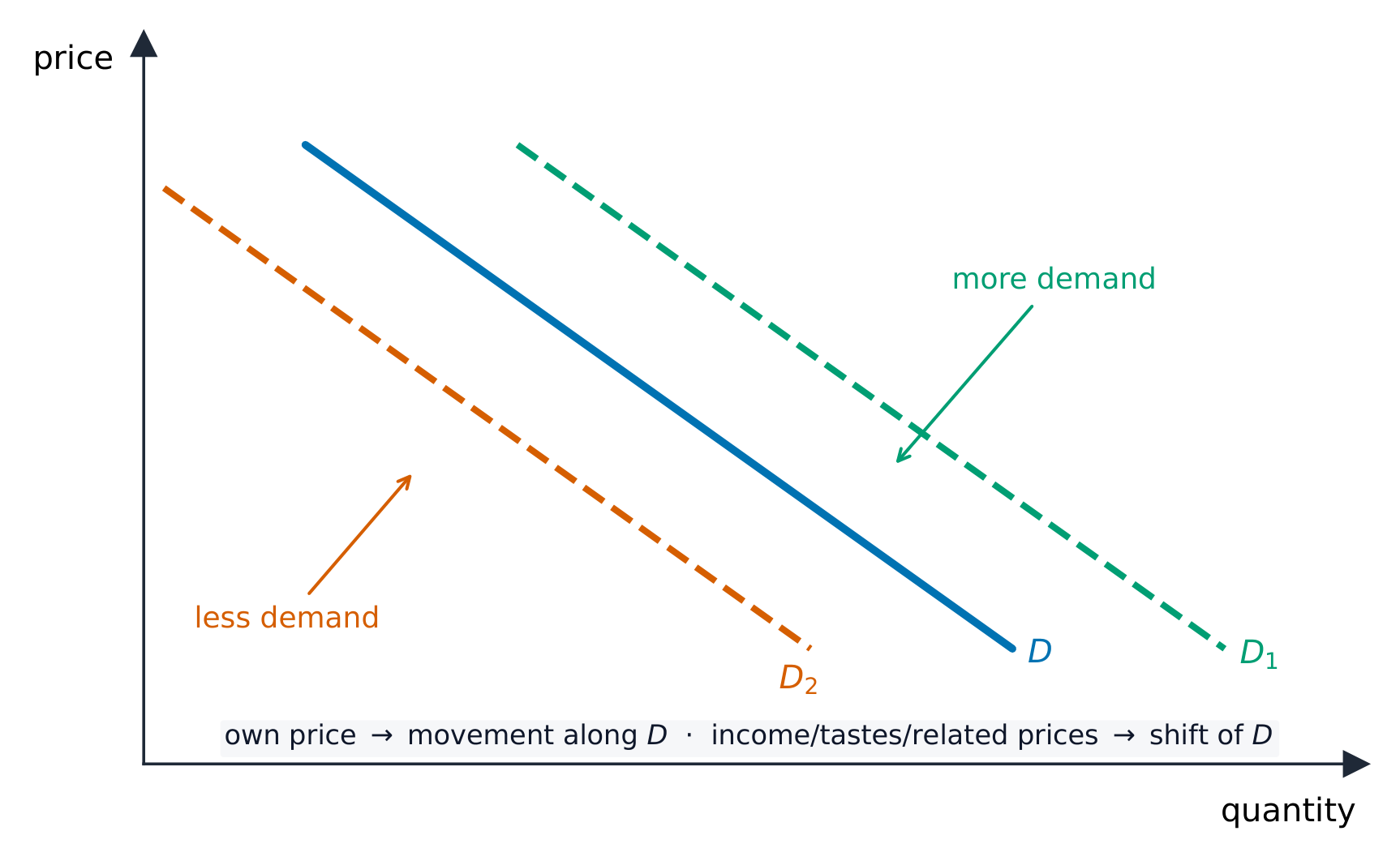
- draw demand curves and distinguish a movement along (change in price) from a shift (change in conditions of demand)
- list the conditions of demand (income, tastes, price of substitutes and complements, population, advertising)
来源:剑桥国际大纲
需求(demand)是消费者(consumers)(买者)在一段时间内、在每个价格上愿意并且能够购买的一种物品(good)的数量。
需求定律(law of demand)说:当一种物品的价格上升时,需求量下降;当价格下降时,需求量上升。价格和数量朝相反方向移动——一种反向关系(inverse relationship)。这在其他条件不变(ceteris paribus)时成立(一个拉丁短语,意思是"所有其他事情保持不变")。
Movements and shifts
分开两个思想有帮助:
- 需求量(quantity demanded)——在一个价格上购买的数量。
- 需求——在每个价格上购买的整个模式。
在一个需求图上,价格在竖轴上而数量在横轴上。需求曲线(demand curve)从左向右向下倾斜:高价格、低数量;低价格、高数量。
- 物品自身价格的一个变化引起沿需求曲线的一个移动。你滑到同一条线上的一个新点。
- 任何其他条件的一个变化引起整条曲线的一个移动(shift)。一个向右的移动意味着在每个价格上需求更多;一个向左的移动意味着需求更少。
Conditions of demand
这些是(除了物品自身价格之外)移动需求曲线的东西:
- 收入(income)——更多收入通常意味着更多需求。
- 偏好(tastes)——若一种物品变得流行,需求上升。
- 替代品(substitutes)的价格——互相代替使用的物品(茶和咖啡)。若咖啡变贵,对茶的需求上升。
- 互补品(complements)的价格——一起使用的物品(汽车和燃料)。若汽车变贵,对燃料的需求下降。
- 人口(population)——更多人意味着更多需求。
- 广告(advertising)——好的广告提高需求。
探索
Demand & supply
Demand slopes down — cheaper means more wanted.
词汇表
训练
| 英文 | 中文 | 拼音 |
|---|---|---|
| demand | 需求 | xū qiú |
| good | 物品 | wù pǐn |
| consumers | 消费者 | xiāo fèi zhě |
| law of demand | 需求定律 | xū qiú dìng lǜ |
| inverse relationship | 反向关系 | fǎn xiàng guān xì |
| ceteris paribus | 其他条件不变 | qí tā tiáo jiàn bù biàn |
| quantity demanded | 需求量 | xū qiú liàng |
| demand curve | 需求曲线 | xū qiú qū xiàn |
| shift | 移动 | yí dòng |
| income | 收入 | shōu rù |
| tastes | 偏好 | piān hǎo |
| substitutes | 替代品 | tì dài pǐn |
| complements | 互补品 | hù bǔ pǐn |
| population | 人口 | rén kǒu |
| advertising | 广告 | guǎng gào |
2.3
供给
大纲
- define supply and explain the law of supply (direct relationship with price)
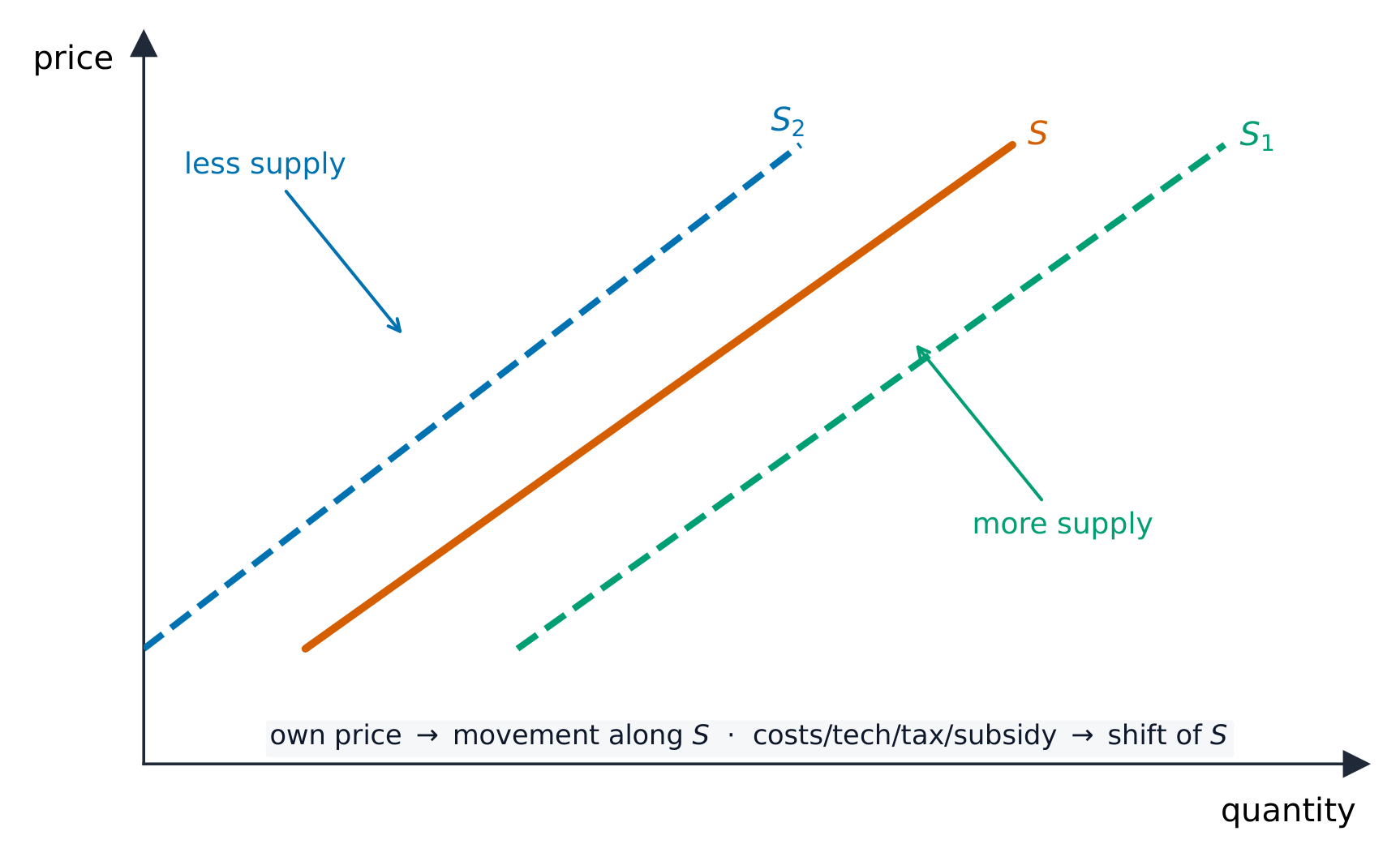
- draw supply curves and distinguish a movement along from a shift
- list the conditions of supply (costs of production, technology, taxes/subsidies, weather, number of firms)
来源:剑桥国际大纲
供给(supply)是企业在一段时间内、在每个价格上愿意并且能够出售的一种物品的数量。
供给定律(law of supply)说:当价格上升时,供给量也上升。价格和数量朝同一方向移动——一种正向关系(direct relationship)。企业在高价格时供给更多,因为它们能赚更多。
Movements and shifts
- 供给量(quantity supplied)——在一个价格上提供的数量。
- 供给曲线(supply curve)从左向右向上倾斜。
- 物品自身价格的一个变化 → 沿曲线的一个移动。
- 任何其他条件的一个变化 → 整条曲线的一个移动。
Conditions of supply
- 生产成本(costs of production)——若成本上升,企业供给更少(曲线向左移)。
- 技术(technology)——更好的技术降低成本,所以供给上升。
- 税收(taxes)和补贴——对一种物品的一项税收(tax)提高企业的成本(供给下降);一项补贴(subsidy)(来自政府的钱)降低成本(供给上升)。
- 天气——对农产品重要。
- 企业数量——更多企业意味着更多供给。
探索
Demand & supply
Supply slopes up — dearer means more made.
词汇表
训练
| 英文 | 中文 | 拼音 |
|---|---|---|
| supply | 供给 | gōng jǐ |
| law of supply | 供给定律 | gōng jǐ dìng lǜ |
| direct relationship | 正向关系 | zhèng xiàng guān xì |
| quantity supplied | 供给量 | gōng jǐ liàng |
| supply curve | 供给曲线 | gōng jǐ qū xiàn |
| costs of production | 生产成本 | shēng chǎn chéng běn |
| technology | 技术 | jì shù |
| tax | 税收 | shuì shōu |
| subsidy | 补贴 | bǔ tiē |
2.4
价格的决定

大纲
- explain market equilibrium: equilibrium price and quantity where demand equals supply
- draw and interpret demand and supply diagrams to find equilibrium
来源:剑桥国际大纲
一种物品的价格在需求和供给相遇处设定。在一张图上画两条曲线。它们在单个点交叉。这个点给出:
- 均衡(equilibrium)价格——买者想买的数量恰好等于企业想卖的数量时的价格。
- 均衡数量——在那个价格上交易的数量。
在均衡处,需求量等于供给量。没有剩下的物品,也没有留下等待的买者。

探索
Demand & supply
Equilibrium is where demand meets supply.
词汇表
训练
| 英文 | 中文 | 拼音 |
|---|---|---|
| equilibrium | 均衡 | jūn héng |
2.5
价格变化

大纲
- explain how shifts in demand and supply cause changes in equilibrium price and quantity
- explain the consequences of disequilibrium (excess demand/shortage, excess supply/surplus)
来源:剑桥国际大纲
当一条曲线移动时,交叉点移动,所以价格和数量变化:
- 需求上升(向右移):价格上升而数量上升。
- 需求下降(向左移):价格下降而数量下降。
- 供给上升(向右移):价格下降而数量上升。
- 供给下降(向左移):价格上升而数量下降。
Disequilibrium
若价格不在均衡,市场处于非均衡(disequilibrium):
- 若价格低于均衡,买者想要的多于企业供给的。这是超额需求(excess demand),也叫短缺(shortage)。买者竞争,所以价格被推高直到均衡回来。
- 若价格高于均衡,企业供给的多于买者想要的。这是超额供给(excess supply),也叫过剩(surplus)。卖者削减价格直到均衡回来。
探索
Demand & supply
A shift in demand or supply moves the equilibrium.
词汇表
训练
| 英文 | 中文 | 拼音 |
|---|---|---|
| disequilibrium | 非均衡 | fēi jūn héng |
| excess demand | 超额需求 | chāo é xū qiú |
| shortage | 短缺 | duǎn quē |
| excess supply | 超额供给 | chāo é gōng jǐ |
| surplus | 过剩 | guò shèng |
2.6
需求的价格弹性(PED)

大纲
- define and calculate PED (% change in quantity demanded ÷ % change in price)
- interpret values (elastic, inelastic, unit) and the determinants of PED
- explain the relationship between PED and total revenue and the usefulness of PED to firms and government
来源:剑桥国际大纲
需求价格弹性(price elasticity of demand)衡量当价格变化时需求量变化多少。
PED = (需求量的变化%) ÷ (价格的变化%)
(我们通常忽略负号并读这个数的大小。)决定因素(determinants)(决定 PED 的东西)包括这种物品是否有相近的替代品、它是一个需要还是一个奢侈品,以及它占收入的多少份额。
Worked example. 当一种物品的价格上升 20% 时,需求量下降 10%。求 PED。
PED = (需求量的变化%) ÷ (价格的变化%) = 10 ÷ 20 = 0.5。
因为 0.5 小于 1,需求缺乏弹性——数量变化的百分比小于价格的。
Reading the value
- PED 大于 1:需求富有弹性(elastic)。数量变化一个大的 %。(有很多替代品的物品,像一个牌子的薯片。)
- PED 小于 1:需求缺乏弹性(inelastic)。数量变化一个小的 %。(替代品少的需要,像汽油或盐。)
- PED 等于 1:单位弹性(unit elastic)。数量变化和价格相同的 %。
PED and total revenue
总收益(total revenue)是一个企业从销售得到的钱:价格 × 售出的数量。(对买者来说,同样的钱是总支出(total expenditure)。)PED 告诉一个企业若它改变价格收益会发生什么:
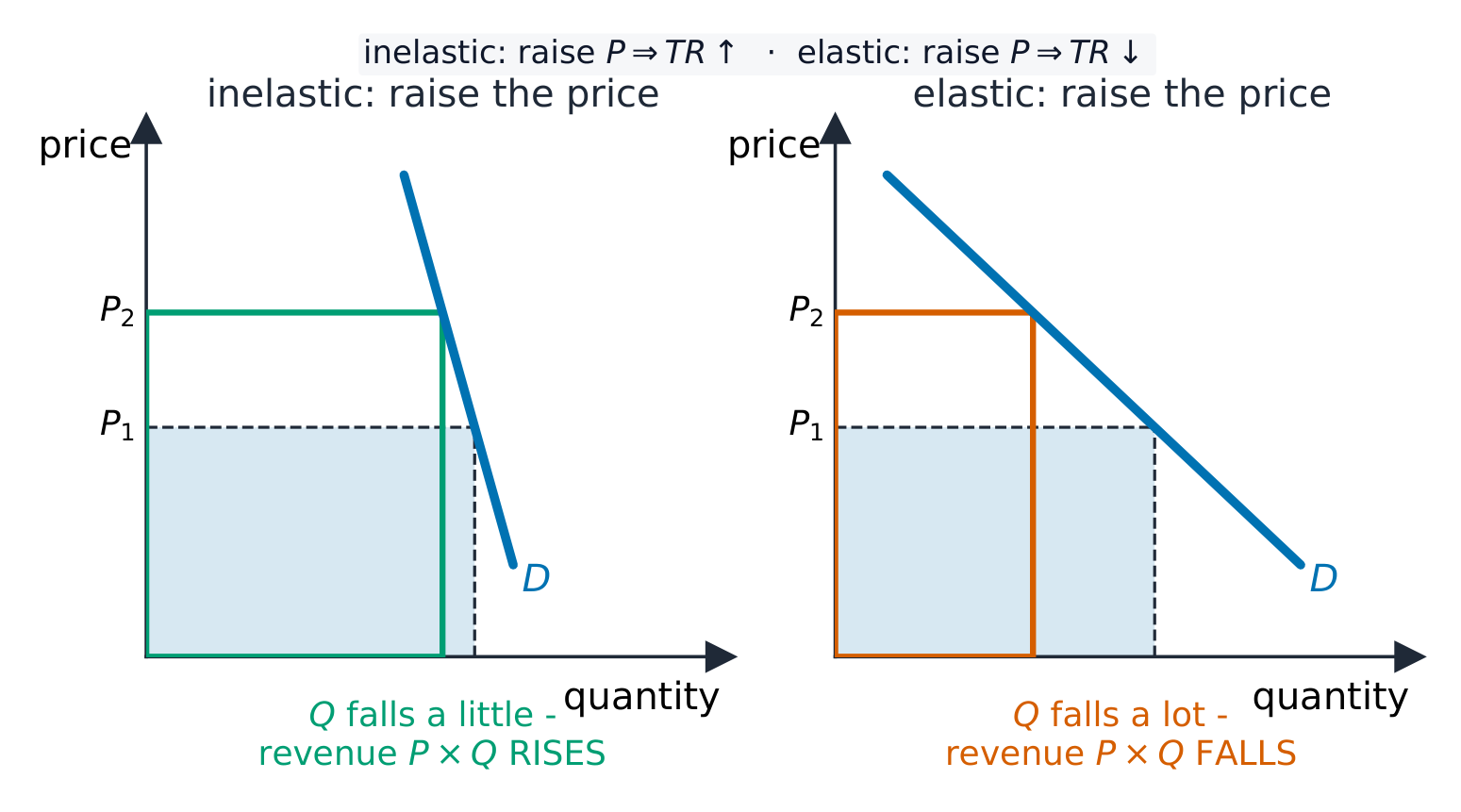
- 若需求缺乏弹性,提高价格提高总收益(数量只下降一点)。
- 若需求富有弹性,提高价格降低总收益(数量下降很多)。
这很有用。一个企业在知道买者会如何反应的情况下设定价格。一个政府对缺乏弹性的物品(像香烟)征税,因为人们继续购买它们,所以这项税收筹集很多钱。
Worked example. 一家公交公司每天以每张 £2 卖 1,000 张票。它把价格提高 10% 到 £2.20,而每日销量下降 5% 到 950。求 PED 以及总收益发生什么。
- PED = 5 ÷ 10 = 0.5,所以需求缺乏弹性(小于 1)。
- 旧收益 = £2 × 1,000 = £2,000。
- 新收益 = £2.20 × 950 = £2,090。
总收益上升了 £90。因为需求缺乏弹性,价格上升的百分比大于数量下降的,所以提高价格提高了收益。
探索
Elasticity & total revenue
PED is the % change in quantity over the % change in price; whether it is above or below 1 decides how total revenue moves.
探索
Demand & supply
Elasticity of demand is the steepness of the curve.
词汇表
训练
| 英文 | 中文 | 拼音 |
|---|---|---|
| price elasticity of demand | 需求价格弹性 | xū qiú jià gé tán xìng |
| determinants | 决定因素 | jué dìng yīn sù |
| elastic | 富有弹性 | fù yǒu tán xìng |
| inelastic | 缺乏弹性 | quē fá tán xìng |
| unit elastic | 单位弹性 | dān wèi tán xìng |
| total revenue | 总收益 | zǒng shōu yì |
| total expenditure | 总支出 | zǒng zhī chū |
2.7
供给的价格弹性(PES)

大纲
- define and calculate PES (% change in quantity supplied ÷ % change in price)
- interpret values and explain the determinants of PES (time, spare capacity, stocks, ease of factor switching)
来源:剑桥国际大纲
供给价格弹性(price elasticity of supply)衡量当价格变化时供给量变化多少。
PES = (供给量的变化%) ÷ (价格的变化%)
若 PES 大于 1 供给富有弹性,而若 PES 小于 1 供给缺乏弹性。
Worked example. 当一种物品的价格上升 10% 时,供给量上升 30%。求 PES。
PES = (供给量的变化%) ÷ (价格的变化%) = 30 ÷ 10 = 3。
因为 3 大于 1,供给富有弹性。
PES 的决定因素是:
- 时间——供给在长时间上更富有弹性,因为企业能改变它们制造多少。
- 闲置产能(spare capacity)——若一个企业有未使用的机器和工人,它能快速提高产出,所以供给富有弹性。
- 库存(stocks)——存放的物品能被快速卖出,使供给富有弹性。
- 转换要素的容易程度——若一个企业能容易地移动生产要素来制造这种物品,供给更富有弹性。
农产品在短期常常有缺乏弹性的供给,因为庄稼要一个季节才长成。
探索
Demand & supply
Supply elasticity is how quantity responds to price.
词汇表
训练
| 英文 | 中文 | 拼音 |
|---|---|---|
| price elasticity of supply | 供给价格弹性 | gōng jǐ jià gé tán xìng |
| spare capacity | 闲置产能 | xián zhì chǎn néng |
| stocks | 库存 | kù cún |
2.8
市场经济体制
大纲
- explain how a market economy allocates resources through the price mechanism
- explain the advantages and disadvantages of the market economic system
来源:剑桥国际大纲
在一个市场经济(market economy)里,价格机制做所有的选择。没有政府计划。(对立面是一个计划经济(planned economy),那里政府做选择。)
市场系统的优点:
- 价格引导资源到它们被需要的地方,不需要任何人计划。
- 企业竞争,所以它们削减成本并创造新的、更好的物品。
- 消费者有广泛的选择。
缺点:
- 一些有用的物品不被制造,因为它们不赚利润。
- 强者(富有的企业和人)做得好;弱者可能被留下一无所有。
- 市场会失灵(见下文)。
探索
How a market allocates
In a market system, price moves to where demand meets supply — that price signal decides what gets made. Shift the curves and watch it settle.
词汇表
训练
| 英文 | 中文 | 拼音 |
|---|---|---|
| market economy | 市场经济 | shì chǎng jīng jì |
| planned economy | 计划经济 | jì huà jīng jì |
2.9
市场失灵

大纲
- define market failure as the inefficient allocation of resources
- explain the causes: external costs and external benefits (social vs private costs/benefits), merit and demerit goods, public goods and the abuse of monopoly power
来源:剑桥国际大纲
市场失灵(market failure)发生在价格机制导致资源的一种低效率(inefficient)使用时——资源没有以对社会最好的方式分配。主要原因:
External costs and benefits
当你生产或消费某物时,对你的成本或效益不总是对每个人的成本或效益。
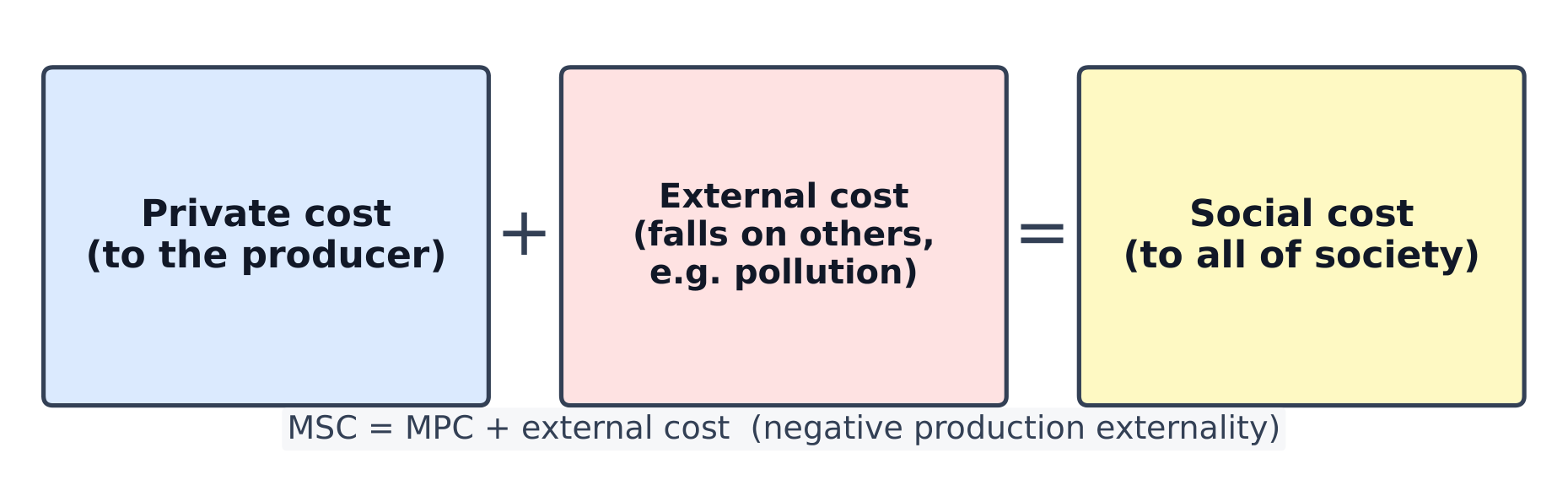
- 一项私人成本(private cost)是对做这项活动的人的成本。
- 一项外部成本(external cost)是由其他人支付的成本——例如,来自一家工厂的烟伤害附近的家庭。
- 社会成本(social cost)是私人成本加外部成本(对整个社会的成本)。
以同样的方式:
- 一项私人效益(private benefit)是对做这项活动的人的效益。
- 一项外部效益(external benefit)是其他人免费得到的效益——例如,你邻居整洁的花园对你也很好。
- 社会效益(social benefit)是私人效益加外部效益。
市场失灵是因为企业和消费者只考虑他们的私人成本和效益,而不考虑外部的那些。
Merit, demerit and public goods
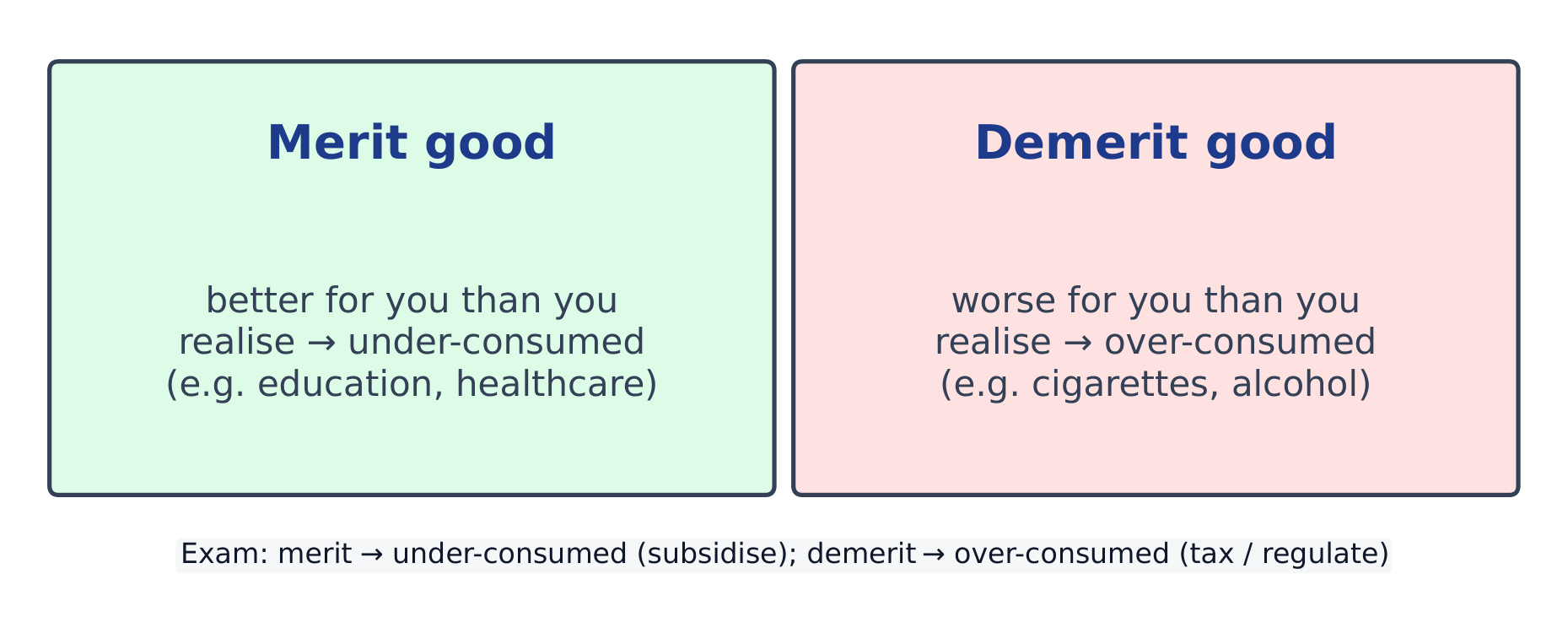
- 有益物品(merit goods)对你比你意识到的更好,所以市场制造太少(教育、医疗)。
- 有害物品(demerit goods)对你比你意识到的更坏,所以市场制造太多(香烟、酒)。
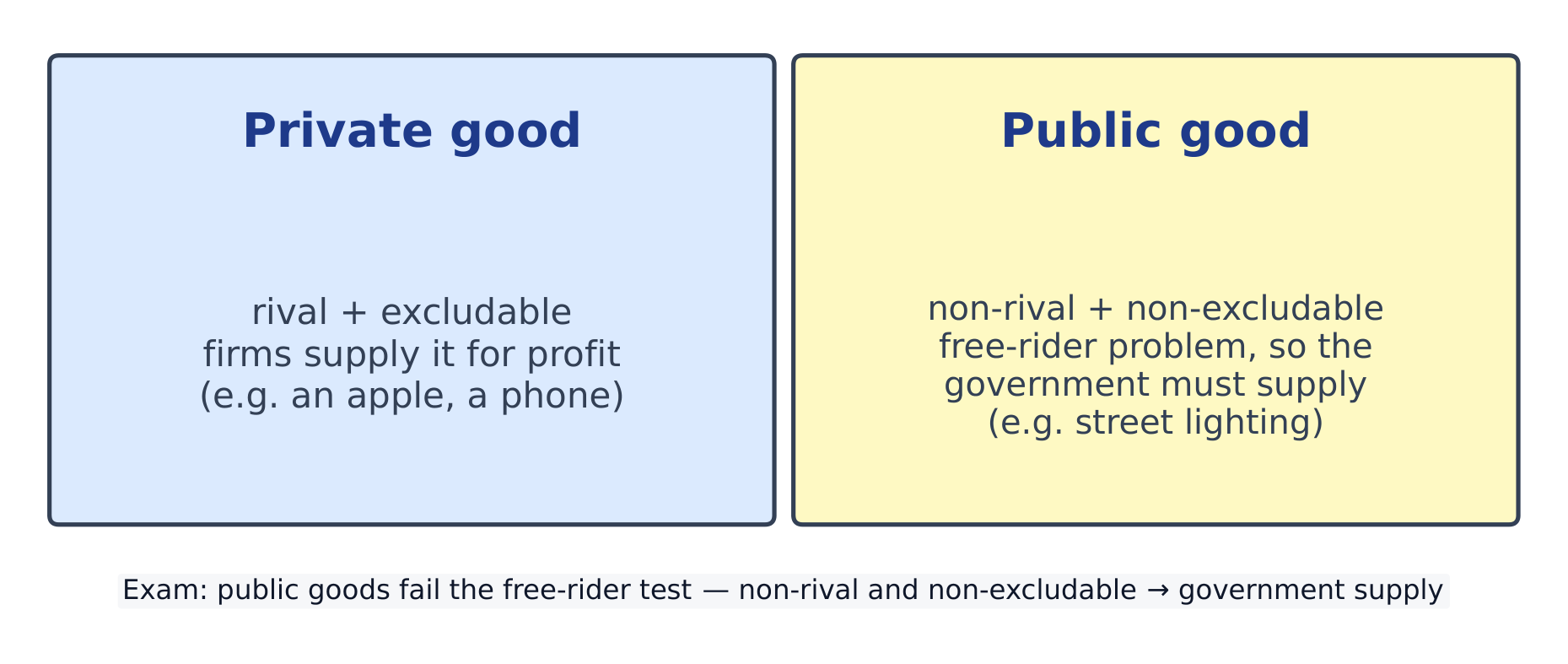
- 公共物品(public goods)是每个人都能用、没有人能被阻止使用的东西,像路灯或国防。市场一个都不制造,因为企业不能对它们收费。
Abuse of monopoly power
一个垄断(monopoly)是一个控制一个市场的单个企业。没有竞争,它能收取高价格并制造劣质物品。这是另一种市场失灵。
探索
Demand & supply
Market failure: the free-market crossing isn't always best for society.
词汇表
训练
| 英文 | 中文 | 拼音 |
|---|---|---|
| market failure | 市场失灵 | shì chǎng shī líng |
| inefficient | 低效率 | dī xiào lǜ |
| private cost | 私人成本 | sī rén chéng běn |
| external cost | 外部成本 | wài bù chéng běn |
| social cost | 社会成本 | shè huì chéng běn |
| private benefit | 私人效益 | sī rén xiào yì |
| external benefit | 外部效益 | wài bù xiào yì |
| social benefit | 社会效益 | shè huì xiào yì |
| merit goods | 有益物品 | yǒu yì wù pǐn |
| demerit goods | 有害物品 | yǒu hài wù pǐn |
| public goods | 公共物品 | gōng gòng wù pǐn |
| monopoly | 垄断 | lǒng duàn |
2.10
混合经济体制
大纲
- explain the features of a mixed economy (private sector and public sector)
- explain methods of government intervention to address market failure: maximum and minimum prices, indirect taxes, subsidies, regulation and direct provision
- evaluate the effects of intervention
来源:剑桥国际大纲
一个混合经济(mixed economy)两者都有:
- 一个私营部门(private sector)——由人拥有、被价格机制引导的企业。
- 一个公共部门(public sector)——由政府经营的活动。
大多数真实经济是混合的;例如中国的是社会主义市场经济。政府介入来纠正市场失灵。这是政府干预(intervention)。主要方法:
| 方法 | 它做什么 |
|---|---|
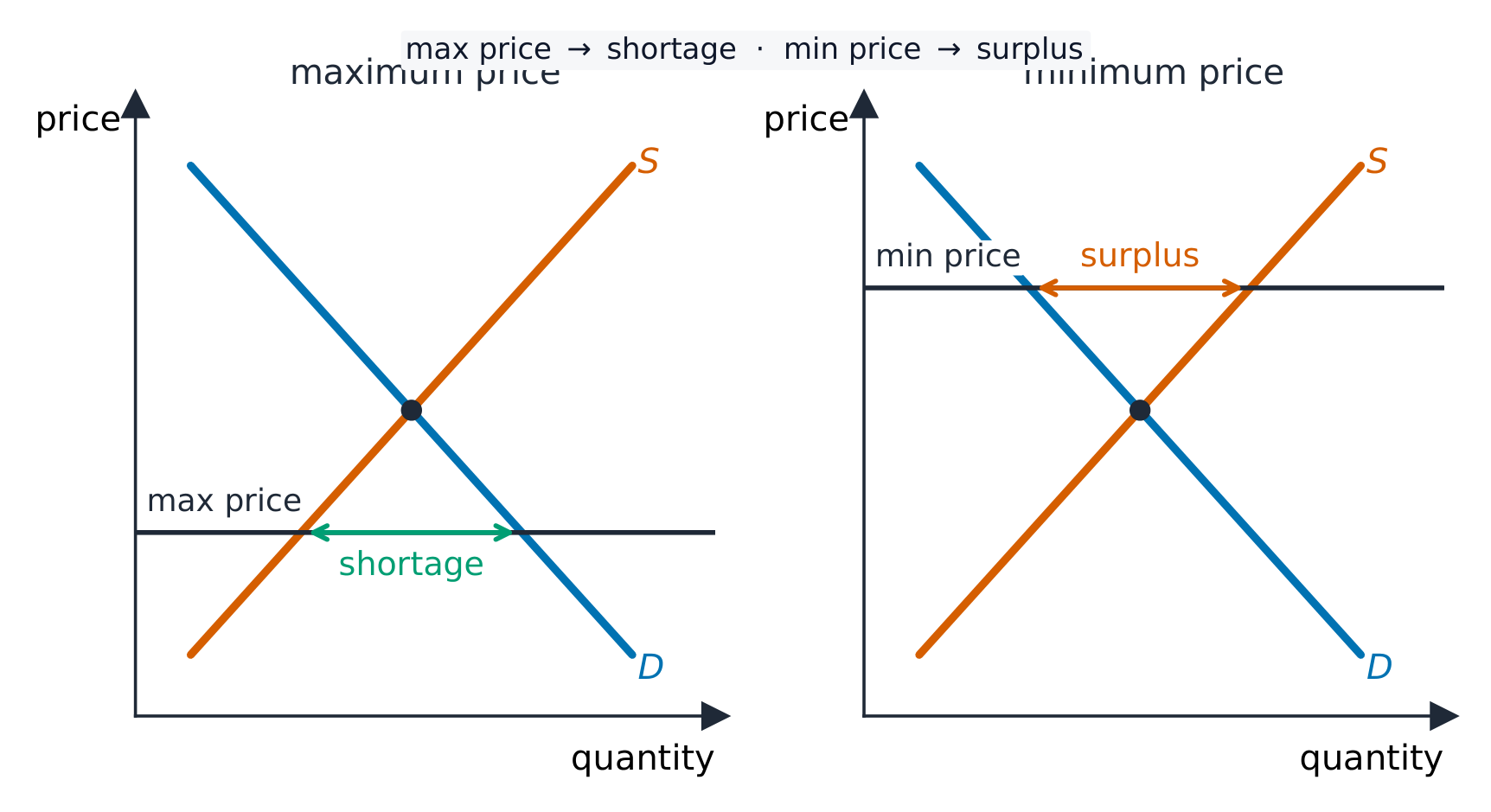
| 最高价格(maximum price) | 一个价格上限,设在均衡之下,以保持一种物品(像租金)便宜——但它造成一个短缺 |
| 最低价格(minimum price) | 一个价格下限,设在均衡之上,以保持一个价格高(像一份公平的工资)——但它造成一个过剩 |
| 间接税(indirect tax) | 对一种物品的一项税(加到它的价格上)以削减对有害物品的需求 |
| 补贴(subsidy) | 付给企业的钱以削减价格并提高有益物品的产出 |
| 监管(regulation) | 规则和法律,像禁止在公共场所吸烟 |
| 直接提供(direct provision) | 政府自己制造并发放物品,像公立学校 |
Judging intervention
干预能修复市场失灵,但它有成本。税收和规则花钱去征收和检查。政府也会把事情搞错(这被称为政府失灵)。所以你应当在决定之前总是权衡好的效果和坏的效果。
探索
Economics case lab
Classify real examples by the economic idea they show.
词汇表
训练
| 英文 | 中文 | 拼音 |
|---|---|---|
| mixed economy | 混合经济 | hùn hé jīng jì |
| private sector | 私营部门 | sī yíng bù mén |
| public sector | 公共部门 | gōng gòng bù mén |
| intervention | 干预 | gān yù |
| maximum price | 最高价格 | zuì gāo jià gé |
| minimum price | 最低价格 | zuì dī jià gé |
| indirect tax | 间接税 | jiàn jiē shuì |
| regulation | 监管 | jiān guǎn |
| direct provision | 直接提供 | zhí jiē tí gōng |
2.10
考试技巧
- 一种物品自身价格的一个变化是沿曲线的一个移动;别的任何东西(收入、偏好、相关价格)的一个变化移动整条曲线。
- 均衡是需求遇到供给的地方。它之下有超额需求(一个短缺,所以价格上升);它之上有超额供给(一个过剩,所以价格下降)。
- PED = %ΔQ ÷ %ΔP。若 PED < 1 需求缺乏弹性(提高价格提高收益),而若 PED > 1 需求富有弹性(提高价格降低收益)。
- 市场失灵(外部成本、有益/有害/公共物品、垄断)意味着资源被糟糕地使用;政府用税收、补贴、规则和直接提供来纠正它。
本主题的互动课程
逐步学习,并即时检测练习。