Price determination
Introduced| English | Meaning |
|---|---|
| equilibrium/ˌiːkwɪˈlɪbrɪəm/ | A state in which opposing influences balance so there is no tendency for the relevant quantities to change. |
| quantity demanded/ˈkwɒntɪti dɪˈmændɪd/ | The amount buyers are willing and able to purchase at a particular price over a specified period. |
| quantity supplied/ˈkwɒntɪti səˈplaɪd/ | The amount sellers are willing and able to offer at a particular price over a specified period. |
| shortage/ˈʃɔːtɪdʒ/ | A situation in which quantity demanded exceeds quantity supplied at the prevailing price. |
| surplus/ˈsɜːpləs/ | An amount exceeding what is required; in a market, quantity supplied above quantity demanded at a given price. |
| clears/klɪəz/ | Describes a market when quantity demanded equals quantity supplied at the prevailing price. |
Where buyers and sellers agree
- Buyers want low prices; sellers want high ones. The market settles at the one price that satisfies both.
- That balancing price is the equilibrium 均衡 — found where supply meets demand.
Market equilibrium is where:
Difficulty 1/5 · 100 coins + a small bonus on first completion today
Equilibrium clears the market — Qd = Qs.
At equilibrium there is always a small shortage.
Difficulty 1/5 · 100 coins + a small bonus on first completion today
False. At equilibrium quantity demanded equals quantity supplied, so there is neither a shortage nor a surplus.
Market equilibrium
- Equilibrium is the price where quantity demanded 需求量 = quantity supplied 供给量.
- At that price there is no shortage 短缺 and no surplus 过剩 — the market clears 出清.
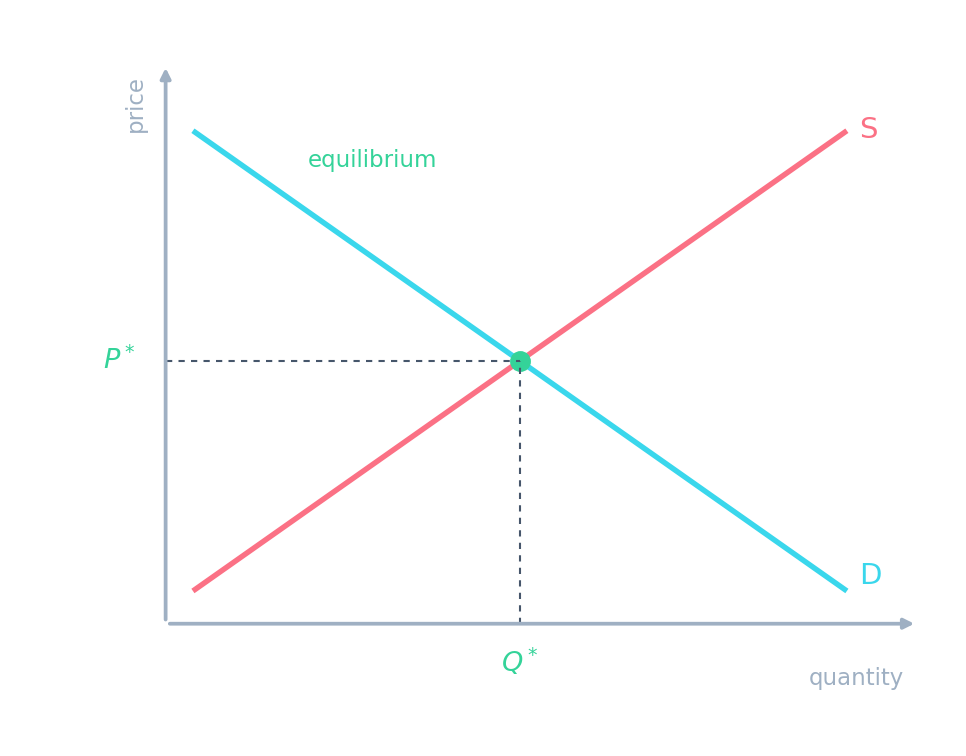
Equilibrium is the crossing point: quantity demanded equals quantity supplied.
Demand & supply
Equilibrium is where demand meets supply.
If price is set above equilibrium, the result is a:
Difficulty 1/5 · 100 coins + a small bonus on first completion today
Above equilibrium, supply exceeds demand — a surplus pushes price down.
When supply exceeds demand at the current price, there is a ______.
Difficulty 1/5 · 100 coins + a small bonus on first completion today
Excess supply is a surplus, which pushes price down.
Surplus pushes price down
- If price is above equilibrium, supply exceeds demand → a surplus → sellers cut prices.
- The price falls back towards equilibrium.
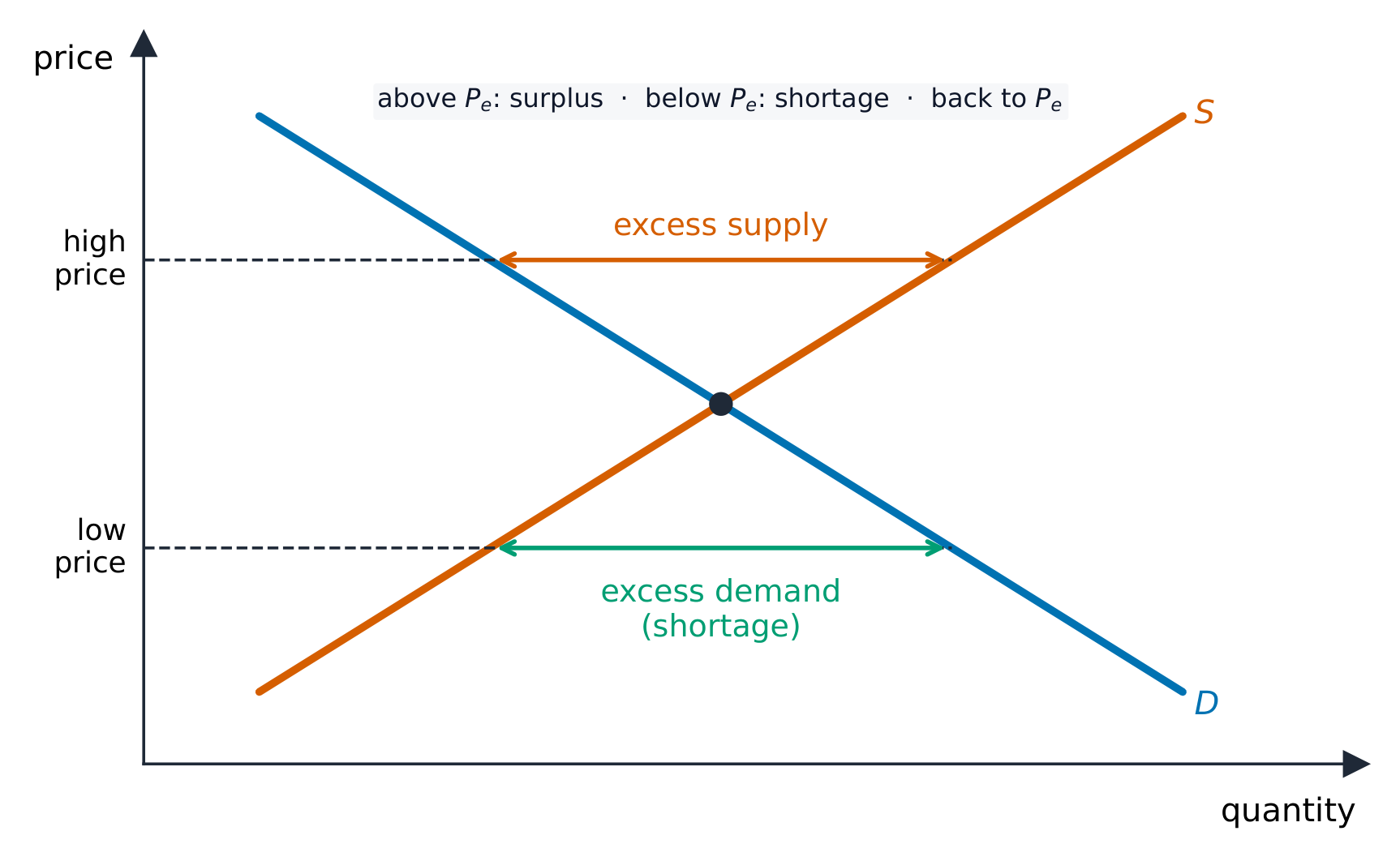
Above equilibrium there is excess supply (a surplus); below it, excess demand (a shortage)
A shortage occurs when price is:
Difficulty 1/5 · 100 coins + a small bonus on first completion today
Below equilibrium, demand exceeds supply — a shortage pushes price up.
Shortage pushes price up
- If price is below equilibrium, demand exceeds supply → a shortage → buyers bid prices up.
- The price rises back towards equilibrium.
Worked example. Concert tickets priced too low sell out instantly (a shortage) and reappear on resale sites at much higher prices — the market pushing back to equilibrium.
You've got it
- equilibrium: quantity demanded = quantity supplied; the market clears
- price above equilibrium → surplus → price falls
- price below equilibrium → shortage → price rises
Write from a surplus of 30
- At a price of 12 dollars, quantity supplied is 80 and quantity demanded is 50.
- Name the imbalance.
At a price of 12 dollars, quantity supplied is 80 and quantity demanded is 50. What is the imbalance, and what is likely to happen to price?
80 minus 50 is 30, and sellers cut price to clear stock.
What is the imbalance at 12 dollars?
Difficulty 1/5 · 100 coins + a small bonus on first completion today
Supply is 30 above demand, so the price is too high.