- describe what is meant by wave motion as illustrated by vibration in ropes, springs and ripple tanks
- understand and use the terms displacement, amplitude, phase difference, period, frequency, wavelength and speed
- understand the use of the time-base and $y$-gain of a cathode-ray oscilloscope (CRO) to determine frequency and amplitude
- derive, using the definitions of speed, frequency and wavelength, the wave equation $v = f\lambda$
- recall and use $v = f\lambda$
- understand that energy is transferred by a progressive wave
- recall and use $\text{intensity} = \text{power}/\text{area}$ and $\text{intensity} \propto (\text{amplitude})^2$ for a progressive wave
Waves
A-Level Physics · Topic 7
Handout
Vocabulary
Vocab test 8
Vocab test 9
Vocab test 10
Vocab test 11
Vocab test 17
Vocab test 18
7.1
Progressive waves

Syllabus
Source: Cambridge International syllabus

A wave 波 carries energy 能量 from one place to another without moving matter overall. The particles of the medium 介质 oscillate 振动 about fixed rest positions; only the disturbance (and its energy) propagates 传播. Examples: a transverse wave 横波 on a rope, a longitudinal wave 纵波 on a slinky spring, ripples on water, and sound in air. A wave that travels and carries energy is a progressive wave 行波.
Wave motion 波动 is a series of oscillations of the particles of a medium, each passing the disturbance on to the next: shake one end of a rope, push one end of a spring, or touch the surface of the water in a ripple tank 水波槽, and the oscillation travels away from where it started. For the one-mark definition, a progressive wave transfers energy from one place to another without transferring matter; the particles only oscillate about their rest positions.
Key terms
- displacement 位移 $y$ — how far a particle has moved from its rest position at a moment. A vector 矢量.
- amplitude 振幅 $A$ — the largest displacement from the rest position.
- wavelength 波长 $\lambda$ — the shortest distance along the wave between two points that move in phase 同相 (for example, two next-door crests 波峰).
- period 周期 $T$ — the time for one full oscillation of a particle.
- frequency 频率 $f$ — the number of full oscillations per second; $f = 1/T$. Unit: hertz 赫兹, $\text{Hz}$.
- speed 速率 $v$ — how fast a crest travels along the medium.
- phase difference 相位差 — the fraction of a cycle by which one oscillation leads or lags another. Given in radians 弧度 (a full cycle is $2\pi$) or degrees (a full cycle is $360°$).
Two points one wavelength apart are in phase (phase difference 0 or $2\pi$). Two points half a wavelength apart are exactly out of phase (phase difference $\pi$).
To find the phase difference between two points from a displacement–distance graph, divide their separation by the wavelength and multiply by $360°$ (or $2\pi$): two points $0.50\ \text{m}$ apart on a wave of wavelength $2.0\ \text{m}$ ($v = 600\ \text{m s}^{-1}$, $f = 300\ \text{Hz}$) differ in phase by $0.25 \times 360° = 90°$. Only the fraction of a cycle matters, so $450°$ is the same as $90°$. From two displacement–time graphs, read the time shift between the peaks as a fraction of the period. Which way is a point moving at the instant a graph shows? The whole profile moves along, so each point takes up the displacement that its neighbour on the side the wave comes from has now; a point at a crest or a trough is momentarily at rest.

Worked example. Points R and T on a string are $0.62\ \text{cm}$ apart and a quarter of a cycle out of phase. The wave speed is $0.27\ \text{m s}^{-1}$. Find the frequency.
A quarter of a cycle is a quarter of a wavelength, so $\lambda = 4 \times 0.62 = 2.5\ \text{cm}$ and $f = v / \lambda = 0.27 / 0.025 = 11\ \text{Hz}$.
The wave equation
In one period $T$, the wave moves forward by one wavelength $\lambda$. So speed $= \text{distance} / \text{time} = \lambda / T = \lambda f$:
$$v = f \lambda.$$
This comes straight from the definitions of speed, frequency and wavelength, and works for every progressive wave. For the two-mark derivation write both steps: in one period $T$ the wave travels one wavelength $\lambda$, so $v = \lambda / T$; and $f = 1/T$, so $v = f\lambda$. Because $v$ is fixed by the medium, a higher frequency means a shorter wavelength. A period question is the same equation the other way round: light of wavelength $460\ \text{nm}$ has $f = c / \lambda = 6.5 \times 10^{14}\ \text{Hz}$ and $T = 1/f = 1.5 \times 10^{-15}\ \text{s}$.
Reading a CRO trace
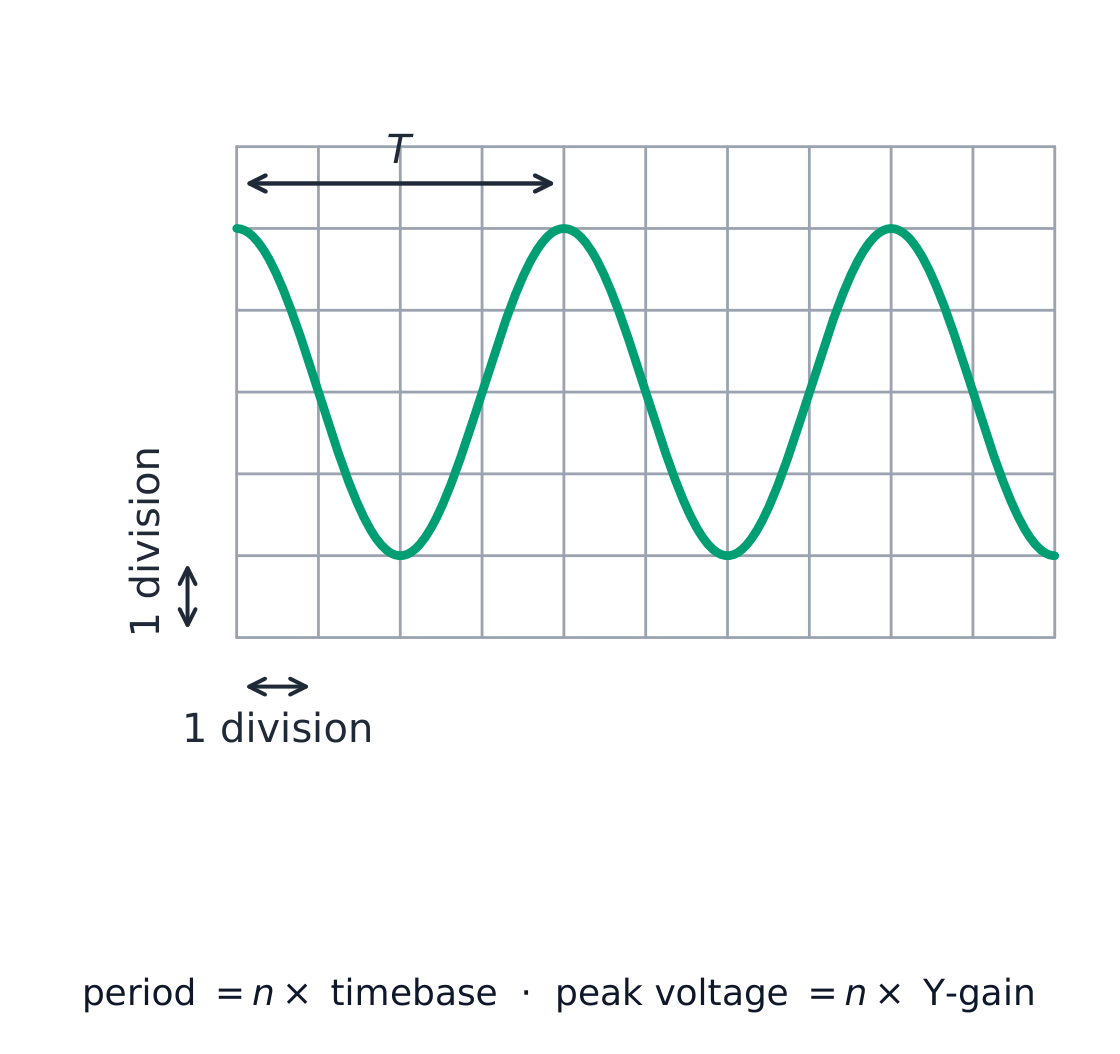
A cathode-ray oscilloscope 示波器 (CRO) draws a voltage signal — for sound, the output of a microphone — against time. Two controls matter:
- time-base 时基 (seconds per division across): turns horizontal distance on the screen into time. Read the period $T$ as the distance between two next-door peaks, then $f = 1/T$.
- y-gain 垂直增益 (volts per division up): turns vertical distance into voltage. The amplitude in volts is the peak height from the centre line.
If the time-base is $5\ \text{ms}/\text{div}$ and one full cycle takes $4$ divisions, then $T = 4 \times 5\ \text{ms} = 20\ \text{ms}$ and $f = 50\ \text{Hz}$.
The time-base is the time represented by one division (or one centimetre) across the screen, in $\text{s}\ \text{div}^{-1}$. To set it for a given signal, work backwards: a $2000\ \text{Hz}$ sound has $T = 0.50\ \text{ms}$, so for one cycle to span $2.5\ \text{cm}$ the time-base must be $0.50 / 2.5 = 0.20\ \text{ms cm}^{-1}$. For the amplitude, multiply the peak height in divisions by the y-gain: $2.0$ divisions at $3.5\ \text{mV cm}^{-1}$ is $7.0\ \text{mV}$. When the intensity of the sound is reduced to a quarter at the same frequency, the trace keeps its period and its peaks halve in height, because $I \propto A^{2}$.

Intensity of a wave
A wave carries energy. The intensity 强度 at a point is the power 功率 passing through unit area at right angles to the direction of travel:
$$I = \frac{P}{A}.$$
Unit: $\text{W m}^{-2}$.
Intensity is proportional to the square of the amplitude:
$$I \propto A^{2}.$$
For a point source 点源 sending out energy equally in all directions, the wavefronts 波前 are spheres; the surface area at distance $r$ is $4\pi r^{2}$, so
$$I = \frac{P}{4\pi r^{2}}, \qquad I \propto \frac{1}{r^{2}}.$$
Doubling the distance cuts the intensity to a quarter, which means the amplitude is halved (since $I \propto A^{2}$).
Worked example. A lamp emits $60\ \text{W}$ of light equally in all directions. Find the intensity of the light $2.0\ \text{m}$ away.
$$I = \frac{P}{4\pi r^{2}} = \frac{60}{4\pi (2.0)^{2}} \approx 1.2\ \text{W m}^{-2}.$$
Worked example. Light of power $750\ \text{W}$ falls at right angles on a square solar panel of side $1.2\ \text{m}$. Find the intensity.
$I = P/A = 750 / 1.2^{2} = 520\ \text{W m}^{-2}$. A smaller panel in the same light receives the same intensity but less power, in proportion to its area. The other way round, a magnifying glass of radius $r$ collects a power $I \times \pi r^{2}$ and concentrates it on a small spot.
Two rules the multiple-choice questions turn on. Because $I \propto A^{2}$, the ratio of two intensities is the square of the ratio of the amplitudes: waves of amplitude $3.0\ \text{cm}$ and $2.0\ \text{cm}$ have intensities in the ratio $2.25$, and when an amplitude falls to a half the intensity falls to a quarter. For a point source, $I \propto 1/r^{2}$ means $A \propto 1/r$, so a sketch of $A/A_{0}$ against $d/x_{0}$ is a curve falling as $1/d$, not a straight line. The one-line statement the scheme wants: intensity is proportional to the amplitude squared.
Explore
Progressive waves
y = a sin(bx + c)
A wave: a is amplitude, b sets the wavelength, c the phase.
Vocabulary
Train
| English | Chinese | Pinyin |
|---|---|---|
| wave | 波 | bō |
| energy | 能量 | néng liàng |
| medium | 介质 | jiè zhì |
| oscillate | 振动 | zhèn dòng |
| propagates | 传播 | chuán bō |
| transverse wave | 横波 | héng bō |
| longitudinal wave | 纵波 | zòng bō |
| progressive wave | 行波 | xíng bō |
| Wave motion | 波动 | bō dòng |
| ripple tank | 水波槽 | shuǐ bō cáo |
| displacement | 位移 | wèi yí |
| vector | 矢量 | shǐ liàng |
| amplitude | 振幅 | zhèn fú |
| wavelength | 波长 | bō cháng |
| in phase | 同相 | tóng xiāng |
| crests | 波峰 | bō fēng |
| period | 周期 | zhōu qī |
| frequency | 频率 | pín lǜ |
| hertz | 赫兹 | hè zī |
| speed | 速率 | sù lǜ |
| phase difference | 相位差 | xiàng wèi chà |
| radians | 弧度 | hú dù |
| cathode-ray oscilloscope | 示波器 | shì bō qì |
| time-base | 时基 | shí jī |
| y-gain | 垂直增益 | chuí zhí zēng yì |
| intensity | 强度 | qiáng dù |
| power | 功率 | gōng lǜ |
| point source | 点源 | diǎn yuán |
| wavefronts | 波前 | bō qián |
7.2
Transverse and longitudinal waves

Syllabus
- compare transverse and longitudinal waves
- analyse and interpret graphical representations of transverse and longitudinal waves
Source: Cambridge International syllabus
Transverse waves
The particles oscillate perpendicular 垂直 to the direction the energy travels. A wave on a rope, all electromagnetic waves, and S-waves in the Earth are transverse.
Longitudinal waves
The particles oscillate parallel to the direction the energy travels. Sound in any medium, P-waves in the Earth, and the squashes on a slinky are longitudinal. The wave is made of compressions 压缩 (higher pressure, particles close together) and rarefactions 稀疏 (lower pressure, particles spread out).

Graphs of waves
A graph of particle displacement against position at one moment looks like a sine curve 正弦曲线 for both kinds of wave. The difference: for a transverse wave the displacement axis is the real sideways displacement; for a longitudinal wave it is the small back-and-forth displacement along the direction of travel (positive one way, negative the other).
For a longitudinal wave take displacement to the right as positive. Where the graph crosses zero going from positive to negative, the particles on either side have moved towards that point, so it is a compression; where it crosses from negative to positive they have moved apart, a rarefaction. Two neighbouring compressions are one wavelength apart, and a compression and the next rarefaction are half a wavelength apart. The direction of motion of a particle follows the same rule as for a transverse wave: it moves towards the displacement of its neighbour on the side the wave comes from.


A graph of particle displacement against time at one point in space is also a sine curve for both kinds. Read the period $T$ from this graph.
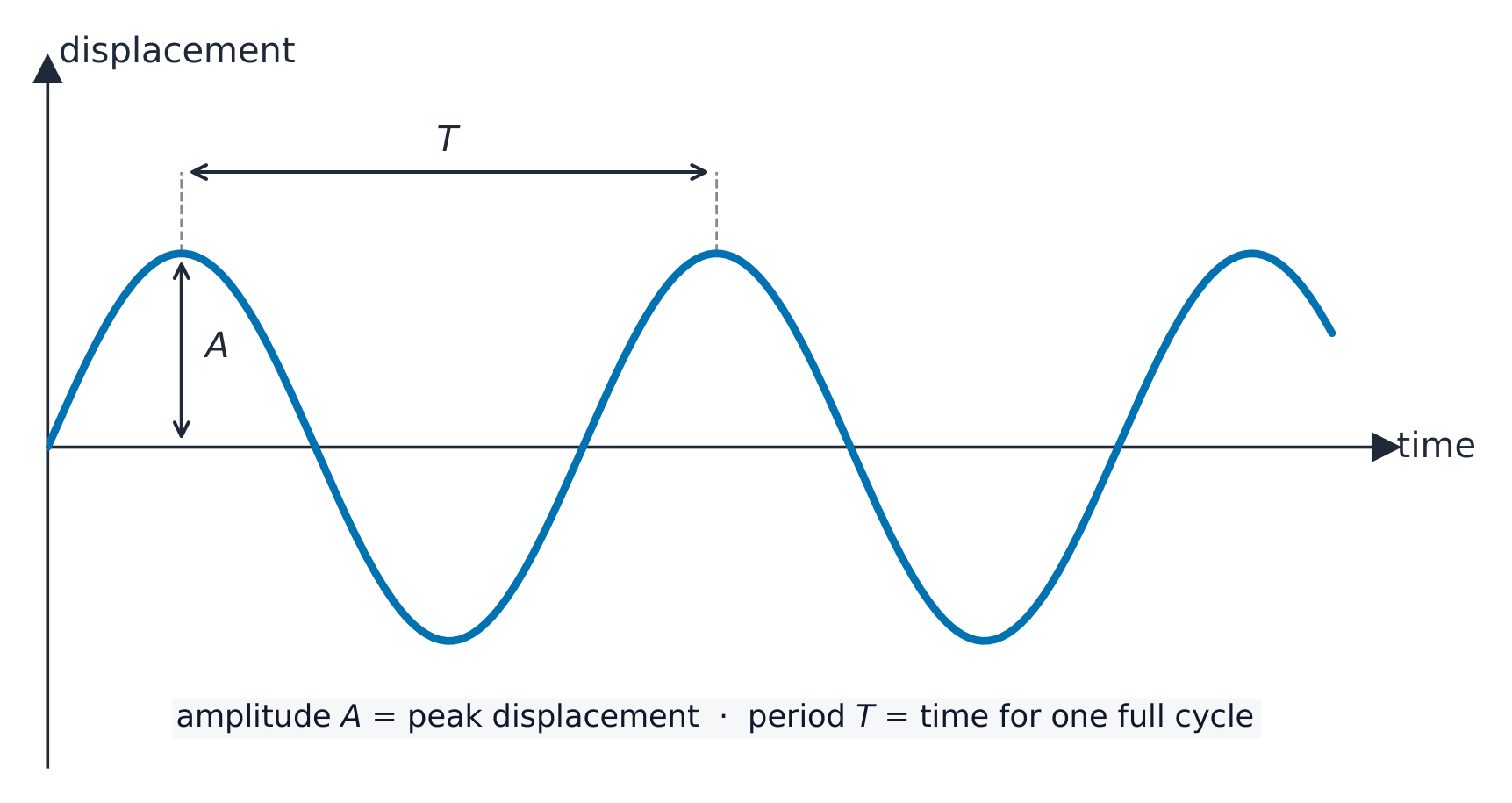
The two-mark comparison, with reference to the direction of energy transfer: in a transverse wave the oscillations are perpendicular to the direction of energy transfer; in a longitudinal wave they are parallel to it. Both kinds transfer energy without transferring matter, both can be reflected, refracted and diffracted, and both can form stationary waves (topic 8). Only transverse waves can be polarised, and only electromagnetic waves, which are all transverse, can travel through a vacuum; sound needs a medium. Reading the two graphs together: the displacement–distance graph gives $\lambda$, the displacement–time graph gives $T$, and $v = \lambda / T$.
Explore
Transverse waves
y = a sin(bx + c)
Change the amplitude and wavelength of the wave.
Vocabulary
Train
| English | Chinese | Pinyin |
|---|---|---|
| perpendicular | 垂直 | chuí zhí |
| compressions | 压缩 | yā suō |
| rarefactions | 稀疏 | xī shū |
| sine curve | 正弦曲线 | zhèng xián qū xiàn |
7.3
Doppler effect (moving source, stationary observer)

Syllabus
- understand that when a source of sound waves moves relative to a stationary observer, the observed frequency is different from the source frequency (understanding of the Doppler effect for a stationary source and a moving observer is not required)
- use the expression $f_{\text{o}} = f_{\text{s}} v / (v \pm v_{\text{s}})$ for the observed frequency when a source of sound waves moves relative to a stationary observer
Source: Cambridge International syllabus
When the source 波源 of a sound moves relative to a stationary 静止 observer 观察者, the heard frequency is different from the source frequency. This is the Doppler effect 多普勒效应.
- source moving towards the observer: the wavefronts in front are squashed, so the wavelength is shorter and the heard frequency is higher.
- source moving away from the observer: the wavefronts behind are spread out, so the wavelength is longer and the heard frequency is lower.
The formula (source moving at speed $v_{\text{s}}$ along the line to the observer; wave speed $v$, source frequency $f_{\text{s}}$, heard frequency $f_{\text{o}}$):
$$f_{\text{o}} = \frac{v \cdot f_{\text{s}}}{v \pm v_{\text{s}}}.$$
Choose the sign to match the physics:
- minus sign on the bottom when the source moves towards the observer ($f_{\text{o}} > f_{\text{s}}$),
- plus sign when the source moves away ($f_{\text{o}} < f_{\text{s}}$).
You only need the case of a stationary observer.
Worked example. A car horn at $f_{\text{s}} = 800\ \text{Hz}$ moves at $30\ \text{m s}^{-1}$ towards a still listener. Speed of sound $v = 340\ \text{m s}^{-1}$:
$$f_{\text{o}} = \frac{340 \times 800}{340 - 30} = \frac{272\,000}{310} \approx 877\ \text{Hz}.$$
Moving away at the same speed, the listener hears $340 \times 800 / (340 + 30) = 735\ \text{Hz}$: the frequency is constant while the car approaches, drops as it passes, and is constant again, lower, as it recedes. A sketch of observed frequency against time for a source passing at constant speed is two level lines joined by a fall. Working backwards, a source of $1200\ \text{Hz}$ heard as $960\ \text{Hz}$ is moving away ($f_{\text{o}} < f_{\text{s}}$): $960 = 1200 \times 340 / (340 + v_{\text{s}})$ gives $v_{\text{s}} = 85\ \text{m s}^{-1}$. A buzzer swung in a horizontal circle at $25\ \text{m s}^{-1}$ while emitting $846\ \text{Hz}$ is heard between $846 \times 330 / 355 = 786\ \text{Hz}$ (moving directly away) and $846 \times 330 / 305 = 915\ \text{Hz}$ (moving directly towards), once each per revolution. If the period of a CRO trace of the sound rises continuously, the observed frequency is falling: the source is moving away with increasing speed. The Doppler effect happens for all waves, light included (topic 25); only the sound formula is examined here.
Explore
Doppler effect
Send the source moving and watch the wavefronts bunch up ahead (higher pitch) and stretch out behind — the siren effect, controlled by the source's speed.
Vocabulary
Train
| English | Chinese | Pinyin |
|---|---|---|
| source | 波源 | bō yuán |
| stationary | 静止 | jìng zhǐ |
| observer | 观察者 | guān chá zhě |
| Doppler effect | 多普勒效应 | duō pǔ lè xiào yìng |
7.4
Electromagnetic spectrum

Syllabus
- state that all electromagnetic waves are transverse waves that travel with the same speed $c$ in free space
- recall the approximate range of wavelengths in free space of the principal regions of the electromagnetic spectrum from radio waves to $\gamma$-rays
- recall that wavelengths in the range 400–700 nm in free space are visible to the human eye
Source: Cambridge International syllabus
All electromagnetic waves 电磁波 (EM waves) are transverse and travel in a vacuum 真空 at the same speed:
$$c = 3.00 \times 10^{8}\ \text{m s}^{-1}.$$
The electromagnetic spectrum 电磁波谱 includes radio waves, microwaves 微波, infrared 红外线, visible light, ultraviolet 紫外线, X-rays X射线 and $\gamma$-rays γ射线.
Approximate wavelength ranges in free space (learn the orders of magnitude):
- radio waves: $> 10^{-1}\ \text{m}$ (up to many km).
- microwaves: $10^{-3}\ \text{m}$ to $10^{-1}\ \text{m}$.
- infrared: $\sim 7 \times 10^{-7}\ \text{m}$ to $10^{-3}\ \text{m}$.
- visible light: $400\ \text{nm}$ (violet) to $700\ \text{nm}$ (red), i.e. $4 \times 10^{-7}\ \text{m}$ to $7 \times 10^{-7}\ \text{m}$.
- ultraviolet: $\sim 10^{-8}\ \text{m}$ to $4 \times 10^{-7}\ \text{m}$.
- X-rays: $\sim 10^{-11}\ \text{m}$ to $10^{-8}\ \text{m}$.
- $\gamma$-rays: $< 10^{-11}\ \text{m}$.
The boundaries between regions are not sharp. Use $c = f\lambda$ to change between wavelength and frequency. Only light with wavelengths $400$–$700\ \text{nm}$ can be seen.
To identify a region, convert to a wavelength with $\lambda = c / f$ and compare with the ranges: $2.1\ \text{cm}$ is a microwave; $138\ \text{pm} = 1.4 \times 10^{-10}\ \text{m}$ is an X-ray; $30\ \text{THz}$ gives $\lambda = 1.0 \times 10^{-5}\ \text{m}$, infrared; $3.0 \times 10^{16}\ \text{Hz}$ gives $1.0 \times 10^{-8}\ \text{m}$, ultraviolet. Visible light spans frequencies of about $4.3 \times 10^{14}$ to $7.5 \times 10^{14}\ \text{Hz}$, so a wave of $5.0 \times 10^{14}\ \text{Hz}$ can be seen and one of wavelength $5.0 \times 10^{-6}\ \text{m}$ (infrared) cannot. Red light has a longer wavelength and a lower frequency than green. A list "in order of increasing wavelength" runs $\gamma$-rays, X-rays, ultraviolet, visible, infrared, microwaves, radio waves. A pulse of light reflected from a wall $150\ \text{m}$ away returns after $2 \times 150 / (3.00 \times 10^{8}) = 1.0\ \mu\text{s}$.
Explore
Slide across the spectrum
Radio waves, visible light and gamma rays are all the same wave — only the wavelength changes, and with it the frequency, photon energy and everyday use.
Vocabulary
Train
| English | Chinese | Pinyin |
|---|---|---|
| electromagnetic waves | 电磁波 | diàn cí bō |
| vacuum | 真空 | zhēn kōng |
| electromagnetic spectrum | 电磁波谱 | diàn cí bō pǔ |
| microwaves | 微波 | wēi bō |
| infrared | 红外线 | hóng wài xiàn |
| ultraviolet | 紫外线 | zǐ wài xiàn |
| X-rays | X射线 | X shè xiàn |
| γ-rays | γ射线 | γ shè xiàn |
7.5
Polarisation

Syllabus
- understand that polarisation is a phenomenon associated with transverse waves
- recall and use Malus’s law ($I = I_0 \cos^2\theta$) to calculate the intensity of a plane-polarised electromagnetic wave after transmission through a polarising filter or a series of polarising filters (calculation of the effect of a polarising filter on the intensity of an unpolarised wave is not required)
Source: Cambridge International syllabus
Polarisation 偏振 means making a transverse wave oscillate in one plane only.
- Only transverse waves can be polarised — the oscillation is perpendicular to the direction of travel, so different perpendicular planes are real choices.
- Longitudinal waves (sound) cannot be polarised — the oscillation is along the direction of travel, so there is no other plane.
So polarisation is a test: if a wave can be polarised, it must be transverse.

Malus's law
Plane-polarised 平面偏振 light of intensity $I_{0}$ passes through a polarising filter 偏振片 whose transmission axis 透光轴 is at angle $\theta$ to the plane of polarisation. The transmitted intensity is given by Malus's law 马吕斯定律:
$$I = I_{0} \cos^{2}\theta.$$
- $\theta = 0°$: filter lined up with the polarisation, $I = I_{0}$, all passes through.
- $\theta = 90°$: filter at right angles, $I = 0$, all blocked.
- $\theta = 60°$: $I = I_{0} \cos^{2} 60° = I_{0} \cdot 0.25 = I_{0}/4$.
Worked example. Plane-polarised light of intensity $12\ \text{W m}^{-2}$ meets a polarising filter whose axis is at $30°$ to the plane of polarisation. Find the transmitted intensity.
$$I = I_{0}\cos^{2}\theta = 12 \times \cos^{2} 30° = 12 \times 0.75 = 9.0\ \text{W m}^{-2}.$$

For two filters in a row, use Malus's law twice with the angle between each pair. Be careful with the angle each time — after the first filter the polarisation is along that filter's axis, and the second filter's angle is measured from there.
(You do not need to work out the effect of a polarising filter on an unpolarised wave.)
When a filter is rotated through $360°$ in front of plane-polarised light, the transmitted intensity varies as $\cos^{2}\theta$: it is a maximum when the transmission axis is parallel to the plane of polarisation ($0°$ and $180°$), zero when perpendicular ($90°$ and $270°$), and never negative. Because $I \propto A^{2}$, the transmitted amplitude is $A_{0}\cos\theta$: at $45°$ the intensity halves and the amplitude falls to $0.71$ of its value. For two filters, the first sets the plane of polarisation along its own axis, so the second filter's angle is measured from that: vertically polarised light through filters at $50°$ and then $80°$ to the vertical keeps $\cos^{2} 50° \times \cos^{2} 30° = 0.31$ of its intensity. The one-mark definitions: polarisation is the oscillation of a transverse wave in a single plane, which contains the direction of travel; sound cannot be polarised because its oscillations are along the direction of travel, so there is no plane to select.
Explore
Polarisation intensity lab
intensity changes with polariser angle
Rotate a polariser and see why only transverse waves can be polarised.
Vocabulary
Train
| English | Chinese | Pinyin |
|---|---|---|
| Polarisation | 偏振 | piān zhèn |
| Plane-polarised | 平面偏振 | píng miàn piān zhèn |
| polarising filter | 偏振片 | piān zhèn piàn |
| transmission axis | 透光轴 | tòu guāng zhóu |
| Malus's law | 马吕斯定律 | mǎ lǚ sī dìng lǜ |
7.5
Definitions the examiner accepts
A definition question is marked against fixed wording. Learn these exactly, and give one answer only.
| Term | Definition |
|---|---|
| progressive wave | a wave that transfers energy from one place to another without transferring matter |
| transverse wave | a wave whose oscillations are perpendicular to the direction of energy transfer |
| longitudinal wave | a wave whose oscillations are parallel to the direction of energy transfer |
| displacement | the distance of a particle from its equilibrium (rest) position, in a stated direction |
| amplitude | the maximum displacement of a particle from its equilibrium position |
| wavelength | the minimum distance between two points on the wave that are in phase (for example, adjacent crests) |
| period | the time for one complete oscillation of a particle (or for the wave to travel one wavelength) |
| frequency | the number of oscillations per unit time (or the number of wavefronts passing a point per unit time) |
| phase difference | the fraction of a cycle, as an angle, by which one oscillation leads or lags another |
| intensity | the power per unit area, at right angles to the direction of travel |
| Doppler effect | the change in the observed frequency of a wave when the source moves relative to the observer |
| polarisation | the oscillations of a transverse wave are in one plane only, containing the direction of travel |
| time-base | the time represented by one division across the screen of a CRO |
7.5
Exam tips
- Define terms precisely (displacement, amplitude, wavelength, period, frequency) and use $v = f\lambda$.
- Distinguish transverse (vibration perpendicular to travel) from longitudinal (parallel); only transverse waves can be polarised.
- For the Doppler effect, the observed frequency rises as the source approaches and falls as it recedes.
- Learn the electromagnetic spectrum order; all its waves travel at $c$ in a vacuum.
Common mistakes
- A phase difference bigger than one cycle, or degrees where radians were asked. Only the fraction of a cycle matters: $450°$ is $90°$, and $90°$ is $\pi/2$.
- Reading the wavelength from a displacement–time graph. That graph gives the period; the wavelength comes from the displacement–distance graph.
- Doubling the amplitude and "doubling" the intensity. Intensity goes as the amplitude squared: four times.
- Choosing the Doppler sign by feel. Towards means minus on the bottom (frequency up); away means plus (frequency down). Check that the answer lies on the right side of $f_{\text{s}}$.
- Using the first filter's angle for the second. After a filter the light is polarised along that filter's axis, and the next angle is measured from there.
- Saying that sound can be polarised. Only transverse waves can.
Interactive lessons on this topic
Work through it step by step, with instant-check exercises.