Polarisation
| English | Chinese | Pinyin |
|---|---|---|
| polarisation | 偏振 | piān zhèn |
| transverse | 横波 | héng bō |
| polarising filter | 偏振片 | piān zhèn piàn |
| transmission axis | 透光轴 | tòu guāng zhóu |
| longitudinal | 纵波 | zòng bō |
| unpolarised | 非偏振 | fēi piān zhèn |
| Malus's law | 马吕斯定律 | mǎ lǚ sī dìng lǜ |
| intensity | 强度 | qiáng dù |
Sunglasses that cut glare
- Polarising sunglasses block the glare off water and roads.
- Rotate them and the brightness changes — even though the scene hasn't.
- They work by letting light through in just one plane.
Polarisation intensity lab
intensity changes with polariser angle
Rotate a polariser and see why only transverse waves can be polarised.
What polarisation 偏振 is
- Polarisation means making a transverse 横波 wave vibrate in one plane only.
- A polarising filter 偏振片 passes the part lined up with its transmission axis 透光轴 and blocks the rest.
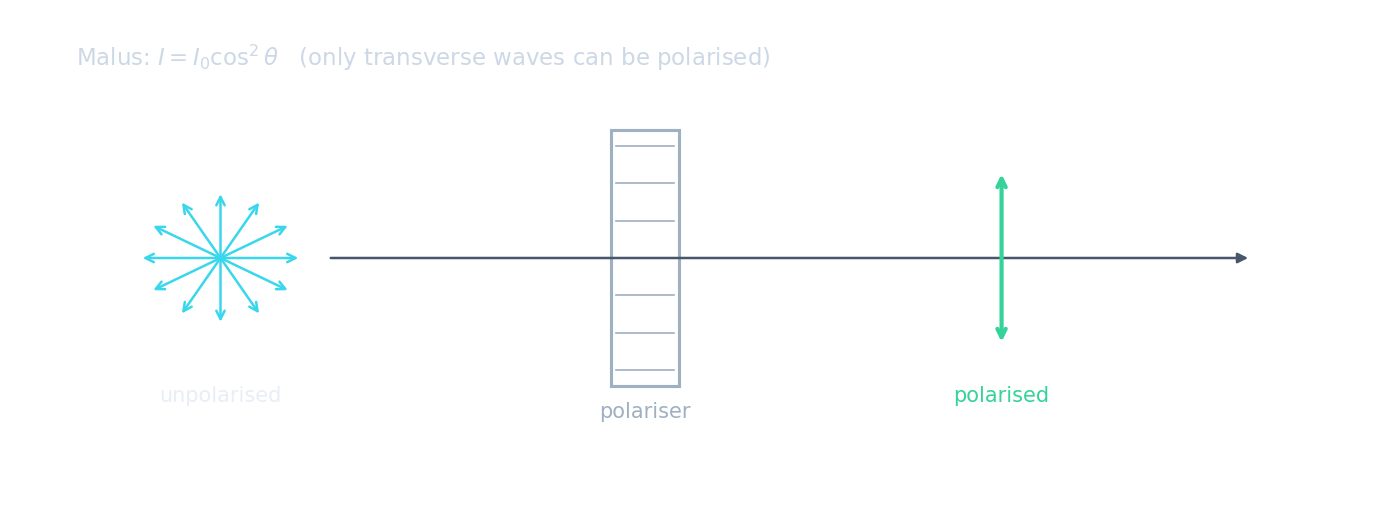
Polarising a transverse wave means making it vibrate:
A polarising filter passes only the vibration lined up with its axis, leaving the wave in a single plane.
Only transverse waves
- A transverse wave has many planes to choose from, so it can be polarised.
- A longitudinal 纵波 wave (sound) vibrates along the travel — there is no other plane, so it cannot.
- So: if a wave can be polarised, it must be transverse.

Unpolarised waves vibrate in many planes; a polarised wave vibrates in one plane
Sound waves can be polarised.
No — sound is longitudinal (it vibrates along the travel), so there is no other plane to pick out.
If a wave can be polarised, it must be ____.
Only transverse waves have vibration directions perpendicular to travel, so only they can be polarised.
The exam sentence for "why not sound?"
- Two marks, two ideas: sound is longitudinal, so its vibrations are parallel to the direction of energy transfer.
- There is only one possible direction of vibration, so there is no plane for a filter to select.
- Light is transverse, so its vibrations can be in any plane perpendicular to the travel — a filter can pick one.
Malus's law 马吕斯定律
- Through a filter at angle $\theta$ to the polarisation: $I = I_0\cos^{2}\theta$.
- $\theta = 0^{\circ}$: all passes. $\theta = 90^{\circ}$: all blocked.

Crossed filters (a) block the light; parallel filters (b) let it pass
Polarised light of intensity $100\ \dfrac{\text{W}}{\text{m}^2}$ meets a filter at $60^{\circ}$ to its plane. What intensity gets through?
$I = I_0\cos^{2}\theta = 100 \times \cos^{2}60^{\circ} = 100 \times 0.25 = 25\ \dfrac{\text{W}}{\text{m}^2}$.
Worked example: one filter
- Polarised light of intensity 强度 $I_0$ meets a filter at $\theta = 60^{\circ}$.
- $I = I_0\cos^{2}60^{\circ} = I_0 \times (0.5)^{2} = \dfrac{I_0}{4}$.
- Amplitude: intensity goes with amplitude squared, so the amplitude ratio is the square root: $\dfrac{A}{A_0} = \cos 60^{\circ} = 0.50$.
- Two crossed filters ($90^{\circ}$) let through nothing at all.
Two polarising filters are crossed at $90^{\circ}$. How much light gets through?
$I = I_0\cos^{2}90^{\circ} = 0$ — crossed filters block the light completely.
Polarised light passes through a filter whose axis is at $60^{\circ}$ to its plane of polarisation. What is the ratio of the transmitted amplitude to the incident amplitude?
$\dfrac{I}{I_0} = \cos^{2}60^{\circ} = 0.25$, and $I \propto A^{2}$, so $\dfrac{A}{A_0} = \sqrt{0.25} = \cos 60^{\circ} = 0.50$.
A third filter in the middle
- Two crossed filters block everything. Slide a third filter between them at $45^{\circ}$ and light gets through again.
- The middle filter passes $\cos^{2}45^{\circ} = \dfrac{1}{2}$ of the light and turns its plane to $45^{\circ}$.
- The last filter is now only $45^{\circ}$ from that new plane, so it passes another half.
- Each filter works on the light as it arrives, not on the original beam.
Worked example: three filters
Unpolarised 非偏振 light of intensity $I_0$ passes through three filters: the first with a vertical axis, the second at $45^{\circ}$, the third horizontal. Find the final intensity.
- First filter: unpolarised light contains every plane equally, so a single filter passes half: $\dfrac{I_0}{2}$, now vertically polarised.
- Second filter at $45^{\circ}$ to vertical: $\dfrac{I_0}{2}\cos^{2}45^{\circ} = \dfrac{I_0}{4}$, now polarised at $45^{\circ}$.
- Third filter at $45^{\circ}$ to that: $\dfrac{I_0}{4}\cos^{2}45^{\circ} = \dfrac{I_0}{8}$.
- Check: remove the middle filter and the first and third are crossed — $\cos^{2}90^{\circ} = 0$, nothing passes. Adding a filter increased the light; that is the surprise the examiner is testing.
Vertically polarised light of intensity $I_0$ passes through a filter at $45^{\circ}$ and then a horizontal filter. What fraction of $I_0$ comes out?
After the $45^{\circ}$ filter: $I_0\cos^{2}45^{\circ} = \dfrac{I_0}{2}$, now polarised at $45^{\circ}$. The horizontal filter is $45^{\circ}$ from that: $\dfrac{I_0}{2} \times \dfrac{1}{2} = \dfrac{I_0}{4}$.
$\theta$ is the angle between the light's plane of polarisation and the filter's transmission axis — not the angle you rotated the filter through, unless it started aligned. Rotating a filter through a full $360^{\circ}$ gives two maxima and two minima. And unpolarised light through one filter always comes out at half the intensity, whatever the filter's angle.
Unpolarised light passes through a single polarising filter. Rotating the filter changes the intensity that comes out.
Unpolarised light has every plane equally, so one filter always passes half of it — the angle makes no difference. Malus's law only applies to light that is already polarised.
You've got it
- polarisation = vibrating in one plane; only transverse waves can do it (sound cannot: its vibrations are parallel to the energy transfer)
- Malus's law: $I = I_0\cos^{2}\theta$; amplitude ratio $= \cos\theta$; crossed filters block all light
- filters act one after another on the light as it arrives — a middle filter lets light through crossed ones