- understand that the weight of an object may be taken as acting at a single point known as its centre of gravity
- define and apply the moment of a force
- understand that a couple is a pair of forces that acts to produce rotation only
- define and apply the torque of a couple
Forces, density and pressure
A-Level Physics · Topic 4
4.1
Turning effects of forces

Syllabus
Source: Cambridge International syllabus
Centre of gravity
The weight 重力 of a large object can be treated as acting at one single point, called the centre of gravity 重心 (the same as the centre of mass 质心 in a uniform gravitational field). For a uniform, regular shape — a rectangle, a sphere, a uniform rod — the centre of gravity is at the middle.
When you draw a free-body diagram 受力图, always put the weight arrow at the centre of gravity.
For an irregular shape, find the centre of gravity by experiment. Hang the object freely from a pin: in equilibrium it settles with its centre of gravity vertically below the pin, because only then does the weight have no moment about the pin. A plumb line 铅垂线 hung from the same pin marks that vertical. Hang the object from a second point and draw the second line; the centre of gravity is where the two lines cross. The same fact answers the exam's "explain why the sheet hangs like this": its centre of gravity is directly below the support, so the weight's line of action passes through the pivot and there is no resultant torque.
For a non-uniform 非均匀 bar, the centre of gravity is not at the middle. Find it by balancing the bar on a pivot, or by taking moments: if the bar's weight $W$ balances a known weight, the distance of its centre of gravity from the pivot is the one moment that makes the two sides equal.
Moment of a force
The moment 力矩 of a force about a point is
$$M = F \cdot d,$$
where $F$ is the size of the force 力 and $d$ is the perpendicular distance 垂直距离 from the point to the line of action 作用线 of the force. Unit: $\text{N m}$.
If the force acts at angle $\theta$ to a lever arm 力臂 of length $r$ from the pivot 支点, then $d = r\sin\theta$, so $M = F r\sin\theta$. Only the part of the force perpendicular 垂直 to the lever arm makes it turn.
Worked example. A force of $50\ \text{N}$ is applied to the end of a spanner $0.40\ \text{m}$ long, at $30°$ to the spanner. Find the moment of the force about the nut.
$$M = F r\sin\theta = 50 \times 0.40 \times \sin 30° = 50 \times 0.40 \times 0.50 = 10\ \text{N m}.$$

A moment is either clockwise 顺时针 or anticlockwise 逆时针 about the chosen point.
Couple and torque
A couple 力偶 is a pair of forces that are:
- equal in size,
- opposite in direction,
- with their lines of action a perpendicular distance apart.
A couple makes the body turn only — its resultant force is zero, so it gives no straight-line acceleration.
The torque 力偶矩 of a couple is the turning effect it makes:
$$\tau = F \cdot d,$$
where $F$ is the size of one force and $d$ is the perpendicular distance between the two lines of action. Unit: $\text{N m}$. The torque is the same about any point — a special property of couples.

A common multiple-choice trap: two equal forces in the same direction are not a couple (they have a resultant force and cause translation 平动). A couple needs equal size and opposite direction.
Watch the distance in the formula. For a couple of two forces $F$ each acting a distance $d$ from a central pivot, on opposite sides, the perpendicular distance between the two lines of action is $2d$, so the torque is $F \times 2d = 2Fd$. Taking moments about the pivot gives the same answer, $Fd + Fd$. The two-mark definition wants both parts: the product of one of the forces and the perpendicular distance between the lines of action of the forces.
Explore
Balance the see-saw
Put a weight on each side and slide it in or out. A small weight far from the pivot can balance a big weight close in — the beam is level when force × distance matches on both sides.
Vocabulary
Train
| English | Chinese | Pinyin |
|---|---|---|
| weight | 重力 | zhòng lì |
| centre of gravity | 重心 | zhòng xīn |
| centre of mass | 质心 | zhì xīn |
| free-body diagram | 受力图 | shòu lì tú |
| plumb line | 铅垂线 | qiān chuí xiàn |
| non-uniform | 非均匀 | fēi jūn yún |
| moment | 力矩 | lì jǔ |
| force | 力 | lì |
| perpendicular distance | 垂直距离 | chuí zhí jù lí |
| line of action | 作用线 | zuò yòng xiàn |
| lever arm | 力臂 | lì bì |
| pivot | 支点 | zhī diǎn |
| perpendicular | 垂直 | chuí zhí |
| clockwise | 顺时针 | shùn shí zhēn |
| anticlockwise | 逆时针 | nì shí zhēn |
| couple | 力偶 | lì ǒu |
| torque | 力偶矩 | lì ǒu jǔ |
| translation | 平动 | píng dòng |
4.2
Equilibrium of forces

Syllabus
- state and apply the principle of moments
- understand that, when there is no resultant force and no resultant torque, a system is in equilibrium
- use a vector triangle to represent coplanar forces in equilibrium
Source: Cambridge International syllabus
Conditions for equilibrium
A body is in equilibrium 平衡 when:
- the resultant force 合力 is zero (no straight-line acceleration), AND
- the resultant moment about any point is zero (no angular acceleration 角加速度).
Both must hold. A body with no resultant force can still be turning; a body with no resultant moment can still be moving in a straight line.
The classic multiple-choice case: four forces, two equal pairs pointing in opposite directions but not along the same lines. The resultant force is zero, so the centre of mass does not accelerate, but the pairs form couples with a resultant torque, so the object spins faster and faster while its centre of mass moves at constant velocity. Only when both conditions hold is the body in equilibrium.
Principle of moments
For a body that is not turning, the total clockwise moment about any point equals the total anticlockwise moment about the same point. This is the principle of moments 力矩原理.
To solve a balance problem:
- Choose a pivot — usually where an unknown force acts, so that force drops out (its distance is zero).
- List every force and its perpendicular distance from the pivot.
- Set $\sum M_{\text{clockwise}} = \sum M_{\text{anticlockwise}}$.
- Use $\sum F = 0$ if you need a second equation.
A ruler balanced on a pivot with masses on each side is solved this way. For a heavy uniform rod, remember to include its weight acting at its centre of gravity. Stated for the marks: for a body in equilibrium, the sum of the clockwise moments about any point equals the sum of the anticlockwise moments about that same point.
Worked example. A uniform beam of length $4.0\ \text{m}$ is pivoted at its centre. A $40\ \text{N}$ weight hangs $1.5\ \text{m}$ from the pivot on one side. How far from the pivot, on the other side, must a $30\ \text{N}$ weight hang to balance the beam?
The beam's own weight acts at the centre (the pivot), so it has no moment. Setting clockwise $=$ anticlockwise moments:
$$40 \times 1.5 = 30 \times d \quad\Rightarrow\quad d = \frac{60}{30} = 2.0\ \text{m}.$$

Worked example. A uniform rod of length $L$ and weight $W = 28\ \text{N}$ is hinged to a wall at one end and held horizontal by a wire from its other end. The wire makes $40°$ with the rod. Find the tension $T$ in the wire.

Take moments about the hinge, so the unknown hinge force drops out. The weight acts at the centre, a distance $L/2$ from the hinge: its moment is $W \times L/2$, clockwise. The tension acts at the end, but not at right angles to the rod, so its moment is $T\sin 40° \times L$, anticlockwise (only the component of $T$ perpendicular to the rod turns it). Equate them:
$$T \sin 40° \times L = W \times \frac{L}{2} \quad\Rightarrow\quad T = \frac{28}{2 \sin 40°} = 22\ \text{N}.$$
The length $L$ cancels, which is why the question need not give it. If a load hangs from the rod as well, add its moment on the clockwise side. This is the shape of almost every moments question: choose the pivot where the unknown force acts, use the perpendicular component of any angled force, and let unknown lengths cancel.
Worked example. A uniform beam of weight $200\ \text{N}$ and length $9.0\ \text{m}$ rests on two supports, X at $1.0\ \text{m}$ from the left end and Y at $6.5\ \text{m}$. A person of weight $700\ \text{N}$ stands $1.7\ \text{m}$ from Y, beyond it. Find the force from each support.

Two unknown forces, $R_{\text{X}}$ and $R_{\text{Y}}$, so take moments about X to remove $R_{\text{X}}$. The beam's weight acts at its centre, $3.5\ \text{m}$ from X; Y is $5.5\ \text{m}$ from X; the person is $7.2\ \text{m}$ from X:
$$R_{\text{Y}} \times 5.5 = 200 \times 3.5 + 700 \times 7.2 \quad\Rightarrow\quad R_{\text{Y}} = \frac{700 + 5040}{5.5} = 1040\ \text{N}.$$
Then the resultant force is zero: $R_{\text{X}} + R_{\text{Y}} = 200 + 700$, so $R_{\text{X}} = 900 - 1040 = -140\ \text{N}$. A negative answer means the beam would lift off X: with the person that far past Y, X must hold the beam down, not up. Questions often ask where a person can stand before the beam tips; that is the position at which $R_{\text{X}}$ becomes zero.
Vector triangle
Three forces in the same plane that are in equilibrium can be drawn as a closed vector triangle 矢量三角形 — drawn tip-to-tail, the three arrows come back to the start. This is a drawing method instead of splitting into components 分量.

Use the sine rule 正弦定理 or the cosine rule 余弦定理 on the triangle to find unknown sizes or directions, or draw the triangle to scale on graph paper.
You can also split each force into horizontal 水平 and vertical 竖直 components and set $\sum F_{x} = 0$ and $\sum F_{y} = 0$.
To draw the triangle for the marks: draw the weight first (vertical, to scale), then add the other two forces tip to tail in their real directions, so the third arrow closes the triangle; label every side with its force and mark the angles. For a block resting on a slope the three forces are the weight (vertical), the normal contact force (perpendicular to the slope) and friction (along the slope), so the triangle is right-angled with the weight as the hypotenuse. For a picture hanging from a string over a pin, the two equal tensions make an isosceles triangle with the weight. The test of any answer is that the triangle closes; if it does not, the object is not in equilibrium.
Worked example. A pulley of negligible weight is held by a spring. A single cable passes under the pulley, and each side of the cable makes $30°$ with the vertical. The tension in the cable is $T = 60\ \text{N}$. Find the force from the spring and the extension of the spring, given its spring constant is $2000\ \text{N m}^{-1}$.

Because it is one continuous cable, the tension is the same on both sides. The two tensions pull down and outwards; their horizontal components cancel and their vertical components add, so the spring must pull up with $F = 2T\cos 30° = 2 \times 60 \times 0.866 = 104\ \text{N}$. From Hooke's law (topic 6), $x = F / k = 104 / 2000 = 0.052\ \text{m}$. If the angle to the vertical grows, $\cos\theta$ falls, so the spring force and extension fall: the cable is pulling more sideways and less upwards.
Explore
Forces in equilibrium
When forces are balanced the resultant is zero — the vectors form a closed loop. Drag the arrows to keep them cancelling.
Vocabulary
Train
| English | Chinese | Pinyin |
|---|---|---|
| equilibrium | 平衡 | píng héng |
| resultant force | 合力 | hé lì |
| angular acceleration | 角加速度 | jiǎo jiā sù dù |
| principle of moments | 力矩原理 | lì jǔ yuán lǐ |
| closed vector triangle | 矢量三角形 | shǐ liàng sān jiǎo xíng |
| components | 分量 | fèn liàng |
| sine rule | 正弦定理 | zhèng xián dìng lǐ |
| cosine rule | 余弦定理 | yú xián dìng lǐ |
| horizontal | 水平 | shuǐ píng |
| vertical | 竖直 | shù zhí |
| vector triangle | 矢量三角形 | shǐ liàng sān jiǎo xíng |
4.3
Density

Syllabus
- define and use density
- define and use pressure
- derive, from the definitions of pressure and density, the equation for hydrostatic pressure $\Delta p = \rho g \Delta h$
- use the equation $\Delta p = \rho g \Delta h$
- understand that the upthrust acting on an object in a fluid is due to a difference in hydrostatic pressure
- calculate the upthrust acting on an object in a fluid using the equation $F = \rho g V$ (Archimedes' principle)
Source: Cambridge International syllabus
Density 密度 is the mass per unit volume:
$$\rho = \frac{m}{V}.$$
Unit: $\text{kg m}^{-3}$ (or $\text{g cm}^{-3}$; $1\ \text{g cm}^{-3} = 1000\ \text{kg m}^{-3}$). Density is a scalar 标量.
Some useful densities to know:
- water: $1000\ \text{kg m}^{-3}$
- air at room conditions: $\sim 1.2\ \text{kg m}^{-3}$
- iron / steel: $\sim 7800\ \text{kg m}^{-3}$
Measuring density is a practical question in disguise. For a cuboid, measure the mass on a balance and the three side lengths with a rule or calipers, then $\rho = m / (xyz)$. Because density is a product and quotient, the percentage uncertainty in $\rho$ is the sum of the percentage uncertainties in $m$, $x$, $y$ and $z$ (topic 1). A zero error on the balance, or a rule whose end is worn, is a systematic error; repeating the readings does not remove it, but subtracting the zero reading does.
Worked example. A block has mass $(120 \pm 1)\ \text{g}$ and sides $(4.0 \pm 0.1)\ \text{cm}$, $(3.0 \pm 0.1)\ \text{cm}$ and $(2.0 \pm 0.1)\ \text{cm}$. Find its density and the percentage uncertainty.
$\rho = 120 / (4.0 \times 3.0 \times 2.0) = 5.0\ \text{g cm}^{-3} = 5000\ \text{kg m}^{-3}$. The percentage uncertainties are $0.8\%$, $2.5\%$, $3.3\%$ and $5.0\%$, so the density is uncertain by $12\%$, about $\pm 600\ \text{kg m}^{-3}$. The shortest side contributes most, which is why a question asks which measurement to improve first.
Vocabulary
Train
| English | Chinese | Pinyin |
|---|---|---|
| Density | 密度 | mì dù |
| scalar | 标量 | biāo liàng |
4.3
Pressure

Pressure 压强 is the force per unit area, where the force acts at right angles to the surface:
$$p = \frac{F}{A}.$$
Unit: $\text{Pa} = \text{N m}^{-2}$. Pressure is a scalar.
The force is the one pressing at right angles to the surface, and the area is the area of contact. A tree trunk of weight $9.0\ \text{kN}$ standing on a post of diameter $0.28\ \text{m}$ presses with $p = F / A = 9000 / (\pi \times 0.14^{2}) = 1.5 \times 10^{5}\ \text{Pa}$; the same weight on a wider post gives a smaller pressure. Convert diameters to radii, and centimetres to metres, before squaring.
Hydrostatic pressure
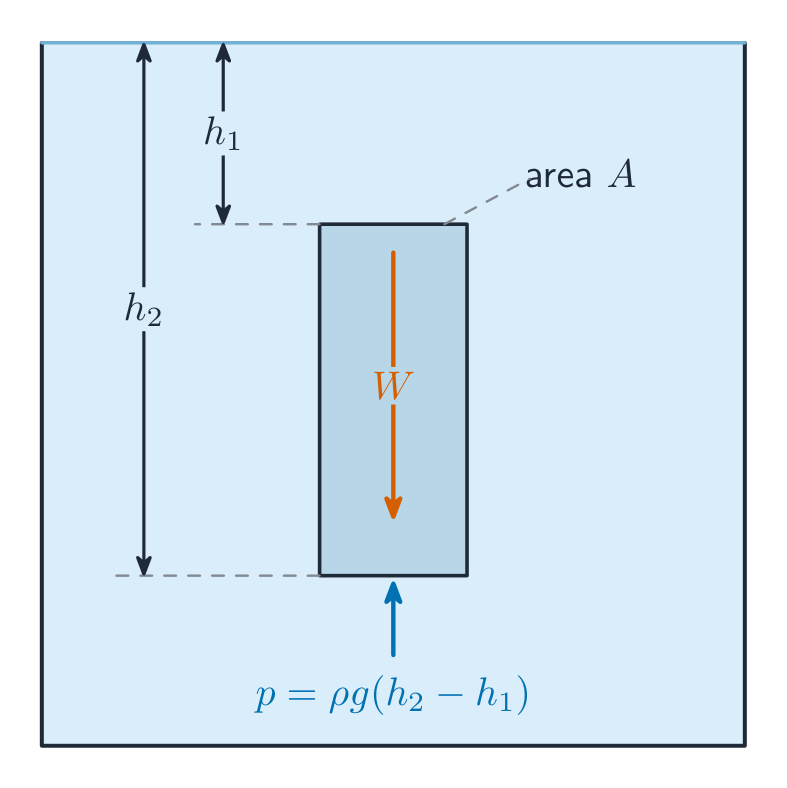
Take a column of fluid 流体 with density $\rho$, cross-sectional area 横截面积 $A$ and height $\Delta h$. Its weight is
$$W = m g = (\rho \cdot A \cdot \Delta h) \cdot g.$$
This weight presses down on the area $A$ at the bottom, so the extra pressure at the bottom compared with the top is
$$\Delta p = \frac{W}{A} = \rho g \Delta h.$$
This is the hydrostatic pressure 流体静压强 equation. It depends only on the density of the fluid and the depth 深度 — the shape of the container does not matter.
Worked example. Find the extra pressure due to the water at the bottom of a swimming pool $2.5\ \text{m}$ deep. (Water density $1000\ \text{kg m}^{-3}$, $g = 9.81\ \text{m s}^{-2}$.)
$$\Delta p = \rho g \Delta h = 1000 \times 9.81 \times 2.5 \approx 2.5 \times 10^{4}\ \text{Pa}.$$
For a submarine at depth $h$ below the surface, the pressure from the water is $\rho_{\text{seawater}}\, g\, h$. For the total pressure, add the atmospheric pressure 大气压强 at the surface (about $1.0 \times 10^{5}\ \text{Pa}$).
Upthrust and Archimedes' principle
When an object is submerged 浸没 in a fluid, the pressure at the bottom of the object is greater than the pressure at the top (by $\rho g \Delta h$, where $\Delta h$ is the object's height). This difference gives a net upward force called the upthrust 浮力.

For an object of volume $V$ (the volume of fluid displaced 排开), the upthrust is
$$F_{\text{upthrust}} = \rho_{\text{fluid}}\, g\, V.$$
This is Archimedes' principle 阿基米德原理: the upthrust on a body in a fluid equals the weight of the fluid it pushes aside.
Worked example. A metal block of volume $2.0 \times 10^{-3}\ \text{m}^{3}$ is fully submerged in water. Find the upthrust on it. (Water density $1000\ \text{kg m}^{-3}$, $g = 9.81\ \text{m s}^{-2}$.)
$$F_{\text{upthrust}} = \rho_{\text{fluid}}\, g\, V = 1000 \times 9.81 \times 2.0 \times 10^{-3} \approx 20\ \text{N}.$$
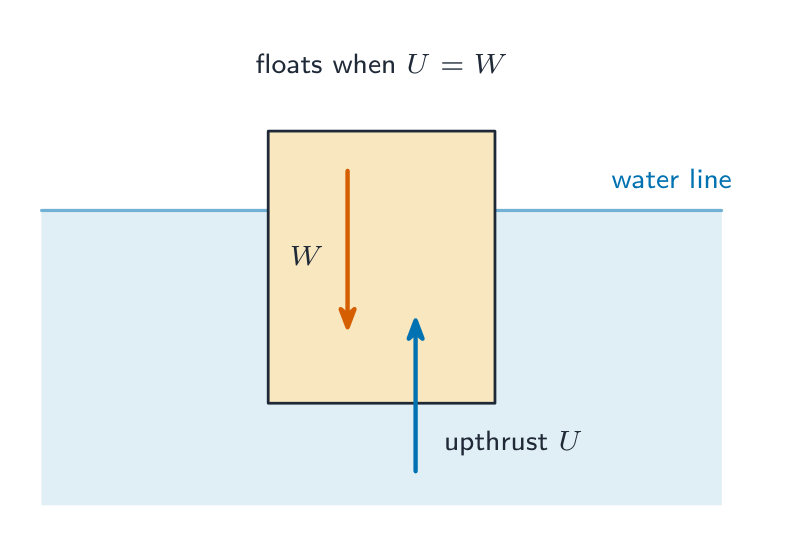
For a fully submerged object, $V$ is its full volume. For a floating 漂浮 object, $V$ is only the volume below the surface — the object floats when the upthrust on the part below the surface equals its weight.
Whether an object floats at all depends on densities: for a fully submerged object the ratio of upthrust to weight is $\rho_{\text{fluid}} V g / \rho_{\text{object}} V g = \rho_{\text{fluid}} / \rho_{\text{object}}$, so it floats if it is less dense than the fluid and sinks if it is denser. Halving the object's density doubles that ratio; changing its volume or the depth changes nothing.
Worked example. A cylinder of mass $11\ \text{kg}$ and diameter $0.78\ \text{m}$ floats upright in water of density $990\ \text{kg m}^{-3}$. Find the depth $y$ of its base below the surface.
Floating means upthrust $=$ weight. The submerged volume is the base area times the depth, $A y$, with $A = \pi \times 0.39^{2} = 0.478\ \text{m}^{2}$:
$$\rho g A y = m g \quad\Rightarrow\quad y = \frac{m}{\rho A} = \frac{11}{990 \times 0.478} = 0.023\ \text{m}.$$
Each extra newton of load on the cylinder needs an extra $1 / (\rho g A)$ of depth, so the depth rises in a straight line with the added weight, wherever on the cylinder it is placed.
Force balance with upthrust
A block held under water by a string tied to the bottom of the container is in equilibrium under three vertical forces: weight (down), tension 张力 (down), upthrust (up). Set $F_{\text{upthrust}} = W + T$ to find the tension.
A submerged block hanging from a newton meter 弹簧测力计 reads less than its weight in air, because of the upthrust: reading $= W - F_{\text{upthrust}}$.
Worked example. A cylinder of weight $25.0\ \text{N}$ hangs from a newton meter fully submerged in water, and the meter reads $10.0\ \text{N}$. Find the volume of the cylinder.
The upthrust is the missing $15.0\ \text{N}$, and upthrust $= \rho g V$, so $V = 15.0 / (1000 \times 9.81) = 1.53 \times 10^{-3}\ \text{m}^{3}$. The same method finds the density of the cylinder: $25.0 / (9.81 \times 1.53 \times 10^{-3}) = 1670\ \text{kg m}^{-3}$.
The upthrust depends on the fluid density and the displaced volume, not on the object's material or depth (for an incompressible 不可压缩 fluid). On a planet with smaller $g$, the upthrust is smaller in the same ratio as the weight, so a floating object still floats with the same fraction below the surface.
Explore
Pressure with depth
p = ρg·h
Pressure is proportional to depth — the gradient is ρg.
Vocabulary
Train
| English | Chinese | Pinyin |
|---|---|---|
| Pressure | 压强 | yā qiáng |
| fluid | 流体 | liú tǐ |
| cross-sectional area | 横截面积 | héng jié miàn jī |
| hydrostatic pressure | 流体静压强 | liú tǐ jìng yā qiáng |
| depth | 深度 | shēn dù |
| atmospheric pressure | 大气压强 | dà qì yā qiáng |
| submerged | 浸没 | jìn mò |
| upthrust | 浮力 | fú lì |
| displaced | 排开 | pái kāi |
| Archimedes' principle | 阿基米德原理 | ā jī mǐ dé yuán lǐ |
| floating | 漂浮 | piāo fú |
| tension | 张力 | zhāng lì |
| newton meter | 弹簧测力计 | tán huáng cè lì jì |
| incompressible | 不可压缩 | bù kě yā suō |
4.3
Definitions the examiner accepts
A definition question is marked against fixed wording. Learn these exactly, and give one answer only.
| Term | Definition |
|---|---|
| centre of gravity | the point at which the whole weight of an object may be considered to act |
| moment of a force | the product of the force and the perpendicular distance from the point to the line of action of the force |
| couple | a pair of equal and opposite forces whose lines of action do not coincide, which produces rotation only |
| torque of a couple | the product of one of the forces and the perpendicular distance between the lines of action of the forces |
| principle of moments | for a body in equilibrium, the sum of the clockwise moments about any point equals the sum of the anticlockwise moments about that point |
| equilibrium | the state of a body on which the resultant force and the resultant torque are both zero |
| density | mass per unit volume |
| pressure | force per unit area, where the force acts at right angles to the surface |
| upthrust | the upward force on a body in a fluid caused by the pressure being greater on its lower surface than on its upper surface |
| Archimedes' principle | the upthrust on a body in a fluid is equal to the weight of the fluid displaced by the body |
4.3
Exam tips
- Take moments about a chosen pivot; for equilibrium, total clockwise $=$ total anticlockwise moments and the resultant force is zero.
- A body in equilibrium under three forces gives a closed triangle of forces.
- Fluid pressure $= \rho g h$; upthrust $=$ weight of fluid displaced (Archimedes).
- Distinguish mass, weight and density, and give the base unit each time.
Common mistakes
- Resolving with $\cos\theta$ where the geometry needs $\sin\theta$. Draw the triangle and check which side the angle is next to before choosing.
- Substituting the weight of the object where the question is about the upthrust on it. Upthrust is the weight of the fluid displaced, $\rho_{\text{fluid}} V g$.
- Leaving out the weight of a uniform beam. It acts at the centre, and it has a moment about any pivot that is not at the centre.
- Using the distance along the rod for an angled force. The moment needs the perpendicular distance, or the perpendicular component of the force.
- Taking the torque of a couple as $Fd$ with $d$ measured from the pivot. The distance is between the two lines of action, so a symmetric couple gives $2Fd$.
Interactive lessons on this topic
Work through it step by step, with instant-check exercises.