Круговое движение
| English | Русский |
|---|---|
| centripetal acceleration/senˈtrɪpɪtl əkˌseləˈreɪʃn/ | центростремительное ускорение |
| angular speed/ˈæŋɡjʊlə spiːd/ | угловую скорость |
| linear speed/ˈlɪnɪə spiːd/ | линейную скорость |
| radian/ˈreɪdɪən/ | радиан |
| tangent/ˈtændʒənt/ | касательную |
| centripetal force/senˈtrɪpɪtl fɔːs/ | центробежная сила |
| conical pendulum/ˈkɒnɪkl ˈpendjʊləm/ | конический маятник |
| energy conservation/ˈenədʒi ˌkɒnsəˈveɪʃn/ | закон сохранения энергии |
| centrifugal/ˌsentrɪˈfjuːɡl/ | центробежная |
| inertia/ɪˈnɜːʃə/ | инерция |
Why you feel pushed out on a roundabout
- Whirl a ball on a string and it pulls outward — yet the force on the ball points inward.
- Anything moving in a circle is constantly accelerating toward the centre, even at steady speed, because its direction keeps changing.
Angular speed 角速度 and linear speed 线速度
- Angular speed $\omega$ (radians 弧度 per second) links to linear speed by:
- A point further from the centre (bigger $r$) moves faster for the same $\omega$.

In circular motion velocity is tangent 切线 and acceleration points to the centre
Угол в радианах
Круговое движение измеряется в радианах: перетащите угол θ и радиус r, чтобы увидеть пройденную дугу — угловая скорость ω преобразует это в линейную v = rω.
Частица движется по окружности радиусом 2 м с угловой скоростью 3 рад/с. Какова её линейная скорость v = rω (м/с)?
v = rω = 2 × 3 = 6 m/s.
Линейная скорость и угловая скорость связаны соотношением v = r ______.
v = rω.
Centripetal acceleration 向心加速度
- The acceleration points to the centre — centripetal acceleration:
- It is caused by a centripetal force 向心力 $F = ma$ (tension, friction, gravity, or a normal reaction).
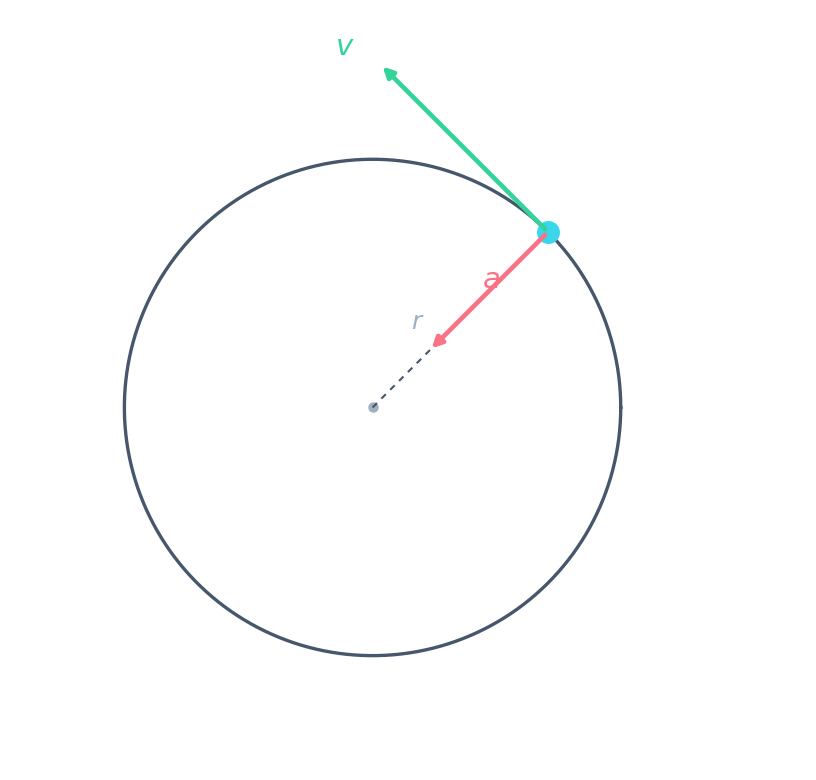
Velocity is tangent to the circle; the acceleration (and net force) point to the centre.
Для той же частицы (r = 2, ω = 3) каково центростремительное ускорение a = rω² (м/с²)?
a = rω² = 2 × 9 = 18 m/s².
Центростремительное ускорение частицы, движущейся по окружности, направлено:
Оно указывает к центру — именно так непрерывно меняется направление движения.
Скорость частицы, движущейся по окружности, направлена вдоль касательной к этой окружности.
Скорость всегда направлена по касательной; ускорение перпендикулярно ей и направлено к центру.
Worked example
- A particle moves in a circle of radius $2$ m at angular speed $3\ \tfrac{\text{rad}}{\text{s}}$.
- Speed $v = r\omega = 2 \times 3 = 6\ \tfrac{\text{m}}{\text{s}}$.
- Centripetal acceleration $a = r\omega^2 = 2 \times 3^2 = 18\ \tfrac{\text{m}}{\text{s}^2}$.
Horizontal vs vertical circles
- Horizontal circle (e.g. a conical pendulum 圆锥摆): speed is constant.
- Vertical circle: speed changes with height, so combine circular motion with energy conservation 能量守恒.
There is no outward "centrifugal 离心 force" on the particle. The real force is the inward (centripetal) one; the outward feeling is your body's inertia 惯性 resisting the change in direction.
- In circular motion the normal contact force or tension provides the centripetal force.
При движении по вертикальной окружности скорость не постоянна, поэтому также используется:
Поскольку высота изменяется, гравитационная потенциальная энергия ↔ кинетическая энергия: используйте закон сохранения энергии вместе с уравнениями кругового движения.
You've got it
- $v = r\omega$; centripetal acceleration $a = r\omega^2 = \dfrac{v^2}{r}$, directed to the centre
- a real inward centripetal force causes it ($F = ma$)
- horizontal circle → constant speed; vertical circle → use energy conservation