Skip to content · ⁨Перейти к содержанию⁩

Trigonometric and Polar Functions · ⁨Тригонометрические и полярные функции⁩

AP Precalculus · Topic 3 · ⁨Тема 3⁩

Video lesson for this topic · ⁨Видеоурок по этой теме⁩ Open the video page · ⁨Открыть страницу видео⁩
8:08

Тригонометрические и полярные функции

Наблюдайте, как точка движется по окружности с постоянной скоростью. Её высота то увеличивается, то уменьшается, повторяясь изо дня в день. Построив эту высоту по оси времени, вы получите…

English narration · English + 中文 subtitles burned in · ⁨Английское озвучивание · Английский + китайские субтитры (встроенные)⁩

3.1

Periodic Phenomena · ⁨Периодические явления⁩

Syllabus · ⁨Программа⁩
English

Learning Objective 3.1.A: Construct graphs of periodic relationships based on verbal representations.

  • 3.1.A.1 A periodic relationship can be identified between two aspects of a context if, as the input values increase, the output values demonstrate a repeating pattern over successive equal-length intervals.
  • 3.1.A.2 The graph of a periodic relationship can be constructed from the graph of a single cycle of the relationship.

Learning Objective 3.1.B: Describe key characteristics of a periodic function based on a verbal representation.

  • 3.1.B.1 The period of the function is the smallest positive value $k$ such that $f(x + k) = f(x)$ for all $x$ in the domain. Consequently, the behavior of a periodic function is completely determined by any interval of width $k$.
  • 3.1.B.2 The period can be estimated by investigating successive equal-length output values and finding where the pattern begins to repeat.
  • 3.1.B.3 Periodic functions take on characteristics of other functions, such as intervals of increase and decrease, different concavities, and various rates of change. However, with periodic functions, all characteristics found in one period of the function will be in every period of the function.
Русский

Цель обучения 3.1.A: Строить графики периодических зависимостей на основе словесных представлений.

  • 3.1.A.1 Периодическую зависимость можно установить между двумя аспектами контекста, если при увеличении входных значений выходные значения демонстрируют повторяющийся паттерн на последовательных интервалах одинаковой длины.
  • 3.1.A.2 График периодической зависимости может быть построен по графику одного цикла этой зависимости.

Цель обучения 3.1.B: Описывать ключевые характеристики периодической функции на основе словесного представления.

  • 3.1.B.1 Период функции — это наименьшее положительное значение $k$, такое что $f(x + k) = f(x)$ для всех $x$ из области определения. Следовательно, поведение периодической функции полностью определяется любым интервалом шириной $k$.
  • 3.1.B.2 Период можно оценить, исследуя последовательные выходные значения одинаковой длины и определяя, где паттерн начинает повторяться.
  • 3.1.B.3 Периодические функции принимают характеристики других функций, такие как интервалы возрастания и убывания, различная выпуклость и различные скорости изменения. Однако в случае с периодическими функциями все характеристики, найденные в одном периоде функции, будут присутствовать в каждом периоде этой функции.
Source: College Board AP Course and Exam Description · ⁨Источник: Описание курса и экзамена College Board AP⁩

English

A relationship is periodic 周期性 if its output pattern repeats at regular input steps. The period 周期 is the smallest positive $k$ with $f(x+k)=f(x)$ for all $x$. You can build the whole graph by copying a single cycle 周期段, and estimate the period by finding how far apart the pattern repeats. Within each cycle a periodic function still has intervals of increase/decrease and maxima/minima.

Русский
МКС на орбите: тригонометрические и полярные функции описывают периодическое и круговое движение

Зависимость является периодической, если её паттерн выхода повторяется через регулярные шаги входа. Период — это наименьшее положительное $k$, такое что $f(x+k)=f(x)$ для всех $x$. Вы можете построить весь график, копируя один цикл, и оценить период, определив расстояние между повторениями паттерна. Внутри каждого цикла периодическая функция всё еще имеет интервалы возрастания/убывания и максимумы/минимумы.

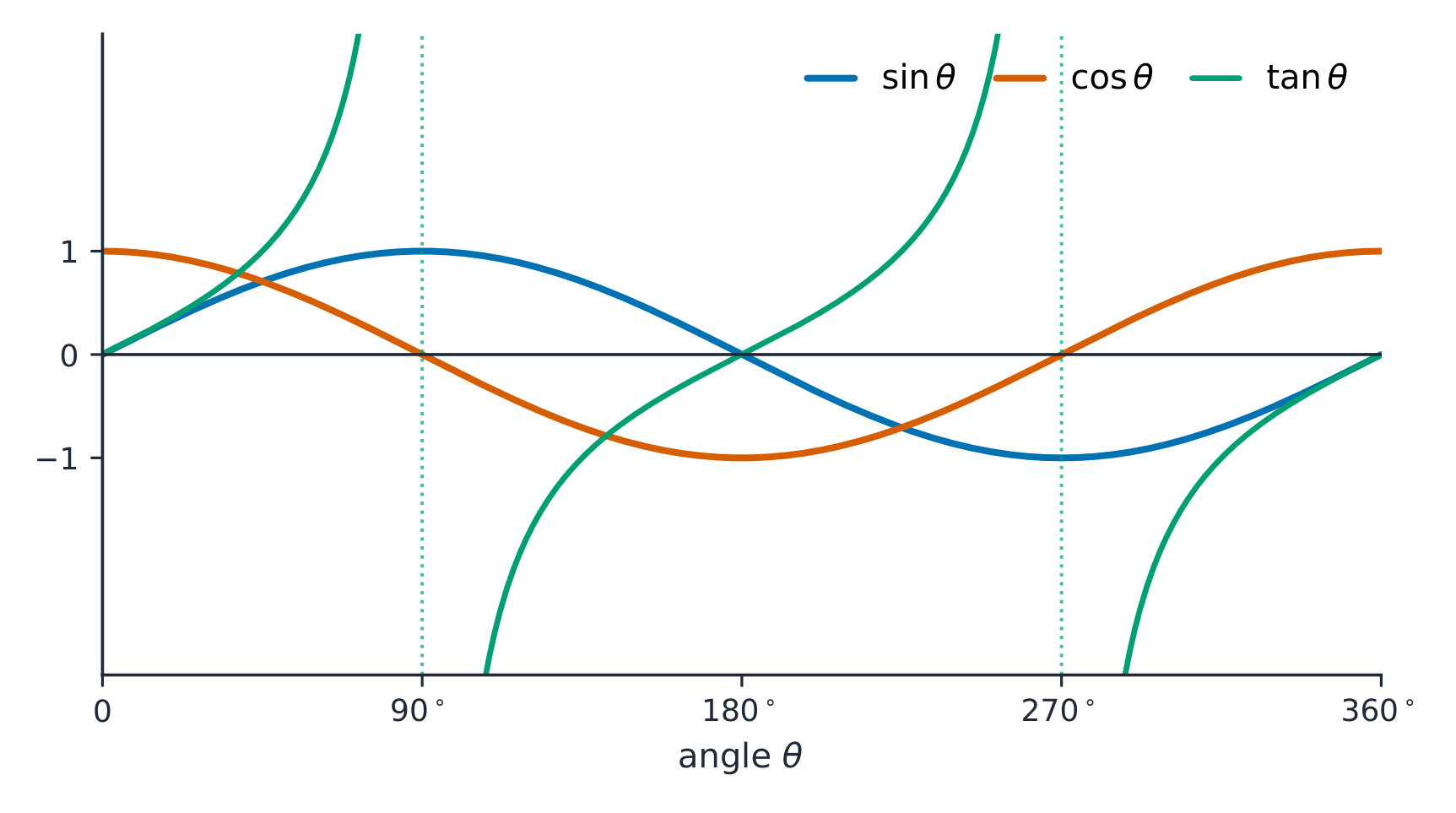
Волны sin и cos между -1 и 1; tan имеет разрывы при 90 и 270 градусах
Волны sin и cos колеблются между -1 и 1; tan разрывается при 90 и 270 градусах
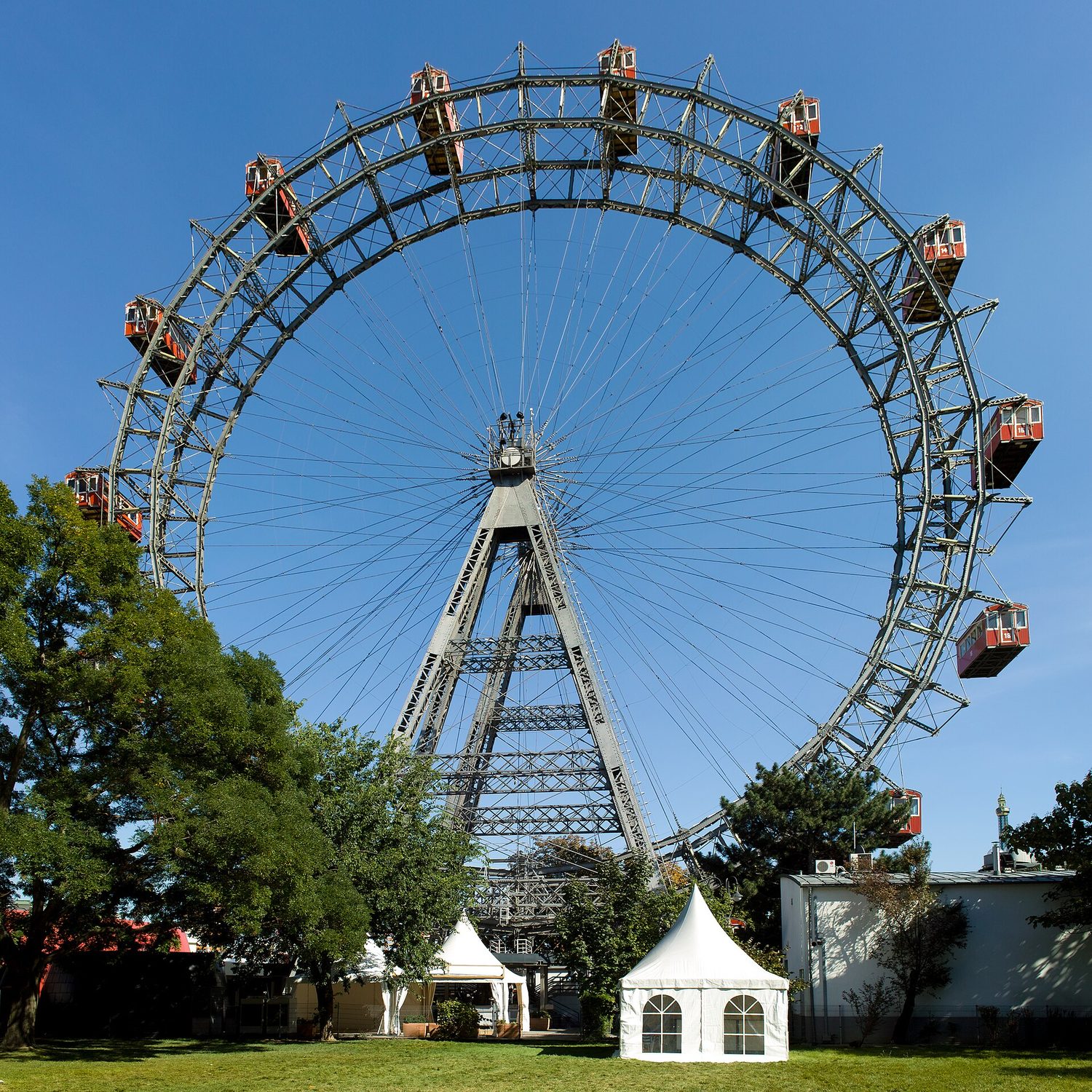
Венский гигантский колесо обозрения на фоне голубого неба
При равномерном вращении колеса вашего высота поднимается и опускается снова и снова — настоящая синусоида во времени
3.2

Sine, Cosine, and Tangent · ⁨Синус, косинус и тангенс⁩

Syllabus · ⁨Программа⁩
English

Learning Objective 3.2.A: Determine the sine, cosine, and tangent of an angle using the unit circle.

  • 3.2.A.1 In the coordinate plane, an angle is in standard position when the vertex coincides with the origin and one ray coincides with the positive $x$-axis. The other ray is called the terminal ray. Positive and negative angle measures indicate rotations from the positive $x$-axis in the counterclockwise and clockwise direction, respectively. Angles in standard position that share a terminal ray differ by an integer number of revolutions.
  • 3.2.A.2 The radian measure of an angle in standard position is the ratio of the length of the arc of a circle centered at the origin subtended by the angle to the radius of that same circle. For a unit circle, which has radius $1$, the radian measure is the same as the length of the subtended arc.
  • 3.2.A.3 Given an angle in standard position and a circle centered at the origin, there is a point, $P$, where the terminal ray intersects the circle. The sine of the angle is the ratio of the vertical displacement of $P$ from the $x$-axis to the distance between the origin and point $P$. Therefore, for a unit circle, the sine of the angle is the $y$-coordinate of point $P$.
  • 3.2.A.4 Given an angle in standard position and a circle centered at the origin, there is a point, $P$, where the terminal ray intersects the circle. The cosine of the angle is the ratio of the horizontal displacement of $P$ from the $y$-axis to the distance between the origin and point $P$. Therefore, for a unit circle, the cosine of the angle is the $x$-coordinate of point $P$.
  • 3.2.A.5 Given an angle in standard position, the tangent of the angle is the slope, if it exists, of the terminal ray. Because the slope of the terminal ray is the ratio of the vertical displacement to the horizontal displacement over any interval, the tangent of the angle is the ratio of the $y$-coordinate to the $x$-coordinate of the point at which the terminal ray intersects the unit circle; alternately, it is the ratio of the angle's sine to its cosine.
Русский

Цель обучения 3.2.A: Определять синус, косинус и тангенс угла, используя единичную окружность.

  • 3.2.A.1 На координатной плоскости угол находится в стандартном положении, когда его вершина совпадает с началом координат, а один луч совпадает с положительной $x$-осью. Другой луч называется конечным лучом. Положительные и отрицательные значения углов обозначают повороты от положительной $x$-оси против часовой стрелки и по часовой стрелке соответственно. Углы в стандартном положении, имеющие общий конечный луч, отличаются на целое число полных оборотов.
  • 3.2.A.2 Значение угла в радианах в стандартном положении равно отношению длины дуги окружности с центром в начале координат, стягиваемой этим углом, к радиусу этой же окружности. Для единичной окружности, радиус которой равен $1$, значение угла в радианах совпадает с длиной стягиваемой дуги.
  • 3.2.A.3 Заданный угол в стандартном положении и окружность с центром в начале координат имеют точку пересечения $P$. Синус угла — это отношение вертикального смещения точки $P$ от оси $x$ к расстоянию от начала координат до точки $P$. Следовательно, для единичной окружности синус угла равен $y$-координате точки $P$.
  • 3.2.A.4 Заданный угол в стандартном положении и окружность с центром в начале координат имеют точку пересечения $P$. Косинус угла — это отношение горизонтального смещения точки $P$ от оси $y$ к расстоянию от начала координат до точки $P$. Следовательно, для единичной окружности косинус угла равен $x$-координате точки $P$.
  • 3.2.A.5 Заданный угол в стандартном положении: тангенс угла — это угловой коэффициент (если он существует) конечного луча. Поскольку угловой коэффициент конечного луча равен отношению вертикального смещения к горизонтальному смещению на любом промежутке, тангенс угла равен отношению $y$-координаты к $x$-координате точки пересечения конечного луча с единичной окружностью; alternatively, это отношение синуса угла к его косинусу.

Source: College Board AP Course and Exam Description · ⁨Источник: Описание курса и экзамена College Board AP⁩

English

An angle is in standard position 标准位置 when its vertex is at the origin and its initial ray lies on the positive $x$-axis. Its radian 弧度 measure is the arc length on a unit circle. For the point $P$ where the terminal ray meets a circle of radius $r$:

$$\cos\theta = \frac{x}{r},\qquad \sin\theta = \frac{y}{r},\qquad \tan\theta = \frac{y}{x}\ (\text{the slope of the terminal ray}).$$

Русский

Угол находится в стандартном положении, когда его вершина расположена в начале координат, а начальный луч лежит на положительной полуоси $x$. Его радианная мера равна длине дуги на единичной окружности. Для точки $P$, где конечный луч пересекает окружность радиуса $r$:

$$\cos\theta = \frac{x}{r},\qquad \sin\theta = \frac{y}{r},\qquad \tan\theta = \frac{y}{x}\ (\text{the slope of the terminal ray}).$$

Обозначение сторон прямоугольного треугольника относительно угла
Название сторон прямоугольного треугольника относительно угла
Explore · ⁨Исследовать⁩

Read sine and cosine off the unit circle · ⁨Считывайте синус и косинус с единичной окружности⁩

On the unit circle a point at angle $\theta$ has coordinates $(\cos\theta,\ \sin\theta)$. Spin the angle to watch sine and cosine trace out as the height and width. · ⁨На единичной окружности точка при угле $\theta$ имеет координаты $(\cos\theta,\ \sin\theta)$. Вращая угол, вы увидите, как синус и косинус отрисовывают высоту и ширину.⁩

3.3

Sine and Cosine Function Values · ⁨Значения синуса и косинуса⁩

Syllabus · ⁨Программа⁩
English

Learning Objective 3.3.A: Determine coordinates of points on a circle centered at the origin.

  • 3.3.A.1 Given an angle of measure $\theta$ in standard position and a circle with radius $r$ centered at the origin, there is a point, $P$, where the terminal ray intersects the circle. The coordinates of point $P$ are $(r\cos\theta, r\sin\theta)$.
  • 3.3.A.2 The geometry of isosceles right and equilateral triangles, while attending to the signs of the values based on the quadrant of the angle, can be used to find exact values for the cosine and sine of angles that are multiples of $\dfrac{\pi}{4}$ and $\dfrac{\pi}{6}$ radians and whose terminal rays do not lie on an axis.
Русский

Цель обучения 3.3.A: Определять координаты точек на окружности с центром в начале координат.

  • 3.3.A.1 Заданный угол меры $\theta$ в стандартном положении и окружность радиуса $r$ с центром в начале координат имеют точку пересечения $P$. Координаты точки $P$ равны $(r\cos\theta, r\sin\theta)$.
  • 3.3.A.2 Геометрия равнобедренных прямоугольных и равносторонних треугольников, с учетом знаков значений в зависимости от четверти, в которой находится угол, позволяет найти точные значения косинуса и синуса углов, кратных $\dfrac{\pi}{4}$ и $\dfrac{\pi}{6}$ радианам, конечные лучи которых не лежат на осях.

Source: College Board AP Course and Exam Description · ⁨Источник: Описание курса и экзамена College Board AP⁩

English

On a circle of radius $r$, $x=r\cos\theta$ and $y=r\sin\theta$. Exact values at the special angles ($0,\tfrac{\pi}{6},\tfrac{\pi}{4},\tfrac{\pi}{3},\tfrac{\pi}{2},\dots$) come from isosceles right and equilateral triangle 等边三角形 geometry, with signs set by the quadrant 象限 of the angle.

Русский

На окружности радиуса $r$, $x=r\cos\theta$ и $y=r\sin\theta$. Точные значения в специальных углах ($0,\tfrac{\pi}{6},\tfrac{\pi}{4},\tfrac{\pi}{3},\tfrac{\pi}{2},\dots$) выводятся из геометрии равнобедренного прямоугольного и равностороннего треугольников, со знаками, определяемыми четвертью положения угла.

3.4

Sine and Cosine Function Graphs · ⁨Графики функций синуса и косинуса⁩

Syllabus · ⁨Программа⁩
English

Learning Objective 3.4.A: Construct representations of the sine and cosine functions using the unit circle.

  • 3.4.A.1 Given an angle of measure $\theta$ in standard position and a unit circle centered at the origin, there is a point, $P$, where the terminal ray intersects the circle. The sine function, $f(\theta) = \sin\theta$, gives the $y$-coordinate, or vertical displacement from the $x$-axis, of point $P$. The domain of the sine function is all real numbers.
  • 3.4.A.2 As the input values, or angle measures, of the sine function increase, the output values oscillate between $-1$ and $1$, taking every value in between and tracking the vertical distance of points on the unit circle from the $x$-axis.
  • 3.4.A.3 Given an angle of measure $\theta$ in standard position and a unit circle centered at the origin, there is a point, $P$, where the terminal ray intersects the circle. The cosine function, $f(\theta) = \cos\theta$, gives the $x$-coordinate, or horizontal displacement from the $y$-axis, of point $P$. The domain of the cosine function is all real numbers.
  • 3.4.A.4 As the input values, or angle measures, of the cosine function increase, the output values oscillate between $-1$ and $1$, taking every value in between and tracking the horizontal distance of points on the unit circle from the $y$-axis.
Русский

Цель обучения 3.4.A: Строить представления функций синуса и косинуса с использованием единичной окружности.

  • 3.4.A.1 Заданный угол меры $\theta$ в стандартном положении и единичная окружность с центром в начале координат имеют точку пересечения $P$. Функция синуса $f(\theta) = \sin\theta$ дает $y$-координату, или вертикальное смещение от $x$-оси, точки $P$. Областью определения функции синуса являются все действительные числа.
  • 3.4.A.2 По мере увеличения входных значений, или мер углов, синусоидальная функция колеблется между $-1$ и $1$, принимая каждое промежуточное значение, и отражает вертикальное расстояние точек на единичной окружности от оси $x$.
  • 3.4.A.3 Для угла меры $\theta$ в стандартном положении и единичной окружности с центром в начале координат существует точка пересечения конечного луча с окружностью, $P$. Косинусоидальная функция, $f(\theta) = \cos\theta$, дает координату $x$, или горизонтальное смещение от оси $y$, точки $P$. Областью определения косинусоидальной функции являются все действительные числа.
  • 3.4.A.4 По мере увеличения входных значений, или мер углов, косинусоидальная функция колеблется между $-1$ и $1$, принимая каждое промежуточное значение, и отражает горизонтальное расстояние точек на единичной окружности от оси $y$.

Source: College Board AP Course and Exam Description · ⁨Источник: Описание курса и экзамена College Board AP⁩

English
The unit circle draws the sine curve

On the unit circle 单位圆 ($r=1$), $\sin\theta$ is the $y$-coordinate and $\cos\theta$ is the $x$-coordinate. As $\theta$ increases, both oscillate 振荡 smoothly between $-1$ and $1$ with period $2\pi$. Sine starts at $0$ (rising); cosine starts at $1$. They are the same wave shifted by $\tfrac{\pi}{2}$.

Русский
Единичная окружность строит синусоиду

На единичной окружности ($r=1$), $\sin\theta$ является координатой $y$, а $\cos\theta$ — координатой $x$. При увеличении $\theta$ обе функции плавно колеблются между $-1$ и $1$ с периодом $2\pi$. Синус начинается со значения $0$ (возрастает); косинус начинается со значения $1$. Они представляют собой одну и ту же волну, сдвинутую на $\tfrac{\pi}{2}$.

y = sin x и y = cos x — плавные волны между -1 и 1
Explore · ⁨Исследовать⁩

Graph a sine wave · ⁨Постройте синусоиду⁩

Unrolling the circle gives the wave $y=\sin x$: it repeats every $2\pi$ (its period) and swings between $-1$ and $1$ (its amplitude). · ⁨Разворачивание окружности дает волну $y=\sin x$: она повторяется каждые $2\pi$ (ее период) и колеблется между $-1$ и $1$ (ее амплитуда).⁩

Vocabulary · ⁨Словарь⁩ Train · ⁨Тренировать⁩
English Русский
periodic/ˌpɪərɪˈɒdɪk/ периодическими
period/ˈpɪərɪəd/ периода
cycle/ˈsaɪkl/ цикл
standard position/ˈstændəd pəˈzɪʃn/ стандартное положение
radian/ˈreɪdɪən/ радиан
equilateral triangle/ˌiːkwɪˈlætərəl ˈtraɪæŋɡl/ равносторонний треугольник
quadrant/ˈkwɒdrənt/ четверть (квадрант)
unit circle/ˈjuːnɪt ˈsɜːkl/ единичной окружности
oscillate/ˈɒsɪleɪt/ колебаться
sinusoidal function/ˌsaɪnəˈsɔɪdl ˈfʌŋkʃn/ синусоидальная функция
frequency/ˈfriːkwənsi/ частоту
Amplitude/ˈæmplɪtjuːd/ Амплитуда
Midline/ˈmɪdlaɪn/ средняя линия
phase shift/feɪz ʃɪft/ сдвиг фазы
inverse trigonometric functions/ɪnˈvɜːs ˌtrɪɡənəʊˈmetrɪk ˈfʌŋkʃnz/ обратные тригонометрические функции
arcsine/ˈɑːksaɪn/ арксинус
reciprocals/rɪˈsɪprəklz/ обратными величинами
Pythagorean identity/ˈpaɪθəɡɔːrɪən aɪˈdentɪti/ пифагорово тождество
sum identities/sʌm aɪˈdentɪtiz/ формулы суммы
double-angle/ˈdʌbl ˈæŋɡl/ двойной угол
Polar coordinates/ˈpəʊlə kəʊˈɔːdɪnəts/ Полярные координаты
complex number/ˈkɒmpleks ˈnʌmbə/ комплексное число
3.5

Sinusoidal Functions · ⁨Синусоидальные функции⁩

Syllabus · ⁨Программа⁩
English

Learning Objective 3.5.A: Identify key characteristics of the sine and cosine functions.

  • 3.5.A.1 A sinusoidal function is any function that involves additive and multiplicative transformations of $f(\theta) = \sin\theta$. The sine and cosine functions are both sinusoidal functions, with $\cos\theta = \sin\left(\theta + \dfrac{\pi}{2}\right)$.
  • 3.5.A.2 The period and frequency of a sinusoidal function are reciprocals. The period of $f(\theta) = \sin\theta$ and $g(\theta) = \cos\theta$ is $2\pi$, and the frequency is $\dfrac{1}{2\pi}$.
  • 3.5.A.3 The amplitude of a sinusoidal function is half the difference between its maximum and minimum values. The amplitude of $f(\theta) = \sin\theta$ and $g(\theta) = \cos\theta$ is $1$.
  • 3.5.A.4 The midline of the graph of a sinusoidal function is determined by the average, or arithmetic mean, of the maximum and minimum values of the function. The midline of the graphs of $y = \sin\theta$ and $y = \cos\theta$ is $y = 0$.
  • 3.5.A.5 As input values increase, the graphs of sinusoidal functions oscillate between concave down and concave up.
  • 3.5.A.6 The graph of $y = \sin\theta$ has rotational symmetry about the origin and is therefore an odd function. The graph of $y = \cos\theta$ has reflective symmetry over the $y$-axis and is therefore an even function.
Русский

Цель обучения 3.5.A: Определять ключевые характеристики синусоидальных и косинусоидальных функций.

  • 3.5.A.1 Синусоидальная функция — это любая функция, включающая аддитивные и мультипликативные преобразования $f(\theta) = \sin\theta$. Синусоидальная и косинусоидальная функции являются синусоидальными функциями с $\cos\theta = \sin\left(\theta + \dfrac{\pi}{2}\right)$.
  • 3.5.A.2 Период и частота синусоидальной функции являются взаимно обратными величинами. Периодом $f(\theta) = \sin\theta$ и $g(\theta) = \cos\theta$ является $2\pi$, а частотой — $\dfrac{1}{2\pi}$.
  • 3.5.A.3 Амплитуда синусоидальной функции равна половине разности между её максимальным и минимальным значениями. Амплитуда $f(\theta) = \sin\theta$ и $g(\theta) = \cos\theta$ составляет $1$.
  • 3.5.A.4 Средняя линия графика синусоидальной функции определяется средним арифметическим (средним значением) максимального и минимального значений функции. Средняя линия графиков $y = \sin\theta$ и $y = \cos\theta$ находится на уровне $y = 0$.
  • 3.5.A.5 При увеличении входных значений графики синусоидальных функций колеблются между выпуклостью вниз и выпуклостью вверх.
  • 3.5.A.6 График $y = \sin\theta$ обладает центральной симметрией относительно начала координат, поэтому является нечетной функцией. График $y = \cos\theta$ обладает осевой симметрией относительно оси $y$, поэтому является четной функцией.

Source: College Board AP Course and Exam Description · ⁨Источник: Описание курса и экзамена College Board AP⁩

English

A sinusoidal function 正弦型函数 is any transformation of sine (or cosine). Its key features:

  • Period and frequency 频率 are reciprocals; $\sin\theta$ has period $2\pi$.
  • Amplitude 振幅 = half the distance between the maximum and minimum output.
  • Midline 中线 $y=d$ = the average of the maximum and minimum (the horizontal center line).

The graph alternates concave up and concave down each half-cycle.

Worked example. For $f(\theta)=3\sin(2\theta)+1$: the amplitude is $3$, the period is $\dfrac{2\pi}{2}=\pi$, and the midline is $y=1$. So the maximum output is $1+3=4$ and the minimum is $1-3=-2$.

Русский

Синусоидальная функция — это любое преобразование синуса (или косинуса). Её ключевые особенности:

  • Период и частота являются взаимно обратными величинами; $\sin\theta$ имеет период $2\pi$.
  • Амплитуда = половина расстояния между максимальным и минимальным значением выхода.
  • Средняя линия $y=d$ = среднее арифметическое максимального и минимального значений (горизонтальная центральная прямая).

График чередует выпуклость вверх и вниз в каждой половине цикла.

Пример решения. Для $f(\theta)=3\sin(2\theta)+1$: амплитуда равна $3$, период равен $\dfrac{2\pi}{2}=\pi$, средняя линия — $y=1$. Следовательно, максимальное значение выхода равно $1+3=4$, а минимальное — $1-3=-2$.

3.6

Sinusoidal Function Transformations · ⁨Преобразования синусоидальных функций⁩

Syllabus · ⁨Программа⁩
English

Learning Objective 3.6.A: Identify the amplitude, vertical shift, period, and phase shift of a sinusoidal function.

  • 3.6.A.1 Functions that can be written in the form $f(\theta) = a\sin(b(\theta + c)) + d$ or $g(\theta) = a\cos(b(\theta + c)) + d$, where $a, b, c,$ and $d$ are real numbers and $a \neq 0$, are sinusoidal functions and are transformations of the sine and cosine functions. Additive and multiplicative transformations are the same for both sine and cosine because the cosine function is a phase shift of the sine function by $-\dfrac{\pi}{2}$ units.
  • 3.6.A.2 The graph of the additive transformation $g(\theta) = \sin\theta + d$ of the sine function $f(\theta) = \sin\theta$ is a vertical translation of the graph of $f$, including its midline, by $d$ units. The same transformation of the cosine function yields the same result.
  • 3.6.A.3 The graph of the additive transformation $g(\theta) = \sin(\theta + c)$ of the sine function $f(\theta) = \sin\theta$ is a horizontal translation, or phase shift, of the graph of $f$ by $-c$ units. The same transformation of the cosine function yields the same result.
  • 3.6.A.4 The graph of the multiplicative transformation $g(\theta) = a\sin\theta$ of the sine function $f(\theta) = \sin\theta$ is a vertical dilation of the graph of $f$ and differs in amplitude by a factor of $|a|$. The same transformation of the cosine function yields the same result.
  • 3.6.A.5 The graph of the multiplicative transformation $g(\theta) = \sin(b\theta)$ of the sine function $f(\theta) = \sin\theta$ is a horizontal dilation of the graph of $f$ and differs in period by a factor of $\left|\dfrac{1}{b}\right|$. The same transformation of the cosine function yields the same result.
  • 3.6.A.6 The graph of $y = f(\theta) = a\sin(b(\theta + c)) + d$ has an amplitude of $|a|$ units, a period of $\left|\dfrac{1}{b}\right|2\pi$ units, a midline vertical shift of $d$ units from $y = 0$, and a phase shift of $-c$ units. The same transformations of the cosine function yield the same results.
Русский

Цель обучения 3.6.A: Определять амплитуду, вертикальный сдвиг, период и фазовый сдвиг синусоидальной функции.

  • 3.6.A.1 Функции, которые можно записать в виде $f(\theta) = a\sin(b(\theta + c)) + d$ или $g(\theta) = a\cos(b(\theta + c)) + d$, где $a, b, c,$ и $d$ — действительные числа, а $a \neq 0$, являются синусоидальными функциями и представляют собой преобразования синусоидальной и косинусоидальной функций. Аддитивные и мультипликативные преобразования одинаковы для обеих функций, поскольку косинусоидальная функция представляет собой фазовый сдвиг синусоидальной функции на $-\dfrac{\pi}{2}$ единиц.
  • 3.6.A.2 График аддитивного преобразования $g(\theta) = \sin\theta + d$ синусоидальной функции $f(\theta) = \sin\theta$ представляет собой вертикальное平移 (сдвиг) графика $f$, включая его среднюю линию, на $d$ единиц. То же самое преобразование косинусоидальной функции дает тот же результат.
  • 3.6.A.3 График аддитивного преобразования $g(\theta) = \sin(\theta + c)$ синусоидальной функции $f(\theta) = \sin\theta$ представляет собой горизонтальный сдвиг (фазовый сдвиг) графика $f$ на $-c$ единиц. То же самое преобразование косинусоидальной функции дает тот же результат.
  • 3.6.A.4 График мультипликативного преобразования $g(\theta) = a\sin\theta$ синусоидальной функции $f(\theta) = \sin\theta$ представляет собой вертикальное растяжение графика $f$ и отличается амплитудой в коэффициенте $|a|$. То же самое преобразование косинусоидальной функции дает тот же результат.
  • 3.6.A.5 График мультипликативного преобразования $g(\theta) = \sin(b\theta)$ синусоидальной функции $f(\theta) = \sin\theta$ представляет собой горизонтальное растяжение графика $f$ и отличается периодом в коэффициенте $\left|\dfrac{1}{b}\right|$. То же самое преобразование косинусоидальной функции дает тот же результат.
  • 3.6.A.6 График $y = f(\theta) = a\sin(b(\theta + c)) + d$ имеет амплитуду $|a|$ единицы, период $\left|\dfrac{1}{b}\right|2\pi$ единиц, вертикальный сдвиг средней линии на $d$ единиц от $y = 0$ и фазовый сдвиг на $-c$ единиц. Те же самые преобразования косинусоидальной функции дают те же результаты.

Source: College Board AP Course and Exam Description · ⁨Источник: Описание курса и экзамена College Board AP⁩

English
Amplitude, period & phase of a sinusoid

The general sinusoid is

$$f(\theta)=a\sin\big(b(\theta+c)\big)+d \quad\text{or}\quad a\cos\big(b(\theta+c)\big)+d,$$
where $|a|$ is the amplitude, $\dfrac{2\pi}{|b|}$ is the period, $-c$ is the horizontal phase shift 相移 (a $+c$ inside the bracket shifts the graph left by $c$), and $d$ is the vertical shift (midline). A negative $a$ reflects the wave.

Русский
Амплитуда, период и фаза синусоиды

Общий вид синусоиды:

$$f(\theta)=a\sin\big(b(\theta+c)\big)+d \quad\text{or}\quad a\cos\big(b(\theta+c)\big)+d,$$
где $|a|$ — это амплитуда, $\dfrac{2\pi}{|b|}$ — период, $-c$ — горизонтальное сдвиг фазы ($+c$ внутри скобки сдвигает график влево на $c$), а $d$ — вертикальный сдвиг (средняя линия). Отрицательный $a$ отражает волну.

Explore · ⁨Исследовать⁩

Stretch and shift a sinusoid · ⁨Растяните и сместите синусоиду⁩

In $y=a\sin(bx+c)+d$: $a$ sets the amplitude, $b$ the period, $c$ a horizontal phase shift, and $d$ a vertical shift. Change each and watch the wave respond. · ⁨В $y=a\sin(bx+c)+d$: $a$ задает амплитуду, $b$ — период, $c$ — горизонтальное сдвиг фазы, а $d$ — вертикальный сдвиг. Изменяйте каждый параметр и наблюдайте за реакцией волны.⁩

3.7

Sinusoidal Function Context and Data Modeling · ⁨Контекст синусоидальных функций и моделирование данных⁩

Syllabus · ⁨Программа⁩
English

Learning Objective 3.7.A: Construct sinusoidal function models of periodic phenomena.

  • 3.7.A.1 The smallest interval of input values over which the maximum or minimum output values start to repeat, that is, the input-value interval between consecutive maxima or consecutive minima, can be used to determine or estimate the period and frequency for a sinusoidal function model.
  • 3.7.A.2 The maximum and minimum output values can be used to determine or estimate the amplitude and vertical shift for a sinusoidal function model.
  • 3.7.A.3 An actual pair of input-output values can be compared to pairs of input-output values produced by a sinusoidal function model to determine or estimate a phase shift for the model.
  • 3.7.A.4 Sinusoidal function models can be constructed for a data set with technology by estimating key values or using sinusoidal regressions.
  • 3.7.A.5 Sinusoidal functions that model a data set are frequently only useful over their contextual domain and can be used to predict values of the dependent variable from values of the independent variable.
Русский

Цель обучения 3.7.A: Составлять модели синусоидальных функций для периодических явлений.

  • 3.7.A.1 Наименьший интервал входных значений, на котором начинают повторяться максимальные или минимальные выходные значения, то есть интервал входных значений между последовательными максимумами или последовательными минимумами, может быть использован для определения или оценки периода и частоты модели синусоидальной функции.
  • 3.7.A.2 Максимальные и минимальные выходные значения могут быть использованы для определения или оценки амплитуды и вертикального сдвига модели синусоидальной функции.
  • 3.7.A.3 Реальную пару входных-выходных значений можно сравнить с парами входных-выходных значений, полученными моделью синусоидальной функции, для определения или оценки фазового сдвига модели.
  • 3.7.A.4 Модели синусоидальных функций для набора данных могут быть построены с помощью технологий путем оценки ключевых значений или использования синусоидальной регрессии.
  • 3.7.A.5 Синусоидальные функции, моделирующие набор данных, обычно применимы только в рамках своего контекстного домена и могут использоваться для прогнозирования значений зависимой переменной по значениям независимой переменной.

Source: College Board AP Course and Exam Description · ⁨Источник: Описание курса и экзамена College Board AP⁩

English

To model periodic data (tides, daylight, temperature): read the period from where the pattern repeats, get the amplitude and midline from the max and min, and set the phase shift so a peak lands at the right input. Technology fits a sinusoidal regression. Such a model is only trustworthy over its contextual domain.

Русский

Для моделирования периодических данных (приливы, продолжительность светового дня, температура): определите период по месту повторения паттерна, получите амплитуду и среднюю линию из максимума и минимума, а также задайте сдвиг фазы так, чтобы пик попадал в нужную точку входа. Технологии позволяют подобрать синусоидальную регрессию. Такая модель надежна только в пределах своего контекстного диапазона.

3.8

The Tangent Function · ⁨Функция тангенс⁩

Syllabus · ⁨Программа⁩
English

Learning Objective 3.8.A: Construct representations of the tangent function using the unit circle.

  • 3.8.A.1 Given an angle of measure $\theta$ in standard position and a unit circle centered at the origin, there is a point, $P$, where the terminal ray intersects the circle. The tangent function, $f(\theta) = \tan\theta$, gives the slope of the terminal ray.
  • 3.8.A.2 Because the slope of the terminal ray is the ratio of the change in the $y$-values to the change in the $x$-values between any two points on the ray, the tangent function is also the ratio of the sine function to the cosine function. Therefore, $\tan\theta = \dfrac{\sin\theta}{\cos\theta}$, where $\cos\theta \neq 0$.

Learning Objective 3.8.B: Describe key characteristics of the tangent function.

  • 3.8.B.1 Because the slope values of the terminal ray repeat every one-half revolution of the circle, the tangent function has a period of $\pi$.
  • 3.8.B.2 The tangent function demonstrates periodic asymptotic behavior at input values $\theta = \dfrac{\pi}{2} + k\pi$, for integer values of $k$, because $\cos\theta = 0$ at those values.
  • 3.8.B.3 The tangent function increases and its graph changes from concave down to concave up between consecutive asymptotes.
Русский

Цель обучения 3.8.A: Строить представления функции тангенс с использованием единичной окружности.

  • 3.8.A.1 Задан угол меры $\theta$ в стандартном положении и единичная окружность с центром в начале координат; существует точка $P$, в которой конечный луч пересекает окружность. Тангенс, $f(\theta) = \tan\theta$, определяет угловой коэффициент (наклон) конечного луча.
  • 3.8.A.2 Поскольку наклон конечного луча представляет собой отношение изменения значений $y$ к изменению значений $x$ между любыми двумя точками на луче, тангенс также является отношением функции синуса к функции косинуса. Следовательно, $\tan\theta = \dfrac{\sin\theta}{\cos\theta}$, где $\cos\theta \neq 0$.

Цель обучения 3.8.B: Описать ключевые характеристики функции тангенса.

  • 3.8.B.1 Поскольку значения наклона конечного луча повторяются каждые пол-оборота круга, период функции тангенса равен $\pi$.
  • 3.8.B.2 Функция тангенса демонстрирует периодическое асимптотическое поведение при входных значениях $\theta = \dfrac{\pi}{2} + k\pi$ для целочисленных значений $k$, потому что $\cos\theta = 0$ в этих значениях.
  • 3.8.B.3 Функция тангенса возрастает, и её график меняет выпуклость с вниз на вверх между последовательными асимптотами.

Source: College Board AP Course and Exam Description · ⁨Источник: Описание курса и экзамена College Board AP⁩

English

$\tan\theta=\dfrac{\sin\theta}{\cos\theta}$ is the slope of the terminal ray. Its slope values repeat every half-revolution, so its period is $\pi$. It has vertical asymptotes where $\cos\theta=0$ (at $\theta=\tfrac{\pi}{2}+k\pi$), and it is always increasing between consecutive asymptotes, switching concavity at each zero.

Русский

$\tan\theta=\dfrac{\sin\theta}{\cos\theta}$ является угловым коэффициентом (наклоном) конечного луча. Его значения углового коэффициента повторяются каждые пол-оборота, поэтому его период составляет $\pi$. Он имеет вертикальные асимптоты там, где $\cos\theta=0$ (при $\theta=\tfrac{\pi}{2}+k\pi$), и всегда возрастает между последовательными асимптотами, меняя выпуклость при каждом нуле.

3.9

Inverse Trigonometric Functions · ⁨Обратные тригонометрические функции⁩

Syllabus · ⁨Программа⁩
English

Learning Objective 3.9.A: Construct analytical and graphical representations of the inverse of the sine, cosine, and tangent functions over a restricted domain.

  • 3.9.A.1 For inverse trigonometric functions, the input and output values are switched from their corresponding trigonometric functions, so the output value of an inverse trigonometric function is often interpreted as an angle measure and the input is a value in the range of the corresponding trigonometric function.
  • 3.9.A.2 The inverse trigonometric functions are called arcsine, arccosine, and arctangent (also represented as $\sin^{-1}x, \cos^{-1}x,$ and $\tan^{-1}x$). Because the corresponding trigonometric functions are periodic, they are only invertible if they have restricted domains.
  • 3.9.A.3 In order to define their respective inverse functions, the domain of the sine function is restricted to $\left[-\dfrac{\pi}{2}, \dfrac{\pi}{2}\right]$, the cosine function to $[0, \pi]$, and the tangent function to $\left(-\dfrac{\pi}{2}, \dfrac{\pi}{2}\right)$.
Русский

Цель обучения 3.9.A: Построить аналитические и графические представления обратной функции для синуса, косинуса и тангенса на ограниченном множестве определения.

  • 3.9.A.1 Для обратных тригонометрических функций входные и выходные значения меняются местами по сравнению с соответствующими им тригонометрическими функциями, поэтому выходное значение обратной тригонометрической функции часто интерпретируется как мера угла, а входное значение — как число из области значений соответствующей тригонометрической функции.
  • 3.9.A.2 Обратные тригонометрические функции называются арксинусом, арккосинусом и арктангенсом (также обозначаются как $\sin^{-1}x, \cos^{-1}x,$ и $\tan^{-1}x$). Поскольку соответствующие тригонометрические функции являются периодическими, они обратимы только при наличии ограниченных множеств определения.
  • 3.9.A.3 Чтобы определить их соответствующие обратные функции, множество определения функции синуса ограничивается $\left[-\dfrac{\pi}{2}, \dfrac{\pi}{2}\right]$, функции косинуса — $[0, \pi]$, а функции тангенса — $\left(-\dfrac{\pi}{2}, \dfrac{\pi}{2}\right)$.

Source: College Board AP Course and Exam Description · ⁨Источник: Описание курса и экзамена College Board AP⁩

English

The inverse trigonometric functions 反三角函数 – arcsine 反正弦, arccosine, arctangent – reverse the trig functions, so they take a ratio and return an angle. Because sine, cosine, and tangent repeat, their domains must be restricted (e.g. sine to $[-\tfrac{\pi}{2},\tfrac{\pi}{2}]$) before an inverse can exist.

Русский

Обратные тригонометрические функции — арксинус, арккосинус, арктангенс — инвертируют тригонометрические функции, поэтому они принимают отношение и возвращают угол. Поскольку синус, косинус и тангенс являются периодическими, их области определения должны быть ограничены (например, синуса до $[-\tfrac{\pi}{2},\tfrac{\pi}{2}]$) перед тем, как существовать обратная функция.

3.10

Trigonometric Equations and Inequalities · ⁨Тригонометрические уравнения и неравенства⁩

Syllabus · ⁨Программа⁩
English

Learning Objective 3.10.A: Solve equations and inequalities involving trigonometric functions.

  • 3.10.A.1 Inverse trigonometric functions are useful in solving equations and inequalities involving trigonometric functions, but solutions may need to be modified due to domain restrictions.
  • 3.10.A.2 Because trigonometric functions are periodic, there are often infinitely many solutions to trigonometric equations.
  • 3.10.A.3 In trigonometric equations and inequalities arising from a contextual scenario, there is often a domain restriction that can be implied from the context, which limits the number of solutions.
Русский

Цель обучения 3.10.A: Решать уравнения и неравенства, включающие тригонометрические функции.

  • 3.10.A.1 Обратные тригонометрические функции полезны при решении уравнений и неравенств, включающих тригонометрические функции, но решениям может потребоваться корректировка из-за ограничений области определения.
  • 3.10.A.2 Поскольку тригонометрические функции являются периодическими, часто существует бесконечно много решений тригонометрических уравнений.
  • 3.10.A.3 В тригонометрических уравнениях и неравенствах, возникающих из контекстной ситуации, часто существует ограничение области определения, которое может быть выведено из контекста и ограничивает количество решений.

Source: College Board AP Course and Exam Description · ⁨Источник: Описание курса и экзамена College Board AP⁩

English

Use inverse trig functions to solve trig equations. Because the functions are periodic, there are usually infinitely many solutions – write the general solution by adding multiples of the period, then keep those in the required (often contextual) domain.

Worked example. Solve $2\sin\theta=1$ on $[0,2\pi)$. Then $\sin\theta=\tfrac12$, and on the unit circle sine is positive in the first and second quadrants, so $\theta=\dfrac{\pi}{6}$ or $\dfrac{5\pi}{6}$. Over all reals you would add $2\pi k$ to each.

Русский

Используйте обратные тригонометрические функции для решения тригонометрических уравнений. Поскольку функции периодические, существует обычно бесконечно много решений — запишите общее решение, прибавляя кратности периода, затем оставьте только те, которые попадают в требуемый (часто контекстный) диапазон.

Пример решения. Решите $2\sin\theta=1$ на $[0,2\pi)$. Тогда $\sin\theta=\tfrac12$, и на единичной окружности синус положителен в первой и второй четвертях, поэтому $\theta=\dfrac{\pi}{6}$ или $\dfrac{5\pi}{6}$. На всех действительных числах к каждому нужно было бы прибавить $2\pi k$.

3.11

The Secant, Cosecant, and Cotangent Functions · ⁨Функции секанс, косеканс и котангенс⁩

Syllabus · ⁨Программа⁩
English

Learning Objective 3.11.A: Identify key characteristics of functions that involve quotients of the sine and cosine functions.

  • 3.11.A.1 The secant function, $f(\theta) = \sec\theta$, is the reciprocal of the cosine function, where $\cos\theta \neq 0$.
  • 3.11.A.2 The cosecant function, $f(\theta) = \csc\theta$, is the reciprocal of the sine function, where $\sin\theta \neq 0$.
  • 3.11.A.3 The graphs of the secant and cosecant functions have vertical asymptotes where cosine and sine are zero, respectively, and have a range of $(-\infty, -1] \cup [1, \infty)$.
  • 3.11.A.4 The cotangent function, $f(\theta) = \cot\theta$, is the reciprocal of the tangent function, where $\tan\theta \neq 0$. Equivalently, $\cot\theta = \dfrac{\cos\theta}{\sin\theta}$, where $\sin\theta \neq 0$.
  • 3.11.A.5 The graph of the cotangent function has vertical asymptotes for domain values where $\tan\theta = 0$ and is decreasing between consecutive asymptotes.
Русский

Цель обучения 3.11.A: Определять ключевые характеристики функций, которые включают частные синуса и косинуса.

  • 3.11.A.1 Функция секанс, $f(\theta) = \sec\theta$, является обратной косинусу, где $\cos\theta \neq 0$.
  • 3.11.A.2 Функция косеканс, $f(\theta) = \csc\theta$, является обратной синусу, где $\sin\theta \neq 0$.
  • 3.11.A.3 Графики функций секанс и косеканс имеют вертикальные асимптоты там, где косинус и синус равны нулю соответственно, и имеют область значений $(-\infty, -1] \cup [1, \infty)$.
  • 3.11.A.4 Котангенс, $f(\theta) = \cot\theta$, является обратной величиной тангенса, при условии, что $\tan\theta \neq 0$. Эквивалентная запись: $\cot\theta = \dfrac{\cos\theta}{\sin\theta}$, при условии, что $\sin\theta \neq 0$.
  • 3.11.A.5 График функции котангенс имеет вертикальные асимптоты для значений области определения, где $\tan\theta = 0$, и является убывающей между последовательными асимптотами.

Source: College Board AP Course and Exam Description · ⁨Источник: Описание курса и экзамена College Board AP⁩

English

These are the reciprocals 倒数 of the main three:

$$\sec\theta=\frac{1}{\cos\theta},\qquad \csc\theta=\frac{1}{\sin\theta},\qquad \cot\theta=\frac{1}{\tan\theta}.$$
Secant and cosecant have vertical asymptotes where cosine and sine are zero; cotangent has them where tangent is zero (where sine is zero).

Русский

Это взаимообратные величины для трех основных функций:

$$\sec\theta=\frac{1}{\cos\theta},\qquad \csc\theta=\frac{1}{\sin\theta},\qquad \cot\theta=\frac{1}{\tan\theta}.$$
Секанс и косеканс имеют вертикальные асимптоты там, где косинус и синус равны нулю; котангенс имеет их там, где тангенс равен нулю (там же, где синус равен нулю).

секанс является обратной величиной к косинусу, с асимптотами там, где косинус равен нулю
3.12

Equivalent Representations of Trigonometric Functions · ⁨Эквивалентные представления тригонометрических функций⁩

Syllabus · ⁨Программа⁩
English

Learning Objective 3.12.A: Rewrite trigonometric expressions in equivalent forms with the Pythagorean identity.

  • 3.12.A.1 The Pythagorean Theorem can be applied to right triangles with points on the unit circle at coordinates $(\cos\theta, \sin\theta)$, resulting in the Pythagorean identity: $\sin^2\theta + \cos^2\theta = 1$.
  • 3.12.A.2 The Pythagorean identity can be algebraically manipulated into other forms involving trigonometric functions, such as $\tan^2\theta = \sec^2\theta - 1$, and can be used to establish other trigonometric relationships, such as $\arcsin x = \arccos\left(\sqrt{1 - x^2}\right)$, with appropriate domain restrictions.

Learning Objective 3.12.B: Rewrite trigonometric expressions in equivalent forms with sine and cosine sum identities.

  • 3.12.B.1 The sum identity for sine is $\sin(\alpha + \beta) = \sin\alpha\cos\beta + \cos\alpha\sin\beta$.
  • 3.12.B.2 The sum identity for cosine is $\cos(\alpha + \beta) = \cos\alpha\cos\beta - \sin\alpha\sin\beta$.
  • 3.12.B.3 The sum identities for sine and cosine can also be used as difference and double-angle identities.
  • 3.12.B.4 Properties of trigonometric functions, known trigonometric identities, and other algebraic properties can be used to verify additional trigonometric identities.

Learning Objective 3.12.C: Solve equations using equivalent analytic representations of trigonometric functions.

  • 3.12.C.1 A specific equivalent form involving trigonometric expressions can make information more accessible.
  • 3.12.C.2 Equivalent trigonometric forms may be useful in solving trigonometric equations and inequalities.
Русский

Цель обучения 3.12.A: Преобразовывать тригонометрические выражения в эквивалентные формы с использованием пифагорова тождества.

  • 3.12.A.1 Теорему Пифагора можно применить к прямоугольным треугольникам с точками на единичной окружности с координатами $(\cos\theta, \sin\theta)$, что приводит к пифагорову тождеству: $\sin^2\theta + \cos^2\theta = 1$.
  • 3.12.A.2 Пифагорово тождество можно алгебраически преобразовать в другие формы, включающие тригонометрические функции, такие как $\tan^2\theta = \sec^2\theta - 1$, и его можно использовать для установления других тригонометрических соотношений, таких как $\arcsin x = \arccos\left(\sqrt{1 - x^2}\right)$, с соответствующими ограничениями области определения.

Цель обучения 3.12.B: Преобразовывать тригонометрические выражения в эквивалентные формы с использованием формул сложения синуса и косинуса.

  • 3.12.B.1 Формула сложения для синуса имеет вид $\sin(\alpha + \beta) = \sin\alpha\cos\beta + \cos\alpha\sin\beta$.
  • 3.12.B.2 Формула сложения для косинуса имеет вид $\cos(\alpha + \beta) = \cos\alpha\cos\beta - \sin\alpha\sin\beta$.
  • 3.12.B.3 Формулы сложения для синуса и косинуса также могут использоваться в качестве формул разности и двойного угла.
  • 3.12.B.4 Свойства тригонометрических функций, известные тригонометрические тождества и другие алгебраические свойства могут быть использованы для проверки дополнительных тригонометрических тождеств.

Цель обучения 3.12.C: Решать уравнения, используя эквивалентные аналитические представления тригонометрических функций.

  • 3.12.C.1 Конкретная эквивалентная форма, включающая тригонометрические выражения, может сделать информацию более доступной.
  • 3.12.C.2 Эквивалентные тригонометрические формы могут быть полезны при решении тригонометрических уравнений и неравенств.

Source: College Board AP Course and Exam Description · ⁨Источник: Описание курса и экзамена College Board AP⁩

English

The Pythagorean identity 毕达哥拉斯恒等式 comes from $x^2+y^2=1$ on the unit circle:

$$\sin^2\theta+\cos^2\theta=1,$$
which rearranges into forms with $\sec$ and $\tan$. The sum identities 和角公式:
$$\sin(\alpha+\beta)=\sin\alpha\cos\beta+\cos\alpha\sin\beta,\qquad \cos(\alpha+\beta)=\cos\alpha\cos\beta-\sin\alpha\sin\beta,$$
also give the difference and double-angle 二倍角 identities (set $\beta=\alpha$).

Русский

Пифагорова тождество выводится из $x^2+y^2=1$ на единичной окружности:

$$\sin^2\theta+\cos^2\theta=1,$$
что можно преобразовать в формы с $\sec$ и $\tan$. Формулы сложения:
$$\sin(\alpha+\beta)=\sin\alpha\cos\beta+\cos\alpha\sin\beta,\qquad \cos(\alpha+\beta)=\cos\alpha\cos\beta-\sin\alpha\sin\beta,$$
также дают формулы разности и двойного угла (подставьте $\beta=\alpha$).

3.13

Trigonometry and Polar Coordinates · ⁨Тригонометрия и полярные координаты⁩

Syllabus · ⁨Программа⁩
English

Learning Objective 3.13.A: Determine the location of a point in the plane using both rectangular and polar coordinates.

  • 3.13.A.1 The polar coordinate system is based on a grid of circles centered at the origin and on lines through the origin. Polar coordinates are defined as an ordered pair, $(r, \theta)$, such that $|r|$ represents the radius of the circle on which the point lies, and $\theta$ represents the measure of an angle in standard position whose terminal ray includes the point. In the polar coordinate system, the same point can be represented many ways.
  • 3.13.A.2 The coordinates of a point in the polar coordinate system, $(r, \theta)$, can be converted to coordinates in the rectangular coordinate system, $(x, y)$, using $x = r\cos\theta$ and $y = r\sin\theta$.
  • 3.13.A.3 The coordinates of a point in the rectangular coordinate system, $(x, y)$, can be converted to coordinates in the polar coordinate system, $(r, \theta)$, using $r = \sqrt{x^2 + y^2}$ and $\theta = \arctan\left(\dfrac{y}{x}\right)$ for $x > 0$ or $\theta = \arctan\left(\dfrac{y}{x}\right) + \pi$ for $x < 0$.
  • 3.13.A.4 A complex number can be understood as a point in the complex plane and can be determined by its corresponding rectangular or polar coordinates. When the complex number has the rectangular coordinates $(a, b)$, it can be expressed as $a + bi$. When the complex number has polar coordinates $(r, \theta)$, it can be expressed as $(r\cos\theta) + i(r\sin\theta)$.
Русский

Цель обучения 3.13.A: Определять расположение точки на плоскости, используя как прямоугольные, так и полярные координаты.

  • 3.13.A.1 Полярная система координат основана на сетке окружностей с центром в начале координат и прямых, проходящих через начало координат. Полярные координаты определяются как упорядоченная пара $(r, \theta)$, такая что $|r|$ представляет радиус окружности, на которой лежит точка, а $\theta$ представляет меру угла в стандартном положении, терминальный луч которого включает точку. В полярной системе координат одна и та же точка может быть представлена многими способами.
  • 3.13.A.2 Координаты точки в полярной системе координат, $(r, \theta)$, можно преобразовать в координаты в прямоугольной системе координат, $(x, y)$, используя $x = r\cos\theta$ и $y = r\sin\theta$.
  • 3.13.A.3 Координаты точки в прямоугольной системе координат, $(x, y)$, можно преобразовать в координаты в полярной системе координат, $(r, \theta)$, используя $r = \sqrt{x^2 + y^2}$ и $\theta = \arctan\left(\dfrac{y}{x}\right)$ для $x > 0$ или $\theta = \arctan\left(\dfrac{y}{x}\right) + \pi$ для $x < 0$.
  • 3.13.A.4 Комплексное число можно рассматривать как точку на комплексной плоскости и определить по соответствующим прямоугольным или полярным координатам. Когда комплексное число имеет прямоугольные координаты $(a, b)$, оно может быть записано как $a + bi$. Когда комплексное число имеет полярные координаты $(r, \theta)$, оно может быть записано как $(r\cos\theta) + i(r\sin\theta)$.

Source: College Board AP Course and Exam Description · ⁨Источник: Описание курса и экзамена College Board AP⁩

English

Polar coordinates 极坐标 locate a point by $(r,\theta)$ – distance $r$ from the origin at angle $\theta$. Convert with

$$x=r\cos\theta,\quad y=r\sin\theta,\qquad r=\sqrt{x^2+y^2},\quad \tan\theta=\frac{y}{x}.$$
A complex number 复数 is the point $(x,y)=x+yi$ and can likewise be written with $r$ and $\theta$.

Русский

Полярные координаты определяют положение точки через $(r,\theta)$ — расстояние $r$ от начала координат под углом $\theta$. Перевод выполняется с помощью

$$x=r\cos\theta,\quad y=r\sin\theta,\qquad r=\sqrt{x^2+y^2},\quad \tan\theta=\frac{y}{x}.$$
Комплексное число — это точка $(x,y)=x+yi$, которую также можно записать с использованием $r$ и $\theta$.

Полярные координаты задают точку по расстоянию r и углу theta
3.14

Polar Function Graphs · ⁨Графики полярных функций⁩

Syllabus · ⁨Программа⁩
English

Learning Objective 3.14.A: Construct graphs of polar functions.

  • 3.14.A.1 The graph of the function $r = f(\theta)$ in polar coordinates consists of input-output pairs of values where the input values are angle measures and the output values are radii.
  • 3.14.A.2 The domain of the polar function $r = f(\theta)$, given graphically, can be restricted to a desired portion of the function by selecting endpoints corresponding to the desired angle and radius.
  • 3.14.A.3 When graphing polar functions in the form of $r = f(\theta)$, changes in input values correspond to changes in angle measure from the positive $x$-axis, and changes in output values correspond to changes in distance from the origin.
Русский

Цель обучения 3.14.A: Строить графики полярных функций.

  • 3.14.A.1 График функции $r = f(\theta)$ в полярных координатах состоит из пар входных и выходных значений, где входные значения — это меры углов, а выходные значения — радиусы.
  • 3.14.A.2 Область определения полярной функции $r = f(\theta)$, заданной графически, может быть ограничена до желаемой части функции путем выбора конечных точек, соответствующих所需的 углу и радиусу.
  • 3.14.A.3 При построении графиков полярных функций вида $r = f(\theta)$ изменения входных значений соответствуют изменениям угловых величин от положительного $x$-оси, а изменения выходных значений соответствуют изменениям расстояния от начала координат.

Source: College Board AP Course and Exam Description · ⁨Источник: Описание курса и экзамена College Board AP⁩

English
Tracing a polar curve

The graph of $r=f(\theta)$ is all points $(r,\theta)$ as $\theta$ sweeps around. Restricting the domain of $\theta$ draws only part of the curve. As $\theta$ increases, $r$ grows or shrinks, tracing spirals, circles, roses, and limaçons.

Русский
Построение полярной кривой

График $r=f(\theta)$ состоит из всех точек $(r,\theta)$ по мере того, как $\theta$ делает полный оборот. Ограничение области определения $\theta$ отображает лишь часть кривой. По мере роста $\theta$ фигура $r$ расширяется или сжимается, описывая спирали, окружности, розы и лимасоны.

Кардиоида r = 1 + cos theta, начерченная непосредственно в полярной форме
Explore · ⁨Исследовать⁩

Plot a curve in polar coordinates · ⁨Постройте кривую в полярных координатах⁩

In polar form a point is a distance $r$ at angle $\theta$. Letting $r$ depend on $\theta$ traces shapes a rule in $x,y$ can't — like this cardioid. · ⁨В полярной форме точка определяется расстоянием $r$ при угле $\theta$. Делая $r$ зависимым от $\theta$, можно нарисовать фигуры, которые формула в $x,y$ не может описать, например, эту кардиоиду.⁩

3.15

Rates of Change in Polar Functions · ⁨Скорости изменения в полярных функциях⁩

Syllabus · ⁨Программа⁩
English

Learning Objective 3.15.A: Describe characteristics of the graph of a polar function.

  • 3.15.A.1 If a polar function, $r = f(\theta)$, is positive and increasing or negative and decreasing, then the distance between $f(\theta)$ and the origin is increasing.
  • 3.15.A.2 If a polar function, $r = f(\theta)$, is positive and decreasing or negative and increasing, then the distance between $f(\theta)$ and the origin is decreasing.
  • 3.15.A.3 For a polar function, $r = f(\theta)$, if the function changes from increasing to decreasing or decreasing to increasing on an interval, then the function has a relative extremum on the interval corresponding to a point relatively closest to or farthest from the origin.
  • 3.15.A.4 The average rate of change of $r$ with respect to $\theta$ over an interval of $\theta$ is the ratio of the change in the radius values to the change in $\theta$ over an interval of $\theta$. Graphically, the average rate of change indicates the rate at which the radius is changing per radian.
  • 3.15.A.5 The average rate of change of $r$ with respect to $\theta$ over an interval of $\theta$ can be used to estimate values of the function within the interval.
Русский

Цель обучения 3.15.A: Описывать характеристики графика полярной функции.

  • 3.15.A.1 Если полярная функция $r = f(\theta)$ положительна и возрастает или отрицательна и убывает, то расстояние между $f(\theta)$ и началом координат увеличивается.
  • 3.15.A.2 Если полярная функция $r = f(\theta)$ положительна и убывает или отрицательна и возрастает, то расстояние между $f(\theta)$ и началом координат уменьшается.
  • 3.15.A.3 Для полярной функции $r = f(\theta)$, если на промежутке происходит смена роста на убывание или убывания на рост, то функция имеет относительный экстремум на этом промежутке, соответствующий точке, относительно ближайшей к началу координат или наиболее удаленной от него.
  • 3.15.A.4 Средняя скорость изменения $r$ по переменной $\theta$ на промежутке $\theta$ представляет собой отношение изменения значений радиуса к изменению $\theta$ на промежутке $\theta$. Графически средняя скорость изменения показывает скорость изменения радиуса на один радиан.
  • 3.15.A.5 Средняя скорость изменения $r$ по переменной $\theta$ на промежутке $\theta$ может использоваться для оценки значений функции внутри этого промежутка.

Source: College Board AP Course and Exam Description · ⁨Источник: Описание курса и экзамена College Board AP⁩

English

As $\theta$ increases, the distance from the origin $r$ changes:

  • $r$ positive and increasing (or negative and decreasing) $\Rightarrow$ moving away from the origin;
  • $r$ positive and decreasing (or negative and increasing) $\Rightarrow$ moving toward the origin.

Where $r$ switches between increasing and decreasing, the distance reaches a relative extreme. The average rate of change of $r$ with respect to $\theta$, $\dfrac{\Delta r}{\Delta \theta}$, estimates how fast the curve moves in or out over an interval.

Русский

По мере увеличения $\theta$ расстояние от начала координат $r$ изменяется:

  • $r$ положительное и возрастающее (или отрицательное и убывающее) $\Rightarrow$ движется от начала координат;
  • $r$ положительное и убывающее (или отрицательное и возрастающее) $\Rightarrow$ движется к началу координат.

В местах, где $r$ переключается между возрастанием и убыванием, расстояние достигает локального экстремума. Средняя скорость изменения $r$ относительно $\theta$, $\dfrac{\Delta r}{\Delta \theta}$, оценивает, насколько быстро кривая движется внутрь или наружу на интервале.

3.15

Exam tips · ⁨Советы для экзамена⁩

English
  • Use radians and the unit circle: $\cos\theta$ and $\sin\theta$ are the coordinates, always between $-1$ and $1$.
  • For a sinusoid $a\sin(b(\theta+c))+d$: $|a|$ is the amplitude, $\tfrac{2\pi}{|b|}$ the period, $d$ the midline, and the phase shift is $-c$ (a $+c$ shifts left).
  • Model periodic data by reading period, amplitude, and midline from the max and min.
  • Inverse trig functions need a restricted domain and return an angle; trig equations have infinitely many solutions (add the period).
  • Convert polar↔rectangular with $x=r\cos\theta$, $y=r\sin\theta$.
Русский
  • Используйте радианы и единичную окружность: $\cos\theta$ и $\sin\theta$ являются координатами, всегда находящимися между $-1$ и $1$.
  • Для синусоиды $a\sin(b(\theta+c))+d$: $|a|$ — это амплитуда, $\tfrac{2\pi}{|b|}$ — период, $d$ — средняя линия, а сдвиг фазы составляет $-c$ ($+c$ сдвигает влево).
  • Моделируйте периодические данные, считывая период, амплитуду и среднюю линию из максимума и минимума.
  • Обратные тригонометрические функции требуют ограниченной области определения и возвращают угол; тригонометрические уравнения имеют бесконечно много решений (прибавьте период).
  • Преобразуйте полярные↔прямоугольные координаты с помощью $x=r\cos\theta$, $y=r\sin\theta$.

Interactive lessons on this topic · ⁨Интерактивные уроки по этой теме⁩

Work through it step by step, with instant-check exercises. · ⁨Пройдите его шаг за шагом с упражнениями мгновенной проверки.⁩

Past Papers · ⁨Архив экзаменационных работ⁩

More topics in AP Precalculus · ⁨Больше тем в AP Precalculus⁩

Log in or create account · ⁨Войти или создать аккаунт⁩

IGCSE, A-Level & AP